Insights / Articles
Firmographic Data Providers Compared: What to Look for Beyond Company Count
Tired of inaccurate firmographic data? See how top firmographic data providers compare beyond just company count.

- Enterprise-focused databases return almost nothing on small-business searches.
- Contact data decays fastest of all firmographic fields and needs closer to weekly verification, not annual.
- Provider accuracy claims don't hold up until tested against your own account list, not a vendor's demo dataset.
Firmographic data providers compete hardest on total company count.
But when you are building target account lists or assessing supplier risk, how much weakness does that headline number hide?
Head count isn't the whole picture; what matters is whether the provider has the companies you need, with data you can trust, and delivers it in a way your team can use.
This article compares the most important criteria you need to look for beyond how many people work in the company.
Coverage, Especially SMBs
A headline company count means little when it doesn't include the companies you are trying to reach.
Coverage for most providers holds up well for large enterprises, then drops once you move down to small and mid-sized businesses.
That is because small businesses close, relocate, and restructure far more often than large companies.
Their public footprint is also scattered and split across:
- Permit filings
- Local directories
- State licensing boards
- Google Business Profiles
They do not run a careers page or maintain a public org chart, and many never claim a LinkedIn company page at all.
These are sources most enterprise-focused databases don't pull from systematically.
That means they're usually not visible to the pipeline in the first place.
Despite all this, small businesses still make up 99.9% of the US business market, according to the SBA Office of Advocacy.
Veridion takes a different approach to sourcing specifically to close that gap.
It does not rely on LinkedIn and corporate websites as primary inputs.
Source: Veridion
Instead, it draws on government business registries for verified legal names and filing history, plus licensing and permit records for regulated trades.
It then applies machine learning to unstructured web content like:
- Local directory listings
- About Us pages
- Press releases
to build a complete profile, even when a company has no stable internet presence at all.
Data Freshness: Weekly vs. Quarterly vs. Annual
Refresh frequency is different depending on the provider you choose.
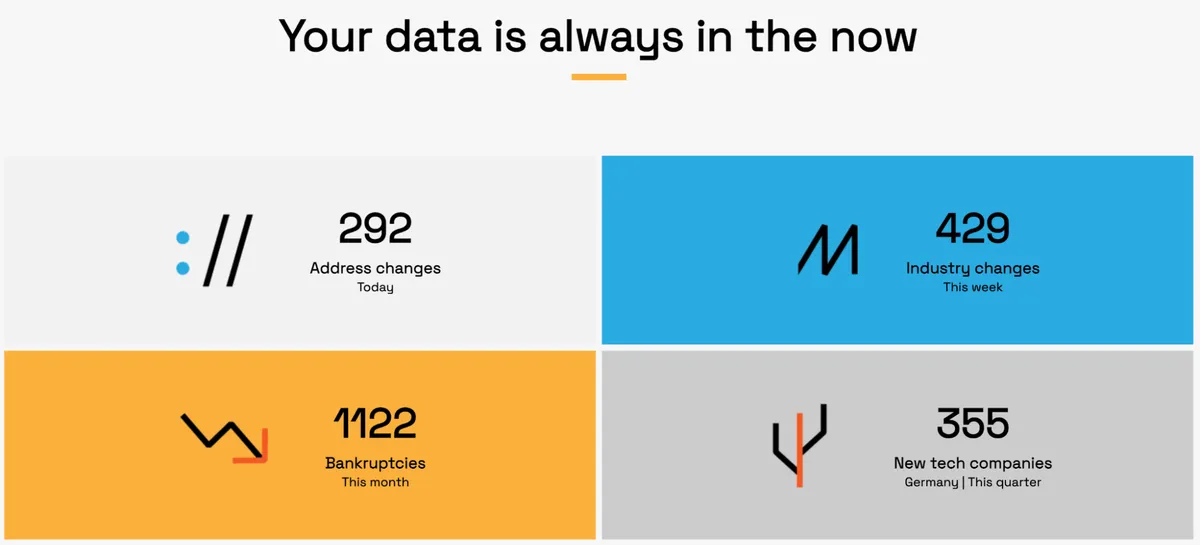
But it's one of the most important things to check because the longer the refresh interval, the less accurate the data is.
A database with 500 million records updated only once a year leaves twelve full months for data to become obsolete due to acquisition changes, relocation, headcount doubling, or business closures.
These changes happen faster than you think; take Mailchimp, an email marketing platform, as an example.
The company operated independently for over two decades before Intuit announced its acquisition of Mailchimp for roughly $12 billion in September 2021, a deal that closed that November.
Mailchimp went from an independent company to a subsidiary folded into Intuit's product suite almost overnight.
This is something you might not catch if your provider updates only once a year.
A smaller database that refreshes weekly, on the other hand, has less total coverage, but every record in it is closer to the company’s actual current state.
Before trusting any provider's data freshness claims, you need to look beyond surface-level promises since almost every provider describes its data as current regardless of cadence.
The things to check for are if existing records get re-verified regularly, if updates happen on a fixed schedule or are triggered by real-world events and if the stated frequency actually holds across all the regions and segments you care about.
Source: Veridion
Confirming these lets you know which providers you will go for to avoid working with outdated data down the road.
Data Accuracy
Data accuracy depends on how well a database overlaps with what you are searching for.
A provider can hit 95% internally and still return a much lower match rate against your specific account list.
That's not something to trust without testing the claim.
To properly test overlap consistency, use a credible source for comparison.
Take a masked sample from your own target accounts, ideally between 250 and 500 records, and ask the vendor to run a match against that sample.
After that, evaluate two metrics independently rather than combining them into a single score.
First, determine what percentage of your sample records received a match at all.
Second, manually verify a portion of those matches against a public platform to confirm their accuracy.
Keep in mind that a vendor who matches 95 percent of a small subset is not the same as one who matches 70 percent of your full database.
The accuracy of these data also varies by field, not just by provider.
Industries like contact fields swing widest between vendors, since they depend on individuals updating their own information across dozens of platforms with no central source of truth to correct them.
Firmographic fields are not uniformly stable.
A company's legal name, registration number, and incorporation date only change when a specific legal event happens, like a merger or a formal name change.
That's because these are tied to a filed legal registration that stays fixed unless amended through that process.
Revenue, headcount, and industry classification on the other hand change with every hiring wave, funding round, or line of business the company adds.
Keep that in mind when going through the testing round.
Depth of Attributes
Not every provider builds the same profile.
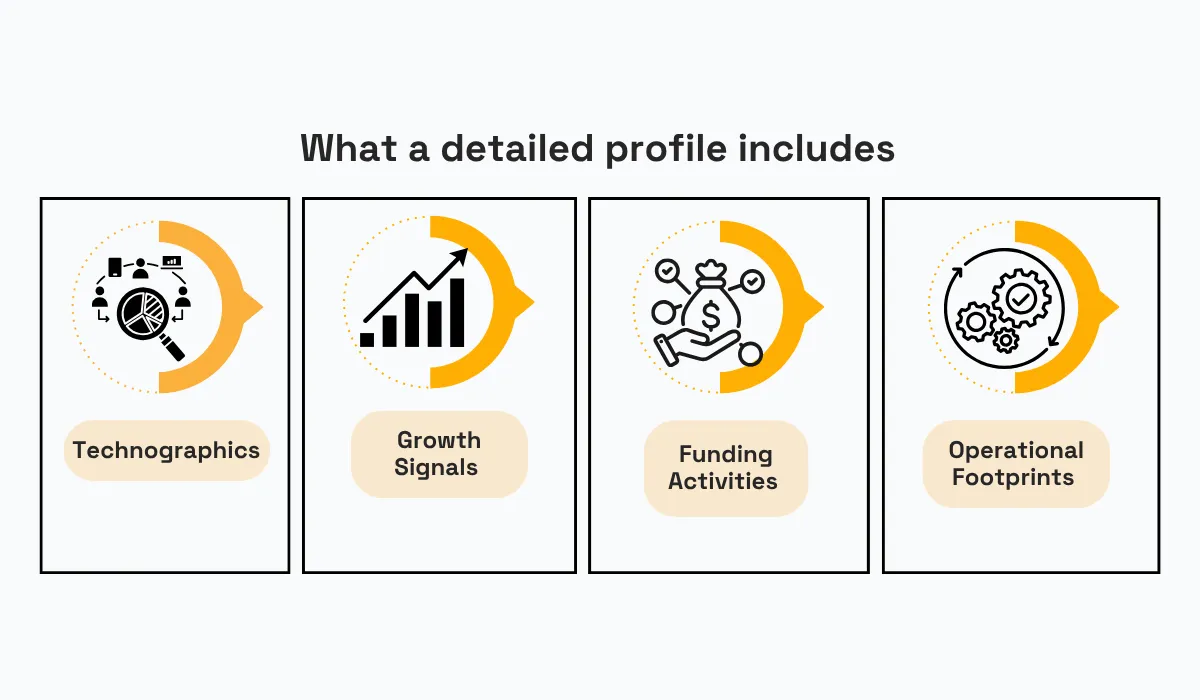
A basic profile covers industry, size, revenue, and location, the four fields that describe what a company is on paper.
A detailed one adds:
Source: Veridion
These fields describe how a company is behaving right now.
The depth of your data profile directly constrains what you can do with it later.
Having a shallow profile might work for basic segmentation, but more sophisticated applications like scoring models and risk assessments require richer inputs. A minimal five-field profile simply was not built to support that level of analysis.
CGAP, the World Bank Group's research arm on financial inclusion, tested this directly on lending data in a March 2024 study.
Researchers built credit scoring models from over 5,000 loans issued by an Indian small-business lender, then measured what each layer of data could predict on its own.
A model built only on basic enterprise attributes, like line of business and income stability, scored barely better than a coin flip.
Adding transactional data, such as sales volume and order frequency, pushed the model's accuracy to a level lenders consider usable for underwriting decisions. Layering in repayment history on top of that pushed it higher still.
The same logic holds outside lending.
A scoring or risk model can only separate strong accounts from weak ones as precisely as the data underneath it allows, and a five-field profile simply doesn't carry that kind of signal.
Integration Options
Strong coverage and validated fields are good, but they won't save you when the delivery format does not fit your stack, and by then, you have already signed the contract.
Even excellent data creates limited value if it can not be delivered the way your team works.
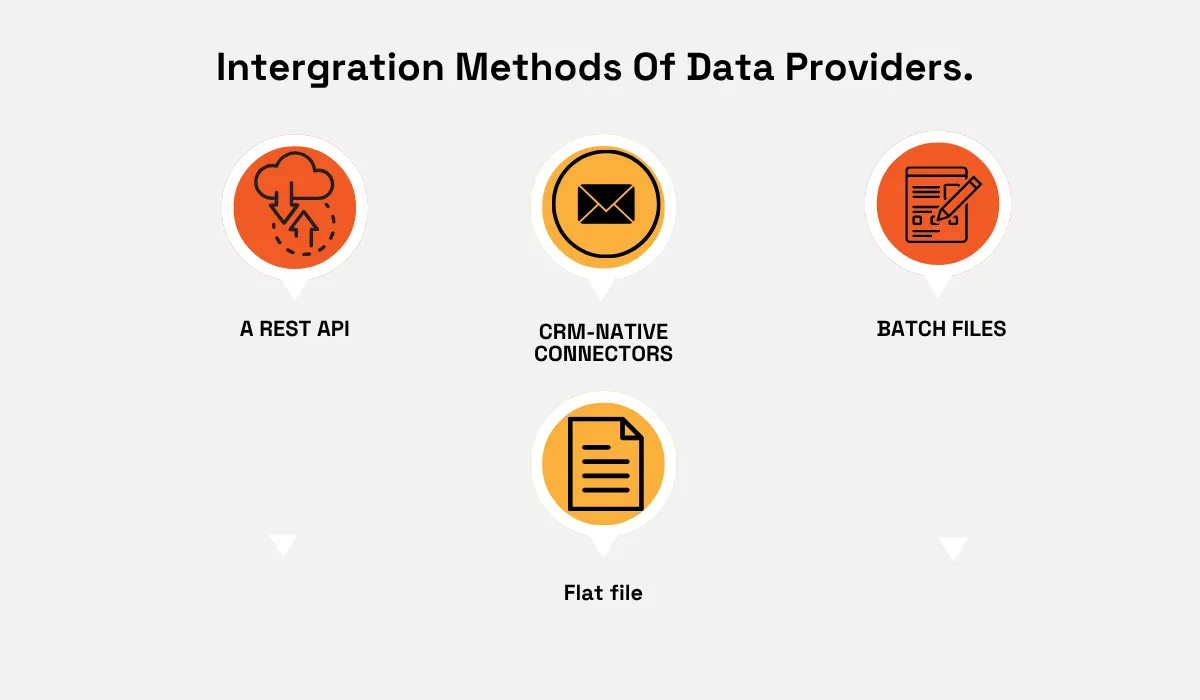
With integration, most providers offer some mix of these four channels:
Source: Veridion
A REST API handles on-demand lookups, where your system sends a request for one company at a time and gets a structured response back in real time.
This is the right choice when a rep is looking up an account mid-call or an application needs to enrich a lead the moment it arrives
Batch files handle scheduled bulk loads instead, dropping a large file of records on a set cadence. It's best when you’re refreshing an entire account list overnight.
CRM-native connectors write data straight into Salesforce or HubSpot fields directly, without anyone exporting or re-importing a file, because manual CSV exports are also where records silently drift out of sync as reps make edits the source data never sees.
Flat file exports feed data warehouses instead of a CRM, formatted for tools like Snowflake or BigQuery so an analytics team can join firmographic data against internal sales history.
Choosing any of these channels depends on who is using the data.
If you're building a scoring model, you need an API with predictable latency, because a scoring model often runs inside a live application and an API that sometimes takes ten seconds to respond will bottleneck that entire flow.
For revenue operations, on the other hand, maintaining account records needs a CRM-native sync instead.
Without it, every data refresh becomes a manual export-and-reimport cycle, and manually updated fields get overwritten the next time someone re-imports.
That is why the delivery format needs to be checked before you commit.
Retrofitting a rigid delivery model onto your stack after signing is slow and expensive, and switching providers later to fix a delivery mismatch means re-running the entire evaluation process you just finished.
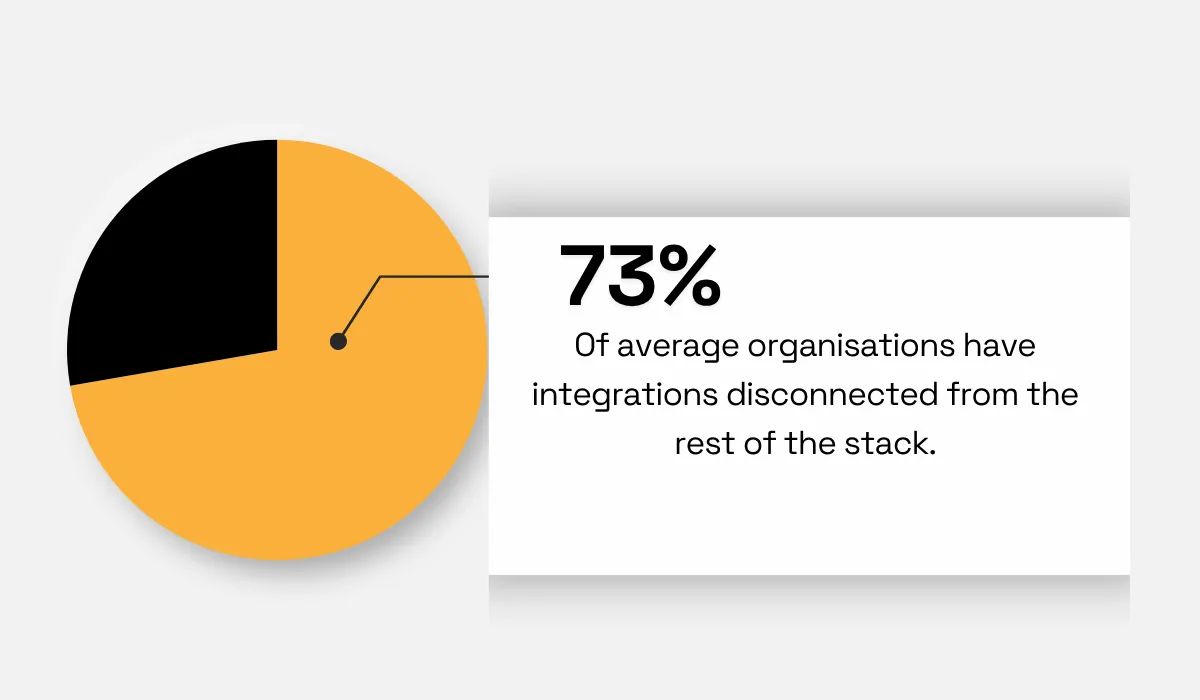
According to MuleSoft’s 2025 Connectivity Benchmark interviews, 73% of average organisations have integrations disconnected from the rest of the stack.
LyondellBasell, a chemicals and plastics manufacturer, used to be one of them.
Before switching, LyondellBasell ran on Microsoft BizTalk, an older, on-premises integration platform that requires a dedicated connector built for every new system it needs to talk to.
Every new data source meant another one-off integration to build and maintain, and work that compounds as a company scales across global supply chains and operational sites.
The company eventually migrated to Azure Integration Services, adopting an API-first architecture where systems connect through a shared layer instead of one-off connectors.
Its adoption led to a 50% increase in integration efficiency alongside lower operational costs from Azure’s pay-as-you-go pricing model.
So, before signing, ask for a working demonstration of each delivery method against your own stack.
That helps you confirm if the data is usable and how you can trace where each data point came from.
Data Traceability
You should be able to trace where a specific data point in your firmographic dataset came from and how it was verified.
A wrong figure that nobody can trace back to its origin can not be corrected, disputed, or defended in an audit.
It just sits in the system as an unverifiable claim, and regulators increasingly treat that inability to explain a figure as a violation in itself.
Regulators are formalizing this expectation rather than leaving it as best practice.
The European Central Bank’s guide on risk data aggregation and risk reporting traces individual fields back to their source rather than just the system that touched them.
The EU AI Act, which began entering into force in 2024, also requires similar documentation for high-risk systems, including where training data came from and what transformations were applied to it.
Neither regulation cares if a figure looks correct in isolation. Both require that you can show your work.
TD Bank's 2024 settlement is a good example of that.
According to FinCEN's consent order, one customer's file listed a maximum annual revenue of $500,000, a figure that drastically conflicted with the actual transaction volume moving through the account.
The account's activity over a short timeframe was, in FinCEN's words, clearly disproportionate to that reported revenue.
Regulators hit the bank with a record $3.09 billion in combined penalties across the Department of Justice, the Federal Reserve, the OCC, and FinCEN, and the FinCEN order specifically faulted the bank's due diligence process for failing to catch mismatches like this one before they escalated.
Veridion prevents this by attaching a source trail to every attribute it delivers, including:
- Specific source
- Confidence score
- Last verification date
So you are not left with a number that has no explanation behind it.
When you evaluate a provider, ask them to show you this trail on a live record.
A vendor that can walk you through why a specific revenue figure is what it is gives your compliance and risk teams something they can defend in an audit.
Conclusion
Choosing a firmographic data provider is a decision about whether the data you buy will actually reach your team in a form they can use, stay current enough to trust, and stand up to scrutiny when you need to defend a decision.
The providers that win your evaluation are the ones that prove coverage in your target segments, disclose refresh cadence, test accurately on your own records, and deliver through your existing stack without requiring expensive workarounds.
Ask those questions before you sign. The right provider will give you the intelligence to find opportunities, reduce risk, and move with confidence.
Articles
Discuss how these trends affect your organization.
Our analysts are available for a short call. Bring a specific question and we will ground it in the data.
Insights
Keep reading
More analysis, research, and outcomes grounded in live company intelligence.
5 Useful Sources of Small Business Data
Looking for small business data? This article will show you five useful sources companies use to find reliable insights.
7 Firmographic Attributes to Weight in Your Account Scoring (and How Much Each One Matters)
Tired of inaccurate account scoring? Discover which firmographic data providers offer the 7 crucial attributes that truly matter.
Is Your Firmographic Data GDPR-Compliant? A Checklist for B2B Data Buyers in Europe
Are you sure your firmographic data providers are GDPR-compliant? Get our essential checklist for B2B data buyers in Europe.