Insights / Articles
The Danger of Stale Data: Mitigating Premium Leakage in Automated Underwriting Systems
Tired of premium leakage in automated underwriting? Discover how decision automation can prevent costly errors caused by stale data.

- Data entry and record-keeping eat up to 43% of an underwriter's workload.
- Automation can make your work faster, but it doesn't fix a stale-data problem.
- Continuous monitoring ensures accurate data and operational efficiency.
Your underwriting system is only as updated as the data feeding it, and that data starts aging the moment a policy is bound.
Without new data, premium leakage compounds across a business, costing you more than you think.
In this blog, we'll look into five reasons stale data keeps costing insurers money and what you can do to fix it.
We also get into exactly why each one matters for you.
Why Stale Data is Such a Problem in Underwriting Systems
Every underwriting decision begins with data, and that data has an expiration date whether anyone tracks it or not.
However, most underwriting systems are built to process whatever comes in, run it through the rating engine, and move to the next submission without noticing if the data is expired or not.
That difference between what the data says and what's true to a business begins to get bigger and bigger and, eventually, it shows up in four places:
- The classification a business gets locked into at binding
- What changes before the policy comes up for renewal
- How much a manual check can catch as volume grows
- What happens once automation starts trusting that same data without question
Let's look into all four closely.
Outdated Classifications Skew Pricing
Every commercial policy begins with a classification, such as a Standard Industry Classification (SIC) code, a North American Industry Classification System (NAICS) code, an occupancy type, or a class code.
That single code tells the underwriting system what kind of business it's looking at.
From there, everything downstream, including the rating factors, the coverage assumptions, and the loss expectations, gets built on top of it.
The problem with this is that businesses don't stay still.
For example, a logistics company can decide to add a fulfillment operation or a contractor can pick up a second trade to fill slow months.
These changes happen very fast and, when they do, commercial policies require the insured to report a material change in risk.
But that obligation only kicks in once the business knows, or reasonably should know, that the change would affect what you'd charge or how you'd underwrite it.
Since many don't, their underwriters keep pricing their risk based on a version of their business that doesn't exist anymore.
This situation isn't as rare as you'd think. According to Relativity6, an underwriting software company, 14% of mid-market commercial accounts carry a NAICS code that no longer reflects what the business does.
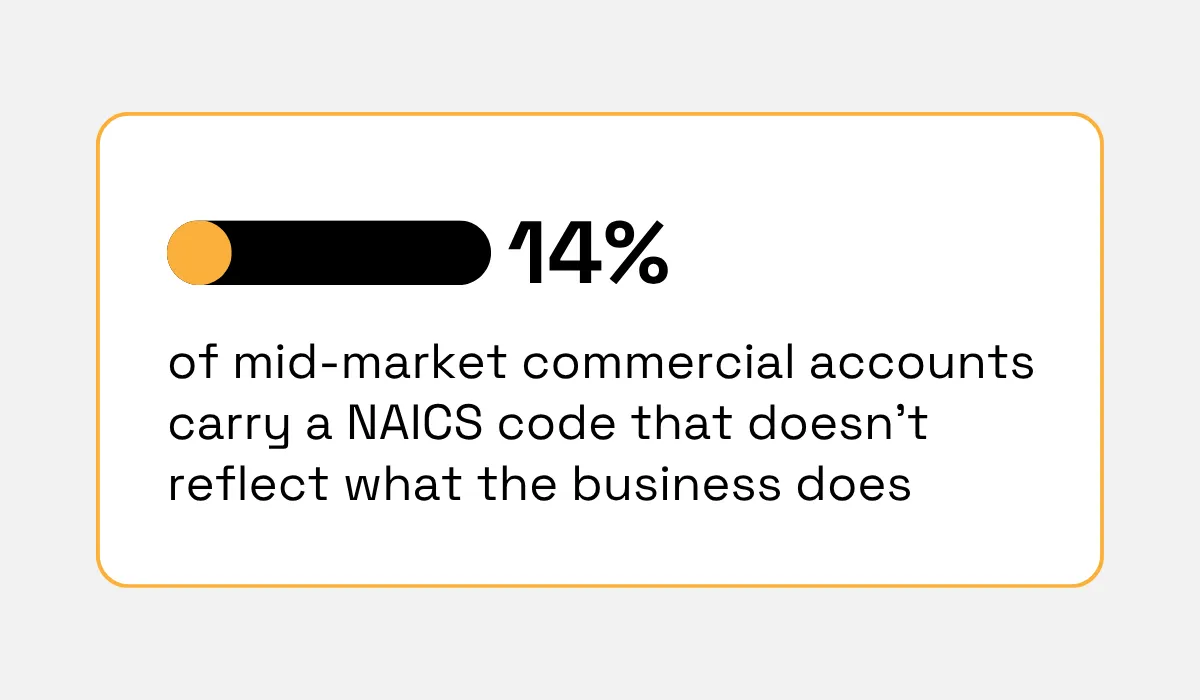
Illustration: Veridion / Data: Relativity6
Roughly half of them had gone through a material operational change in the past 18 months, and none of it showed up in the renewal packet.
When this happens, the results play out in two ways.
First, you're priced too low, leaving margin on the table on every policy in your book that drifted the same way.
Or you're priced too high, because the code still reflects that the operation is riskier than the business is now, which leads you to quote a rate a competitor can easily beat.
When the claim eventually reveals the changes in operations, you have to trace back to see if that same blind spot exists across every account that shares:
- The code
- Renewal date
- Underwriter's book
All of which makes the correction very expensive.
Unfortunately, businesses aren't going to self-report every operational change any more than they do today.
What can help is checking the classification against what a business is doing now.
Data Drifts Between Quote and Renewal
A policy priced correctly on day one can be wrong by day two hundred.
That's because many insurers use the point-in-time underwriting system which only looks closely at a business twice: the day you quote it, and the day it comes up for renewal.
This effectively takes one high-resolution photograph of the business at the moment you write the policy, then prices against that image for the entire term, no matter how much the business changes in the meantime.
Take a mid-sized distributor as an example.
Between those two dates, they might hire a full team ahead of their busiest quarter, then lose a department a few months later when a client contract falls through.
These are changes that cause both operational changes and risks to the business.
As Paul Vacquier, CEO of Beagle Services, put it,
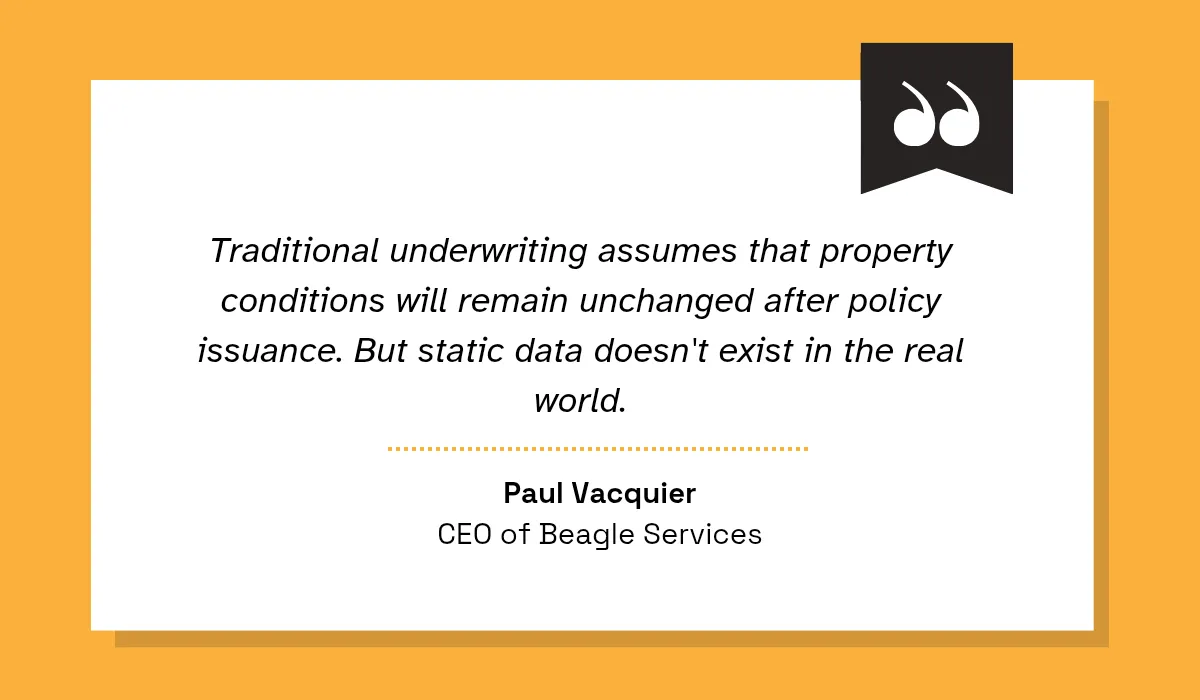
Illustration: Veridion / Quote: Paul Vacquier
And Vacquier couldn't be more right, because the data is only a representation of things that have already happened in the real world.
So a better alternative for this is continuous risk assessment, where you treat the policy term as a stretch you keep watching.
This way, the data underneath your pricing keeps moving even when the renewal date hasn't arrived yet, so a change in a business's size or operations shows up so you can make informed decisions.
Manual Verification Doesn't Scale
Speed isn't the only thing manual verification loses; it also suffers from a decrease in attention.
When you're checking a handful of submissions a day, you can easily tell what's off because you have the time to look at it.
A lot of that checking also means rekeying, pulling numbers off a broker's email or a PDF and typing them into your own system by hand.
But the moment submission volume increases, these steps are the first thing to get rushed.
Now, your checking has to happen faster, so you're spending less time on details. This means things like a classification that doesn't match the business description, or a missing document, can be easily missed.
A survey by Capgemini, the IT consultancy company, showed that administrative work, data entry, record-keeping, and internal meetings eat up to 43% of an underwriter's workload.
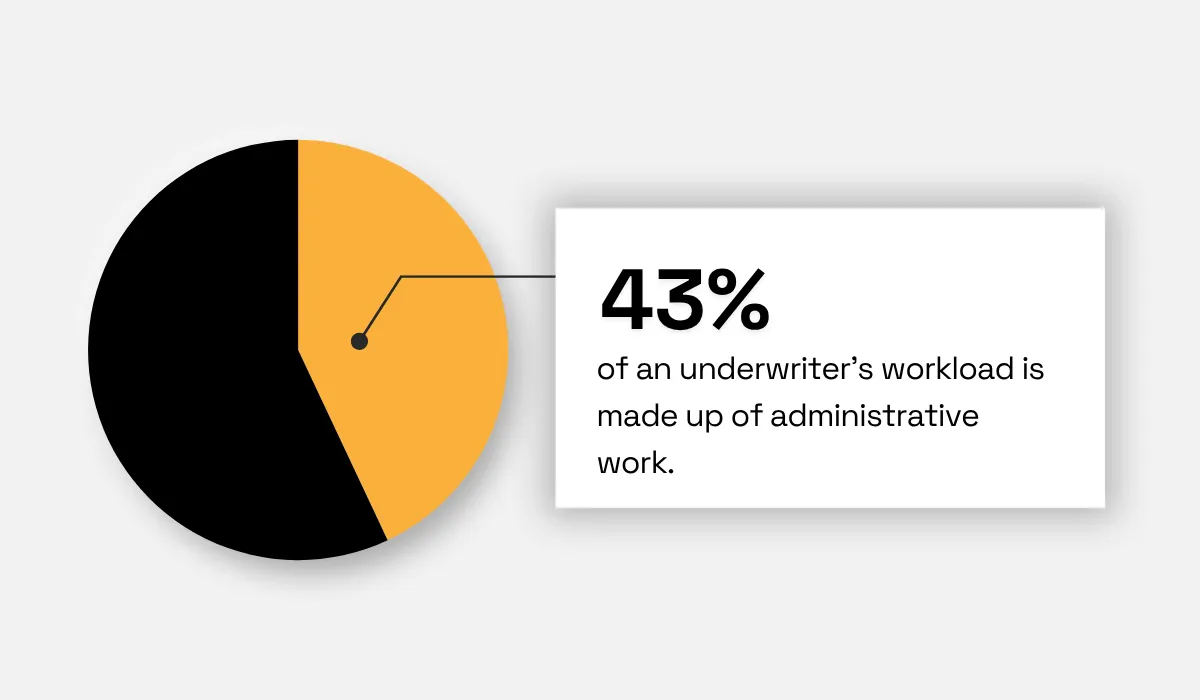
The time that should be spent deciding if a risk is priced correctly is instead spent getting the submission into a state where a decision is even possible, before the main judgment call starts.
Sinking that much time into checking is why it can't be scaled manually: you'll always have a ceiling to how much you can get done.
The international insurance group Hiscox hit this ceiling on its sabotage and terrorism line.
Their underwriters were manually reading broker emails and pulling more than 15 data points out of each one by hand, a process that typically took up to three days per submission.
They knew this wasn't a system that would last them well so they combined an internal tool with Google Cloud's Gemini model to read submissions and generate a pricing-ready quote automatically.
Their turnaround dropped to three minutes.
But what matters more than the speed is what it did to capacity: the same underwriting team could handle increased volume without adding headcount because a system was doing the extraction instead of a person working against the clock.
Automation Can Amplify Bad Inputs
Automation can make your work time faster, but it doesn't fix a stale-data problem.
An AI model or rules engine doesn't know when the data it's fed is wrong because nothing within these systems asks that question.
This is the "garbage in, garbage out" problem: they take whatever's in front of them and treat it as ground truth, then generate a decision that looks precise like a risk score, a recommended price, a confidence percentage.
That precision is the trap because the end results feel more trustworthy than a person's gut call, even when the number was built on the same bad input a person would have caught.
That's one of the dangers of automation: a mistake that happened in one account is now mass-repeated across several others, at a high speed.
And most organizations already sense this coming. McKinsey's 2026 AI Trust Maturity Survey found that 74% of respondents name inaccuracy as a highly relevant AI risk as adoption grows.
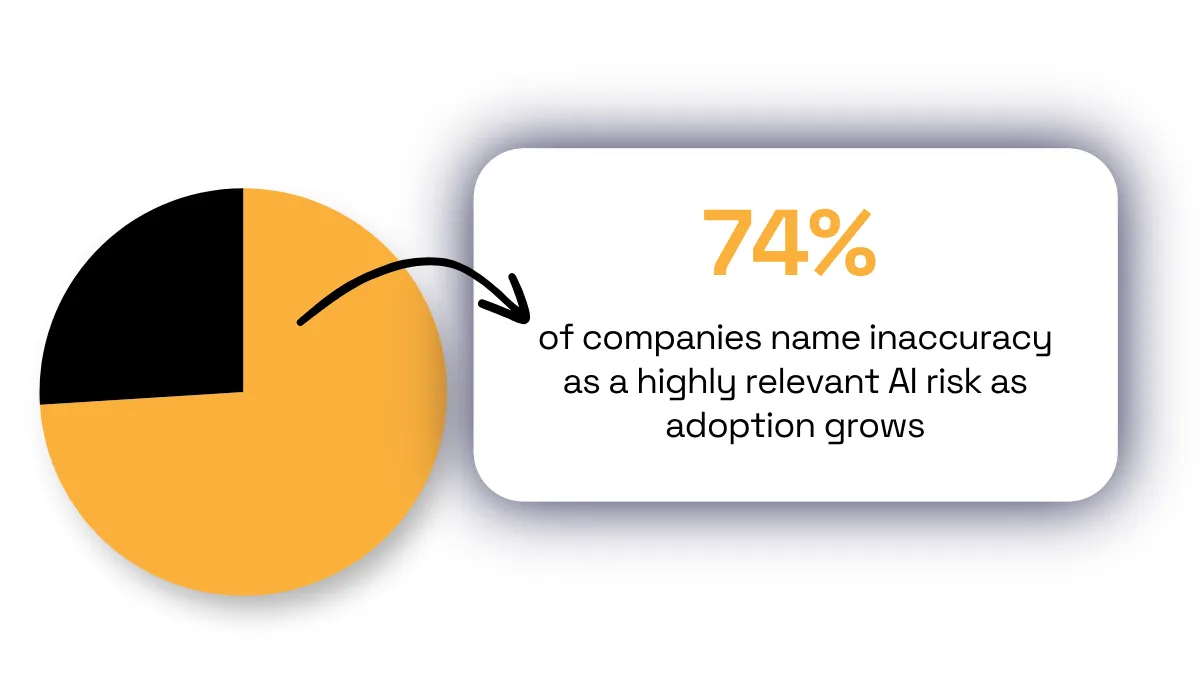
Yet active mitigation for that risk consistently lags behind how relevant people say it is.
In other words, most organizations already know their automated systems can be confidently wrong, but not many of them have built anything to catch it.
Zillow, an online real estate marketplace, had firsthand experience with the consequences of calling wrong data with AI.
Its home-buying arm ran its pricing algorithm on data that checked real-time market conditions. But when the housing market cooled in 2021, the model kept assuming prices were still climbing.
It meant Zillow still kept buying at outdated, inflated valuations because the system never questioned its own inputs.
Due to this, they lost over $500 million and had to shut down the entire program.
None of this is an argument against automating underwriting.
It’s an argument for making sure what you automate is built on inputs that are correct, since a faster engine pointed at the wrong inputs just gets you to the wrong answer sooner.
Continuous Data Monitoring Closes the Gap
All the problems covered so far all have one fix: continuous monitoring.
Continuous monitoring means your data keeps checking itself, without waiting for you to ask.
Instead of a business's classification, location, or risk exposure sitting frozen at whatever it was on binding day, continuous monitoring keeps that profile moving at roughly the same pace as the business itself.
Every change gets picked up close to when it actually happens.
To catch that, though, takes a tool built to watch continuously.
Veridion does exactly that.
It builds and maintains structured profiles on more than 693M businesses worldwide.
These profiles are refreshed weekly, pulling from each company's digital footprint, public filings, and other public sources.
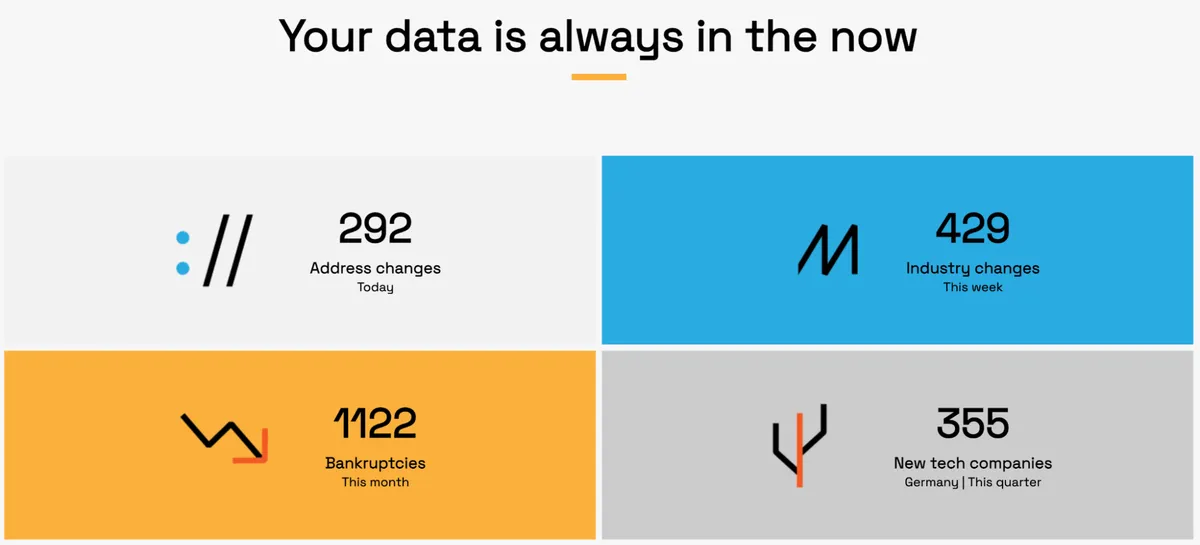
That weekly cadence is what helps with continuous monitoring because there's no scheduled date the data waits for.
Veridion's Search Service also tracks your company's online presence for changes in:
- Products
- Locations
- Risk exposure
- Operational models
- Hazardous material involvement
One of the leading commercial P&C insurers in Canada put this to use with Veridion's SME data and saw a 4x increase in the depth of data insights available on incoming quotes, while its match rate for identifying valid small business records climbed from 15% to 60%.
That's the effect of having continuously accurate data
That said, even with continuous data monitoring, underwriting judgment still does the actual deciding.
The difference is that the judgment gets applied to the business as it is right now, instead of a version of it that stopped being true somewhere between quote and renewal.
Conclusion
Every reason covered here points back to the same truth: risk doesn't stay still just because a policy does.
As an insurer of ever-changing risk, you’ll need data that moves as fast as the businesses you're pricing.
Nothing about a stale record looks urgent until the day it starts being a loss.
Get ahead of it, and pricing accuracy becomes something your data does for you, every day the policy is live.
Articles
Discuss how these trends affect your organization.
Our analysts are available for a short call. Bring a specific question and we will ground it in the data.
Insights
Keep reading
More analysis, research, and outcomes grounded in live company intelligence.
7 Types of Tools Insurance Underwriters Need
Explore the seven essential types of tools insurance underwriters need to strengthen their processes and make data-backed business decisions.
5 Key Benefits of Underwriting Data Analytics
Explore how leveraging advanced data analytics can fundamentally change your underwriting strategy for the better.
Underwriting Data Analytics: A Guide
Learn what underwriting data analytics is, how it’s being used, and the best practices to keep in mind when implementing it.