Insights / Articles
How to Build Comparable Peer Groups for Private Company Credit Analysis
This article will explain how to create peer groups for private company credit analysis and improve benchmarking when financial disclosure is limited.

- Matching peers by industry can overstate a smaller company's borrowing capacity.
- Two companies headquartered in the same state can face different risks.
- A subsidiary and a standalone firm with identical financials can carry different credit risk.
A peer group can make private company credit analysis much easier, but only when the companies you're comparing are actually similar.
This similarity is easy to misread because two companies operating in the same industry, or even having the same headquarters, can have very different business and financial structures.
Building a useful peer group starts with what makes the two companies comparable, rather than the labels attached to them.
In this guide, we'll walk through the key checks for building a comparable peer group for private company credit analysis.
We'll also look at why the final peer set needs analyst judgment.
Confirm Matching Business Activity and Model
Building a peer group from an industry code alone is the fastest way to get started.
It's also a common way to get the comparison wrong.
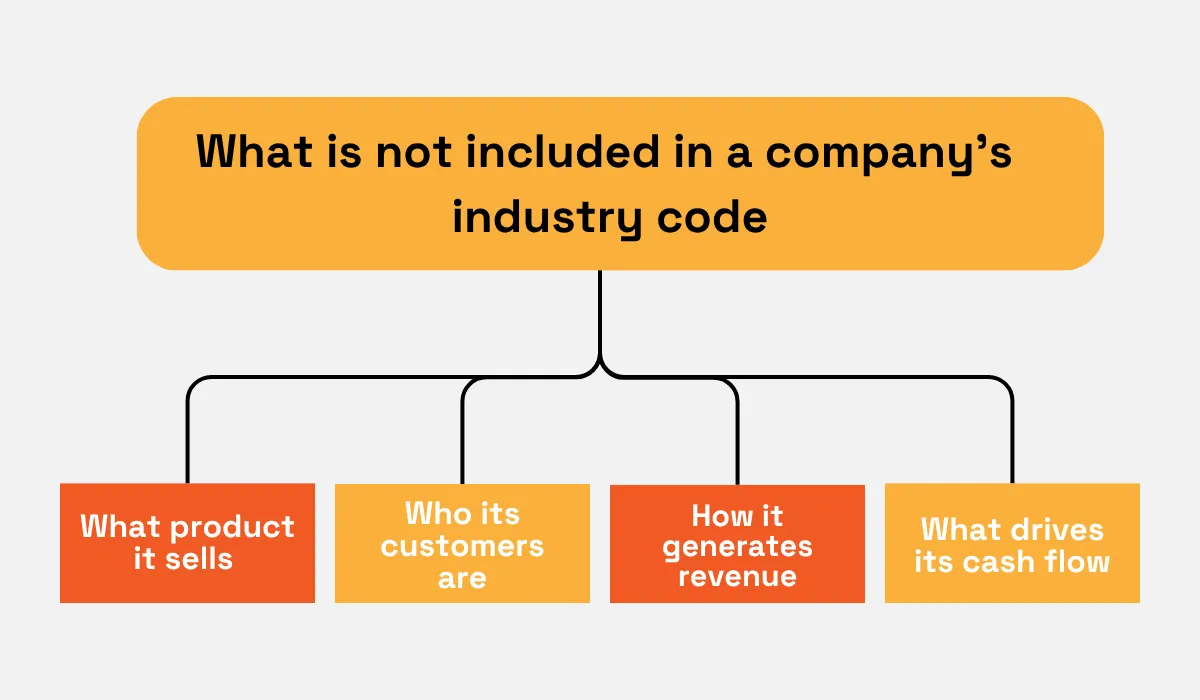
An industry code only tells you where a company is placed within a broad classification system, not necessarily what products it sells, who its customers are, or what drives its cash flow.
Source: Veridion
That's why you shouldn't stop at the industry classification.
As an example, S&P Global Ratings’ methodology for financial institutions builds a separate factor called business position into every assessment, layered on top of the country and industry anchor.
It scores governance and strategy, business stability, and diversification as separate analytical categories, because two entities can share a classification and still diverge on the features that drive their repayment risk.
Imagine two institutions that fall under the same commercial banking classification.
One runs primarily on commercial and industrial lending, so its income tracks business borrowing demand, and its risk depends mainly on borrower credit quality and the business cycle.
Another runs mortgage banking, so its income is tied to origination volume and refinancing activity, while its risk concentrates in housing prices and long-duration interest rate exposure.
Because their structures and cash flows differ this much, putting these two in the same peer group because they share a code means comparing entities that respond to different parts of the economic cycle.
Outside financial services, differences in business models create the same problem.
Source: Veridion
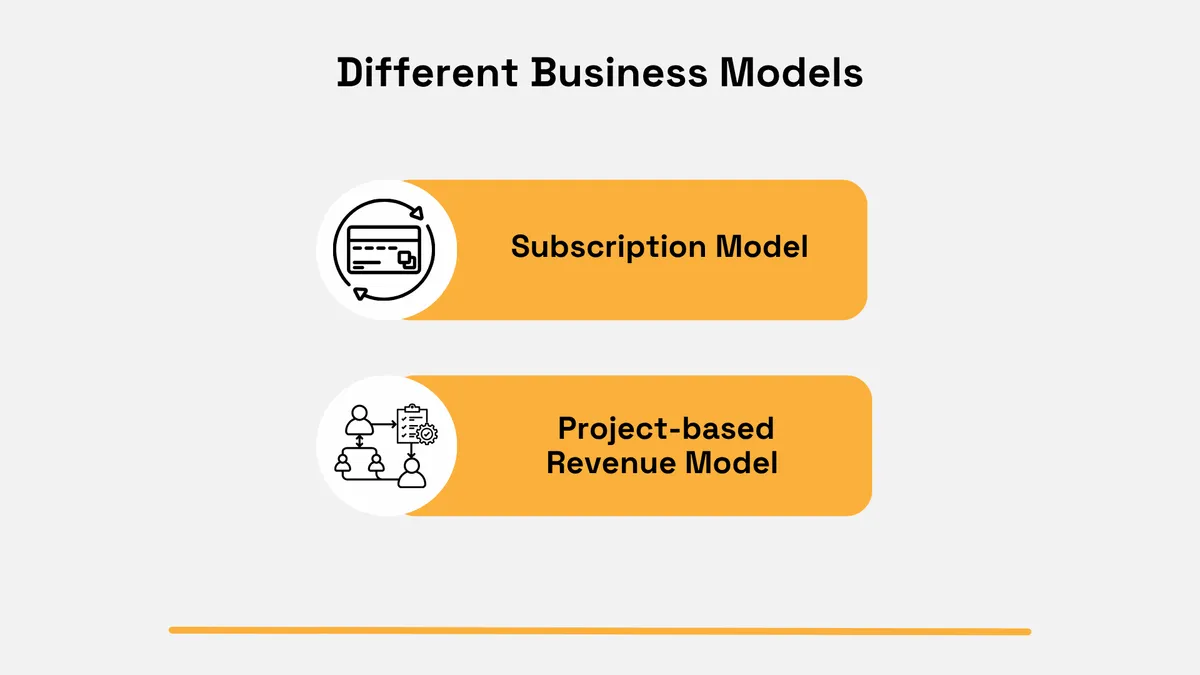
A subscription business collects relatively predictable recurring revenue, while a company that relies on new licenses or project-based services experiences larger swings in revenue from one period to the next.
Those differences affect cash-flow predictability and, in turn, how much debt a company can reasonably support.
As you can see, business activity and model come first for a reason.
If you get the underlying business wrong, every comparison that follows is being made against the wrong set of companies.
Match Company Scale Within a Reasonable Range
Two companies can look almost identical on paper and still behave nothing alike once one of them is ten times the size of the other.
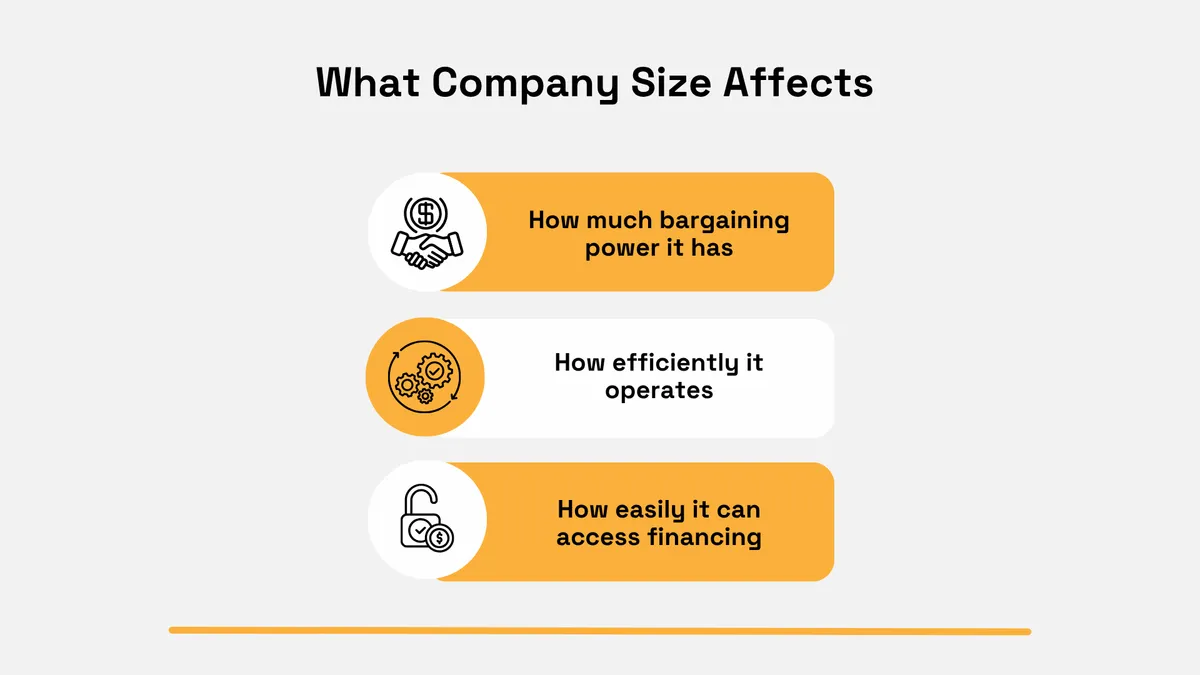
Company size affects how the company operates, including its bargaining power and access to financing
Source: Veridion
A larger company can spread fixed costs across a wider revenue base, negotiate better terms with suppliers, and access a broader range of lenders.
A smaller company operating in the same industry faces higher costs and fewer financing options even when its underlying business model is similar.
S&P Global Ratings treats this as a formal part of its corporate credit analysis.
Its corporate methodology scores scale, scope, and diversity as one of four distinct components of competitive position.
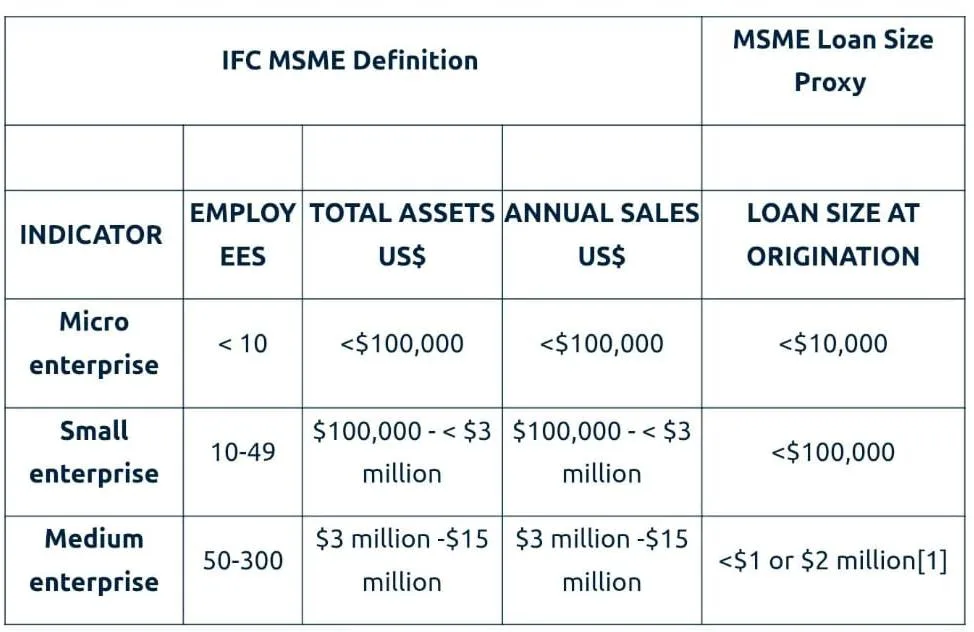
A useful starting point for measuring a company's size is to combine financial and operational measures, such as revenue, total assets, and employee count.
The International Finance Corporation (IFC), for example, uses employees, total assets, and annual sales as three core indicators when defining the size of private-sector businesses.
Revenue and assets also come from the financial statements used to calculate the leverage, liquidity, and coverage measures a credit analyst is already comparing.
Using them to establish a reasonable size range therefore keeps the peer-selection criteria connected to the financial characteristics being assessed.
Let's look at a comparison as an example.
A services firm with $50 million in revenue and 40 employees looks very different from a manufacturer with $50 million in revenue and 400 employees.
The manufacturer has a different asset base, fixed-cost structure, working-capital needs, and financing requirements.
That's why the size range should also reflect what is typical for the industry, since 40 employees can be large for a services firm but small for a manufacturer.
Getting scale right means setting a reasonable size range before you compare credit metrics.
The goal is to benchmark a company against businesses with broadly similar operating and financing characteristics, so the ratios you calculate reflect meaningful differences in credit risk.
Account for Geography and Operating Footprint
Where a company operates is just as important as the industry it belongs to when you're building a peer group.
A company's geographic footprint determines which regional economies its revenue depends on, which regulators oversee its operations, and which currencies affect its income and costs.
Source: Veridion
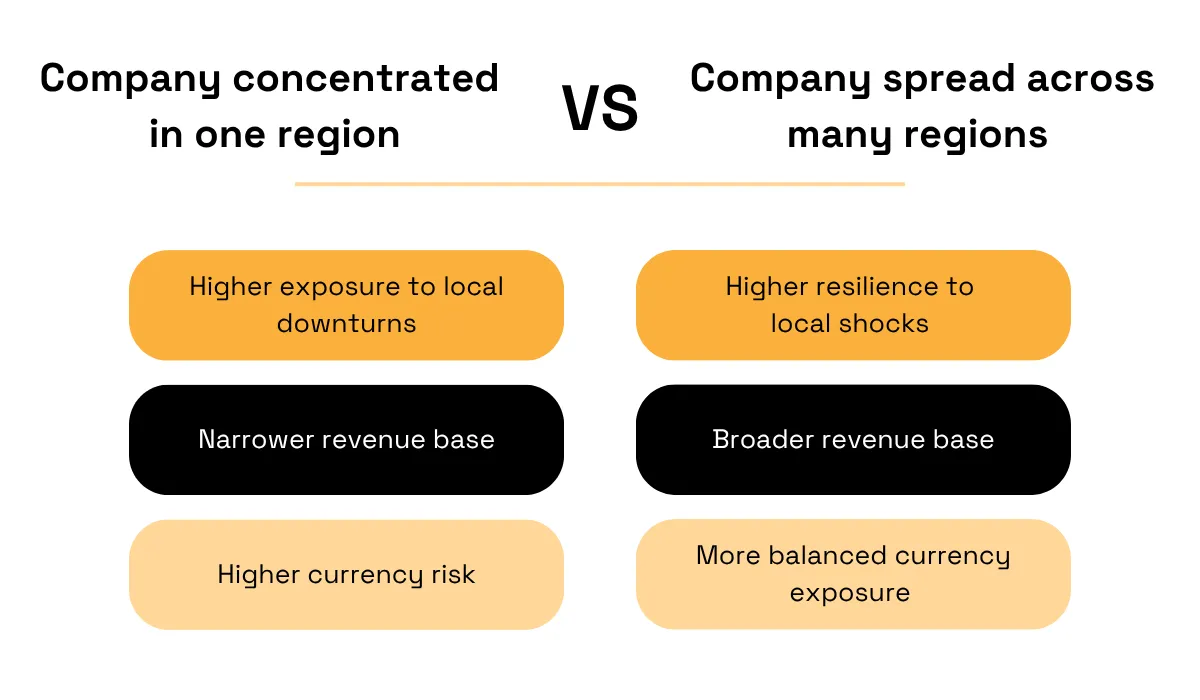
When a company is concentrated in one region, it has more exposure to whatever happens there and therefore responds very differently to an economic downturn, recession or local disruption than a similar company spread across several markets.
The same principle applies to currency exposure.
Earning revenue or holding assets in foreign markets and changing exchange rates can affect the value of those earnings when they are converted into the company's reporting currency.
The effect becomes more important when the company's debt and operating cash flows are denominated in different currencies.
To see these differences more clearly, let's compare Diamondback Energy and Occidental Petroleum.
Diamondback Energy and Occidental Petroleum are both leading Permian Basin oil producers, and both are headquartered in Texas.
On paper, that makes them look like close peers, but their operating footprints tell a different story.
Diamondback operates as a pure-play Permian producer.
Based on their 2025 filing, the overwhelming majority of their oil sales came from the Midland and Delaware basins, both within the Permian.
Occidental also has a major Permian position, but their operations extend beyond that basin.
Their portfolio includes assets in the Rockies and Gulf of America, alongside international operations in Algeria, Oman, Qatar, and the UAE.
So even though both companies share a home state and a major operating region, their geographic exposure is different enough to affect how you interpret their financial performance.
For peer-group construction, this means headquarters should be treated as a starting point.
But, beyond that, what matters more is the distribution of the company's economic activity.
Look at where revenue is generated, where major operating assets are located, and which jurisdictions have a direct effect on the business.
Check Ownership and Group Position
A subsidiary and a standalone company running the exact same operating business do not necessarily have the same credit risk.
That's because the operating business is only one part of what determines if a company can keep paying its obligations when conditions get difficult.
A subsidiary can have a parent company that provides financial support when the business comes under pressure.
That support can take several forms like the following:
- Injecting cash during a bad quarter
- Guaranteeing the subsidiary's debt
- Extending an intercompany working capital facility
Importantly, a parent does not have to transfer cash to a subsidiary for its financial strength to be taken into consideration when creating the subsidiary's credit risk.
A willingness and ability to provide support in a period of financial stress can influence how you assess the subsidiary even when that support has not yet been recorded.
Fitch Ratings, one of the three major global credit rating agencies, treats group position as a formal step in its corporate rating criteria.
If the parent lacks sufficient control over the subsidiary, Fitch rates the two entities separately. However, if the parent has control, Fitch compares the parent's consolidated profile with the subsidiary's standalone profile.
The strength of the legal, strategic and operational ties then decides how much weight each profile carries in the subsidiary's rating.
Fitch also notes that weak ties can lead it to deconsolidate a subsidiary from the parent's figures.
Therefore, a subsidiary with strong links to its parent and a standalone company should not share a bucket, even when their financial statements match.
Two companies reporting identical revenue, margins, and debt loads doesn't mean they face the same credit risk if one can draw on a financially stronger parent during a liquidity problem while the other has to fund the shortfall alone.
S&P Global Ratings builds this consideration directly into its group methodology.
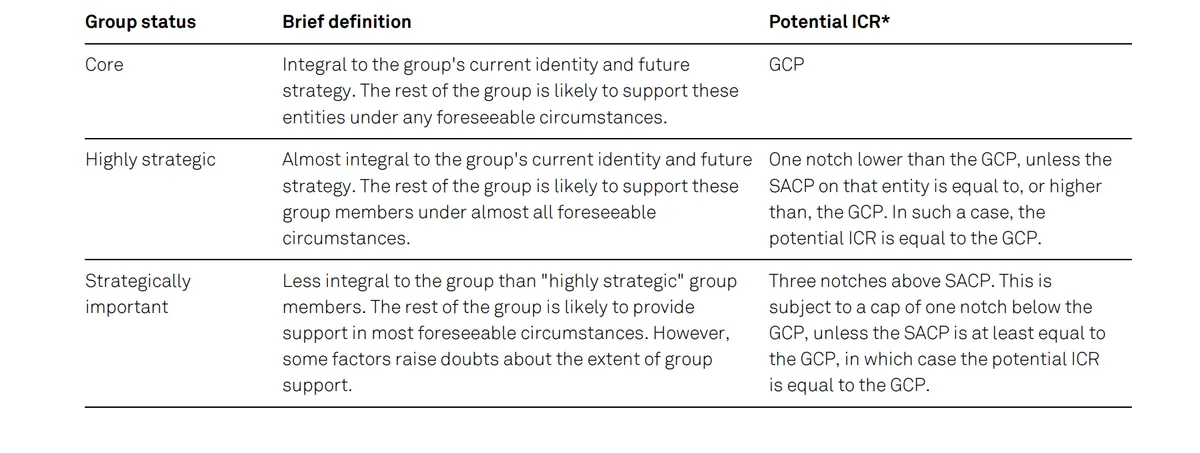
Illustration: Veridion / Source: S&P Global Ratings
It classifies group companies into five categories: core, highly strategic, strategically important, moderately strategic, and nonstrategic.
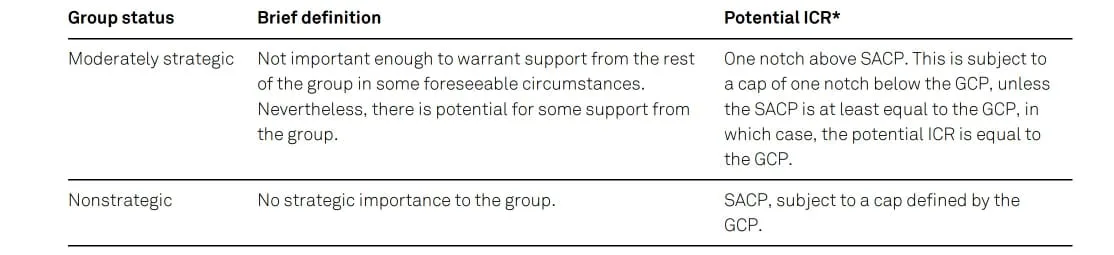
Illustration: Veridion / Source: S&P Global Ratings
The categories reflect how likely S&P believes the group is to provide extraordinary support if a subsidiary comes under credit stress.
In your analysis, look at the ownership structure first.
Then check if the parent guarantees debt, provides cash-management facilities, shares treasury functions, or has publicly committed to supporting the subsidiary.
Also check if the subsidiary is operationally important to the parent, since strategic importance can influence the likelihood of support even when no formal guarantee exists.
The result should be a more meaningful peer group.
Apply Dynamic Classification Instead of a Static Code
An industry code gives you a useful starting point for identifying companies, but it can only describe a business through the classification assigned to it.
The problem starts when you treat that classification as a complete and current picture of what the company does.
The U.S. Securities and Exchange Commission (SEC) uses Standard Industrial Classification, or SIC, to categorize companies according to their principal business.
That makes the code useful for organizing filings and searching for companies within broad industries.
It does not, however, capture every product, service, customer group, or business activity a company may have developed since that classification was assigned.
Domino's Pizza is a good example of why you should check what the code actually represents before relying on it for candidate discovery.
The recent SEC filings identify the company under SIC 5140, Wholesale-Groceries & Related Products.
That is not the restaurant classification you might expect from a company whose consumer-facing business is built around pizza delivery and carryout.
So, you need to identify companies based on what they are doing now.
Then you can screen those candidates using the factors that are a priority to your credit analysis, including business activity, revenue model, scale, geography, and ownership.
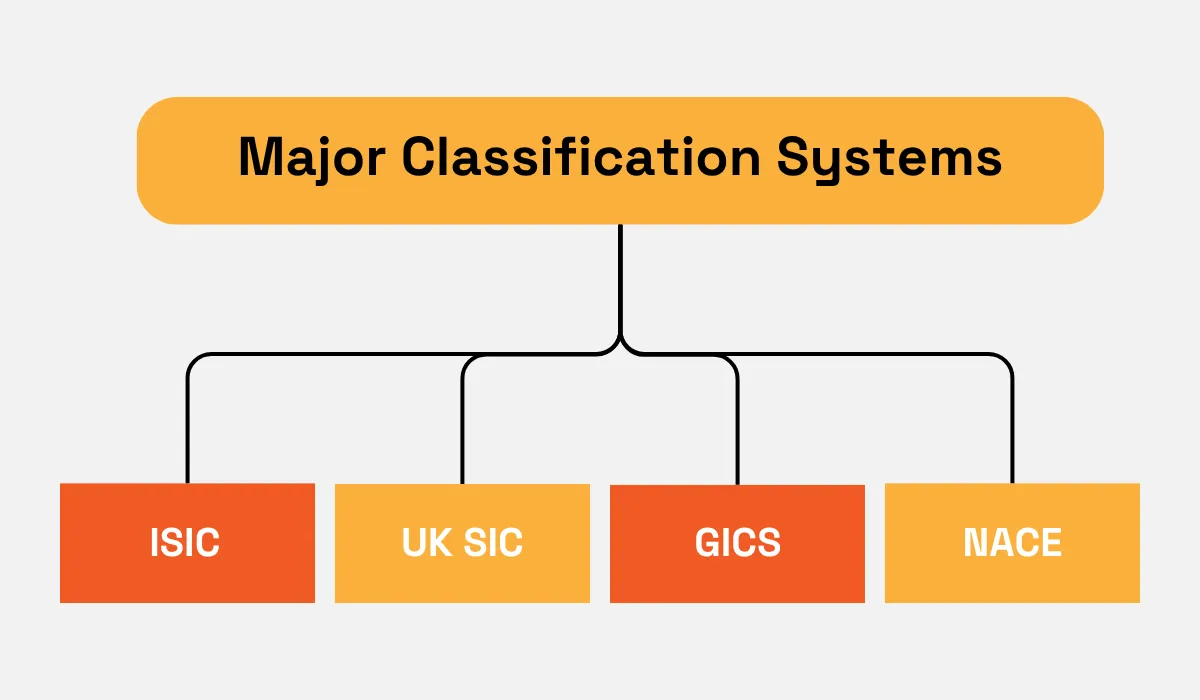
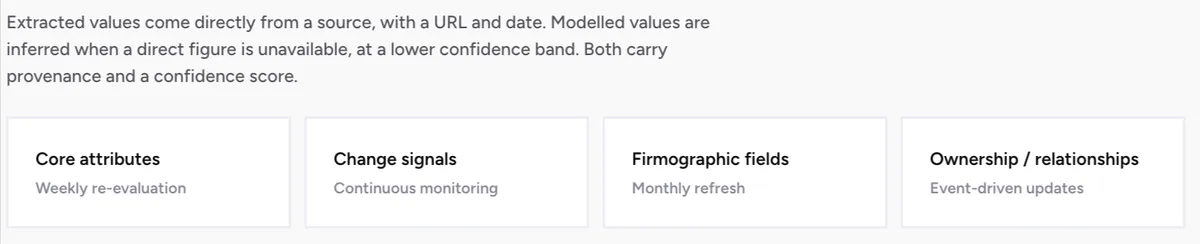
Veridion takes a granular approach, classifying each company across up to ten lines of business and giving each activity a share that reflects how much of the company's operations it accounts for.
The system also maps activities across major classification systems.
Source: Veridion
Veridion also combines registry information with its live digital footprint, including web data, products and services, technographics, hiring activity, and news.
That gives your candidate discovery more current signals than relying on a filing classification alone.
Use standardized industry codes when they help you establish the initial universe, then layer current business-activity information on top before deciding who belongs in the peer group.
That prevents the classification itself from becoming the definition of comparability.
Source: Veridion
Your final candidates should still be companies whose current activities, business models, scale, geography, and ownership make sense alongside the company you're analyzing.
Review Edge Cases With Analyst Judgment
The screening process covered so far can narrow your peer group down to companies that look comparable across the major dimensions.
But, it doesn't mean that every company left on the list is comparable.
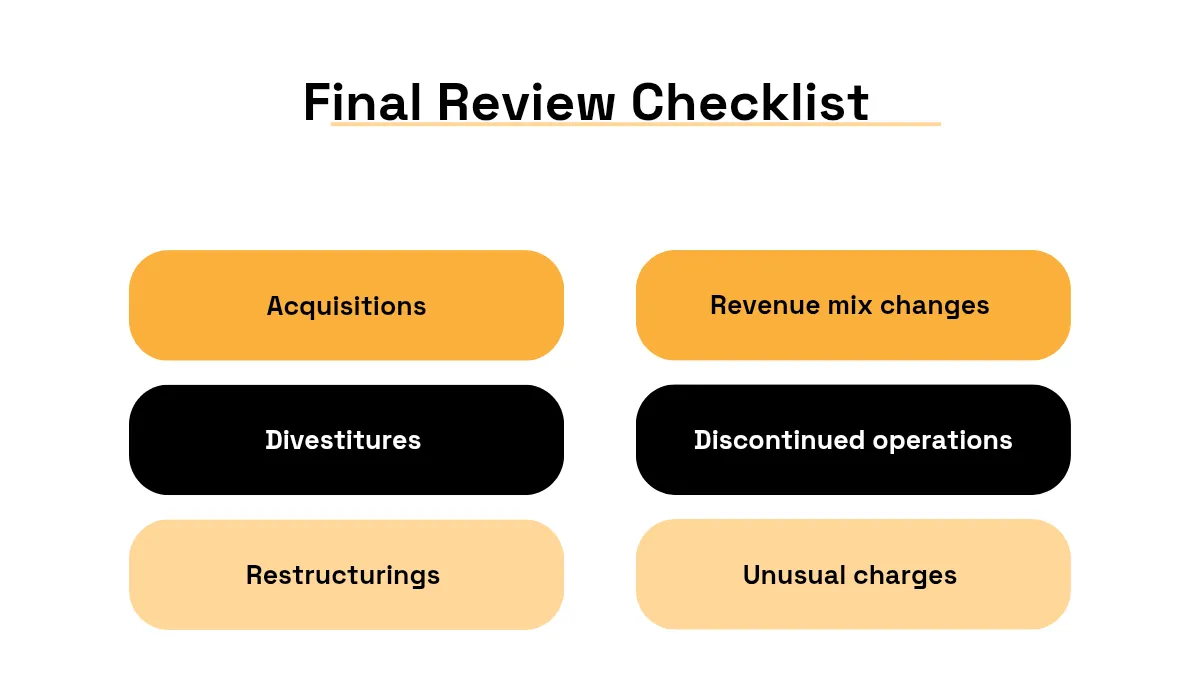
The company still needs a closer look, especially in cases of something unusual happening inside the business.
These scenarios include:
- Recent Acquisition
- Hybrid Business Models
- One-off Financial Events
Take a company that recently acquired a competitor. The latest revenue and debt figures reflect the newly combined business.
Similarly, a company that started as a manufacturer could now generate a significant share of its revenue from software subscriptions and recurring services, which makes its original manufacturing peers less relevant.
In situations like these, you still need human judgement from an analyst to adjust or separately consider these items when making company-to-company comparisons.
That decision requires you to understand what caused the unusual result and how likely it is to continue.
This final review should happen after the automated screening, and for the analyst, this can be as simple as going back through the remaining candidates and checking what has changed recently.
Source: Veridion
Veridion's granular activity classification and corporate hierarchy data can support this review by giving you more context around what the company currently does and how it relates to other entities in its corporate structure.
Conclusion
A good peer group gives you a better basis for understanding how a private company compares with businesses facing similar credit conditions.
The key is to look beyond the labels attached to a company and examine the characteristics that shape its financial risk.
When those characteristics are genuinely comparable, the credit metrics you calculate become much more useful for judging the company you're analyzing.
And when a company still raises questions after screening, that's where your judgment matters most.
Articles
Discuss how these trends affect your organization.
Our analysts are available for a short call. Bring a specific question and we will ground it in the data.
Insights
Keep reading
More analysis, research, and outcomes grounded in live company intelligence.
5 Trends Shaping the Future of Market Intelligence
Want to future-proof your business strategy? Explore the top trends defining the future of market intelligence.
Best Practices for Leveraging Market Intelligence
Not sure how to apply market intelligence effectively? Learn which practices top businesses rely on and how you can too.
How to Gather Market Intelligence In 5 Steps
In this guide, we're breaking down the five key steps you need to take to gather market intelligence that drives real action.