Insights / Articles
Coresignal Alternatives for Company Data at Scale
Not every team that outgrows Coresignal needs the same data. Six Coresignal alternatives compared by data sources, coverage, refresh and pricing.

Coresignal sells public web data on companies, employees, and job postings through APIs and datasets, so the right alternative depends on which part of that data your team needs and where you want it to come from.
Veridion is worth considering for global company intelligence and continuously refreshed business profiles.
Crustdata, Dun & Bradstreet, Orbis, OpenCorporates, and Bright Data also offer different approaches to company intelligence, business research, and web data collection.
Coresignal Alternatives at a Glance
Coresignal competitors like Veridion, Crustdata, Dun & Bradstreet, OpenCorporates, Orbis, and Bright Data offer access to business or web data, but differ in their data sources, coverage, refresh practices, and delivery options.
Tool | Best for | Main data sources | Company coverage (regions) | Data updates | Access | Pricing model |
|---|---|---|---|---|---|---|
Coresignal | Company, employee, and job data for enrichment and AI | Company websites, professional networks, and other public web sources | 70M+ companies across 185+ locations | API records refreshed 24/7; historical headcount monthly | API, bulk datasets, web app, webhooks | From $49/mo |
Veridion | Company intelligence, supplier discovery, and entity resolution | Registries, company websites, and other web sources | 693M+ companies across 250 countries | Continuous refresh and change detection | API, batch files, data marketplaces | Custom/contact sales |
Dun & Bradstreet | Business verification, credit, and supplier risk | Registries, company websites, partners, and trade-payment data | 650M+ entities across 190+ countries | Not publicly specified | APIs, data products, reports | Custom/contact sales |
Moody's Orbis | Private-company research, ownership, and credit analysis | Registries, company financials, ownership records, and 170+ data providers | 635M+ entities across 200+ jurisdictions | Not publicly specified | Web app, APIs, bulk feeds | Custom/contact sales |
OpenCorporates | Legal-entity verification and due diligence | Official government registries | 220M+ companies across 140+ jurisdictions | Not publicly specified | Web search, API, bulk data | From £2,250/year |
Bright Data | Web data collection and custom datasets | Public websites | Not publicly specified | Depends on product or dataset | Scraper APIs, datasets, bulk downloads | Datasets from $250 |
Crustdata | Real-time company and people enrichment | Company and professional profiles, job data, news, and other web sources | 60M+ companies; regional breakdown not publicly specified | Live enrichment; cached database refreshed monthly | API, datasets, webhooks, MCP | Custom/contact sales |
The sections below cover each tool in more detail, including how it compares to Coresignal.
Veridion
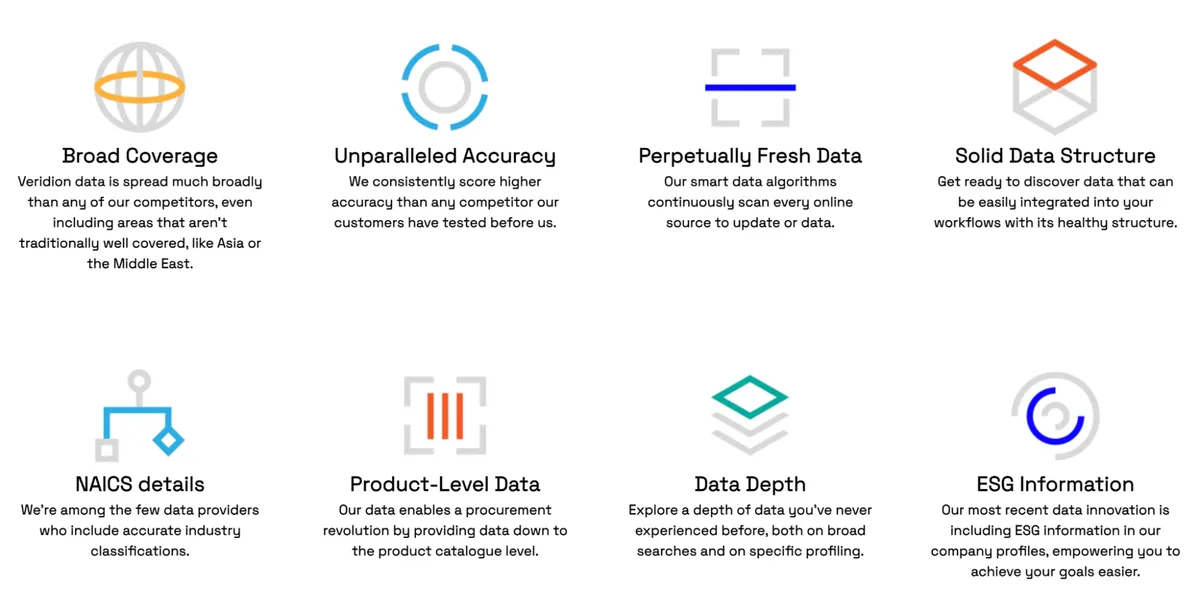
Veridion is a global company intelligence database built for company data enrichment, business research, and market analysis.
Source: Veridion
Veridion uses machine learning to process information from business websites, public registries, and other sources, creating connected company profiles that you can enrich and monitor as businesses change.
For example, a global market-research firm needed company-level data to expand from industry reports into company and ESG products.
It ran a data-quality evaluation of Veridion against another company data provider on the same set of companies, comparing employee counts by country, key-personnel samples, and how completely each provider classified companies.
After the evaluation, the firm chose Veridion as its core company data layer.
Its industry research, company data, and ESG products now draw on one resolved company graph instead of several separate vendor feeds, delivered via API and matched to the firm’s existing identifiers through entity resolution.
Key features:
Extensive global coverage | Access data on 693M+ companies across 250 countries and territories, including private businesses and smaller firms that traditional databases may overlook |
|---|---|
Company matching and enrichment | Match records using existing identifiers and enrich them with 461, covering firmographics, locations, technology adoption, hiring activity, and corporate relationships |
Continuously refreshed data | Track changes in company operations, products, hiring, and ownership. Field-level source links and confidence scores help you verify information and decide which records meet your data quality requirements. |
How Veridion compares to other providers: Veridion builds structured company profiles from websites, public registries, and other web sources, delivered through APIs and bulk datasets.
Unlike Coresignal, which also sells employee and job posting data, Veridion focuses on company data. You can see how it compares to other competitors on its comparison pages.
Limitations: It may not suit you if you need individual-level contact data or dedicated employee and job posting datasets.
Enterprise access and custom data requirements may require direct discussions with its team.
Pricing: Veridion uses customized pricing based on your data coverage, usage volume, refresh frequency, and integration requirements.
Dun & Bradstreet
Known for its business information and risk intelligence, Dun & Bradstreet (D&B) helps you evaluate customers, research prospects, and assess suppliers through its database, which covers more than 650 million business entities.
Source: Dun & Bradstreet
The platform draws data from public registries, business websites, partners, and commercial records.
Key features:
Extensive global coverage | Access company profiles, financial information, industry classifications, contact details, and corporate family relationships to research businesses across markets |
|---|---|
Business identity and risk intelligence | Use D-U-N-S Numbers to identify and match businesses across records. D&B also offers credit scores, payment histories, ownership information, and proprietary risk assessments to help you evaluate counterparties. |
Data quality and enrichment | D&B reports running over 60 billion data quality checks monthly. Its tools help you standardize and deduplicate company records, enrich CRM data, and integrate business intelligence into existing workflows. |
How D&B compares to other providers: D&B offers deeper financial-risk data and business identity matching than Coresignal, which focuses on structured public web data delivered through APIs and datasets.
Limitations: D&B's extensive coverage does not guarantee equally detailed or current information for every company or attribute.
Its traditional strength lies in credit, financial, and registry-linked data, which may not provide the operational detail or rapid change signals you may need for market discovery.
Pricing: Custom/contact sales.
Bureau van Dijk (Moody's Orbis)
If you need to look beyond basic company profiles, Orbis brings financials, firmographics, ownership records, and risk indicators together for research across markets.
Orbis is Moody's global company database, originally developed by Bureau van Dijk.
Source: Orbis
You can use this Coresignal alternative to compare businesses, investigate corporate relationships, assess suppliers, or shortlist potential acquisition targets.
Key features:
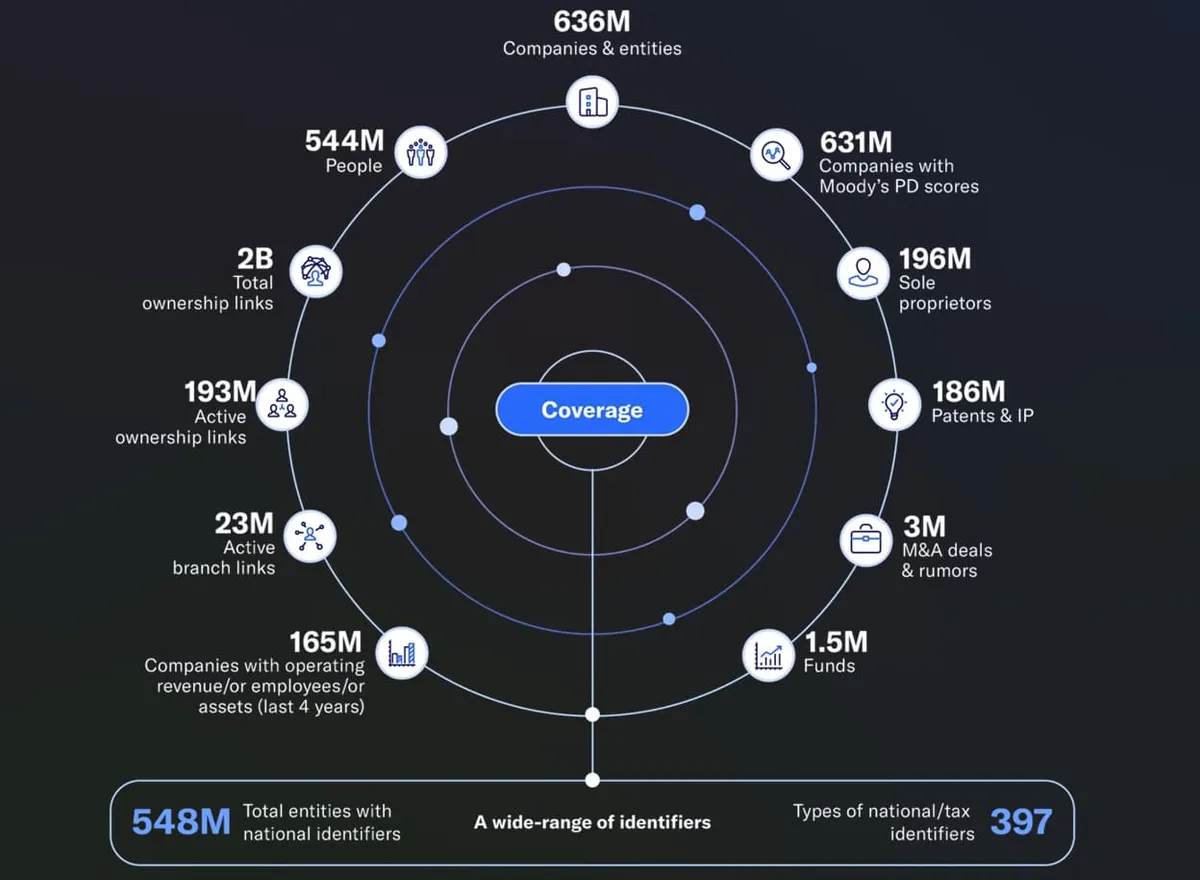
Global company coverage | Access data on over 635 million entities, including private and listed companies. You can search across countries and industries to build a broader picture of your target market. |
|---|---|
Comparable financial data | Orbis standardizes company financials, names, and industry classifications across different markets. This helps you compare businesses using consistent criteria, even when their local reporting standards differ. |
Ownership and corporate hierarchies | Explore over 2 billion ownership links to understand how companies connect through subsidiaries, shareholders, and parent organizations. This can help you investigate business relationships and assess potential risks. |
How Orbis compares to other providers: Compared with Coresignal, which offers company, professional, and job data for enrichment and AI-driven applications, Orbis focuses more on financial research, private company intelligence, and ownership analysis.
Limitations: Orbis may not be the best fit if your priority is sales prospecting.
It lacks verified decision-maker contact details and buyer intent signals. You should also account for differences in data depth and freshness across countries, along with the learning curve involved in using its extensive features.
Pricing: Custom/contact sales.
OpenCorporates
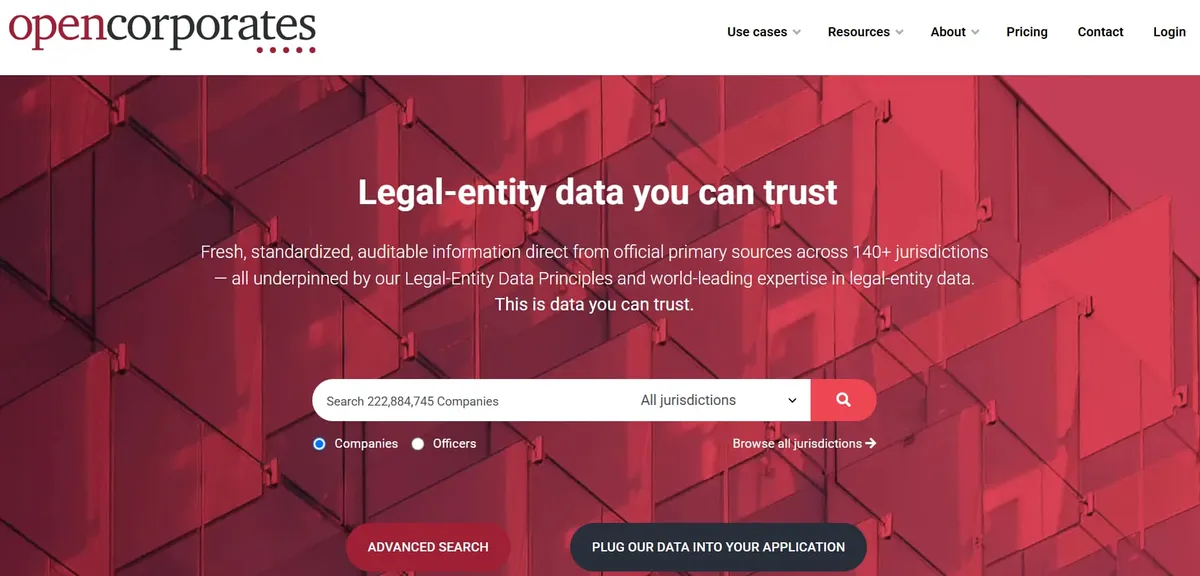
Need to verify a company registered in another country? OpenCorporates lets you search company records across more than 140 jurisdictions, with details such as registration numbers, legal status, and links to related entities where available.
Key features:
Extensive legal-entity coverage | Explore over 220 million company records, including registration numbers, legal forms, addresses, and operational status. You can use these details to identify businesses across jurisdictions. |
|---|---|
Corporate relationships and officer research | Examine company officers, related entities, and available registry links to investigate business connections. This can help you verify counterparties and support compliance checks. |
API and bulk data access | Connect company records to your existing applications through APIs or bulk data delivery. You can choose relevant jurisdictions and delivery frequencies to support onboarding, investigations, and large-scale data analysis. |
How OpenCorporates compares to other providers: Unlike Coresignal, which builds records from public web sources, OpenCorporates relies on official registries, so its data focuses on legal identity rather than operational detail.
Limitations: OpenCorporates may not be enough if you need detailed financials, company valuations, or advanced sales intelligence.
Pricing: OpenCorporates’ Essentials plan costs £2,250 a year, Starter £6,600, and Basic £12,000. Enterprise customers can request bulk data delivery and customized API access. Eligible public-benefit projects may qualify for free access.
Bright Data
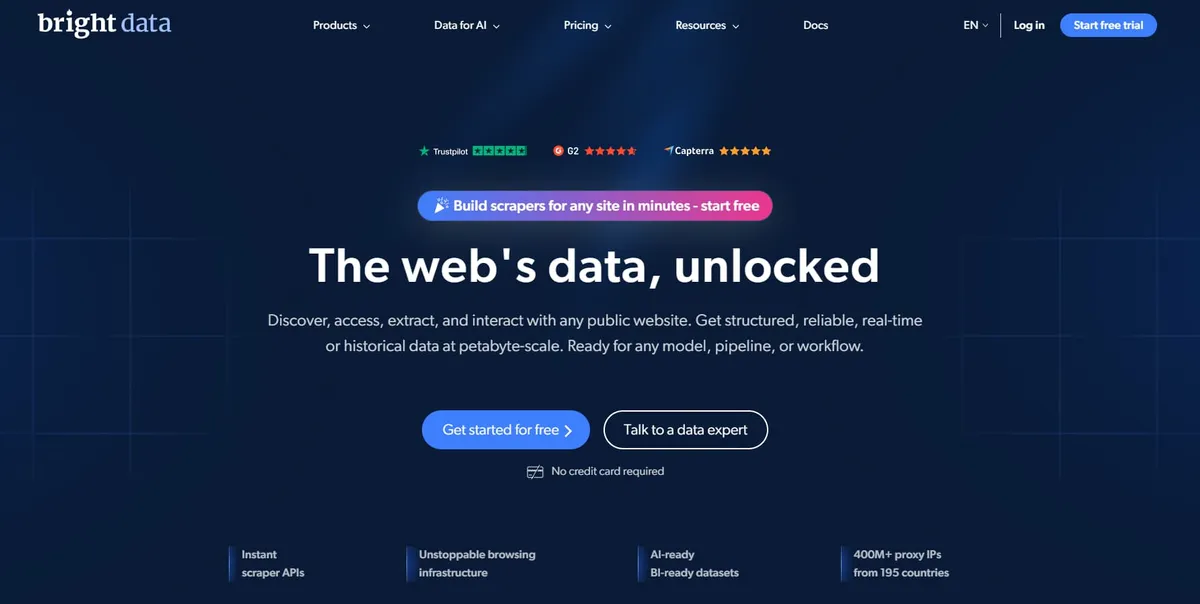
If you need to collect business information from websites at scale, Bright Data gives you the infrastructure to build your own data collection workflows.
Source: Bright Data
You can extract website content, gather search results, access ready-made datasets, or develop custom scraping processes.
Key features:
Multiple data collection options | Access ready-made datasets, scrape websites through APIs, or build custom extraction workflows. Its Dataset Marketplace covers 250+ domains, while Business Search helps you find companies using specific criteria. |
|---|---|
Infrastructure built for scale | Use a global proxy network, browser automation, and website-unblocking tools to collect data across locations. Bright Data also offers managed collection services if you need help handling complex projects. |
Flexible data access | Choose between downloadable datasets, structured API responses, and real-time website extraction, depending on your workflow. Its tools can also support AI agents that need access to live web information. |
How Bright Data compares to other providers: Bright Data is more focused on web data collection infrastructure and extraction, while Coresignal specializes in structured B2B datasets covering companies, employees, and job postings.
Limitations: Bright Data's extensive product range can make it hard to choose the right tools, especially if you're new to web scraping.
Some offerings require deep technical expertise, and you may need to maintain your own scraping workflows. Costs grow with data volume, product choice, and collection complexity.
Pricing: Bright Data offers several pricing models depending on the solution. Its Web Scraper API, for instance, includes a free tier with 5,000 records per month, pay-as-you-go access at $1.50 per 1,000 records, and a Scale plan at $499 per month with 384,000 records included.
Crustdata
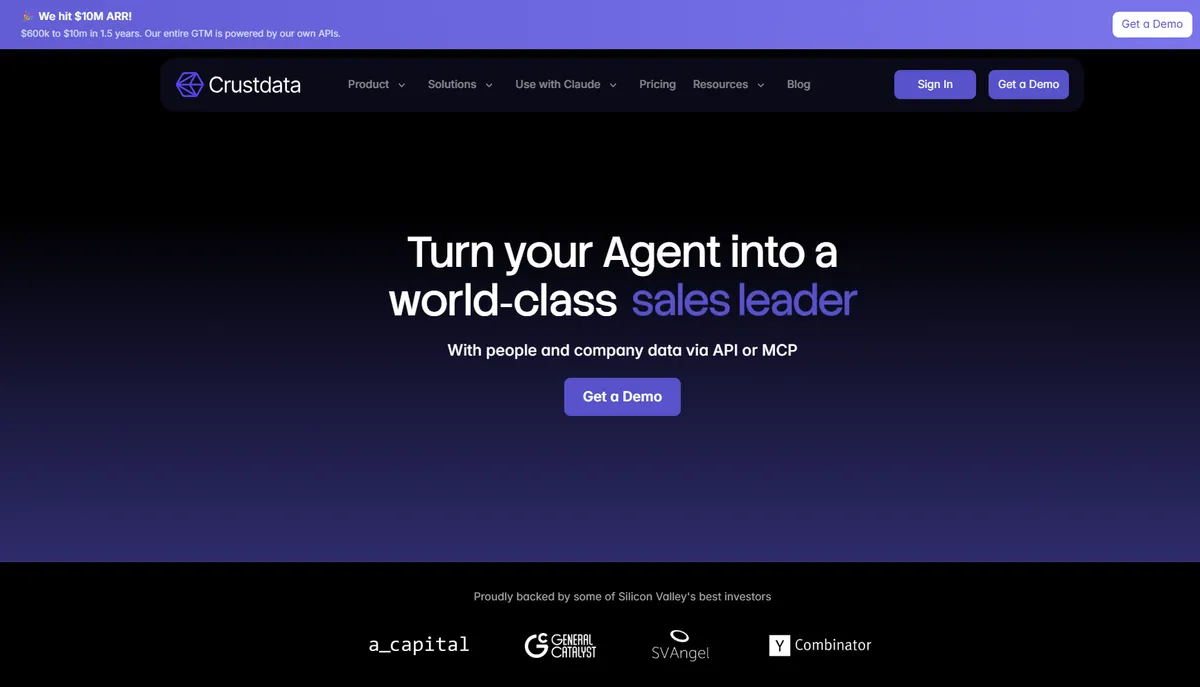
When you need to research thousands of businesses, scattered data can slow down everything from prospecting to market analysis. Crustdata helps you bring that information together through APIs, searchable company profiles, and bulk datasets.
Source: Crustdata
This Coresignal competitor gives you access to firmographics, funding details, employee growth, technology usage, and other business signals to help you build a clearer picture of your target companies.
Key features:
Detailed company profiles | Access 60M+ company profiles with 250+ data points covering firmographics, funding, headcount, technologies, web traffic, reviews, and hiring activity |
|---|---|
Real-time search and enrichment | Find companies using filters for attributes such as location, employee growth, funding, and technology usage. Enrich existing records with data consolidated from 15+ sources. |
Automated change monitoring | Use webhooks to track company developments, including funding activity, hiring trends, and headcount changes, without repeatedly checking records manually |
How Crustdata compares to other providers: Crustdata pulls data live at query time, while Coresignal's bulk datasets refresh on a fixed schedule.
Limitations: Crustdata is primarily built for developers, so you may need engineering support to connect its APIs to your CRM and build custom workflows. Its credit-based pricing can also make costs harder to forecast at high volumes.
Pricing: Custom/contact sales.
Conclusion
Choosing a Coresignal alternative starts with identifying the data your team needs and how you intend to use it.
Veridion suits global company intelligence, entity matching, and ongoing change detection. Crustdata offers company enrichment and growth signals, while D&B and Orbis support business risk, financial, and ownership research.
OpenCorporates focuses on legal entity verification, and Bright Data provides tools for collecting web data at scale.
If you're evaluating these for a production pipeline, request a sample match against your own company list from your top two or three candidates before you commit, since coverage and fill rates vary more in practice than vendor pages suggest.
Articles
Discuss how these trends affect your organization.
Our analysts are available for a short call. Bring a specific question and we will ground it in the data.
Insights
Keep reading
More analysis, research, and outcomes grounded in live company intelligence.
Market Intelligence: Use Cases Across Departments
Want to make better decisions across departments? Learn how market intelligence use cases apply to your entire organization.
How Market Intelligence Drives Smarter Business Decisions
Want to improve your decision-making process? This guide will show you how to leverage market intelligence for business growth.
5 Types of Market Intelligence You Need to Know About
Explore five different types of market intelligence that can shape your competitive edge. Find out which ones your team should prioritize.