Insights / Articles
How to Find Local B2B Suppliers in Germany Using AI Taxonomies
Tired of endless searching? Find local B2B suppliers in Germany with AI taxonomies. Streamline your sourcing and boost your business.

- Capability-based searches uncover suppliers that traditional methods may miss.
- Siemens reduced its procurement workload by up to 90% through AI supplier discovery.
- Automated outreach and continuous monitoring keep supplier pipelines active and current.
What if some of the best German suppliers for your category are already out there, but your sourcing system cannot find them?
That can happen when supplier discovery relies on rigid industry codes and predefined categories.
AI taxonomies take a different approach.
They organize companies around more granular products, services, and capabilities.
In this guide, we’ll explore how your enterprise’s procurement team can use AI taxonomies to uncover relevant B2B suppliers across Germany.
1. Build an AI Supplier Taxonomy
Before asking AI to find suppliers for your business, give it a map of what “suitable” means. A supplier taxonomy provides that map.
It is a structured classification system that organizes supplier requirements into categories, subcategories, and searchable attributes.
Source: Veridion
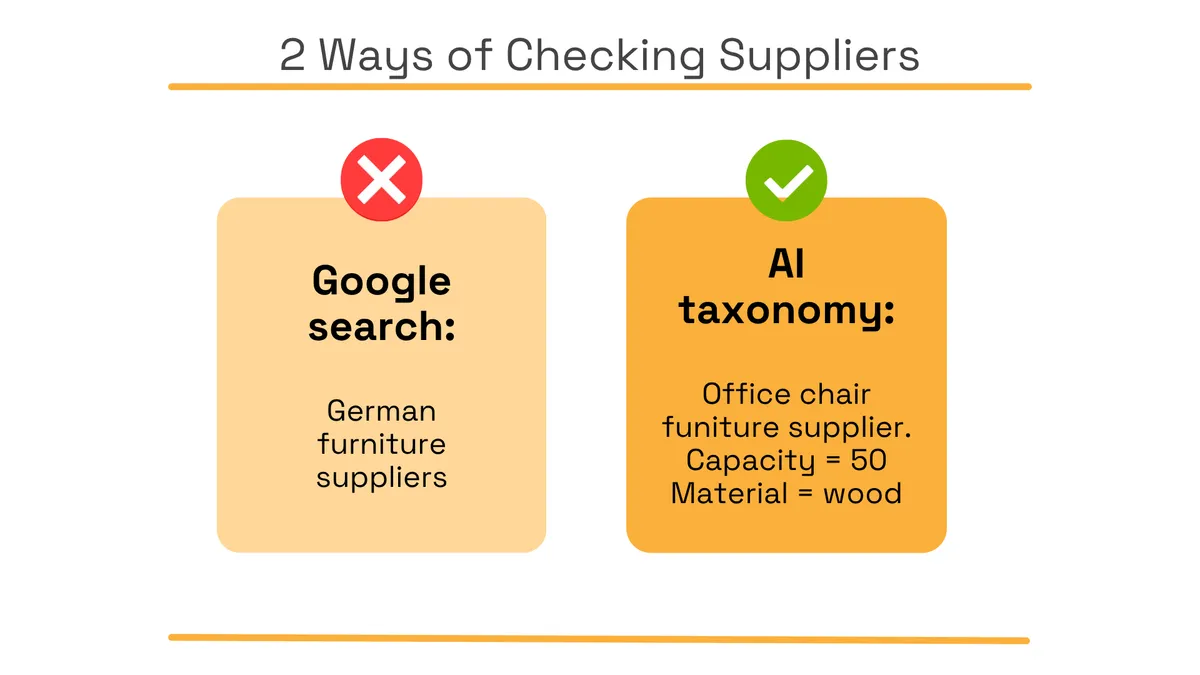
For example, “furniture” may be the parent category, “office furniture” a subcategory, and “office chairs” the specific product category. The taxonomy can then attach requirements such as material, manufacturing process, certification, and business function.
This doesn’t mean every search for “furniture” automatically becomes a search for office chairs. It means AI can place a specific requirement within the correct category and evaluate suppliers against the attributes attached to it.
But why not enter the same detailed requirements into Google?
A buyer could search for “German office chair manufacturer FSC-certified wood high production capacity.” Google would return webpages containing some of those terms. The buyer would still need to open each result, determine whether the company is a manufacturer or distributor, and verify whether it meets every requirement.
An AI supplier discovery platform works differently.
It uses the taxonomy as an instruction set for searching structured company profiles built from supplier websites, product pages, and other business signals. It can also connect related terminology, such as “modled plywood seating,” even when suppliers do not use the buyer’s exact wording.
The advantage, therefore, is not a longer search query. It is the ability to evaluate many companies against the same capability-based criteria and return a comparable shortlist
And this is not just theory.
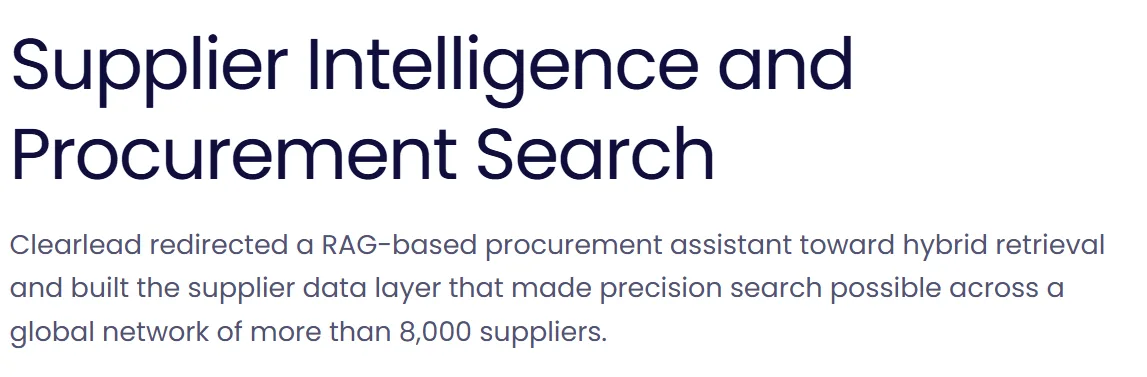
Clearlead, an AI consulting company, ran a procurement project in which an industrial parts distributor managed more than 8,000 suppliers but lacked structured classifications for some products. Clearlead enriched the supplier records and built taxonomies covering safety equipment, PPE and consumables.
Source: Clearlead
The result?
A searchable supplier knowledge base capable of answering precise technical queries, surfacing qualified suppliers and reducing reliance on manual investigation.
That is the real value of a supplier taxonomy.
It turns a broad search into structured discovery and gives AI the language needed to identify suppliers that genuinely fit the requirement.
2. Explore Germany's Mittelstand Supplier Network
The Mittelstand refers to Germany’s network of small- and medium-sized enterprises that are mostly owner-managed, family-controlled businesses that are known for long-term thinking and deep specialization.
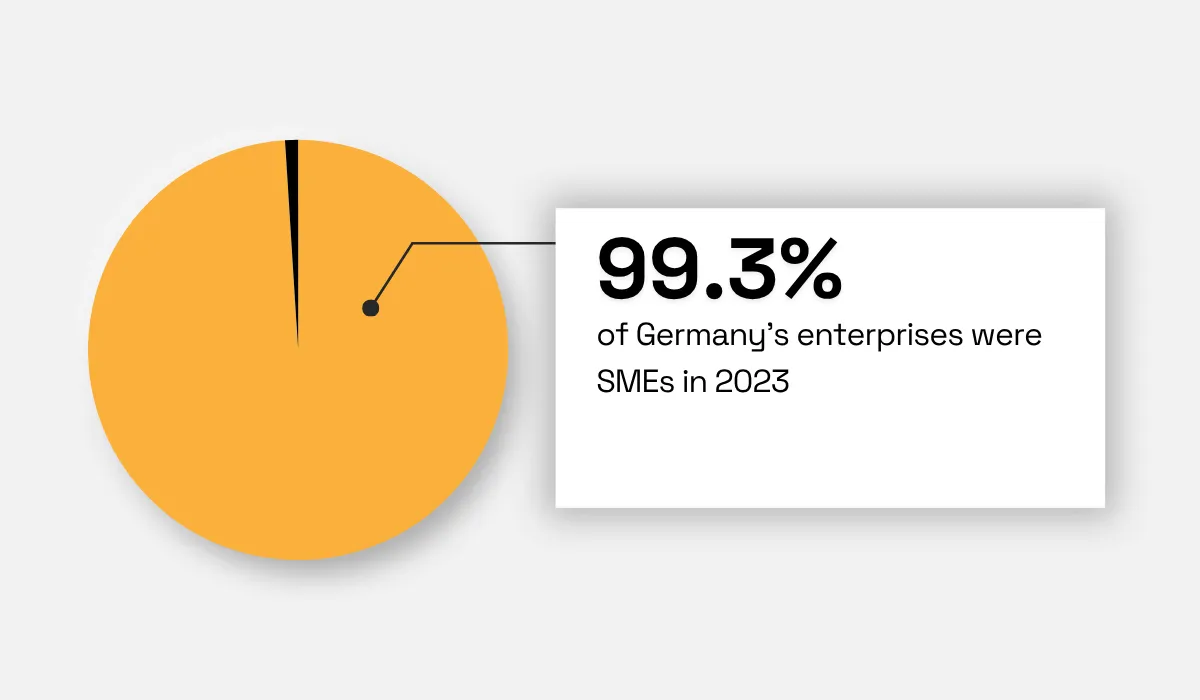
This distinction matters because “Mittelstand” describes how a company is owned and managed, while SME is primarily a size classification. Still, the scale of Germany’s smaller-business economy shows how wide the potential supplier pool is: the Federal Statistical Office reports that SMEs represented 99.3% of German enterprises in 2023.
Many of these German B2B companies spend decades refining one product, component, or manufacturing process.
One study identified long-term orientation, generational continuity, and a focus on core competencies as recurring Mittelstand characteristics. It also found that niche strategy is what distinguishes hidden champions from other Mittelstand firms.
These hidden champions can lead global niche markets while remaining unknown outside their industries.
That is impressive for Germany’s economy. But it creates a problem for procurement teams.
A buyer may search Google or a trade directory for “industrial pump manufacturers in Germany”. A qualified supplier may describe itself through a specific pumping technology, material or industrial application instead.
If its terminology does not match the buyer’s keyword or directory category, it can easily fly under the radar.
Also, traditional supplier discovery relies heavily on manual research and databases, which can be static or require manual input. That makes the search particularly weak for niche suppliers with limited marketing visibility.
AI supplier discovery changes the question from “who appears for this keyword?” to “who can meet these requirements?”
AI tools can analyze websites, supplier databases and unstructured data, then match companies by products, capabilities and locations. Natural language queries allow procurement teams to describe what they actually need, helping surface niche suppliers in Germany based on operational fit.
Siemens shows this approach in practice.
Source: Scoutbee
The German technology company used Scoutbee’s AI-powered procurement platform for supplier identification and enriched supplier profiles. Across 94 projects and 18 business units, the initiative identified 6,893 suppliers and reduced procurement workload by up to 90%.
The lesson is simple: finding Mittelstand suppliers requires searching by capability, not brand visibility.
But discovering them is only the beginning. Strategic supplier sourcing also requires you to evaluate and validate them.
3. Extract Supplier Intelligence with AI
Finding a supplier is one thing. Knowing exactly which company you found is another.
Before onboarding a B2B German supplier, your procurement team must confirm the correct legal entity, validate its capabilities, and understand its ownership and risks.
Doing that manually means moving between disconnected sources.
A typical U.S. sourcing workflow illustrates the problem. Analysts may consult supplier directories to access capabilities, SAM.gov to verify an entity, SEC EDGAR to review corporate filings, and OFAC lists to check restricted parties.
The specific sources change by jurisdiction, but the work remains the same.
Analysts must reconcile company names, addresses, subsidiaries, and registration identifiers across systems. Each handoff adds time and creates another opportunity for an error.
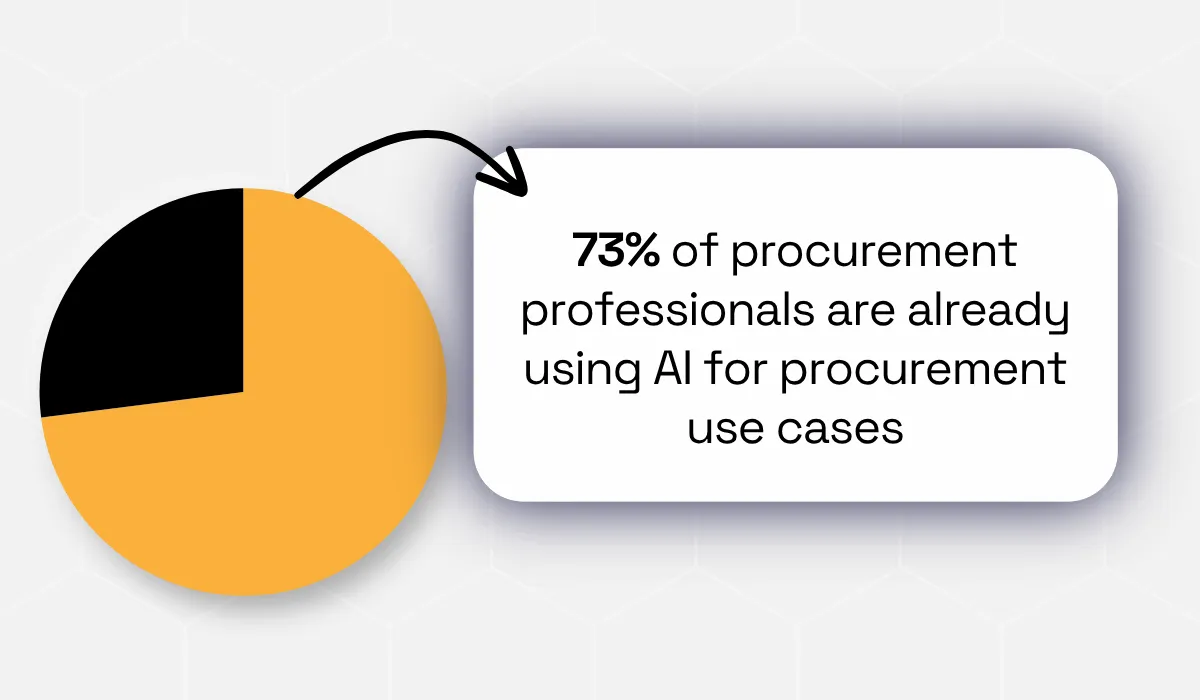
Procurement teams are already looking for a better model. Ironclad’s 2025 survey of more than 800 procurement professionals found that 73% were already using AI for procurement use cases.
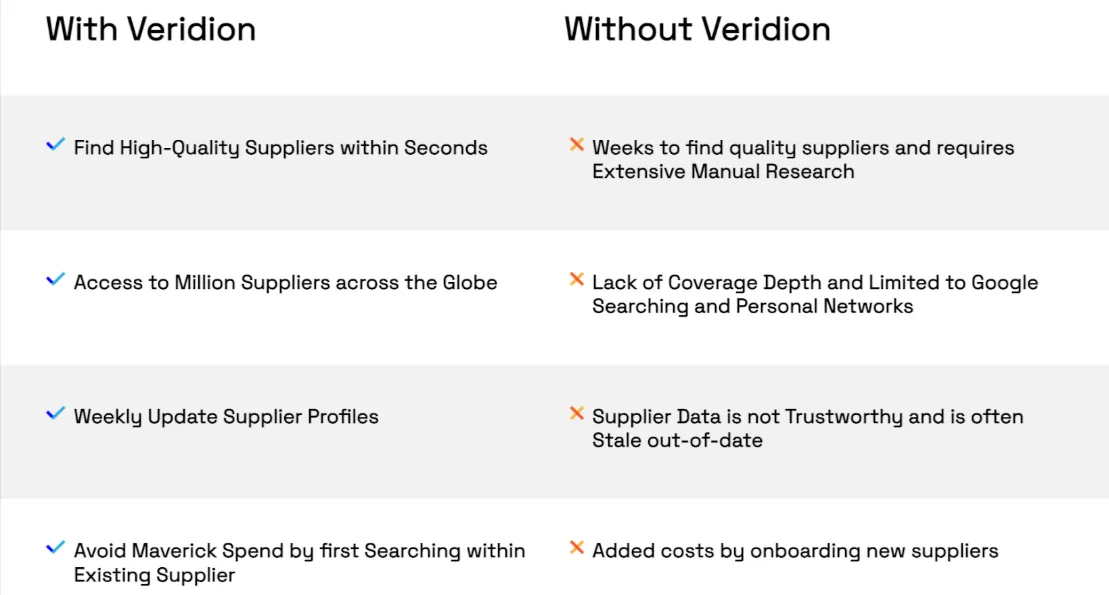
This is where an AI supplier intelligence platform like Veridion changes the workflow.
Its supplier-sourcing layer searches companies by products, certifications, and taxonomy attributes, helping you find alternative suppliers beyond the vendor master.
Source: Veridion
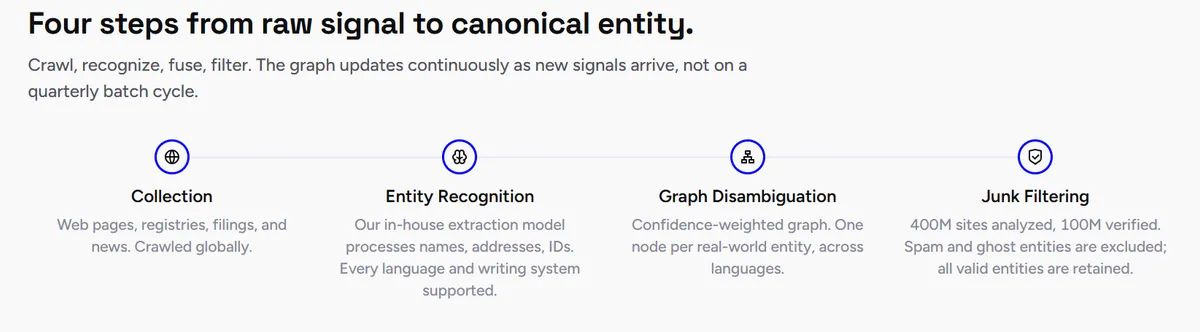
However, discovery is only useful if every candidate resolves to the right business.
Veridion’s entity resolution collects evidence from web pages, registries and filings, then links aliases, operating companies, parents and subsidiaries into one canonical profile with a confidence score.
Source: Veridion
The same workflow continues working after onboarding.
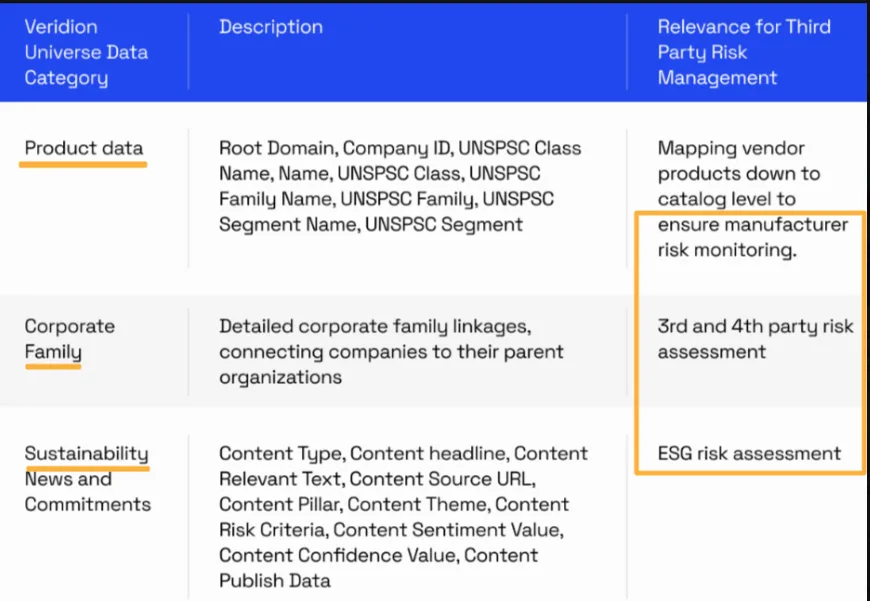
The third-party risk data refreshes firmographics, facility functions, and corporate relationships. Your team can then easily monitor sanctions, ESG issues, financial distress and operational disruptions instead of waiting for a periodic review.
Source: Veridion
But centralized intelligence only creates value when it leads to better action. Tom Mills, the founder of Procurement Protagonist Ltd, summarizes that distinction by saying:
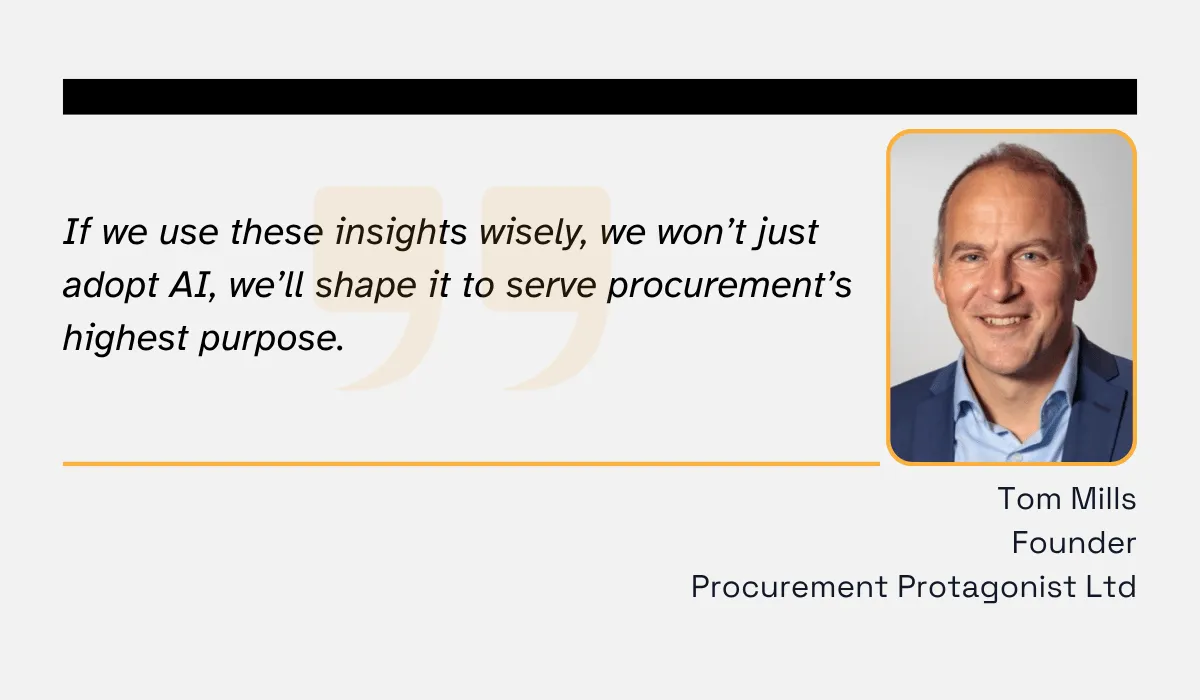
And companies like Exiger have done that.
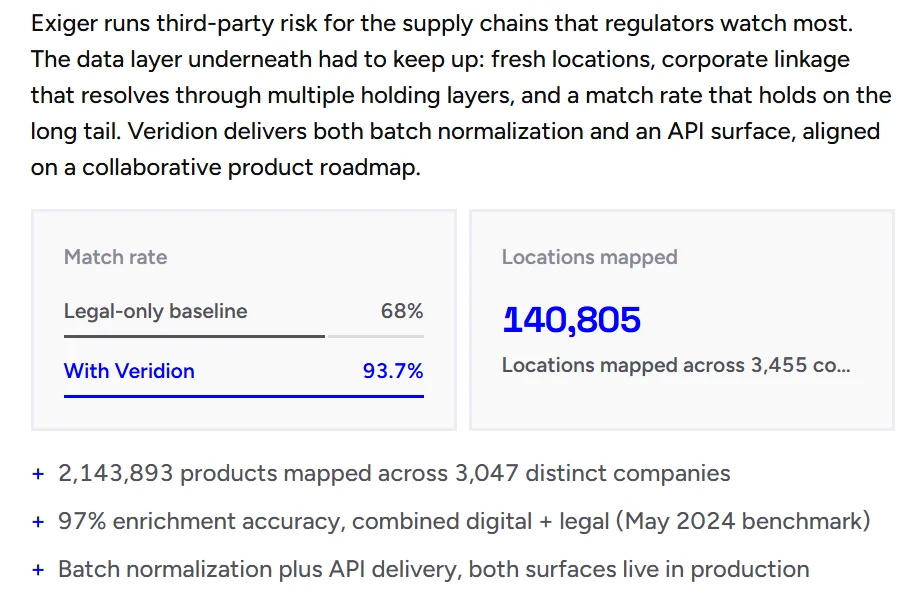
It’s an AI-powered supply-chain risk platform that uses Veridion to improve long-tail company matching and location intelligence. Its match rate increased from a 68% legal-only baseline to 93.7%. The project mapped 140,805 locations across 3,455 companies and more than 2.1 million products with 97% enrichment accuracy.
Source: Veridion
That is why AI beats manual supplier sourcing. It turns fragmented evidence into one living supplier record supporting discovery, verification, and monitoring.
4. Create AI Supplier Scoring
A qualified supplier is not necessarily the right supplier.
Once AI produces a shortlist, it still needs to rank candidates against the project’s priorities.
How can you make it work?
First, the system should check each supplier against non-negotiable requirements, such as location, certification, or production capacity. Candidates that fail a mandatory condition have to be removed.
Next, the AI should score the remaining suppliers on factors such as price, product quality, lead time, and supplier risk. It should convert the information into a common scoring scale so you can make an apples-to-apples comparison.
It should then apply weights based on your priorities.
For a critical component, quality may carry more weight than the price. For a less critical purchase, cost and delivery speed may matter more. The system should calculate an overall score and create a supplier ranking based on these weights.
The catch?
A polished score can still mislead if the underlying supplier data is unreliable.
A 2026 survey by Graphite Connect, an AI procurement company, found that 55% of procurement leaders named increased risk exposure as a major consequence of poor supplier data. Duplicate records sat at 50% while inefficient procurement processes at 41.7%.
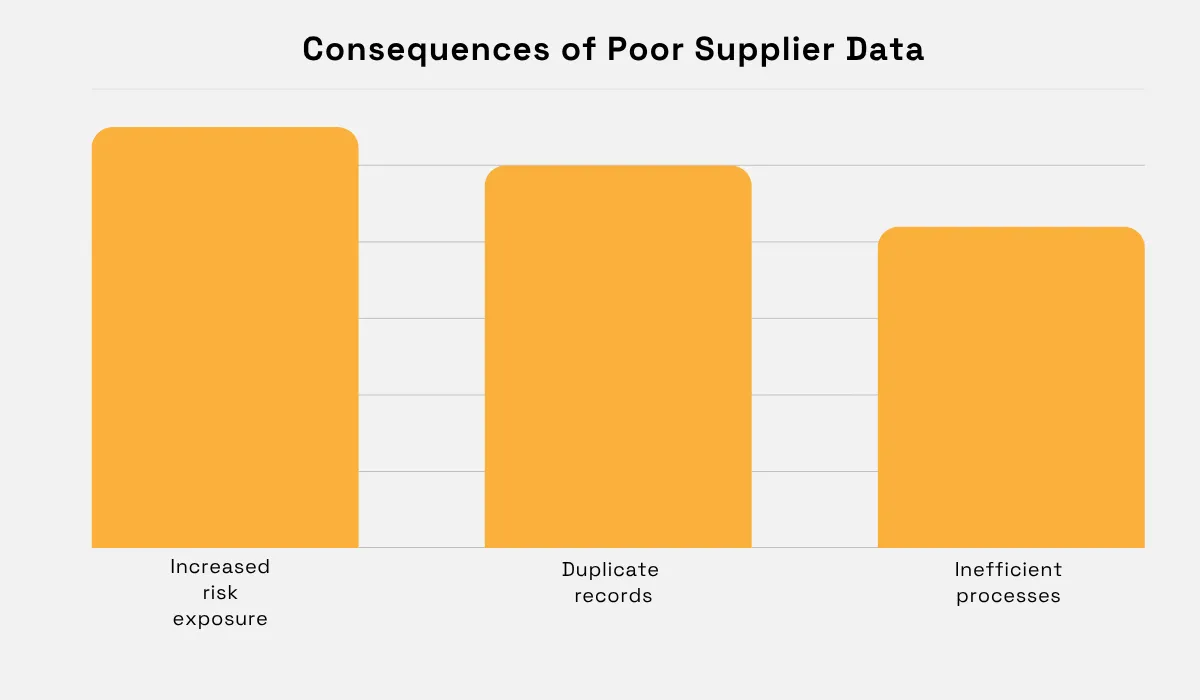
Those problems feed directly into the ranking. Duplicate profiles can split performance histories, while missing capacity information can push a weaker supplier higher than it belongs.
Done well, AI supplier scoring turns a shortlist into a defensible priority order, ready for supplier outreach.
5. Initiate Autonomous Outreach
Once AI supplier discovery produces a ranked shortlist of local suppliers in Germany, autonomous outreach should come into play.
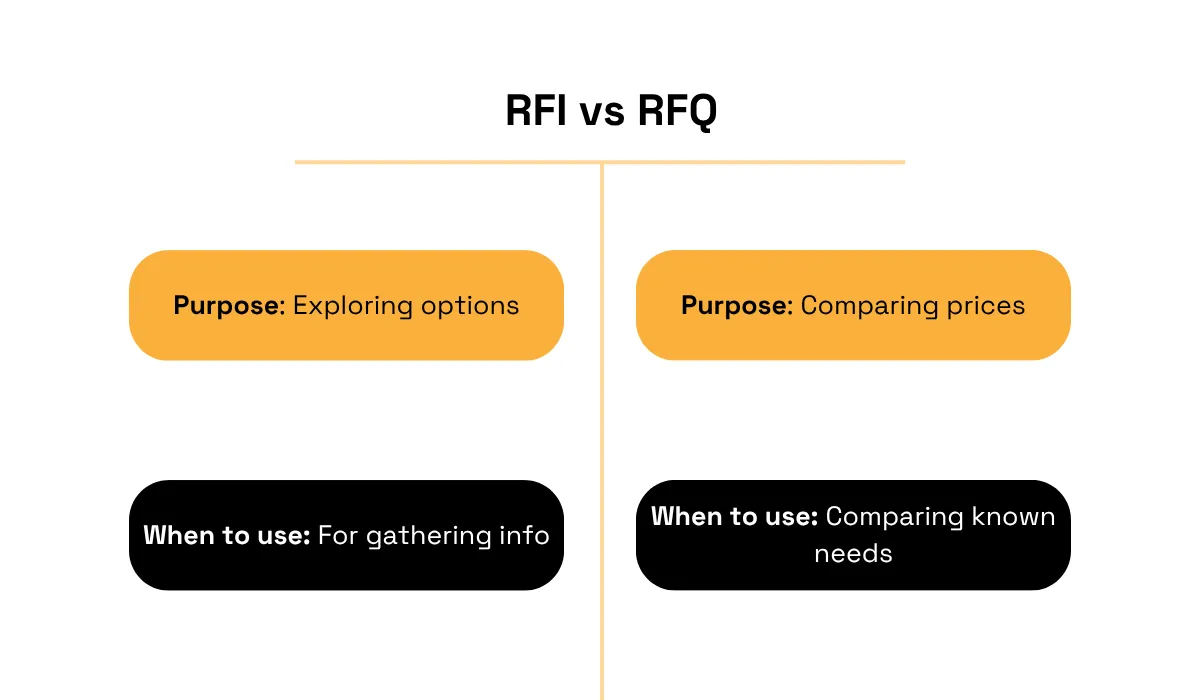
AI agents can prepare and send tailored requests for information (RFIs) or requests for quotation (RFQs), two critical stages in the supplier sourcing process.
The distinction matters.
An RFI verifies whether a supplier can meet the requirement. Using structured profiles and scoring data, AI asks German B2B companies to confirm capabilities, certifications, capacity, lead times and service regions.
An RFQ moves qualified suppliers into commercial comparison. AI adds technical specifications, volumes, delivery locations, pricing fields and response deadlines.
Source: Veridion
What happens next?
The agent sends each request through an approved channel, follows up with nonresponders, extracts answers, and compares bids against consistent criteria.
This takes repetitive back-and-forth off your plates and helps niche suppliers compete on capability rather than marketing visibility.
Autonomous outreach can even extend into negotiation. However, autonomous shouldn’t mean uncontrolled.
The sourcing agents can manage supplier engagement and negotiations but your procurement leaders should be the ones who set objectives and guardrails and manage anomalies manually.
This division of labor is most useful when negotiation volume is the main obstacle. Walmart’s work with Pactum, a supplier pricing negotiating platform, demonstrates why.
Source: Pactum
The retailer used autonomous agents to negotiate payment terms and price discounts across a supplier network that would have been impractical for buyers to cover manually.
Pactum reports that the initiative achieved a 3% average gain, extended payment terms by 35 days on average, and closed agreements with 68% of participating suppliers.
That is the real role of autonomous outreach. It removes repetitive execution while keeping strategic judgement, exceptions, and final accountability with procurement.
6. Build an AI Supplier Monitoring System
A supplier shortlist captures the market once. The market, however, keeps moving.
- What if a new Mittelstand supplier enters the market after the shortlist is approved?
- How quickly can procurement respond when industry news reveals a new capability on one vendor?
This is why supplier discovery should be an always-on process.
An AI supplier monitoring system scans websites, business registries, trade-show exhibitor lists, certifications, product launches, and industry news. It then compares each signal against the supplier taxonomy.
If a company launches a relevant product, opens a facility, or gains a required certification, the system updates its profile and alerts the category team. That keeps AI supplier discovery in Germany current without buyers repeating the same Google searches.
Monitoring works in the other direction, too.
The system detects when an incumbent drops a product line, loses a certification, changes ownership, or shows signs of financial pressure. Procurement can then investigate and surface alternative suppliers before the change becomes a sourcing emergency.
But collecting more information is not enough. It must be current and connected to a procurement decision.
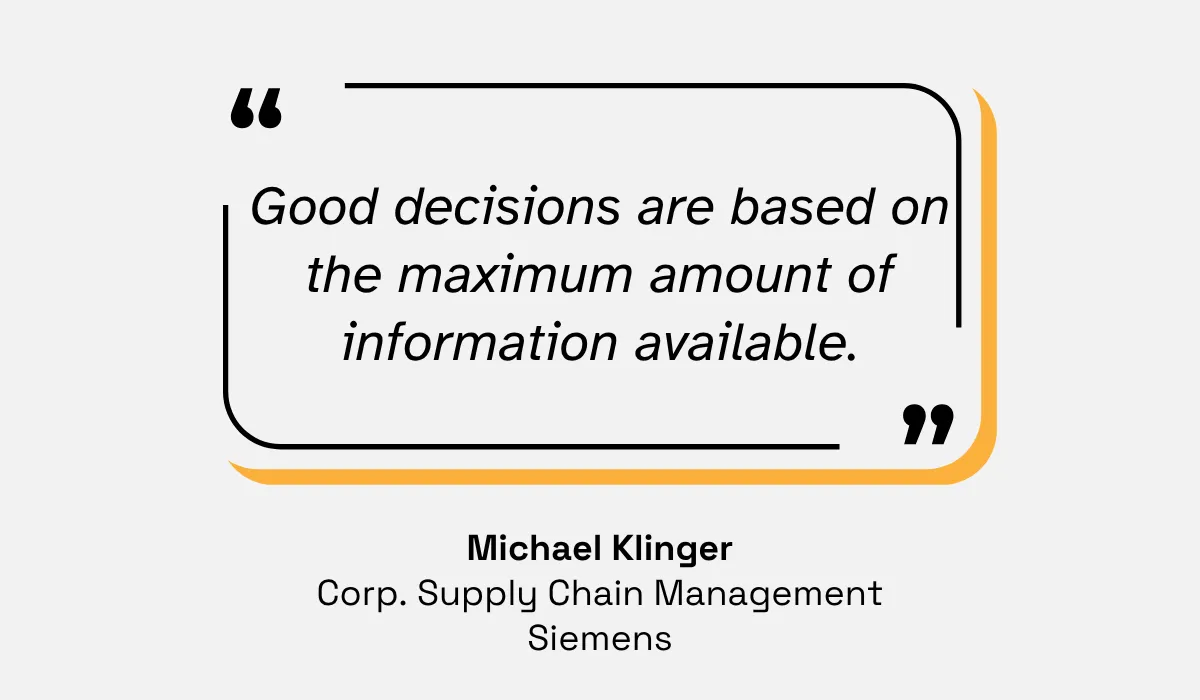
Michael Klinger, Corp. Supply Chain Management at Siemens, summarizes this principle:
This can’t happen if the updated info is not fed into the AI workflow.
Ultimately, continuous monitoring is a core part of a supplier management system because it creates a living market map, giving procurement fresh options before disruption makes them urgent.
Conclusion
Finding local B2B suppliers in Germany used to mean searching Google, checking trade directories, and relying on vendor lists.
That approach no longer works when specialized Mittelstand suppliers remain hidden, markets shift quickly, and procurement teams need alternatives at a quicker pace.
AI taxonomies change that equation. They translate requirements into searchable dimensions, uncover niche suppliers by capability, rank matches, automate outreach, and keep monitoring the market after contracts are signed.
The companies that make this shift will gain wider choice and stronger supply chain resilience.
Build the taxonomy now, and let Germany’s best suppliers finally come into full view.
Articles
Discuss how these trends affect your organization.
Our analysts are available for a short call. Bring a specific question and we will ground it in the data.
Insights
Keep reading
More analysis, research, and outcomes grounded in live company intelligence.
How to Find the Right Suppliers for Your Business
Want to find reliable suppliers for your business? This guide will show you how to identify, evaluate, and choose the right ones.
Supplier Sourcing: What CPOs Need to Know
Supplier sourcing is not just about finding the cheapest suppliers. It’s about building long-term partnerships that move you forward.
7 Key Steps of Successful Supplier Sourcing
Want to optimize your supplier sourcing process? Get better at each of the key seven steps we outlined and you'll get there.