Insights / Articles
How to Find Local B2B Suppliers in Vietnam Using AI Taxonomies
Tired of struggling to find reliable B2B suppliers in Vietnam? Unlock the power of AI taxonomie to streamline your search.

- AI taxonomies organize suppliers by products, certifications, and industry expertise.
- Industrial cluster mapping helps identify manufacturers located near established production hubs.
- Continuous monitoring keeps supplier data accurate as businesses grow and evolve.
- 58% of procurement leaders are implementing or planning AI initiatives
What do Apple, Nike, and Samsung have in common?
A significant part of their supply chain runs through Vietnam.
Over the past decade, the country has become one of the world's leading manufacturing hubs, attracting global companies looking to diversify production beyond China.
But Vietnam's supplier ecosystem is growing and changing rapidly, making it harder for procurement teams to identify the right partners using traditional supplier directories or manual research alone.
AI taxonomies solve this challenge by organizing suppliers based on products, capabilities, and other business attributes.
This blog shows how you can build one.
Build an AI Supplier Taxonomy
Most supplier searches begin with a broad request such as 'find furniture suppliers in Vietnam' or 'Vietnam electronics manufacturers.'
While these searches may return hundreds or even thousands of results, they rarely produce a supplier list that truly fits your business requirements.
And that's why your first step should be building an AI supplier taxonomy.
An AI supplier taxonomy is a structured framework that tells AI exactly what kind of supplier you're looking for.
Instead of treating every business in the same industry as identical, it classifies suppliers by:
- Product
- Manufacturing capabilities
- Certifications
- Export experience
- Business model and other attributes
This breaks your sourcing requirements into specific attributes that help identify better supplier matches.
As Peter Morville, information architecture pioneer and co-author of Information Architecture for the World Wide Web, as well as Founder and President of Sentient Sanctuary, puts it:
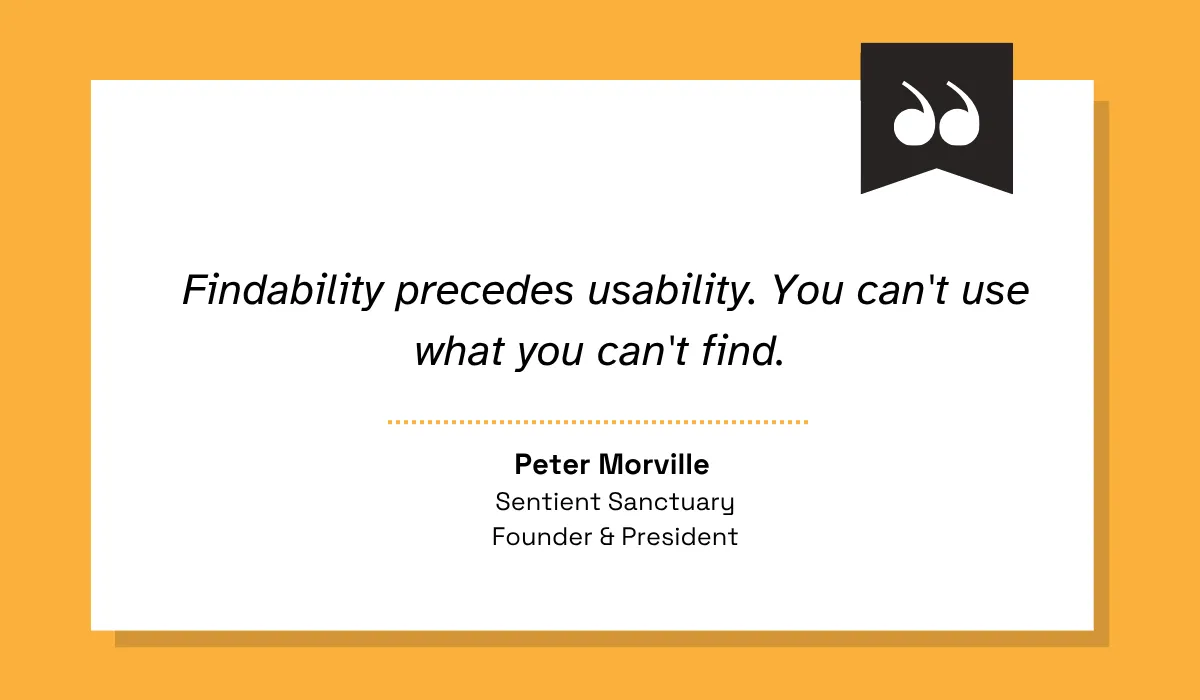
Illustration: Veridion / Quote: Information Architecture for the World Wide Web
For example, a search for "Furniture suppliers in Vietnam" can be interpreted as:
- Office furniture manufacturers
- OEM or ODM manufacturers
- FSC-certified wood processors
- Suppliers exporting to North America or Europe
- ISO 9001-certified manufacturers
- Companies with in-house product design
- Manufacturers with custom production capabilities
Each layer makes your search more precise.
Think about aluminum die-casting suppliers.
A basic keyword search could return equipment dealers, raw material sellers, trading companies, and actual manufacturers.
An AI taxonomy would identify businesses based on what they actually do, not just the words they use on their website.
That means AI can distinguish manufacturers from distributors, pressure die-casting specialists from sand-casting companies, or suppliers serving the automotive industry from those producing consumer goods.
This becomes even more important because many MSME suppliers may operate the traditional way, i.e through phone calls or face-to-face interactions.
That means many capable suppliers may never appear in a traditional database or on the first few pages of Google.
AI overcomes this by looking at business directories, company registries, marketplaces, certifications, industry associations, location data, and many other digital signals to classify suppliers more accurately.
When building your supplier taxonomy, define attributes such as:
- Product categories and subcategories
- Manufacturing capabilities
- Production processes
- Business model (manufacturer, OEM, ODM, distributor, trading company)
- Certifications and regulatory compliance
- Industries served
- Export markets
- Geographic preferences
- Company size or production capacity
The clearer your taxonomy is, the less time you'll spend reviewing businesses that don't match your needs
Map Vietnamese Industrial Clusters
Vietnam's manufacturing industry is not spread evenly across the country.
Over the past two decades, different provinces have developed expertise in different industries because of industrial parks, skilled labor, infrastructure, export networks, and government investment.
A great supplier taxonomy will certainly narrow your search, but you need to know where your ideal suppliers are most likely to operate.
If you search the entire country, you'll spend time reviewing suppliers that were never a good fit.
If you search the right manufacturing clusters first, you'll reach relevant suppliers much faster.
For example, Vietnam's major industrial clusters include:
Industry | Major manufacturing regions | Why these regions matter |
|---|---|---|
Electronics | Bắc Ninh, Bắc Giang, Hải Phòng | Strong electronics ecosystem, skilled workforce, export infrastructure |
Furniture & wood products | Bình Dương, Đồng Nai, Ho Chi Minh City | Large concentration of furniture exporters and wood processing facilities |
Textiles & garments | Ho Chi Minh City, Bình Dương, Đồng Nai, Nam Định | Mature supply chains and experienced manufacturing workforce |
Automotive & industrial manufacturing | Hải Phòng, Vĩnh Phúc, Quảng Nam | Established supplier networks supporting large manufacturers |
Seafood processing | Cần Thơ, Cà Mau and the Mekong Delta | Close to aquaculture production and export logistics |
Vietnam's position in global manufacturing has strengthened these clusters even further.
The country has signed 18 free trade agreements, giving manufacturers preferential access to markets representing almost 90% of global GDP.
Plus, in the first half of 2026, Vietnam attracted USD 34.65 billion in foreign direct investment, depicting opportunities for serious growth.
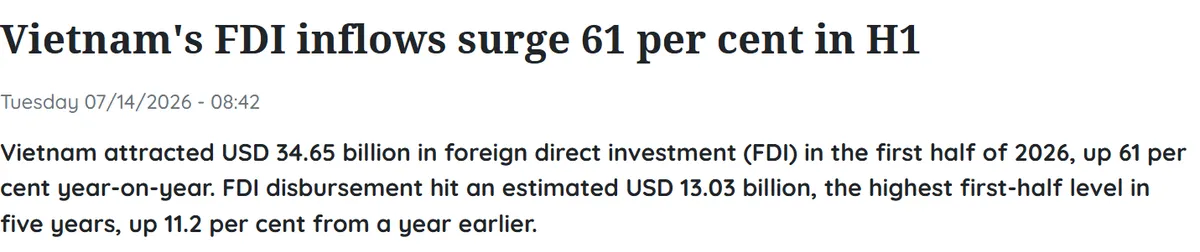
Source: Vietnam Law Magazine
But here's something worth thinking about.
Not every electronics supplier is in Bắc Ninh.
Not every furniture manufacturer is in Bình Dương.
So how do you avoid overlooking good suppliers?
This is where AI becomes much more powerful than manual research.
Instead of applying only one filter, AI combines your supplier taxonomy with Vietnam's industrial geography.
For example, instead of searching for electronics manufacturers in Vietnam, you could search for:
- ISO 13485-certified electronics contract manufacturers in Bắc Ninh
- PCB suppliers in Hải Phòng exporting to Europe
- EMS providers with automotive manufacturing experience
So, rather than searching thousands of companies across Vietnam, you're focusing on businesses operating inside regions where the right suppliers are already concentrated.
Extract Supplier Intelligence with AI
Once you have a good taxonomy and cluster map, the next step is finding suppliers that are actually worth contacting.
The real challenge here is checking whether suppliers have experience with buyers in your region and confirming they are transparent about what they can and cannot do.
For instance, a procurement team may build a shortlist of 50 companies, only to discover that some are trading companies, some have outdated certifications, and a few are no longer operating at the same scale.
This Reddit post is a good example of what can go wrong when supplier information isn't verified.
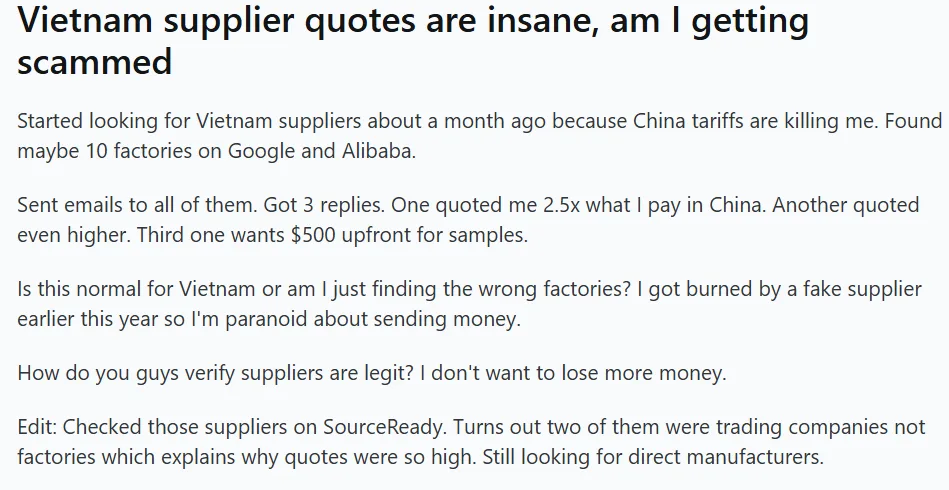
Source: Reddit
Another Reddit user reinforces the same point from a different perspective.
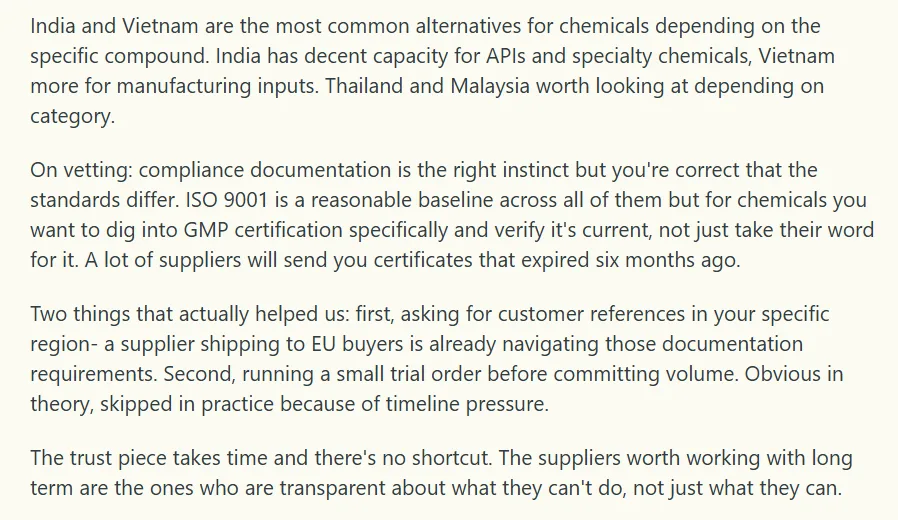
Source: Reddit
So rather than relying on one website or reference, your procurement team must look for multiple signals that confirm a supplier is active and credible.
And Veridion can help with that.
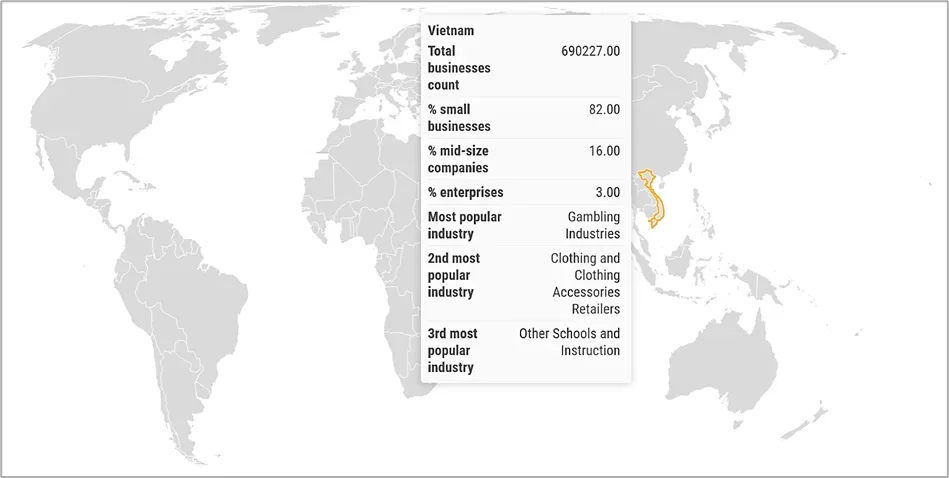
Veridion maintains a continuously updated company graph that tracks 693M companies across 250 countries, with 461 structured attributes per company and ongoing change detection across legal, operational, and parent entities.
Source: Veridion
Here’s what that means for supplier sourcing:
- Factory and office locations
- Product and service offerings
- Certifications and compliance indicators
- Corporate ownership and hierarchy
- Revenue and employee estimates
- Operational footprint and business status
For example, a company profile can show whether the business is active, when it was last updated, how many locations it operates, and which manufacturing categories it belongs to.
Veridion continuously acquires data from web sources, public registries, and other business records, crawling around ~1.4B web pages each month. Its AI models generate roughly 100 million structured company predictions every day, and company records are refreshed whenever meaningful changes are detected
That completely solves outdated supplier data headaches for your team.
The goal with such intelligence is not just to build a supplier list.
It's to build a shortlist of companies whose operations match their sales pitch, so your team spends time talking to the most credible suppliers first.
Create AI Supplier Scoring
By now, you've probably identified dozens of potential suppliers.
Some may have the right certifications.
Others may offer better pricing.
So, how do you compare them fairly?
This is where AI supplier scoring becomes useful.
AI evaluates every supplier against the same set of criteria.
Each company receives a score based on the factors that matter most to your business.
The scoring model may look different for every organization:
- A medical device company may prioritize ISO certifications and regulatory compliance.
- An automotive manufacturer may focus on production capacity, quality systems, and delivery performance.
- A retailer may care more about sustainability, export experience, and pricing.
The important part is defining these factors before supplier evaluation begins.
For example, your scoring model could include:
Evaluation area | What AI can assess |
|---|---|
Manufacturing capability | Production processes, equipment, and specialization |
Certifications | ISO standards, industry certifications, compliance |
Export experience | Countries served and customer industries |
Business stability | Company activity, operational signals, business profile |
Geographic fit | Location within key manufacturing clusters |
Sustainability | Environmental and social certifications |
Capacity | Company size and manufacturing scale |
Not every factor needs the same weight.
If compliance is critical, you may assign it a higher score than to geographic location.
Take the case of Samsung, a global electronics and appliance manufacturer, which has deep supply chains in Vietnam.

Source: Sammy Fans
To become part of its supplier network, including suppliers based in Vietnam, businesses are expected to meet strict quality, environmental, and operational standards.
For example, Samsung requires its suppliers to obtain internationally recognized certifications such as ISO 14001 for environmental management and ISO 45001 for occupational health and safety.
So, ultimately, the goal is to make supplier selection more objective.
Without a structured scoring system, procurement teams often spend hours debating suppliers based on incomplete information.
According to Graphite Connect's 2026 State of Supplier Data Report, 21.7% of procurement leaders say poor supplier data reduces confidence in business decisions, while 31.7% struggle to consolidate supplier information across multiple systems.
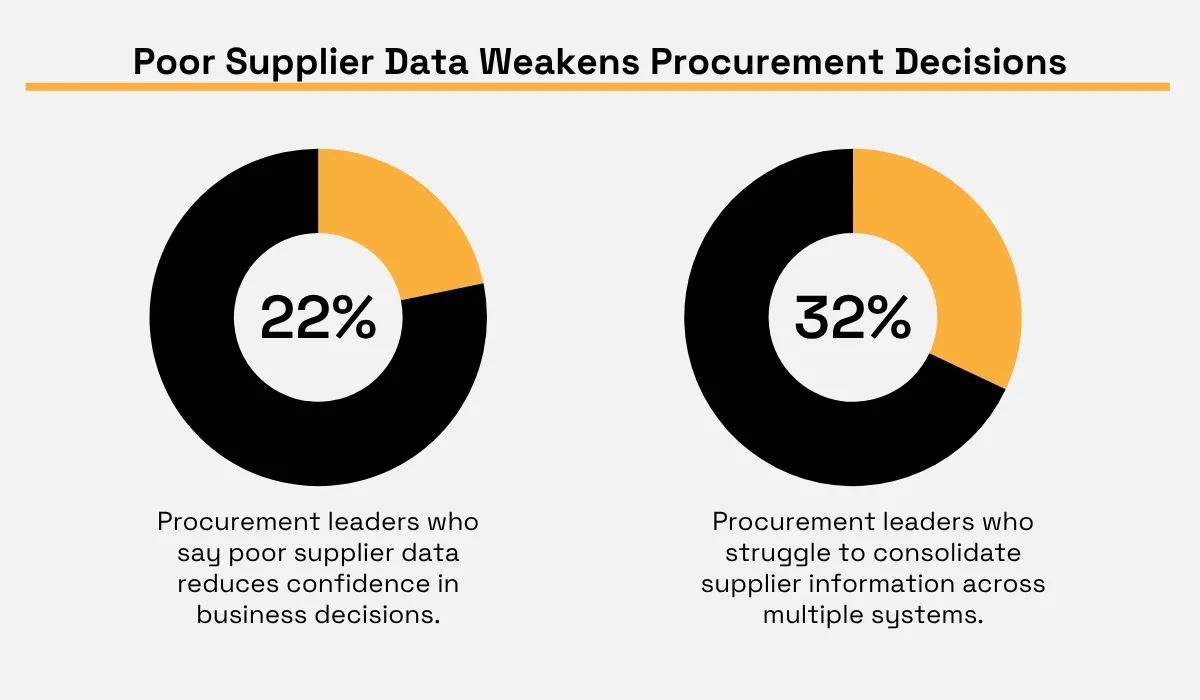
Illustration: Veridion / Data: Graphite Connect
AI scoring helps solve issues like this by bringing supplier data together and evaluating companies against the criteria that matter most to your business.
Once you've identified the best suppliers, one final step remains.
You need to make sure they continue to be the right suppliers tomorrow, next month, and next year.
Build an AI Supplier Monitoring System
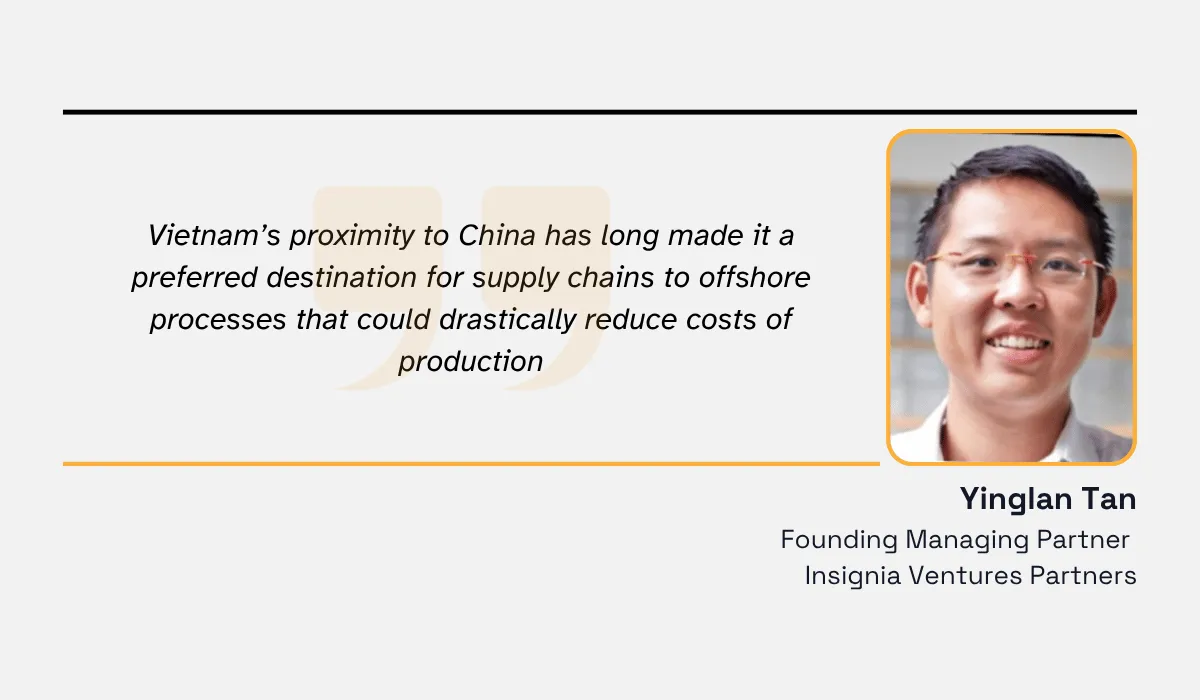
Vietnam's supplier ecosystem continues to evolve as more companies diversify production through China+1 strategies.
As Yinglan Tan, Founding Managing Partner at Insignia Ventures Partners, an early-stage Southeast Asian venture capital firm, explains:
So, if your supplier data isn't monitored regularly, even the best sourcing decisions can become outdated.
A manufacturer may add a new production line, earn a certification, expand into new markets, or start producing entirely different products.
The opposite can happen too.
Business ownership can change, or compliance issues may appear without warning.
That's why supplier discovery shouldn't end after onboarding.
AI makes continuous supplier monitoring possible by tracking updates such as:
- New certifications
- Changes in manufacturing capabilities or product portfolios
- Factory expansions or relocations
- Entry into new export markets
- Company ownership or leadership changes
- Trade show participation
And this shift is already happening across the industry.
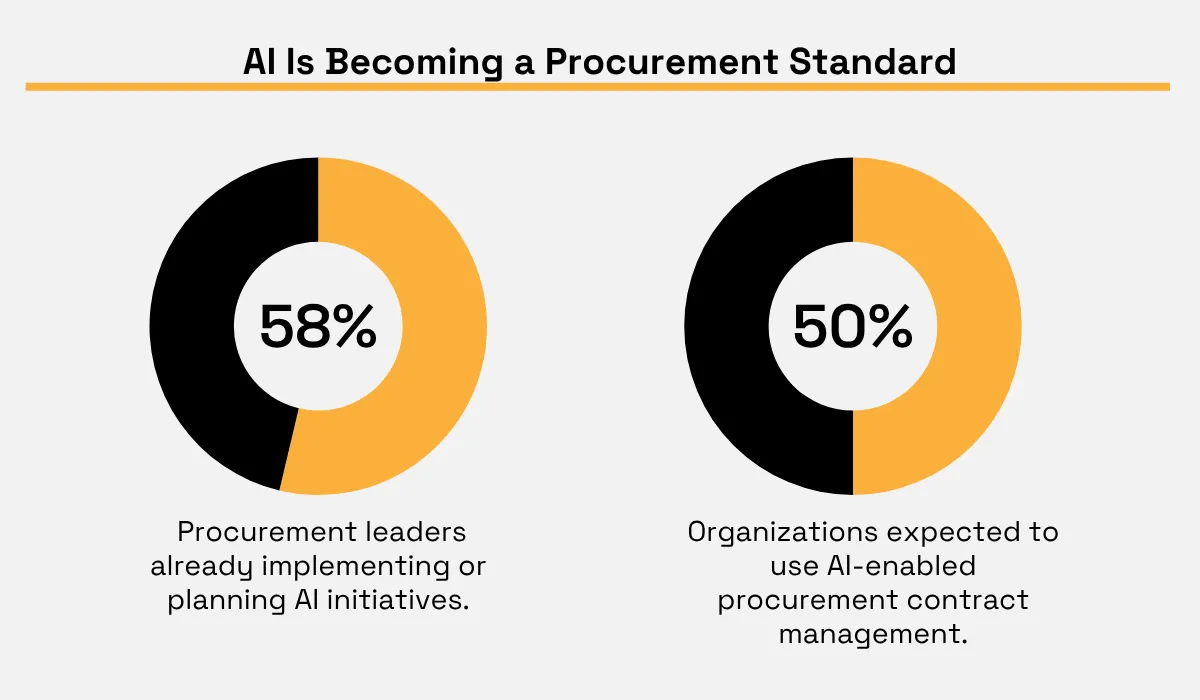
According to Gartner, 58% of procurement leaders are already implementing or planning AI initiatives, while 50% of organizations are expected to use AI-enabled procurement contract management by 2027.
And the value of AI extends beyond monitoring individual suppliers.
It helps monitor thousands of businesses at once, saving procurement teams the time and effort of manually tracking updates across multiple sources.
So, if you want to find local B2B suppliers in Vietnam using AI taxonomies, don't stop at discovery.
Combine AI taxonomies with industrial cluster mapping, supplier intelligence, supplier scoring, and continuous monitoring to build a supplier network that stays accurate, competitive, and ready for change.
Conclusion
If you are looking for local B2B suppliers in Vietnam, just searching business directories or attending trade shows may not help.
The best way forward is to combine multiple data sources and continuously monitor supplier information as markets evolve.
AI taxonomies help procurement teams identify relevant suppliers faster, while supplier intelligence, industrial cluster mapping, supplier scoring, and continuous monitoring provide the context needed to evaluate them with confidence
As Vietnam's manufacturing ecosystem continues to grow, businesses that use AI-powered supplier discovery will be better positioned to build stronger, more resilient supplier networks.
Articles
Discuss how these trends affect your organization.
Our analysts are available for a short call. Bring a specific question and we will ground it in the data.
Insights
Keep reading
More analysis, research, and outcomes grounded in live company intelligence.
How to Find Suppliers In Vietnam
In this guide, you’ll learn how to find suppliers in Vietnam, vet them properly, and make sure they meet your quality and compliance needs.
6 Mistakes to Avoid when Gathering Market Intelligence
Think your market intelligence is on point? Check out these five frequent mistakes and how to avoid them before it’s too late.
5 Trends Shaping the Future of Market Intelligence
Want to future-proof your business strategy? Explore the top trends defining the future of market intelligence.