Insights / Articles
Harmonic.ai Alternatives for Private-Market Company Discovery
Specter, Dealroom, Tracxn, Crunchbase and Veridion find companies differently. Compare five Harmonic.ai alternatives on coverage and pricing for your team.

Harmonic describes itself as “The startup discovery engine”, but it may not align with every investor’s requirements.
The tool choice for private company discovery depends on what the team needs: a startup-focused discovery tool, a broader view of private companies, funding- and revenue-based data, or company data delivered into its own systems.
Harmonic.ai alternatives like Crunchbase, Specter, Tracxn, Dealroom, and Veridion offer different approaches to private-market company discovery.
For example, Crunchbase is a predictive intelligence platform, while Veridion is a company data provider that teams build discovery on top of.
We will compare the features and limitations of Harmonic.ai competitors to help you identify which tool best fits your needs.
Harmonic.ai Alternatives at a Glance
Specter, Veridion, Dealroom, Tracxn, and Crunchbase are Harmonic.ai alternatives that, like Harmonic, help teams find and research private companies before they show up in a deal process.
Tool | Best for | Company coverage | How records are verified | Data updates | Access |
|---|---|---|---|---|---|
Harmonic | VC, growth equity, corp dev, and GTM teams | Startups first; other companies refreshed less often | Shown companies need a verified name, website or LinkedIn, and a linked person | Startups every 2 weeks; headcount and bulk data weekly | Web app, API, CSV, bulk (S3, BigQuery, Snowflake) |
Specter | VC and PE deal sourcing | Startups, public and emerging private companies, global | Not publicly specified | Daily incremental updates | Web app, API, CSV, bulk (S3, Google Cloud, Snowflake) |
Veridion | PE, VC, procurement, risk, and market-intelligence teams | Public and private companies of every size, global | Confidence score and source trail per attribute; cross-source checks | Profiles continuously, volatile signals daily | APIs, batch files, Snowflake, BigQuery, Databricks |
Dealroom | Investors, corporates, and governments | Tech startups and scale-ups, global | AI collection plus analyst review | Not publicly specified | Web app, API, MCP, bulk feeds |
Tracxn | VC, PE, corp dev, and investment banks | Private companies from unfunded to unicorns, global | Technology plus human-in-the-loop review | 7.8K+ companies added daily; refresh cadence not specified | Web app, API, data dumps, integrations |
Crunchbase | Investors, sales, and analyst teams | Startups to public companies, global | AI grading, validation, and analyst review | Continuous; predictions weekly | Web app, API, data licensing |
The main difference is the type of company universe and signals each platform helps you investigate.
Harmonic, Specter, Dealroom, Tracxn, and Crunchbase emphasize startup and investment intelligence (Harmonic, for instance, refreshes startups first), while Veridion extends company discovery, including those outside the typical venture-backed startup universe.
Specter
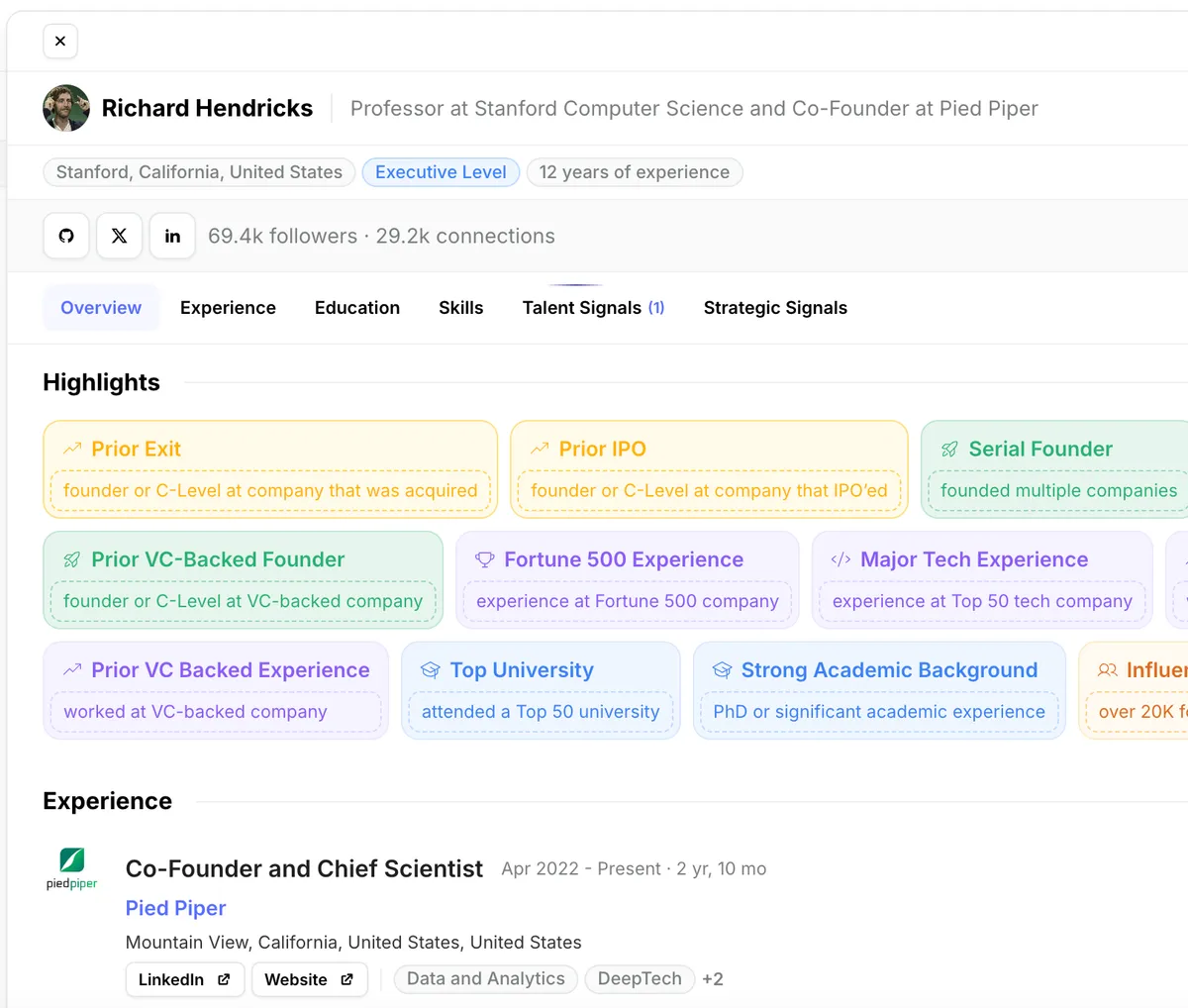
Specter is a private-market intelligence and deal-sourcing platform for investment firms. Its database consists of more than 55 million companies with 250+ data points.
Source: Specter
It helps investment firms find potential deals by bringing together company, funding, M&A, and investor data, along with signals that point to new opportunities.
These are the platform features that matter most for early deal sourcing:
- It detects 1,000+ talent signals a day, including stealth founders, spinouts, and senior moves that surface early opportunities.
- It also tracks 7,000+ investor-interest signals a week, which shows you what companies other investors are tracking.
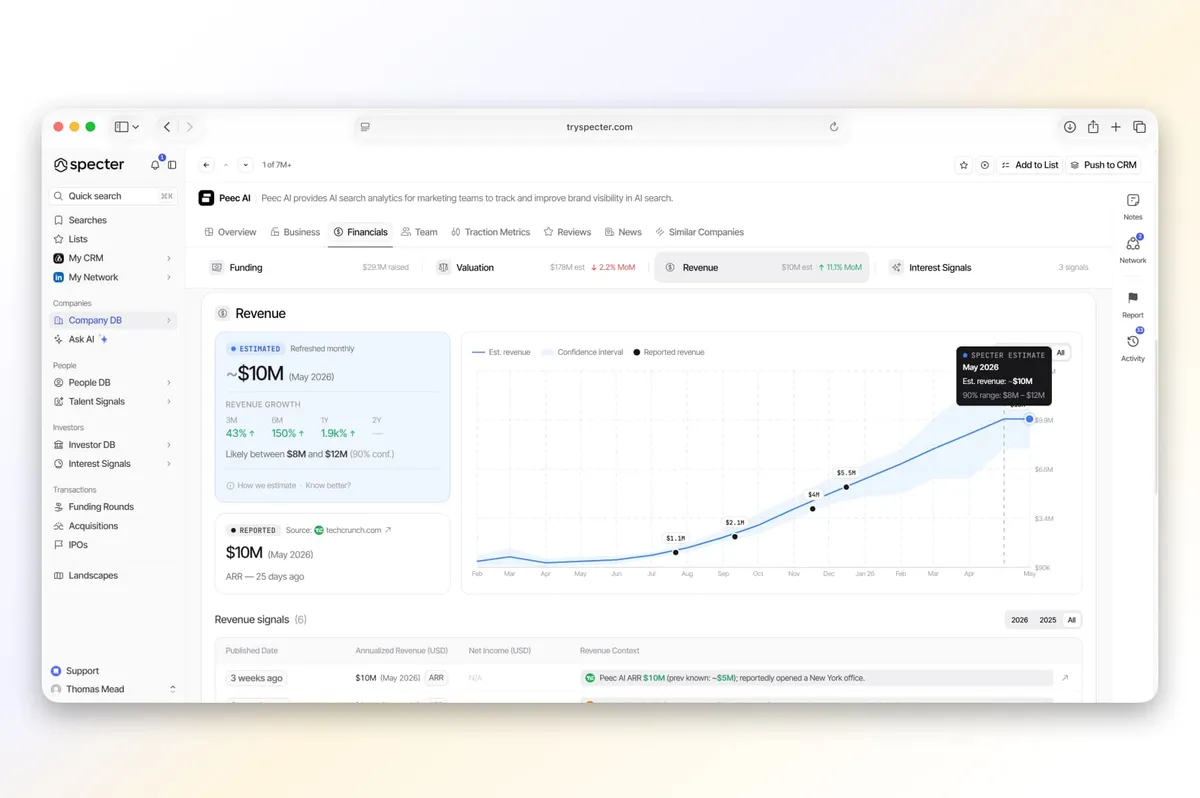
- It re-models revenue and valuation estimates every month and provides confidence bands for reliability. Estimates are anchored to verified disclosures, and the valuation estimate resets to each priced round.
Besides the firmographic, growth metrics, hiring, funding, and ratings and reviews, one aspect of its data depth is news collected from 60,000+ sources.
Specter turns your saved searches into live API feeds that return new matches.
For bulk data delivery, you can use S3, Google Cloud, or Snowflake, or you can sync the data with CRMs such as Salesforce, Affinity, and Attio.
Like Harmonic, Specter finds startups early through founder backgrounds, talent movements, and network signals.
It also offers investor-interest signals that help you track market trends and shifts in investor activity.
Its modeled revenue and valuation estimates help you assess potential deals.
Source: Specter
Specter’s data and workflows are built for investment teams, so its profiles center on startups, founders, investors, and deals rather than on what a business makes or where it operates.
Specter offers platform subscriptions, API access, and bulk data delivery, with pricing available on request.
Veridion
Veridion is a company intelligence database consisting of 744.5M companies that builds structured profiles from company websites, trade registries, news, map data, social media, and satellite imagery.
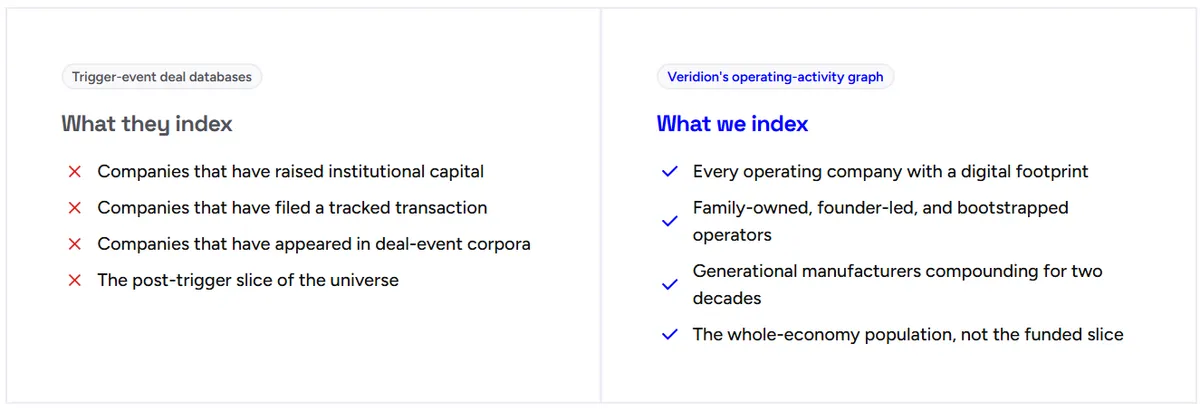
It covers private businesses of every size and location, including small, family-owned and bootstrapped firms that have never raised outside funding.
Source: Veridion
You can use its Search API to screen the wider economy for companies that match an investment thesis.
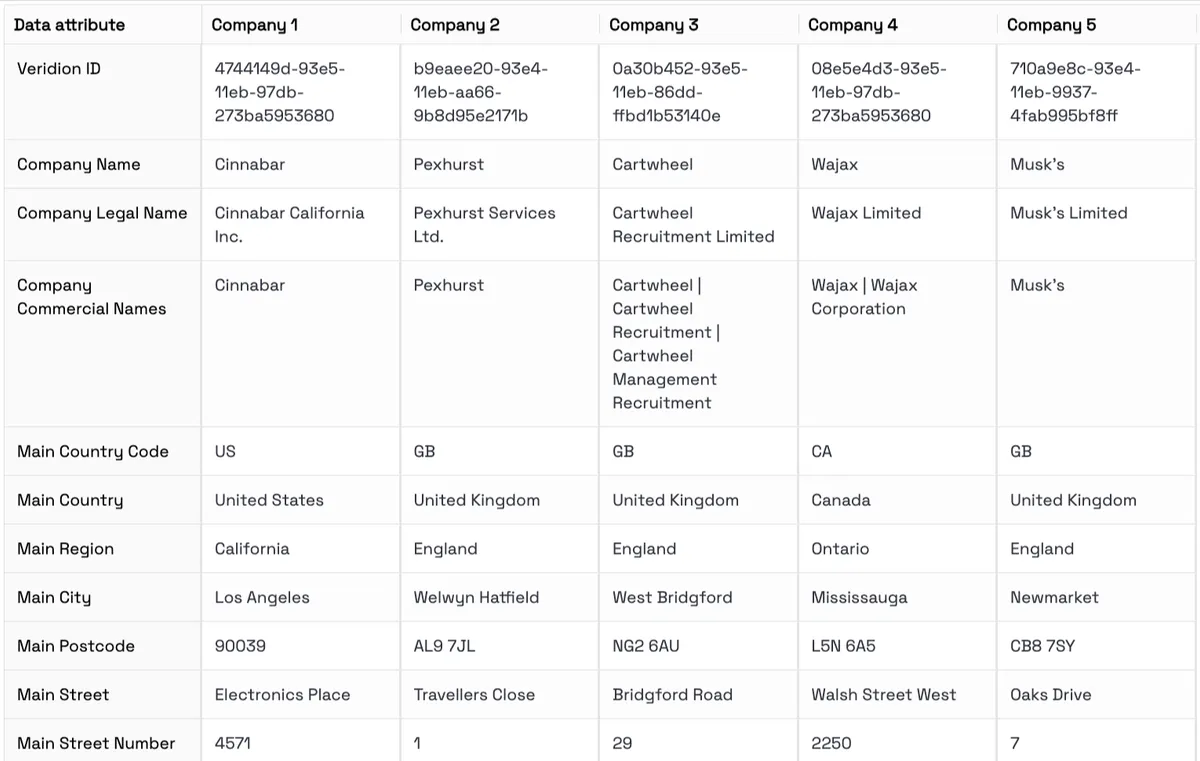
Here’s just a portion of one example data sample:
Source: Veridion
It provides 465 attributes per company, helping you understand what a business does and how it operates.
Its key features for private-company discovery are:
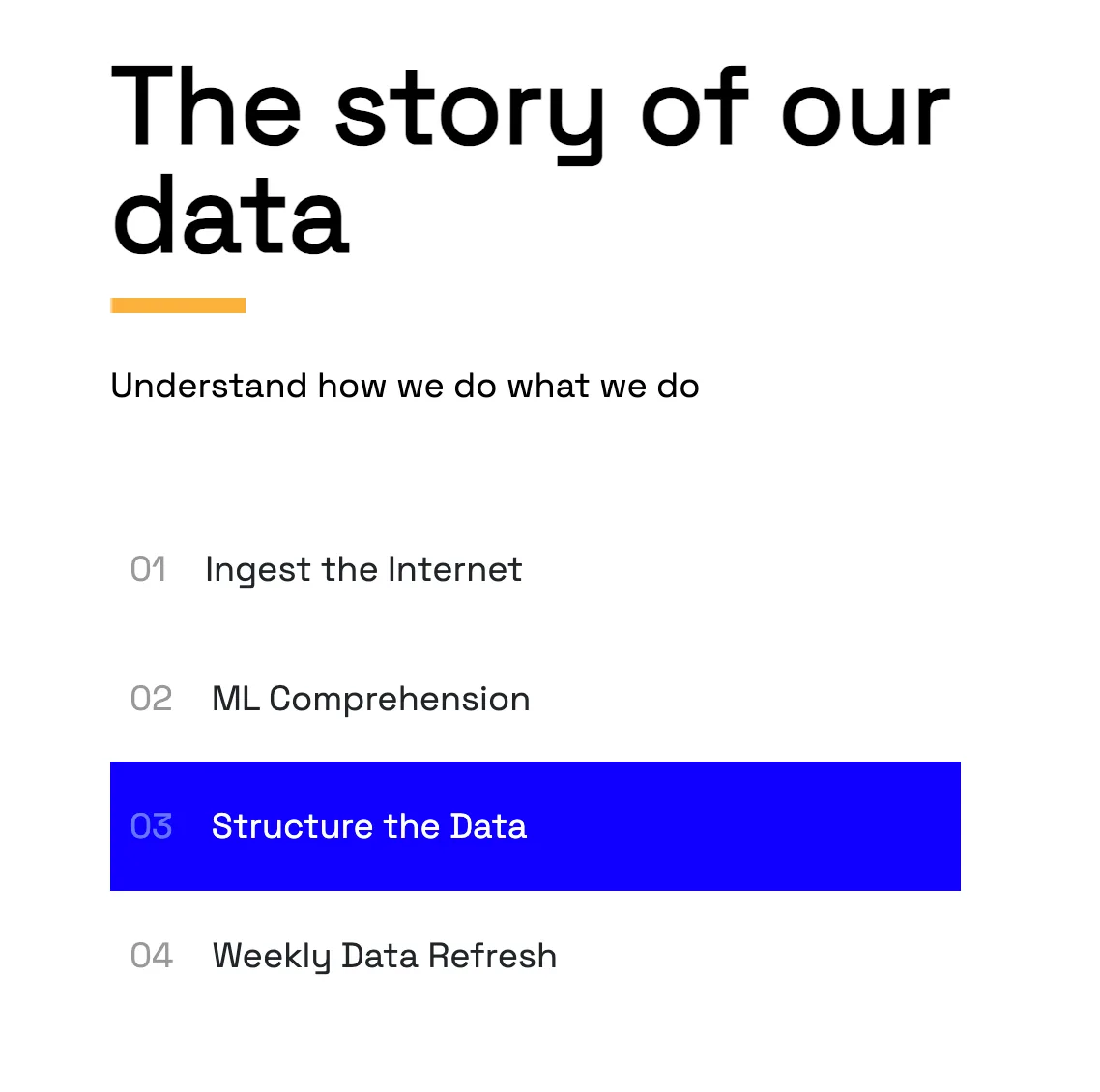
- Veridion runs its own crawl fleet, which handles >99% of its crawl volume, and combines web crawling with registry ingestion. A company can show up the week its website goes live, before any funding event.
- Core company profiles refresh continuously, volatile signals daily, and technographics on a rolling 90-day window, with under 24 hours from source crawl to resolved attribute.
- You search companies using specific filters and review supporting evidence for each match. Its entity resolution matches records across data sources to identify distinct companies and avoid duplicates.
Veridion built four signals on its company graph to help a financial-data provider identify businesses gaining momentum before it reflected in their financials.
The signals tracked hiring momentum, new locations, headquarters upgrades, and customer review trends. Its relocation analysis found 1,670 companies with headquarters or footprint changes, and 1,209 of them (72%) were missing from the provider’s existing list.
Unlike Harmonic, Specter, and other tools on this list, Veridion is not built around funded startups or deal sourcing.
It finds companies by crawling the web, so it also picks up private companies that have never raised funding.
It lets users search for companies by products, services, industries, locations and operating characteristics, then view their complete business profiles and ownership data.
Source: Veridion
Veridion doesn’t collect personal data, so it has no founder or people profiles, and it doesn’t cover funding rounds, investor data, or investor workflows.
Veridion uses custom pricing. Its packages include Data Foundations, Company Intelligence, and Strategic Program.
Dealroom
Dealroom.co is a private-market intelligence platform focused on tech.
Source: Dealroom
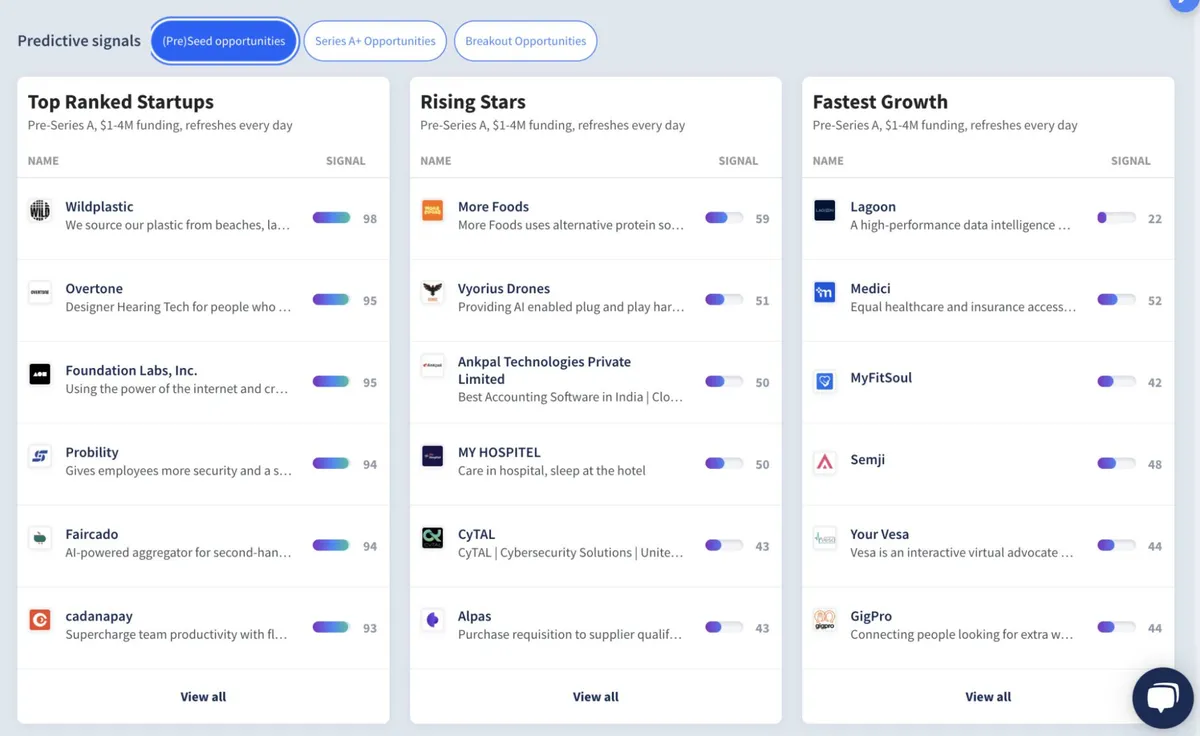
Its database connects company profiles with funding rounds, investors, founders, team growth, and other indicators necessary for investment analysis.
Its API and data feeds offer three main features for deal and data teams:
- Dealroom detected 76K new startups in 2025, often months before press coverage.
- It provides revenue, annual recurring revenue (ARR), and growth data for private companies, plus enterprise value-to-revenue (EV/revenue) ratios and exit multiples by segment, which is useful for growth-stage and private equity (PE) screening.
- You can receive data through REST API, a hosted MCP server, and bulk and incremental feeds into warehouses such as Snowflake and CRMs such as Salesforce and Affinity.
Similar to Harmonic and Specter, Dealroom picks up new and stealth companies early, using filings, hiring, and founder signals.
But Dealroom differs from Harmonic by offering market-level data on revenue, growth, and valuations to support deeper investment research.
Unlike Specter, which provides monthly modeled revenue and valuation estimates, Dealroom offers financial benchmarking data for growth-stage and private equity screening.
Source: Dealroom
However, Dealroom's coverage centers on tech startups and scale-ups, so teams screening traditional, non-tech businesses will find fewer of them there
Dealroom offers three packages: Premium, Premium Plus, and Enterprise. Premium and Premium Plus are priced per seat, billed annually, with a minimum of three seats (individual user accounts), and the per-seat rate drops as the team grows.
On its US pricing page, a 10-seat team pays $288 per seat a month for Premium and $383 for Premium Plus. Enterprise is for 20+ seats and has custom pricing, and API access is an add-on priced on call volume.
Tracxn
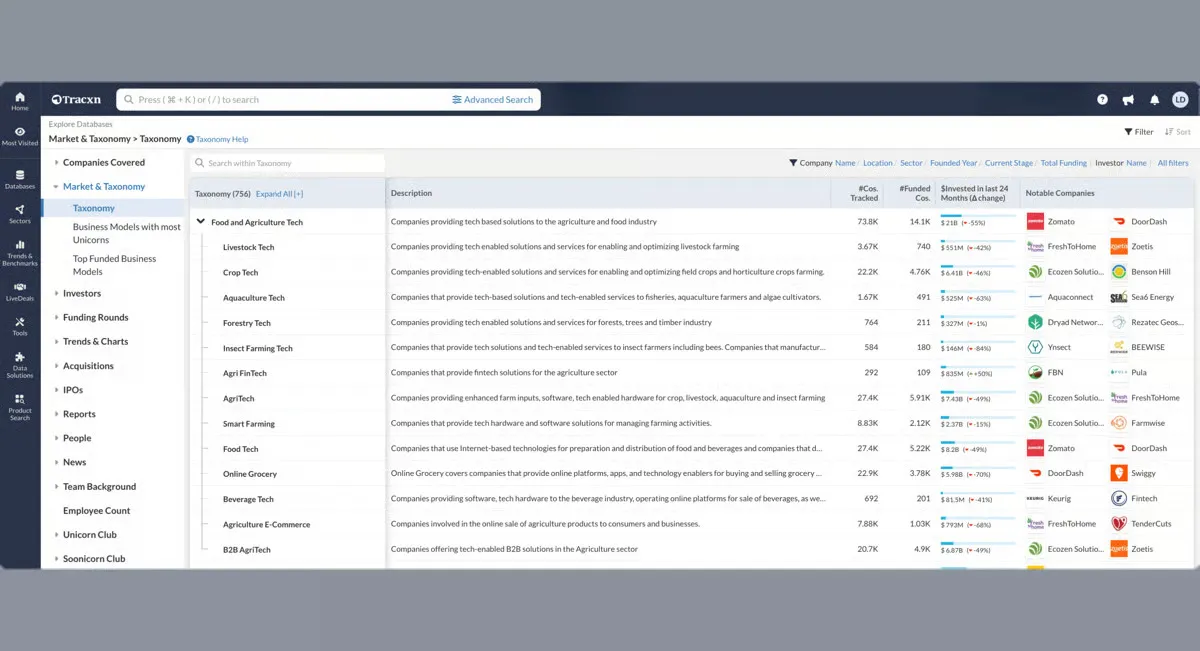
Tracxn is a deal-sourcing platform that organizes private companies by sector and business model. It lets investors follow funding activity and investor behavior, and surfaces new companies that fit a chosen mandate.
Its key features for deal discovery are:
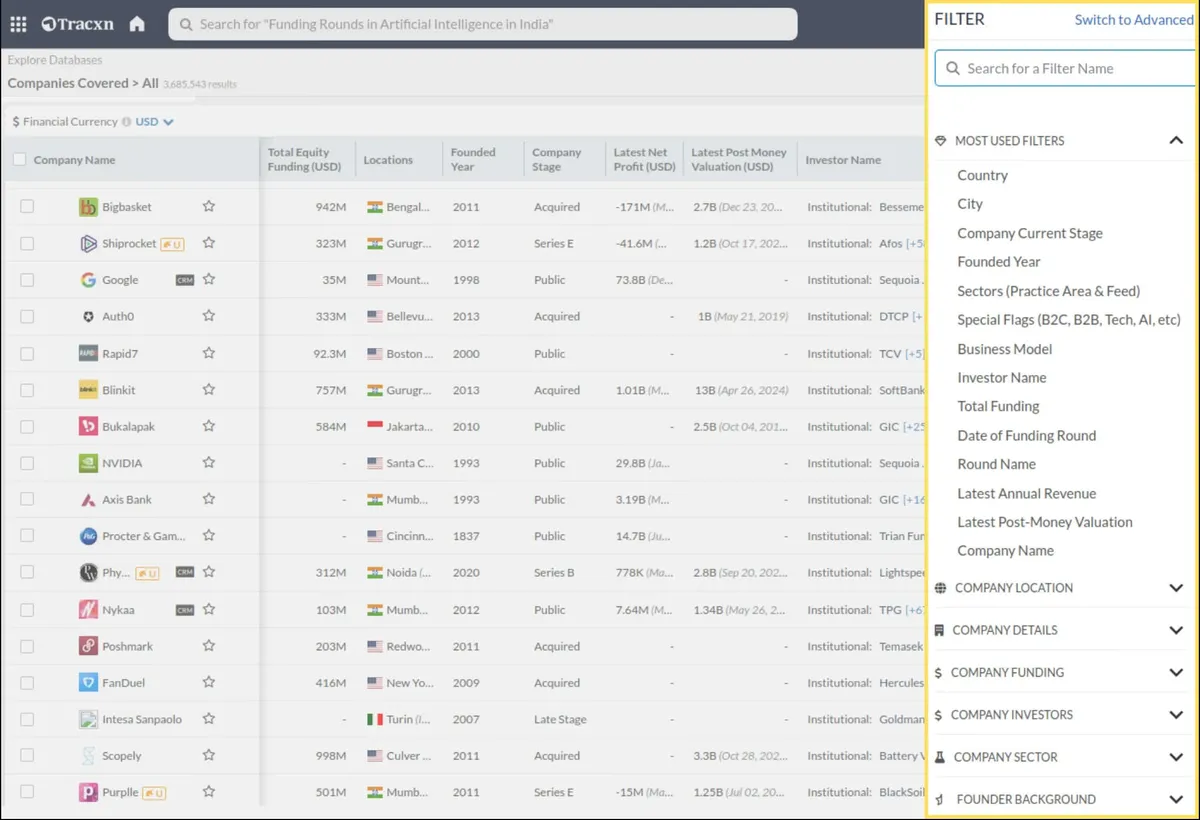
- You can screen 8.4M+ private companies, from unfunded to unicorns, across 3K+ feeds and 55.7K+ taxonomies using 100+ filters
- Tracxn follows 26,000+ VCs, 180K+ angels, 1,700+ family offices, and 13,000+ PEs. This is particularly helpful in finding other investors’ investments and tracking where capital is flowing.
- It provides live boards by sector, stage, geography, or thesis, plus custom alerts on startup and funding signals, gathering all your required data in one place.
Tracxn’s extensive filters include sector, location, business model, founder profile, growth stage, EBITDA, revenue, profit, and valuation.
Source: Tracxn
It offers free sign-ups which gives you a preview of the premium database which allows you to explore its features before moving to paid plans.
Unlike Harmonic and Specter, which are organized around people and signals, Tracxn is organized around business categories and tracks investment activity across thousands of investors.
Although Tracxn has a deep classification of businesses, companies that don't fit its curated categories may be harder to discover.
Source: G2
Tracxn offers two packages: Lite for personal use and Premium for commercial needs. You can get started with Lite for free; usage limits apply.
Premium operates on custom quotes.
Crunchbase
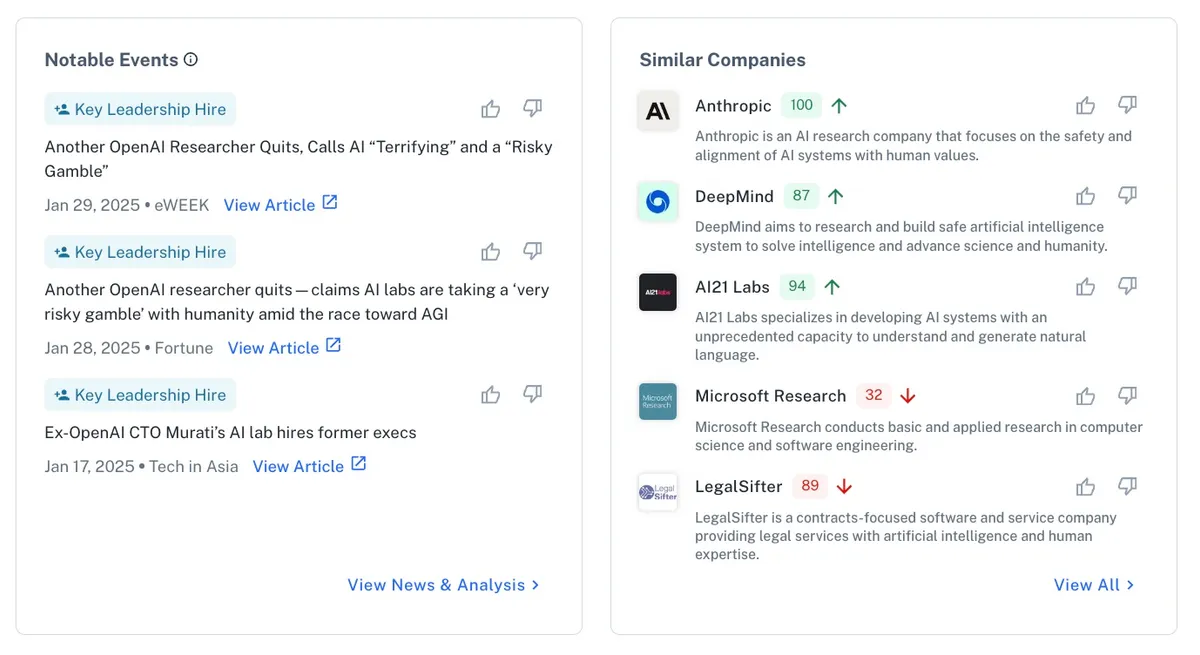
Crunchbase is a private company database and predictive intelligence platform to help you find and prioritise opportunities.
Source: Crunchbase
Its key features combine private company data with predictions:
- You can search across 4M+ private companies with full results, saved searches, lists, and notifications.
- Crunchbase generates and refreshes 15 million predictions weekly across funding, growth, acquisitions, IPOs, layoffs, closures, and companies likely to remain private. Its models correctly forecast 84% of real funding rounds, according to its published figures.
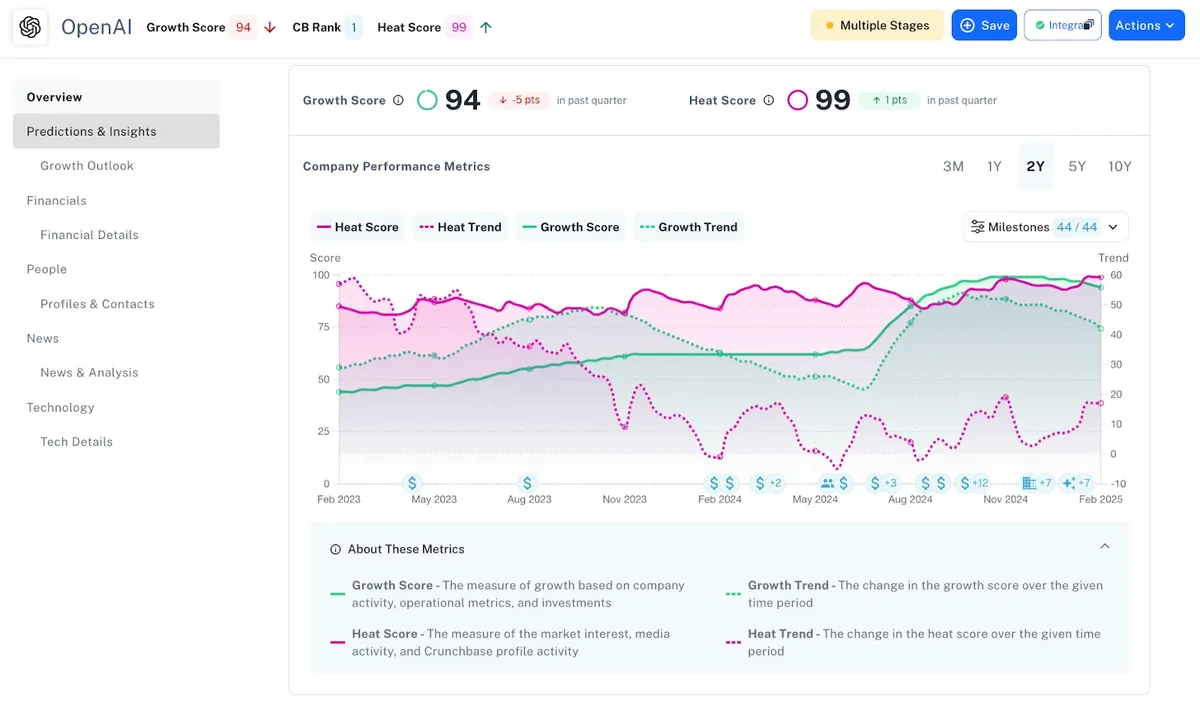
- It also offers growth and heat scores to help you assess a company's growth potential and market interest based on profile activity and media coverage.
Like Tracxn, Crunchbase is built on funding rounds and investor data and not on people movements like Harmonic and Specter.
Its distinguishing feature is its predictions of which companies may raise money, be acquired or go public.
Source: Crunchbase
These serve a similar purpose to Specter’s investor-interest signals, but these are forecasts rather than reports of observed activity.
However, small, local, and bootstrapped businesses may be harder to discover because Crunchbase's coverage may favour companies with more public information and investment activity.
Crunchbase offers three pricing models: Pro for individuals, Business for teams, and Custom Data Solutions for organizations.
The Pro plan starts at $49/month, while the Business plan starts at $199/month, both billed annually.
Custom Data Solutions pricing is available on request.
Conclusion
Just like Harmonic may not be the right fit for you, its alternatives each have their own strengths and limitations.
Your team needs data it can trust and a platform that fits its research process.
A firm hunting early-stage startups has different data needs from one looking for established private businesses or building its own company research system.
Assess your requirements and cross-check each tool against your list.
Shortlist two to three tools and run a small sample of known private companies, including a few outside the venture-funded world.
Compare which companies each platform finds and how current its records are.
Articles
Discuss how these trends affect your organization.
Our analysts are available for a short call. Bring a specific question and we will ground it in the data.
Insights
Keep reading
More analysis, research, and outcomes grounded in live company intelligence.
Key Differences Between Competitive and Market Intelligence
Discover the key distinctions between market and competitive intelligence - so you can apply the right approach in your strategy.
5 Trends Shaping the Future of Market Intelligence
Want to future-proof your business strategy? Explore the top trends defining the future of market intelligence.
How Market Intelligence Drives Smarter Business Decisions
Want to improve your decision-making process? This guide will show you how to leverage market intelligence for business growth.