Insights / Articles
How to Find Local B2B Suppliers in Romania Using AI Taxonomies
Procurement teams wondering how to find suppliers in Romania can use AI taxonomies to map regional hubs, score candidates and keep monitoring them.

- The biggest mistake in AI supplier discovery is starting with a keyword instead of a taxonomy.
- Romania's manufacturing strengths vary by region.
- A standardized taxonomy also makes supplier searches easier to automate across procurement teams.
- AI can now handle everything from supplier discovery to scoring, outreach, and continuous monitoring.
Searching for "Romanian furniture suppliers" sounds simple. At least until your search returns thousands of companies that manufacture everything from office desks to luxury hotel interiors.
That’s modern procurement teams’ challenge today, in a nutshell.
AI can accelerate supplier discovery, but only when it knows exactly what you’re looking for. This means you need a well-structured supplier taxonomy, or a language that translates your business requirements into searchable data.
That’s what this article is about.
Read on to learn how to build an AI-driven sourcing process that helps you identify, evaluate, and continuously monitor the right B2B suppliers across Romania.
1. Build an AI Supplier Taxonomy
One big mistake procurement teams tend to make is assuming AI can work magic from a vague request.
Take a prompt like "Find Romanian furniture manufacturers."
Even the best AI platform has to make countless assumptions. Are you looking for residential or commercial furniture? Upholstered or solid wood?
Without specific context, AI is forced to cast a very wide net.
That's why successful supplier discovery begins with a taxonomy.
As Oracle explains, a taxonomy is a structured classification system. It organizes information into logical categories.
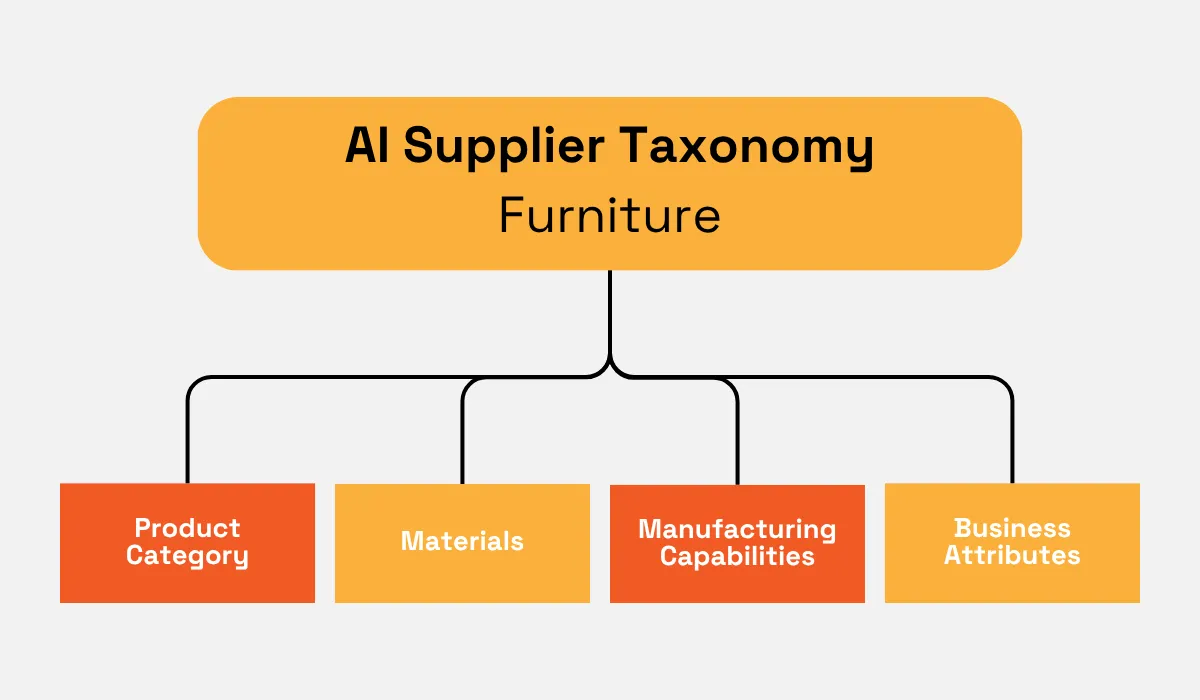
Here’s how that might look for a furniture supplier:
Source: Veridion
The goal is that both people and machines understand exactly how a particular industry is structured.
In procurement, this is the framework that helps AI interpret your sourcing requirements consistently, instead of treating every search as a brand-new question.
A taxonomy breaks your requirements into several searchable dimensions.
For example, you can define your ideal furniture supplier using these attributes:
- Product category (office furniture, hospitality furniture, kitchen cabinets)
- Materials (solid oak, MDF, recycled plastic, aluminum)
- Manufacturing capabilities (CNC machining, upholstery, powder coating)
- Certifications (ISO 9001, FSC, PEFC)
- Production capacity
- Export markets
- Factory location
- Company size
- Sustainability requirements
Each of these attributes gives AI another signal to work with.
A good taxonomy thus mirrors the way procurement teams actually think about sourcing decisions.
Seth Earley, Founder and CEO of Earley Information Science, sums this up beautifully:
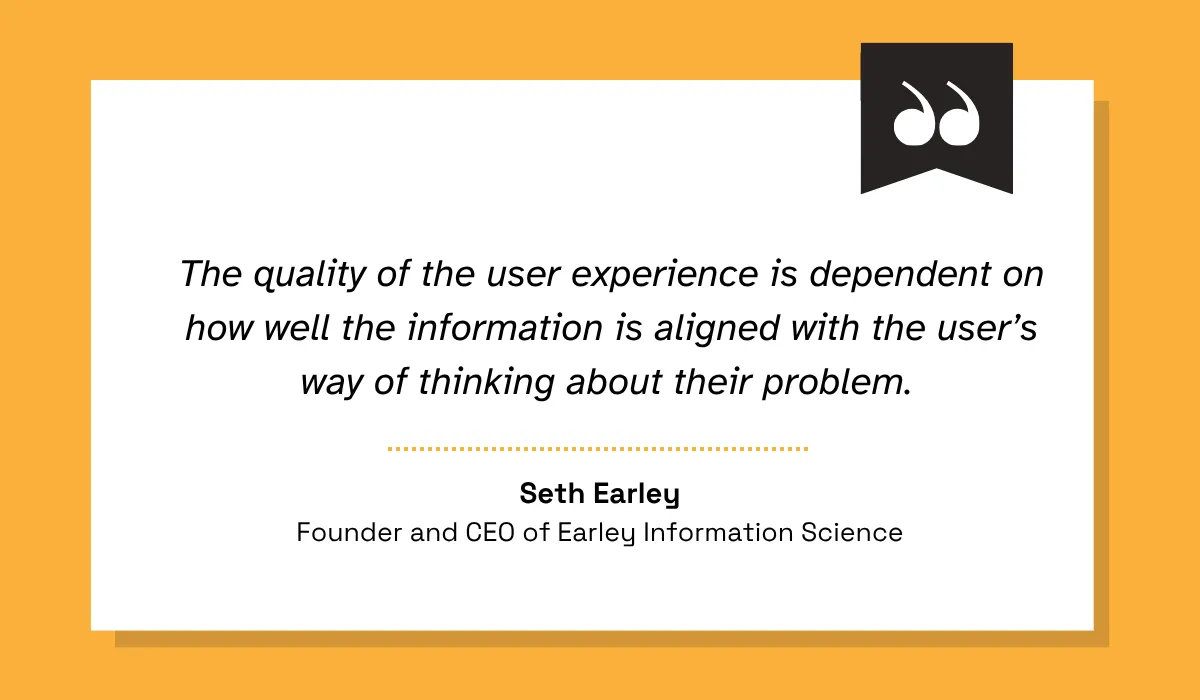
Illustration: Veridion / Quote: Seth Earley
When everyone works from the same structured framework, AI can interpret supplier requirements more consistently and at a much larger scale.
Without a shared taxonomy, two procurement managers can describe the same supplier in completely different ways. One can search for "plastic injection molding" and the other for "thermoplastic component manufacturer."
A standardized taxonomy maps both phrases to the same underlying capability. That makes supplier discovery consistent across teams.
Many organizations build these taxonomies on classification systems like the United Nations Standard Products and Services Code (UNSPSC). Then, they extend them with their own sourcing priorities.
Once you've established that common language, AI can move past simple keyword matching and start identifying suppliers based on your own business fit.
That’s the foundation for every step that follows.
2. Map Romania's Manufacturing Hubs
So you've defined what you're looking for. The next step is deciding where to look.
Manufacturing isn't spread evenly throughout Romania. It has actually developed into regional clusters.
What’s more, different parts of the country specialize in different industries, production capabilities, and supply chain networks.
It’s important to know those specific regional strengths before asking AI for help. It basically lets AI eliminate less relevant suppliers long before you begin evaluating individual companies.
Romania Insider makes a great point: 36 of Romania's 41 counties rank among Europe's most attractive regions for industrial investment. The country is one of Europe’s fastest-growing manufacturing hubs.
Manufacturing activity has also skyrocketed in recent years, accounting for over a third of industrial leasing demand during 2023–2024.
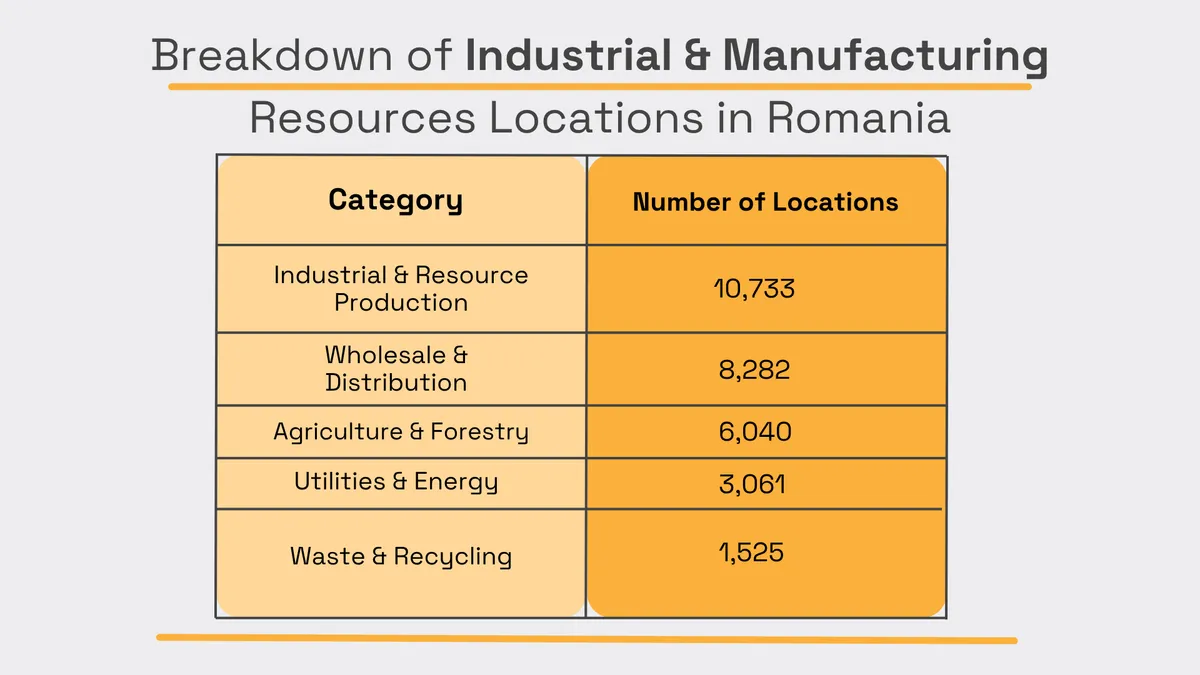
But geography alone isn't enough.
The real advantage comes from combining location with the taxonomy you built in the previous step.
Here's what that might look like in practice:
Industry you're sourcing | Romanian regions AI prioritizes | Why? |
|---|---|---|
Automotive components | Western Romania (Timișoara, Arad, Oradea) | Strong automotive manufacturing ecosystem and transport links |
Aerospace | Brașov | Long-established aerospace industry |
Furniture | Maramureș, Suceava, Harghita | Strong woodworking traditions and access to timber resources |
So geography is just one signal.
AI combines it with other supplier attributes, like:
- Manufacturing capabilities
- Certifications
- Production capacity
- Product specialization
The goal is to identify the businesses that are best suited to your sourcing needs.
The result isn't simply a shorter supplier list. It's a more relevant one. At the end of the day, it reduces manual research and improves matches.
3. Extract Supplier Intelligence with AI
Finding potential suppliers is only half the battle.
Then, the real challenge is determining if they're legitimate. And of course, if they’re right for your business.
Procurement teams have done this manually for a long time. They search Google, browse supplier directories, review company websites, check legal registries, and so on.
It's a slow and pretty daunting process. Plus, each source tells only part of the story, so it's easy to overlook vital details.
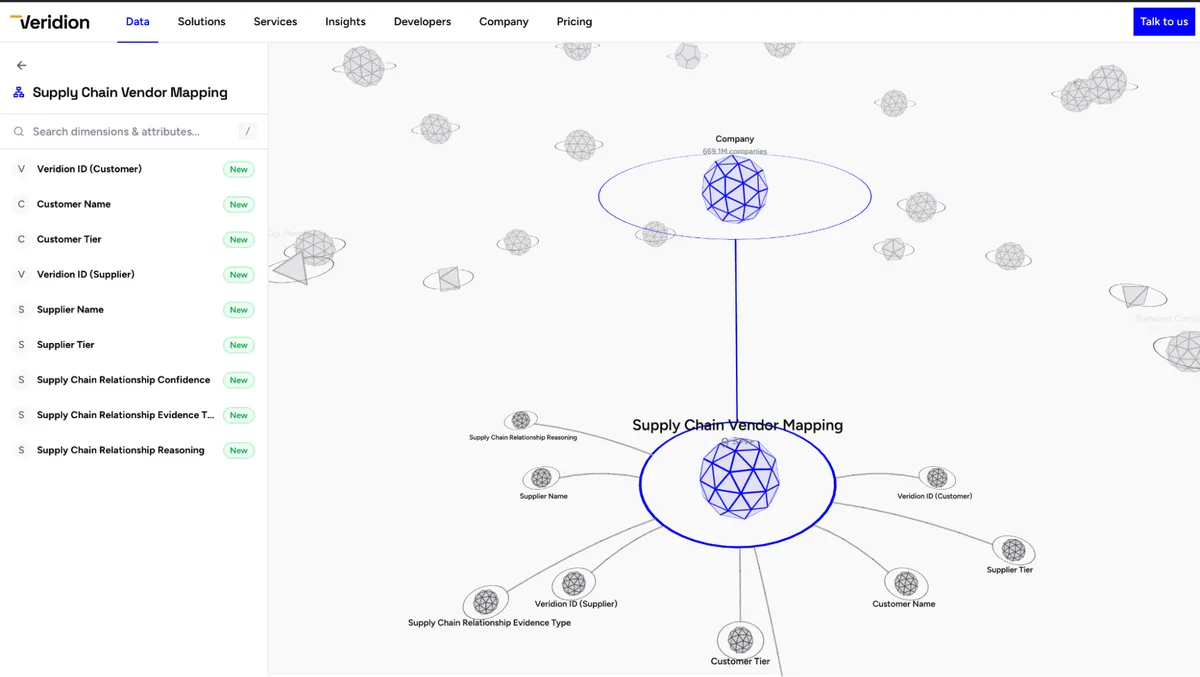
AI platforms like Veridion streamline that workflow.
Source: Veridion
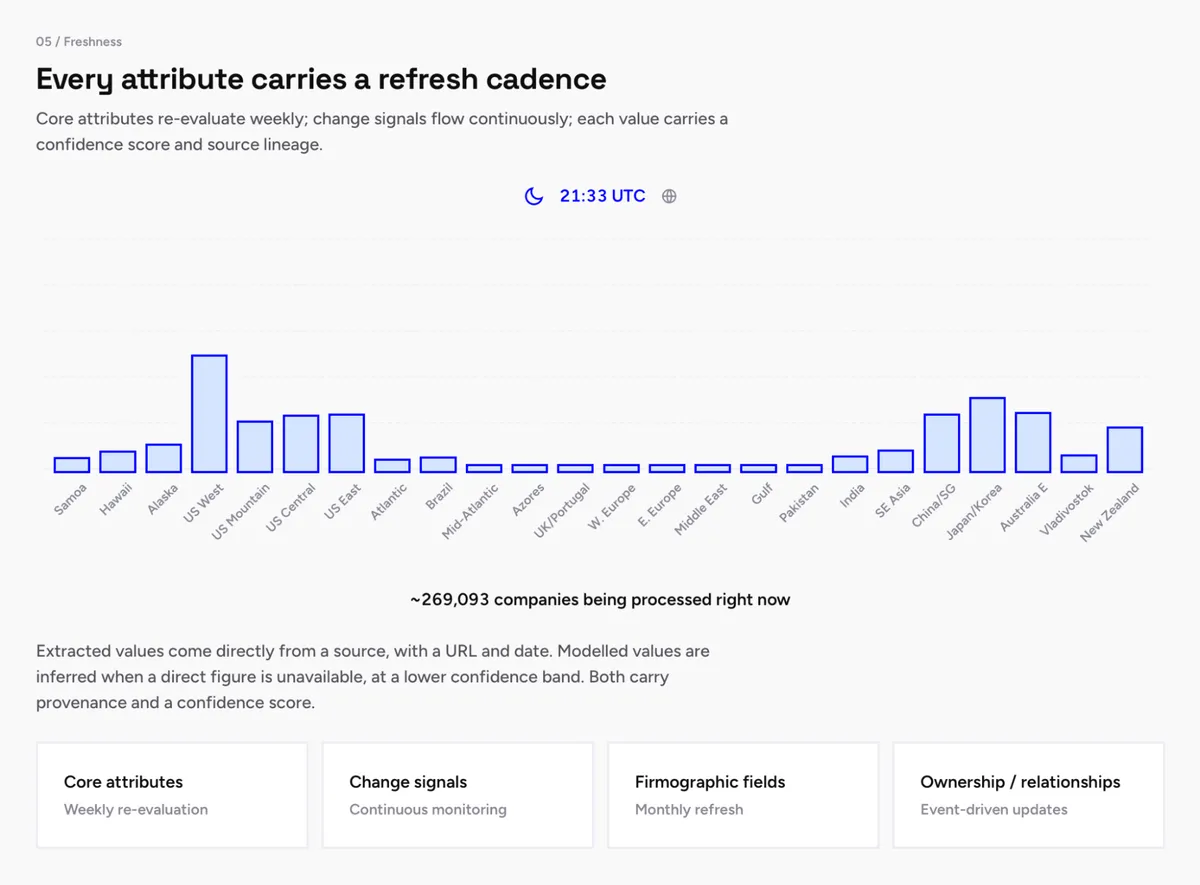
Veridion brings supplier intelligence into one continuously refreshed platform.
And every supplier attribute has its own refresh cadence:
Source: Veridion
So procurement teams always work with current information (rather than static records).
The supplier lifecycle follows three stages: discovery, verification, and continuous monitoring.
Let’s start with supplier discovery.
You can search suppliers by products, certifications, locations, manufacturing capabilities, and more.
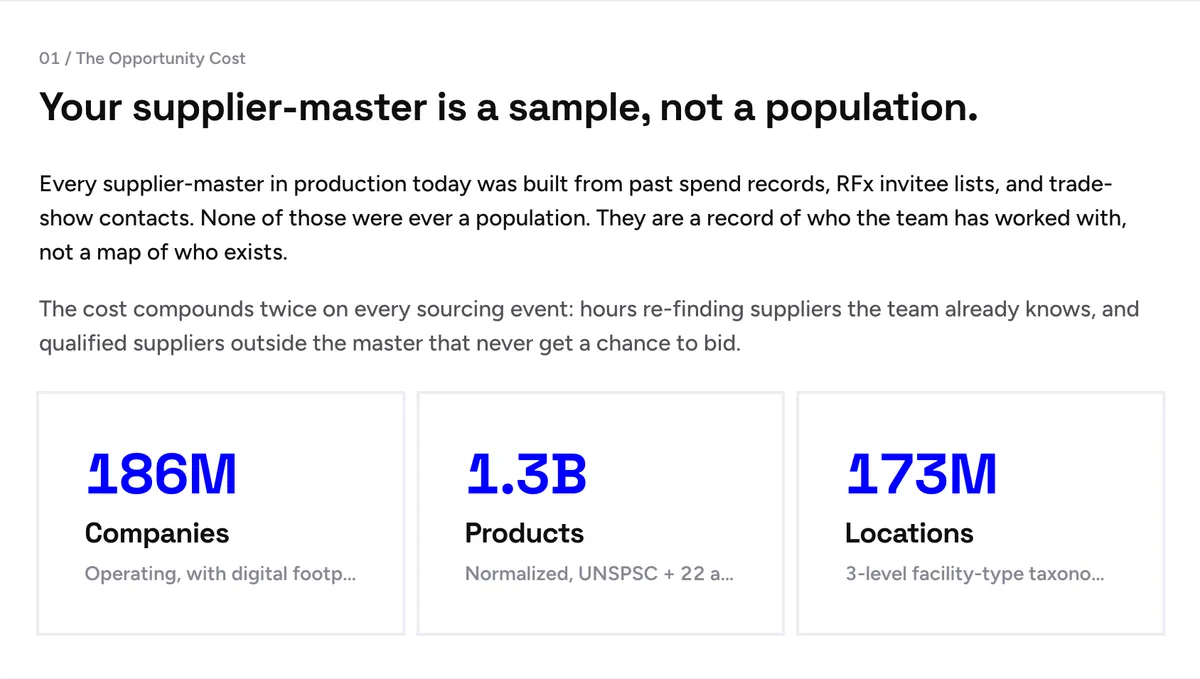
Behind the scenes, Veridion’s AI classifies 1.3+ billion products and services across 186 million operating companies.
Source: Veridion
So you can search by what a business actually produces, not just how it describes itself.
Next comes verification.
Company data is notoriously fragmented. The same supplier may appear under different legal names, subsidiaries, abbreviations, or outdated addresses across multiple databases.
Veridion uses entity resolution to connect those records into a single, verified company profile. It combines legal registry data with digital signals like:
- Websites
- Products
- Locations
- Ownership structures
The result is cleaner supplier data with fewer duplicates and false matches.
The job doesn't end once you've selected your supplier, either.
Companies evolve constantly. They earn new certifications, expand operations, change ownership, or run into financial, regulatory, or operational issues.
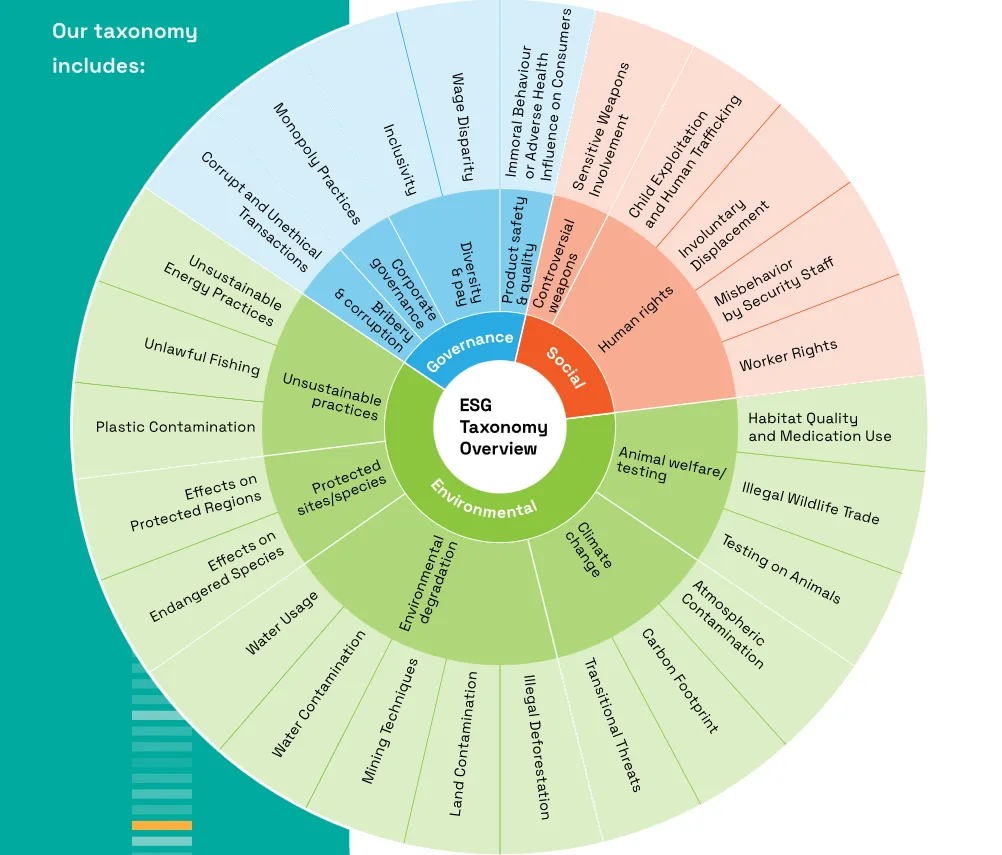
Veridion continuously refreshes company profiles and flags meaningful changes, from ESG issues and sanctions exposure to ownership updates and financial distress.
That lets your procurement teams investigate risks before they disrupt the supply chain.
Source: Veridion
Together, these features turn supplier sourcing into a continuous intelligence process.
That saves you hours of manually searching and monitoring suppliers. Your procurement teams get a single, up-to-date view. In turn, that leads to faster and smarter sourcing decisions.
4. Create AI Supplier Scoring
At this point, you've got a shortlist of potential suppliers.
Now comes the big question: Which one is the best fit?
The answer hinges on your priorities.
Maybe your company is prioritizing cost at the moment. Perhaps you’re focusing on sustainability, production capacity, delivery reliability, or regulatory compliance. The list goes on.
AI supplier scoring ranks suppliers according to the criteria that matter most to your business.
A simplified scoring model might look something like this:
AI SUPPLIER SCORING MODEL | |
|---|---|
Manufacturing capability | 95 |
Quality certifications | 90 |
Production capacity | 93 |
Financial health | 82 |
Distribution proximity | 88 |
↓ | |
Overall Supplier Score | 91 / 100 |
Let’s say you're sourcing precision-machined components from Romania. You’ll probably prioritize manufacturing capability, quality certifications, production capacity, financial health, and proximity to your distribution center.
AI evaluates every supplier against those weighted criteria and delivers a ranked shortlist tailored to your sourcing strategy.
This makes procurement decisions easier to justify, too.
Buyers can point to measurable business attributes that explain exactly why one supplier ranked above another.
AI can also help interpret your supplier info once the scoring is done.
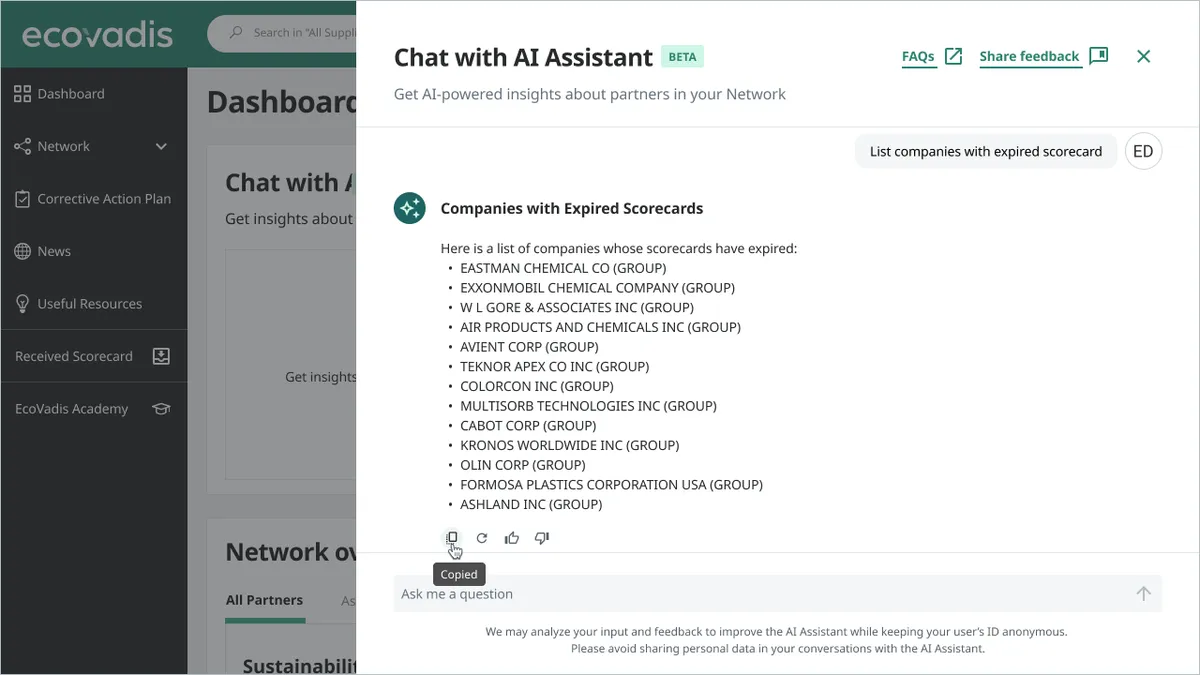
For example, EcoVadis' AI Assistant offers several features designed to simplify supplier analysis.
Source: EcoVadis
Among its features:
- Summarizing supplier scorecards
- Highlighting strengths and weaknesses
- Identifying opportunities for improvement
And all that, without requiring procurement teams to review lengthy reports themselves.
However, it’s time to note something important. AI doesn't replace procurement professionals. It just gives them a stronger starting point.
So instead of evaluating hundreds of suppliers manually, your team can focus on the handful that match your priorities.
5. Initiate Autonomous Outreach
So you've identified your highest-ranked suppliers. Great!
But there's still one major bottleneck left: making first contact.
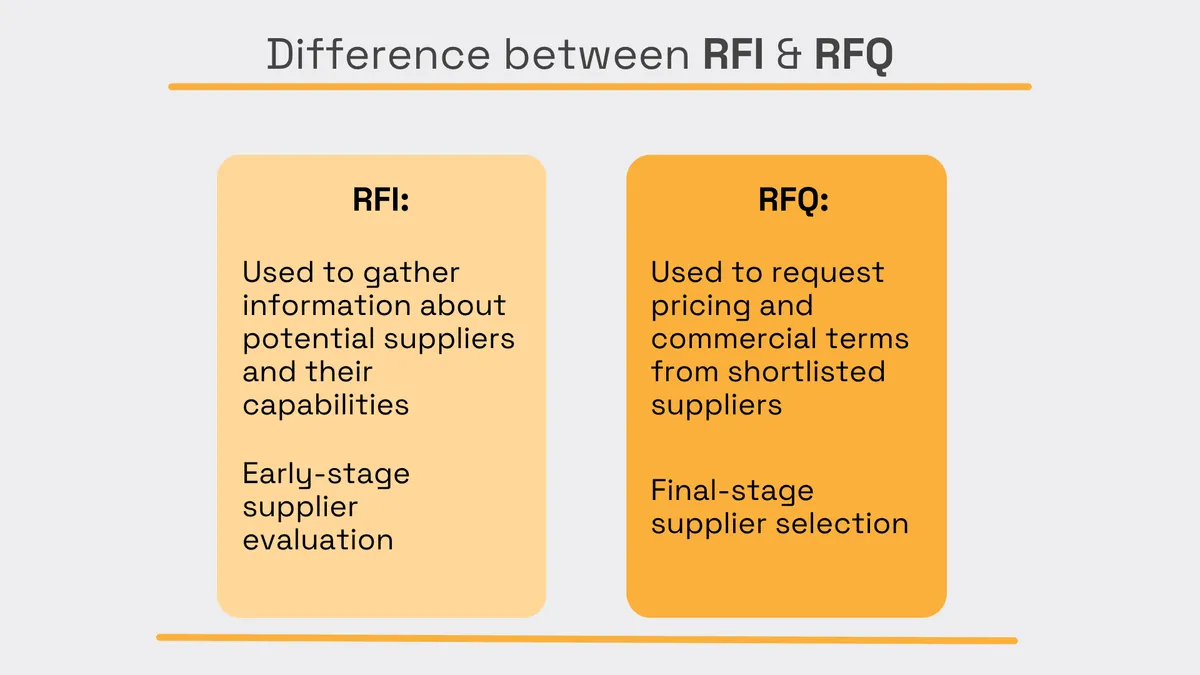
That can be anything from preparing outreach emails to drafting Request for Information (RFI) documents, issuing Requests for Quotation (RFQs), answering supplier questions, and following up with non-responders. This can become a full-time job for procurement teams.
This is where autonomous sourcing comes in.
As procurement company Zycus explains, one of the defining characteristics of autonomous procurement is that AI agents execute routine sourcing workflows.
Meanwhile, it leaves decisions like approvals and negotiations to people.
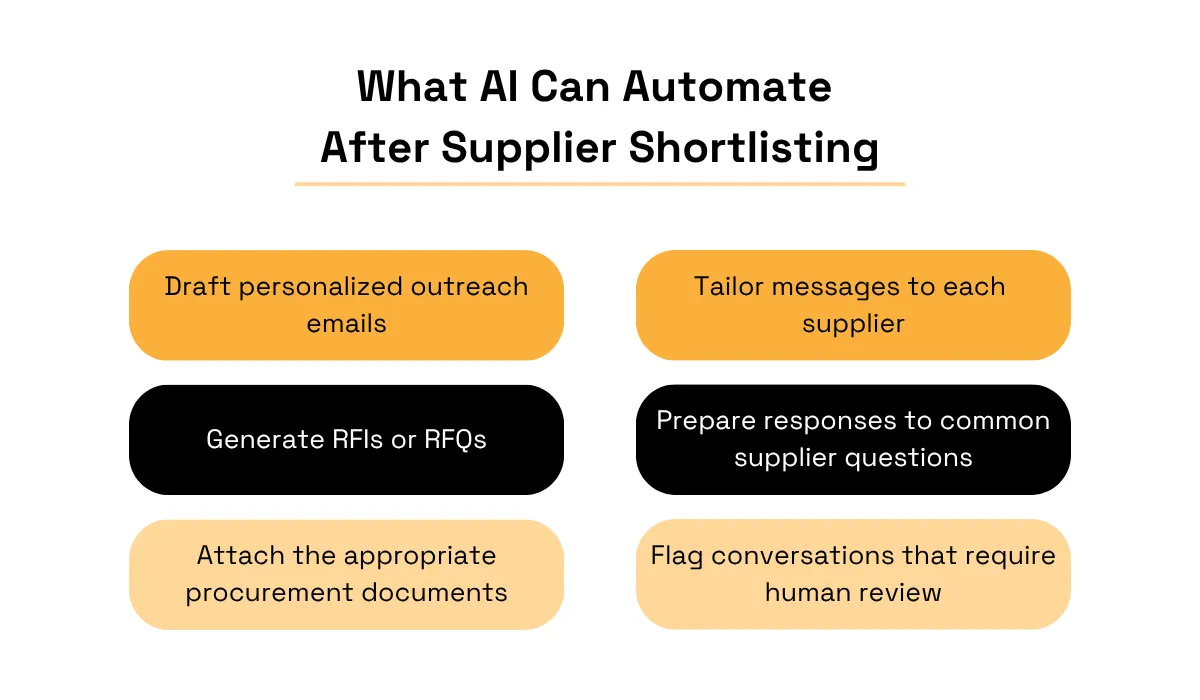
AI can draft personalized outreach based on the sourcing criteria you've already defined, including:
- Product specifications
- Certifications
- Production volumes
- Delivery timelines
Before diving in, it's worth distinguishing the two most common procurement documents:
Source: Veridion
Here’s a practical example.
Say you’ve already selected ten Romanian suppliers. AI can automatically:
Source: Veridion
Contract negotiations, pricing discussions, supplier visits, and long-term partnerships still require human judgment and relationship building.
AI handles the repetitive administrative work so you can focus on the conversations that create the most value.
6. Build an AI Supplier Monitoring System
Finding the right supplier may feel like the finish line but, in reality, it's just the beginning of a relationship: a relationship with a changing partner.
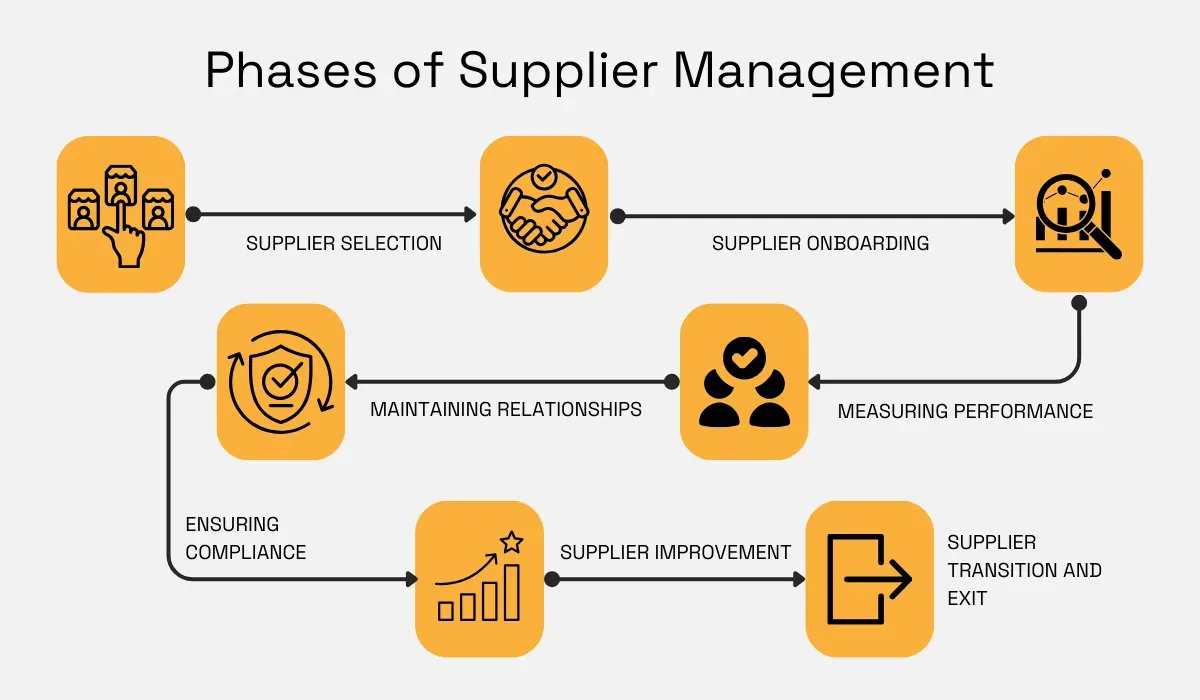
In fact, supplier discovery is just the first phase of supplier management. Organizations also need to qualify, onboard, collaborate with, monitor, and continuously evaluate their suppliers over time.
Source: Veridion
This ongoing approach has become increasingly important as markets continue to evolve.
That's why leading procurement teams are moving from one-time supplier discovery to continuous supplier monitoring.
It's also becoming standard practice. According to the 2024 State of Flux survey, 92% of business leaders already have a well-defined supplier management strategy.
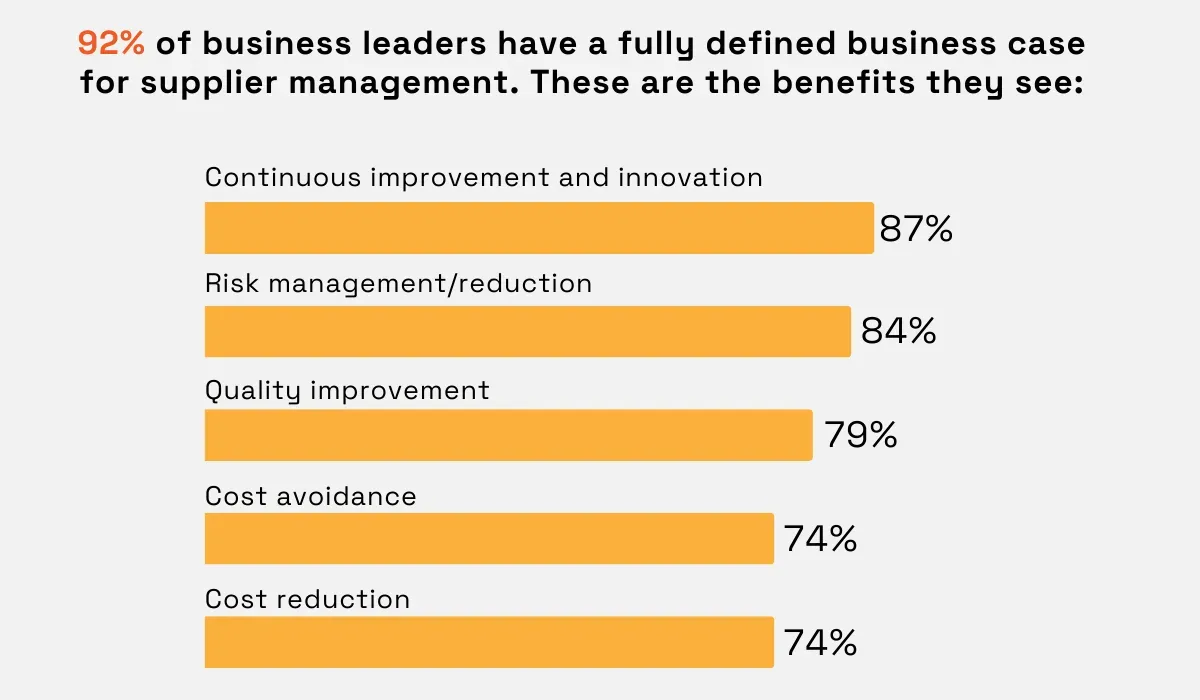
Illustration: Veridion / Data: State of Flux
The reason: suppliers don’t stay the same for long right now.
Suppliers can expand into new product categories, open manufacturing facilities, earn certifications, change ownership, or experience financial and operational challenges.
Meanwhile, lots of new suppliers enter the market each year.
So if your supplier database only reflects the day you signed the contract, it becomes outdated almost overnight.
With AI, though, you don’t have to keep restarting the sourcing process. AI continuously scans for new information that could affect your supplier ecosystem.
That includes changes to existing suppliers as well as opportunities to discover entirely new ones.
For example, AI can automatically monitor:
- Newly established manufacturers that match your sourcing criteria
- Companies exhibiting at industry trade shows
- New product launches and manufacturing capabilities
- Company websites and digital footprints
- Industry news and press releases
- Regulatory filings and certifications
- ESG developments and sanctions lists
- Ownership and leadership changes
That turns supplier management from a reactive process into a proactive one.
Instead of waiting for annual supplier reviews, procurement teams can spot new opportunities and investigate potential risks before they actually impact your business.
In the long run, continuous monitoring in supplier discovery gives you a competitive advantage.
You’re not asking "Who are the best suppliers today?"
You're continually answering: "Who's becoming the best supplier tomorrow?"
Conclusion
Finding local B2B suppliers in Romania is all about building a smarter sourcing process.
By combining AI taxonomies, regional manufacturing insights, supplier intelligence, scoring, autonomous outreach, and continuous monitoring, you can spend less time searching and more time building solid supplier relationships that will stand the test of time.
Now it's your turn.
Start small, refine your process as you go, and let AI handle the heavy lifting while your team focuses on making the best procurement decisions.
Articles
Discuss how these trends affect your organization.
Our analysts are available for a short call. Bring a specific question and we will ground it in the data.
Insights
Keep reading
More analysis, research, and outcomes grounded in live company intelligence.
Best Practices for Leveraging Market Intelligence
Not sure how to apply market intelligence effectively? Learn which practices top businesses rely on and how you can too.
9 Essential Sources of Market Intelligence
Want to boost your market knowledge? These 9 market intelligence sources will show you where to look and how to apply the insights.
How to Build a Strong Market Intelligence Strategy
Learn how to build a strong market intelligence strategy that helps you track trends, understand competitors, and make smarter decisions.