Insights / Articles
How To Build Proprietary Deal Flow With Live Company Data
Every teaser in your inbox has already reached the other buyers. Set up proprietary deal sourcing in six steps, from thesis signals to tests on past deals.

- Signals work best when each one traces to a line of the investment thesis.
- Continuously refreshed data, like Veridion's, lets you watch a whole thesis universe for signals.
- Testing signals on past deals shows which ones find companies worth a conversation.
The banker's teaser in your inbox has also reached every other buyer on the list.
Proprietary deal sourcing is how a private equity (PE) team reaches companies before that teaser exists.
You turn your thesis into signals, watch them in live company data, and review a company before any sale process starts.
The data shows what changed, and your team decides what it means.
These six steps show how to build it.
1. Define What Counts as Pre-Broker Discovery
Proprietary deal flow means reaching a company before a sale process has formed around it, so your first conversation happens without rival bidders in the room.
Firms typically apply "proprietary" to deals with no auction, a short exclusive window, or simply a head start over other buyers.
Two neighboring labels sit alongside it:
"Off-market" describes a company that is not being marketed to buyers at all. Off-market deal sourcing is the work of finding those companies before anyone markets them.
"Semi-proprietary" describes a limited process, where a handful of invited buyers compete, or one buyer holds a short exclusive window.
No standard definition exists for any of these, so write down what each one means inside your firm, using the stages of a sale process as markers.
A typical sale process runs like this:
- An owner picks an adviser and signs an engagement letter.
- The adviser prepares a teaser and a confidential information memorandum, then builds a buyer list.
- Outreach follows under non-disclosure agreements, and interested buyers submit non-binding indications of interest.
- Shortlisted buyers then attend management presentations and enter a data room, and the last stage is the second-round bids and exclusivity.
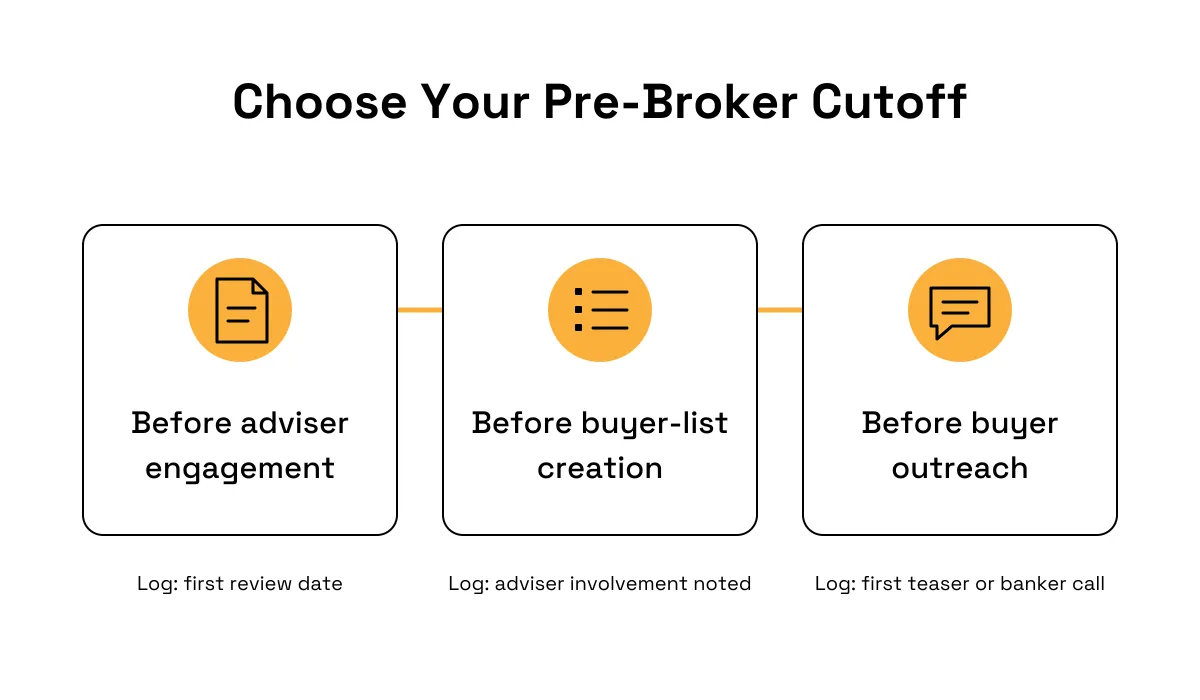
Each stage can serve as a marker for where "early" ends.
Source: Veridion
The earlier the marker, the harder it is to observe, because no company dataset shows when an owner signs an engagement letter with an adviser.
Most teams settle on the third marker as the working line and track the other two as a measure of how early they got.
Whichever you choose, one sentence in your sourcing playbook should state it.
A head of origination usually proposes it and the investment committee approves it, because it also decides which deals your firm labels proprietary when it reports on its private equity deal origination.
2. Turn Your Thesis Into Observable Signals
A thesis signal is an observable change in a company that bears on one line of your investment thesis.
A new location in a target state counts if your thesis is about regional coverage. The same location means little if your thesis is about product depth.
A standard list of triggers, such as revenue growth or new hires, returns the same names to every firm that uses it, so start from the thesis and ask what a good target must be.
Take a thesis for founder-owned commercial HVAC and refrigeration service companies in the US Southeast, with a handful of locations, that a platform could consolidate.
Four conditions come from this. The company sits in your size range, operates in your target states, sells the service mix you want, and still stands outside a larger group.
Each condition becomes one signal. The table below sets out what to watch, over what window, and which data field shows it.
What changed | Time window | Data field that shows it | Observed or estimated | What it suggests |
|---|---|---|---|---|
Headcount moved into your target size band | Rolling 12 months | Employee count trajectory | Depends on the record: check whether the value is extracted or modeled | A reason to review whether the company now fits your size range |
New location opened in a target state | Last 6 to 12 months | Location records, verified open | Observed | A reason to review the company's expansion in your target region |
New service line added | Last 12 months | Products and services read from the company website, with a confidence score | Observed | A reason to review whether its service mix is moving toward your thesis |
Change in ultimate parent or majority group | Since the last review | Corporate group hierarchy | Observed | A reason to review whether the company still belongs in your universe |
Every row ends in a reason to review a company, never a reading of what its owner intends.
These four rows are company-level signals, which describe one business at a time.
The table is a starting point to adapt.
You can add hiring in a function your thesis cares about, such as technicians for a service business.
That one depends on your data source: if it reports only total headcount, function-level hiring becomes a question for a person.
Leadership changes, such as a new CEO or CFO, and funding events can also count as triggers. Check whether your data source covers them, and if it doesn't, a person has to confirm them.
Market-level signals describe the sector around those companies. Competitor activity is the clearest case.
When a rival platform completes an acquisition in one of your target states, the companies near that deal deserve a second look.
New entrants show where the sector is adding capacity, and a rising share of declining operators shows where it is thinning.
Qualitative sources cover what data leaves out. Expert calls with former employees, customers and competitors fill those gaps.
A 2025 working paper by researchers at Harvard Business School and Indiana University's Kelley School of Business, based on call transcripts from one large expert network, found that calls about a private company build up two to three months before a deal, with customer calls the most closely linked.
Most of those deals were venture rounds, and the link was weaker for buyouts.
The practical point is the order: data finds a company worth reviewing, and expert calls test what the data cannot see.
Tracking all of this across a whole universe by hand takes more time than you have, which is where continuously refreshed company data helps.
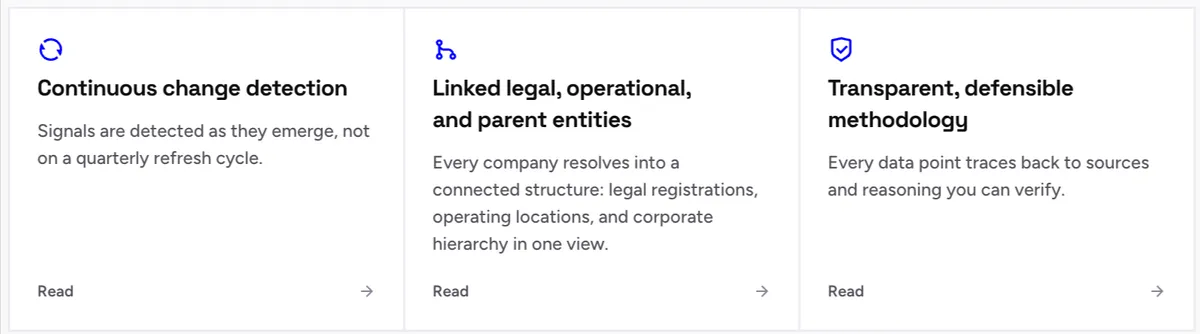
Veridion refreshes 744.5M company profiles continuously and includes corporate hierarchy and location-level data.
Source: Veridion
Veridion's private equity page describes change flags on location, ownership, products, certifications and operational signals, delivered as a continuously refreshed batch feed.
For a closer look at how a footprint gets verified, see Veridion's guide to verifying a company's operational footprint.
Veridion's sector view groups a thesis universe by signal trend, so a reviewer can see which operators are rising, stable, declining or dormant without rerunning the full screen.
Before moving on, rewrite your thesis as a short set of conditions and give each one a field and a window. Any condition without a field goes to a person.
3. Build a Proprietary Deal Sourcing Universe From Structured Filters
Build your universe broad first and let signals narrow it.
A narrow list only works if you know in advance which owners are ready to talk, and you rarely do. A wide universe raises the chance that the right company is already on your list when something about it changes.
Sutton Place Strategies (SPS), a provider of private equity deal data, benchmarked 177 of its private equity clients across eight peer groups. For deals closed in the 12 months to June 30, 2025, the median firm had reviewed 18.4% of the advisor-led deals in its target market.
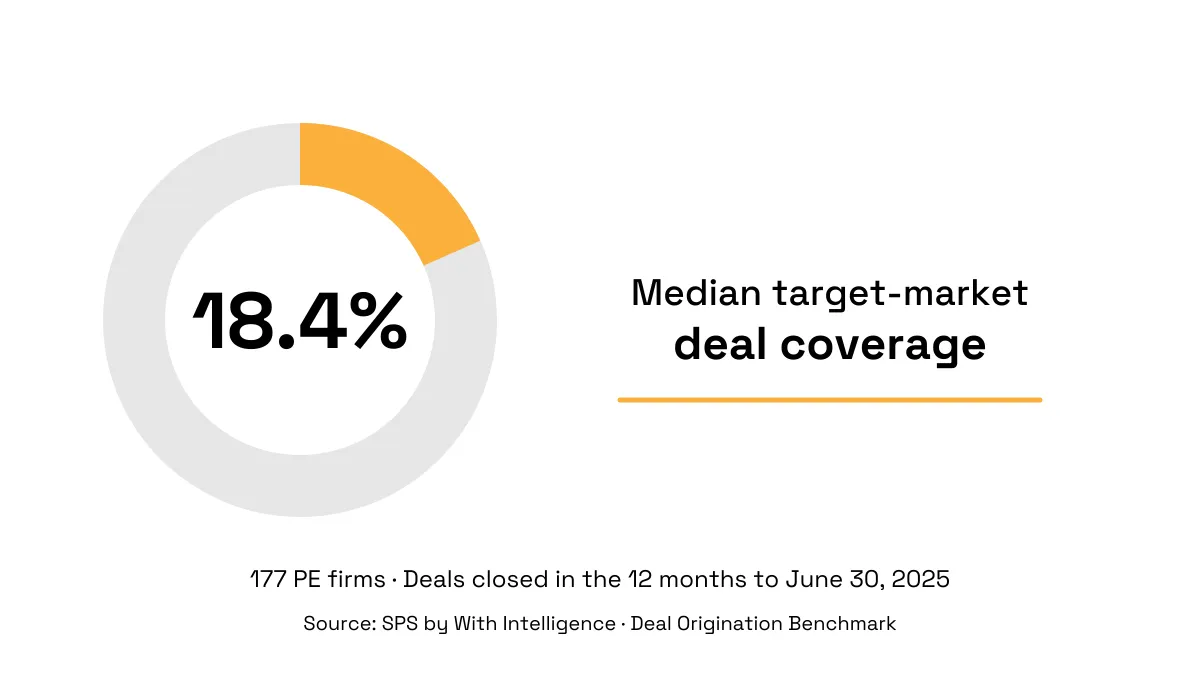
Illustration: Veridion / Data: Sutton Place Strategies by With Intelligence
Even among banker-run deals in its own target market, the typical firm reviewed fewer than one in five.
A list pulled from a deal database, or a banker's buyer list, hands you the same names every other firm has, so reaching a company first turns into a race to the same phone call.
Five filter types decide who belongs in the universe:
- Activity
- Products/services
- Size
- Geography
- Ownership type
Once the universe exists, tag what you already know about each company before signals begin to fire. You can use three tags for this.
The first tag marks companies in a process.
Company data won't show that an owner has hired an adviser or that a colleague has heard about a process, so this tag comes from your team. This tag also marks where the pre-broker line from the first step has been crossed.
The second tag marks companies that recently transacted. Set a lookback window your partners agree on, and tag any company whose ownership changed inside it.
The third tag marks companies your firm already covers. It keeps outreach from duplicating a conversation a colleague started last year.
Tagged companies stay in the universe, because a recently transacted company can become relevant again.
4. Set Refresh Logic for Each Signal
Refresh logic is four written answers for every signal: how often the data refreshes, what the current value is compared against, how large a change counts, and how long a change has to hold before a person looks at it.
Without those answers, two reviewers looking at the same company will disagree about whether anything happened.
Start with the refresh frequency, because it sets the ceiling for everything else. Checking more often returns the same result, and checking less often leaves changes unread.
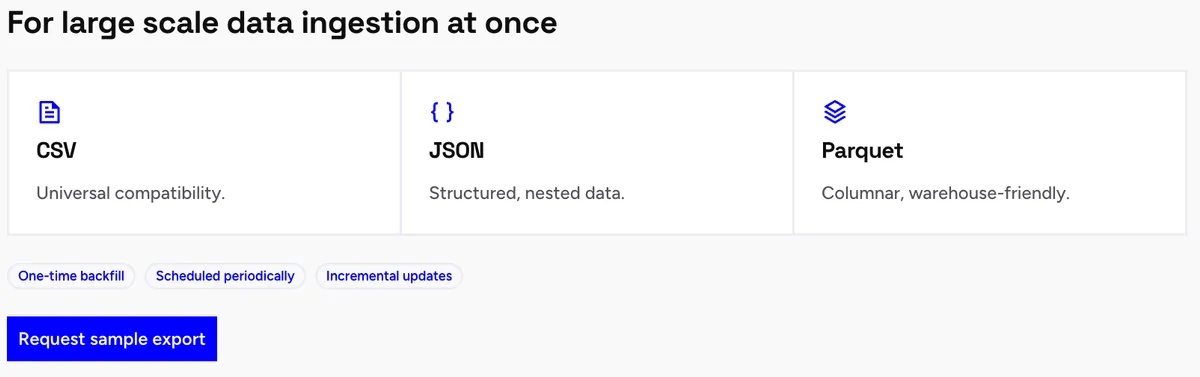
Providers also refresh different fields at different speeds. Veridion, for example, publishes a refresh cadence by attribute type: core attributes are re-evaluated weekly, firmographic fields monthly, and ownership changes update as events happen.
Veridion delivers data through APIs, batch files or a data warehouse, and batch delivery can run as scheduled incremental updates, so new changes reach your queue between your own review cycles.
Source: Veridion
When you evaluate any provider, check how often each field refreshes and what triggers an update, whether a scheduled crawl, a live signal or a manual review.
Veridion's guide to data enrichment best practices explains why those answers matter.
Next, decide what the current value is compared against. The right baseline depends on the signal.
The last review shows what changed since your team last looked, which suits a count such as locations.
A rolling baseline, such as the previous 12 months, shows direction and suits headcount, while a fixed line, such as the edge of your size band, shows whether a company has crossed into your range.
Then set how large a change has to be. Write the threshold in the units your thesis already uses.
A threshold set too low fills the queue with companies that did not change in any way that matters. One set too high hides the early movers you want to find.
A practical test is to ask what change would make a partner agree the company deserves a look, and write that down as the number.
After that, match the rule to the signal's speed: a fast signal can hold for one refresh, while a monthly signal needs two, which delays the alert by about a month and is worth accepting for fewer false alarms.
New locations and ownership events move quickly, so review them weekly. Headcount band and service mix move slowly, so review them monthly.
Keep review cadence separate from data refresh.
Each quarter, check every threshold against what reviewers did with past alerts.
One more rule sits across all signals: how smaller changes combine. A single weak change, such as a refreshed website, rarely justifies a review on its own. Two or three independent changes in the same window, such as a new location, rising headcount and a new service line, make a stronger case. Write the rule down, for example one strong signal or two weak ones within 90 days, and record which signals fired so the reviewer sees why.
Whatever the cadence, keep a record of every value you see. Without dates and prior values, you cannot show a partner what changed and when.
Veridion returns a source URL, a last-verified timestamp and a confidence score with each value.
Your own log adds the rest: the previous value, the date your team first saw the change, and the signal it fed.
With the logic written down, each change that clears your bar becomes an alert. Before moving on, pick one signal and write its four answers in a single line.
5. Route Detected Changes to the Deal Team for Review
A detected change is where the data job ends and the deal team's job begins. The change tells you where to look, but not whether the company deserves a conversation, and it never makes first contact. Between detection and outreach sits a review: someone reads the alert, decides what it means for the thesis, and chooses what happens next. That person can weigh what the data does not hold, such as a prior conversation, a colleague's read on the founder, or how the sector is moving.
An alert earns this attention only if the reviewer can judge it quickly. Each alert should show what changed and when, the source and confidence behind the value, which line of the thesis it relates to, and the company's group position and ownership.
Write every alert in the language of observation.
"Opened a second location in Georgia" describes a change. "Expanding and may be ready to sell" claims knowledge the data does not have.
The first wording keeps the reviewer thinking, and the second invites them to stop.
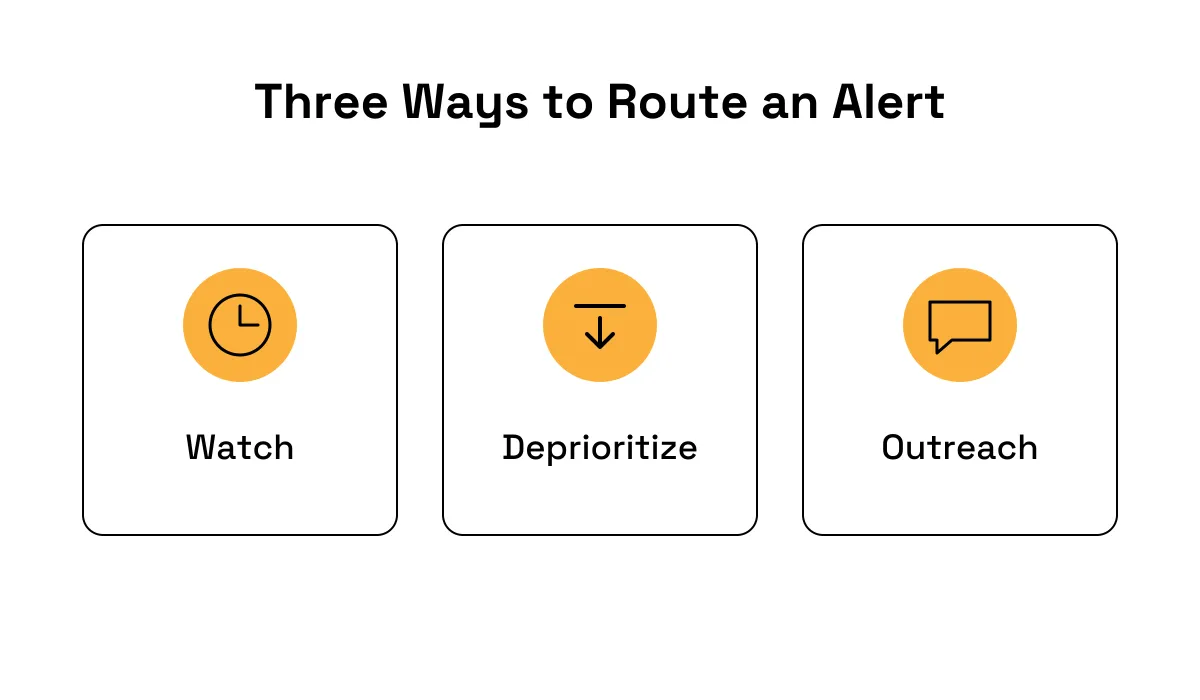
Three outcomes cover every case:
Source: Veridion
Watch keeps the company in the queue with a date to look again. Deprioritize closes the alert with a logged reason.
Decide in advance who owns each choice.
A reasonable split lets the first reviewer, usually an associate or analyst, choose between watch and deprioritize.
Moving a company to outreach then needs sign-off from the person who owns the thesis, such as the VP or principal.
Writing the split down prevents two people from making different calls on the same alert.
As the universe grows, so does the volume of alerts, and a queue that is too long hides good targets.
Group alerts by company, so a firm with three changes in a month appears once, with all three listed, and not three times.
Order the queue by how many independent signals fired, using the combination rule from step 4.
Then, protect against misses.
Each quarter, pull a small sample of deprioritized alerts and have a second person review them.
If the sample turns up companies that deserved a conversation, the threshold or the reasons for deprioritizing need adjusting.
Every outcome you log is also evidence about your signals.
Before moving on, write the three outcomes and the name of the person who owns each decision into your sourcing playbook.
6. Test Your Signals Against Past Deals
A signal earns its place in your queue by showing it would have put the right companies in front of your team.
Take companies your firm cared about in the past, ask whether the signal would have flagged them, and use only what anyone could have known at the time.
Pick past targets from three groups:
- Deals you closed
- Deals you looked at and passed on
- Public transactions in your thesis sector
For each one, write down the date you would have reviewed it, which should fall before any sale process begins.
Then allow only information that existed on that date.
A company's profile today fails this test, because it carries everything that has happened since, including the sale itself.
That mistake is called look-ahead bias, and it inflates every result it touches.
Rebuilding what was knowable takes dated sources: filings, registry records and press releases.
The Internet Archive's Wayback Machine keeps dated copies of company websites, and its Availability API returns the capture closest to a date you choose.
Check whether your data source can show a value as it stood on a past date. If it cannot, rely on dated sources and your own alert log.
When history is thin, run the test forward instead: log every alert from today and judge the signals once enough outcomes build up.
The mistake that most often flatters this test is counting only the deals that closed.
Companies that already have a known outcome are not a random sample, because some outcomes, such as failures or quick sales, resolve faster than others, so a result built only on resolved cases can look better than it is.
Your signals are not meant to predict a sale.
A company with no known outcome is not a miss, so keep it in the test as "still open."
Keep a log of every alert you review, because it is the evidence the test runs on.
Record the alert date, the signals that fired, the reviewer, the outcome (watch, deprioritize or outreach), the reason, and what happened later.
A log in this shape lets you score each signal on one question: how often did its alerts end in a company the reviewer judged worth a conversation? Compare that rate with the quarterly sample of deprioritized alerts from the previous step.
Use the same log to refine thresholds.
Set a threshold on some of your past deals and test it on others, and avoid adjusting it after every new deal.
Finally, you will probably have a small number of past deals to test on, so avoid overstating what they show.
Report counts and ranges, not single percentages.
For illustration, a signal that flagged four of twenty past targets did not catch exactly 20% of them in any reliable sense.
A 95% Wilson interval puts the plausible range at roughly 8% to 42%.
A widely cited 2001 review in Statistical Science recommends the Wilson interval for small samples, because the textbook formula behaves erratically when counts are low, and common statistics tools can calculate it.
Treat a small-sample result as a reason to keep logging, not as a verdict.
Conclusion
Live company data earns its place in proprietary deal sourcing by widening what your team sees and by dating every change it spots.
It cannot show whether an owner wants to sell, and it cannot make the first call. Those stay with your people.
This week, pick one thesis and write four of its conditions as signals, each with a field, a window and a threshold.
Then check which of them would have found five past targets before any sale process began.
Articles
Discuss how these trends affect your organization.
Our analysts are available for a short call. Bring a specific question and we will ground it in the data.
Insights
Keep reading
More analysis, research, and outcomes grounded in live company intelligence.
How to Verify a Company’s Operational Footprint in Private Equity Due Diligence
We break down the process of surfacing and validating every location and activity that keeps a business running for PE due diligence.
Best Practices for Data Enrichment
Learn how data enrichment best practices help businesses turn raw data into accurate and actionable insights.
How Is AI Revolutionizing Market Intelligence?
Explore the key ways AI is transforming market intelligence workflows and helping businesses stay ahead of the competition.