Insights / Articles
Who Owns Your Company Data? A Framework for Firmographic Data Governance in RevOps
Who truly owns your company data? Understand firmographic data providers and establish robust data governance for RevOps success.

- Data quality fails when everyone assumes someone else owns it.
- RACI turns vague blame into four clear roles: Responsible, Accountable, Consulted, Informed.
- Automated, continuously refreshed data cuts governance overhead without sacrificing accuracy.
- Forecast accuracy can go to over 90% when specific fields have real owners.
Your CRM contains thousands of company records, but it may be unclear who owns the fields and processes that keep them accurate.
Marketing expects Sales to correct errors, while Sales assumes Operations has already handled them.
That gap is where forecasts break, campaigns misfire, and deals stall.
The problem is a lack of visibility into who does the work, who approves it, and who needs to be consulted before something changes.
RACI (Responsible, Accountable, Consulted, and Informed) helps clarify those roles.
Today you'll learn how to fill any ownership vacuum using RACI so you can keep your company data clean and trusted.
Let's get started.
The Ownership Vacuum: Why Nobody Actually Owns the Data
The interesting thing about firmographic data quality is that everybody works with it, but nobody knows who owns it.
Pipeline stages have a clear owner because a deal must move forward for someone to get paid, but data quality has no such forcing function.
Data quality often crosses functions: Marketing defines and captures lead source, Sales corrects account details, and Finance relies on the resulting records for reporting.
When definitions and ownership are unclear, each team can reasonably assume another team is responsible for fixing an error.
If your organization has a similar structure, you've likely seen the consequences.
Maybe your ICP scoring was negatively affected by an outdated headcount field, or credit was split between two accounts because of duplicates, and no one was responsible for catching it.
RevBlack reports that, across dozens of HubSpot and Salesforce audits, some clients improved forecast accuracy from roughly 60% to more than 90% after assigning owners to revenue-critical fields.
Treat this as a vendor-reported observation rather than a general benchmark.
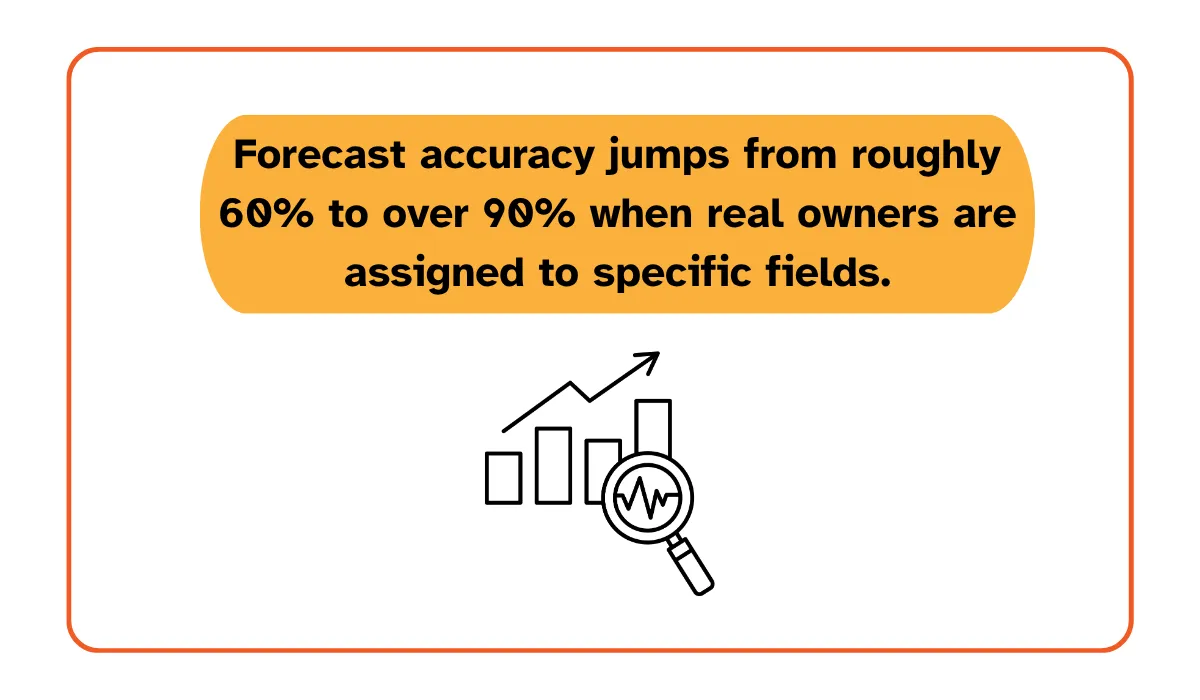
The example suggests that unclear ownership can be a major source of data-quality problems even when the underlying tools remain unchanged.
Centralizing all governance decisions in IT can create a mismatch: IT can implement controls and integrations, but business teams must define terms such as ‘qualified account’ and decide which attributes matter.
Those are business judgments, not technical ones.
The fix isn't picking one owner for everything. It's deliberately distributing ownership, with each piece of the puzzle assigned to the function best positioned to own it. That's the job RACI does.
RACI: Key to Strong Firmographic Data Governance
RACI is an acronym for Responsible, Accountable, Consulted, and Informed.
It's a framework that has been used in project management to answer one question precisely:
For any given task or decision, who does the work, who owns the outcome, whose input matters, and who just needs to know?
When applied to firmographic data, it replaces vague ownership with four defined roles:
Responsible | the person or people who perform the work |
|---|---|
Accountable | the one person who owns the outcome and approves it |
Consulted | stakeholders whose input is sought before a decision or action |
Informed | people kept updated on decisions or progress |
Most RevOps teams have already used a version of it somewhere else, such as a product launch or a compliance audit, without ever applying it to the data itself.
RACI doesn't require a massive governance program. It requires a spreadsheet, a workshop, and the discipline to write down who actually owns what.
Below is how each role maps onto firmographic data governance specifically.
Responsible: Who Owns Enrichment and Ongoing Maintenance
The Responsible role is the team that does the daily work: enriching records, deduplicating accounts, and keeping fields current.
In many organizations, operational responsibility sits with RevOps or a dedicated data-operations function, while business users contribute corrections through controlled workflows.
Still, not every field needs an owner in the same team. Functional ownership is also efficient.
Marketing Ops can be assigned lead source, UTM parameters, and campaign attribution fields.
Sales Ops can own deal stages, pipeline fields, and account hierarchy. Customer Success Ops can own health scores and onboarding fields, while Finance handles billing and contract terms.
With this allocation, each team works with the fields they use most and avoids extra responsibility.
However, you need a document to prove this arrangement exists, not just a conversation in a Slack channel. Put it in your data dictionary, include it in onboarding, and check it when the team structure changes.
Another ownership problem is shared control over some fields. Company name and website domain are fields every team uses. These should have clearly defined owners, even if RevOps still coordinates everything else.
Tooling supports the Responsible role, but it doesn't replace it. For example, email and calendar syncs capture activities automatically. Also, instead of manual input, teams can have scheduled enrichment jobs that pull updated firmographic attributes from external providers.
Research on CRM data decay estimates that roughly 25–30% of usable B2B contact records become outdated each year without active maintenance.
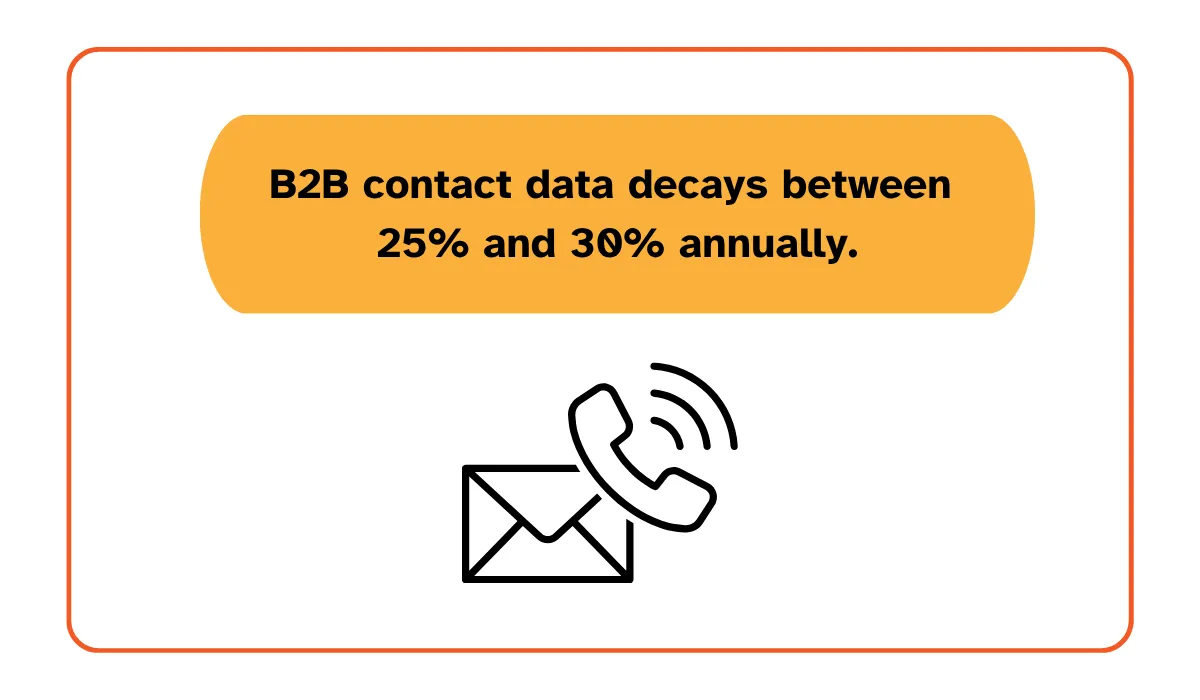
Even a recently cleaned database will accumulate stale records over time. The practical response is to define freshness thresholds by field and reverify records on a risk-based cadence.
An efficient approach is to have the Responsible team configure these systems, then handle the exceptions automation can't catch.
Accountable: Who Owns the Quality KPIs
The Accountable role is the single person who answers for data accuracy standards and quality KPIs. This differs from Responsible in that the person doing the enrichment work isn't necessarily the person asked why the forecast was off by 15%.
RACI's core rule calls for exactly one Accountable owner per area. Split accountability across two people and you're back in the ownership vacuum from earlier, just with extra meetings.
This matters especially for firmographic data because diffused accountability is the exact failure mode governance is trying to fix.
If the Accountable role is split between RevOps and IT, neither party feels the full weight of a bad forecast, and both can plausibly point to the other when leadership asks what happened.
A single Accountable owner, usually the head of RevOps or a dedicated data governance lead, closes that gap.
KPIs tracked by the Accountable role are highly specific:
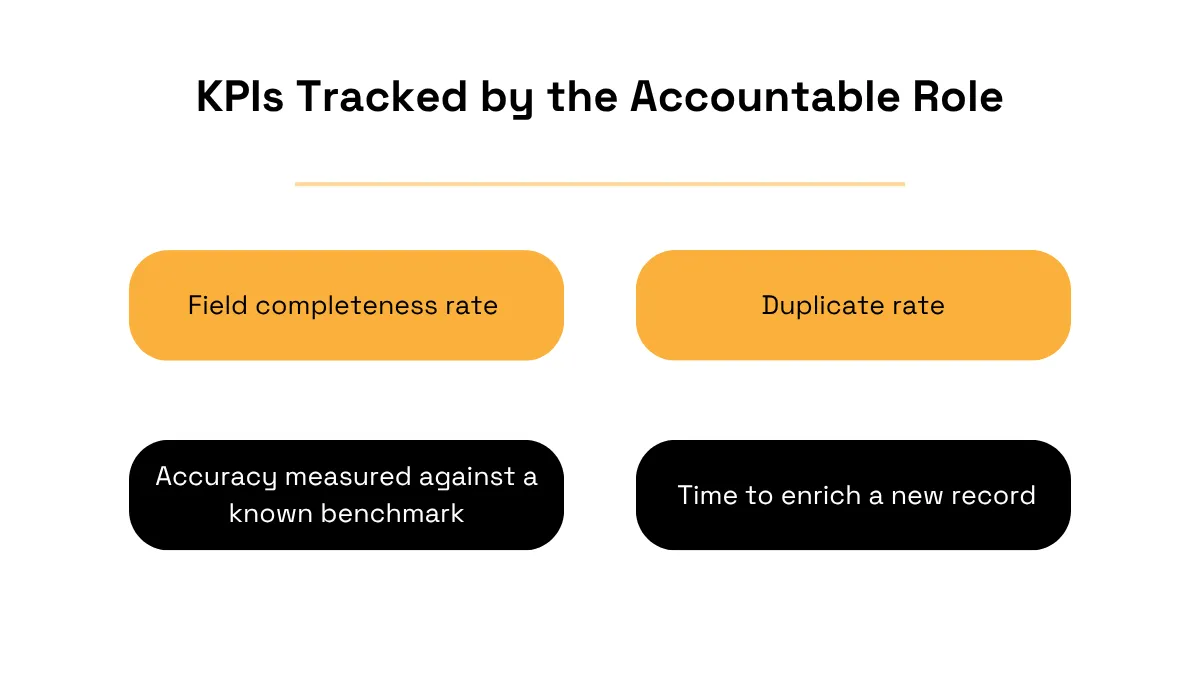
Illustration: Veridion
Of course, a summary score can help leadership scan trends, but the underlying measures should remain visible and should not be treated as the sole explanation for forecast performance.
Unfortunately, measuring quality in any capacity is an issue for many companies.
Gartner reports that 59% of organizations don't measure data quality at all, which means most Accountable owners, where they exist, have no dashboard to check.
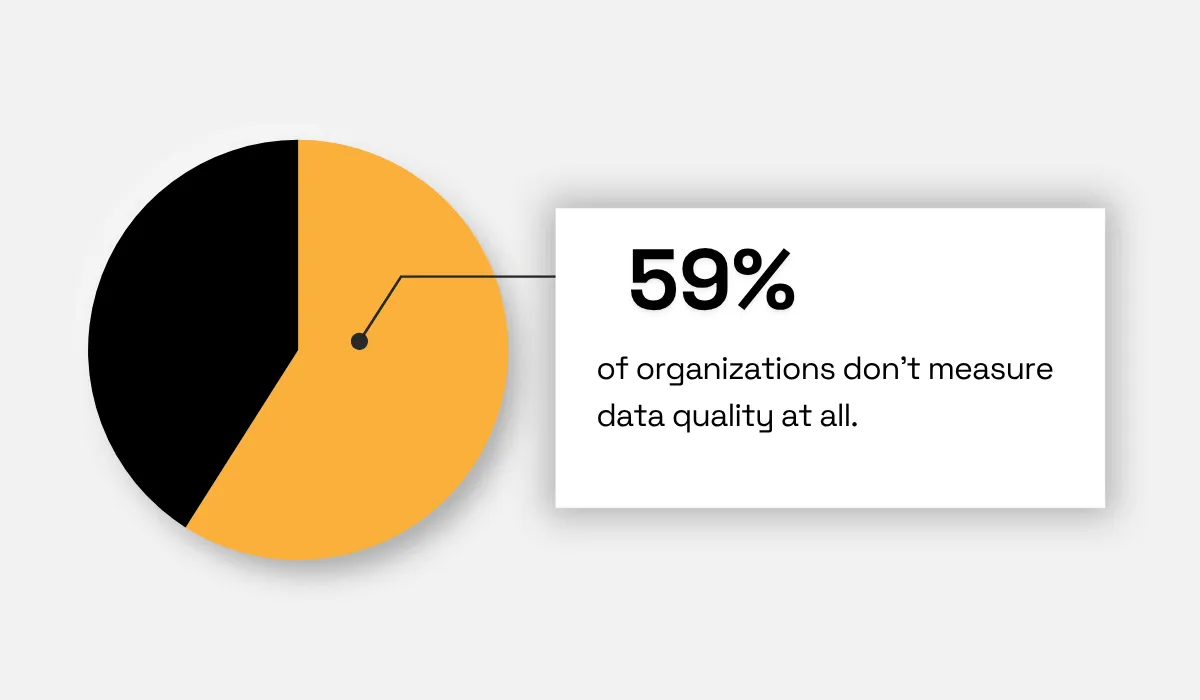
Though this finding is broader than CRM governance, it reinforces the need to define and monitor the dimensions that matter to each use case.
In any case, when Responsible teams fall short of the standard, the Accountable owner needs a clear escalation path, not an informal nudge.
That usually means a defined SLA. For instance, if a field's completeness rate drops below a pre-defined level for two consecutive weeks, it's mentioned at a weekly pipeline review meeting. Then the Responsible team gets a set number of business days to fix this issue, or else it escalates to leadership.
To make this process work efficiently, ensure your KPI dashboard is available during forecast review meetings.
Quality metrics in another report get ignored while quality metrics that are right there, along with the pipeline metrics, get acted upon.
Consulted: Who Weighs In on Data Provider Decisions
The Consulted role covers stakeholders whose input matters before a decision gets made, in this case, before your organization selects, renews, or switches a firmographic data provider.
This decision ripples across every downstream team, so RevOps shouldn't make it alone.
Sales leadership cares whether coverage matches their actual territories, while Marketing Ops cares whether the attributes support segmentation the way campaigns need.
Finance and procurement care about total cost and contract terms, and in regulated industries, legal weighs in on compliance and how the data gets sourced in the first place.
These stakeholders should weigh concrete, measurable criteria, not vendor marketing claims. When comparing firmographic data providers, your stakeholders should evaluate:
- refresh frequency
- coverage breadth across your actual target segments
- attribute depth beyond basic firmographics
- match rates against your existing CRM records
- how much engineering effort the integration takes
These features are crucial because a provider that scores well on raw database size but refreshes quarterly will still leave your CRM stale between cycles, no matter how big the number on the homepage looks.
Additionally, a provider with a clean API but thin coverage in your core verticals creates the opposite problem: fast integration, weak data underneath.
If you skip this consultation step, you'll hear about it later, just at a worse time.
The provider selected without Sales Ops input doesn't match the accounts sales reps sell to. A provider selected outside the procurement team will face contract issues once the deal is done. The complaints will show up either way.
Before signing a long-term contract, test the provider through a time-boxed pilot using a representative sample of your own accounts.
Each Consulted stakeholder should evaluate the use case and acceptance criteria they own.
That single step catches most mismatches before they become a year-long contract regret.
Informed: Who Needs Visibility Into Data Quality Trends
The Informed role covers everyone who doesn't need to make governance decisions but still needs regular visibility into data quality trends to trust the system they're working in.
It includes not only the Sales leader and the Procurement lead, but also Sales reps, Marketing campaign managers, and Customer Success teams that use the CRM but aren't part of the Governance Council.
The reporting cadence can be set according to data volatility and business impact.
For example, weekly for operational exceptions and monthly for leadership trends. And you can include defined measures such as:
- Critical-field completeness
- Duplication rate
- Freshness
- Unresolved exceptions
- Affected segments
The point isn't to overwhelm frontline teams with dashboards; it's to keep them from silently losing trust in the system. When reps stop trusting the CRM, they don't complain; they build shadow or personal spreadsheets, and the moment that happens, your single source of truth splits into a dozen inconsistent ones.
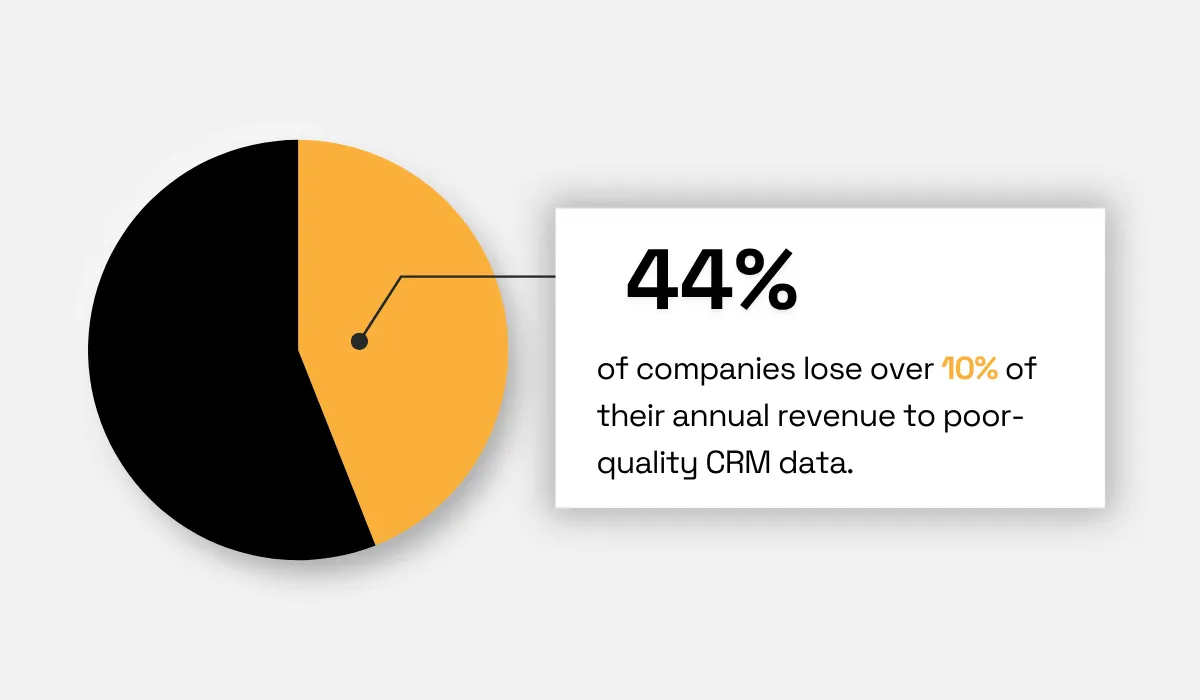
The stakes are real. According to Validity's survey, 44% of companies estimate losing over 10% of annual revenue to poor-quality CRM data.
A short monthly update costs far less than rebuilding your reps' trust later.
This reporting loop should flow in the other direction too—to the Accountable owner, not just to the frontline teams.
Repeated data quality complaints in the Informed monthly summary clearly signal that the process or provider should change, not just the record.
A useful reporting convention is to end each data-health update with the largest recurring issue, the accountable owner, the next action, and its due date.
How to Reduce Governance Overhead Without Jeopardizing Data Quality
RACI solves who's responsible. It doesn't solve the underlying workload, and a fully staffed governance program still needs data that doesn't decay the moment your attention moves elsewhere.
The most effective way to reduce that overhead is to automate the parts of governance that don't require human judgment, particularly ongoing enrichment and verification, while keeping human ownership over decisions and standards.
This is where an external data partner can serve as a governed reference source for firmographic enrichment, while your CRM or master-data platform remains the internal system of record.
For example, Veridion offers a company enrichment solution that continuously scans corporate registries, news, and online sources.
Source: Veridion
Our platform continuously verifies, collects, and revalidates company data from web, registry, public, and partner sources.
Core profiles are refreshed continuously, volatile signals are refreshed daily, and technographics use a rolling 90-day window; each delivered attribute includes confidence and source information.
For teams applying the RACI model above, a continuously maintained source doesn't replace the Responsible or Accountable roles. Still, it dramatically shrinks the manual maintenance workload those roles carry.
It also frees your team to spend less time firefighting inaccurate records and more time using reliable data for revenue decisions.
Moreover, the effect compounds.
A continuously refreshed data layer can surface material changes, such as acquisitions, leadership changes, or technology adoption, sooner than a quarterly snapshot.
As a result, the accountable owner can work from fresher, source-traceable information, while informed stakeholders receive clearer visibility into changes and unresolved gaps.
Conclusion
Clean firmographic data starts with clear ownership. As we've shown, the root issue is rarely technology.
It's accountability.
Get the RACI model right by defining who does the enrichment, who signs off on quality, who gets consulted on tools, and who stays in the loop on metrics. Then let automation handle the maintenance grind.
Now the result is a CRM that more reliably reflects your accounts, with clearer ownership when data is incomplete, outdated, or disputed.
Articles
Discuss how these trends affect your organization.
Our analysts are available for a short call. Bring a specific question and we will ground it in the data.
Insights
Keep reading
More analysis, research, and outcomes grounded in live company intelligence.
Benefits of Clear Data Ownership
We will explore the most important data ownership benefits and explain how structured ownership models enhance data accuracy and protection.
Data Attributes That Make Risk Models Smarter Than Basic Firmographics
Tired of basic firmographics? See how advanced data attributes help you identify emerging market risks and build smarter, more resilient risk models.
Top 5 Business Data Providers
Looking for the best business data providers? This article highlights five reliable tools that help companies access scalable data.