Insights / Articles
Competitive Intelligence in SaaS: A Guide to Staying Ahead of the Competition
Tired of losing SaaS market share? Master competitive intelligence for SaaS to uncover competitor strategies, and identify opportunities.

- GenAI is now raising prediction accuracy by 33% within CI platforms.
- Public product review sites are the most consulted source for B2B software buyers.
- Having too much data can be just as problematic as having too little.
Most SaaS sales deals aren't won or lost on product alone. A competitor is already in the conversation, and how well your rep handles that can decide the outcome.
The information you need to outrank is largely out there. The problem is that most teams either aren't looking in the right places or move too slowly when they find something useful.
This guide covers what SaaS competitive intelligence actually includes, where the best signals come from, and the common mistakes that cost teams.
SaaS Competitive Intelligence Explained
SaaS competitive intelligence (CI) is the structured collection and analysis of signals about your competitors. It is the wider market that shapes:
- Product
- Pricing
- Sales
- Positioning decisions
CI draws on both public and proprietary data, like a competitor's pricing page update, negative reviews, or a sudden push into a new region. Each can tell you something useful.
Each type of competitive intelligence serves a different team, and knowing which is which is what turns scattered monitoring into a real strategy.
While the three look distinct on paper, they feed into one another in practice.
An operational signal, like a competitor's pricing tweak, can quickly escalate into a strategic conversation.
Type | What it covers | Who uses it | How it’s used |
|---|---|---|---|
Strategic intelligence | Long-term direction: M&A activity, market entries, executive hires, positioning shifts | Product and executive teams | Roadmap and category decisions |
Tactical intelligence | Live deal support: battlecards, objection-handling scripts, rep-level talking points | Sales teams | Activated the moment a competitor comes up on a call |
Operational intelligence | Day-to-day pulse: feature releases, pricing tweaks, marketing campaigns, content launches | Product marketing teams | Rolling updates that keep the go-to-market motion accurate |
Generative AI is now raising prediction accuracy by 33% and cutting data processing time by 45% within CI platforms, according to research conducted by Mordor Intelligence, a leading market research firm.
With such progress, CI is now a core business function, not a background task.
Now, that raises a simple question: where does the intelligence actually come from?
Where Can SaaS Companies Find Competitive Intelligence
Once you know what you’re after, the question becomes where to find it.
The richest CI sources usually sit in four buckets, each offering different avenues to the information you need:
- Competitors' public assets
- Customer review platforms
- Dedicated CI platforms
- Company intelligence platforms
Here’s what each one delivers and how to use it.
Competitors’ Public Assets
Some of the most valuable competitive intel comes from data your competitors publish themselves.
Their websites, pricing pages, release notes, job postings, etc., reveal strategic intent in real time.
The signals are out there, but most teams simply don’t watch them systematically.
Here are a few places to start:
Release Notes | What a competitor ships tells you what they chose to focus on. A run of mobile-first features means they are betting on that audience. |
|---|---|
Pricing Pages | When a competitor restructures their pricing or breaks out a new add-on, they are testing a different way to make money. |
Job Postings | Certain hiring signals indicate what a competitor is going to do. A new Head of Channel Partnerships means they are putting money into a partnership strategy. |
Homepage Messaging | When a competitor rewrites their headline, they are repositioning how they want to be seen in the market. |
As Alex McDonnell, Market & Competitive Intelligence at Airtable, the cloud collaboration service company, puts it in the Competitive Intelligence Alliance practitioner guide:
"In competitive intel your deliverable is not just the information. It's a clear and defensible point of view that's based on that information."
That point of view comes from reading patterns, not single data points.
A single job posting is an anecdote. A cluster of five aligned postings over sixty days is intelligence you can act on.
Public assets show what competitors say about themselves. The next source shows what their customers say back.
Customer Review Platforms
Review platforms are a direct access to customer sentiment, and they surface information that competitors would never publish themselves.
Four platforms dominate the space in B2B SaaS:
- G2
- Capterra
- TrustRadius
- Gartner Peer Insights
Use them as a layer, not a one-off.
The G2 2024 Buyer Behavior Report found that public product review sites are now the most consulted source for 31% of B2B software buyers.
So, what does that mean in practice?
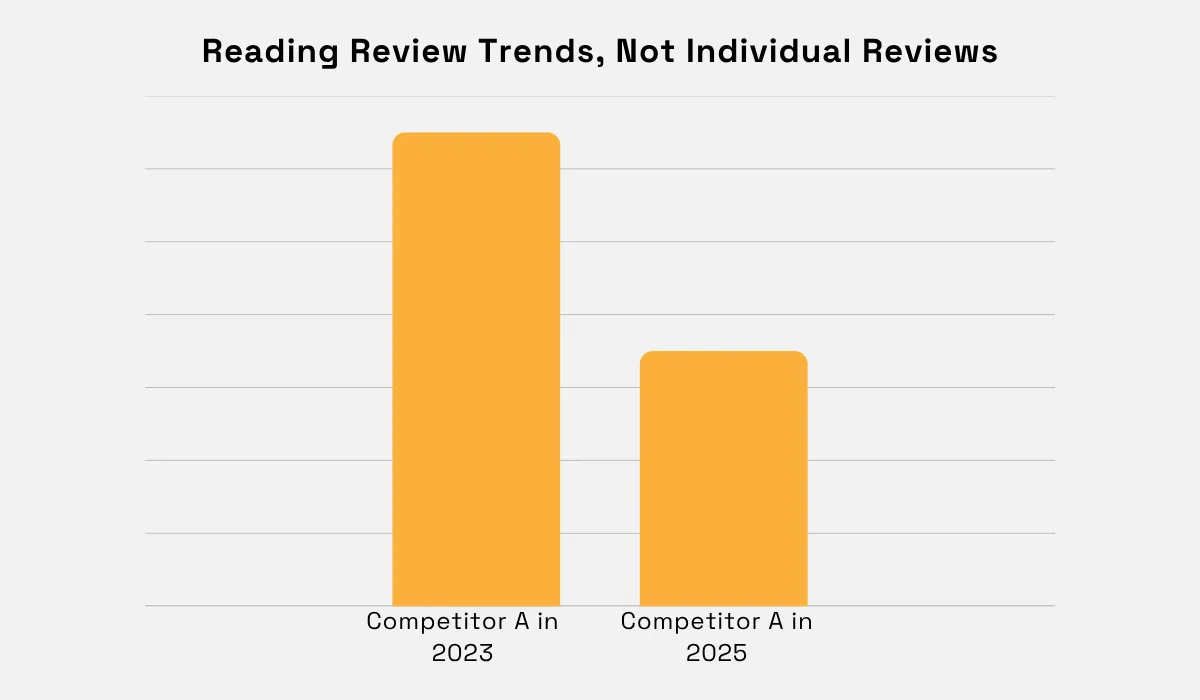
The value sits in trends and not in individual reviews.
A one-star rating doesn’t necessarily mean anything on its own, but a pattern of reviews over the last six months is a product gap you can convert into a sales talk.
Two patterns specifically are worth looking for.
Recurring complaints expose product gaps your reps can target in discovery. If a competitor’s customers repeatedly cite a clunky reporting dashboard, you have a real differentiator to lead with.
Recurring praise reveals competitive strengths. If five-star reviews keep highlighting one specific feature, that feature is part of why they win. You either match it or position around it.
Both patterns become more useful when you look at them over time rather than as a snapshot.
Source: Veridion
This bar chart shows exactly that.
A competitor with strong 2023 reviews and weak 2025 reviews had a quality regression. This can be worth it for your next competitive conversation.
One thing to remember is that reading public assets and reviews by hand works at a small scale.
However, once you get past a few competitors, you need automation, which is where dedicated platforms come in.
Competitive Intelligence Platforms
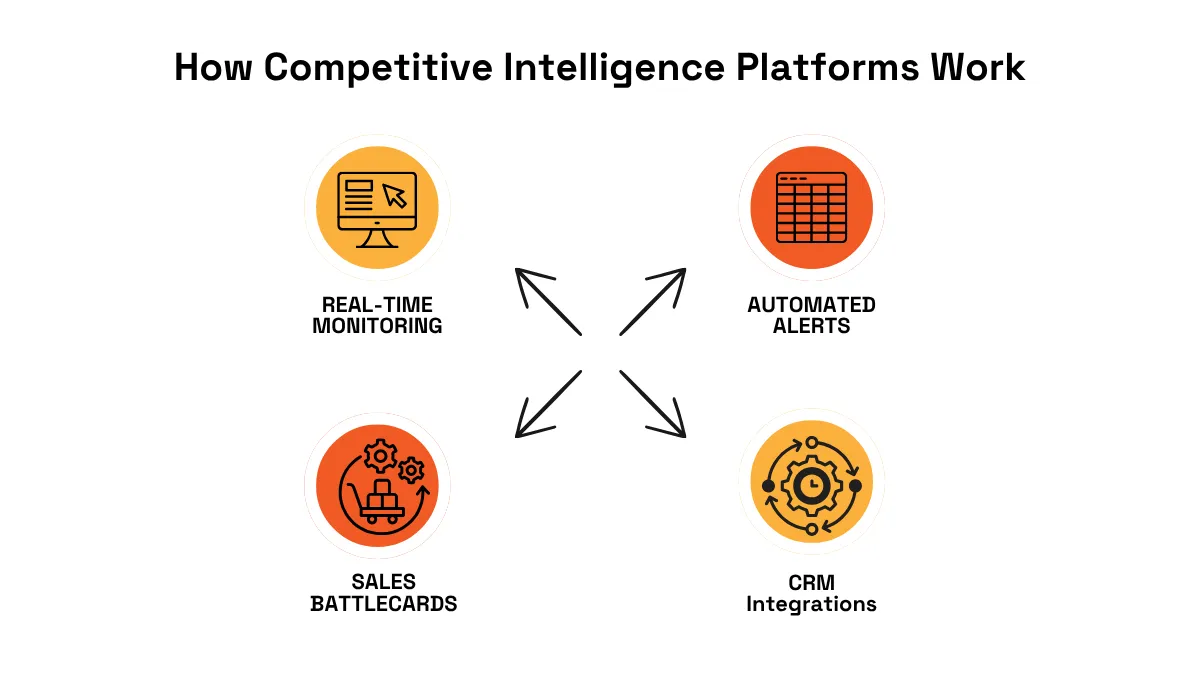
Dedicated competitive intelligence platforms automate what manual tracking cannot scale.
They offer continuous monitoring across hundreds of public signals, delivered to the right people at the right time.
Source: Veridion
They pull intel from competitor websites, product pages, social channels, review sites, news mentions, and job boards into one workflow.
Your team gets relevant intelligence automatically, instead of spending hours assembling it manually.
For a deeper look at how these platforms compare, see our guide to the different types of SaaS competitive analysis platforms.
Klue, the competitor analysis software company, did a case study with Blackbaud, a cloud computing company, which documents a 28% increase in win rates against top competitors after implementing AI-assisted competitive intelligence.
These platforms do four things well:
- Real-time competitor monitoring
- Automated alerts on meaningful changes
- Sales battlecards that update as the landscape shifts
- CRM integration that puts intelligence inside your reps' existing workflows
CI platforms cover the competitors you already know.
The next layer you need to pull back is the broader market around them.
Company Intelligence Platforms
Competitors aren't the only thing that moves. Markets do too.
You need accurate, current data on every company in your market, not just the ones you already track.
Company intelligence platforms answer questions CI tools can’t.
- Which companies actually fit your ideal customer profile right now?
- Which industries are growing, contracting, or consolidating?
- Which businesses are expanding into new geographies or adjacent markets?
- Which organizations are adopting new technologies that signal a future buying window?
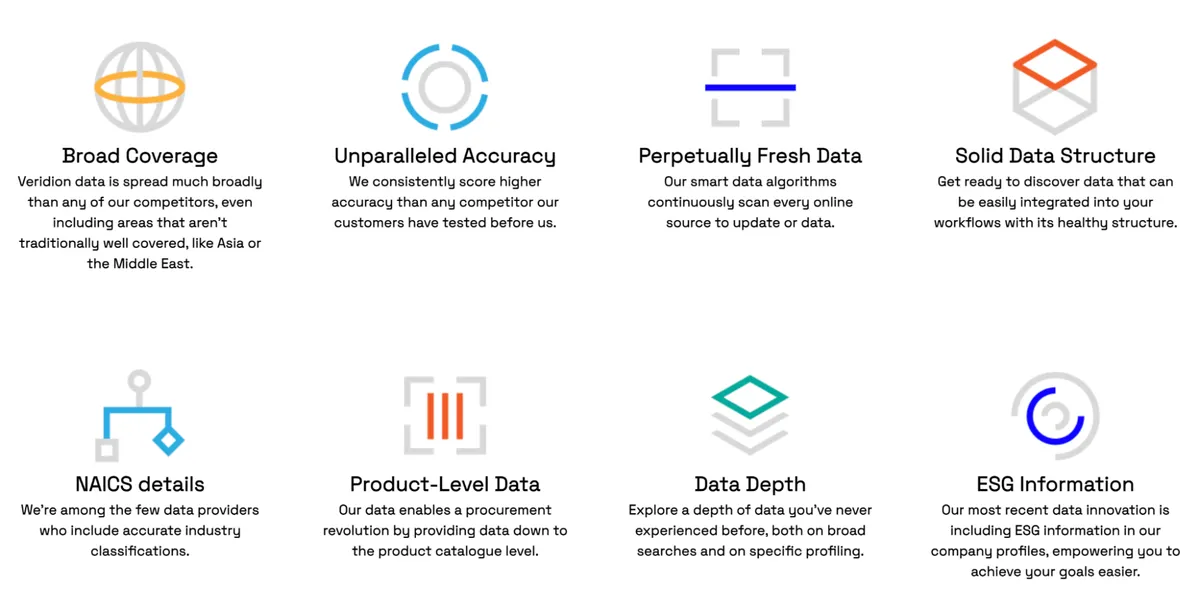
Veridion is a company intelligence platform built for this layer.
It maintains a database of 693M companies across 250 countries, refreshed weekly from over ~1.4B web pages crawled per month, and the product-level data is classified using UNSPSC codes.
SaaS teams use it to map their market, find new accounts, and spot companies showing buying signals.
Source: Veridion
Explore the full data catalogue, the data set built for third-party risk management, and the data built for market intelligence teams for the full picture.
Competitor monitoring tells you what your rivals are doing. Company intelligence tells you what the market they are competing in actually looks like, who is in it, and how it is shifting.
The distinction matters.
However, good sources are only half the problem.
Here’s what trips up most CI programs once they are running.
Common Competitive Intelligence Mistakes
Building the right sources is one half of the job, and keeping a CI program on track as it scales is the other.
Three negative patterns show up across intelligence teams, each one draining the value of the intelligence you have already collected.
But the good news is that these are fixable with small process changes, and not a bigger budget.
Intelligence Hoarding
The most common CI failure isn’t collecting too little. It’s collecting plenty and never moving it to the people who can act on it.
You’ve seen the pattern. Competitive insights sit in shared drives that no one opens. Quarterly reports get sent to executives who skim them and move on.
The data is rarely the problem. The pipeline from data to decision is.
Intelligence that doesn't reach a decision-maker has no impact. If your sales team can't access the latest competitor pricing before a discovery call, the work that produced it was wasted.
Before you collect anything, define the decision the intelligence will support:
Who needs it?
When will they need it? Where will they see it?
Every piece of intel should map to one of three outputs, like a live deal action, a product roadmap input, or a positioning change.
If it doesn’t map to any of those, the honest question is: why are you collecting it?
CI is a system for changing decisions, not a system for producing reports.
The second common mistake is closely related. Even when intel is moving to the right people, too much of it dilutes the signal.
Tracking Too Many Competitors
The second pattern is the assumption that more monitoring automatically produces better intelligence.
Many SaaS teams try to track everything. Every direct rival, every adjacent player, every startup that mentions a similar feature.
Kompyte, a competitive intelligence provider, has customer benchmark data that shows its users track an average of 33 competitors each. For most SaaS teams, that’s well beyond what active sales motion can actually use.
The result is predictable. Equal attention goes to major competitors and irrelevant ones. More hours are spent collecting than analyzing.
Not every competitor deserves the same level of attention. A realistic split may look like this.
Tier | Who | What it looks like |
|---|---|---|
Tier 1 | The 3–5 competitors you face in active deals every week | Full battlecards, weekly review, named ownership |
Tier 2 | 10–15 adjacent players who appear occasionally or could enter your space | Light monitoring, automated alerts, quarterly review |
Tier 3 | Everyone else | A spreadsheet and an annual scan |
It's tempting to track everything. However, the teams that win are the ones that go deep on a short list, not shallow on a long one.
Even a focused list goes to waste if you only check it when something breaks, which brings us to the third common mistake.
Only Gathering CI Reactively
The third pattern is treating competitive intelligence as a fire drill rather than an ongoing system.
Most SaaS teams only look at competitive intel when something goes wrong. It can be a lost deal or a competitor nobody saw coming.
By then, the moment has passed.
The cost is missed opportunities. And by the time your quarterly review lands, your competitors have already moved.
A competitor can ship a feature on Tuesday, change pricing on Wednesday, and reach out to your top prospect on Thursday.
If your CI cadence is “we’ll look at this next quarter,” you’ve already lost the window.
Continuous CI doesn’t require a bigger team. It requires a smaller, recurring habit.
- A fifteen-minute weekly scan of competitor release notes, pricing pages, and job postings for your Tier 1 set
- A monthly review of review-platform sentiment for the same Tier 1 set
- A quarterly recalibration of which competitors actually belong in Tier 1, based on what your sales team is seeing in real deals
Reactive CI catches threats after they have already cost you. Continuous CI catches them while you still have time to respond.
The Bottom Line
Strong competitive intelligence isn’t about gathering more data.
It’s about drawing from the right sources, focusing on the competitors who matter, and moving insights to the people who can act on them.
The sources exist, and so does the framework. The only variable is whether your team treats CI as a system or a fire drill.
Do it consistently and get the intel to the right people. Act on it while it still matters.
That’s how you stop losing deals you should be winning.
Articles
Discuss how these trends affect your organization.
Our analysts are available for a short call. Bring a specific question and we will ground it in the data.
Insights
Keep reading
More analysis, research, and outcomes grounded in live company intelligence.
Tips for Maximizing the Value of Competitive Insights
Looking for competitive insights tips? This guide will show how to use insights effectively and gain a stronger competitive advantage.
5 Types of Tools for SaaS Competitive Analysis
Explore 5 types of tools you can use to enhance your competitive intelligence, with a focus on specific platforms and their key features.
Where to Find Data on Businesses
Looking for where to find data on businesses? This guide will show key sources for company information, insights, and market intelligence.