Insights / Articles
Looking for a Firmographic Data Provider? Here Are the Top Options to Consider
Tired of sifting through endless lists for firmographic data providers? Find the top options that will streamline your sales.

Two companies can have access to millions of business records and still make completely different decisions.
A sales team uses firmographic data to identify accounts most likely to convert, while a procurement team uses it to evaluate suppliers before signing a contract.
A market intelligence team might analyze the same data to uncover expansion opportunities and monitor competitors.
The difference isn’t the data itself, but how the organization uses it.
That’s also why choosing a firmographic data provider isn’t as simple as comparing database sizes or feature lists.
Each provider is designed to solve different business problems and support different use cases.
This article compares five top firmographic data providers using a consistent evaluation framework to help you understand what each platform does best and identify the one that suits your organization's goals.
Veridion
Veridion is an AI-powered company intelligence platform that provides firmographic data by continuously collecting and analyzing publicly available web data.
The platform uses AI-driven web crawling to build detailed company profiles that support sales prospecting, procurement, market intelligence, supplier discovery, and overall data enrichment.
This approach gives richer operational insights than providers that focus primarily on static company records or contact data.
The platform provides:
- Company profile and legal information
- Industry classification
- Employee and revenue estimates
- Products and services
- Technologies uses
- Certifications
- Digital presence
- ESG and sustainability indicators
- Supply chain intelligence
- Geographic data
One of Veridion's biggest differentiators is the depth and breadth of its company intelligence.
In addition to standard firmographic attributes, it captures operational, digital, sustainability, and supply chain signals that help organizations build a more complete picture of each business.
The platform tracks more than 693M companies across 250 countries and territories, including over 90% of SMEs, digital-first businesses, unregistered businesses, and micro-businesses that are often underrepresented in conventional business databases.

Source: Veridion
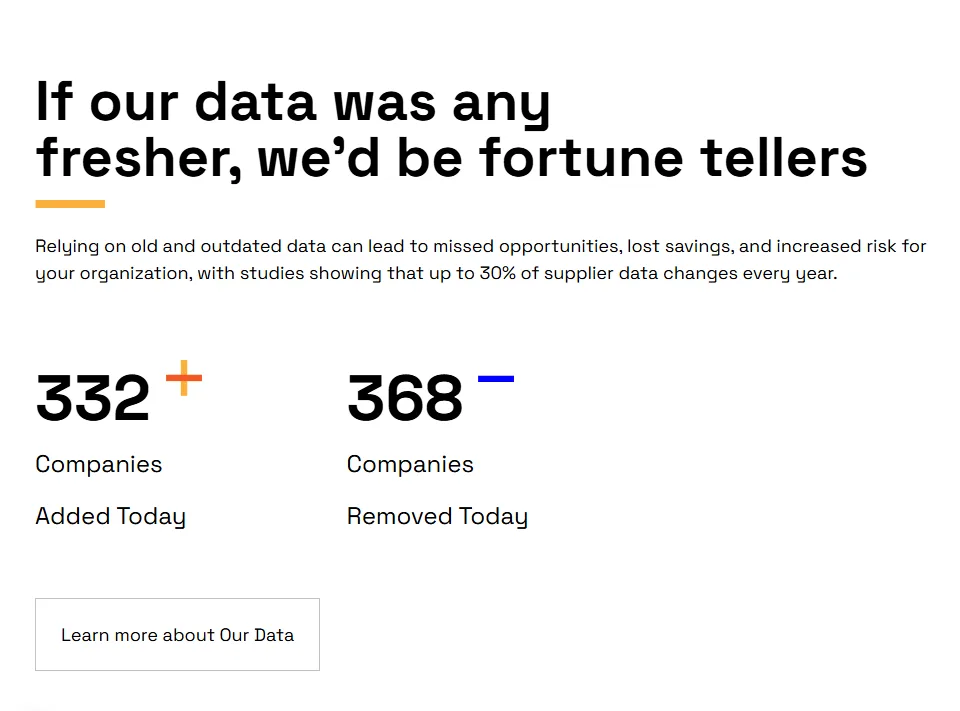
Veridion continuously monitors publicly available web data and refreshes its company profiles weekly, helping users work with current business information.
Source: Veridion
By comparison, many firmographic providers refresh portions of their databases monthly or on varying schedules depending on the underlying data source.
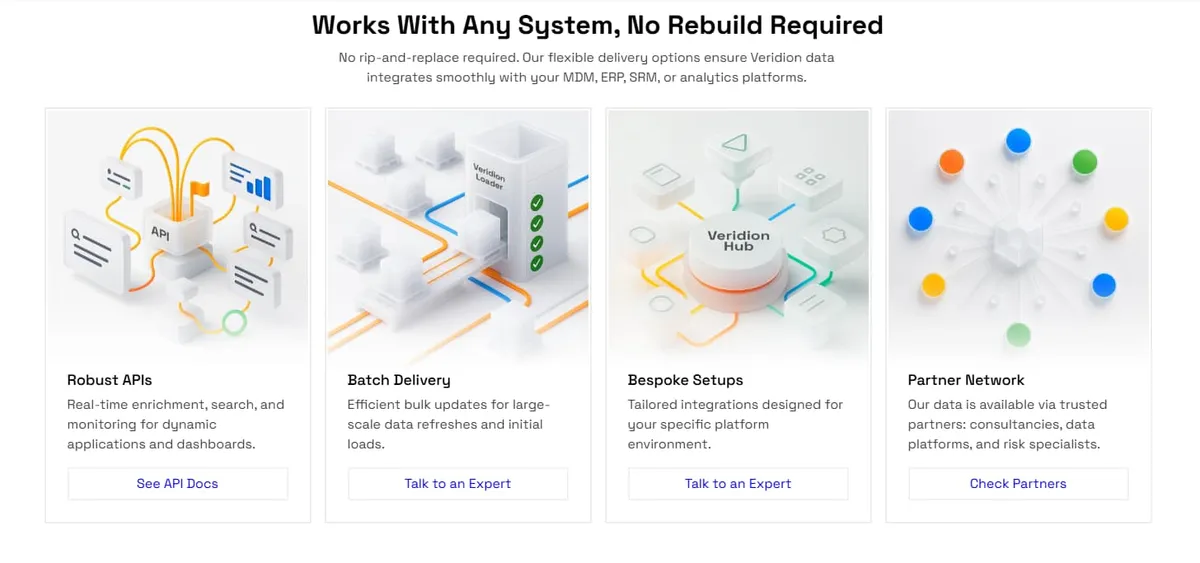
Veridion is also designed for integration into existing business workflows through APIs and data enrichment capabilities.
Organizations can enrich CRM records, identify new target accounts, support procurement initiatives, improve supplier discovery, and power internal analytics or market intelligence applications without relying on manual research.
Source: Veridion
The platform is GDPR- and CCPA-compliant and builds its company profiles from publicly available business information.
Veridion is best suited for:
- Businesses with global go-to-market strategies
- Procurement and supply chain organizations
- Companies conducting market intelligence or competitive research
- Organizations building data-driven sales or enrichment workflows
- Enterprises that require frequently refreshed company intelligence
If your primary goal is finding verified business contacts for outbound prospecting, you might want to consider alternative platforms that place greater emphasis on contact discovery and sales engagement.
Veridion offers custom pricing based on an organization’s data requirements, usage volume, and deployment needs.
Contact the sales team if you need a quote.
Onfire
Onfire is a vertical AI revenue intelligence platform designed for B2B companies that sell complex technical products.
It combines firmographic, technographic, and intent data to help go-to-market (GTM) teams identify technical buying committees and prioritize accounts showing active buying signals.
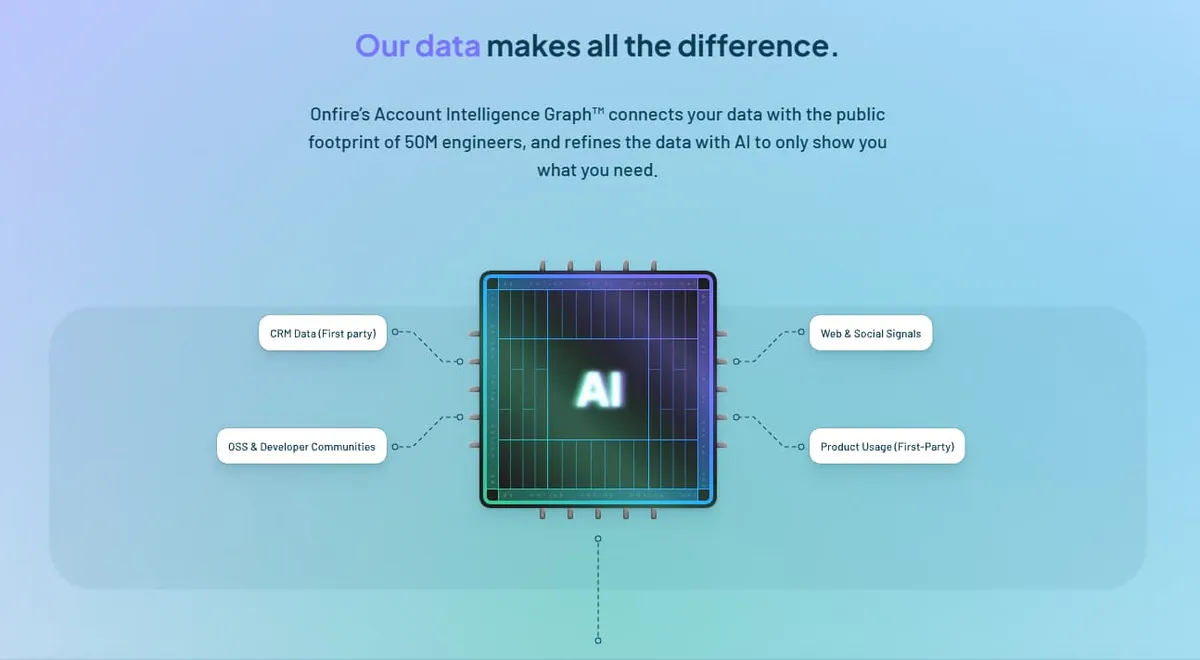
Onfire uses its proprietary Account Intelligence Graph™ to connect firmographic data with signals from developer communities, open-source ecosystems, hiring activity, and other technical sources.
Source: Onfire
In other words, firmographic data is one layer of the platform rather than its primary product.
On top of company attributes such as industry, size, revenue, and location, Onfire enriches those firmographics with technographic intelligence and behavioral signals.
This enables sales teams to identify companies that match their ideal customer profile (ICP) while uncovering which technologies they use, how their engineering organizations are evolving, and whether they’re actively evaluating new solutions.
The platform provides:
- Company profile and firmographics
- Technographics
- Contact enrichment
- Buyer intent signals
- Hiring trends
- Open-source adoption
- Community and event participation
- Engineering organization insights
- CRM enrichment
One of Onfire's biggest differentiators is its emphasis on live buying signals rather than static company records.
The platform continuously processes millions of buying signals from more than 100,000 technical data sources, allowing sales teams to identify technology adoption, developer activity, hiring trends, and other behaviors that may indicate purchase intent.
Onfire continuously updates its Account Intelligence Graph™ as new signals become available, enabling GTM teams to monitor changes in technology adoption and buying behavior with near real-time visibility.
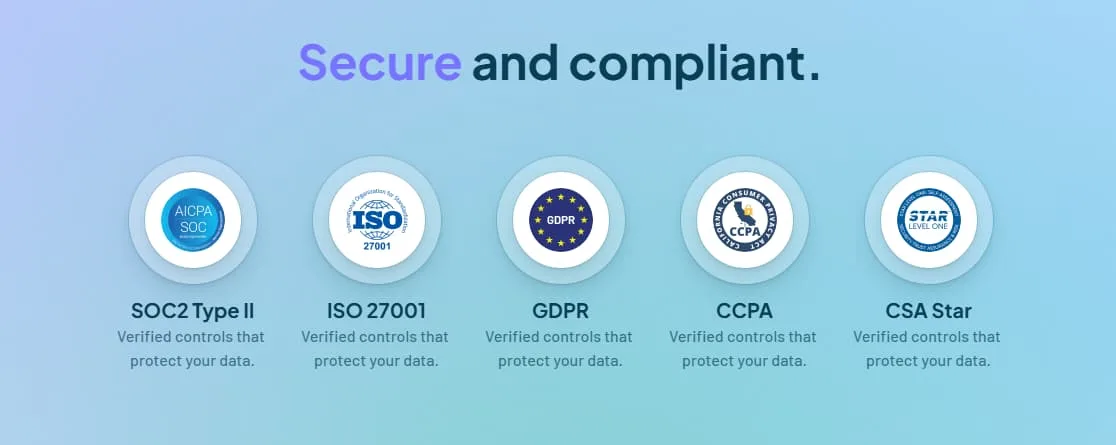
Onfire states that it’s GDPR and CCPA-compliant, and processes only publicly available or consented business data.
The company also maintains SOC 2 Type II, ISO 27001, and CSA STAR certifications, making it suitable for organizations with stringent security and compliance requirements.
Source: Onfire
Onfire is best suited for:
- B2B SaaS companies selling to technical buyers
- Developer tools and DevOps vendors
- Cybersecurity companies
- Cloud infrastructure and data platform providers
- Organizations prioritizing intent-based prospecting over static account lists
However, if you’re looking for broad company intelligence to support procurement, supplier discovery, market research, or supply chain analysis, you may find a dedicated firmographic data provider like Veridion more suitable.
Onfire offers custom pricing across multiple plans: Basic, Pro, and Elite, with pricing tailored to team size, usage requirements, and feature needs.
Organizations can request a customized quote or start with a free trial that provides full platform access.
Coresignal
Coresignal is a public web data provider that delivers company, employee, and job data through APIs and downloadable datasets.
It’s designed as a public web data infrastructure provider that enables organizations to build analytics and AI applications, as well as custom enrichment workflows, using structured business data.
Coresignal delivers structured datasets and APIs that organizations can integrate directly into their own applications, data warehouses, and enrichment pipelines.
In addition to standard firmographic attributes, the platform provides:
- Company profiles and firmographics
- Employee data
- Job postings
- Workforce and headcount trends
- Technographics
- Funding data
- Web traffic data
- Company enrichment
- Historical company and workforce data
One of Coresignal’s biggest differentiators is the scale of its public web data.
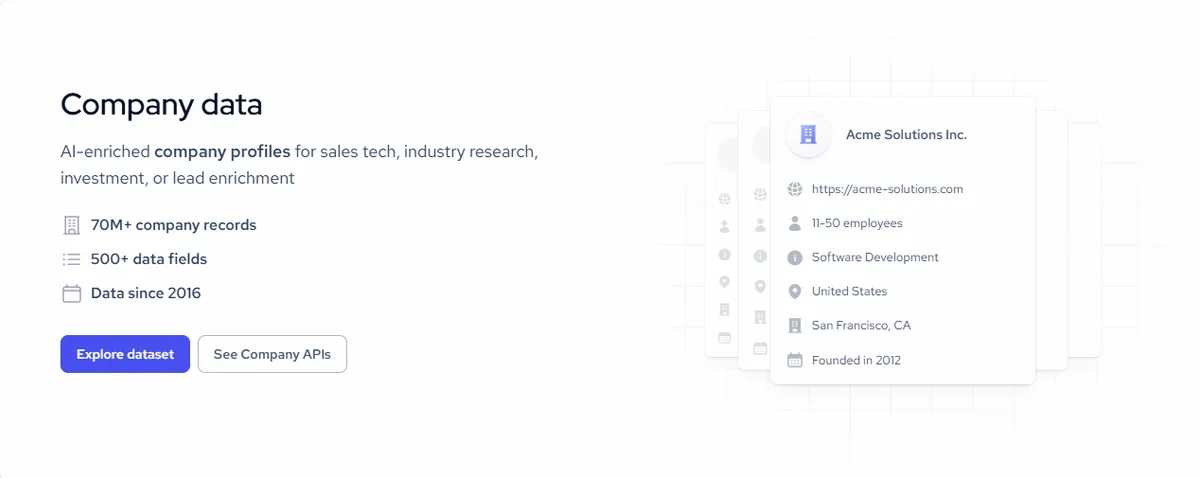
The platform maintains more than 4.5 billion records collected from 15+ public web data sources, including more than 70 million company profiles, as well as employee, job, funding, and workforce datasets.
Source: Coresignal
Coresignal continuously updates its API-connected databases as new information becomes available, while downloadable datasets are refreshed on daily, weekly, or monthly schedules, depending on the dataset.
Certain datasets are also available on a quarterly delivery schedule.
Each record includes a timestamp indicating when it was last updated, giving organizations greater visibility into data freshness and making it easier to manage ongoing enrichment and analytics workflows.
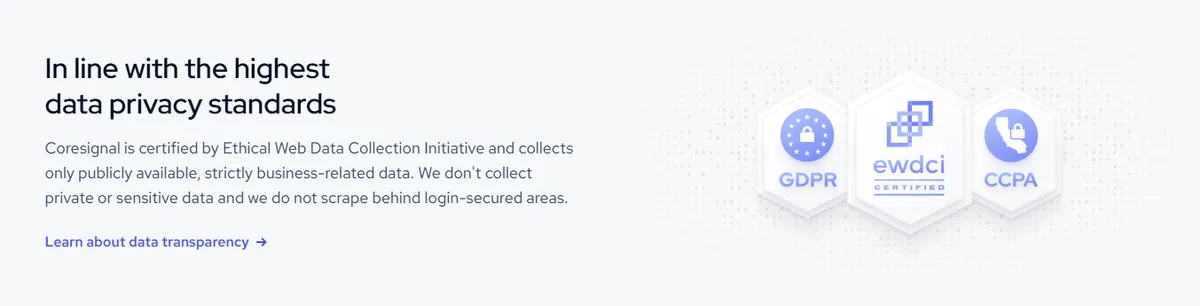
Coresignal collects only publicly available business information and states that it doesn’t scrape data from login-protected areas.
Its data collection practices align with both GDPR and CCPA, and the company is a founding member of the Ethical Web Data Collection Initiative (EWDCI), reflecting its commitment to responsible public web data collection.
Source: Coresignal
Coresignal is best suited for:
- Companies building AI-powered products or data platforms
- Businesses that require API-first access to structured B2B data
- Organizations conducting workforce or labor market analysis
- Teams performing large-scale company enrichment
- Enterprises requiring historical company and employee datasets
If your organization is looking for a complete sales engagement platform with built-in prospecting, outreach, and workflow automation, you might be served better by a dedicated sales intelligence solution.
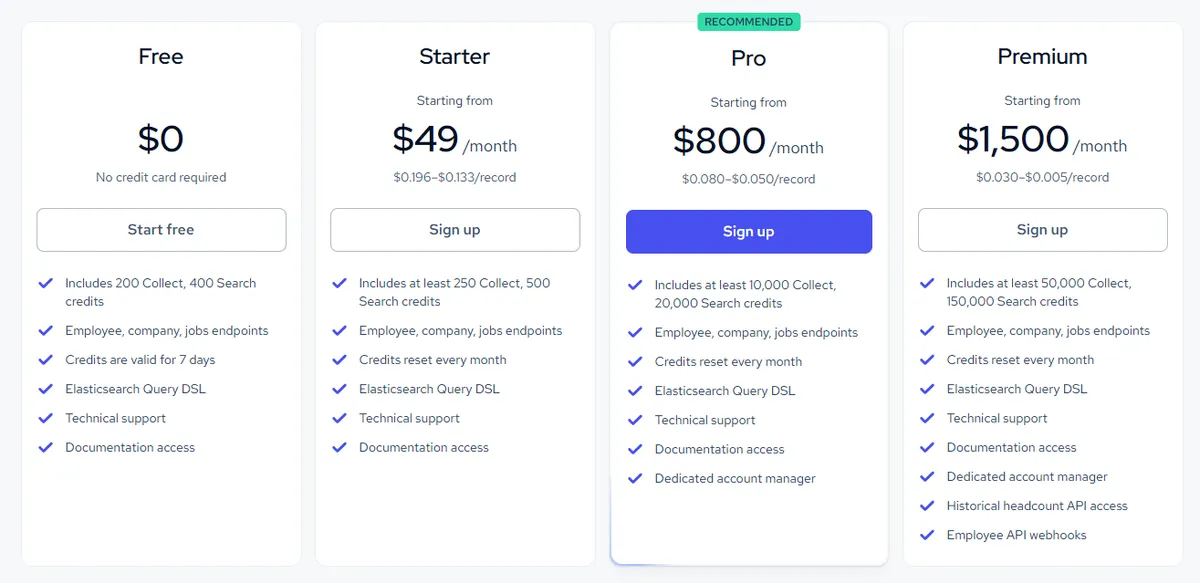
Coresignal offers both API subscriptions and downloadable datasets.
Their plans start with a free tier and paid subscriptions beginning at $49 per month, while downloadable datasets start at $1,000.
Source: Coresignal
Enterprise clients can also request custom pricing based on their data requirements and usage volumes.
Dun & Bradstreet
Dun & Bradstreet (D&B) is one of the world’s oldest and most established business data providers, tracing its data practice back to 1841.
At the core of its platform is the D&B Data Cloud, built around the proprietary D-U-N-S® Number, a unique nine-digit identifier that links business identities, corporate hierarchies, credit files, and firmographic records.
Rather than focusing exclusively on company intelligence or contact discovery, it helps organizations verify business identities, assess financial health, and manage business risk across customers, suppliers, and partners.
In addition to standard company attributes, it provides:
- Company profiles and firmographics
- D-U-N-S® business identifiers
- Corporate family trees
- Revenue and employee estimates
- Commercial credit scores and ratings
- Payment history
- Financial risk indicators
- Supplier and third-party risk data
- ESG and compliance intelligence
- Sales and marketing data
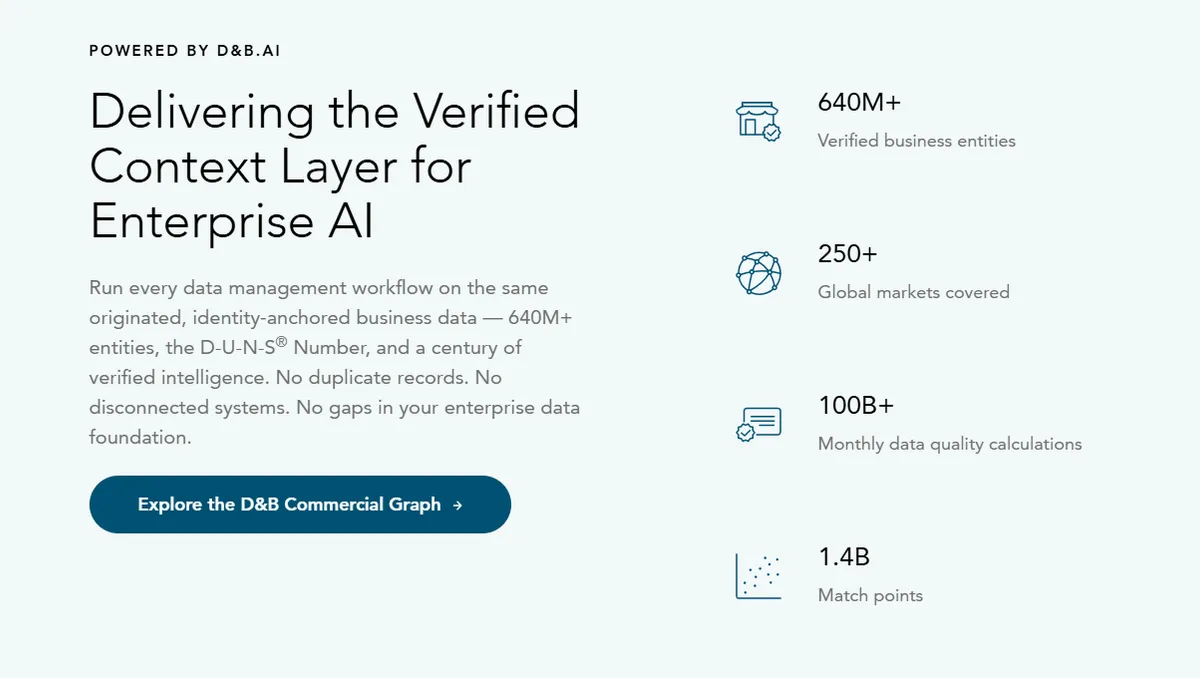
Dun & Bradstreet maintains one of the world's largest commercial business databases.
The D&B Data Cloud contains information on more than 600 million businesses worldwide, organized across 2,500+ business attributes that support company identification, credit analysis, procurement, sales, and compliance workflows.
Source: Dun & Bradstreet
Its data is collected from a broad network of public, private, and proprietary sources, giving organizations access to standardized business information across global markets.
One of D&B's biggest differentiators is its emphasis on trusted business identity.
Every record is built around DUNSRight™, its trademarked process for matching, verifying, and assigning a D-U-N-S® Number to each entity before businesses enter its Data Cloud.
D&B continuously updates its Data Cloud, processing millions of updates each day and performing more than 60 billion data quality checks each month.
It also supports organizations with regulatory compliance through solutions for Know Your Business (KYB), Know Your Customer (KYC), anti-money laundering (AML), sanctions screening, and third-party risk management.
D&B is best suited for:
- Global enterprises managing large customer or supplier networks
- Financial institutions performing due diligence
- Organizations requiring commercial credit and payment intelligence
- Companies standardizing global business records
- Businesses managing regulatory and supplier risk
Organizations focused primarily on sales prospecting or buyer engagement may benefit more from platforms that emphasize contact discovery, intent data, or account-based marketing.
Dun & Bradstreet offers custom enterprise pricing for most of its data and intelligence solutions.
Some SME-focused products, such as D&B Hoovers Essentials, start at $49 per month, while broader enterprise offerings are customized based on factors such as the number of users, integrations, and data requirements.
Demandbase
Demandbase is a go-to-market (GTM) platform that combines firmographic, technographic, intent, and engagement data to help B2B organizations identify, prioritize, and engage high-value accounts.
Rather than functioning as a standalone firmographic database, it integrates account intelligence with account-based marketing (ABM), advertising, sales intelligence, journey orchestration, and analytics to support the entire B2B buying lifecycle.
Alongside standard company attributes, the platform provides:
- Company profiles and firmographics
- Technographics
- Buyer intent signals
- Corporate hierarchy
- Account engagement data
- Buying stage insights
- Contact and account enrichment
- Relationship intelligence
- CRM and marketing automation enrichment
One of Demandbase's biggest differentiators is its ability to activate firmographic data across the entire go-to-market motion.
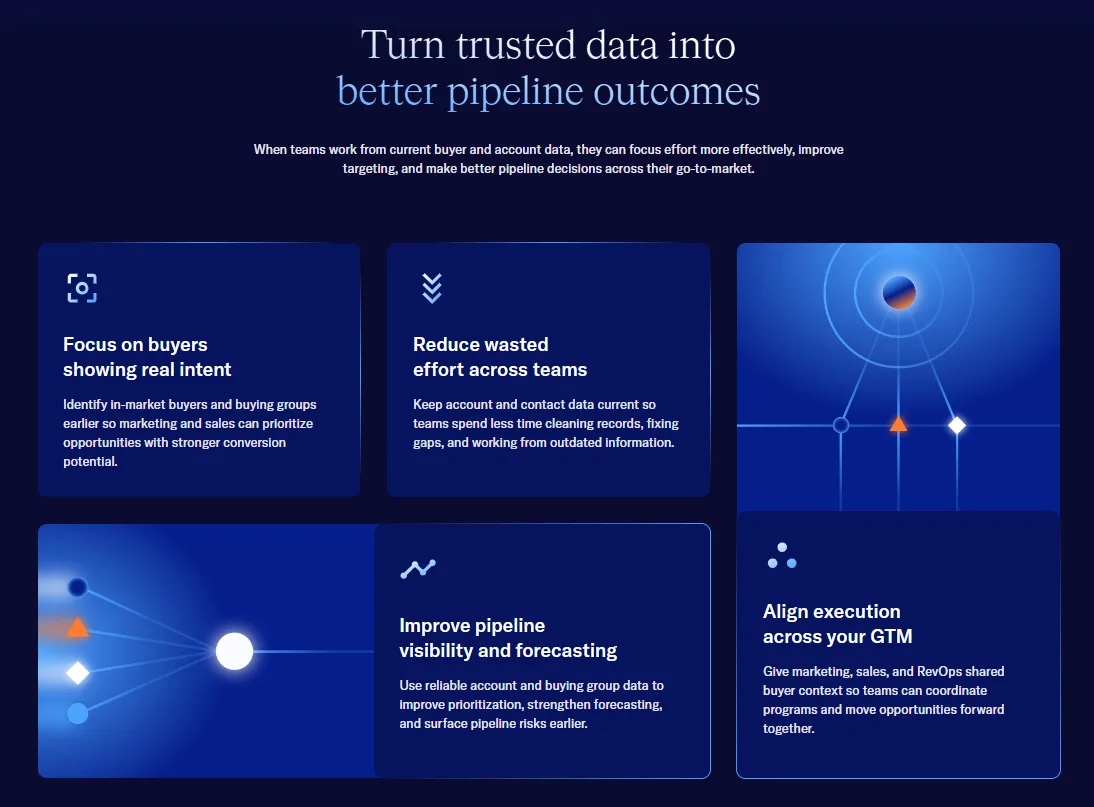
The platform combines firmographic, technographic, intent, and engagement signals to prioritize buying opportunities, coordinate sales and marketing activities, personalize advertising, and measure account progression throughout the customer lifecycle, all within a unified platform.
Source: Demandbase
Demandbase continuously incorporates new first-party engagement data alongside third-party firmographic, technographic, and intent signals into its account intelligence.
The platform focuses on maintaining an up-to-date view of account engagement and buying behavior instead of relying on scheduled database refreshes, which helps revenue teams identify opportunities as they emerge and adjust outreach based on evolving customer activity.
Demandbase complies with major privacy regulations, including GDPR and CCPA, and provides governance features that help organizations manage consent and customer data responsibly.
The platform also maintains industry-standard security certifications to support enterprise deployments and integrations.
Demandbase is best suited for:
- B2B companies practicing account-based marketing (ABM)
- Enterprise sales organizations with complex buying committees
- Marketing teams focused on account-based advertising
- Revenue teams seeking unified sales and marketing intelligence
- Organizations investing in GTM orchestration and pipeline optimization
If your organization is primarily looking for a standalone firmographic database; an API-first data enrichment platform; or company intelligence for procurement, supplier discovery, market research, or financial risk analysis, then you may find a specialized data provider more suitable.
Demandbase doesn’t publicly disclose pricing for its platform.
Pricing is provided through custom enterprise quotes based on factors such as organization size, required modules, user licenses, and integration requirements.
Conclusion
Choosing the right firmographic data provider means selecting a solution that aligns with how your organization uses company data.
That’s why understanding their differences will help you invest in a platform that solves your specific business challenges rather than paying for capabilities you don’t need.
As you compare providers, define the problems you want to solve, your primary use case, types of data your teams rely on, and how that data will integrate with your existing workflows.
Ultimately, the right firmographic data provider shouldn’t just help you find companies.
It should provide the trusted insights your team needs to identify opportunities, make better decisions, and drive measurable business outcomes.
Articles
Discuss how these trends affect your organization.
Our analysts are available for a short call. Bring a specific question and we will ground it in the data.
Insights
Keep reading
More analysis, research, and outcomes grounded in live company intelligence.
Do We Trust Our Data?
Everyone knows what you mean when you ask them, “do you trust the data you use?” And everyone WILL answer you. Perhaps not articulately, but they will have an opinion. “It’s decent”, or “it’s crap”, they will say, and so on. But don’t ask anyone to define what trust is [...]
A Closer Look at the Data Enrichment Providers Businesses Trust Most
We will take a closer look at data enrichment providers and show how they help organizations build more accurate and complete datasets.
Which Online Business Data Providers Stand Out in Today's Market?
This article will highlight online business data providers that businesses trust for accurate company information and actionable insights.