Insights / Articles
How to Buy Company Data: What You're Actually Paying For
Paying $0.10 per record turns into $0.17 at a 60% match rate. Before you buy business data, test format, coverage, freshness and how vendors charge.

- A low price per record can cost more once unmatched records and extra fields are added.
- Match the delivery format to your workflow before you compare prices.
- A large company count can still miss the firms you need, so test coverage on your own list.
- "Updated regularly" is not a measurable service level.
To buy business data that works for you, choose the right delivery format, check coverage and freshness against your own target list, and understand how the vendor charges.
A low price per record means little if records don't match, fields are stale, or the format requires extra engineering effort.
Some providers, including Veridion, let you test their data on your own records before you commit.
Decide on the Delivery Format: API, Batch, or Static Dataset
The format you choose determines how much engineering work it takes to get the data into your workflow.
Most providers offer three delivery formats:
- A real-time API that charges per call or per matched record
- Scheduled batch delivery that sends you a file on a set schedule
- A static dataset that is a one-time export
A real-time API fits enrichment at the point of capture. Your application sends a company name, domain, address, or identifier and receives a matched profile.
This option is best for onboarding, account creation, risk assessment, and product features that require up-to-date information. The downside is cost and overhead, since per-call or per-match costs increase as traffic grows. Retries, rate limits, observability, and error handling also require additional engineering effort.
Scheduled batch delivery fits large, repeatable refreshes. You send or receive CSV, JSON, or Parquet files on a daily, weekly, monthly, or custom schedule.
Batch processing gives you predictable throughput and works well for Customer Relationship Management (CRM), Enterprise Resource Planning (ERP), Master Data Management (MDM), and warehouse backfills. It does not give you an immediate answer when a new record enters the system.
A static dataset is a one-time export. This option can be the least expensive and best for a specific research project or model development, but it becomes outdated as soon as the vendor exports it.
Here's a quick summary of the three data delivery formats:
Format | Best for | Main trade-off |
|---|---|---|
Real-time API | Immediate enrichment during onboarding, account creation, or risk checks | Current data, but costs and engineering work grow with usage |
Scheduled batch | Large, recurring CRM, ERP, MDM, and warehouse refreshes | Predictable at scale, but not real time |
Static dataset | One-time research or model-development projects | Lowest upfront cost, but starts aging immediately |
You must also budget for storage, deduplication, schema mapping, and the next replacement file.
Before you buy business data, map each use case to its latency and volume needs.
Use an API when speed is essential. Use batch when volume and completeness matter more than speed. Use static files only if there's an end date to the analysis.
Poor data handling already has a measurable cost. In a 2023 survey of more than 80 large organizations, McKinsey found that 82% spent at least one day each week resolving master-data quality issues, and 66% still used manual review to manage data quality.
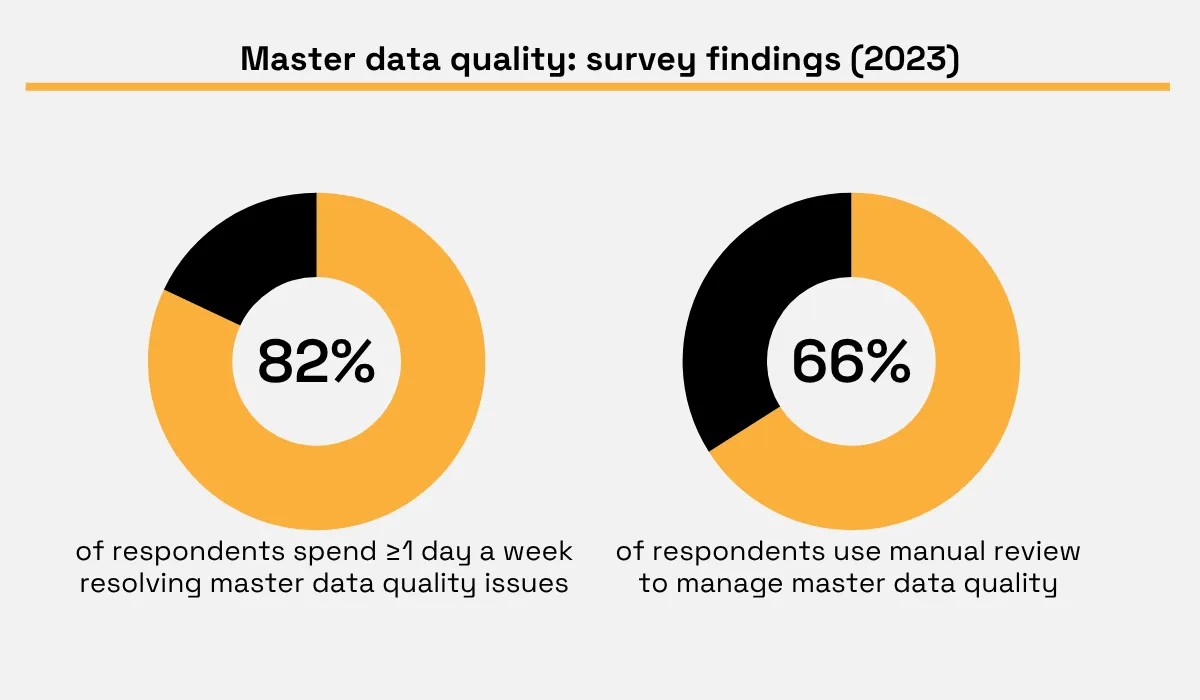
Choosing the wrong format can add another manual process to your workload.
Check Coverage Against Your Own Target List
A provider's total company count shows the size of its inventory, not whether it fits your needs. Before you buy company database access, check whether your companies are in it.
Coverage is often strongest for large, public companies in the US and UK, and thinner for private firms, small businesses, and non-English-speaking markets. These categories are usually where your use case sits.
The US Small Business Administration reports that 99.9% of US businesses (about 36.2 million) are small. A database can cover most large employers and still miss most of the market.
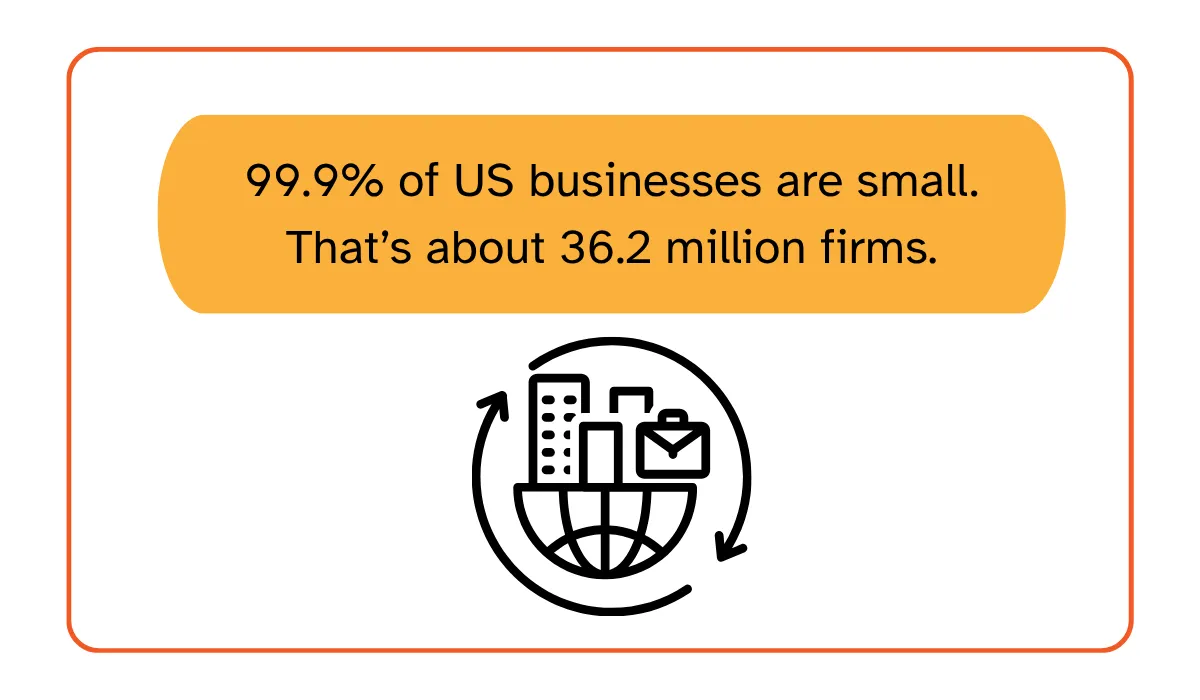
Illustration: Veridion / Data: US Small Business Administration
Registries have gaps too. In Canada, many companies register by their number instead of a name. As a result, the registry record contains nothing useful for an underwriter: no sector, description, or location.
Established vendors like Dun & Bradstreet and ZoomInfo provide coverage information in their own documentation.
Dun & Bradstreet says it builds its Data Cloud from public registries and tens of millions of websites, with each business identified by a D-U-N-S Number.
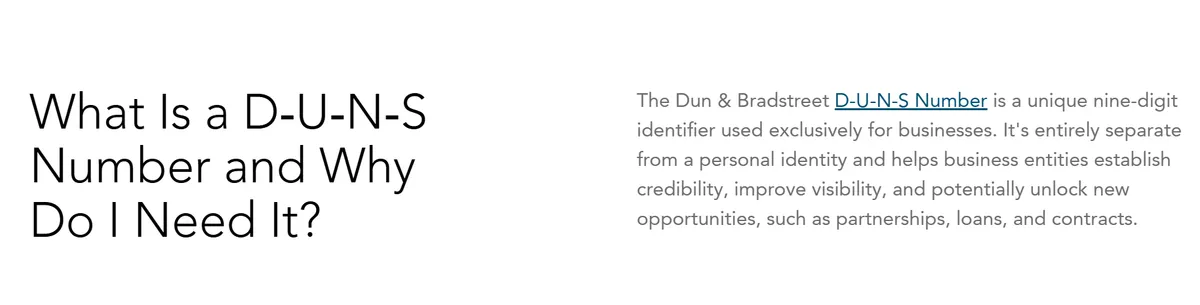
Source: Dun & Bradstreet
ZoomInfo highlights its company and contact search, and its data page shows most of its company records are in North America.
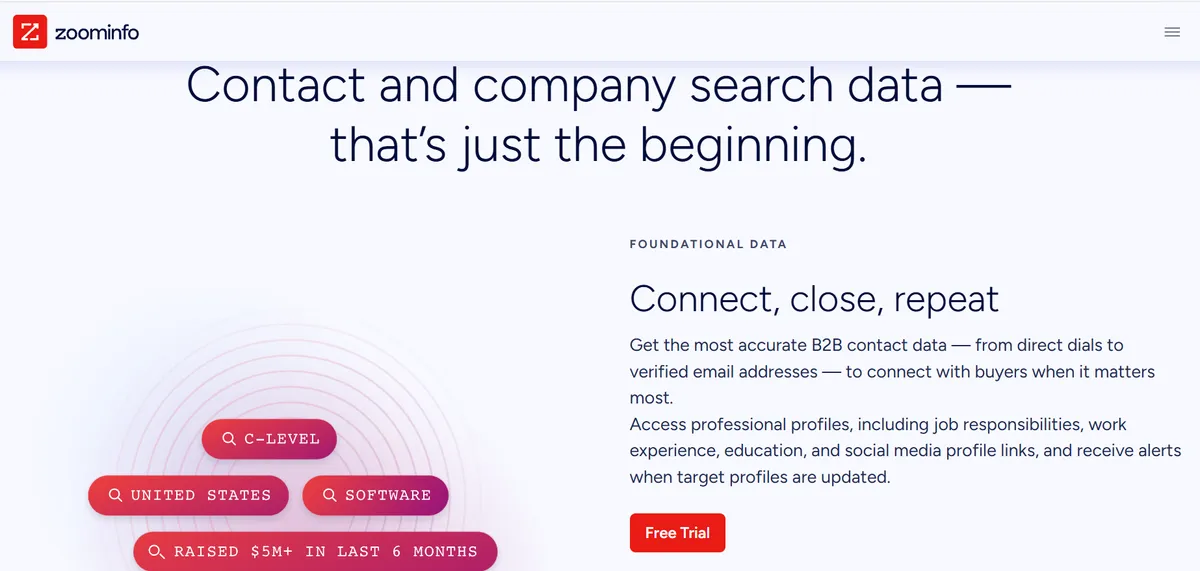
Source: ZoomInfo
Both descriptions cover the database as a whole. Neither tells you how well it covers your list.
If you want to choose the right data vendor, test coverage with your target list before purchasing anything. Export your target list with country, company size, and industry information.
Ask each vendor to match it and return the match rate by segment, not one overall figure.
First, calculate the match rate, the percentage of submitted records linked to the correct company. Second, calculate the field fill rate for the attributes your workflow requires. Third, review false matches and unmatched records by segment.
For broader discovery work, also test whether the provider finds companies that are absent from your list. Veridion's market intelligence data supports searches by company identity, industry, location, and operational attributes.
Check How Fresh the Data Is
"Updated regularly" is not a specification. Ask what changes, when it changes, and how you can verify the update.
Companies change all the time. The US Bureau of Labor Statistics counted 323,000 new private-sector establishments in the third quarter of 2025. In the fourth quarter of 2024, 306,000 establishments closed for good. BLS publishes closure data with a three-quarter lag, so the latest figures cover different quarters.
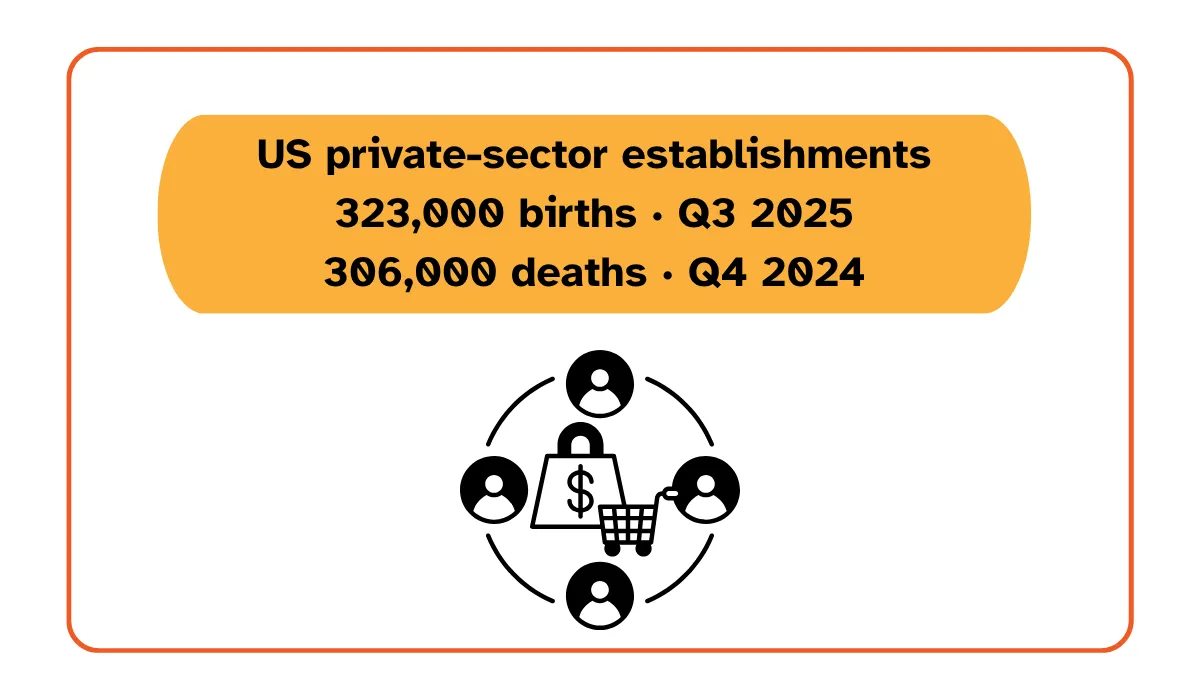
Illustration: Veridion / Data: US Bureau of Labor Statistics
Every opening and closure can make a record you bought outdated.
Different fields have different volatility. Company status, operating locations, headcount, products, leadership signals, and web technologies may change quickly. Incorporation date and some classification fields change less often.
A provider can refresh a small set of volatile fields each week while leaving the rest untouched for a year, then market the entire database as weekly updated.
IBM defines timeliness as whether data "reflects the most current situation." It treats timeliness as one of six core data-quality dimensions, alongside accuracy, completeness, consistency, validity, and uniqueness. That's why freshness has to be checked field by field.
Ask the vendor for a field matrix with five columns: source, collection date, last-verified date, refresh trigger, and cadence.
Also ask for recent examples of company closures, address changes, acquisitions, and product launches.
Compare the returned values to an authoritative source and note the detection lag.
Then add freshness to your contract. Specify the maximum acceptable age for each critical field as well as the monitoring and remediation procedures.
You may accept an older founding year. You may also require a newly inactive supplier status within days. Those are different service levels.
Veridion documents a methodology in which attributes include confidence and a source trail with a last-harvested date. Its data model also ships lower-confidence values with lower scores and omits values instead of guessing when it lacks evidence.
Understand How Vendors Charge
When you buy B2B data, you pay for more than records. Vendors usually charge in three ways:
- Per record or per API call
- A flat annual license
- Tiered pricing, depending on the level of data enrichment
Per-record or per-call pricing ties cost to consumption. Define the billable event before you compare rates. It could be an attempted call, a successful match, a returned record, a field group, or a refreshed record. One provider may charge once per matched company. Another may charge each time you request it.
While the flat annual license makes budgeting easier, the contract may impose limitations such as the number of seats, exports, applications, geographies, refreshes, or redistribution.
Tiered pricing adds another layer. Basic firmographics may be included in the introductory package, but financials, ownership, technographics, locations, or historical data may cost extra.
Each model has hidden costs. A low price per record becomes expensive when match rates are poor.
Some providers bill only for matched records, so check which model applies before you compare quotes.
Do the math before you sign. Say a vendor charges $0.10 per record and matches 60% of your list. Each matched record then costs about $0.17.
Poor data also costs your company revenue. Forrester reports, based on 2023 data, that more than a quarter of global data and analytics employees who say poor data quality hinders data literacy estimate their organizations lose more than $5 million a year as a result.
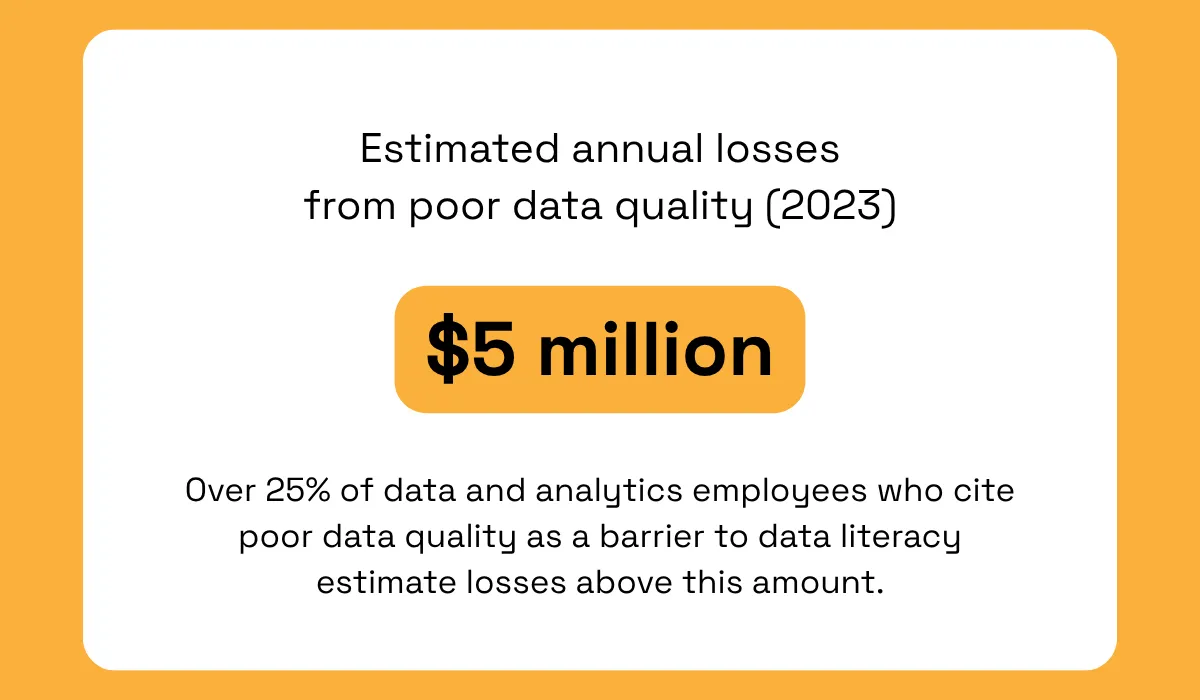
Before signing a deal, confirm three things:
- Are you charged for unmatched records?
- Which fields are included in the basic price?
- What is the cost per usable record (price/match rate)?
Then ask for a trial or paid proof of concept using your records. A polished demo on the vendor's own sample proves only that the interface works. It does not guarantee that your match rate, target coverage, or the fields you need will meet production standards.
Test Data Quality Before You Buy
Every risk above comes down to one question: can you verify what you are buying before you commit? A sales page cannot answer it. Your own records can.
A useful test begins with a representative sample of your own records. For a large enterprise, include enough records to expose segment gaps rather than selecting only familiar global companies.
Set acceptance criteria before submitting the file. Score:
- Match accuracy, counting false positives as errors.
- Match confidence distribution, not only the average.
- Coverage by geography, size, industry, language, and public or private status.
- Fill rate for each required field.
- Accuracy against trusted internal records or authoritative sources.
- Freshness, based on field-level verification dates and known recent changes.
- Provenance, including the source and whether a value is observed, extracted, or modeled.
- Integration fitness, including schema stability, identifiers, latency, error handling, and file size.
Veridion is built for this kind of evaluation. It delivers data via API or batch and attaches field-level information showing each value's reliability.
Veridion's revenue attribute shows what field-level reliability looks like. Companies that publish their revenue, such as public companies, return an official value. Companies that do not publish it return an estimate.
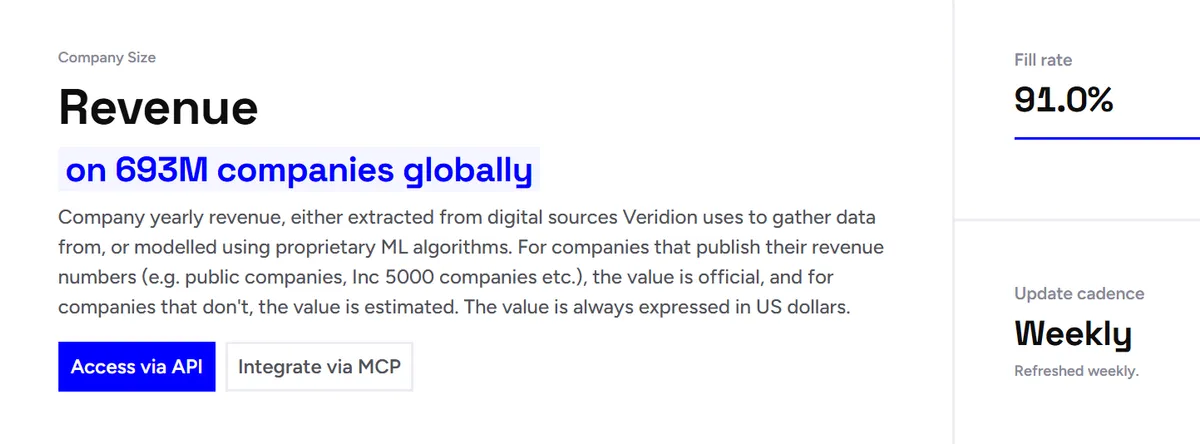
Source: Veridion
Each value carries a confidence score and a last-updated date, and its type shows whether the figure was published or modeled.
Veridion tracks 744.5M companies, but the number that matters is how many of yours it matches.
A real customer example shows the validation process works in practice. A global e-commerce and cloud-services company relied on supplier questionnaires that reached only a fraction of its ~69,000 suppliers.
It piloted Veridion on 500 suppliers, then compared 25 of them, plus nine priority suppliers, against their full self-reported questionnaires. Veridion also resolved the full supplier base and reported how much of it the method could cover.
Each data point had a source URL, timestamp, detection path, and confidence score. The pilot used a minimum precision threshold of 0.95 for deterministic data and 0.80 for AI-generated data.
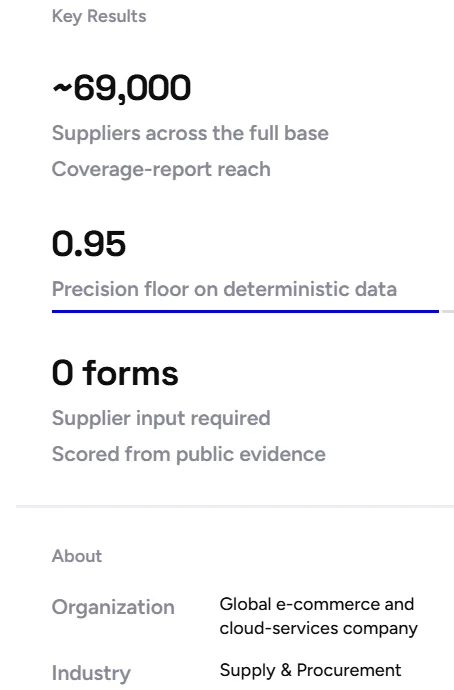
Source: Veridion
Validate a vendor's data in four steps:
- Make sure your database is ready, since duplicates and missing values can skew the match rate for the wrong reason.
- Pick 300 to 500 accounts that mix customers, prospects, and hard cases.
- Run validation and evaluate the match rate by segment, confidence score, and timestamp on selected fields.
- Check 20 returned records against what you know to be true.
This shows you exactly what you're buying before you commit.
How Does Veridion Compare to Other Company Data Providers?
The table below compares Veridion with five established providers across the criteria that affect real-world value: private-company coverage, freshness, delivery, pricing, and the ability to test the data before buying.
Provider | Pricing | Private-company coverage | Update documentation | Delivery | Test on your records | |
|---|---|---|---|---|---|---|
Veridion | Custom, scoped by coverage and usage. | Public and private companies, including SMBs, within 744.5M companies. | Field-level confidence, source, and last-updated date. | API, batch files, warehouses, marketplaces. | Yes, with sample data or API access. | |
Dun & Bradstreet | Not publicly specified. | Not publicly specified. | Billions of monthly checks; no field-level schedule. | UI, Direct+ API, batch files. | Yes, D&B Connect free trial. | |
ZoomInfo | Credits per enriched record; search is free. | Not publicly specified. | Daily processing volumes; no field-level schedule. | UI, API, bulk endpoints. | Yes, free API tier and bulk preview. | |
Orbis (Bureau van Dijk, Moody's) | Annual subscription; no public prices. | Mostly private companies. | Mostly weekly; some datasets within 24 hours. | Web, APIs, bulk feed, cloud. | Demo on request. | |
OpenCorporates | Annual API plans; bulk by quote. | Registry-listed legal entities, including private ones. | Source URL and date per record; bulk monthly or quarterly. | Web UI, JSON/XML API, bulk CSV. | Not publicly specified. | |
Coresignal | Monthly or annual credit plans; datasets priced separately. | Not publicly specified. | Records refreshed continuously; datasets daily to monthly. | UI, API, JSON/CSV/Parquet files. | Yes, 7-day trial with 2,000 credits. |
Provider fit depends on the job. Registry-based providers suit legal-entity verification, contact-focused platforms suit go-to-market workflows, and financial and ownership databases suit private-company research.
Web-signal datasets suit teams that build their own analysis, while operational company intelligence like Veridion suits enrichment, mapping, and workflows that need traceable company-level attributes.
Conclusion
The true cost of buying company data comes after implementation. Inconsistent coverage, outdated fields, poor matching, extra charges, and integration challenges can overwhelm an initially low record cost.
Before you buy company data, evaluate vendors against your real workload.
Test shortlisted vendors on your own target list, ask for a sample match with field-level detail, and choose based on the results, not the demo.
Articles
Discuss how these trends affect your organization.
Our analysts are available for a short call. Bring a specific question and we will ground it in the data.
Insights
Keep reading
More analysis, research, and outcomes grounded in live company intelligence.
Market Intelligence: Use Cases Across Departments
Want to make better decisions across departments? Learn how market intelligence use cases apply to your entire organization.
5 Trends Shaping the Future of Market Intelligence
Want to future-proof your business strategy? Explore the top trends defining the future of market intelligence.
Key Differences Between Competitive and Market Intelligence
Discover the key distinctions between market and competitive intelligence - so you can apply the right approach in your strategy.