Insights / Articles
Commercial Due Diligence With Company-Level Data: A Practical Framework
A target promises 15% yearly growth in three new regions. Use four steps and company data to test each claim before your commercial due diligence sign-off.

- Company data maps a target’s market, competitors, and ownership structure.
- Multiple data sources provide a more complete picture of the target and its market.
- Evidence-based CDD tests growth projections and exposes investment risks.
- Veridion supports CDD with structured, up-to-date, and traceable company data.
Commercial due diligence is one of the core investment checks. It helps you evaluate whether a target's growth plans support its investment case.
Company-level data gives you evidence to test these plans: it shows what the target does, who it competes with, and where its growth plans have gaps.
Below, we walk through a four-step commercial due diligence framework using a fictional target.
What Can Company-Level Data Add to Commercial Due Diligence?
Commercial due diligence (CDD) checks whether a target matches the investment thesis.
Unlike financial due diligence, which checks historical performance, CDD looks at the target's market, competitive position, and business plan to judge whether its growth expectations are realistic, including what that growth would cost.
Guillermo García-Barrero, Managing Director in EQT's Infrastructure team, defines CDD like this:

Company data helps you answer core CDD questions in areas such as:
- Business model
- Market position and coverage
- Competitive positioning
- Growth plan and its practicality
- Revenue concentration
- Acquisition rationale
- Risks and assumptions
You can use company-level data to examine these areas for CDD. For example:
- Business activity, products, and services can tell if a company’s market positioning and description match its actual activity.
- Operational footprint shows whether its current scale can support its growth and expansion plans.
- Company size and operating status show whether a competitor is large enough to target the same buyers and whether it is still active.
- Corporate hierarchy shows parents, subsidiaries, and other relationships that can reveal dependencies and conflicts of interest.
Company data alone is not enough for CDD. You need to combine it with other sources to get a complete picture.
In PwC’s 2024 Private Equity Trend Report, a survey of 250 European PE principals, 87% said they use data analytics to identify targets, and the same share use it for due diligence.
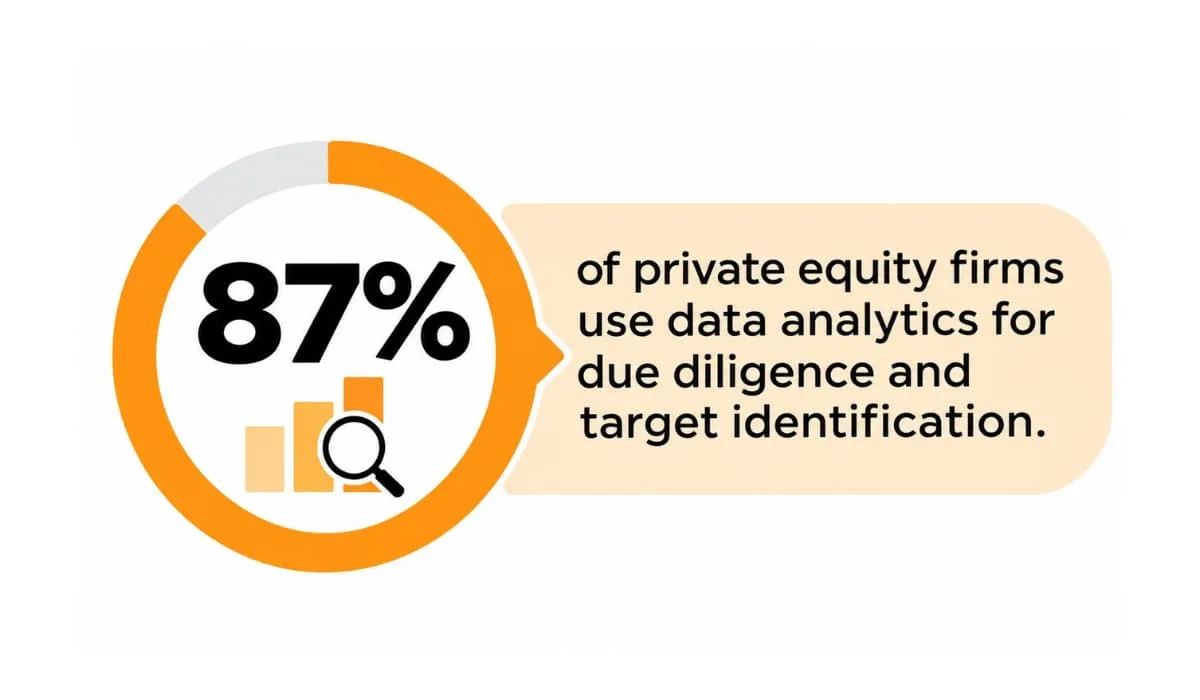
PwC also found that firms are looking beyond traditional sources and adding external data to test assumptions about a target's competitive position. In CDD, these sources fall into three broad categories:
Data source type | Useful CDD questions | Limitations |
|---|---|---|
External company data | Business activities, market presence, locations, company size, corporate relationships, competitor footprint. | Incomplete records, outdated information, limited visibility into actual performance. |
Target's internal data | Revenue breakdown, customer concentration, sales pipeline, operating capacity, historical performance. | Management bias, inconsistent reporting, unverified assumptions. |
Customer or expert research | Customer demand, satisfaction, buying behavior, competitor strengths, market trends. | Limited sample size, subjective feedback, time and access constraints. |
Use all three, since each covers a different part of CDD and none can replace the others.
A Practical Framework for Commercial Due Diligence With Company Data
This framework has four steps. First, you define the claims to test. Next, you check the company data and then the wider market. Finally, you test the growth plan against what you found.
1. Define the Commercial Claims to Test
Treat the target's business plan as a hypothesis. Break it down into specific claims you can test, so you can judge whether the plan is realistic.
The claims usually fall into these areas:
- Market attractiveness
- Customer base and demand
- Competitive positioning
- Products, services and pricing
- Revenue model and growth potential
- Sales strategy and go-to-market execution
- Business risks and external factors
From these areas, pick the claims that matter most to the investment case.
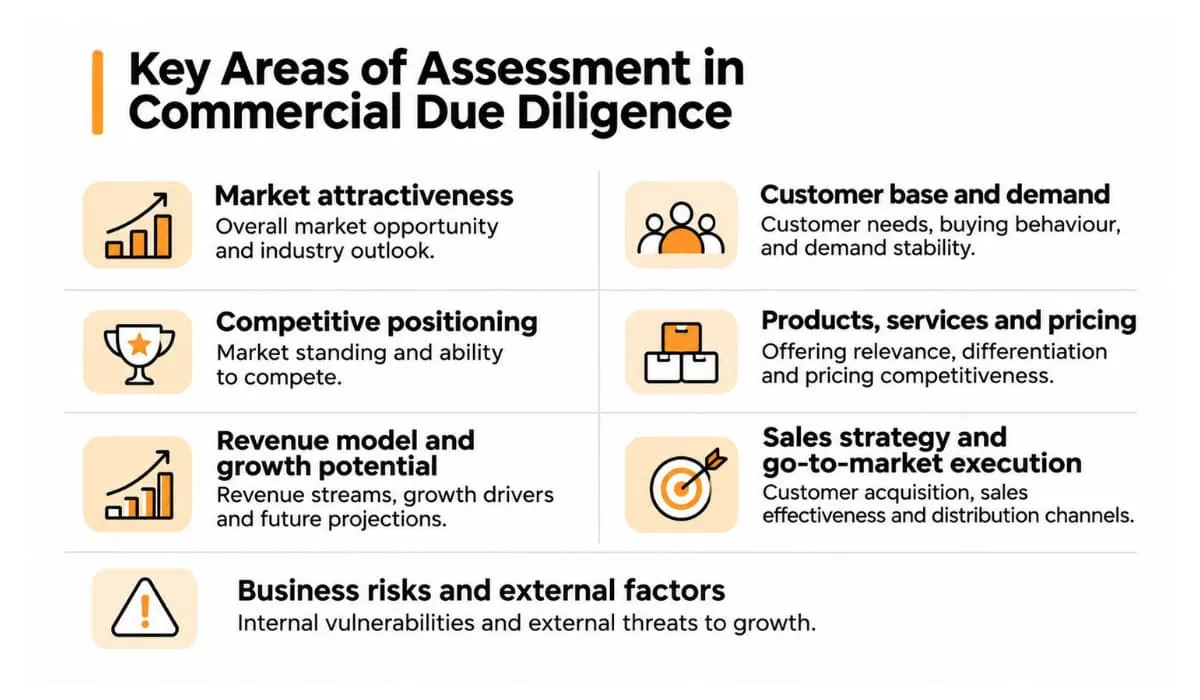
Illustration: Veridion
Take a fictional packaged food manufacturer that makes ready-to-eat products.
It expects to grow revenue by 15% a year over the next five years, driven by rising consumer demand, expansion into new regions, and new product categories.
The plan rests on three commercial assumptions: demand for the target's products is growing, new markets can generate additional revenue, and new product categories can attract customers.
It also assumes the business can increase production without hurting quality or delivery, expand its distribution network into new markets, and develop, launch, and sell new product categories.
Before you test them, define the scope: which products and customer segments the plan covers, which regions the target plans to enter, and over what time period. Then note what evidence would support or challenge each assumption. For example, strong established competitors in a new region would challenge the expansion plan, while evidence of unmet regional demand would support it.
2. Check the Company Data and Its Sources
With the scope set, you can start gathering company data.
Source, accuracy, and freshness are the key checks for any commercial due diligence data.
Before you use a company list, check it for four issues: coverage gaps (companies missing from the list), outdated records, duplicate companies, and missing corporate-group links. Each one can distort your conclusions.
External sources include public registries, but these often hold limited information on private companies.
Third-party data providers like Veridion are a more complete option. They combine company websites, trade registries, and other sources and refresh the data continuously, giving you all the information in one place.
Veridion tracks 744.5M companies worldwide, from public and private businesses to newly formed ones. Its data shows what companies do, where they operate, how large they are, and who owns them.
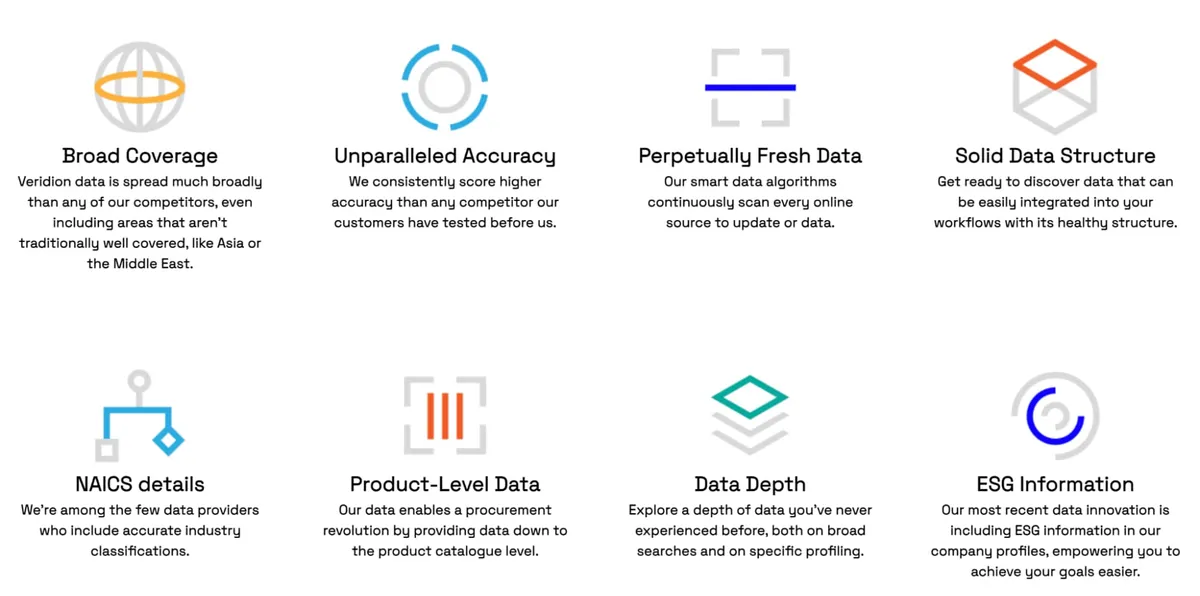
Source: Veridion
Every Veridion attribute comes with a confidence score that shows how reliable it is.
It also includes the source, so you can trace each data point back to where it came from, and a last-verified timestamp that shows when it was last checked.
This allows you to properly document every data point with its source and confidence level, because data reliability is just as important as having the data itself.
Flag any estimated values. If a data point is missing, write missing, not zero. If two sources disagree, record both values and note which one you used and why.
Your data source should flag estimated and missing values, too. For example, Veridion labels financial figures as modeled when a private company doesn't disclose them.
Veridion's case study shows how outdated records can distort competitive intelligence. A global market-intelligence provider found that about 30% of the domains in its company data were outdated or broken, around 20% of addresses were wrong, and defunct companies were still listed as active. Veridion matched 99% of its companies, corrected the domains and addresses, captured around 200 missed acquisitions and 200 rebrands, and mapped corporate groups of up to 260 entities.
The provider now has a more accurate view of competitors and their ownership structures.
Whatever source you use, company data for due diligence should resolve each company to the exact legal entity, with no duplicates.
3. Assess Market Structure and Competitor Density
Next, assess the target’s market through two lenses: market structure and competitor density.
Market structure tells you how a market is organized, including the number of businesses, their size, ownership, geographic presence, and distribution across segments.
Competitor density is the number of credible competitors (those targeting the same buyers in the same region) within a defined market or area.
Together, they show what kind of market the target operates in and what constraints it could face.
To measure them, search for businesses with the same activity in a specific region.
You will get company counts, along with company profiles and ownership structures where they are available. Their footprint, headcount, and financial data help you gauge their scale.
Let’s return to our packaged food manufacturer and compare the three regions it plans to enter (all figures are fictional).
Region | Relevant businesses/operating sites | Independent corporate groups | Available size indicators | What the pattern suggests |
|---|---|---|---|---|
Region A | 120 businesses / 180 sites | 85 groups | Employee count, revenue | High competitor presence; ownership overlap needs verification |
Region B | 65 businesses / 90 sites | 50 groups | Operating sites, production capacity | Lower competitor density; market demand remains unclear |
Region C | 40 businesses / 75 sites | 25 groups | Revenue, employee count | Fewer groups, many with multiple sites; possible market concentration |
Region A has the most competitors, but its 120 businesses belong to 85 groups, so there are fewer independent rivals than the count suggests. Region B has fewer competitors, but demand there still needs checking. Region C has the fewest groups, which may mean a few larger players already control it.
The results can change depending on how you define the market. A smaller region will have fewer competitors than a larger one.
According to Eurostat, large enterprises (250+ employees) made up only 0.2% of EU businesses in 2024, but generated 51.3% of total net turnover.
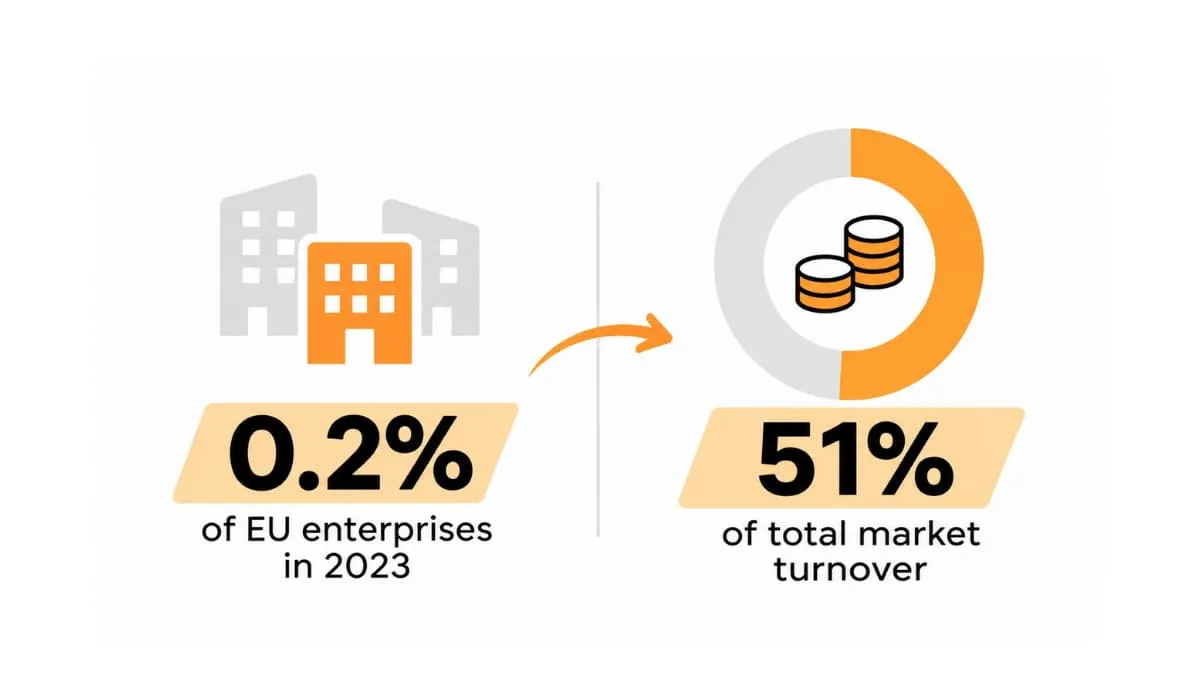
A company count alone says little about concentration: a market with many businesses can still be dominated by a few large ones. Ownership adds another layer, because several of those businesses may report to the same parent.
This is why the scope you set in step 1 matters.
4. Test the Target's Growth Plan Against the Evidence
Now you can test the assumptions from step 1 against the data you collected.
Vincenz Borrmann, Managing Director at EQT, explains how buyers should treat sellers' projections:
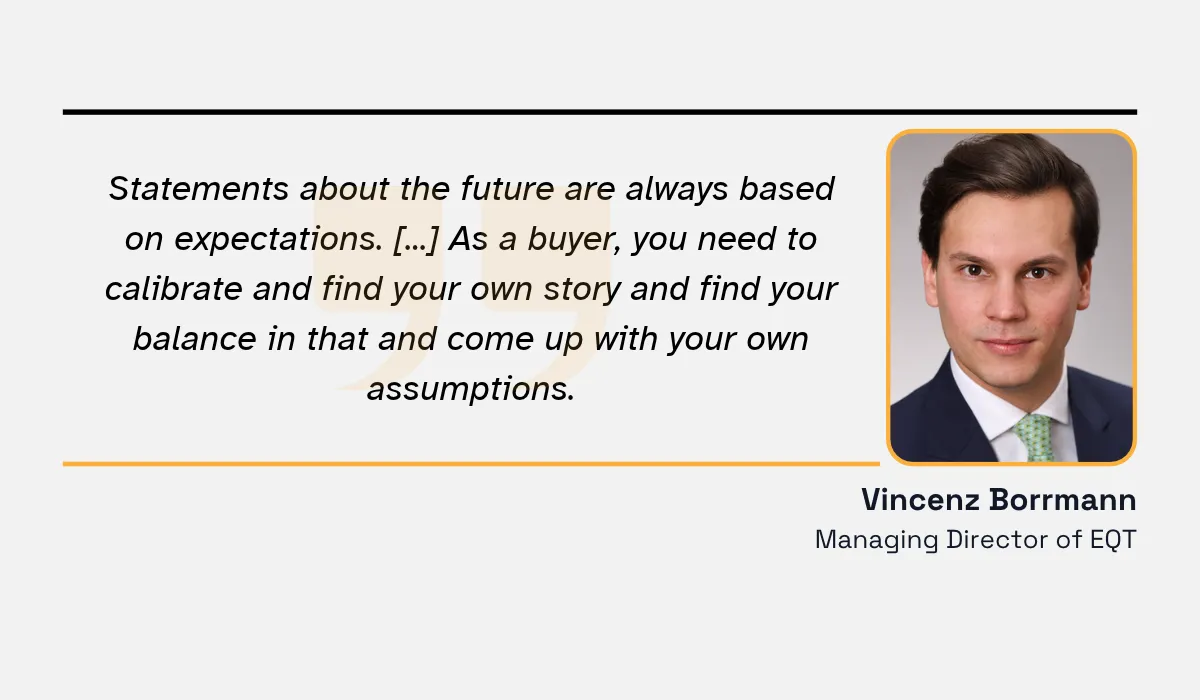
For our packaged food manufacturer, company-level data can identify competitors in the target regions.
It can show where their production facilities are located and compare their geographic reach with the target's existing presence.
For the new product categories, company data shows which competitors already make similar products and how established the market is.
You can compare their employee numbers, operating sites, and production capacity with the target to understand how they measure up.
However, company profiles cannot tell whether consumers will purchase the target's new products, whether demand is growing fast enough to support its projections, or whether existing customers will continue buying from the business.
These claims require additional evidence, such as customer interviews, historical sales data, pricing information, and customer retention figures that you can find through customer research or internal company data.
You should also test your conclusions under different reasonable assumptions.
For example, you can assume expansion into two new regions in the base case, three in the upside case, and one in the downside case. This shows whether the growth plan still holds under different conditions.
Lastly, some growth assumptions depend on the company's ability to execute.
Questions about production capacity, supply chain readiness, workforce requirements, and infrastructure need operational due diligence.
Together, these findings show whether the target's growth plan is realistic and where the main risks lie.
How Should the Findings Affect the Investment Case?
Each finding will either support a claim, contradict it, or show that you need more information.
Link every finding back to a claim in the business plan. The more evidence supports the plan, the stronger the investment case.
In our packaged food manufacturer example, suppose company data shows that two of the three target regions have a strong competitor presence.
This may challenge the assumption that geographic expansion will be easy.
However, competitor presence alone does not prove that the market is saturated. You still need to check market demand and the target's ability to compete.
Similarly, if competitors already manufacture products in the new categories, this confirms that an established market exists, but not that consumers will buy the target's products.
An evidence table brings these findings together:
Claim being tested | Finding and supporting source | Confidence and remaining gaps | Effect on investment case | Next check and person responsible |
|---|---|---|---|---|
Geographic expansion | Company data identified strong competitor presence in two target regions. | High confidence in competitor locations; market demand is unverified. | May require a more cautious expansion plan. | Assess regional demand (commercial team). |
New product categories | Company data identified several manufacturers already producing similar products. | Competitor activity is verified; customer demand is unknown. | Supports the existence of an established market but does not confirm sales potential. | Conduct customer research (market research team). |
Increased production | Internal data shows that current production capacity may not support the projected increase in sales. | Requires verification of actual capacity and planned investment. | May increase execution costs or delay growth. | Review production capacity (operations team). |
The table separates facts from conclusions. For example, competitor locations are facts, but their impact on expansion needs further research.
It should also record what you don't know yet, such as future customer demand and production capacity, so the deal team can see what still needs checking.
Conclusion
Commercial due diligence helps you test a company's growth plans against real market and company data.
It shows what the evidence supports, where the risks are, and what is still missing, so you can judge whether a target is worth the investment.
Company-level data gives you the base for that work: a clear view of the target, its market, and its competitors.
Start with one growth claim from a live deal. Note what the data tells you, what's still unclear, and what you need to check next.
This gives your team a clear starting point for testing the investment case.
Articles
Discuss how these trends affect your organization.
Our analysts are available for a short call. Bring a specific question and we will ground it in the data.
Insights
Keep reading
More analysis, research, and outcomes grounded in live company intelligence.
Operational Due Diligence: A Guide for Investors
Learn what operational due diligence is, the areas investors should examine, the process to perform it, and how it helps uncover risks.
How to Verify a Company’s Operational Footprint in Private Equity Due Diligence
We break down the process of surfacing and validating every location and activity that keeps a business running for PE due diligence.
Sizing the Opportunity: How Bottom-Up Company Data Sharpens TAM and Market Sizing
Struggling with inaccurate market sizing? Learn how bottom-up company data reveals crucial market signals for strategic planning.