Insights / Articles
Competitive Landscape Analysis for Commercial Due Diligence
In one Veridion project, 72% of companies found were missing from the client list. Run a competitive landscape analysis in six steps your team can defend.

- Who counts as a competitor depends on the deal thesis, not on a universal rule.
- One company can appear under three names and quietly inflate the competitor count.
- In one Veridion project, 72% of the companies found weren't on the client's existing list.
- US antitrust guidelines point to one simple signal of how closely two companies compete.
Competitive landscape analysis in commercial due diligence (CDD) helps you test an acquisition target's competitive position and growth prospects.
But the findings depend on the competitor universe you choose. For example, if you leave out smaller rivals or substitutes, the target might look stronger than it actually is.
Your competitor list decides how accurate your conclusions are. Here's how to build, validate, and document it.
What Does a Competitive Landscape Do in Commercial Due Diligence?
A competitive landscape helps assess a company's position against the businesses competing for its customers. In commercial due diligence, it tells you three things:
- Who the target competes with
- How it compares to competitors today
- How its competitive position might change
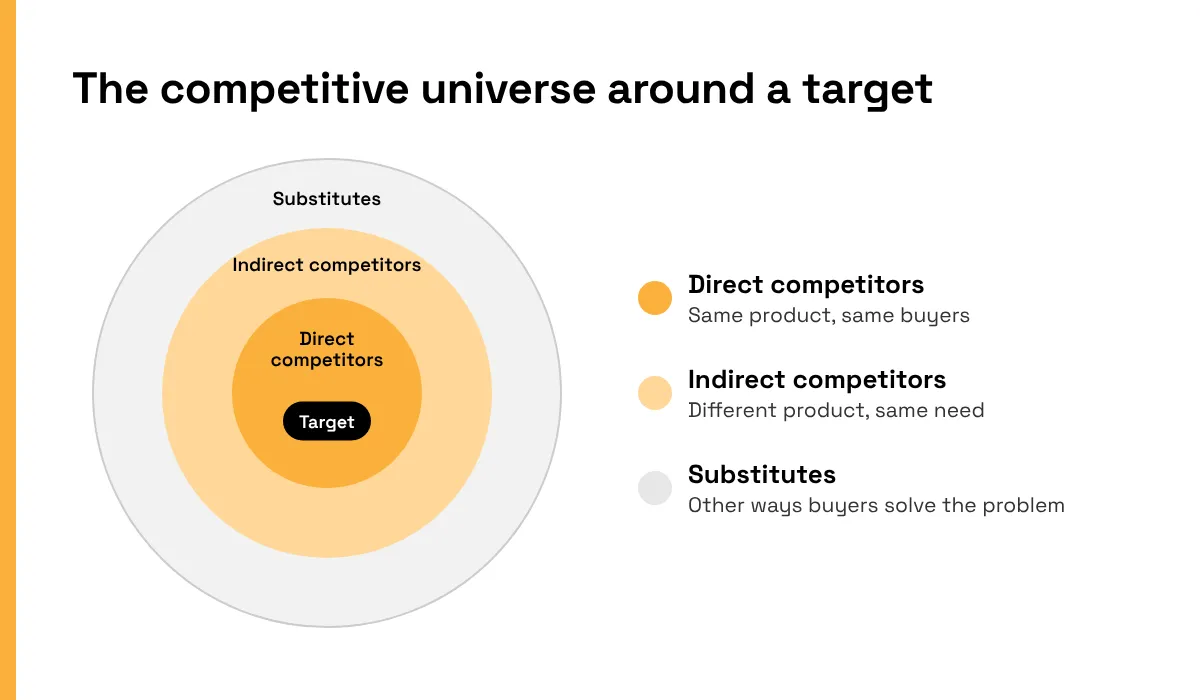
A competitive landscape should start from a broad set of competitors, including the less obvious ones, so you get the full picture of the market before you narrow it down.
Source: Veridion
Leaving out companies that seem less relevant at first, like indirect competitors or substitutes, can lead to the wrong conclusions.
For example, you might overestimate a company's growth potential by overlooking alternatives buyers could choose instead.
That's why defining the competitive universe is essential before assessing market share, benchmarking, or growth. Your investment thesis then decides which competitors stay in.
How to Build a Competitive Landscape Analysis for a Deal
Building a competitive landscape analysis starts with defining your competitors and finding companies that fit that definition.
After that, you should check if your company profiles are correct, segment competitors for accurate assessments, and validate the universe before it reaches the model.
The last step is recording the analysis so other analysts can review it and re-run it later.
1. Define the Competitive Boundary From the Deal Thesis
Start with a broad definition of competition, then narrow it down based on your deal thesis.
Umbrex, a management consulting network, suggests considering these five angles:
Angle | Definition |
|---|---|
Direct competitors | Companies offering similar products or services to the same customers, addressing the same use cases. |
Adjacent solutions and substitutes | Companies offering different products, services, or approaches that address similar customer needs. |
Channel and platform power | Distributors, marketplaces, and technology platforms that control access to customers and the terms of sale. |
Upstream and downstream integrators | System integrators, managed service providers, and service firms that can steer purchase decisions or replace the target's functionality. |
DIY, open-source, and internal alternatives | Spreadsheets, in-house tools, and open-source technologies that customers use instead of buying a product. |
For example, here's what a competitor universe may look like for a B2B competitive intelligence tool:
Angle | Example |
|---|---|
Direct competitors | Other B2B competitive intelligence tools |
Adjacent solutions and substitutes | Market research platforms and sales enablement tools |
Channel and platform power | CRM platforms |
Upstream and downstream integrators | Consulting firms that combine market data and monitoring tools into customized solutions |
DIY, open-source, and internal alternatives | In-house competitor tracking systems built using spreadsheets, web scraping, and internal dashboards |
There's no universal rule for which competitors to include. You decide, based on the target's business model and the assumptions you need to test.
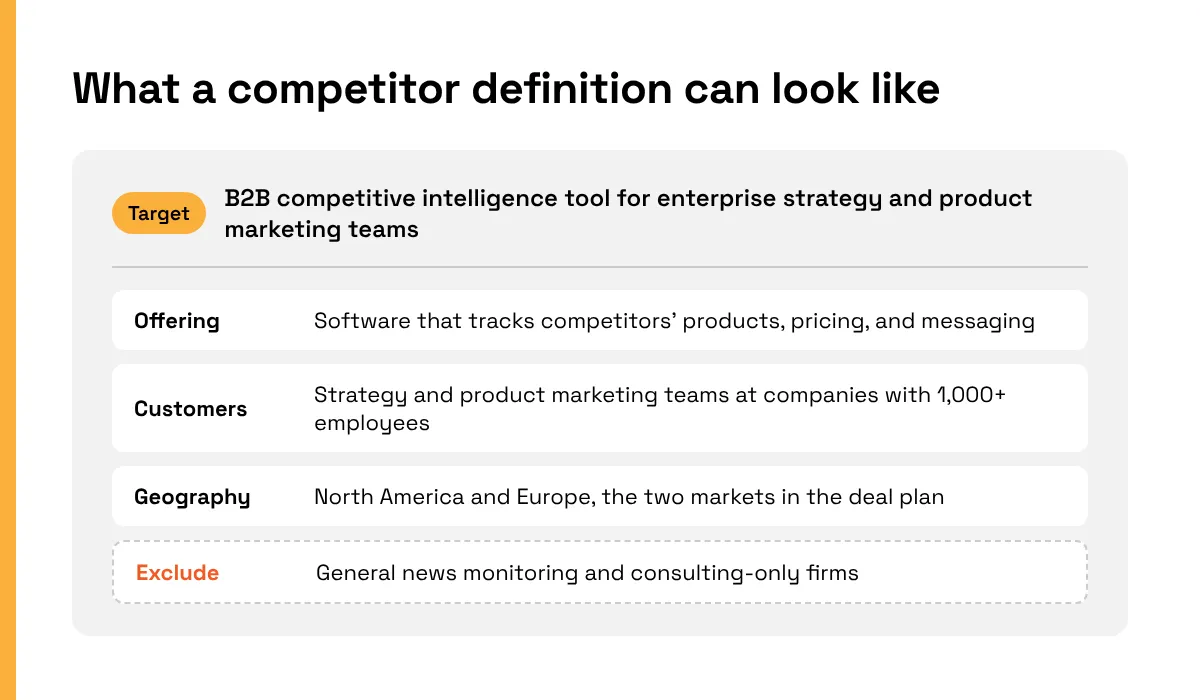
Here's what a definition might look like:
Source: Veridion
If you're struggling with the definition, check whether these three inputs are clear:
- Target offering: What the target sells.
- Customers and use cases: Which customer groups and purchasing situations are central to the investment thesis.
- Geographic scope: Where the target currently competes and which expansion markets matter to the deal.
Write explicit inclusion and exclusion rules based on these inputs before you start searching. That way, the companies you find can't quietly reshape the definition, and the CDD workstream lead can sign off on the rules before any analysis starts.
2. Build the Candidate Universe Bottom-Up
Don't rely solely on the seller's list or competitors your analysts already know.
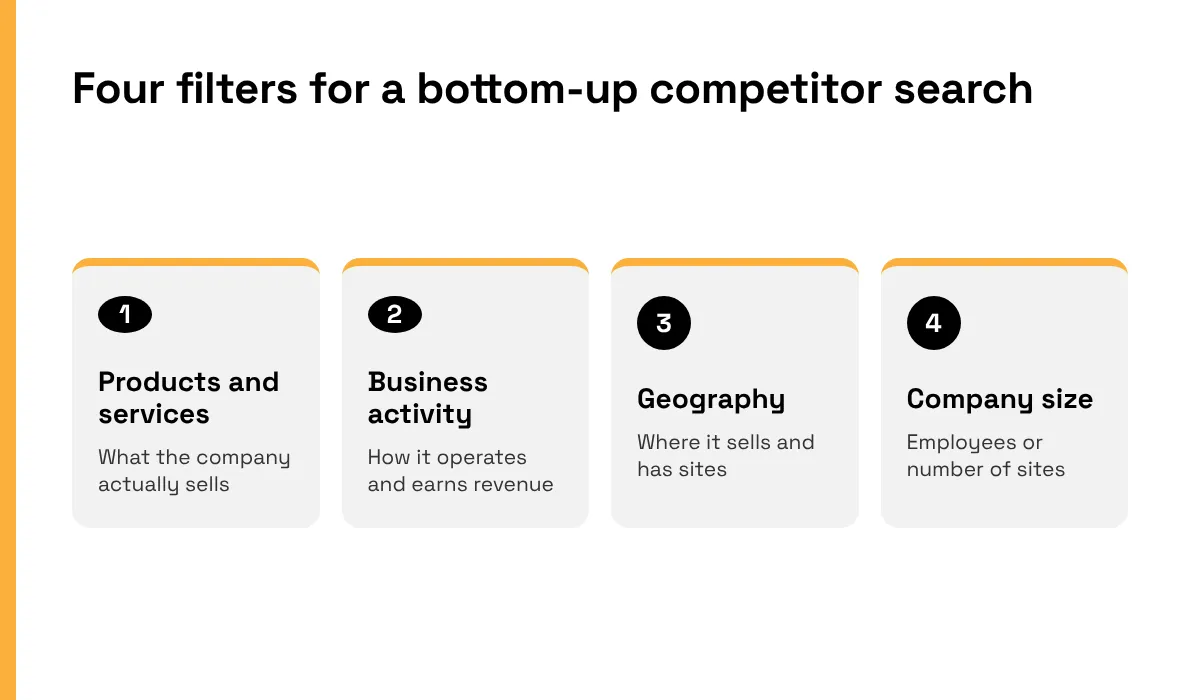
Instead, build your candidate universe from the ground up by searching for companies based on their products and services, business activities, geography, and size.
This approach helps uncover less obvious competitors, like private companies that may not appear in traditional deal databases.
Source: Veridion
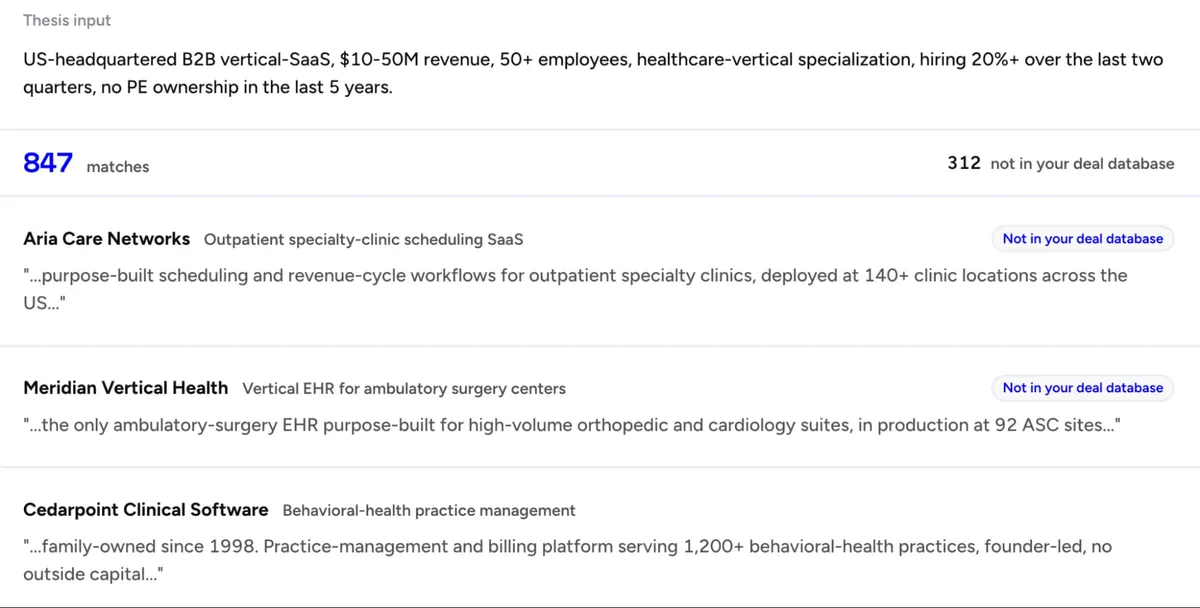
To find companies that fit your definition, use a data provider like Veridion.
Veridion provides PE-grade data on 744.5M companies worldwide. This includes the company-level evidence you need to construct and validate a competitive universe:
- Industry tags
- Scale indicators
- Business activity
- Geographic footprint
- Products and services
- Corporate relationships
With that data, you can find companies that fit your thesis but are missing from your database.
Source: Veridion
Our work with a US financial-data provider shows how much this approach can expand your company universe.
This client wanted to identify promising private businesses that weren't on its lists yet.
We used four operational signals to find them:
- Hiring momentum
- Geographic expansion
- Headquarters upgrades
- Reputation trends (changes in customer reviews)
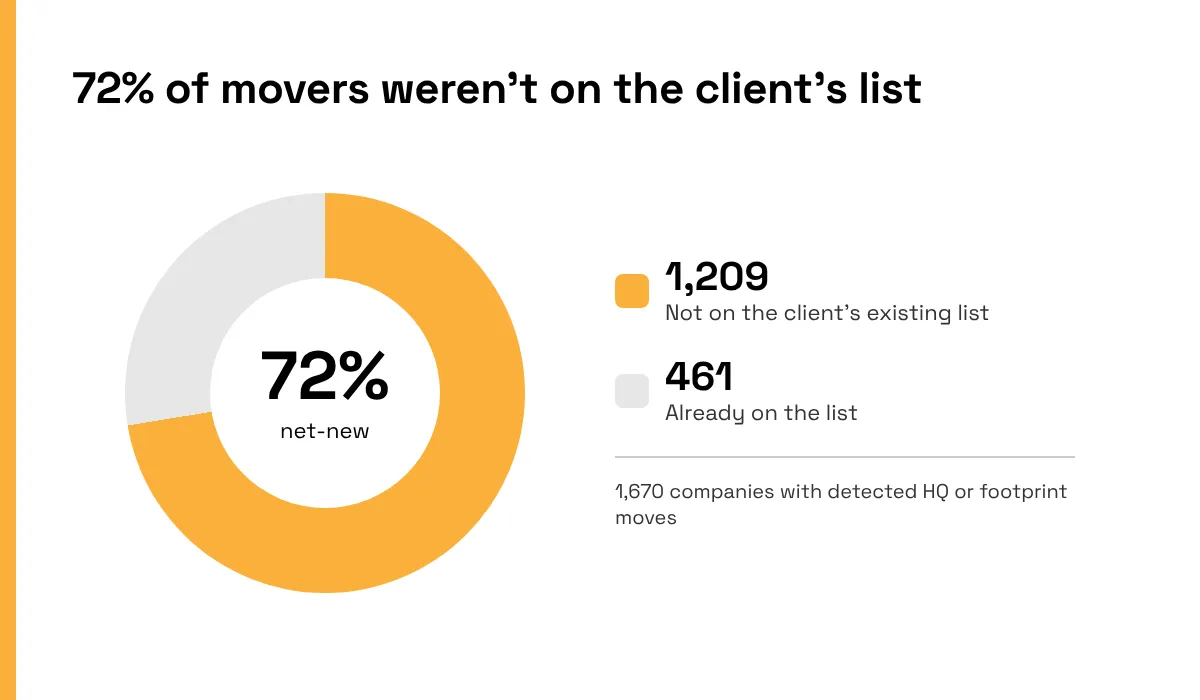
In the relocation analysis alone, we detected 1,670 companies that had moved their headquarters or expanded their footprint.
Of those, 1,209 (72%) weren't on the client's existing list.
The client's list relied on backward-looking data, like static financials and registration records, which show where a company has been, not where it's heading. Our forward-looking signals surfaced companies on the way up, not only established ones.
Source: Veridion
The same approach works for a competitor universe, where it surfaces peers that a list of known names would miss.
At this step, keep both: what you already have and what you uncover through bottom-up research. Tag each candidate with its source (seller's list, analyst, expert, or data search) and a one-line reason for including it. If you reject a candidate, keep it on a separate list with the reason, so reviewers can see what was considered and why it was left out.
3. Resolve Each Competitor to One Record
Next, check whether multiple company profiles actually represent the same business. If they do, merge them into a single record.
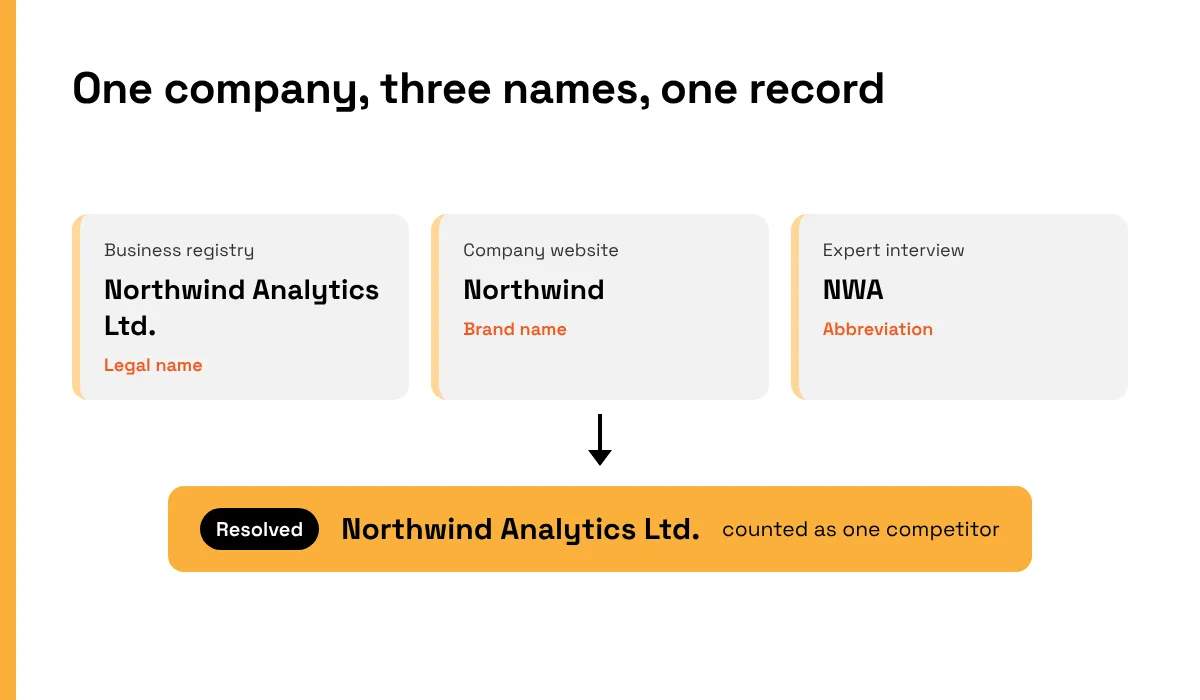
This often occurs when a company appears under different names in different sources. It might be listed under its legal name in a registry, use its brand name on its website, and be referred to by an abbreviated name in an expert interview.
If your database doesn't recognize that these names point to the same entity, it will list them as separate competitors, inflating the universe and distorting your comparisons.
Source: Veridion
You can prevent duplicates by cross-checking company names, identifiers, websites, addresses, and other available details.
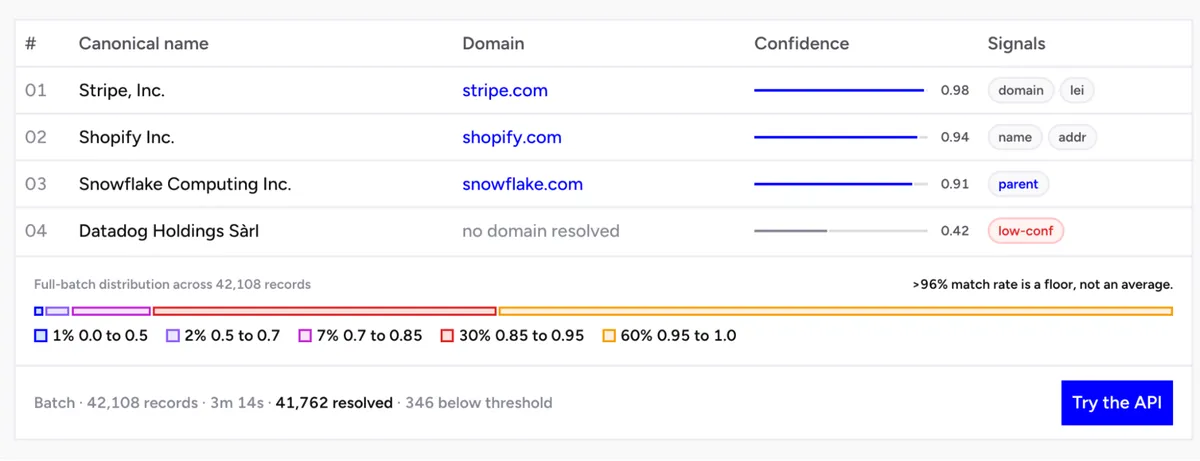
For example, Veridion's Entity Resolution cross-references a company's legal entity, digital presence, corporate relationships, and subsidiaries and returns one profile per company.
In one batch of 42,108 records, it resolved 99.2% on the first pass, and it shows the reasoning and signals behind each match.
Source: Veridion
Veridion's Entity Resolution also links each company to its corporate hierarchy, alias chains, and historical identities.
This shows you when two "competitors" on your list roll up to the same parent company, which changes how many independent rivals the target actually faces.
It's up to you whether your universe will list entities within the same corporate group separately.
If several subsidiaries sell the same solution, you might count them as one competitor. But if they compete independently in different segments, keeping them separate may make more sense.
In either case, record your decision so the count stays consistent.
4. Segment the Universe
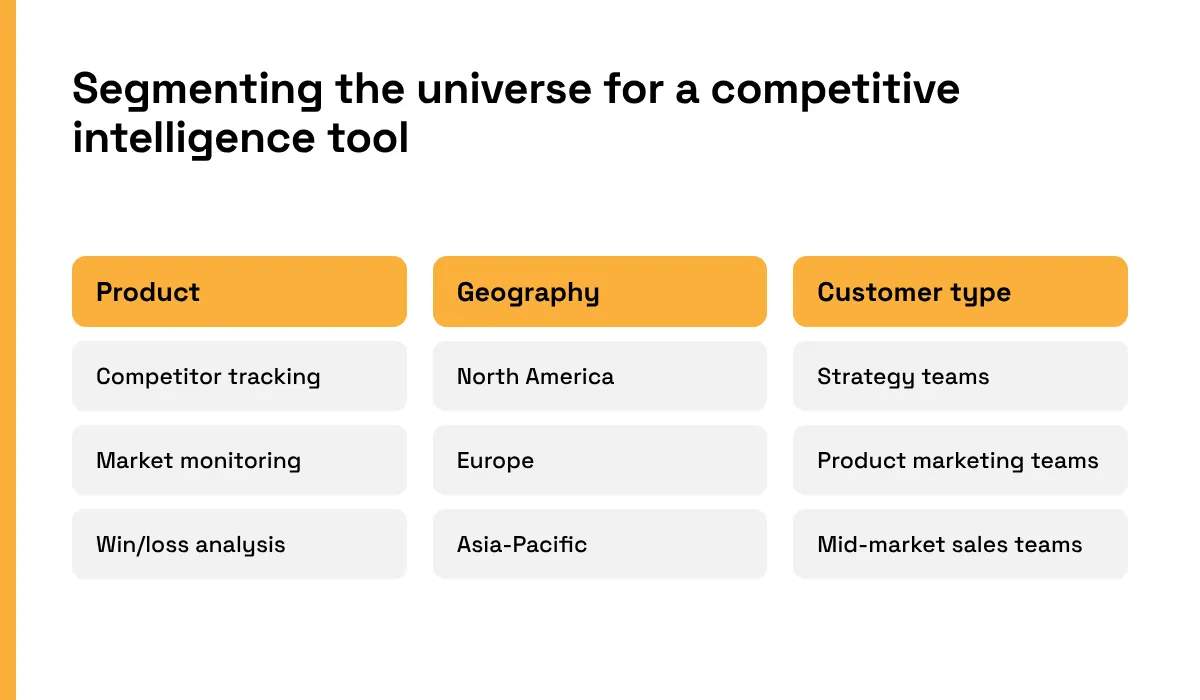
Now divide the companies into groups that reflect how customers choose between them. This usually means segmenting competitors by:
- Product
- Geography
- Customer type
Here's what that might look like for our hypothetical B2B competitive intelligence target:
Source: Veridion
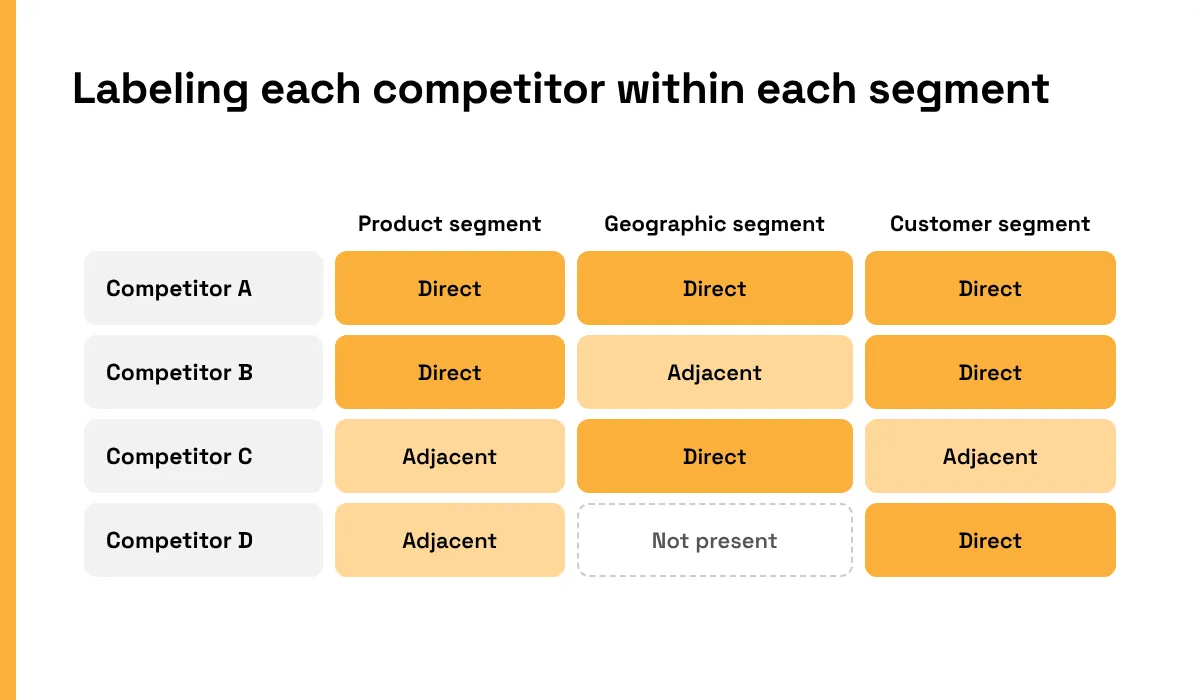
Place each company in all relevant segments and label it as a direct or adjacent competitor within each:
Source: Veridion
You can also separate larger businesses from smaller specialists using employee counts or the number of operating sites. Just remember that these are proxies for market position, not market-share figures.
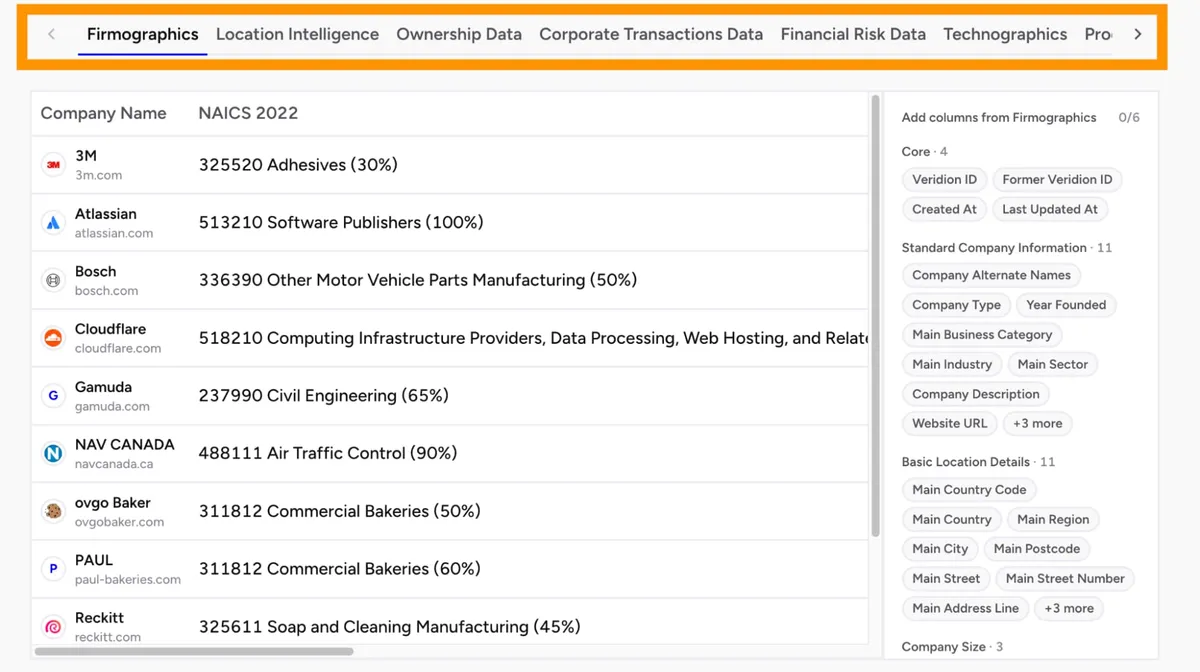
Veridion's market intelligence data keeps your segmentation consistent, with standardized attributes for business activity, location, company size, and industry classification.
Source: Veridion
Once you've grouped companies into relevant segments, make one final distinction based on how closely they compete with the target.
Split them into two lists:
- Active set: Confirmed competitors with clear relevance to the target.
- Watch list: Potential entrants or borderline companies that might become relevant.
Rather than removing borderline companies, flag them for review and add a brief note explaining:
- Why their inclusion is uncertain
- What evidence you'd need to resolve it
- When the company should be reassessed
This way, potential competitors stay on your radar instead of falling through the cracks.
You now have a segmented universe that can feed into positioning, share, and benchmarking analysis.
5. Validate the Universe Before It Reaches the Model
Before the list reaches the model, check two things: is it complete, and does every company on it belong there?
Don't rely only on the target company's view. Validate your findings through independent research:
- Interview industry experts to identify overlooked competitors and emerging players.
- Review public filings to identify companies with overlapping products, customers, or markets.
- Conduct channel checks with distributors and resellers to identify providers competing for the same customers.
- Speak with the target's customers and references to learn which alternative providers they considered.
References picked by management tend to be satisfied customers, so also talk to independently recruited buyers, former customers, or lost prospects where possible.
Their answers are especially useful for judging whether a company is truly a comparable peer.
The 2023 Merger Guidelines from the US Department of Justice and the FTC treat customers' willingness to switch as an important part of competition: the more willing customers are to switch between two companies, the closer competitors they are.
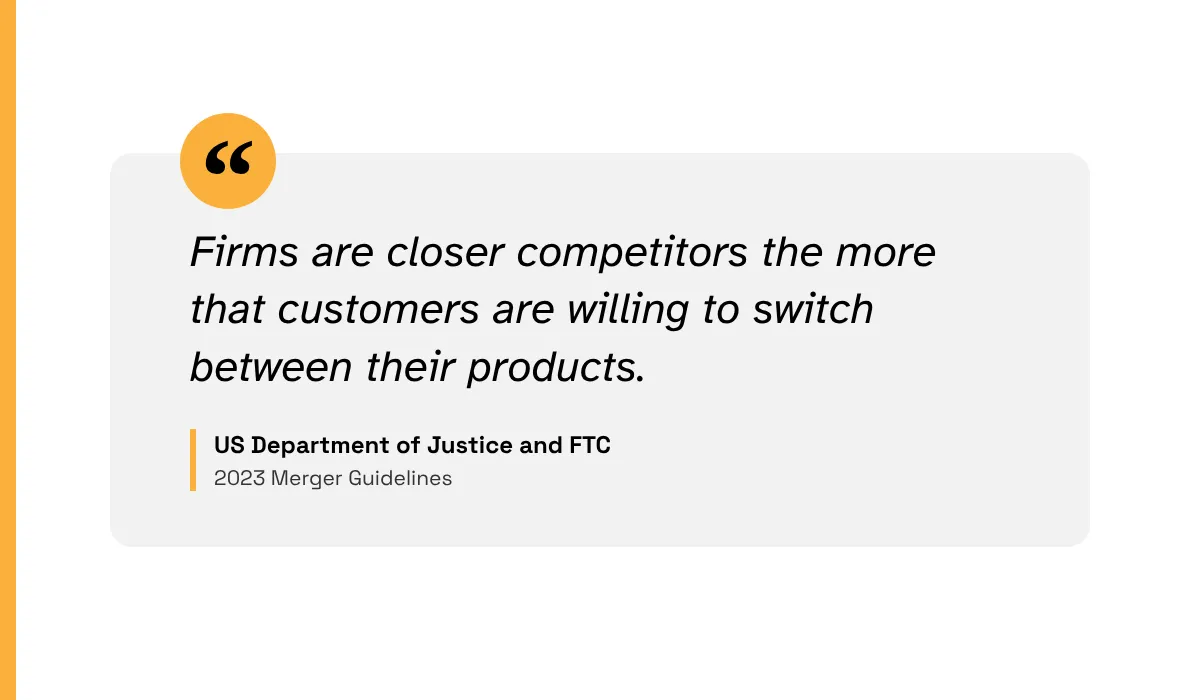
Illustration: Veridion / Quote: US Department of Justice
Then audit the included and excluded companies against the evidence you collected. For example, if several experts mention a company missing from your list, consider adding it.
Investigate any missing competitors, and mark every company with high, medium, or low confidence based on the strength of the evidence.
Keep unresolved cases visible and avoid treating them as confirmed competitors until checked.
6. Record the Universe in a Reusable Template
Finally, record your findings in a competitive landscape analysis template that other analysts can check and reuse in the future.
Your template should show:
- Who each company is
- Why the company made the list
- What evidence supports that decision
- What's still uncertain
That way, the investment team can trace conclusions back to their sources instead of rebuilding the list from scratch.
Start with a company profile.
Here's what to include for each company, with two sample entries:
Field | Example 1 (not a real company) | Example 2 (not a real company) |
|---|---|---|
Company (resolved name and identifier) | ExampleData Ltd (EX-01) | RegistryWorks LLC (EX-02) |
Parent or group | Independent | Sample Holdings |
Segment | Company intelligence | Registry data |
Competitor type (direct, adjacent, substitute, channel) | Direct | Substitute |
What it sells (activity and products or services) | Company profiles and business-data API | Public-registry data aggregation |
Customers or end-markets | Banks and investors | Compliance teams |
Geography and footprint | UK; 2 offices | US; 1 office |
Scale proxy (employees or number of sites) | 80 employees (proxy) | 20 employees (proxy) |
In our example, ExampleData sells a similar product to similar buyers, so it's a direct competitor to our target (a hypothetical company intelligence platform). RegistryWorks offers an alternative to company intelligence, so it's a substitute.
Next, prepare an evidence and validation table that makes it easy for other analysts to understand whether a competitor is confirmed or only plausible.
Include these fields:
Field | Example 1 (not a real company) | Example 2 (not a real company) |
|---|---|---|
Company | ExampleData Ltd | RegistryWorks LLC |
Reason for inclusion | Similar product and buyers | Alternative way to obtain company data |
Evidence (source and date) | Fictional product page, Oct 2026 | Fictional service page, Oct 2026 |
Confidence (high, medium, low) | High | Medium |
Validation status (data check, expert, customer, not yet checked) | Data check; expert | Data check; customer pending |
Open questions | Does it sell outside the UK? | Do buyers consider it a replacement? |
For example, RegistryWorks' offering may be relevant, but a customer check is still needed to confirm whether buyers actually treat it as an alternative.
Lastly, save a short review record each time you update the universe:
Review field | Illustrative entry |
|---|---|
Date | 20 October 2026 |
Version | 1.2 |
Analyst | CDD research analyst |
Inclusion rules | Relevant company-data offerings, overlapping buyers, and in-scope geographies |
Sample audit result | 20 included and 20 excluded records checked; 2 cases flagged for review |
Companies added or removed since last version | 3 added; 1 removed |
Approver | CDD workstream lead |
Most fields can be filled from structured company data, so you can spend your time on validation instead of data entry.
Conclusion
Your competitive landscape can look convincing and still be misleading if the underlying list misses relevant companies or counts the wrong ones.
Clear boundaries, bottom-up research, and independent checks make its conclusions easier to defend.
A practical place to start is the competitor list from your last deal. Put it into the template and mark every company that has no evidence beyond the seller's materials. Those are the companies to validate first.
Articles
Discuss how these trends affect your organization.
Our analysts are available for a short call. Bring a specific question and we will ground it in the data.
Insights
Keep reading
More analysis, research, and outcomes grounded in live company intelligence.
7 Best Competitive Intelligence Tools
Discover the 7 best competitive intelligence tools to help you track competitors, analyze markets, and make data-driven decisions.
How to Build Comparable Peer Groups for Private Company Credit Analysis
This article will explain how to create peer groups for private company credit analysis and improve benchmarking when financial disclosure is limited.
5 Trends Shaping the Future of Market Intelligence
Want to future-proof your business strategy? Explore the top trends defining the future of market intelligence.