Insights / Articles
From Annual Review to Continuous Credit Risk Assessment
How continuous credit risk assessment works in practice: setting a baseline, choosing refresh cadence, defining triggers and routing changes.

- Credit data can be months old by the time it reaches a lender’s review process.
- Early warning signals can appear well before a borrower defaults.
- Continuous credit assessment combines scheduled reviews with event-driven monitoring.
- Effective early warning systems (EWS) could reduce loan loss provisions by 10–20%.
Traditional credit reviews capture a snapshot in time. But a borrower’s financial position can shift significantly between formal credit reviews.
Veridion’s continuously refreshed company data helps lenders keep relevant company information under regular watch, so material changes can trigger a closer assessment.
Continuous credit assessment does not mean re-rating borrowers every time a metric moves. It means combining current data, defined triggers, and analyst review to identify changes that could materially affect credit risk.
What Continuous Credit Assessment Actually Means
A credit assessment can be accurate when it is completed, and still become outdated months later.
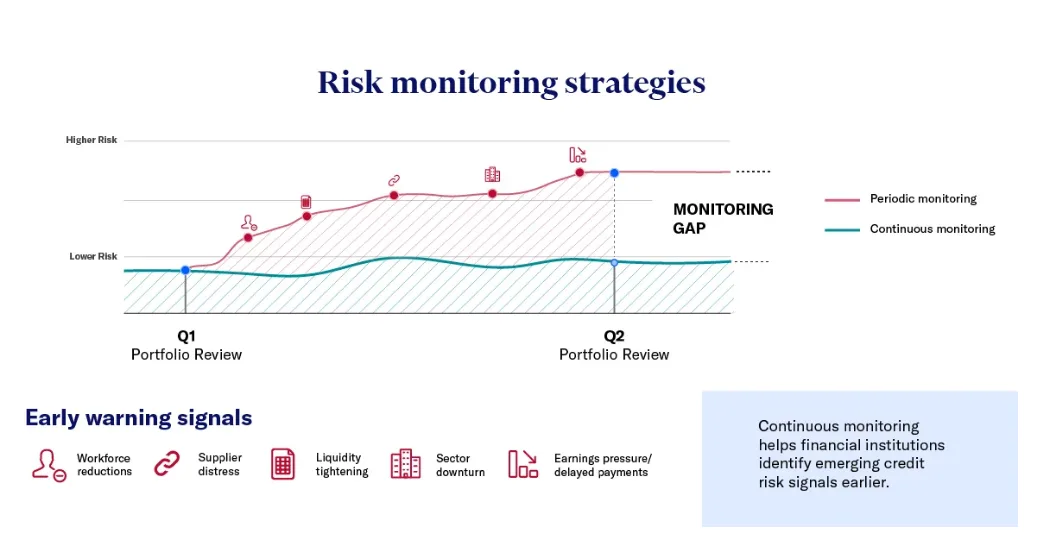
That is one of the main weaknesses of periodic or annual credit reviews, as depicted in this illustration by Moody’s.
Source: Moody’s
This is because traditional CRA processes often rely on financial reports that are already several months old, with the underlying data becoming even more dated as the fiscal year progresses.
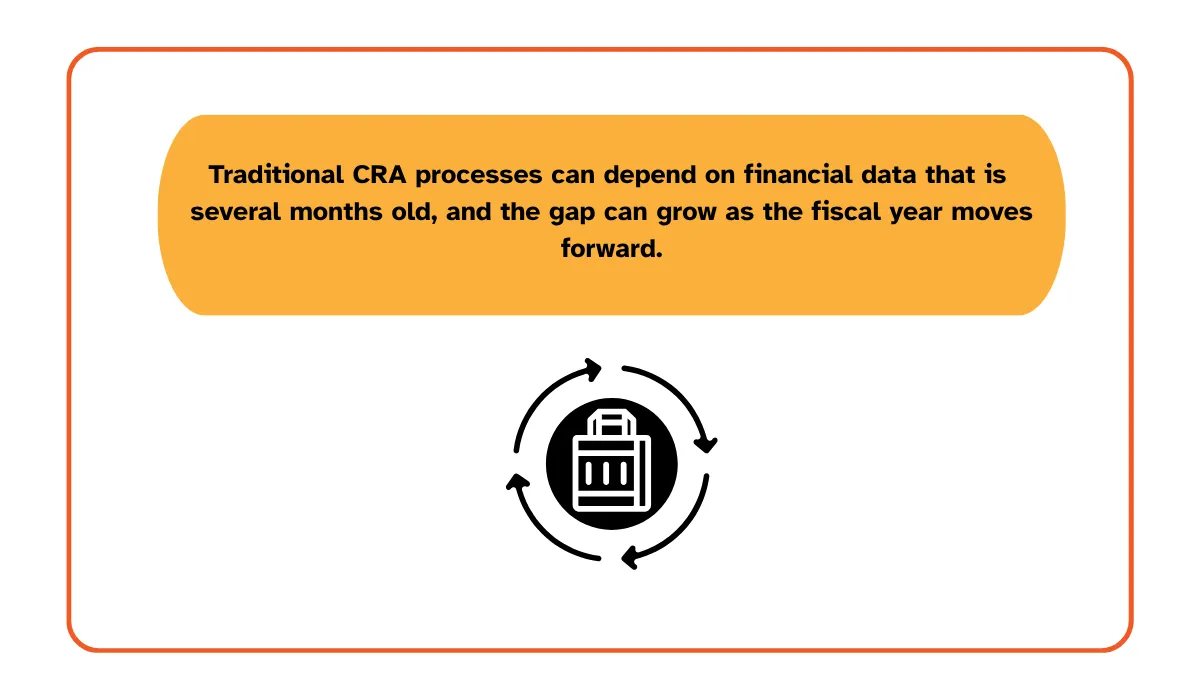
Illustration: Veridion
That can create a gap between what a lender assessed and the borrower it is actually exposed to.
This difference matters when borrowers operate in a market where financial stress can build faster than the review cycle.
Just in the US, business bankruptcy filings increased 4.5% to 23,043 in the year ending June 30, 2025, up from 22,060 a year earlier, according to the US Federal Courts.

Illustration: Veridion / Data: Dun & Bradstreet
For lenders, this means waiting for the next annual review can leave them working with an outdated picture of a borrower’s financial position.
But continuous assessment does not mean re-rating a borrower every time a number moves.
Revenue can fall slightly, or a new director can join. Neither of these changes automatically means that the borrower’s credit quality has deteriorated.
The more useful approach is to separate data movement from material credit deterioration.
Recent S&P Global Market Intelligence analysis also shows why continuous monitoring can matter. Its Early Warning Signals framework identified 83% of defaulting companies at least 12 months before default, based on analysis through February 2026. The detection rate rose to 89% within three months of default.
Continuous monitoring also needs to look beyond just financial statements. A borrower may not have reported a major deterioration yet, but changes in credit-line usage, account activity, payment behaviour, or cash flows may provide an earlier indication that something is changing.
At the same time, monitoring every movement creates its own problem.
If every small change becomes an alert, analysts can quickly face a wall of noise. They spend time investigating normal business volatility while more meaningful signals become harder to identify.
The goal, therefore, is not to react to every change. It is to identify changes that are unusual, relevant, and large enough to justify further review.
And how can that be done? By building a continuous credit assessment workflow, as explained below.
Building a Complete Continuous Assessment Workflow
A continuous assessment framework works best as a sequence rather than a collection of alerts.
The process starts with a baseline, defines what to monitor, assigns refresh frequencies, establishes event triggers, sends material changes to analysts, and records the resulting decision.
Set the Baseline Assessment and Watch Variables
The first step to building a complete continuous assessment workflow is to establish a detailed baseline at origination or during the latest full credit review.
Depending on the industry, this should cover the borrower's financial condition, debt structure, repayment capacity, liquidity, collateral, industry exposure, ownership, and other factors that influenced the original credit decision.
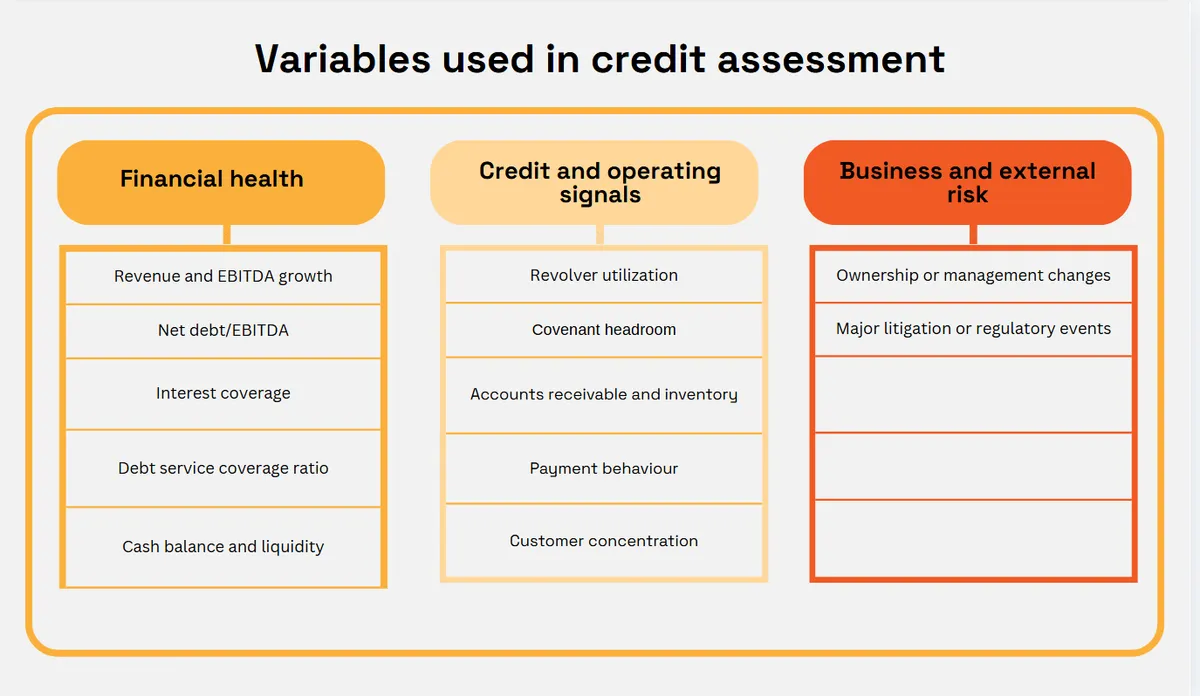
The baseline should also identify the variables that could materially alter the assessment. For a corporate borrower, these may include:
- Revenue and EBITDA growth
- Net debt/EBITDA
- Interest coverage
- Debt service coverage ratio (DSCR)
- Cash balance and liquidity
- Revolver utilization
- Covenant headroom
- Accounts receivable and inventory
- Payment behaviour
- Customer concentration
- Ownership or management changes
- Major litigation or regulatory events
Source: Veridion
The European Banking Authority (EBA) guidelines on loan origination and monitoring specifically recommend monitoring ratios such as net debt/EBITDA, interest coverage ratio, and DSCR as part of ongoing covenant monitoring.
For example, an illustrative lender framework could flag a borrower when net leverage moves above 4.0x, interest coverage falls below 2.0x, or covenant headroom falls sharply.
Those numbers are not universal regulatory thresholds. They would need to be calibrated against the borrower's sector, facility structure, historical performance, and risk appetite.
The baseline should also capture why the borrower received its current assessment.
Suppose a manufacturer was approved with 3.0x net leverage because it had stable margins, strong recurring customers, $100 million of liquidity, and a manageable debt maturity profile.
Six months later, leverage reaches 3.8x, EBITDA falls 10%, and available liquidity drops to $60 million.
The significance comes from the combination.
Without a baseline, the system sees three separate numbers. With one, it can identify a deterioration from the conditions that supported the original credit decision.
This matters because credit risk is not distributed evenly across portfolios. Federal Reserve data showed that total US bank loan delinquency was about 1.5% in the first half of 2025, while office-loan delinquency at large banks remained near 10% in Q2 2025.
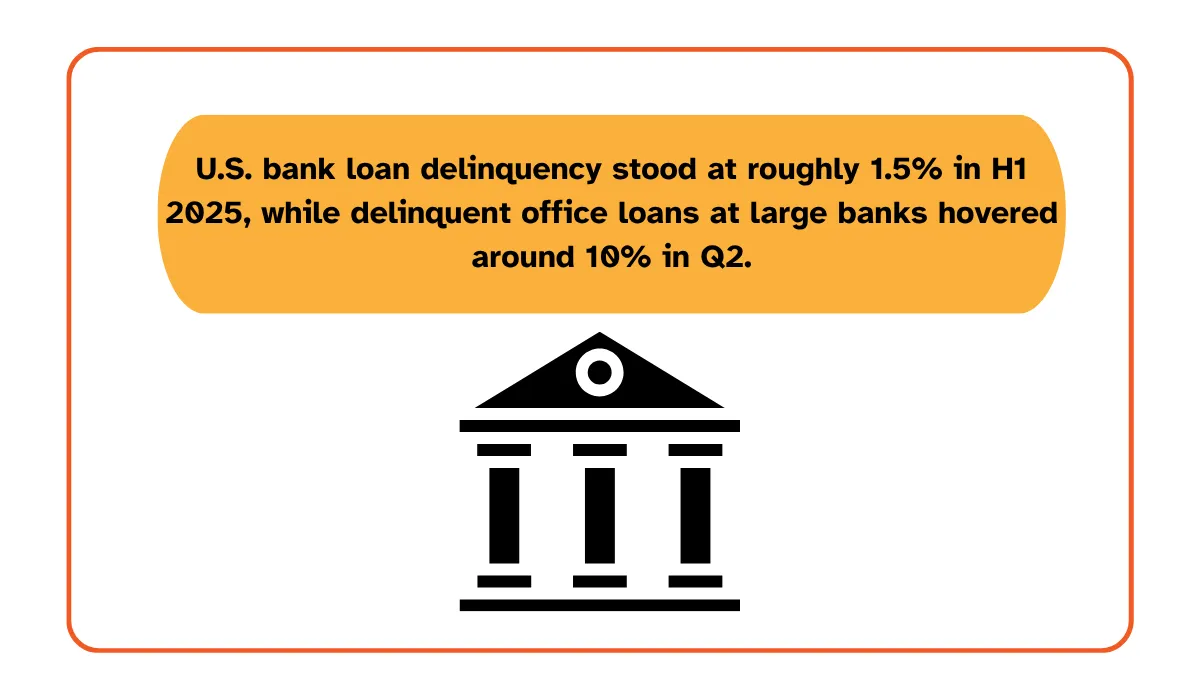
Illustration: Veridion / Data: Federal Reserve
A commercial real estate exposure, therefore, may need a different monitoring framework from a consumer loan or an asset-light software company.
The baseline should reflect that difference.
Define Refresh Cadence and Event Triggers
The next question is simple: how often should each piece of information be refreshed?
There is no reason to refresh every variable at the same frequency. Financial statements may arrive quarterly, while ownership changes, bankruptcies, acquisitions, lawsuits, or rating actions can happen at any time.
A practical framework can therefore combine scheduled refreshes with event-driven monitoring.
Veridion’s continuously refreshed company data can help here.
It maintains a living company graph designed to detect changes as they emerge, rather than waiting for the next scheduled refresh.
A market-intelligence provider saw why this matters when it audited its own company data.
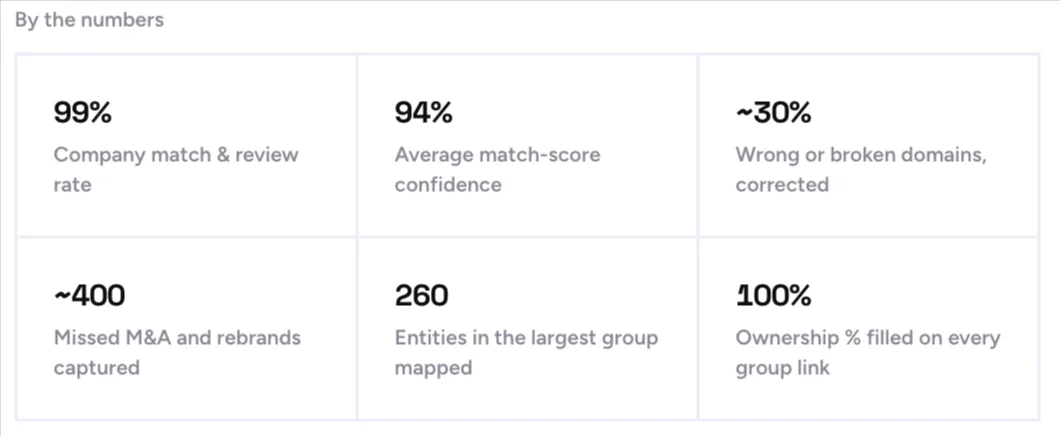
Around 30% of domains were outdated, incorrect, or broken. About 20% of addresses were wrong or incomplete, while roughly 200 acquisitions and 200 rebrands had gone uncaptured.
Veridion matched the provider's company universe at a 99% match-and-review rate, with 94% average match-score confidence.
Source: Veridion
It corrected core fields, linked about 250 fragmented local-country domains to their parent companies, and captured the missed M&A and rebrand events.
It also mapped corporate groups spanning hundreds of subsidiaries, including one group with 260 entities, with ownership percentages filled on 100% of group links.
Remember that refresh cadence cannot just be a technical setting. It has to be part of the credit workflow.
The lender needs to decide what gets refreshed regularly, what events trigger an immediate check, and whether the underlying company data is reliable enough to support that process.
In other words, the cadence should reflect the speed of the risk.
Route Material Changes to Analyst Review
Once a monitoring system identifies a change, the next step is deciding what that change actually means for the borrower.
This is where analyst review becomes important. Credit assessment still involves information from multiple sources, and bringing those sources together can take significant time.
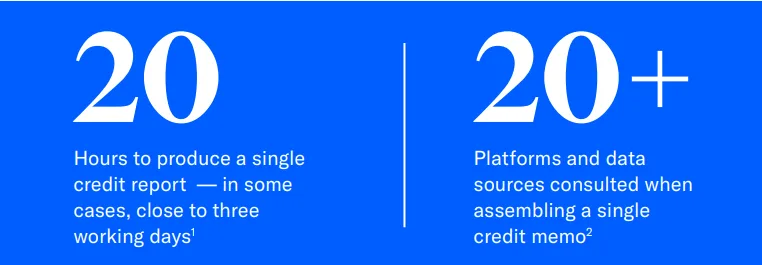
Moody’s 2026 whitepaper on the future of credit assessment found that producing a single credit report can take 20 hours, with more than 20 platforms and data sources consulted in some cases.
Source: Moody’s
Further, S&P Global Market Intelligence's survey of 39 credit risk teams found that 46% considered credit memo preparation too manual and time-consuming. Another 41% still relied heavily on tools such as Word and Excel.

Illustration: Veridion / Data: S&P Global Market Intelligence
Now, if every signal sends an analyst into another manual research exercise, the workflow can quickly become unmanageable.
That is why the monitoring workflow needs a clear handoff.
The system should identify a potentially material change and give the analyst enough context to investigate it.
The analyst can then compare the new information with the baseline, review related variables, and decide whether the signal actually changes credit risk.
Consider a company with quarterly reporting, for instance. Its next set of financial statements may not arrive for six weeks, but a customer representing 35% of its revenue files for bankruptcy.
Waiting for the next scheduled review could leave the lender with an outdated view of the borrower. The event should therefore ideally trigger an interim assessment.
The analyst can investigate questions such as:
- Has leverage moved sharply?
- Has liquidity weakened?
- Did payment behaviour deteriorate?
- Is a covenant getting close to its limit?
- Did a management or ownership change alter the risk profile?
The reverse is also important. A small monthly decline in revenue should not automatically create an analyst case.
A 2% revenue change may sit within normal volatility. A sustained 15% decline, combined with margin compression and weaker liquidity, is more significant.
The approach prevents analysts from drowning in alerts. The aim is not to maximize the number of warnings. It is to surface the changes most likely to alter the credit decision.
The review should also preserve the evidence behind the decision. Analysts should see the source, information date, calculation, and reasoning. This matters when multiple systems or data providers contribute information.
Update the Assessment or Rating Only When Warranted
Updating a rating is never an isolated event and cannot be done based on one or two signal changes.
Analysts need to incorporate several different factors before deciding on rating re-evaluation.
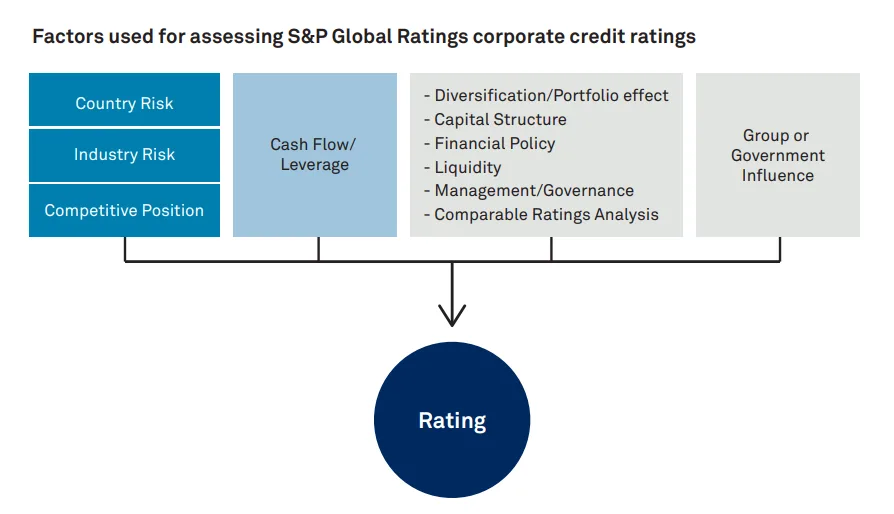
Take the case of S&P Global, for instance. It considers factors such as financial strength, industry and country risk, ownership, and debt obligations when formulating corporate credit ratings.
Source: S&P Global Ratings
A material change in one of these areas may warrant a reassessment. But if the change has little or no effect on credit risk, the review can be closed with a documented no-action decision.
Many banks and lenders also rely on early warning systems (EWS) to help identify these situations sooner.
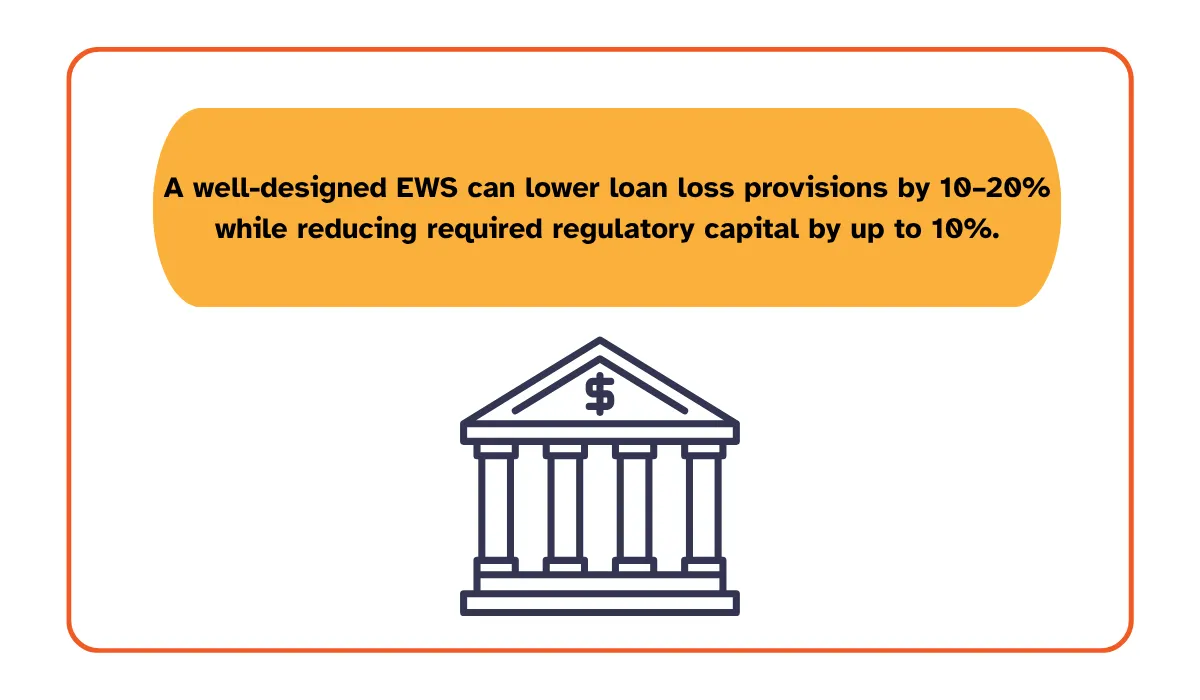
Galytix’s report (a domain-specialised AI platform) in partnership with PwC, in fact, has estimated that an effective EWS could reduce loan loss provisions by 10–20% and required regulatory capital by up to 10%.
And not just EWS; take probability of default (PD), another signal used by lenders and agencies.
An analysis by S&P Global’s Market Signal PD model of several hundred public non-financial companies that defaulted between 2003 and 2015 found that 50% had a probability of default (PD) above 8% one year before default. By the time of default, the median PD had risen to 15%.
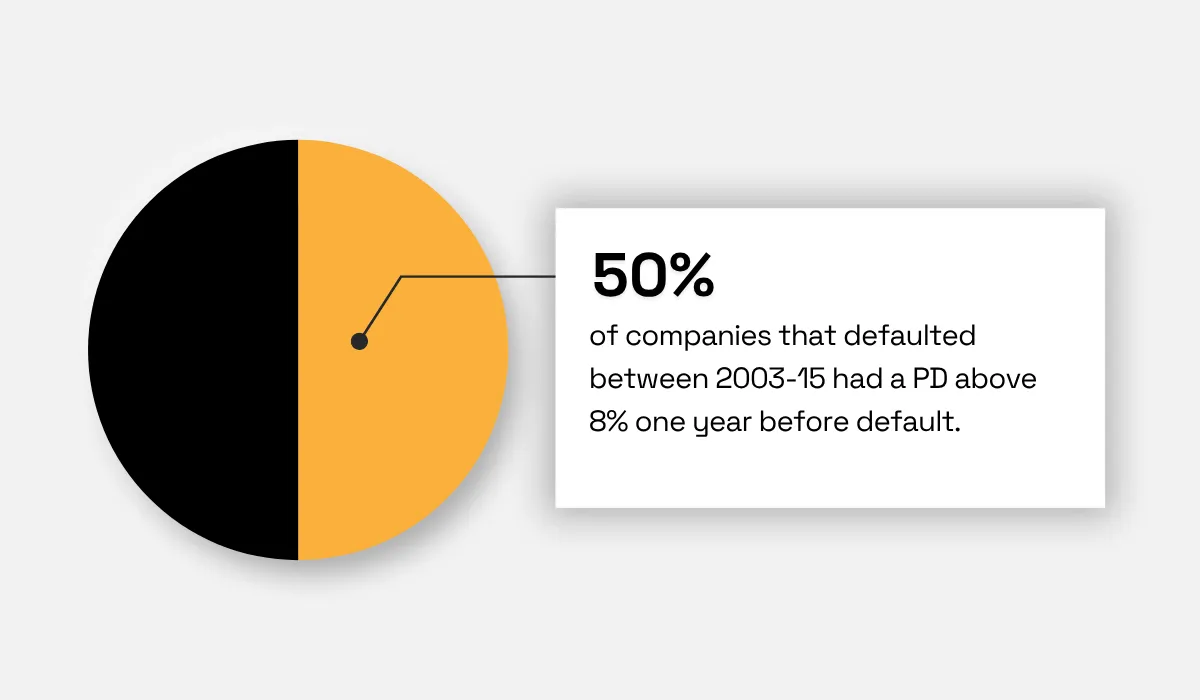
Illustration: Veridion / Data: S&P Global
The value of these systems and signals, however, depends on what happens after a warning is raised.
The Credit Suisse-Archegos case shows why.
Credit Suisse lost approximately $5.5 billion after Archegos Capital Management defaulted in March 2021.
But the risk had been building for months. By August 2020, Archegos had potential exposure (PE) of nearly $530 million against a $20 million limit.
Its scenario exposure was also repeatedly above the permitted level. On July 22, 2020, net scenario exposure reached $828 million, more than three times the $250 million limit.
These were not isolated movements. The breaches continued, and the risks were discussed internally. Yet the investigation found that the information did not lead to sufficiently decisive action.
The bank's risk committees were also working with data that could be 4–6 weeks old, adding another problem to an already difficult situation.
So, if an EWS alert, PD movement, exposure change, or other event points to a meaningful shift in risk, the analyst should reassess the relevant factors and determine whether the existing assessment still holds.
If the evidence does not support a change, that conclusion should also be recorded. A documented, reviewed, no-action outcome shows that the signal was assessed rather than ignored.
Conclusion
Continuous credit assessment closes the gap between a borrower's last formal review and its current condition.
A practical workflow does not require every metric to refresh continuously. It requires the right data to refresh at the right frequency, clear triggers for material changes, and a defined route to analyst review.
The final decision still belongs to the credit team.
Continuous monitoring simply ensures that the decision is based on the borrower's current evidence, rather than an assessment that may have become outdated months earlier.
Articles
Discuss how these trends affect your organization.
Our analysts are available for a short call. Bring a specific question and we will ground it in the data.
Insights
Keep reading
More analysis, research, and outcomes grounded in live company intelligence.
Using Alternative Firmographics for Faster SMB Credit Risk Assessment
Struggling with slow SMB credit risk assessment? Uncover how alternative firmographics can revolutionize your process and speed up decisions.
9 Essential Sources of Market Intelligence
Want to boost your market knowledge? These 9 market intelligence sources will show you where to look and how to apply the insights.
Key Differences Between Competitive and Market Intelligence
Discover the key distinctions between market and competitive intelligence - so you can apply the right approach in your strategy.