Insights / Articles
Parent vs. Subsidiary Credit Ratings: Why Corporate Hierarchy Data Matters
How corporate hierarchy data shapes credit analysis: group perimeters, parent support, finance vehicles, entity resolution and ownership changes.

- A company’s ultimate parent isn’t always the entity that matters most for credit analysis.
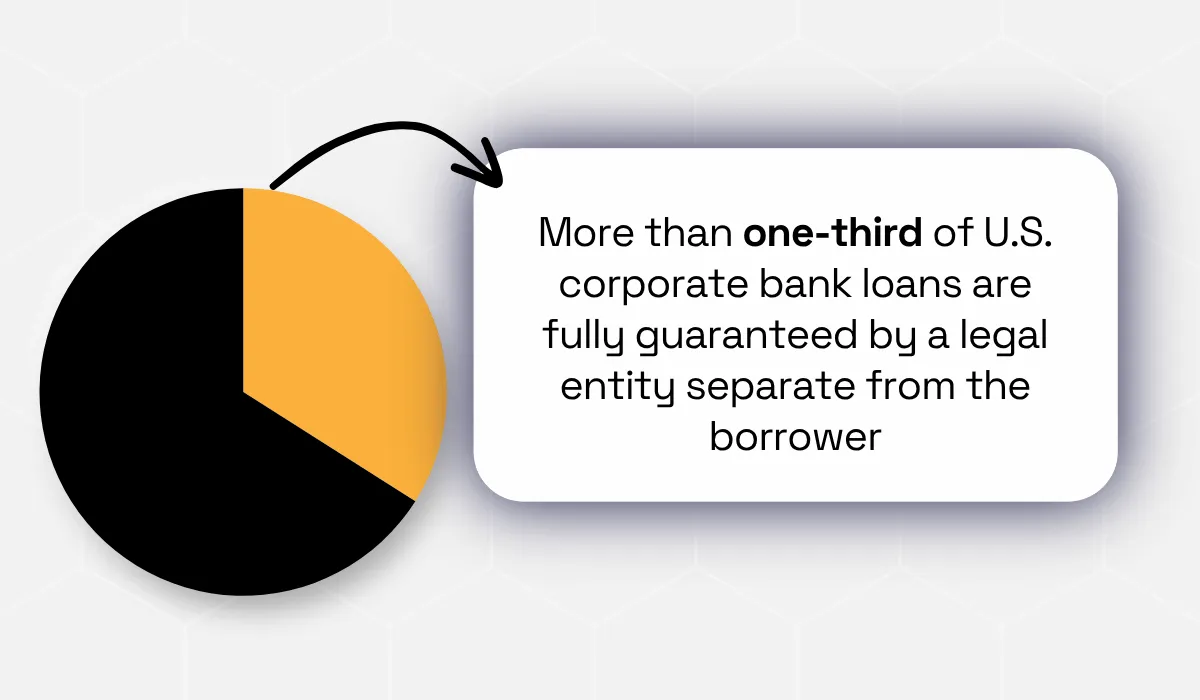
- Over a third of U.S. corporate loans aren’t guaranteed by the borrowers.
- An entity-resolution error can attach accurate evidence to the wrong company.
- Ownership changes reshape the credit picture without changing the underlying business.
Credit risk isn't always contained within a single legal entity.
A company can have strong standalone financials and still be exposed to a parent’s financial stress.
To assess that risk properly, analysts need to understand how the entity connects to the wider corporate group.
That includes its parent, subsidiaries, guarantors, finance vehicles, and other material entities.
This article examines why these relationships matter, how corporate events change analytical perimeters, and why accurate hierarchy data is essential for connecting financial evidence to the right entities.
A Legal Entity Isn't the Same as the Economic Group Being Assessed
It’s tempting to treat the ultimate legal parent as the natural starting point for credit analysis.
You can follow ownership upward until you reach the top of the hierarchy, then treat everything below it as part of the relevant group.
But credit-rating methodologies don’t always work that way.
As an example, S&P Global Ratings explicitly distinguishes the group parent used for credit analysis from the ultimate holding entity.
Its methodology says the group can be, but is not necessarily, the ultimate holding company.
While a legal-entity database defaults to the top-level holding company, rating methodologies look past intermediate entities that lack material operating assets or liabilities.
If those intermediate entities exist strictly for tax, regulatory, or structural purposes, a lower-level operating parent can be treated as the true credit anchor.
Fitch’s 2024 assessment of InRetail Peru shows how this works in practice.

Source: Fitch
The group’s legal structure extends from Intercorp Peru, the ultimate parent, through Intercorp Retail and InRetail Peru to operating subsidiaries such as InRetail Consumer and InRetail Real Estate.
Fitch assessed the operating subsidiaries through InRetail Peru, reflecting its ownership and the lack of legal ring-fencing, rather than treating the ultimate parent as the only relevant analytical layer.
The opposite can also be true.
An intermediate holding company that carries significant debt or other liabilities may be relevant to the group's creditworthiness even though it isn't the ultimate parent.
Excluding that entity because it is in the middle of the ownership chain could leave material group risk outside the analytical perimeter.
A change in the legal hierarchy also doesn't necessarily change the economic or credit perimeter.
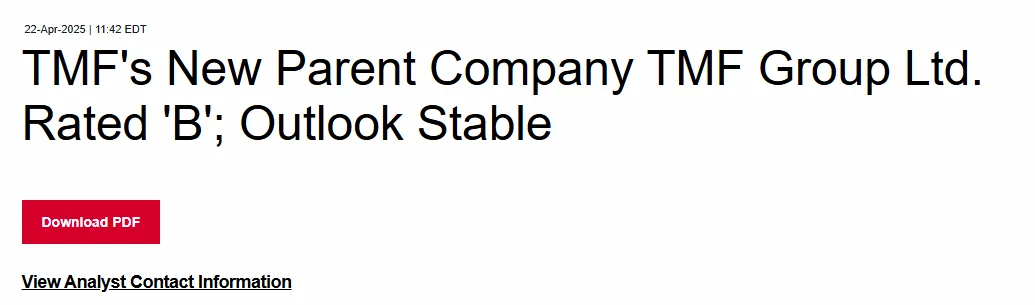
TMF Group provides a useful example.
Source: S&P
In 2025, the company created TMF Group Ltd. as a new UK-based top-level parent, replacing TMF Group Holding B.V. at the relevant level of the legal structure.
S&P maintained its assessment because the restructuring didn’t materially change the group’s operating or financial management.
The takeaway is to track legal structure and analytical relevance separately.
The relevant perimeter depends on economic relevance, control, liabilities, and credit impact, not ownership depth alone.
Parent and Subsidiary Links Determine How Risk and Support Flow
A parent-subsidiary relationship can strengthen a subsidiary's credit profile, but it can also expose the subsidiary to financial stress elsewhere in the group.
The effect depends on how closely the entities are connected, how much control the parent has, and whether the subsidiary can operate independently under stress.
The impact is visible in recent rating actions
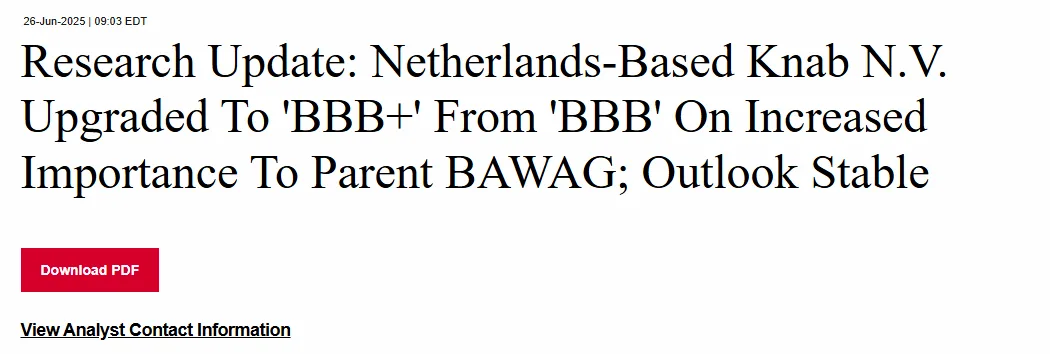
In June 2025, S&P upgraded Knab N.V. from BBB to BBB+ after reassessing it as a core subsidiary of BAWAG and increasing the support it expected from the parent.
Source: S&P
But parent support doesn’t automatically result in a higher rating.
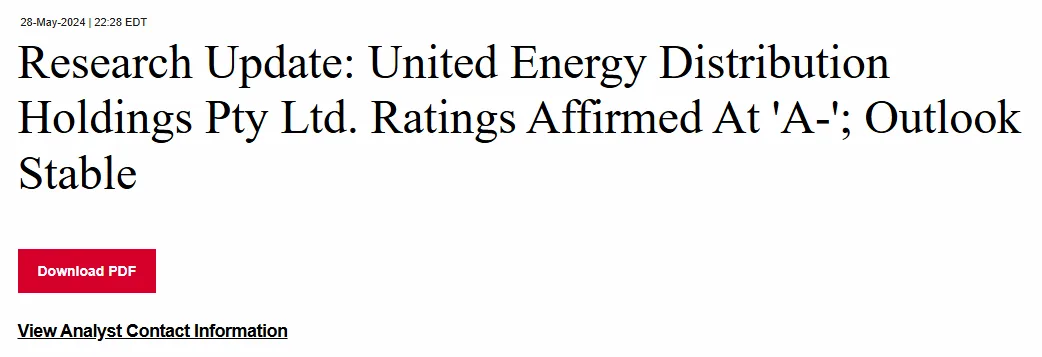
In its May 2024 assessment of United Energy Distribution (UED), S&P expected timely group support but kept the rating at A-.
Source: S&P
UED's standalone credit profile and the group's credit profile limited the benefit that support could provide.
S&P captures these differences by classifying subsidiaries according to their strategic importance and integration within the group.
These group status categories are shown below.
Group status | What it means | Potential rating effect |
|---|---|---|
Core | Integral to the group's identity and strategy; support is highly likely. | Generally aligned with the group credit profile (GCP). |
Highly strategic | Very important to the group, but support may be limited. | Generally 1 notch below GCP. |
Strategically important | Important to the group, with support likely in most foreseeable circumstances. | Potential uplift from the standalone credit profile (SACP), subject to a GCP cap. |
Moderately strategic | Meaningful group links, but weaker incentives or ability to provide support. | Potential 1-notch uplift, subject to the GCP cap. |
Nonstrategic | Limited strategic importance or integration. | Generally assessed on its SACP. |
These relationships can also work in the opposite direction.
A stronger subsidiary isn't automatically protected from a weaker parent.
The parent may have access to the subsidiary's resources, while the subsidiary may depend on the wider group for funding, infrastructure, or other critical operations.
Conversely, a subsidiary can be sufficiently insulated from the group to maintain a stronger credit profile.
Operational separation, independent funding and cash flows, minority ownership, independent governance, or regulatory restrictions can reduce the impact of group distress.
This is why a hierarchy record showing “Parent A owns 80% of Subsidiary B” isn’t enough for credit analysis.
It tells you who controls whom, but not whether Subsidiary B is strategically essential, financially dependent on the parent, protected by a guarantee, or able to operate independently during group stress.
Finance Vehicles Need to Be Traced to the Right Operating Entity
A company’s debt doesn’t always appear on the balance sheet of the operating company that needs funding.
Large corporate groups often use dedicated finance subsidiaries to raise debt and centralize funding.
That allows them to access capital markets and separate financing activities from day-to-day operations.
The separation between borrower and credit support is not unusual.
A 2025 study using Federal Reserve data found that more than one-third of U.S. corporate bank loans were fully guaranteed by a legal entity separate from the borrower.
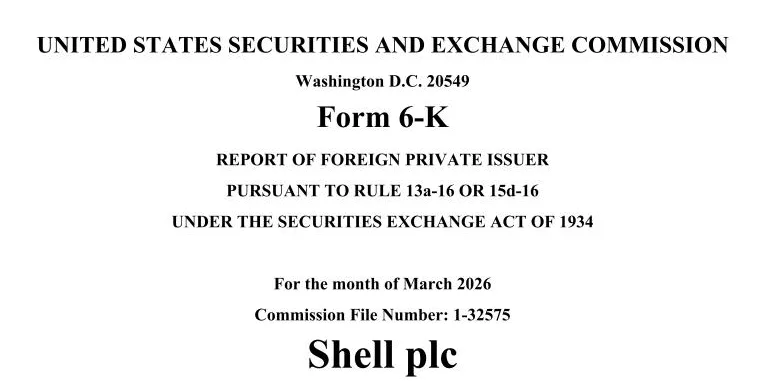
Shell plc, the oil and gas multinational, provides a recent example.
At the end of 2025, $42.7 billion of Shell Group’s $75.6 billion total debt had been issued by two wholly owned finance subsidiaries, Shell International Finance B.V. and Shell Finance US Inc.
Source: SEC
Shell plc fully and unconditionally guarantees the obligations and describes the subsidiaries as financing vehicles that raise debt for the group and on-lend the proceeds to other companies within it.
For credit analysis, identifying the legal issuer is only the first step.
You also need to establish who received the financing, where the repayment cash flows come from, and which entity ultimately supports the debt.
Without those links, a credit system could attribute the debt to a finance vehicle with little meaningful operating activity while overlooking the operating company whose cash flows ultimately service it.
A parent guarantee can make the distinction even more important.
When the parent fully guarantees a finance subsidiary’s obligations, the parent’s creditworthiness becomes directly relevant to the debt.
A useful credit-data model should therefore connect three layers:
- Debt issuer
- Guarantor or other credit support provider
- Economic beneficiary or repayment source
These links help distinguish debt supported by the finance vehicle’s own resources from debt that ultimately depends on an operating subsidiary or the parent’s balance sheet.
Entity-Resolution Errors Can Attach Evidence to the Wrong Company
Distinguishing between parents and subsidiaries becomes difficult when companies share similar names, addresses, or identifiers.
A parent and subsidiary may use nearly identical legal names, while unrelated companies can share a business name across different jurisdictions.
Abbreviated or historical names and incomplete registration details can make the distinction even harder.
The consequences can be significant.
A bankruptcy filing, covenant breach, debt default, or credit-rating action attached to the wrong entity can distort the risk profile of the company being assessed.
The problem is that the underlying evidence may be accurate but attached to the wrong node in the corporate hierarchy.
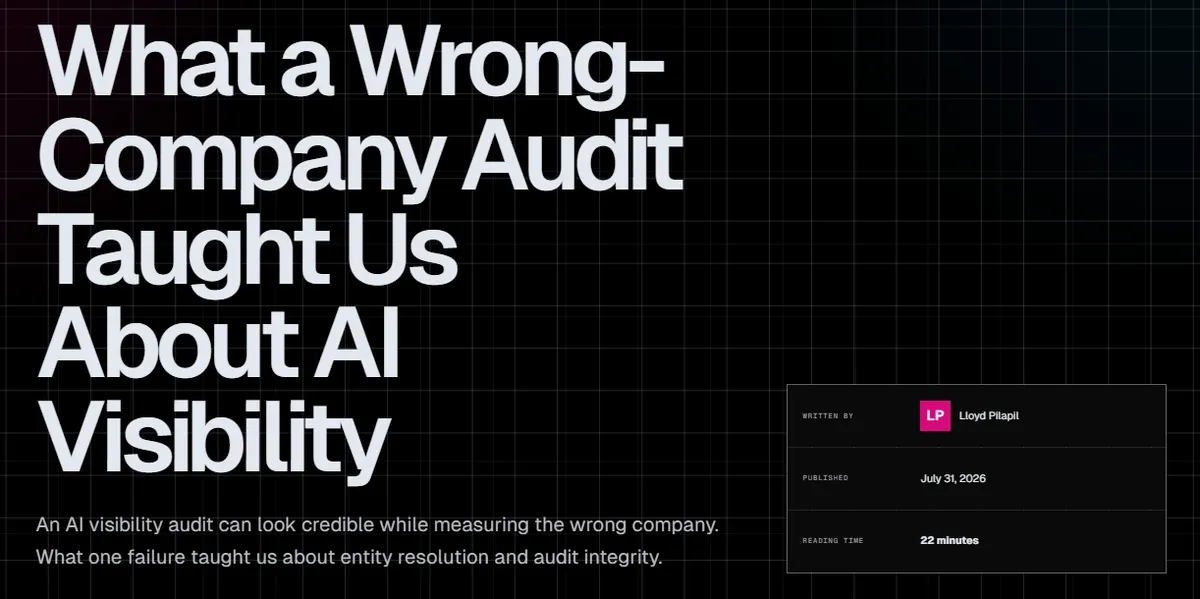
A July 2026 case illustrates how easily this can happen.
Source: Pixelmojo
An AI-visibility platform incorrectly resolved a German company, WREB.DEsign GmbH, to an unrelated U.S. dental testing organization with a similar name.
The resulting analysis produced plausible metrics, but for the wrong organizations.
After the entity was correctly resolved, the platform’s brand disambiguation score rose from 20 to 100.
The problem can also exist at a significant scale.
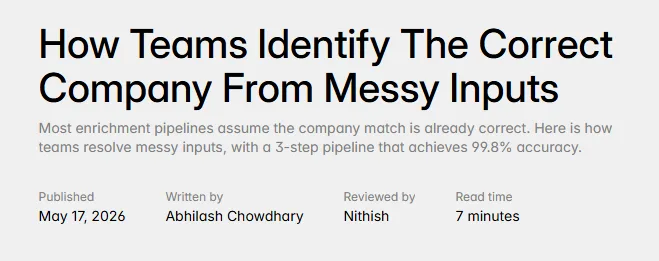
In a 2026 case study, one data team reported having 20 million raw company records that entity resolution could reduce to roughly 7 million canonical entities.
Source: Crustdata
This is why entity resolution is a critical part of data enrichment.
It helps you distinguish between the same legal entities or those within the same corporate group and completely unrelated companies.
Without that distinction, additional data can be attached to the wrong company during enrichment.
A rating action concerning a subsidiary should remain associated with that subsidiary, with its relationship to the parent represented separately.
Likewise, a bankruptcy filing involving an unrelated company with a similar name shouldn't affect another entity's risk profile.
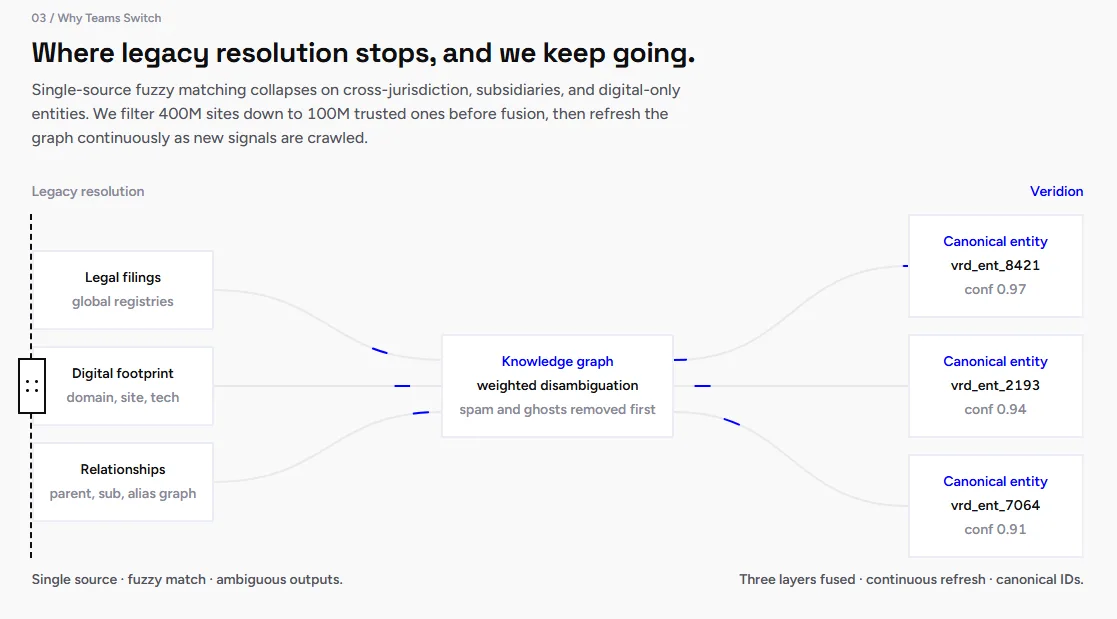
Veridion’s Entity Resolution service uses combinations of business attributes, including names, addresses, identifiers, and other signals, to distinguish and link entities rather than relying on exact name matches alone.
Source: Veridion
This helps ensure that evidence is associated with the right company and the right position in the corporate hierarchy.
Ownership Changes Shift the Analytical Group Perimeter
The group you analyze today may not be the same group you would have analyzed a year ago.
An acquisition can bring a new subsidiary into the group, while a divestiture can remove one.
A restructuring can also change which entity controls a business without changing the underlying operations.
Control can also exist below an outright majority stake, depending on voting arrangements and other rights.
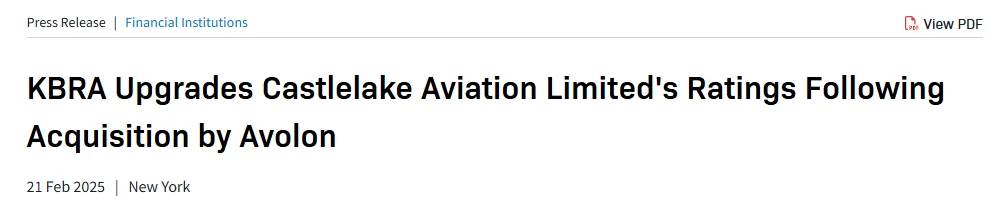
A February 2025 KBRA rating action shows how an acquisition can change an entity’s position within a credit group.
Following Avolon’s $1 billion acquisition of Castlelake Aviation, KBRA upgraded the company from BB+ to BBB+, citing its new status as a wholly owned and integrated subsidiary of Avolon.
Source: KBRA
This matters because the group perimeter determines which entities' financial results, obligations, cash flows, and support relationships are relevant to the analysis.
For example, IFRS 10 uses control to determine whether to consolidate an investee.
Similarly, S&P Global Ratings defines group membership around direct or indirect control and notes that control can exist even when a group owns 50% or less of an entity.
In fact, you should treat certain corporate events as signals to reassess the ownership structure rather than simply append this new information to an existing company record.
Ownership change | Why it matters for the hierarchy |
|---|---|
Acquisition | Adds an entity to the group and may bring its financials, obligations, and support relationships into scope. |
Divestiture | Removes an entity from the group, so its financial evidence and former parent relationships may no longer be relevant. |
Restructuring | Can move ownership, debt, or control between entities, changing how the group should be mapped. |
Change in control | A change in voting rights or other control arrangements can alter consolidation even without a majority ownership change. |
The problem arises when these changes aren’t reflected in the hierarchy.
If a subsidiary was sold but remains linked to its former parent, downstream systems can continue associating its revenue, debt, litigation, ratings, or other evidence with the wrong group.
If a newly acquired entity is missing, analysts may overlook exposures that have moved into the group.
Keeping these records current requires continuous data enrichment, not just periodic updates to ownership fields.
Support assumptions can become stale too.
A subsidiary may previously have benefited from a parent's guarantees, shared financing, strategic importance, or willingness to provide extraordinary support.
After an ownership change, those relationships may no longer exist.
An ownership change should therefore trigger a reassessment of group membership, control, consolidation status, financial dependencies, guarantees, and support relationships.
Conclusion
Corporate hierarchy is the framework that determines which entities, obligations, and relationships belong in your credit analysis.
When that framework is wrong or outdated, even accurate financial data can lead you to the wrong conclusion.
The answer isn’t more data.
It’s a hierarchy that is correctly resolved, fully connected, and continuously updated.
Build that foundation well, and your credit analysis can reflect the economic reality of the businesses you’re assessing, not just the legal structure recorded in a registry.
Articles
Discuss how these trends affect your organization.
Our analysts are available for a short call. Bring a specific question and we will ground it in the data.
Insights
Keep reading
More analysis, research, and outcomes grounded in live company intelligence.
Best Practices for Data Enrichment
Learn how data enrichment best practices help businesses turn raw data into accurate and actionable insights.
A Closer Look at the Top B2B Data Enrichment Companies Businesses Rely On
Struggling to find reliable firmographic data providers? Uncover the top B2B data enrichment companies that businesses trust to fuel growth.
6 Issuer Data Quality Checks Before a Case Reaches the Rating Committee
Tired of rating committee delays? Ensure top-notch issuer data quality with 6 essential checks. Avoid costly errors and streamline your process.