Insights / Articles
6 Issuer Data Quality Checks Before a Case Reaches the Rating Committee
Tired of rating committee delays? Ensure top-notch issuer data quality with 6 essential checks. Avoid costly errors and streamline your process.

- Even the right issuer can carry the wrong corporate relationships.
- Conflicting industry classifications can quietly reshape your peer set.
- A data point can be accurate yet still too stale to trust.
- Unresolved gaps don’t have to disappear before a case reaches committee.
If a rating committee received the wrong issuer’s financials by mistake, they’d catch it immediately.
But what about the right issuer with a slightly wrong hierarchy link, a classification code nobody’s updated since onboarding, or a data point sourced from two providers that quietly disagree?
These errors are harder to spot precisely because they look plausible.
This guide covers six checks you can use to verify that an issuer record is ready for committee review and the decisions that follow.
Confirming the Record Describes the Right Company
Identity checks should come before financial, operational, or risk analysis.
If the issuer record points to the wrong legal entity, even internally consistent downstream data can describe the wrong company.
Entity resolution should establish the correct legal entity at the start of the workflow and preserve that identity throughout the rating process.
Entity Confirmation
Start by confirming that the issuer record actually matches the entity being rated.
Similar company names, inconsistent naming conventions, stale identifiers, and subsidiaries that share a brand with their parent can all create wrong entity risk.
The same company can also appear differently across internal systems and external data sources, making a name-only match unreliable.
Verify entity identity rather than assume it.
Alexandre Kech, CEO of the Global Legal Entity Identifier Foundation (GLEIF), a nonprofit organization that oversees the global LEI system, captures it succinctly:

For issuer data, that means corroborating the company name against stable identifiers and other attributes rather than treating a plausible name match as sufficient.
Depending on the market and available data, these identifiers can include:
- Legal Entity Identifier (LEI)
- Tax identification number (TIN)
- D-U-N-S Number
- Company registration number
- Other authoritative identifiers
Reconcile these identifiers against your internal issuer ID and confirm that they refer to the same legal entity.
You should also validate each identifier’s status and effective dates, since a historically valid identifier may no longer reflect the issuer after a merger, restructuring, or other corporate action.
Treat the LEI as one corroborating signal alongside the legal name, jurisdiction, registration details, and corporate relationships rather than as a standalone proof of identity.
The scale of this verification infrastructure illustrates its value.
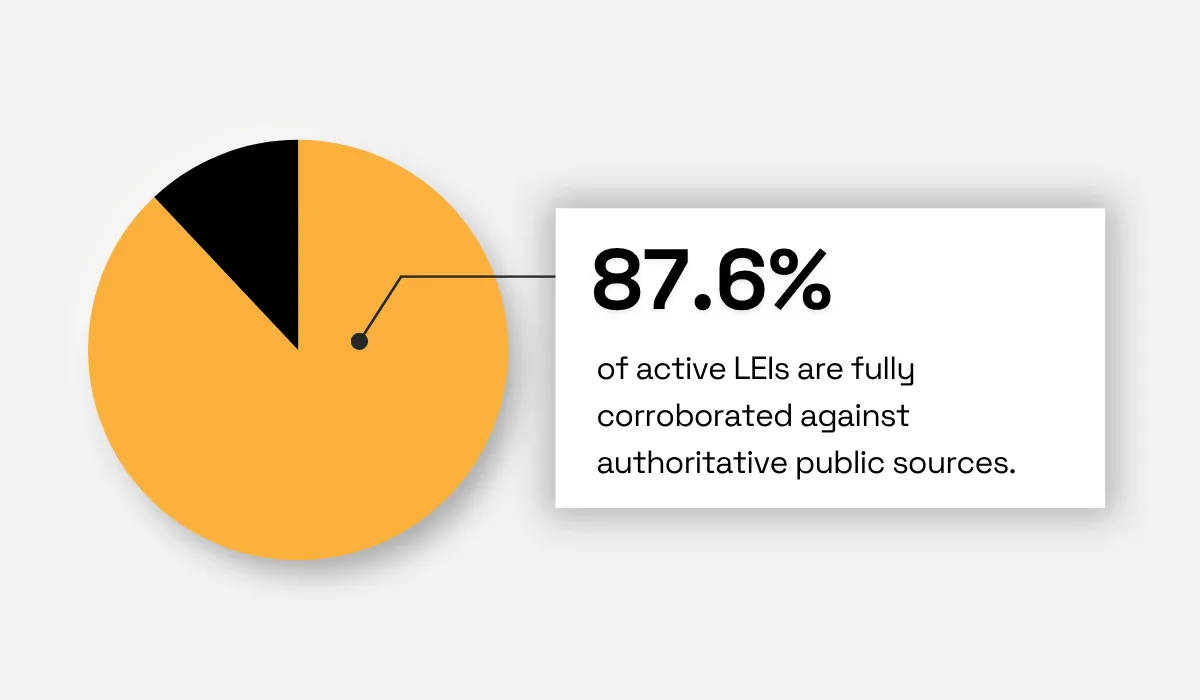
GLEIF reports that 87.6% of active LEIs were fully corroborated against authoritative public sources at the end of Q1 2026, showing how entity identifiers can link to independent reference data to strengthen identity verification.
A practical validation rule is to require agreement across multiple identity attributes before treating the record as verified.
A matching legal name, valid identifier, jurisdiction, registration details, and known corporate relationship provide substantially stronger evidence than a fuzzy name match alone.
Hierarchy Validation
Once you’ve confirmed the correct legal entity, validate where it sits in the current corporate structure.
A stale parent-subsidiary relationship can misattribute financial exposure, particularly when ownership has changed, or a subsidiary operates under a different name from its parent.
This deserves its own freshness check.
Corporate structures can change through acquisitions, divestitures, mergers, and spin-offs.
Multinational law firm WilmerHale recorded 44,817 reported M&A transactions worldwide in 2025, highlighting the scale of corporate activity that can change ownership structures.
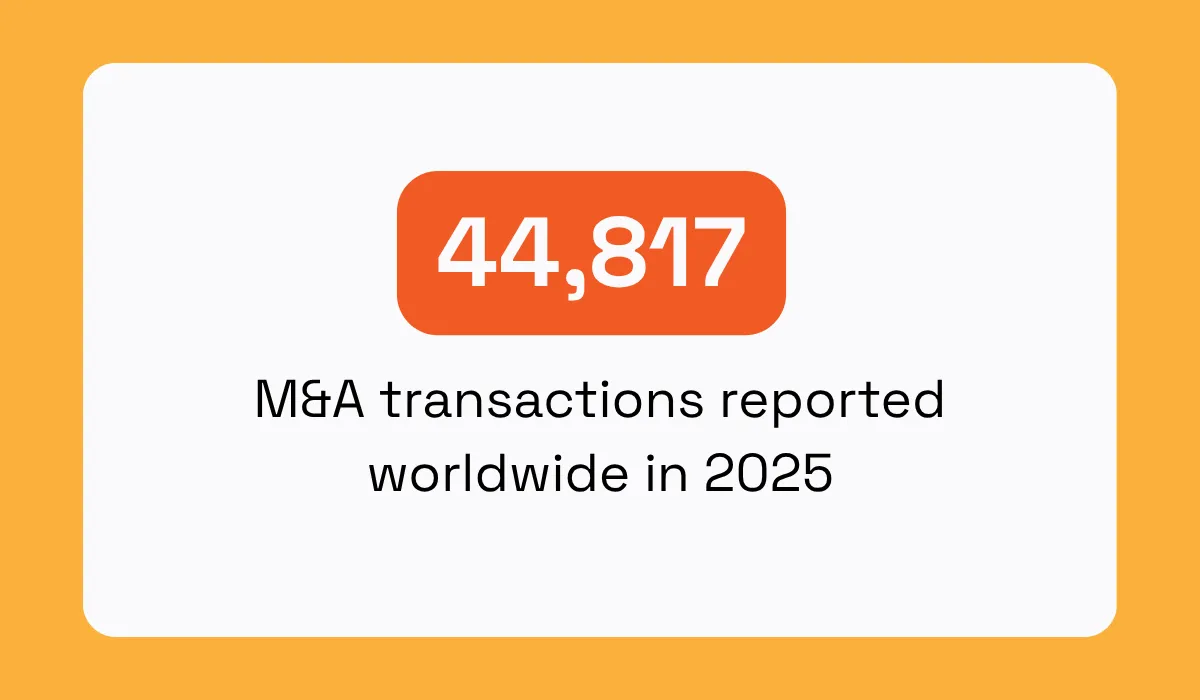
Illustration: Veridion / Data: WilmerHale
The credit impact can also depend on these relationships.
In a 2024 rating of Western Alliance Trust Company, the Kroll Bond Rating Agency (KBRA), a global credit rating agency, identified it as a wholly owned subsidiary of Western Alliance Bancorporation and said the BBB+ issuer rating was based principally on its ownership and an unconditional guarantee from the ultimate parent.

Source: KBRA
KBRA also stated that any change in the parent’s rating or outlook would trigger the same action for the subsidiary.
This illustrates the potential consequence of an incorrect hierarchy, not an error that occurred in the KBRA case itself.
Reconcile parent, subsidiary, affiliate, and ultimate-parent relationships against current corporate or registry data.
Compare those relationships with your issuer master, flag discrepancies, and preserve the distinction between the operating entity and the wider group.
Veridion can support this as a structured company intelligence layer.
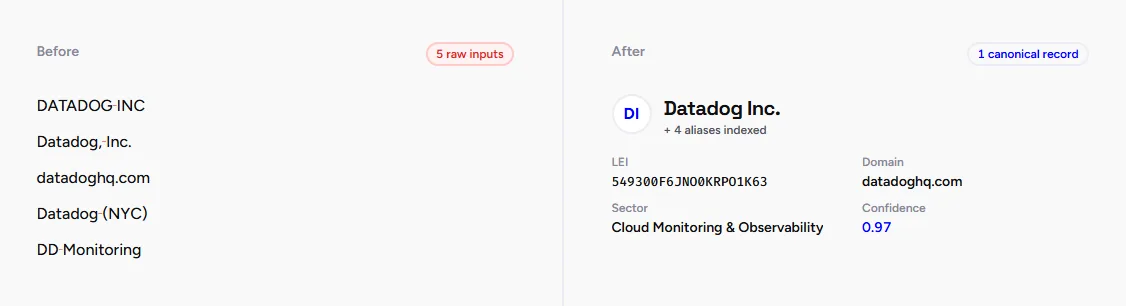
Its Entity Resolution capability can resolve corporate relationships and provide hierarchy data that you can compare against existing issuer records.
It also provides match confidence and the reasoning behind each resolution, so technical teams can distinguish stronger matches from records that need further review.
Source: Veridion
Veridion’s resolved entity and hierarchy data can sit alongside an existing issuer master, not replace it.
You can join its entity IDs and corporate relationships back to your internal records, compare the current hierarchy with your existing data, and flag discrepancies for investigation.
Its corporate groups capability can also connect an operating organization to its ultimate parent while distinguishing relationships such as subsidiaries and affiliates.
The purpose is to ensure that the issuer’s corporate relationships are represented correctly so analysts and the committee can assess the resulting credit exposure and support.
Classification Consistency
Once you’ve confirmed the issuer and its corporate hierarchy, check that its industry and sector classification is current and consistent across the systems feeding the rating workflow.
Classification can influence peer selection, operating-performance benchmarks, and the sector-specific risks analysts consider.
The downstream impact can be significant.
A stale industry code can exclude an issuer from the intended peer set, while conflicting classifications can produce different comparables depending on which dataset an analyst queries.
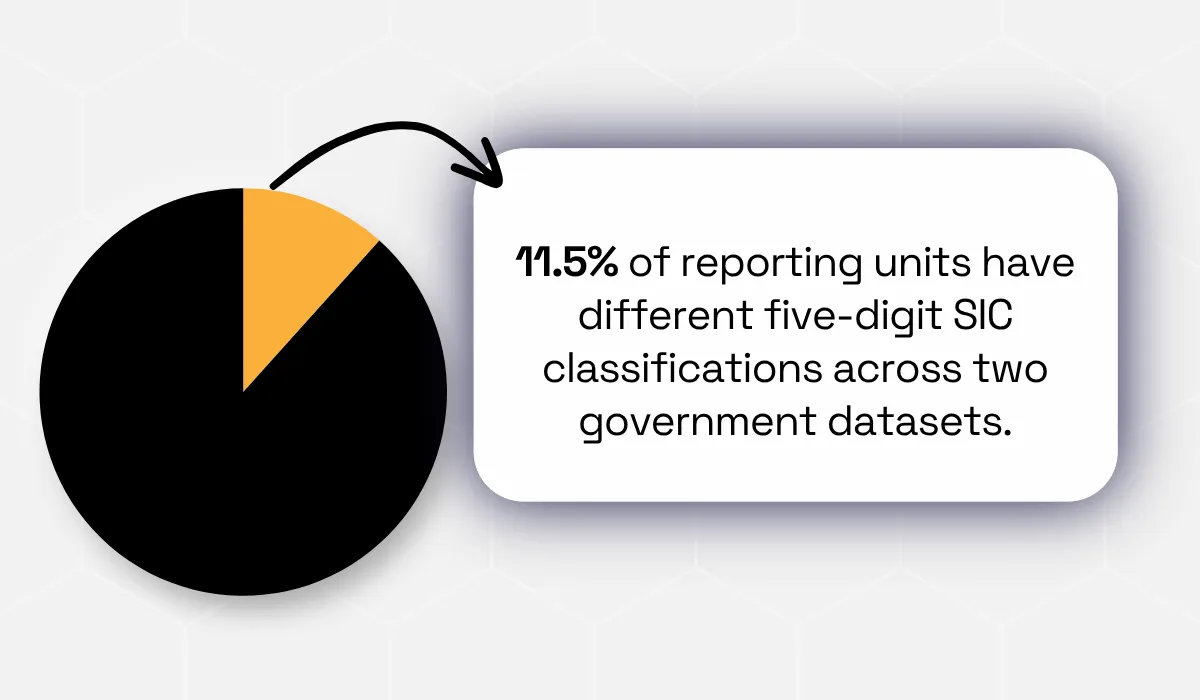
A UK Office for National Statistics (ONS) comparison found that 11.5% of reporting units had different SIC classifications at the five-digit level between two government datasets, with the agency estimating an 8.1% genuine error rate.
A recent practitioner discussion illustrates how inaccurate industry classifications can distort downstream peer analysis, particularly when classification determines which companies enter a comparison set

Source: Reddit
For a rating workflow, that means an inconsistent or outdated classification can affect the comparables presented for committee review even when the issuer’s underlying financial data is accurate.
The check shouldn’t simply require every system to use the same code.
Different sources may legitimately use different taxonomies, including the North American Industry Classification System (NAICS), Standard Industrial Classification (SIC), Nomenclature of Economic Activities (NACE), or proprietary sector classifications.
Instead, normalize classifications to a common taxonomy and verify that the mappings describe the same underlying business activity.
For diversified issuers, also check whether the classification reflects the primary activity or whether peer selection needs a more granular, segment-level view.
Implement the check as a cross-source consistency control.
Compare the issuer’s current classification against trusted reference data, flag unexplained changes or material disagreements, and preserve both the original source classification and normalized value.
This gives analysts a traceable basis for understanding how the issuer was categorized and which classification fed the peer analysis.
Confirming the Evidence Behind the Record Is Reliable
Correctly identifying the issuer is only the first layer of data quality.
The record can point to the right company and still contain outdated, conflicting, or otherwise unreliable supporting evidence.
Before a case reaches the rating committee, you need to establish whether the evidence behind its key data points is sufficiently current, consistent, and reliable to support the analysis.
Source Reconciliation and Recency
Start by comparing material issuer data points across the sources that feed your rating workflow.
Differences don’t necessarily mean one source is wrong.
Providers may collect information at different times, use different methodologies, or update their records on different schedules.
Even large, regulated data environments encounter this problem.
A 2026 U.S. Government Accountability Office (GAO) review found quality issues in all nine federal data sources it examined, while seven contained inconsistencies between sources, including overlapping values that should have been mutually exclusive.
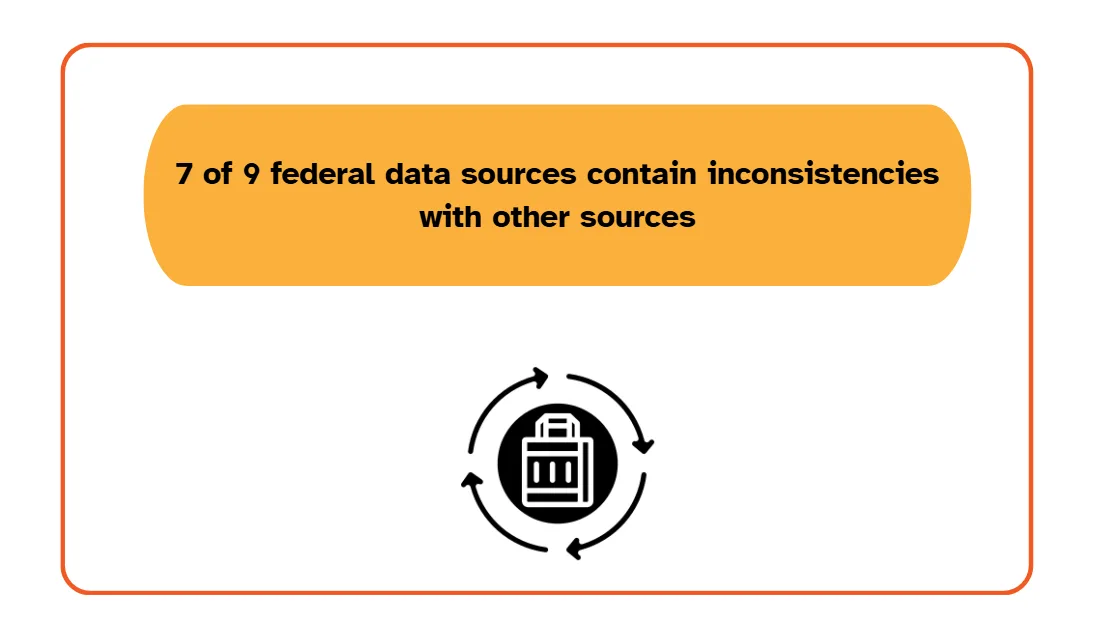
GAO concluded that these issues undermined the reliability and interoperability of the data used for eligibility decisions.
When sources disagree on a material attribute, reconcile the discrepancy before treating either value as authoritative.
Compare the observation dates, source provenance, collection methodology, and level of detail to determine whether the difference is explainable.
For example, two revenue figures may differ simply because they come from different reporting periods.
If both claim to represent the same period but provide materially different values, flag the conflict for investigation rather than selecting the more plausible figure.
Recency matters for the same reason.
A data point can be accurate when collected but no longer represent the issuer’s current position.
Ownership may change after an acquisition, while employee counts, operating metrics, or other business signals can move substantially between updates.
Dominic Allon, CEO of Cognism, a B2B sales intelligence and data provider, describes the broader principle:
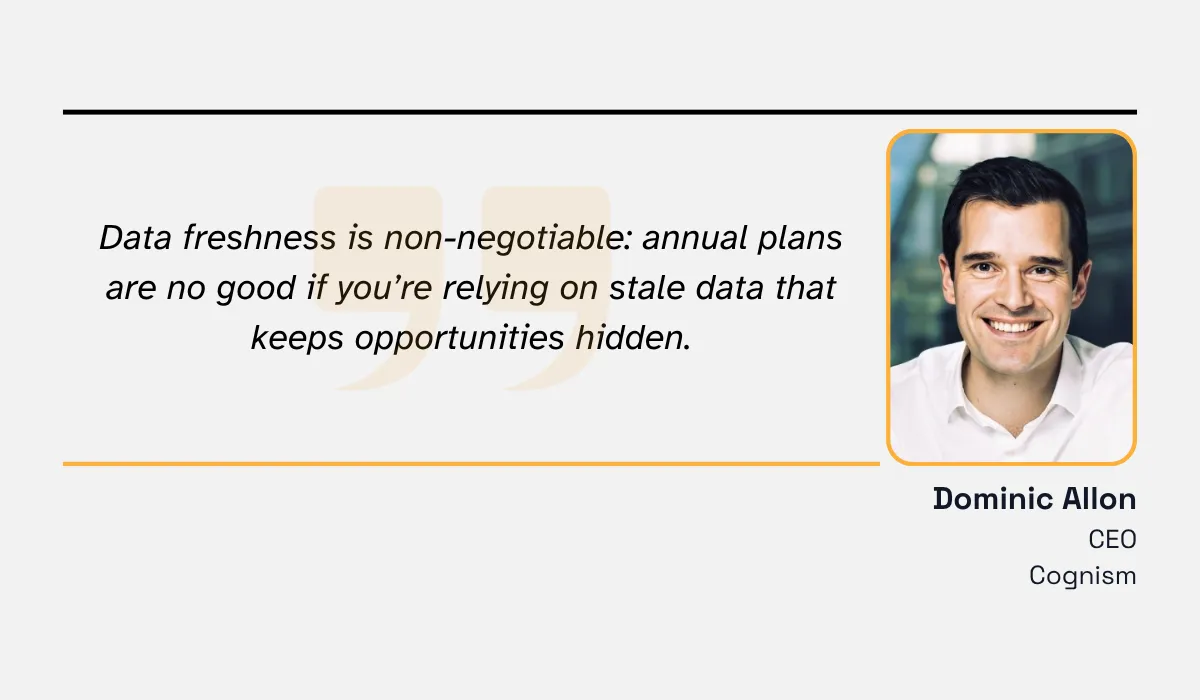
Attach a source and observation date to each material data point, and define freshness thresholds by attribute.
Financial statements may remain relevant for longer because they represent a defined reporting period, while ownership, management, operating status, and other structural facts may require more frequent validation.
The threshold should reflect how quickly the attribute can change and how materially a stale observation could affect the assessment.
You can implement this as a field-level validation control.
Flag values that exceed their freshness window or conflict with another trusted source, then route those exceptions for analyst review.
This creates an auditable record of what the sources reported, when they reported it, and how discrepancies were resolved rather than leaving analysts to discover inconsistencies while preparing committee materials.
Evidence Confidence
A record can be correctly identified and current while still containing evidence with different reliability levels.
A directly reported financial figure, a value extracted from a regulatory filing, and an estimate inferred from other company signals shouldn’t be presented as equally certain.
Before a case reaches the committee, make that distinction explicit so reviewers can see which inputs are directly supported and which require more judgment.
Assign a confidence level to each material evidence item based on its provenance and how directly it supports the underlying claim.
For example, a value taken directly from an audited filing could receive a high-confidence designation, while an estimate derived from multiple indirect signals could receive a medium- or low-confidence designation.
The labels matter less than defining what each level means and applying the criteria consistently.
Keep the confidence assessment separate from the value itself.
A revenue estimate of $50 million isn’t equivalent to verified revenue of $50 million simply because both appear as numerical fields in the same issuer record.
Your data model should preserve the distinction between:
- The observed value
- Its source
- The observation date
- The method used to derive it
Different sources can also produce materially different assessments of the same issuer.
A 2024 study published in the Review of Accounting Studies found that bank and credit rating agency ratings differed in more than 60% of firm-month observations.
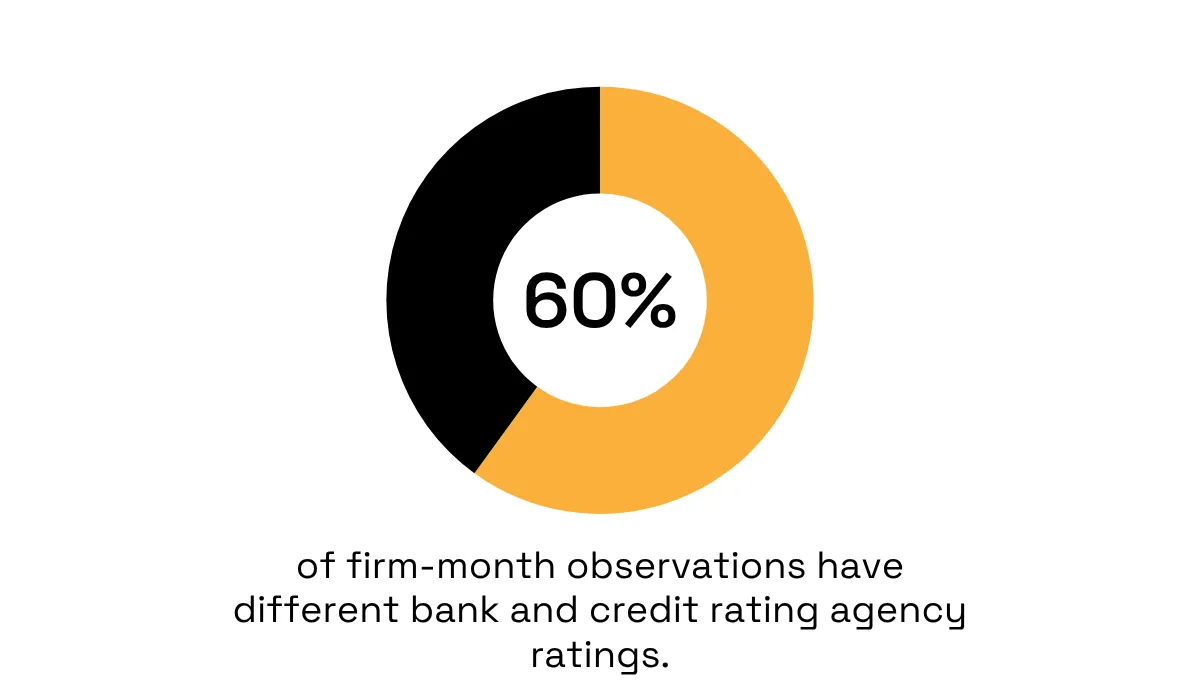
Illustration: Veridion / Data: Review of Accounting Studies
The researchers also found that bank ratings contained information that improved predictions of defaults and subsequent CRA rating revisions.
Rather than treating one source as automatically authoritative, the finding reinforces the value of preserving provenance so analysts can understand why assessments differ and decide how much weight to give each.
The same principle applies when an issuer record combines evidence of different strengths.
An issuer may have a directly reported debt balance alongside an estimated employee count, an inferred operating location, or a modeled growth signal.
Without an explicit confidence indicator, those fields can appear equally authoritative, even though the supporting evidence differs substantially.
Carry the confidence level, along with the underlying evidence, into the committee materials.
A concise evidence quality indicator, source reference, observation date, and explanation of any inference or adjustment give committee members the context they need to challenge uncertain inputs without reconstructing the evidence trail themselves.
Logging and Escalating Unresolved Gaps
Not every information gap can be resolved before a case reaches the rating committee.
The important control is to ensure that an unresolved discrepancy doesn’t disappear into the final dataset or appear as though the record were complete.
Instead, log the gap, document what you investigated, assess its potential impact, and escalate it with enough context for the committee to decide whether the case can proceed.
This is consistent with established rating practices that treat information sufficiency as part of the rating process.
Moody’s recognizes that analysts may encounter information that doesn’t provide a full and accurate picture and that insufficient information can affect whether and how a rating action proceeds.
Your escalation record should capture:
- The affected data point
- The conflicting or missing sources
- The available observation dates
- The checks already performed
- The potential analytical impact
- The person or forum responsible for resolving or accepting the gap
This gives the committee a concise evidence trail rather than forcing members to reconstruct the problem from underlying data.
This prevents an unresolved gap from being accidentally converted into an inferred value.
If you can’t verify a company’s current ownership structure, mark the relationship as unresolved and explain any provisional value rather than allowing an inferred parent to appear as verified data.
Recent regulatory findings reinforce the need for this visibility.
In its 2025 review of rating committee governance, the UK Financial Conduct Authority (FCA) found that some firms didn’t discuss issuer data quality or information gaps in the committees it observed.
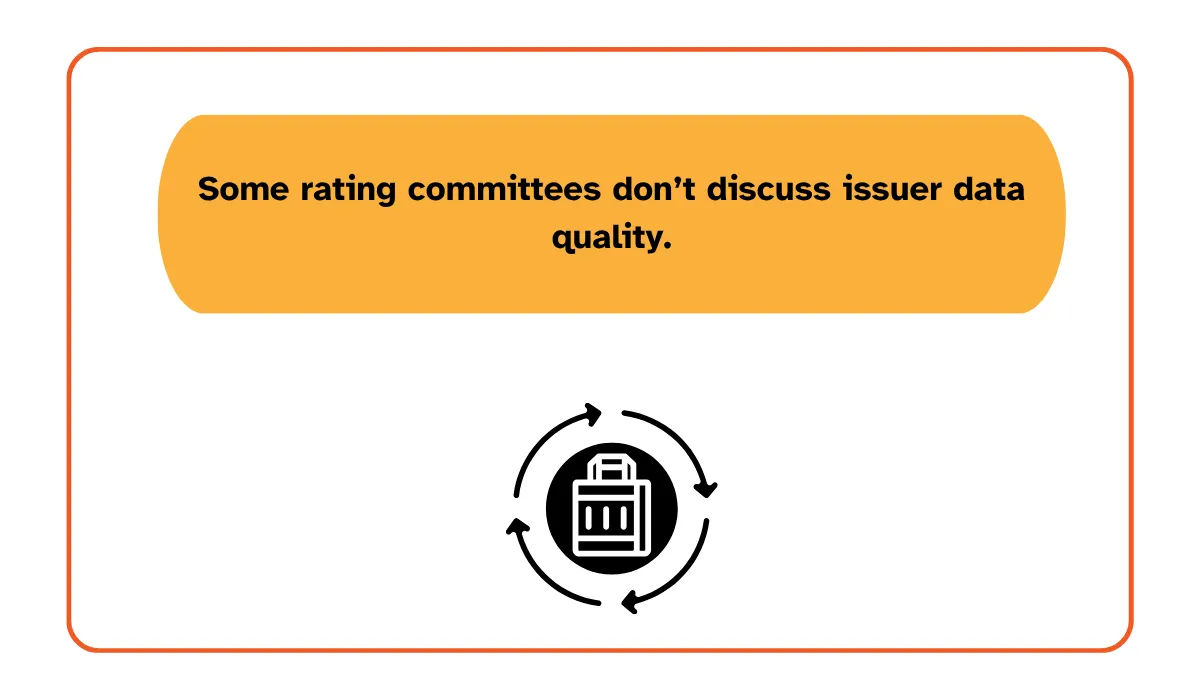
The FCA warned that analysis based on incorrect or incomplete data could affect rating quality and said firms should assess and evidence information-quality standards within the rating process.
Distinguish between data not found, data in conflict, and data insufficient to support the analysis.
Those are different conditions and may warrant different actions.
A non-material missing attribute may simply be documented, while a material discrepancy in debt, ownership, liquidity, or other rating input may require further investigation or committee review.
Your pipeline can make this process machine-visible by generating an exception record when a material validation fails, attaching the supporting evidence and provenance, assigning a severity or materiality level, and routing it to the appropriate analyst or review forum.
The system should ensure that unresolved uncertainty remains visible to the people responsible for deciding whether the rating can proceed.
Conclusion
These six checks help ensure the case reaches the committee with a reliable, well-supported record.
That allows the discussion to focus on creditworthiness rather than whether the underlying data can be trusted.
A committee working from flawed inputs risks reaching the wrong conclusion and spending its expertise solving the wrong problem.
Build these checks into the workflow before committee review, and you create a process where problems are caught earlier, uncertainty is visible, and analysts spend less time questioning the record and more time assessing what it means.
The goal is greater confidence in the decisions the evidence supports.
Articles
Discuss how these trends affect your organization.
Our analysts are available for a short call. Bring a specific question and we will ground it in the data.
Insights
Keep reading
More analysis, research, and outcomes grounded in live company intelligence.
How to Assess Operational Risk When Industry Codes Don’t Match
What if industry codes don’t match reality? Learn how to assess operational risk accurately when standard classifications fall short.
Why Legacy SIC and NACE Rev. 2 Codes Miss Modern Niche B2B Companies
Struggling with niche industrial product sourcing? Legacy industry codes fail modern B2B companies. Find out why and how to adapt.
Beyond Static Data: What Growth Signals Reveal That Traditional Firmographics Miss
Tired of relying on outdated firmographic data? Uncover hidden growth signals that traditional firmographic data providers miss.