Insights / Articles
Credit Risk API vs. Financial Data API: When You Need Both
On paper the borrower looks stable, yet its credit score disagrees. Compare what a credit risk API and a financial data API return and when you need both.

- A credit risk API returns scores, ratings, and default probabilities.
- A financial data API provides financial data for independent assessment.
- Use both APIs to compare risk scores with financial performance.
A credit risk API returns the provider's judgment of a company: a score, rating, default probability, or credit limit. A financial data API returns the facts behind it, such as reported statements, ratios, and filing dates, which your team analyzes itself.
If you rate or lend to private and mid-market companies, you usually need both, plus a company data layer like Veridion that ties each record to the right entity and adds current, non-financial context.
This guide explains what each API returns, when one is enough, and how to combine them without conflicting results.
Credit Risk API vs. Financial Data API: What Each One Returns
The terms credit risk API and financial data API can be confusing. A credit risk API may typically refer to consumer credit bureau checks or business credit assessments, while a financial data API may return stock market data or bank account transactions.
This article, however, focuses on B2B credit risk: company credit assessments and APIs that provide business financial statements and fundamentals.
Which one you need depends on whether you want a ready-made risk assessment, the financial inputs to build your own, or both.
What a Credit Risk API Returns
Say you're lending to hundreds of businesses and need to screen them before deciding which ones deserve a closer review. Calculating a separate risk score for every borrower could take considerable time and resources.
A credit risk API saves that time and those resources in the first round of assessment.
Depending on the provider, it may return:
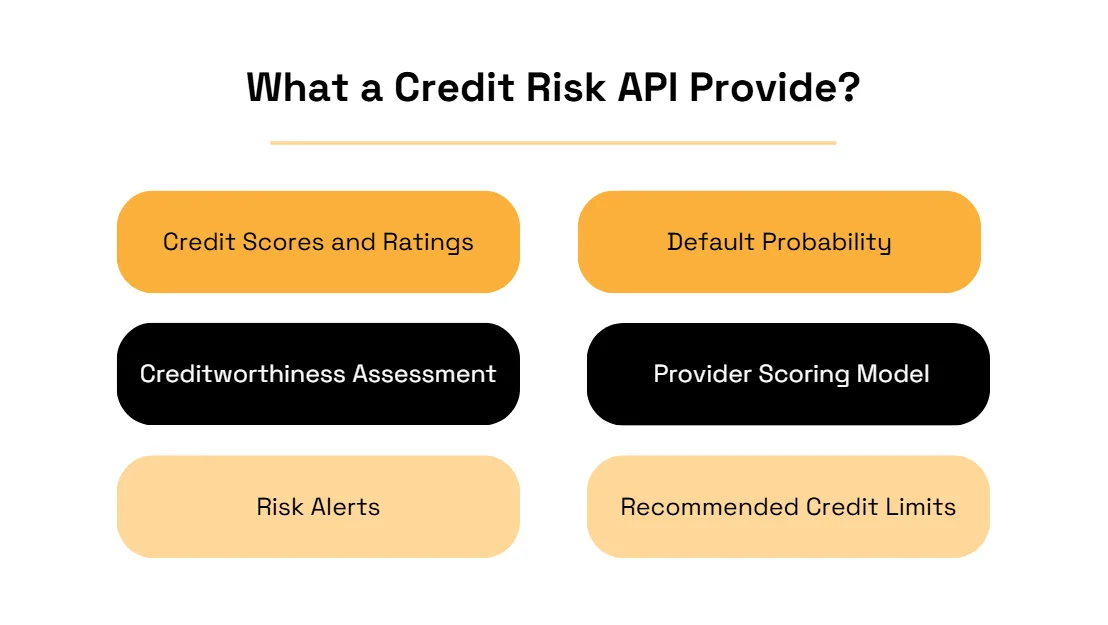
Illustration: Veridion
For example, Dun & Bradstreet describes D&B Direct for Finance as a credit risk API that delivers standardized scores and ratings directly into a company's existing systems.
The main benefit is speed. Your team gets a consistent risk output across many companies without having to build every scoring model from scratch.
However, a ready-made score comes with a trade-off. The provider controls how its model weighs different signals and converts them into a final assessment.
You might receive supporting factors or an explanation of the result, but whether you can inspect every input, assumption, and calculation behind the score depends on the provider.
This matters when an analyst needs to explain a rating, test a different set of assumptions, or investigate a result that conflicts with other evidence.
A score gives you a starting point for the assessment. It doesn't automatically tell you the full financial position of the business or explain every factor affecting its ability to repay.
When you evaluate a provider, check how much transparency it offers and whether its output meets your requirements for screening, monitoring, and model validation.
What a Financial Data API Returns
Now, suppose a borrower receives a healthy credit rating, but your analysts want to understand how it was reached. Is the company's cash flow strong enough to support its debt? Are its liabilities growing faster than its earnings?
A financial data API gives your team the figures to investigate these questions.
Depending on the provider and the company, you may receive:
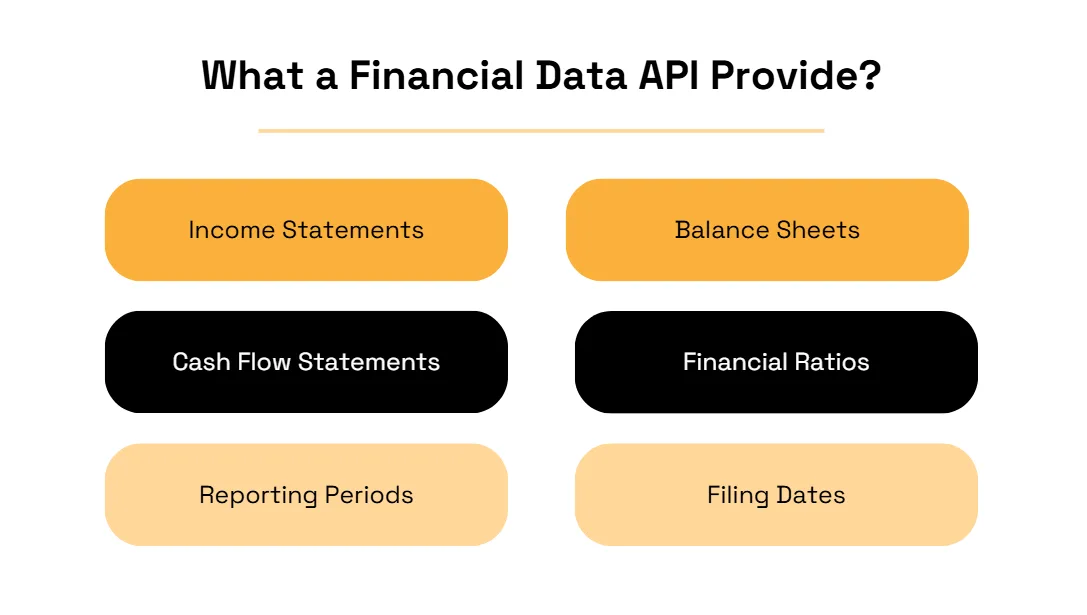
Illustration: Veridion
With these inputs, your analysts can calculate their own measures, apply internal rating criteria, and compare companies using a consistent methodology.
For example, your team could examine a borrower's debt relative to its earnings, check whether operating cash flow supports its repayment obligations, and compare those figures across reporting periods.
In other words, you control the calculations and can adjust your approach to suit the exposure, sector, or type of borrower. This is particularly useful when you need to apply proprietary criteria or investigate why a company's financial position has changed.
But access to financial figures doesn't guarantee a complete assessment.
Public companies are required to publish regular financial statements. Private businesses may disclose far less information, and the available records may vary by jurisdiction.
In the United States, for example, private companies generally aren't required to submit financial disclosures to the Securities and Exchange Commission (SEC) simply because they're private businesses.

Illustration: Veridion / Data: Library of Congress
As a result, their financial information may be incomplete, delayed, abbreviated, or unavailable for certain periods.
Some B2B data API providers may supply estimates or derived figures when reported data is missing.
Your team needs to distinguish those values from figures taken directly from company filings. An estimated revenue figure, for example, shouldn't be treated as an audited result.
A company financial data API therefore gives you more control over the analysis, but the quality of your conclusions still depends on the quality, coverage, and meaning of the underlying data.
How They Compare
A credit scoring API gives you a provider-generated assessment. A financial data API gives you financial information to analyze under your own methodology.
Here's how that difference affects your workflow:
Criteria | Credit risk API | Financial data API |
|---|---|---|
What it returns | Scores, ratings, default probabilities, credit limits, and risk alerts | Financial statements, ratios, reporting periods, and filing dates |
Who controls the logic | The provider controls its scoring methodology | The provider controls how source data is collected and prepared; your team controls the analysis |
Update timing | Depends on the provider's scoring and monitoring schedule | Depends on filing availability and provider refresh schedules |
Historical depth | Depends on whether the provider supplies dated scores or prior assessments | Depends on the provider's coverage of past reporting periods |
Company identification | May use a provider ID, registry number, or other business identifier | May use legal names, registry numbers, or provider-specific IDs |
Private-company coverage | Depends on the provider's coverage and available risk signals | Depends on financial disclosure and available records |
Explainability | Depends on the provider's model transparency and supporting factors | Analysts can inspect available figures and document their calculations |
Role in the workflow | Risk screening, benchmarking, and credit assessment | Financial analysis and internal model inputs |
Both APIs share a limitation: neither guarantees that you have matched the correct legal entity or captured the company's current operating context.
A score may refer to a parent company while the financial statements belong to a subsidiary. A company may also have changed its name, ownership, or operations since the data was collected.
This is where Veridion's company intelligence layer can help. Its Match & Enrich API resolves company records and returns a veridion_id that you can use to connect data about the matched entity.
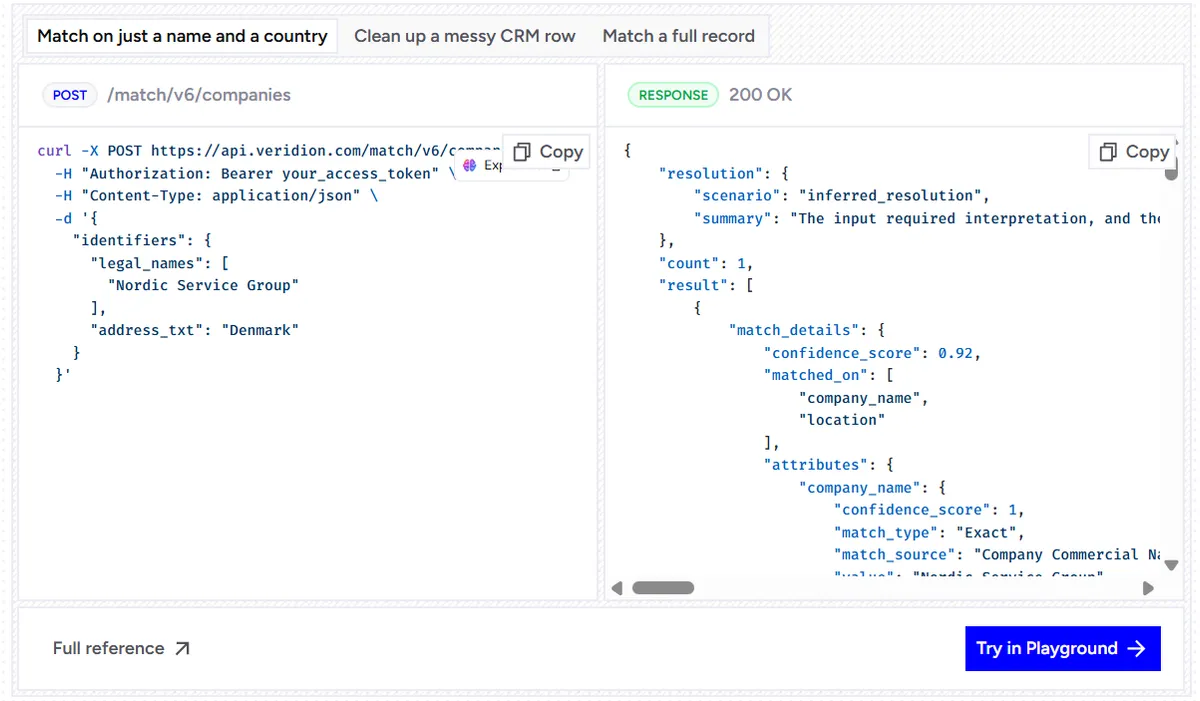
Source: Veridion
Its response can include registered names, addresses, business classifications, and operational information. Revenue and employee figures carry a type such as "Extracted" or "Modelled", helping you distinguish values published in sources from values modelled by Veridion.

Source: Veridion
That context helps your team interpret financial and risk data more carefully. Veridion does not, however, turn modelled company figures into reported financials or replace a credit assessment.
When You Need Both a Credit Risk API and a Financial Data API
You don't necessarily need both APIs for every decision.
A credit data API may be enough when you need fast, consistent screening across a large portfolio. A financial data API could suffice when you're assessing companies with suitable financial disclosures and your analysts control the full assessment.
Using only one API becomes a problem in three situations: when the borrower is a private company with limited disclosures, when you're building or validating a proprietary credit model, and when you need to monitor borrowers between reviews.
Consider a private mid-market borrower. Your credit risk API returns a healthy rating, but the latest financial statements show declining cash flow.
The score gives you an external benchmark, while the financial data gives you evidence to examine. Neither result should automatically override the other.
Your analysts need to understand the difference, check the reporting periods, and determine whether the score reflects the latest available information.
If the financial statements are incomplete, you'll also need to account for those gaps before drawing a conclusion.
The same principle applies when your team builds and validates credit models.
Assume your internal model assigns a higher risk level to a company than an external provider does.
Don't adjust your model to match the provider before you investigate the difference.
Perhaps your model responds more strongly to declining cash flow. Perhaps the provider uses different company records, reporting periods, or risk signals.
Treat external credit scores as benchmarks or challengers instead. If the results diverge, your analysts can examine why.
Note that current company data or revised financial figures can introduce information from the future and make a model appear more accurate than it was.
Before choosing a provider, check whether it supplies dated historical values and preserves earlier versions. You need to reconstruct the information available at the time of each historical decision.
Regulators expect the same scrutiny of vendor models.
In April 2026, the Federal Reserve, OCC, and FDIC issued SR 26-2, revised model risk management guidance that replaces SR 11-7. It applies mainly to banks with over $30 billion in assets, but its principles are useful for any team that relies on vendor models.
It expects banks to validate vendor models and monitor them over time, and it covers vendor data and parameter values as well as complete models.
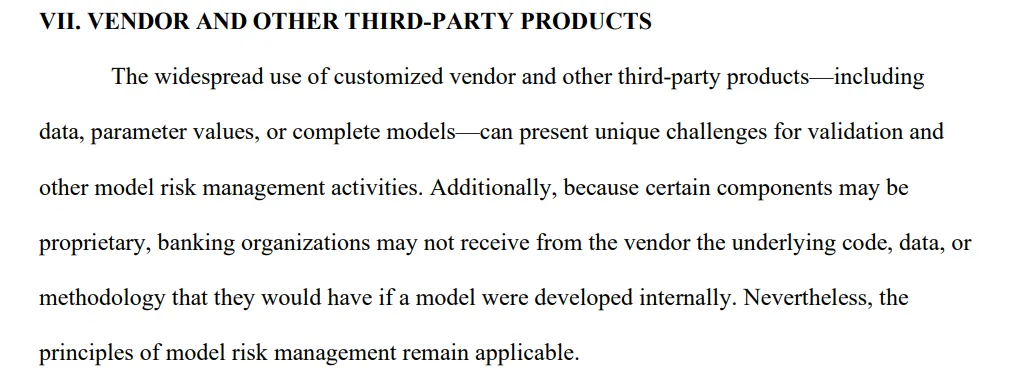
Source: Federal Reserve
Monitoring borrowers between reviews is the third case. Filings arrive quarterly or annually, and scores update on the provider's schedule. In the meantime, a borrower can open new sites, close locations, slow its hiring, or change ownership, and neither API may reflect it until the next update.
Company data can fill that gap. In one customer story, a US financial-data provider wanted to spot which private companies were gaining momentum, since static financials only showed where a company had been.
Veridion built forward-looking signals on its company knowledge graph, tracking hiring momentum, new sites, review trends, and headquarters upgrades. Its relocation analysis detected 1,670 companies that had moved headquarters or expanded their footprint, and 1,209 of them (72%) were missing from the provider's existing list.

Source: Veridion
For a credit team, the same signals can flag a borrower whose situation has changed before the next filing or score update shows it.
A score can support a risk assessment, financial statements can support your own analysis, and company intelligence can help confirm which business you are assessing and provide additional context.
How to Combine Both Without Conflicting Results
Once you've decided to use both APIs, the next challenge is making their outputs work together.
First, confirm that both APIs refer to the same legal entity.
One provider may identify a business by its registry number, another by its Legal Entity Identifier (LEI), and a third by its own internal ID. These identifiers are not always interchangeable.
A parent company and its subsidiary may have similar names but separate financial obligations.
What happens if you join these records using the company name alone? You could attach a risk score to the wrong financial statements.
Use stable identifiers where available, supported by entity-resolution rules that account for name changes, subsidiaries, and related businesses.
Veridion's veridion_id can serve as a common join key for records resolved through its Match & Enrich API. If an ID changes, the response also returns a former_veridion_id, so you can keep historical records linked.
Next, decide how your team will handle disagreements.
Suppose a company has a healthy credit score but declining cash flow. Or perhaps its financial statements look stable, but a recent closure raises questions about its operations.
Your system shouldn't automatically average these signals into a single number.
They measure different things, and combining them without a clear methodology can make the final assessment harder to explain.
Set rules for which source provides each type of information. You might use the financial data provider for reported financial figures, the credit risk provider for its own score, and company records to check identity and operating context.
When the sources conflict, flag the case for analyst review.
Remember to also store each score with its source and assessment date. A score from an earlier period should not appear to be a current assessment simply because it sits beside newer financial information.
Finally, before integrating either API, check two things:
- Data usage rights: Does the license allow you to use the data to train, test, or validate your own models, or only to support individual assessments?
- Historical availability: Can you obtain dated historical values, or does the service return only the current state? This distinction matters when testing models against past outcomes.
Note: An API that works well for individual credit checks may not suit bulk model training or repeated historical backtests. Check the provider's endpoints, rate limits, pagination, export options, and licensing terms against your intended workload.
Conclusion
A credit risk API and a financial data API solve different parts of the credit assessment problem.
Using both can help you compare external assessments with your own findings, investigate disagreements, and build more transparent credit models.
Start by defining what each API should contribute.
Then test the integration against a small sample of borrowers, including private companies and cases where the available data conflicts.
Once you can trace each assessment back to the right company, source, and reporting period, you'll have a stronger foundation for scaling the workflow.
Articles
Discuss how these trends affect your organization.
Our analysts are available for a short call. Bring a specific question and we will ground it in the data.
Insights
Keep reading
More analysis, research, and outcomes grounded in live company intelligence.
Top B2B Data APIs for Powering Enterprise Decision Engines
Struggling with enterprise decision-making? Unlock powerful insights with top B2B data APIs designed for decision automation.
7 Financial Data Providers You Need to Know About
In this guide, we break down seven financial data providers, key features, pros and cons, and what to expect in terms of pricing.
What Is the Difference Between Business and Market Intelligence?
Not sure whether you need business intelligence or market intelligence? This article compares them and shows when to choose each.