Insights / Articles
From Millions of Companies to a Shortlist of 50: A Data-Driven Approach to VC Deal Sourcing
Data-driven VC deal sourcing starts with 134 million companies and narrows them with firmographic filters and growth signals to a shortlist of 50.

- The best investment opportunities can disappear from view before your search even begins.
- Early growth signals can reveal promising companies before they become obvious to the wider market.
- Data doesn’t replace investor judgment but determines where that judgment gets spent.
How do venture capital firms discover tomorrow's unicorns before everyone else does?
It often comes down to starting with the broadest possible view of the private market, then systematically narrowing down to a shortlist worth investigating.
And by systematically, we mean using a data-driven approach.
Read on to learn how a data-driven sourcing process helps you spend less time searching and more time evaluating companies that fit your unique investment thesis.
1. Start With a Market of Millions of Companies
Every VC investment starts with a basic question: Which companies should we look at?
The obvious answer might seem to be in:
- Founder referrals
- Accelerator demo days
- Warm introductions
- Companies already making headlines.
After all, these channels have fueled venture investing for decades.
The problem is that all of these begin with an invisible filter.
If your sourcing process depends mainly on your network, you only see companies that have already found a path into that network.
Take into consideration:
- Businesses founded outside major startup hubs
- Companies without well-connected founders
- Promising startups that haven't yet attracted public attention
All of these can remain invisible, no matter how strong they are. That's becoming a growing concern as competition for high-quality deals intensifies.
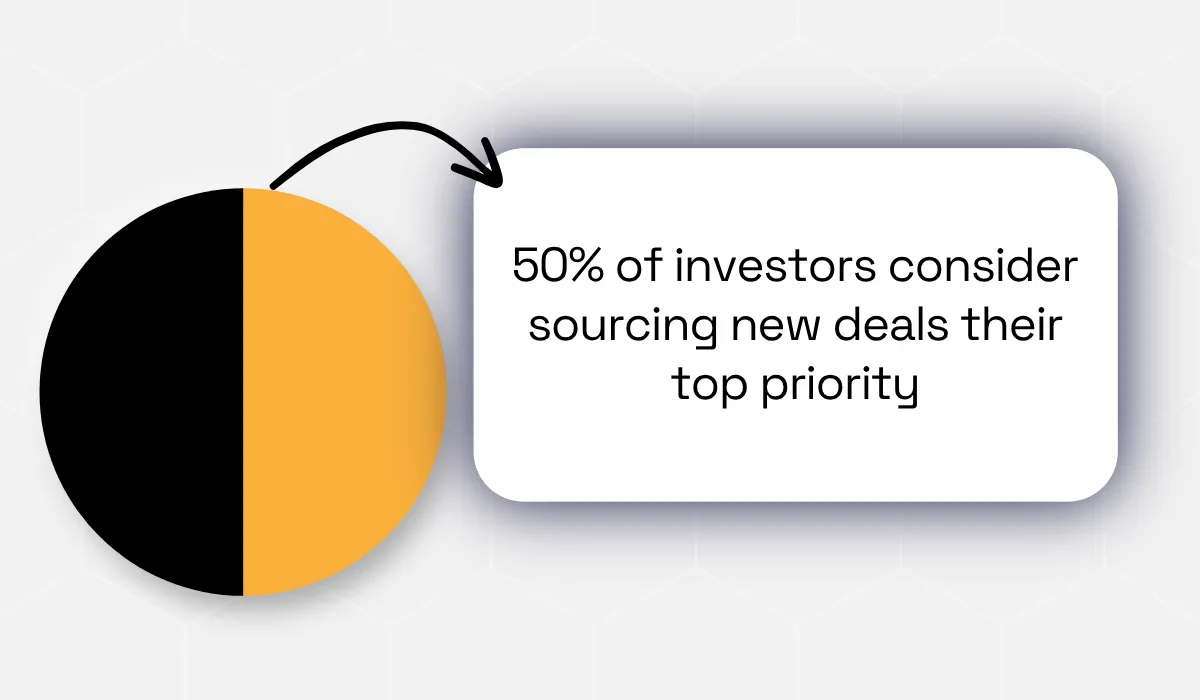
According to Affinity's 2026 Private Capital Predictions Report, half of investors now consider sourcing new deals their highest priority.
Moreover, 46% say competition from other firms is significantly affecting deal activity. At the same time, 68% expect overall deal volume to increase.
This leaves investors with even more companies to evaluate and less time to evaluate each one.
In this context, relying only on traditional sourcing channels means competing for opportunities that many other investors are already seeing.
That doesn't mean networks have stopped mattering.
In fact, a Harvard Business Review analysis of nearly 900 VC firms found that more than 70% of VC investments originate through existing professional networks.
Those relationships are incredibly valuable, but they're not enough on their own.
Instead, many firms are complementing relationship-driven sourcing with systematic, data-driven discovery.
The idea behind it is simple.
You’re not beginning with a list of companies you already know. You’re beginning with every single company that could potentially fit your investment thesis.
That creates a much bigger opportunity set.
Here’s where Veridion helps.
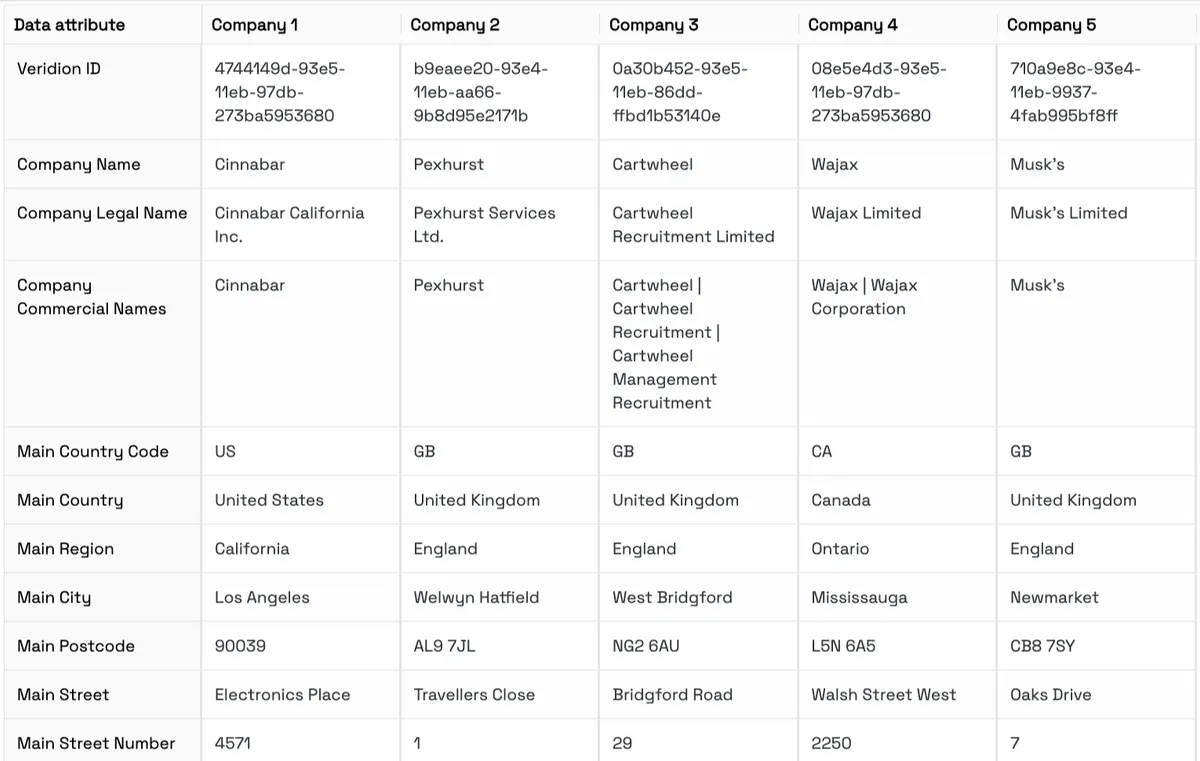
Our AI-powered data engine covers every active company in the world.
It’s refreshed continuously and captures hundreds of attributes for each company profile, some of which are shown next.
Source: Veridion
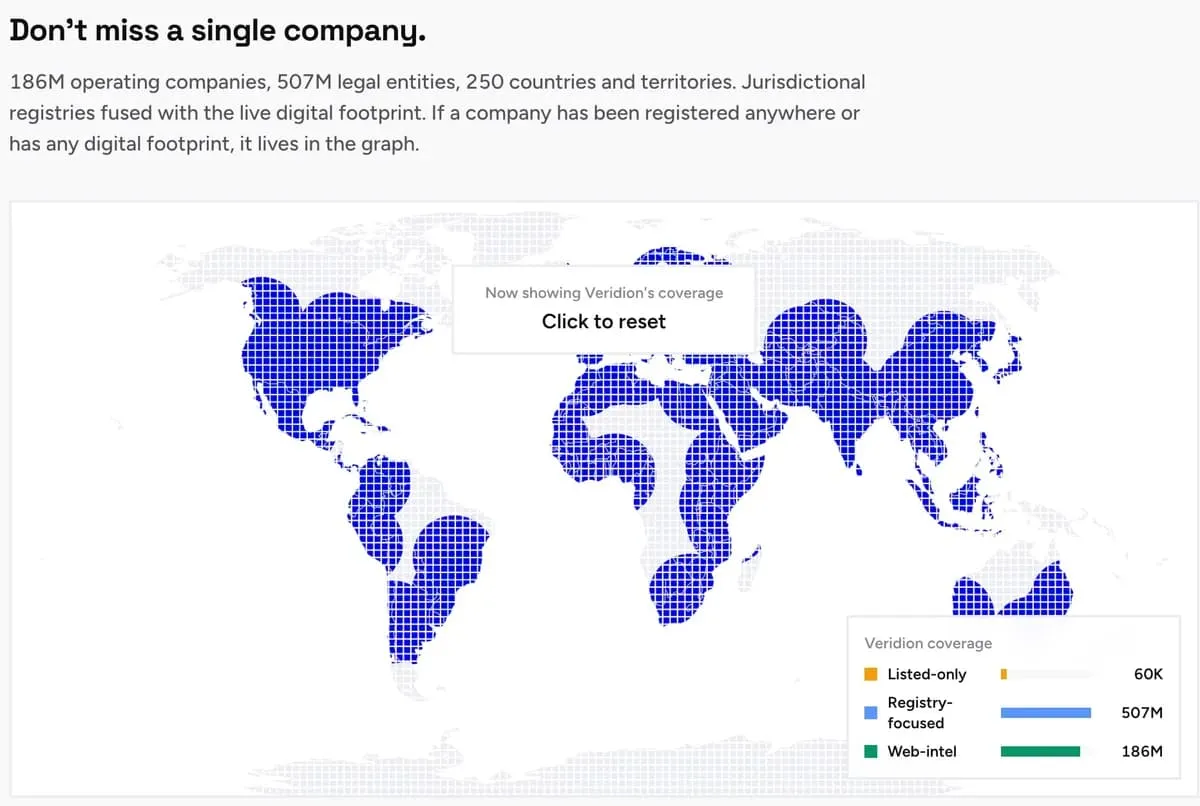
And there’s something else that sets Veridion apart: its coverage of SMBs and early-stage businesses.
Later-stage and growth-equity investors are looking for companies that already have a solid track record.
Seed and pre-seed companies, though, are a different story.
At this stage, a business may consist of a small team, a website, a handful of customers, and little public recognition.
Yet these are exactly the companies early-stage investors need to find before their growth makes them obvious to everyone else.
Unfortunately, this is also where traditional business datasets can become less comprehensive.
For example, ZoomInfo is a strong platform when it comes to data on big US enterprises.
However, coverage can become less consistent for smaller and more regional businesses.
Veridion takes a different approach.
We cover more than 90% of SMBs. That includes digital-first, micro, and even unregistered businesses that conventional sources may overlook.
Source: Veridion
For an early-stage investor, that broader coverage means more promising companies enter the sourcing funnel before they become widely visible.
And VC firms are increasingly using data to do just that.
Networks are still relevant, but Affinity's 2025 European VC benchmark found that firms are turning to data-driven sourcing tools to widen their deal funnels.
The number of data-driven VCs grew by 20% in a year, while 38% of those firms were already using data tools to source more than 40% of their deals.
More recent Affinity research points in the same direction.
AI use for investment decisions more than doubled year over year. And 35% of data-driven VCs now say their tools generate around half of the deals they source.
So, starting with the broadest possible market doesn't mean evaluating millions of companies individually.
It means removing visibility as an accidental screening criterion.
Once you've built that wider universe, the task changes completely.
You have the market.
Now you need to narrow it down, using a set of objective firmographic filters drawn from your investment thesis.
2. Apply Firmographic Filters to Narrow the Universe
Starting with millions of companies doesn't mean you’re treating them all equally.
The next step is applying firmographic filters.
These are objective characteristics that define exactly what your fund is looking for.
Think of them as non-negotiable eligibility criteria. If a company doesn't satisfy them, it leaves the funnel immediately.
These filters should come straight from your investment thesis.
For example, a fund may invest only in Seed and Series A B2B SaaS companies headquartered in Europe.
Another may focus exclusively on climate technology startups in North America.
Each thesis thus translates into a specific set of screening criteria.
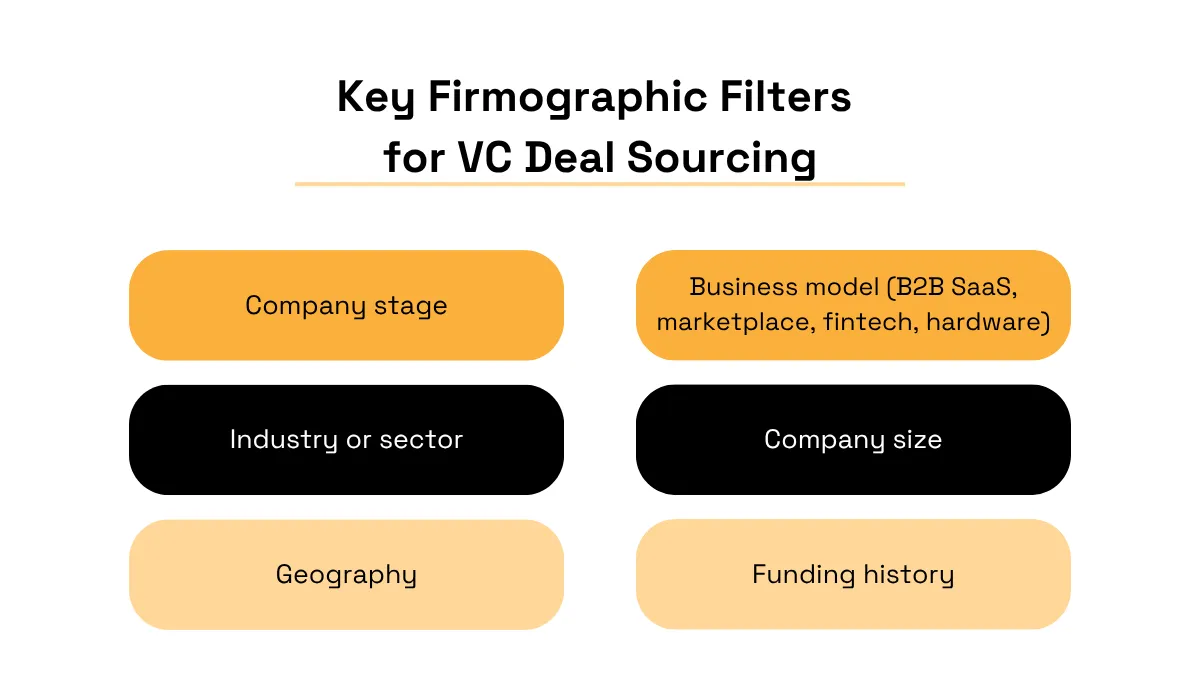
The visual below shows the most common factors included:
Source: Veridion
But the important part comes after defining these filters. You need to define them consistently.
Without a standardized framework, two analysts reviewing the same company can easily reach completely different conclusions about how it fits the fund's mandate.
One might classify it as enterprise software, another as fintech. One may consider it early-stage, another too mature.
That inconsistency makes sourcing hard to scale.
Modern deal sourcing platforms increasingly solve this problem.
As explained in this Growthpal article, modern platforms translate an investment thesis into structured search parameters.
So instead of manually deciding whether every company belongs in the funnel, the criteria are codified once, then applied uniformly across the entire dataset.
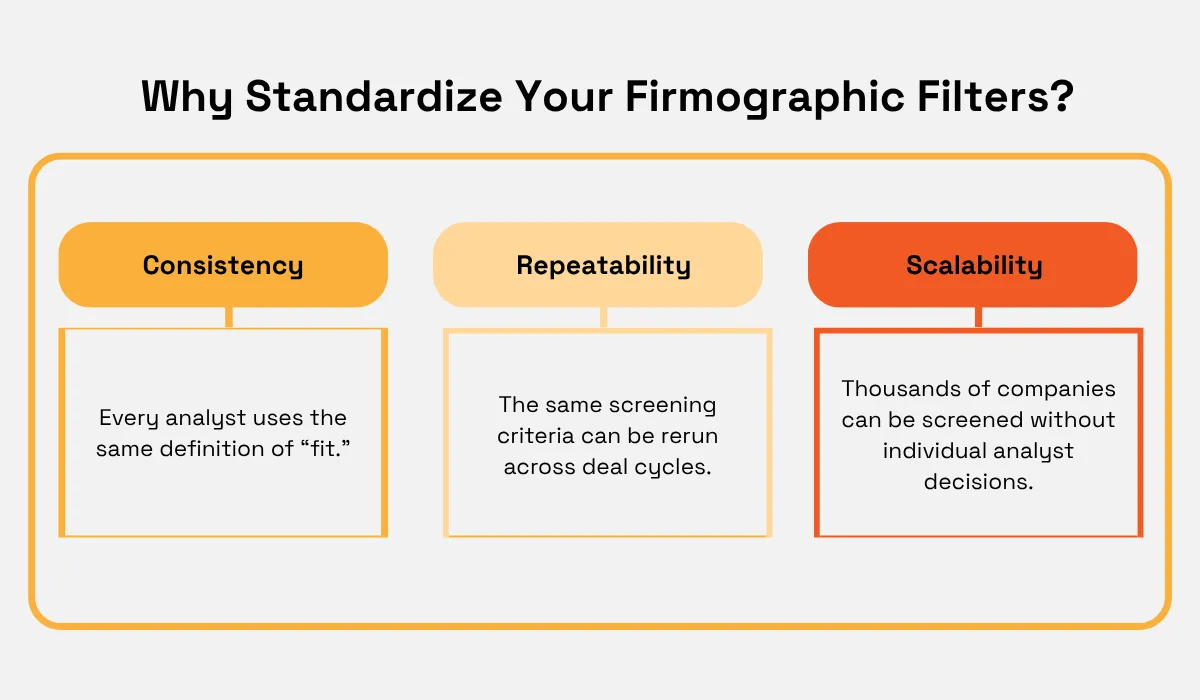
Overall, standardizing these filters brings three major advantages, as shown below:
Source: Veridion
Investment theses evolve, markets change, and new companies emerge all the time.
A standardized screening framework ensures consistent, reliable evaluations despite these changes.
It also transforms an impossible search into a manageable one.
For example, filtering for European B2B SaaS companies at Seed or Series A with 10–100 employees could reduce a global dataset to a much smaller pool that already fits your mandate.
The exact reduction depends on the strategy.
A well-designed set of firmographic filters can narrow an initial universe of millions into a few thousand realistic candidates before deeper analysis begins.
That's a huge improvement.
But it's way too many companies to evaluate individually.
At this point, every remaining business looks promising on paper.
The challenge is determining which ones are actually building momentum.
3. Layer in Growth Signals to Surface Momentum
Matching your criteria is a good starting point, but it doesn't necessarily make a company a compelling investment opportunity.
The next layer is looking at growth signals that separate companies matching your general criteria from those genuinely accelerating toward breakout potential.
Thousands of businesses may fit your preferred sector, geography, and stage.
The challenge is identifying the ones that are accelerating before the wider market notices them.
This is where growth signals matter.
While firmographics stay relatively stable, these signals are dynamic, revealing how a company evolves over time.
That’s what helps you distinguish businesses that exist from those actively building traction.
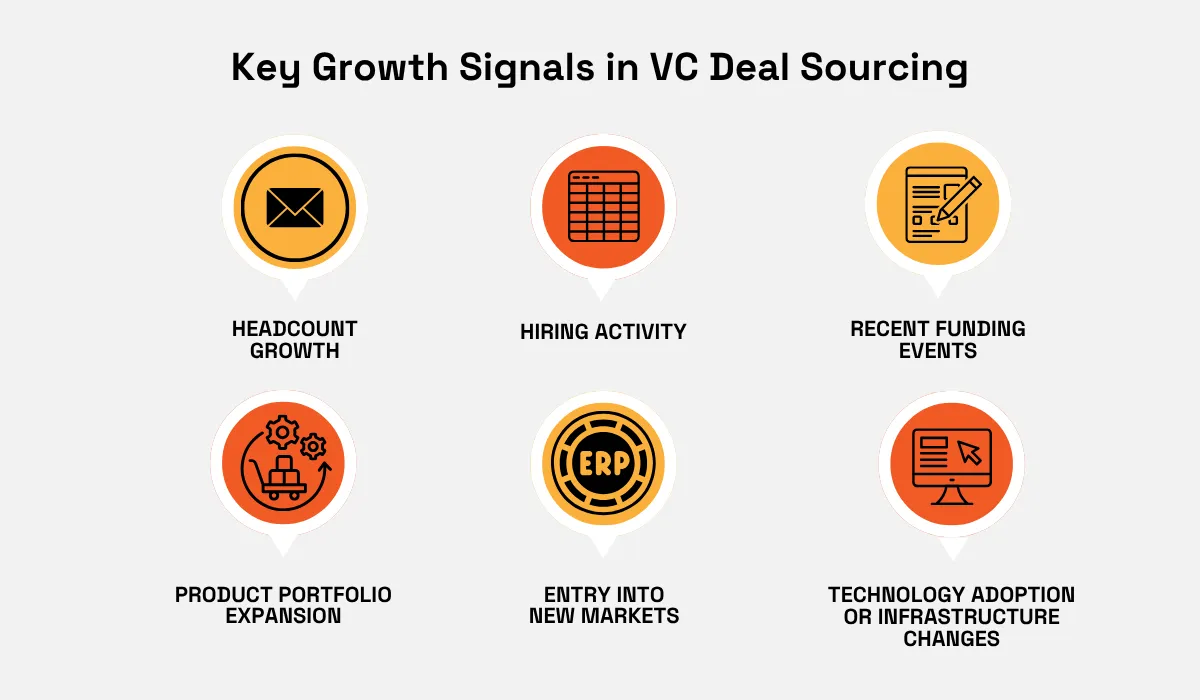
Some of the most commonly used signals include:
Source: Veridion
Each tells part of the story.
Here’s what some growth signals might indicate:
Growth signal | What it could signal |
|---|---|
Rapid engineering hiring | A major product launch or expansion may be approaching |
Entry into new countries | The company may be scaling after finding product-market fit |
Expanding product portfolio | Growing customer demand or successful adoption of existing products |
Perhaps most importantly, these signals often appear before a startup becomes well-known.
That's the real advantage of signal-based sourcing.
By the time a company announces a major funding round or receives widespread media coverage, dozens of investors may already be competing for the opportunity.
As written in a Coresignal article, monitoring operational signals lets you identify promising businesses much earlier, when competition is lower.
It also means relationships can be built before a formal fundraising process begins.
Of course, no single signal tells the whole story.
Headcount can increase because of rapid growth, or because a company is replacing employees after high turnover.
A funding round may indicate investor confidence, but it can also reflect a startup raising additional capital just to stay afloat.
That's why experienced investors don’t rely on just one metric.
Instead, they layer multiple signals together.
That way, one noisy metric doesn't create a false positive. And a combination of independent signals can build a more reliable picture of momentum.
4. Arrive at a Focused Shortlist of Investment Targets
By this stage, the sourcing funnel is much narrower.
What began as a universe of millions of companies has been narrowed first by firmographic fit, then by measurable growth signals.
The result isn’t overwhelming anymore. You now have a focused shortlist of about 50 companies that deserve genuine (human) attention.
That may sound like a dramatic reduction, but it reflects how VC sourcing works in practice.
Research shows that VC firms routinely evaluate hundreds or thousands of companies to make only a handful of investments each year.
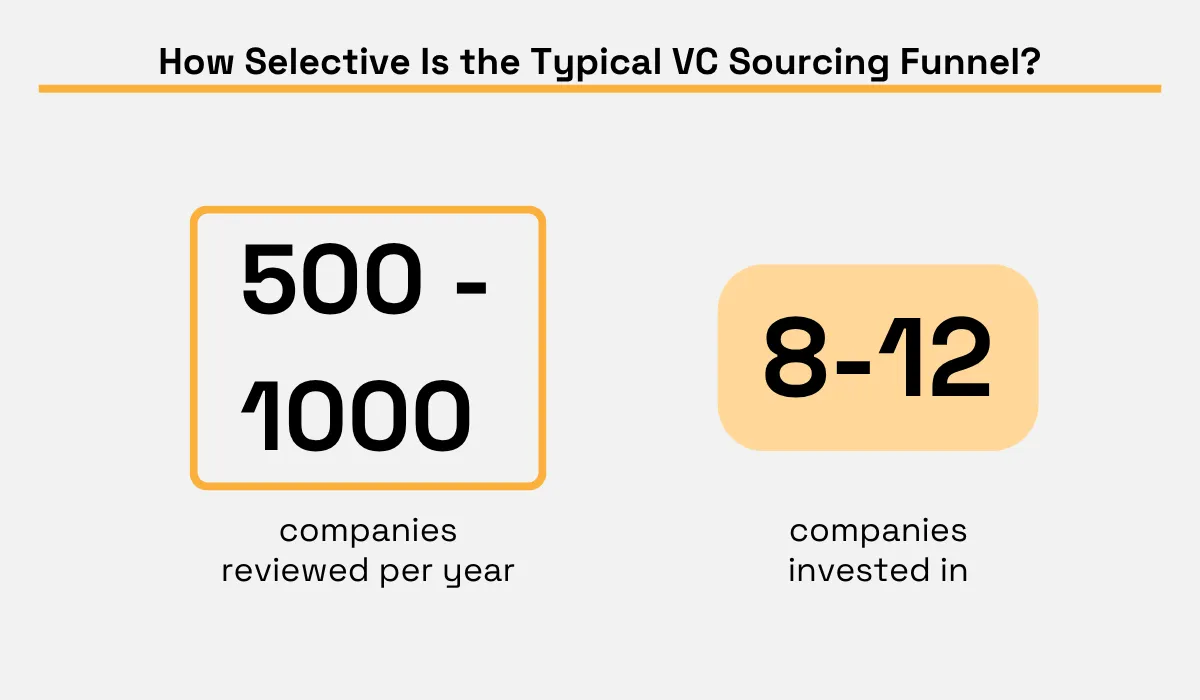
According to VC Backed, many firms review 500 to 1,000 companies annually.
They also hold 150 to 200 initial meetings and conduct 30 to 50 rounds of formal due diligence.
Out of all these companies, firms ultimately invest in only 8 to 12.
Similarly, DevsData estimates that some firms screen around 200 companies to complete just four investments.
In a nutshell, VC sourcing is extremely selective.
Now, a shortlist of around 50 companies fits naturally within that broader funnel.
It gives investment teams enough high-quality opportunities to compare, but it’s small enough for meaningful human evaluation.
And this is where data stops leading the process.
Once your company reaches the shortlist, qualitative analysis takes over.
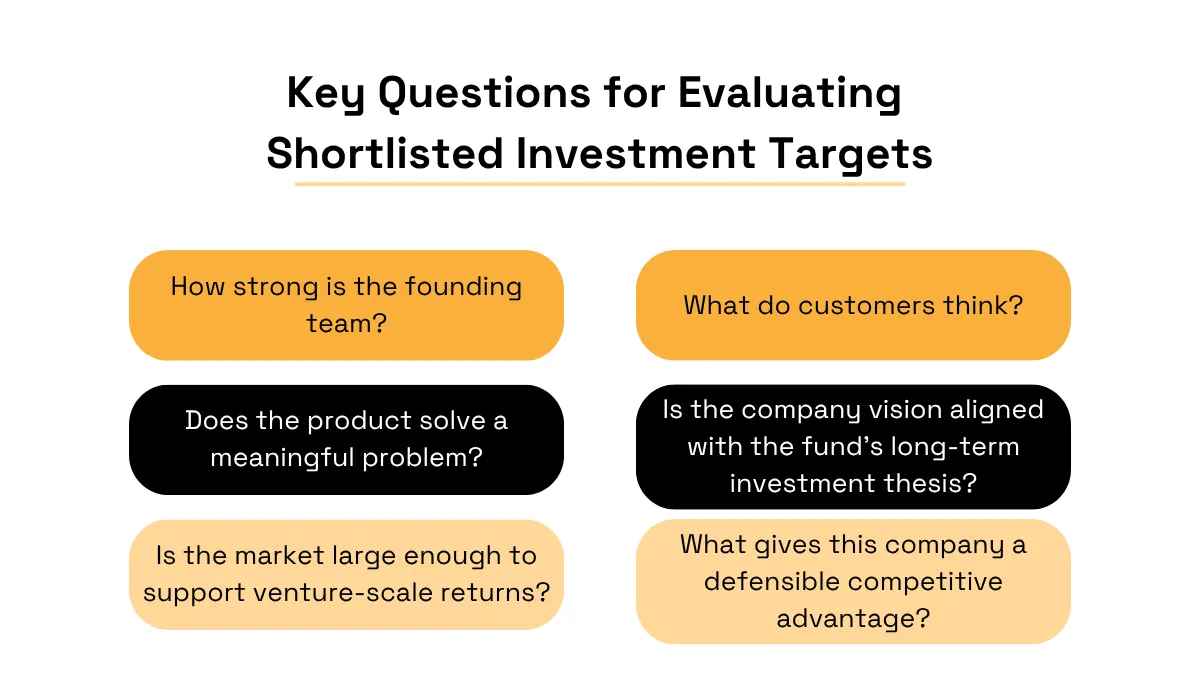
Partners and analysts begin asking questions that no dataset can answer on its own.
The visual below shows some of the most common questions.
Source: Veridion
At this stage, many firms also cross-reference shortlisted companies against their existing networks.
They can look for founders, operators, customers, or previous investors who can provide additional context.
Others assign analysts to conduct deeper market research, evaluate competitors, or prioritize outreach based on strategic fit.
In other words, the shortlist becomes a working pipeline rather than a final answer.
And that’s the note we want to end on.
A data-driven sourcing process doesn't replace human judgment.
It just changes where that judgment creates the most value. And it saves your team time and reduces logistical friction.
Instead of spending days searching for companies that might fit the thesis, investors can devote their time to understanding the businesses that already do.
So the conversation shifts from "Who should we look at?" to "Which of these exceptional companies deserves our conviction?"
At the end of the day, that's the real benefit of starting with the broadest possible market.
Conclusion
The best investment opportunities aren't always the most visible. They're often the ones you discover before everyone else does.
So combine broad market coverage with structured filtering and growth signals.
That way, you can spend less time searching and more time evaluating companies with real potential.
Start with the widest possible universe, trust the data to narrow it intelligently, and let your expertise make the final call.
Articles
Discuss how these trends affect your organization.
Our analysts are available for a short call. Bring a specific question and we will ground it in the data.
Insights
Keep reading
More analysis, research, and outcomes grounded in live company intelligence.
Business Directory Data Providers Every Company Should Know
We're sharing our list of the most relevant business directory data providers, helping you decide which one is right for you.
A Closer Look at the Data Enrichment Providers Businesses Trust Most
We will take a closer look at data enrichment providers and show how they help organizations build more accurate and complete datasets.
Beyond Static Data: What Growth Signals Reveal That Traditional Firmographics Miss
Tired of relying on outdated firmographic data? Uncover hidden growth signals that traditional firmographic data providers miss.