Insights / Articles
6 Growth Signals That Turn Stale Company Profiles into Live Buying Indicators
Tired of stale company profiles? Uncover 6 growth signals that transform them into live buying indicators. Find the best firmographic data providers.

- Headcount growth can reveal momentum that a static employee count misses.
- Department-level hiring shows where a company is investing.
- A funding round creates a real buying window, but only for a limited time.
- New products and locations can reveal priorities before firmographics catch up.
By the time growth shows up in traditional company data, the buying window it created may already be closing.
The company that just tripled its engineering hiring may already be investing in the infrastructure needed to support that growth.
The one that just opened a new regional office may already be evaluating vendors for the new market.
Waiting for lagging indicators can mean showing up after those decisions are already underway.
The good news is that these changes don't have to be a surprise.
This article covers six growth signals that can turn a static company profile into a live buying indicator, helping you spot where momentum is shifting while there's still time to act on it.
1. Headcount Growth Percentage
A company actively adding employees is committing resources to expansion.
That makes headcount growth more informative than company size alone.
A static firmographic profile might tell you that an account has 200 employees.
But it can't tell you whether that number represents rapid expansion from 150 employees or a decline from 250.
The growth rate reveals the trajectory behind the snapshot.
That trajectory can also indicate changing technology needs.
A 2025 analysis of one million B2B software purchases found that companies with at least 20% headcount growth made 38% more software purchases than companies whose headcount remained flat.
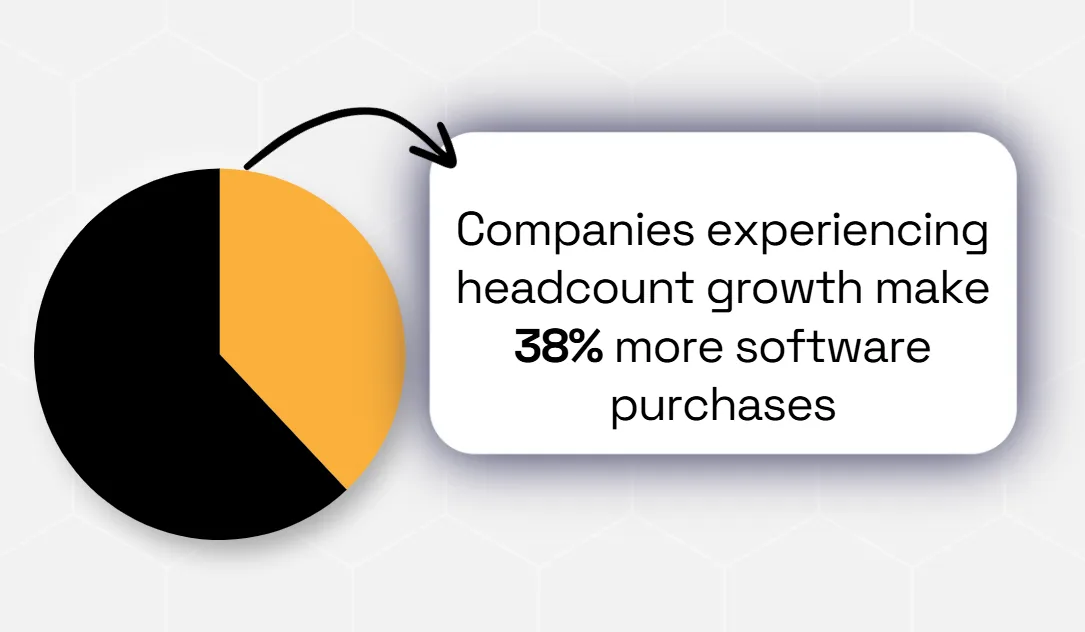
Illustration: Veridion / Data: Bloomberry
The finding doesn't establish causation, but it supports the idea that organizational expansion can coincide with increased technology demand.
A single growth percentage still doesn't tell you whether momentum is increasing or fading.
That’s why you should compare headcount growth across multiple windows to see how the trajectory is changing.
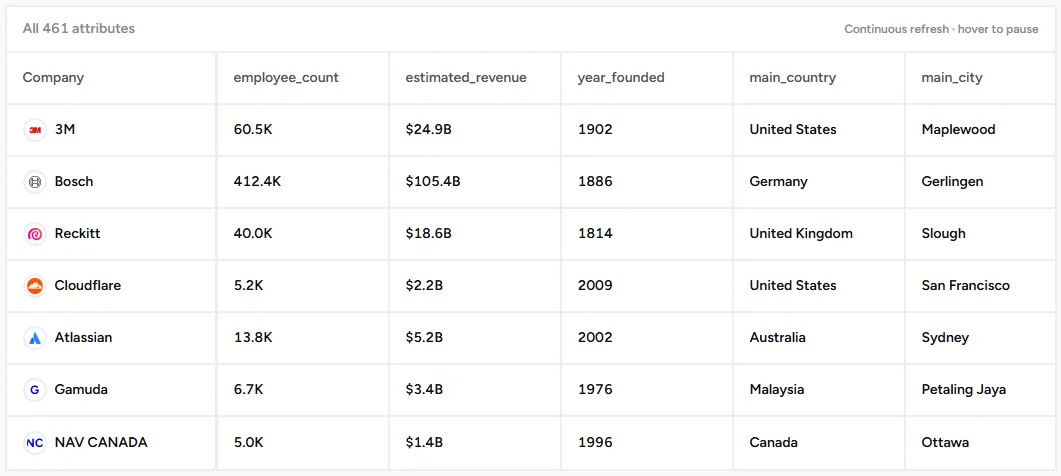
With Veridion, you can compare six-month, one-year, and two-year headcount growth to distinguish sustained expansion from recent acceleration or slowdown.
Source: Veridion
For example:
Six-month growth | One-year growth | Two-year growth | Interpretation |
|---|---|---|---|
Low | Low | Low | Stable |
Moderate | Moderate | Moderate | Sustained growth |
High | Moderate | Low | Recent acceleration |
High | High | High | Sustained rapid growth |
Negative | Low/negative | Moderate | Possible slowdown |
These aren't universal buying-readiness scores, but a way to segment accounts by organizational momentum and then investigate what is driving the change.
This layered view matters because a company that has grown steadily for two years may be less urgent than one that was flat until recently and is now accelerating.
The latter may be scaling a new initiative, entering a new market, or building capacity for increased demand.
Because Veridion refreshes its underlying company data weekly, you can monitor those changes without relying on a headcount figure that was accurate months ago but no longer reflects the company's current trajectory.
2. Hiring Velocity in ICP-Relevant Departments
Headcount growth tells you that a company is expanding, while hiring velocity tells you where that expansion is happening.
A surge in sales development representative (SDR) hiring can signal a scaling outbound motion.
A rise in data engineering roles can point to investment in data infrastructure.
An increase in compliance or security hiring may indicate preparation for greater regulatory or operational complexity.
Two companies with 500 employees in the same industry may have completely different priorities if one is rapidly building its sales organization while the other is expanding its engineering team.
For a sales engagement platform, the first company may be entering a period of increased demand for sales infrastructure.
For a data platform, the second may be the stronger prospect because its hiring points toward growing technical and data requirements.
The signal isn't simply how many positions are open. It's where hiring is accelerating.
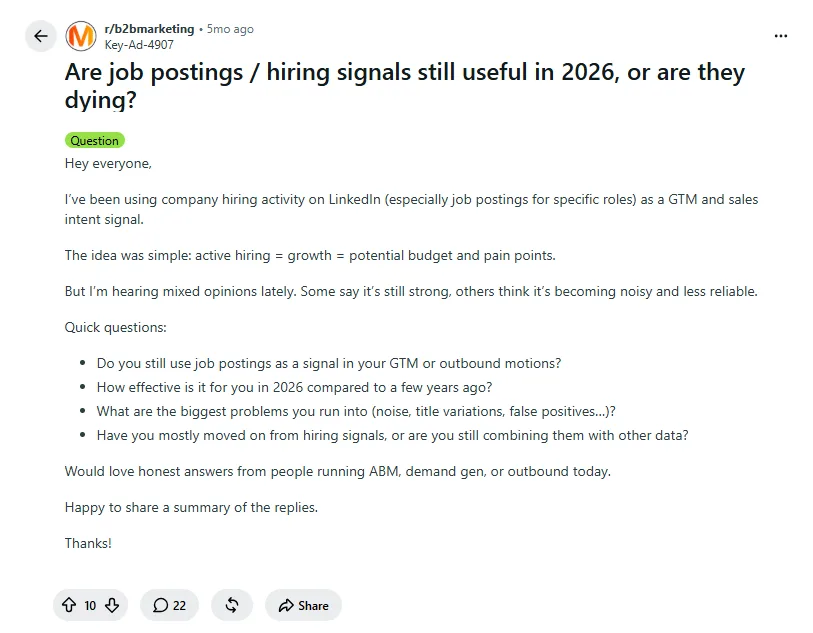
But don’t mistake job postings for hiring momentum: a job posting alone is weak evidence.
Companies can leave positions open for months, recruit continuously for evergreen positions, or advertise positions they aren't actively prioritizing.
B2B practitioners have similarly pointed out that generic job postings can be noisy unless the role, volume, and broader business context line up.
Source: Reddit
That makes the trend more useful than the raw count.
One SDR opening tells you little, but a sustained acceleration in SDR hiring at an ICP-fit account is a much stronger reason to investigate.
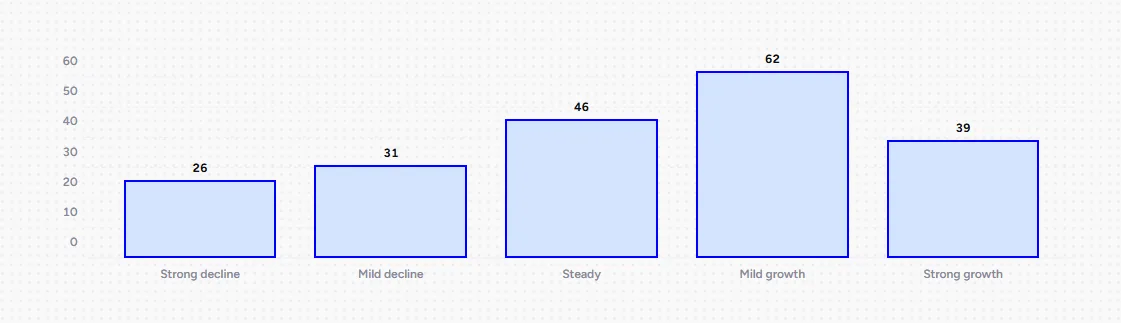
Veridion lets you track hiring trends by department and identify whether they're accelerating, steady, or decelerating.
Source: Veridion
You can then layer that signal with firmographic fit, company growth, technology usage, or other relevant indicators.
The result is a more precise view of organizational momentum: overall headcount tells you that a company is growing; department-level hiring tells you where it's putting that growth to work.
3. Funding Events Within the Last 12 Months
A funding round can change the time horizon of its priorities.
New capital gives leadership resources to deploy against growth targets, hiring, market expansion, infrastructure, product development, or sales capacity.
For vendors supporting those initiatives, the funding event can create a timely reason to engage.
Recency matters as much as the funding event itself.
A company that raised $50 million last month is in a very different position from one that raised the same amount three years ago.
Both might appear as "Series B" companies in a firmographic database, but only the first has recently secured capital and may still be translating that funding into operating plans.
That's why “funding stage” is a weak proxy for buying readiness while funding recency is more actionable.
Recent events can also make outreach more relevant.
Instantly, an outreach and lead sourcing company, found in their 2026 Cold Email Benchmark Report that emails using advanced, signal-specific personalization achieved an 18% response rate versus 3.4% for generic outreach.
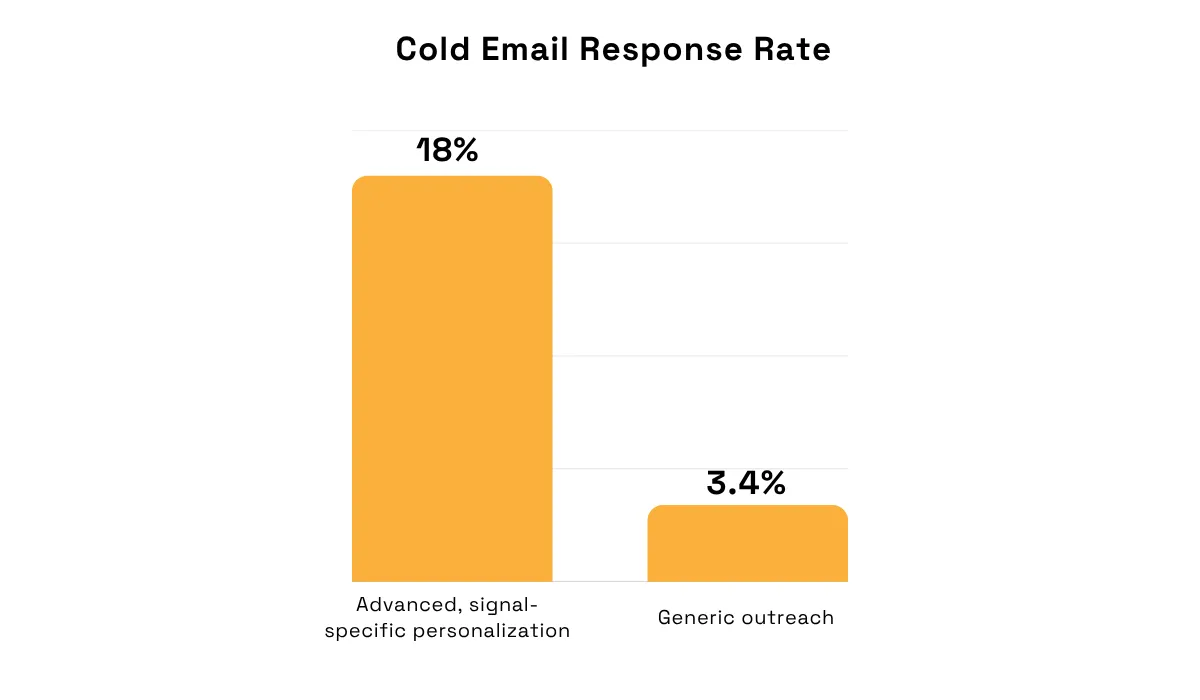
The finding isn't specific to funding, but it illustrates the commercial value of grounding outreach in recent company events.
But funding alone is noisy.
A company might use the capital for an acquisition, debt, international expansion, or an initiative unrelated to your product.
A stronger buying hypothesis comes from what happens after the round.
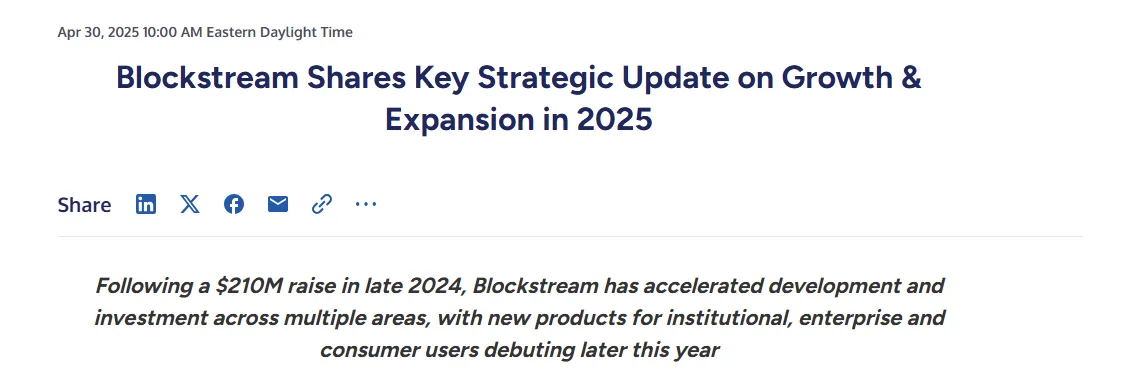
Blockstream, the Bitcoin-powered financial infrastructure company, provides a useful example.
Source: Business Wire
After raising $210 million in late 2024, the company accelerated investment across its infrastructure and software offerings, introduced products for institutional, enterprise, and consumer customers, and expanded into asset management.
The lesson is that the funding announcement itself is only the starting point.
The more useful signal is what the company does with the capital afterward.
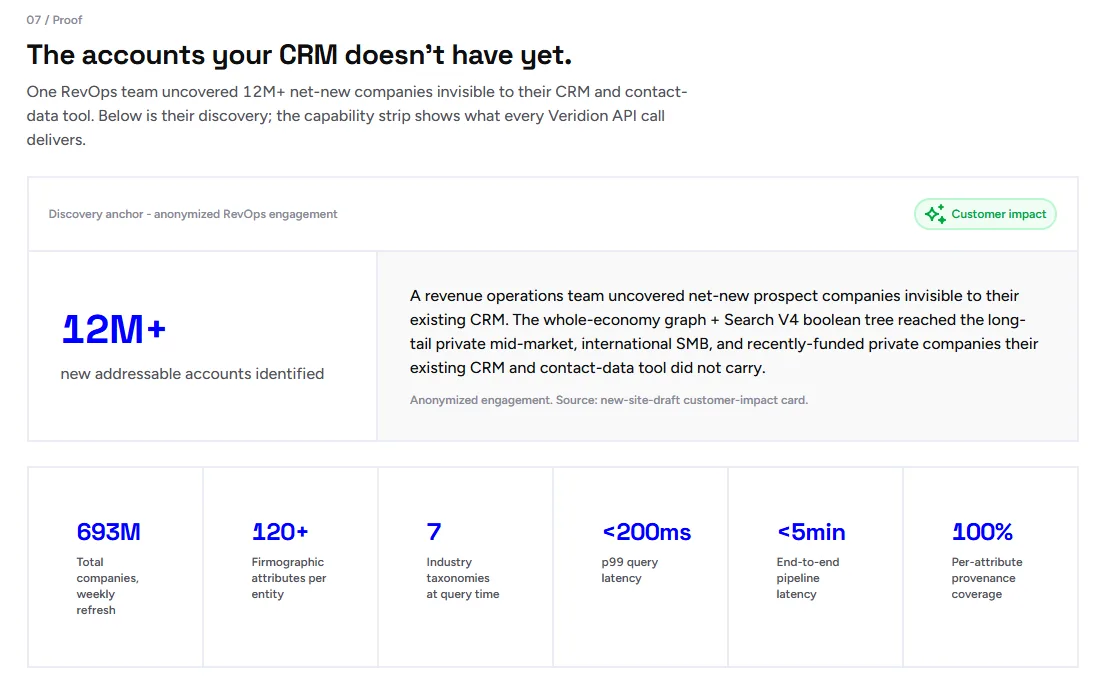
Veridion lets you monitor recent funding events alongside other live company signals, so you can identify newly funded accounts and investigate what they’re doing with the capital.
Source: Veridion
Fresh funding creates potential, but visible investment after the round is what turns that potential into a more credible buying signal.
4. New Office or Location Openings
A new office, branch, warehouse, or operating facility represents a physical commitment to expansion.
It can create new requirements for technology, connectivity, security, recruitment, compliance, and vendor capacity across the organization as well as at the new site.
That makes location expansion a potentially powerful buying signal.
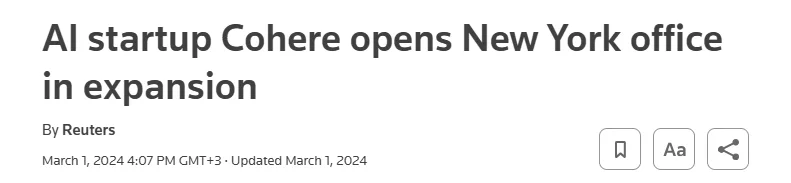
Cohere, an AI startup, illustrates how those effects can extend beyond the new site itself.
Source: Reuters
When the company opened a New York office in 2024, the expansion was designed to give it access to local talent while bringing it closer to customers and partners.
The office also supported the company's work with enterprise customers adopting AI.
A static address field can't capture that change.
A company with offices in five countries today may look identical in a static database whether it opened its fifth location last month or five years ago.
And the new site may not change its headquarters at all: companies can add sales offices, distribution centers, manufacturing facilities, data centers, or regional branches while leaving their registered address unchanged.
The useful signal is not where a company is located, but where it is expanding.
Veridion tracks business locations beyond headquarters, helping you identify new branches and facilities as they appear in the company's geographic footprint.
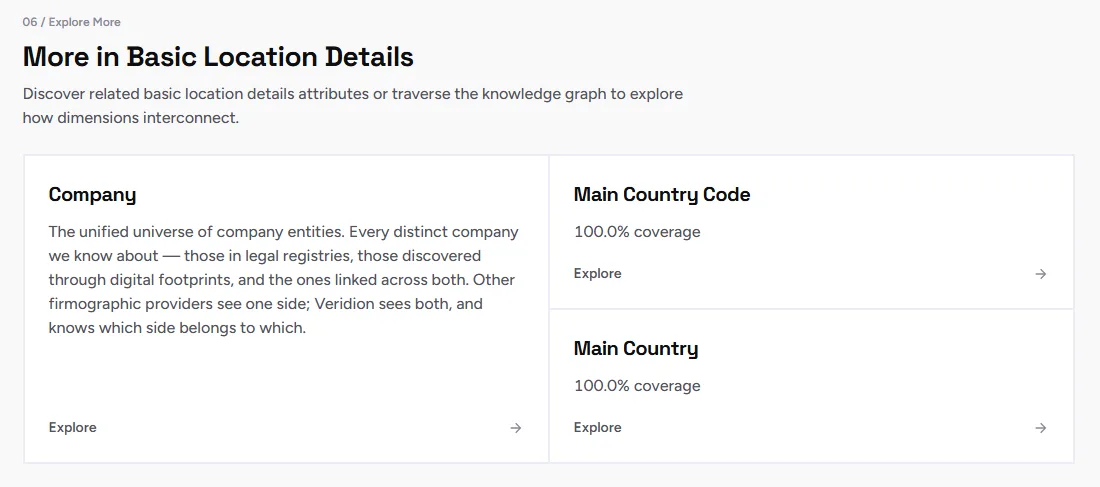
Source: Veridion
The context around the expansion can make the signal even more useful:
Expansion signal | What it can indicate |
|---|---|
New office + local hiring | Building an operational presence |
New facility + capacity investment | Expanding physical operations |
New international location + customers/partners | Entering or strengthening a market |
New shared-services center + process centralization | Organization-wide operational transformation |
None of these combinations proves that a company is ready to buy.
But they give you a stronger reason to investigate than a static list of office addresses ever could.
5. Product Portfolio Expansion
A company can change its buying needs without increasing headcount or raising new capital.
Sometimes the clearest signal is what it has started selling.
Launching a new product, service, or solution represents a specific commercial investment.
It can create new requirements for technology, data, infrastructure, distribution, compliance, and external vendors that aren't visible in the company's existing firmographic profile.
Consider a software company that has historically sold an analytics product but launches an AI-powered platform.
Its industry and employee count may remain largely unchanged, while its requirements for AI infrastructure, data pipelines, security, and governance change significantly.
That makes product expansion different from other growth signals.
Funding tells you the company has resources. Headcount tells you it's adding capacity. Product expansion tells you where that capacity is being directed.
Remitly, a cross-border payment company, illustrates why that distinction matters.
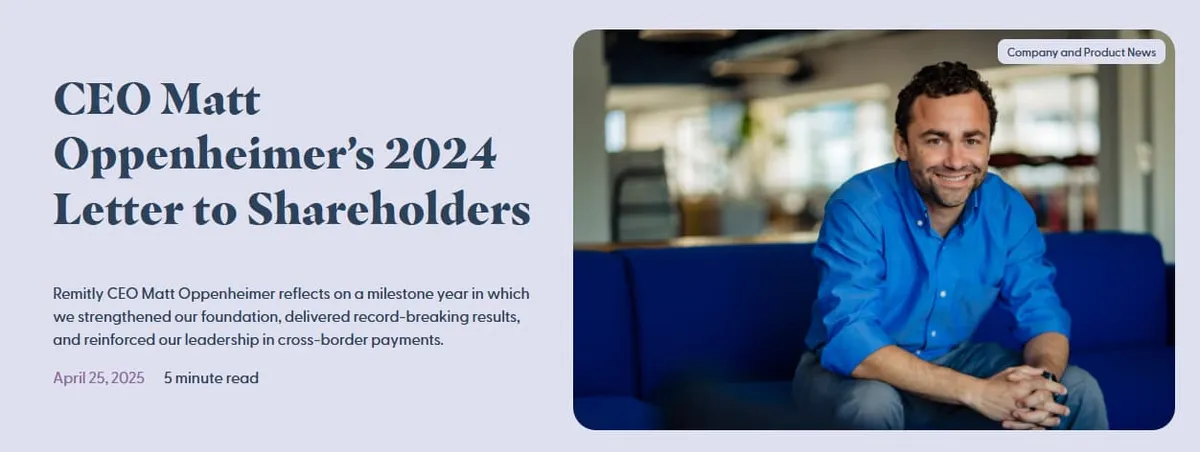
Source: Remitly
In 2024, the company expanded into new payment methods and customer segments, including PayTo in Australia, Klarna in Germany, and broader mobile-wallet access in Africa.
These initiatives extended the capabilities and geographic reach of its existing platform without necessarily changing its core firmographic profile.
Static industry and product classifications can lag behind these changes.
A company classified as a software provider may be moving into cybersecurity or data infrastructure, while a manufacturer may be entering an entirely new product category.
If your data still describes what the company was selling yesterday, you can miss what it's building today.
You can detect these changes through new product pages, service descriptions, press releases, customer case studies, and changes to website navigation.
The key is distinguishing genuine business expansion from a minor marketing update.
Veridion uses real-world web signals to continuously update its business activity classifications, helping you identify when a company's public-facing activities move into a new product or service category.
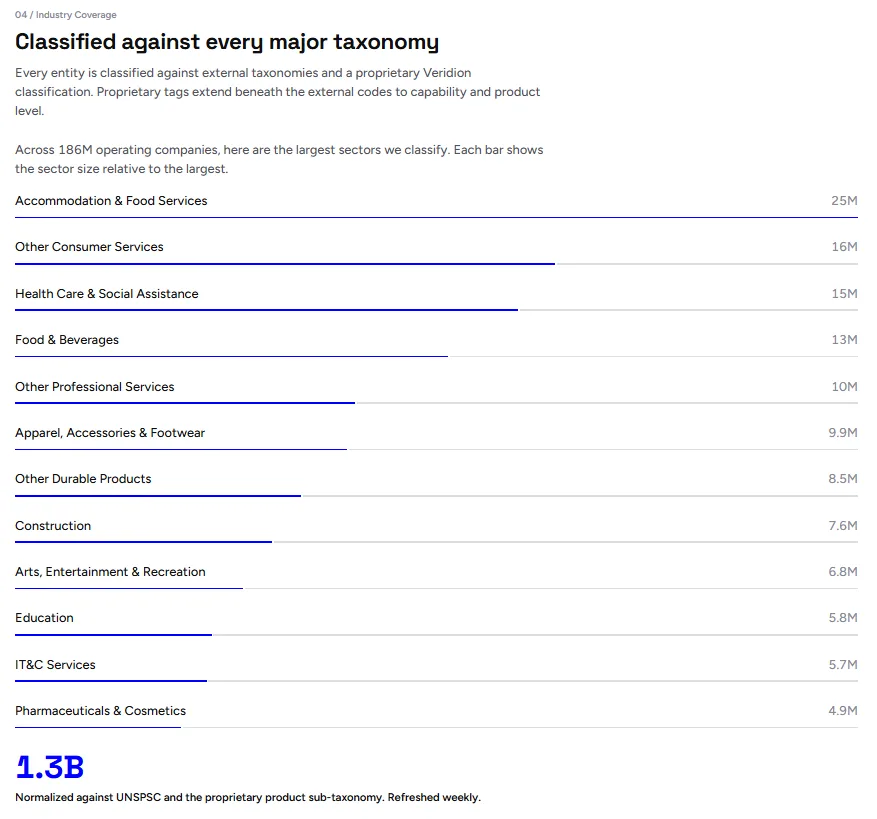
Source: Veridion
The opportunity isn't simply spotting that a company launched something new, but recognizing what that launch changes about the company's likely technology, infrastructure, and vendor requirements.
6. Web Traffic and Digital Footprint Growth
A company's digital presence can change before those changes appear in traditional firmographic data.
Rising web traffic, search visibility, publishing activity, or expansion across digital properties can indicate that a company is investing more heavily in demand generation, entering new markets, or launching new initiatives.
That makes digital footprint growth an early indicator of momentum, but only when you look at how the footprint is changing over time.
Two companies can have identical industry, employee-count, and location profiles while being in completely different stages of growth.
One may have maintained a flat digital presence for years, while the other's online activity has accelerated sharply in the past six months.
The important signal, then, is not a high traffic number but a meaningful change in digital activity.
Intelligence platform Gartner’s 2024 Technology Marketing Benchmarks Survey found that 16% of technology companies with at least $100 million in annual revenue identified SEO/organic website traffic as their best-performing channel for generating marketing-qualified leads.
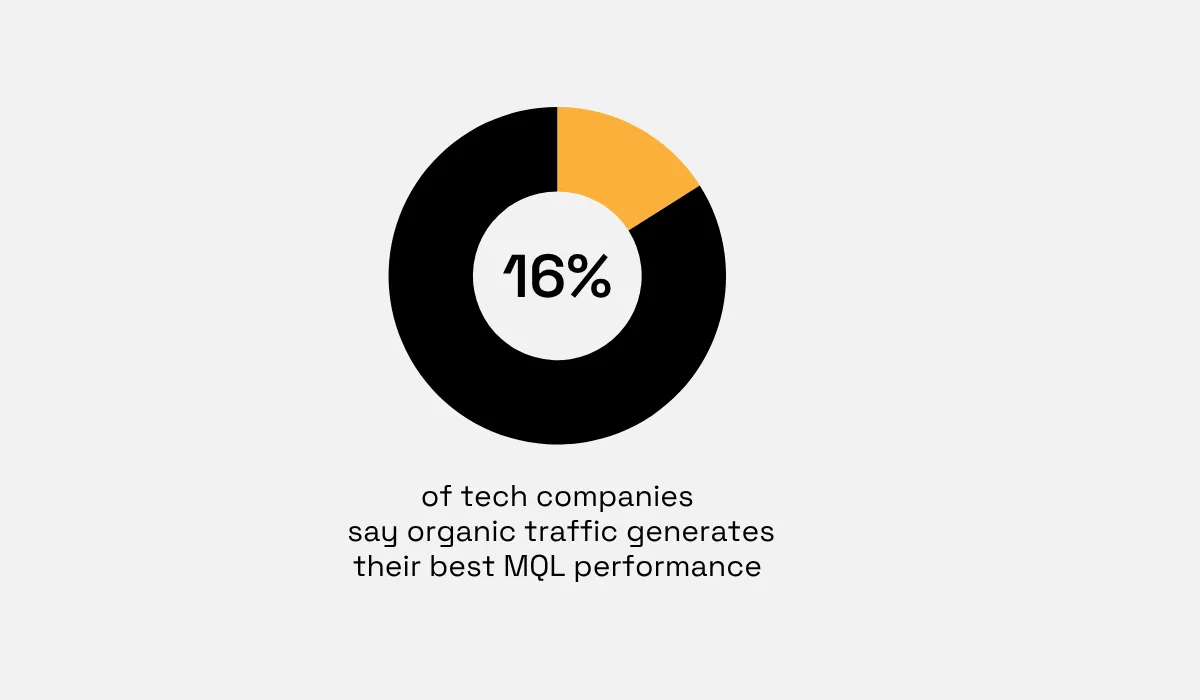
The figure comes from companies reporting at least 10% revenue growth, reinforcing the role digital channels can play in active demand generation.
Kameleoon, a French SaaS company, provides a useful example.

Source: HubSpot
After expanding into three new markets, the company turned to HubSpot to scale its marketing strategy; within six months, its website traffic doubled, monthly leads quadrupled, and blog traffic increased threefold.
The point isn't that traffic growth automatically signals buying intent.
It's that a sharp change in digital activity can reveal broader business momentum when it occurs alongside other changes.
Useful digital-footprint signals include:
- Rising web traffic or search visibility
- Increasing publishing activity
- New pages, domains, or other digital properties
A company showing accelerating web activity alongside relevant hiring or a new product launch presents a much stronger growth hypothesis than one with high traffic alone.
Veridion incorporates digital footprint and web presence signals into its structured company data, allowing you to monitor these changes alongside firmographics and other growth indicators.
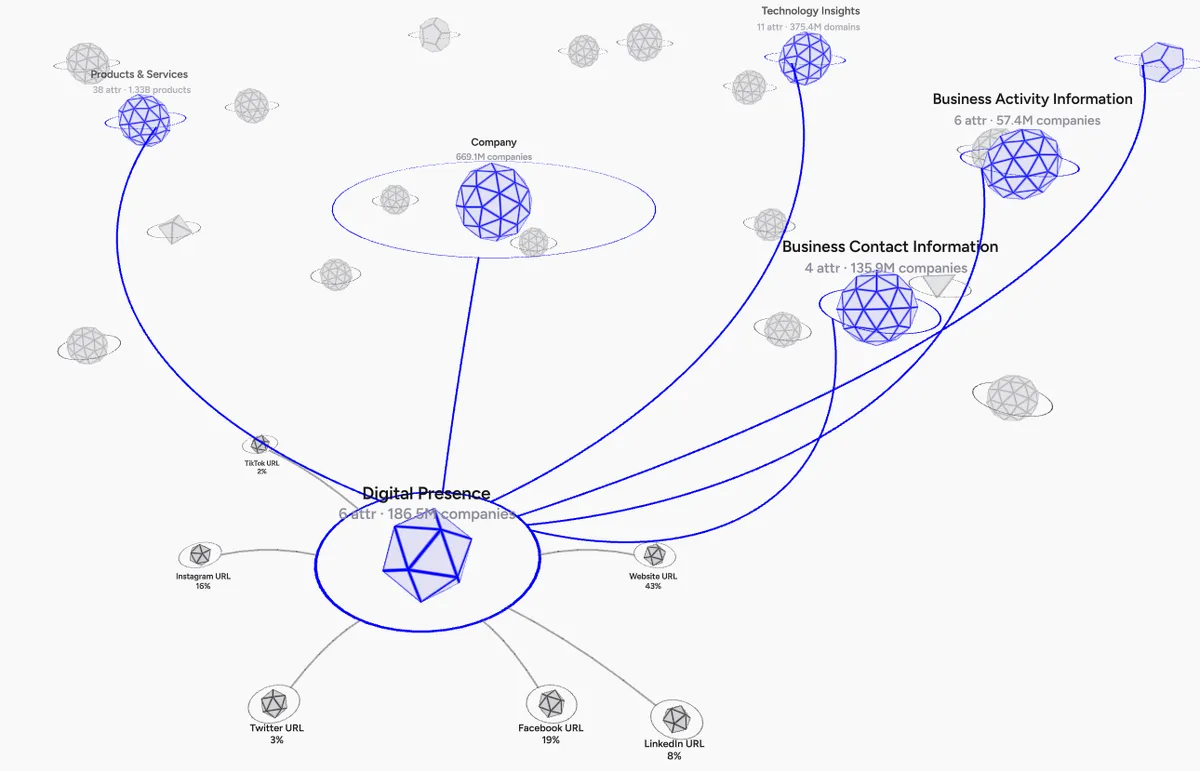
Source: Veridion
The goal isn't to treat website activity as a buying signal on its own.
It's to detect when a company's digital momentum changes, and then use that change to decide which accounts deserve a closer look.
Conclusion
Firmographic data was never wrong.
It was just built to answer a different question than the one that helps you assess buying readiness.
What a company is and what that company is doing now aren’t the same thing.
Firmographics tell you whether an account fits your ICP, while growth signals help you understand whether something is changing inside that account right now.
None of these six signals works best on its own.
The real value comes from stacking them, letting each signal corroborate or challenge the others, and building a picture of momentum rather than relying on any single data point.
The goal isn't to replace firmographics, but to add the context, recency, and momentum they were never designed to capture.
Articles
Discuss how these trends affect your organization.
Our analysts are available for a short call. Bring a specific question and we will ground it in the data.
Insights
Keep reading
More analysis, research, and outcomes grounded in live company intelligence.
How to Use Company Data Signals to Find Whitespace and Expansion Markets
Tired of guessing where to expand? Uncover hidden opportunities and untapped markets using powerful company data signals.
12 Firmographic Variables That Actually Matter for B2B Targeting
In this article, you will learn which firmographic variables for B2B targeting matter most and how they help identify better-fit companies.
Is Your Firmographic Data GDPR-Compliant? A Checklist for B2B Data Buyers in Europe
Are you sure your firmographic data providers are GDPR-compliant? Get our essential checklist for B2B data buyers in Europe.