Insights / Articles
How Automated Company Profiling Works: From Entity Match to Structured Company Intelligence

- Automated company profiling builds comprehensive profiles from short inputs.
- It has three stages: entity resolution, attribute enrichment, and signal detection.
- Compared to manual research, automated profiling is up to 50x more time-efficient.
Building a company profile shouldn't take 30 minutes. Yet researching the right information across company websites, registries, news, and other sources can quickly add up when you're working with hundreds or thousands of companies.
Automated company profiling streamlines this process by collecting and structuring company data in seconds. It doesn't require hours of manual research and is, in fact, often far more accurate.
We'll show you how it works and how to get started below.
What is Automated Company Profiling?
Automated company profiling refers to building comprehensive company profiles from simple inputs using technologies such as AI and multi-source application programming interfaces (APIs).
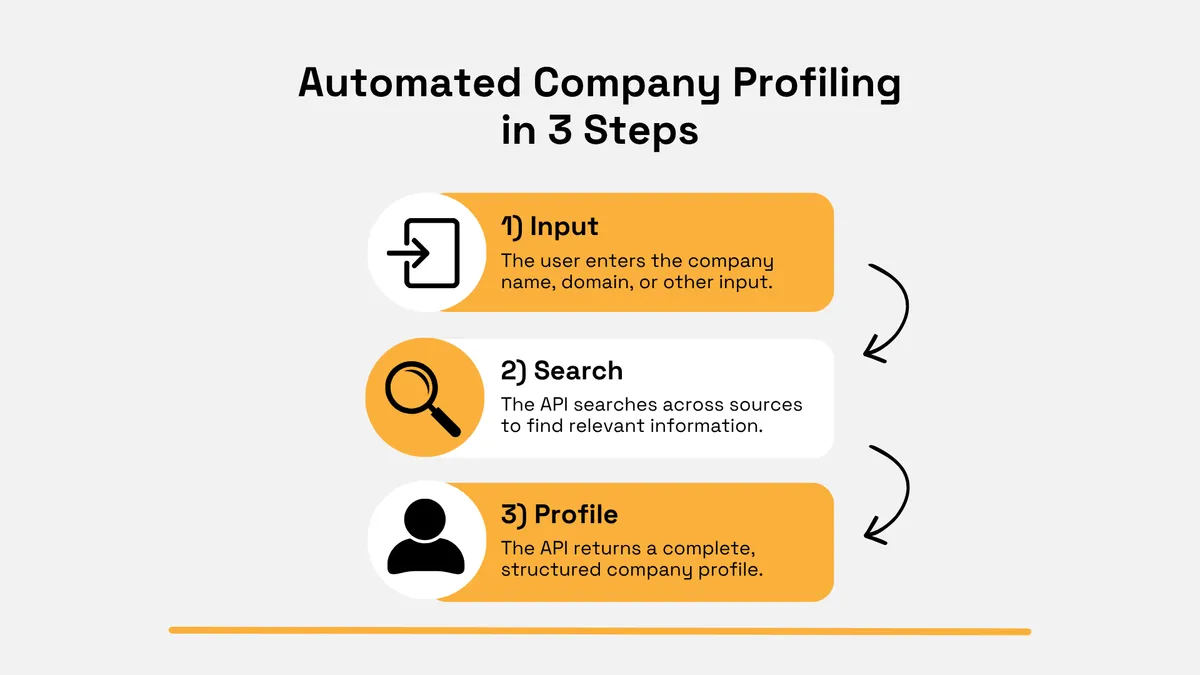
In practice, the process starts with the basic company information you already have, such as the company name, domain, or registration number.
After you enter this information into company intelligence software, it will search across multiple sources to identify the company, find additional information, and build a complete, structured profile.
Source: Veridion
The profile contains the information you initially provided, as well as additional information the software finds. This can include everything from firmographics, like company industry, size, and ownership, to business signals such as growth trajectory and technology stack.
This gives you a complete picture of a company, which lets you understand not just what it is and what it does, but also where it currently stands and whether it meets your additional criteria, like predefined ESG standards.
That way, you can decide what the next best action is, and whether to act at all.
What Are the Three Stages of Automated Company Profiling?
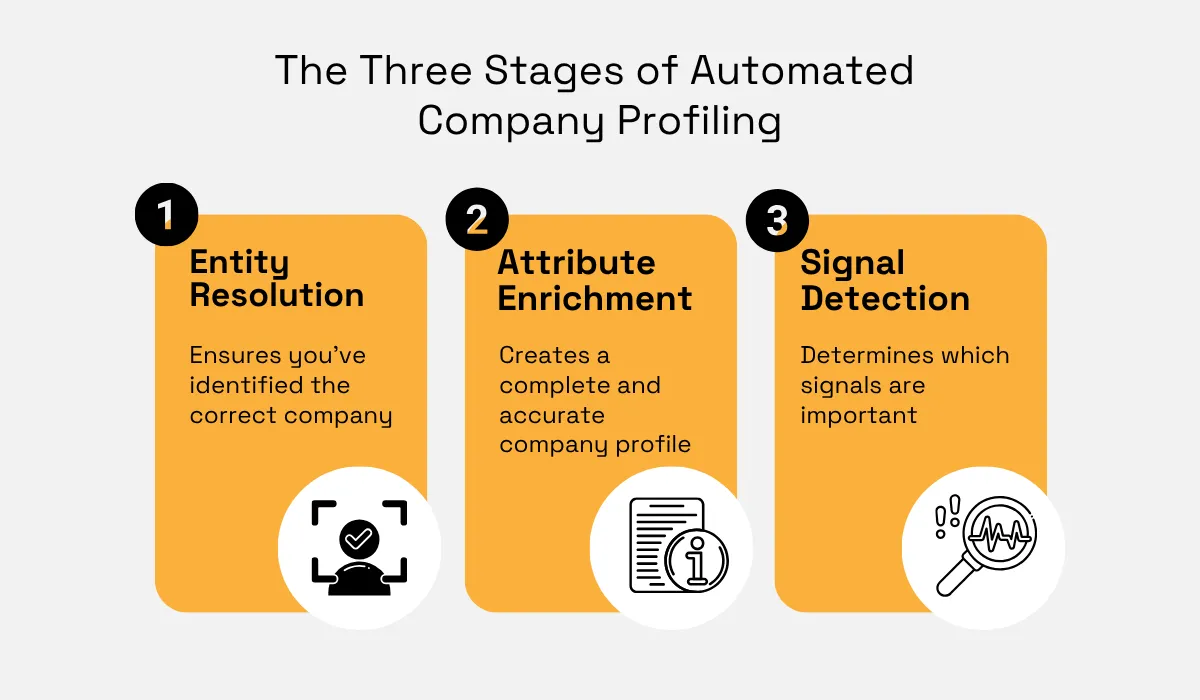
Automated company profiling consists of three stages, carried out in this order:
- Entity resolution
- Attribute enrichment
- Signal detection
Each stage depends on the one before it.
Entity resolution comes first because it ensures the software matches your input to the right company. This matters because multiple companies can share similar properties, like names, and selecting the wrong one can compromise the entire process.
If the initial match is wrong, all the enriched information and business signals will be wrong too.
Once the entity is resolved, the software can move on to attribute enrichment, which fills the company profile with additional information.
This comes second because reliable signal detection requires complete and accurate profiles. Without that context, you risk drawing conclusions from completely irrelevant data.
Source: Veridion
So, to sum up: entity resolution must come first, attribute enrichment second, and signal detection last. The order matters because you need to resolve your input to the right company before enrichment, and you need a complete profile before interpreting its signals.
Let’s now see how to put each step into practice.
Entity Resolution: Matching the Input to the Right Company
As mentioned, the first step is identifying the company your input refers to.
This is often more challenging than it seems.
The information you have is likely to be incomplete or ambiguous, and the same attributes may apply to multiple companies. Relying on limited inputs can therefore lead to incorrect identification and data being pulled from the wrong company.
Even when the information isn’t identical, similarities or relationships between companies can cause a system to confuse one company with another.
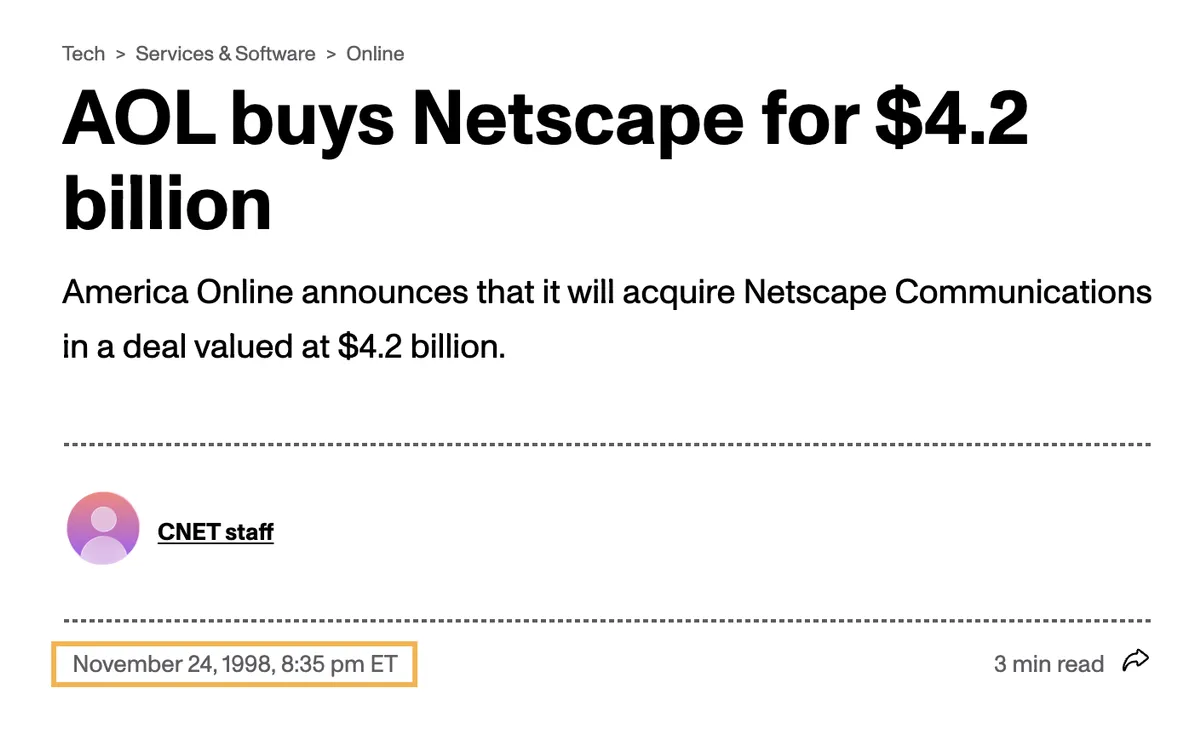
For instance, Crustdata, a B2B data provider for AI agents, describes a case where querying "AOL" returned Netscape as a match.
For context, the two companies are related, but not the same. In fact, one of them doesn't even exist anymore: AOL acquired Netscape all the way back in 1998, after which Netscape ceased to operate as an independent company.
Source: CNET
This illustrates how easily a system can confuse related companies when the input is incomplete or unclear. It also shows why it's important to resolve your input to exactly one real-world company, not two, three, or more.
So at this stage, you should do just that.
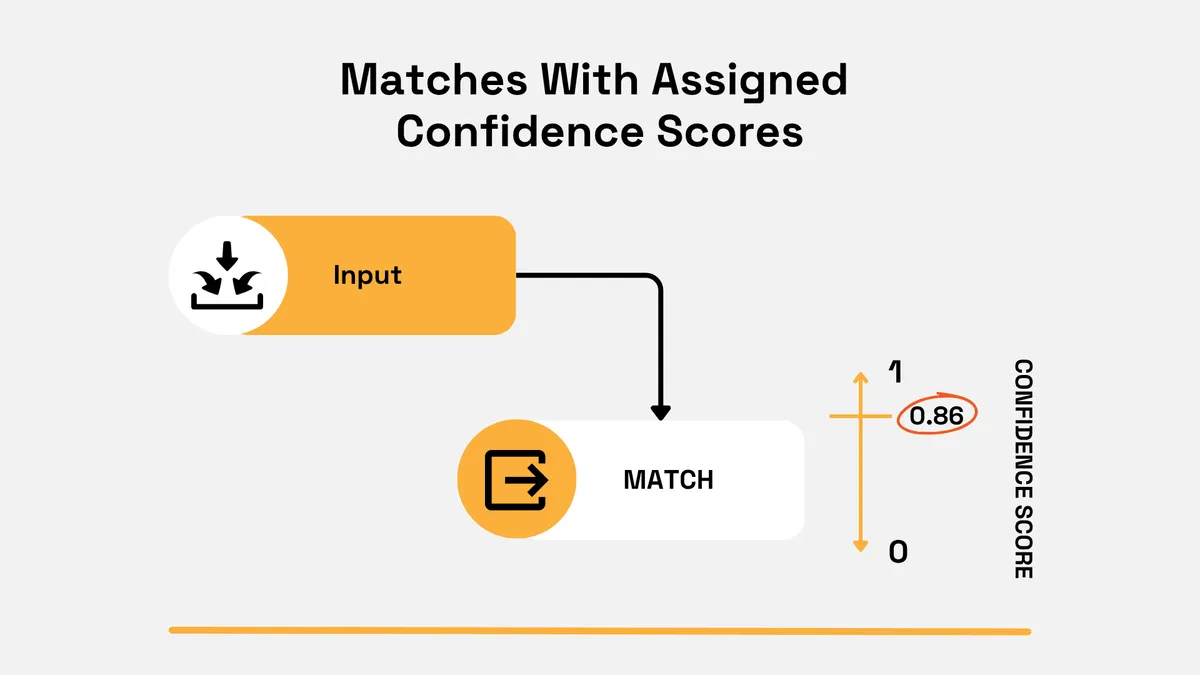
Some software solutions can help you do this by assigning a confidence score to each match. This tells you how confident the software is that your input refers to the company it found.
In the above example, Netscape could've been assigned a confidence score of, for instance, 52%. This would signal to the team that the entity doesn't necessarily match the input and requires further review.
At the same time, AOL could've been given a confidence score of 99%, allowing the team to immediately zero in on the most likely match.
Source: Veridion
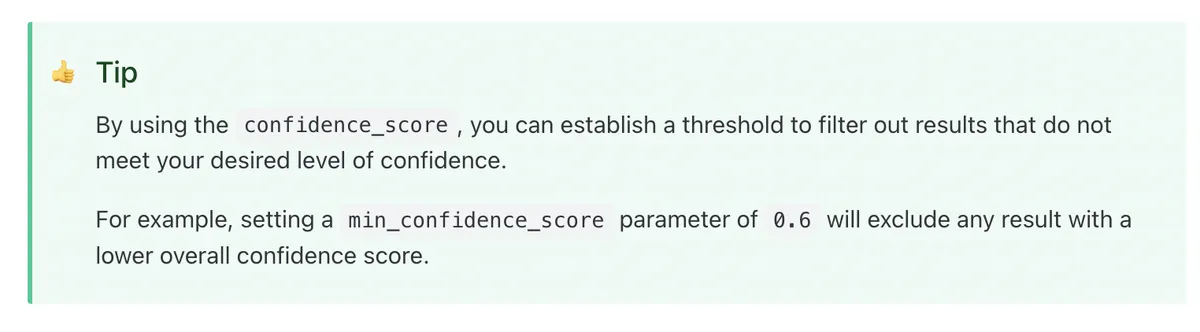
Some tools also let you set thresholds and automatically filter out the matches that don't meet your desired confidence level.
That way, you avoid wasting time on entities that probably aren't what you're looking for.
Source: Veridion
A system might also be able to auto-accept high-confidence matches, while routing ambiguous ones to employees for review.
In either case, the important thing is to resolve your input to a single entity.
Once you've done that, you can move on to the next step: enriching the existing company profile with additional, verified attributes.
Attribute Enrichment: Populating the Full Profile
The second stage is where the company profile actually gets built. It involves populating all available structured fields for the company, such as:
- Size
- Industry
- Locations
- Ownership
- ESG signals
- Technology stack
- Financial indicators
- Products and services
To populate these fields, the software searches multiple data sources in one pass. This can include the company website, various industry and financial databases, business registers, and even news sources.
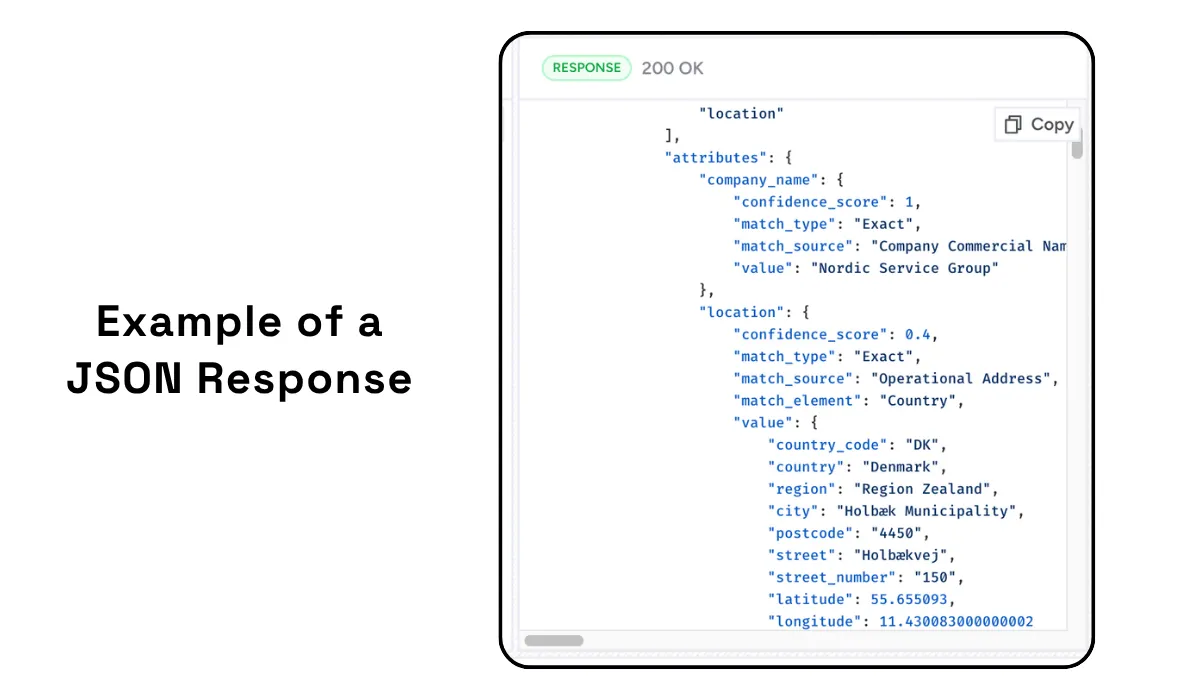
Typically, data enrichment APIs structure their response as a single JavaScript Object Notation (JSON) object covering firmographics, technographics, and organizational data all at once.
The response usually looks like this:
Source: Veridion
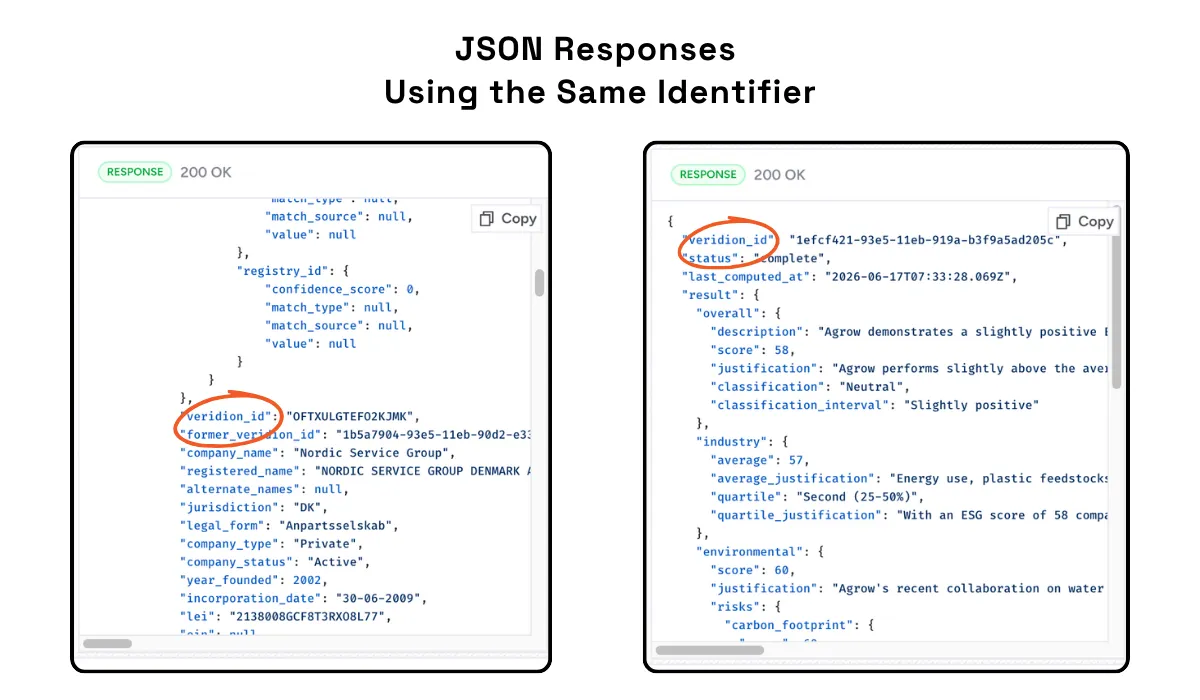
Some software uses separate endpoints for different enrichment needs.
For instance, one endpoint might match your input to an entity and build the majority of its profile, while another might be designed specifically for adding sustainability scores.
When that’s the case, it’s important that the endpoints can be combined reliably. Each should use the same identifier, such as the same company ID – like "veridion_id."
This gives you confidence that the data from all endpoints refers to the same entity.
Source: Veridion
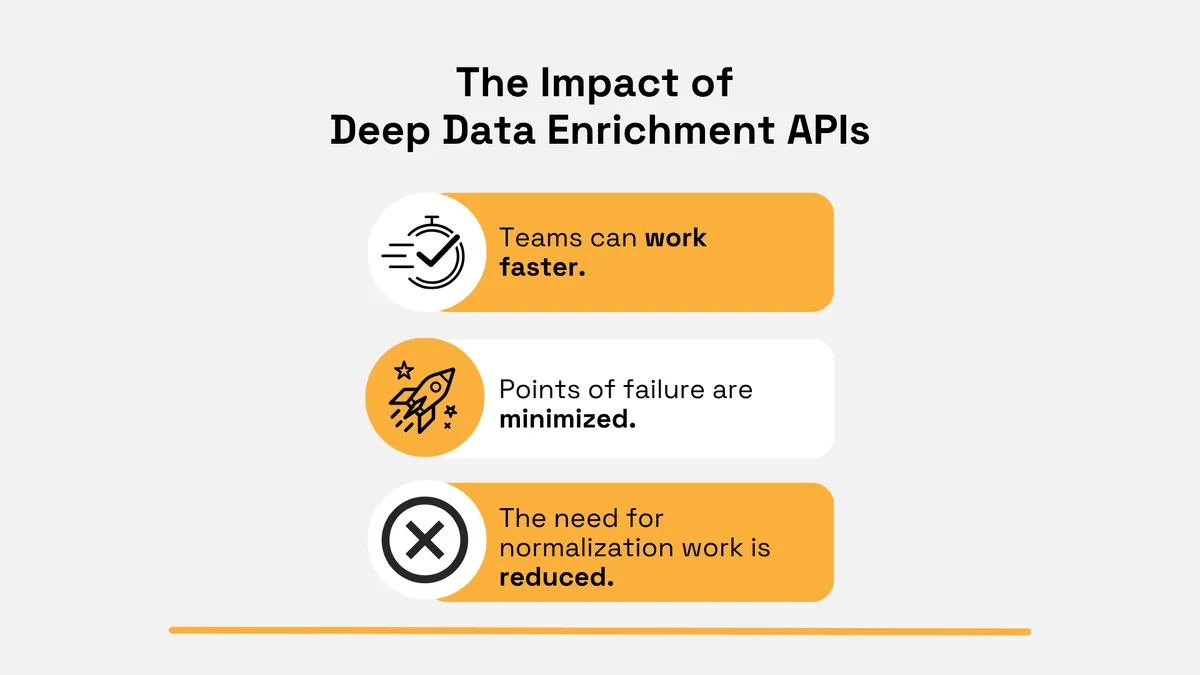
That said, the more data you get with a single endpoint, the better; this allows your team to work faster.
Instead of making multiple API calls and stitching the results together, they can make one call and move to the next step, like contacting the company or preparing a contract.
On top of that, fewer API calls also mean fewer potential points of failure.
When different endpoints provide different attributes, each one needs to be monitored and validated separately. The more endpoints you rely on, the more opportunities there are for errors.
Finally, using fewer endpoints reduces the need for data normalization.
Data from different endpoints may use different naming conventions, identifiers, or data structures, adding extra work to the integration process. Using a single endpoint for most of your data reduces this complexity.
Source: Veridion
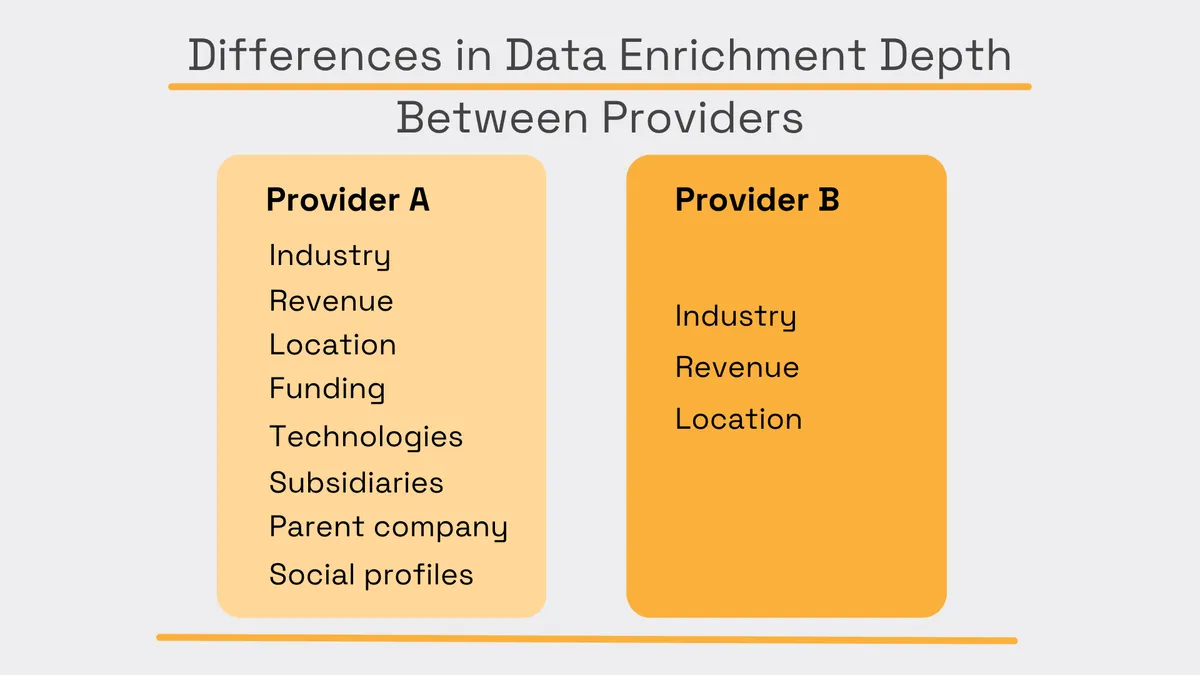
How much data you can retrieve at once varies by provider.
For example, one provider might return eight attribute categories from a single API call, while another returns only three.
Here’s what this could look like:
Source: Veridion
Two main factors that determine how much data is retrieved are dataset breadth and product architecture.
So when evaluating providers, ask:
- How many different sources do they use to pull data?
- How many API calls are needed to build a complete company profile?
Ideally, the provider combines data from many different sources, like those mentioned above, and makes most of it available through a single endpoint.
Keep these factors in mind when choosing a provider.
Not all APIs return the same depth of information, nor do they reduce manual work to the same extent.
That said, once your company profiles are complete, you can move on to the final stage: identifying key signals.
Signal Detection: Flagging What's Notable
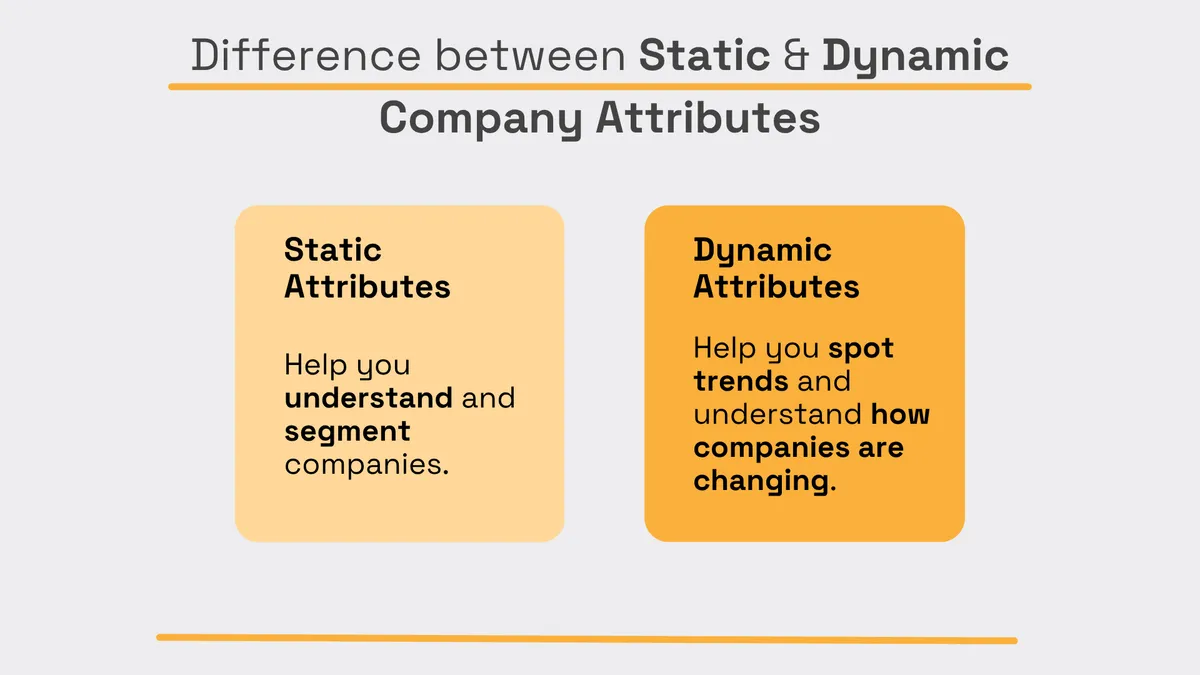
At this stage, it's important to distinguish between static and dynamic company attributes.
Static attributes are those that either never change or change rarely, such as:
- Industry (e.g., SaaS)
- Location (e.g., Austin, Texas)
- Ownership (e.g., privately held)
- Founded year (e.g., founded in 2012)
Dynamic attributes, on the other hand, can change quite frequently. These include, for instance:
- Technology stack (e.g., adopts Salesforce)
- Leadership (e.g., a new CEO or CFO joins)
- Products or services (e.g., launches a new product)
- Employee count (e.g., growing from 200 to 300 employees)
Static attributes are thoroughly helpful in many areas. For example, they can help you identify companies that fit your criteria, like company size and industry.
But they don't tell you whether now is the right time to act or what action to take.
Say you've found a supplier that fits your criteria based on its industry, location, and size. But what if its employee count has recently declined significantly or its ownership has changed? These signals could indicate underlying issues that might need to be addressed first.
Dynamic attributes help you spot such issues, as well as catch time-sensitive opportunities.
Source: Veridion
So, signal detection is primarily about monitoring the attributes that are subject to frequent change. This allows you to identify the changes worth acting on, such as revenue decline, funding activity, and leadership changes.
It also enables you to act before issues escalate or opportunities close.
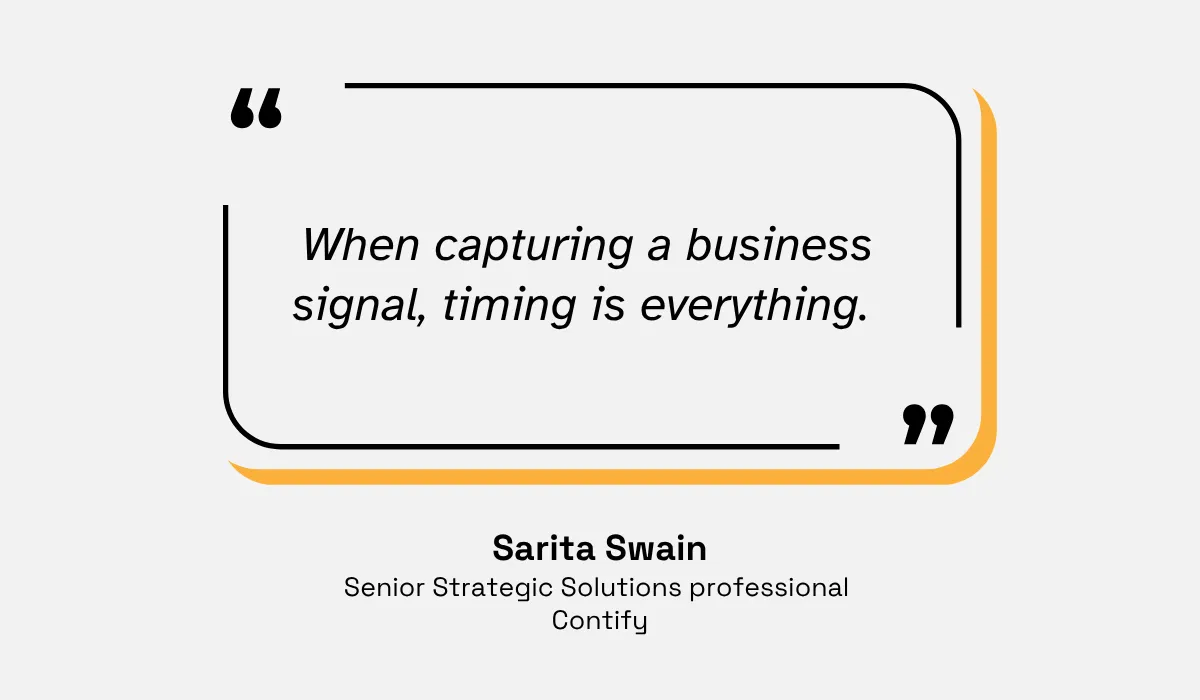
As Sarita Swain, Senior Strategic Solutions professional at intelligence company Contify, puts it, timing is everything when it comes to capturing business signals.
And while it might be enough to occasionally check on static company attributes, capturing business signals requires continuous tracking.
That's exactly where automated company profiling provides the most value.
Teams simply can't monitor signals as quickly or consistently at scale. Automation helps close those gaps and ensure you don't miss critical windows to act.
How Does Automated Profiling Compare to Manual Research?
Manual company profiling involves checking multiple sources, like the company's own site, registries, news, and LinkedIn, and assembling a picture by hand. This often takes 15 to 25 minutes per company, and might take even longer for enterprise research.
By contrast, automated profiling returns the same structured picture from a single API call in under a second. A complete company profile can be created in just 30 to 60 seconds, making automation up to 50x more time-efficient.
Manual profiling | Automated profiling | |
|---|---|---|
Time per company | 15–25 minutes; up to 90 minutes for enterprises | 30–60 seconds |
Consistency of fields | Variable; fields and interpretations can differ by profiler | Standardized; same attributes, structure, and methodology applied every time |
Update cadence | Usually point-in-time | Continuous or periodic |
Scalability | Linear with time; at 15 min/company, 1,000 companies take 250 hours | Scales across the entire list programmatically, with minimal incremental effort |
So apart from taking too much time and bogging down your team, manual profiling is often inconsistent and unreliable.
Different profilers might use different methodologies, naming conventions, sources, or other approaches. This can make it difficult to reliably compare profiles and make accurate, informed decisions.
Automated profiling, on the other hand, returns a fixed, repeatable set of fields every time. There are no surprises, no exceptions, and no inconsistencies. The same data is retrieved using consistent sources, methodologies, and formats every time.
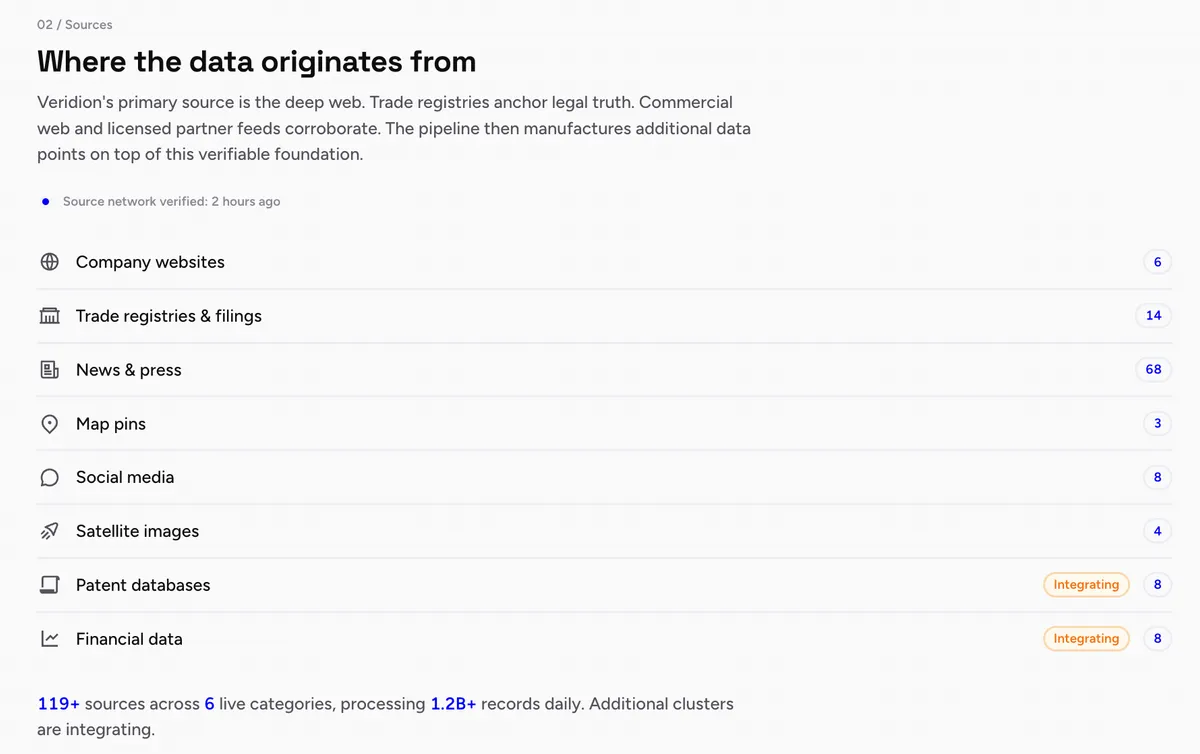
Veridion's Match & Enrich API implements this approach in three stages:
- Input: the user provides a company name, domain, registration number, or a similar data point.
- Entity resolution: the API identifies the correct company.
- Profile enrichment: the API returns a complete company profile with a full set of attributes in a single call.
This replaces and speeds up time-consuming manual profiling, and helps companies resolve and enrich entities even with minimal input data.
Source: Veridion
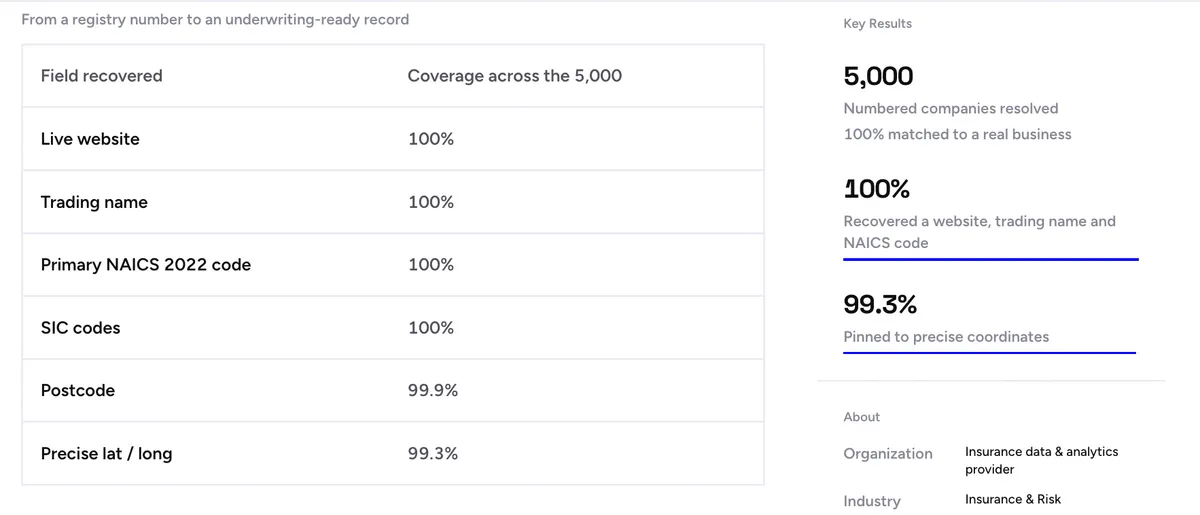
For example, one insurance data and analytics provider used Veridion to resolve 5,000 companies based on a single data point: a non-descriptive registration number, such as 0127494 B.C. LTD.
Of those companies, 99.3% were also mapped to precise coordinates and a postcode, while 100% recovered a website, trading name, and North American Industry Classification System (NAICS) industry code.
Source: Veridion
This turned previously unclassified, nameless accounts into classified, located, web-verified businesses the provider can underwrite, score, size, and match.
You, too, can make your records actually useful with Veridion.
Whether you're looking to validate suppliers and vendors, find suitable acquisition targets, or assess potential policyholders, Veridion will turn basic identifiers into complete, structured profiles you can act on.
Conclusion
Manual company profiling isn't just time-consuming or tedious. It's inconsistent, prone to errors, and, most importantly, increasingly unnecessary.
There are far better, automated options available today.
In the long run, these options are more time- and cost-efficient, especially if you're continuously profiling large numbers of companies.
That said, it might be time to upgrade your operations. Evaluate providers based on the criteria mentioned above, and enable your team to move from research to action faster.
Articles
Discuss how these trends affect your organization.
Our analysts are available for a short call. Bring a specific question and we will ground it in the data.
Insights
Keep reading
More analysis, research, and outcomes grounded in live company intelligence.
6 Best Data Enrichment APIs
Looking for the best data enrichment APIs? This article will introduce six powerful tools to enhance and validate your data.
Firmographic Data vs Technographic Data vs Intent Data: What Each One Actually Tells You
Looking into firmographic vs technographic vs intent data? This guide will explain what each data type tells you and when to use it for B2B targeting.
How Is AI Revolutionizing Market Intelligence?
Explore the key ways AI is transforming market intelligence workflows and helping businesses stay ahead of the competition.