Insights / Articles
How to Find Out Who Owns a Company
The name on a registry filing is often a director or agent, not the real owner. Here is how to find company owner information.

- Officers and directors are not always the true owners.
- Business registries don't show the full ownership picture and are only the starting point.
- Beneficial ownership registers and SEC filings reveal deeper ownership links.
- Company data providers consolidate corporate links and hierarchies in one place.
Registries and filings show the director, officer, or a registered agent as the owner but this is not always true/the case. The ownership chain may run long; however, registries often show only the first link in it.
To reach the end of the ownership chain to find out who owns the company, you require linkage across corporate hierarchies. Veridion maps that out and gives you a full ownership picture.
The following are the steps to find company owner information beyond what is presented in business registries.
1. Decide What Level of Ownership You Need
Corporate structures are complicated, with three main levels of control, ownership, and power.
These levels range from identifying a company’s direct owners to tracing its ultimate beneficial owners.
Leadership and senior management | These are the directors, presidents, and officers (CXO) listed on company records. The title may vary, but these people manage the company on paper. They can be one of the owners or a hiree with no ownership stake. Records may also list a registered agent, who only receives legal documents on the company's behalf. |
|---|---|
Parent company and ownership tree | The company that owns all or most of another company’s shares, like Meta owns Instagram. Ownership chains can have several layers, so the ultimate parent is the entity at the top of the chain, not the one directly above the company. |
Ultimate Beneficial Owner (UBO) | The real person at the top of the ownership tree who ultimately controls or profits from the company |
Before you find company owner information, it is better to know what level of ownership detail you require, as every method targets different levels.
2. Search Business Registries for Officers and Directors
The easiest and first approach to find who owns a company is to check government registries.
Businesses disclose their leadership and ownership data based on the regional jurisdictions. This information is made available to the public through government registries.
The following are a few country registries.
- UK: Companies House
- USA (directory of state registries): National Association of Secretaries of State (NASS)
- Canada: Corporations Canada (for federal corporations only)
- New Zealand: Companies Register
Government registries are mostly free, but some information could be behind paywalls.
Australia’s company and organisation registers provide you with general business information, but official documents and company relations come with a small fee.
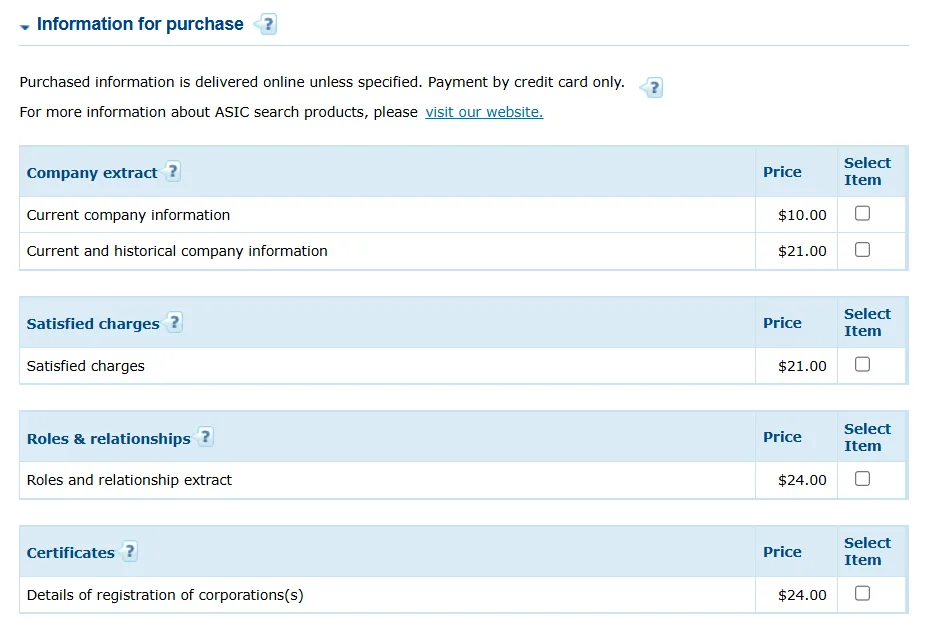
Source: Company and organisation registers, Australia
However, there’s no guarantee that business registries will provide you with the director or owner’s name, it is highly dependent on the jurisdiction of each state and province. Hence, it varies across regions.
If you do find the ownership information, it may show the registered owner/director/manager. These are appointed roles that can change.
For example, the UK and Australian registries show current and former (resigned) ownership details.
US Government Accountability Office (GAO) has also highlighted this challenge in its discussion of corporate transparency:
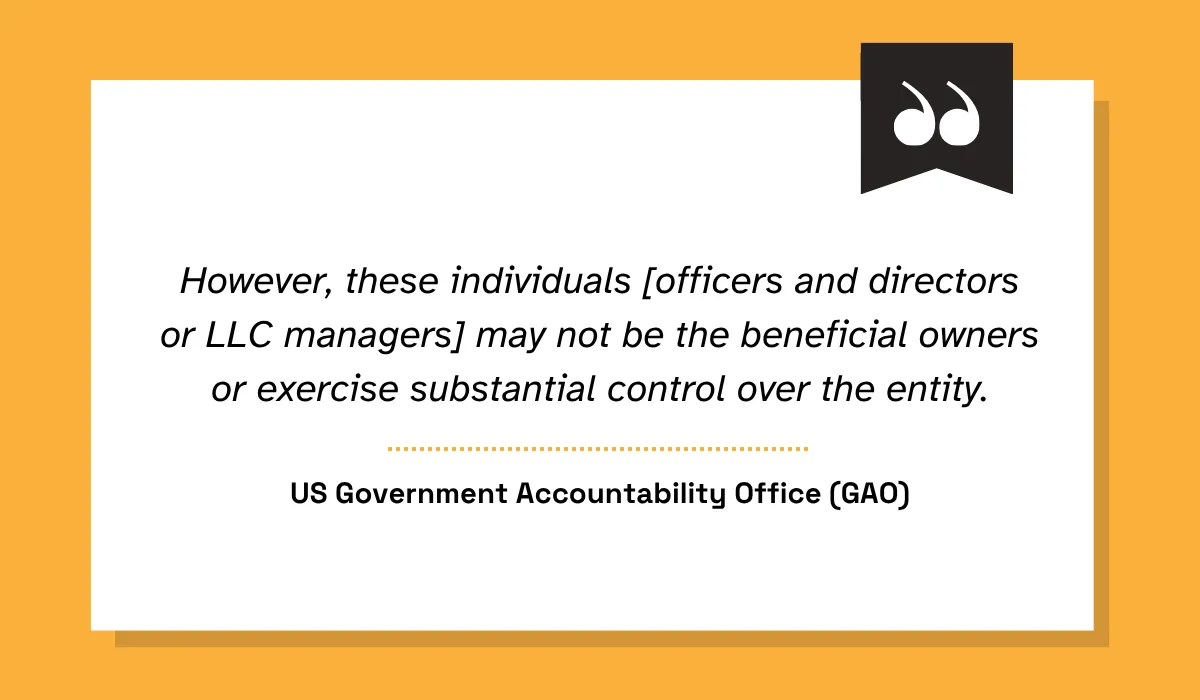
Illustration: Veridion / Quote: US Government Accountability Office (GAO)
If you’re dealing with a company that operates in multiple regions, you’ll have to search each state’s registry.
In the US, you will search state-registered companies through the Secretary of State, which you can find through NASS. But public companies file their ownership data with SEC EDGAR.
We find the same in the case of Canada. Corporations Canada is for federally registered companies. For provincially registered companies, you have to search each province’s dedicated registry.
So you have to find the right registry based on the company you intend to search.
It is a doable task with a few companies at hand. But at scale, it is an inefficient approach that halts the entire system.
Providers such as Orbis and Dun & Bradstreet bring this information into one searchable database, so you don’t have to navigate each registry separately.
However, these databases still depend on what each jurisdiction reports and how frequently those records are updated.
3. Check Beneficial Ownership Registers
If the business registry doesn’t mention ownership information, you might need to search for beneficial ownership registries.
However, they are not as common as business registries. According to Open Ownership, there are 103 live beneficial ownership registers.
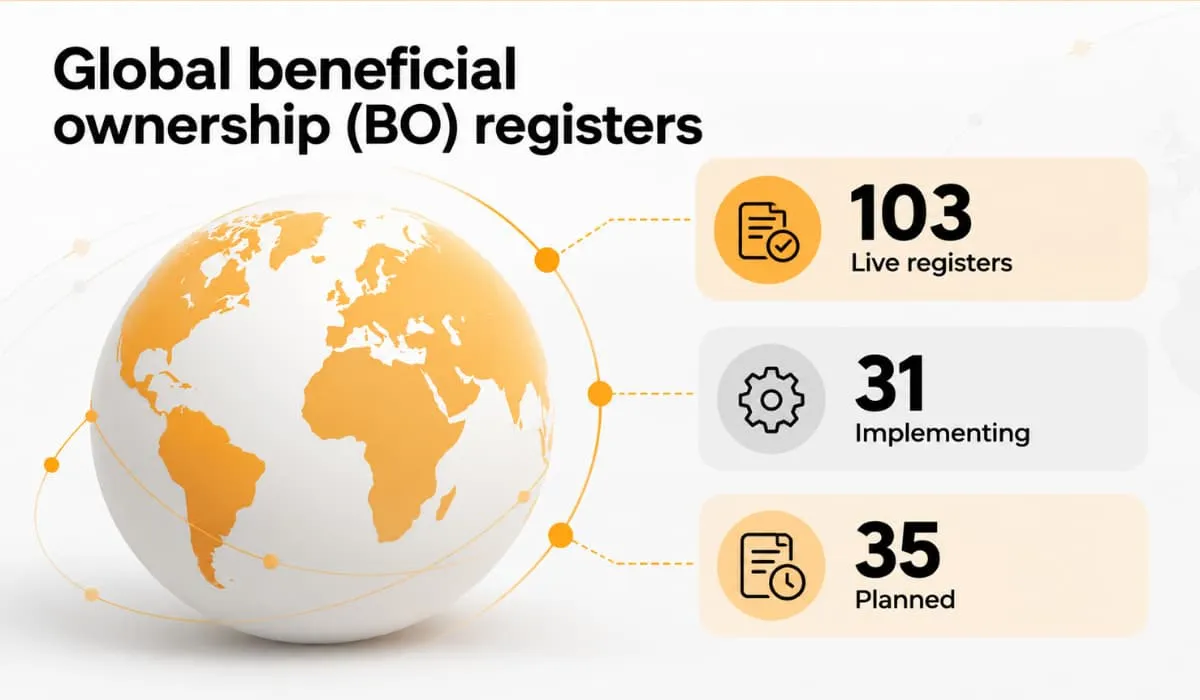
Illustration: Veridion / Data: Open Ownership
In some countries, the business and ownership registries are separate. For example, the Netherlands has the KVK UBO register, Germany has the Transparenzregister, and Ireland has the Register of Beneficial Ownership (RBO).
All three are dedicated to ownership information, while general business registers are separate.
However, these registries are not public. After the 2022 EU court ruling, the registries are restricted to competent and authorized authorities or require a legitimate interest.
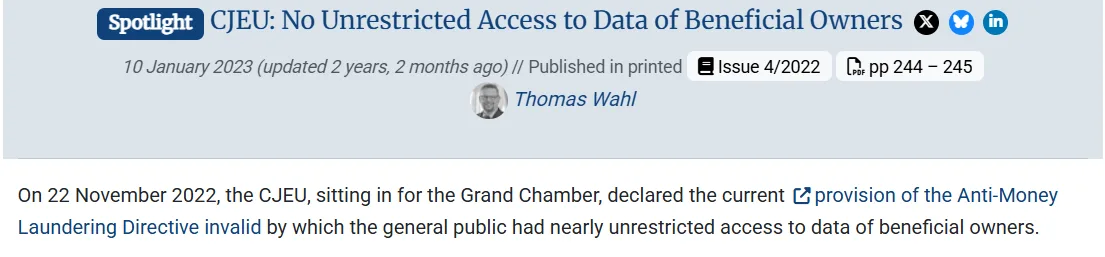
Source: eucrim
Beneficial ownership information is also not publicly searchable in the US. The 2026 FinCEN rule exempts US companies from BOI reporting. FinCEN has also announced it will delete the BOI data that US companies already reported.
On the other hand, we have the UK with its person with significant control (PSC) database, built into the business registry, which is fully public and free.
Beneficial owner registries give the closest information about who owns a company, because they specifically identify the individuals who ultimately own or control a company, beyond its registered shareholders.
The catch is that, outside fully public registers like the UK's, you often have to prove a legitimate interest and wait for access. These registers also rely on self-reporting, and ownership thresholds differ by country. This is, again, a small-scale approach, and when you work with thousands of companies, it is not feasible.
4. Check SEC Filings for Public Companies and Their Subsidiaries
If you are dealing with a public company listed in the US, you can easily find its ownership data through SEC EDGAR.
All publicly listed companies in the US must file certain documents with the US Securities and Exchange Commission (SEC), which are publicly available for free.
These documents include annual reports (10-K), quarterly reports (10-Q), proxy statements, and ownership disclosures.
For ownership searches, Schedule 13G and 13D filings are particularly useful as they reveal who owns more than 5% of the company's voting shares.
13D | Used by investors who may try to influence or take over the company (activists, for example) |
|---|---|
13G | For passive investors, such as asset managers like Vanguard and BlackRock, who are just holding shares. |
Another important document, Exhibit 21 of the 10-K, lists a company's significant subsidiaries. For example, Meta, or Meta Platforms, Inc., has listed its subsidiaries in Exhibit 21.
If you’re dealing with a private entity held by a public company, you can use Exhibit 21 to verify the link.
In addition, you can use the ownership disclosures and shareholder data in proxy statements of the parent company to reach the ultimate owner/shareholder of a subsidiary private company.
One limitation to note is that this method only works for public companies or if a public company sits somewhere in the ownership chain.
5. Map Ownership and Corporate Hierarchy at Scale
All the above methods work well for small-scale needs or occasional projects.
A registry might identify a legal entity. An SEC filing might reveal its parent. Another source might identify a subsidiary under that parent.
But if you belong to credit rating, credit analysis, investment, or any related domain where you need to evaluate businesses at scale, these methods have limits because they leave you to connect the dots.
You need a system with consolidated data so you can find everything in one place instead of searching for the right registry and waiting for information access.
You will also need that system to be reliable and updated. Because inaccurate or outdated information creates an incomplete ownership picture, which leads to wrong assessments and decisions.
You also need broad business coverage. If the system fails to detect small, new, or lesser-known businesses, its data will have blind spots.
This is where Veridion can help you.
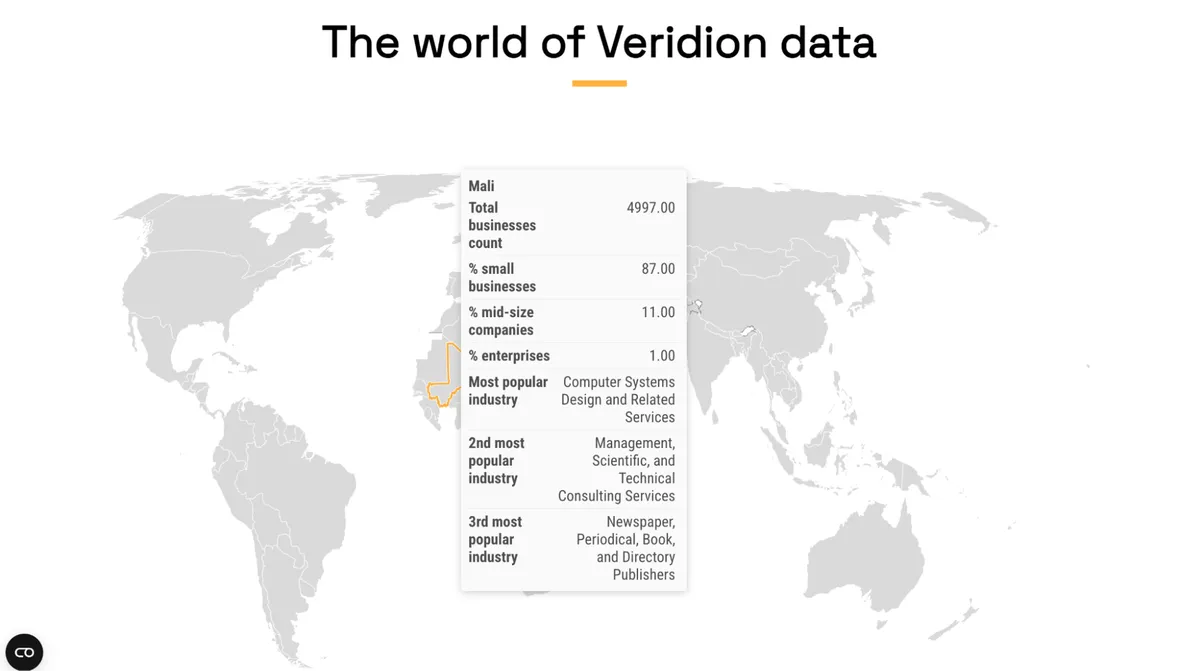
Veridion is an AI-powered intelligence platform that gives risk, insurance, and procurement teams continuously updated data on 744.5M companies across 250 countries.
Source: Veridion
Veridion’s entity resolution connects records that refer to the same company or related legal entities, even when they appear under different names, identifiers, or corporate structures.
You can now map how they relate to one another, giving you a connected ownership tree that a single registry record can't show.
This matters when you're analysing a large supplier base, investment portfolio, or customer list.
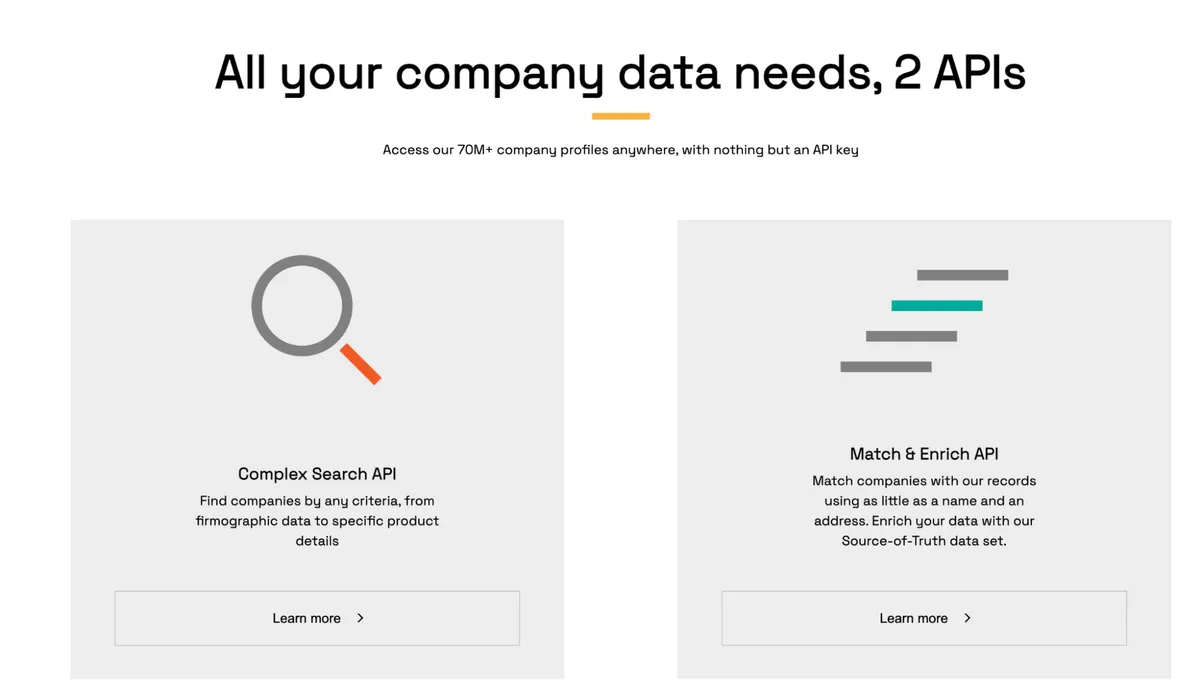
Rather than opening registries one by one, you can send your company list through the Match & Enrich API or use batch delivery to resolve and enrich the entities at scale.
Source: Veridion
A structured-finance rating agency sent Veridion deal names, not companies. Veridion resolved each trust and special-purpose vehicle (SPV) to the operating entities across 7 asset classes, labelling about 13 roles per structure.
The resulting company graph connected the relevant trusts, SPVs, and operating entities with the relationships, and the ownership structure was then verified against SEC filings and rating-agency reports.
Three supplied inputs became 62 firmographic attributes per entity, spanning 21 countries and 327 NAICS codes.
This created a clear, structured view of all the entities.
Veridion brings ownership mapping, entity resolution, and continuous data updates into one system built for scale.
So instead of piecing together corporate structures manually, teams can map entire portfolios with deeper, more reliable coverage.
How Does Veridion Compare to Other Company Data Providers for Ownership Data?
Here is an overview of where major company data providers stand in terms of ownership data.
Provider | Ownership depth | Company coverage | Update frequency | Delivery |
|---|---|---|---|---|
Veridion | The Corporate Groups API resolves a company to its operating org and ultimate parent. The hierarchy has four ownership layers. | 744.5M companies, of which 19% are mid-market companies. 50M+ entities have ownership data. Veridion covers Sub-Saharan Africa, Central Asia, and other informal economies. | Ownership and relationships are updated on an event basis. Core attributes are re-evaluated weekly. Firmographic fields are refreshed monthly. | Through APIs, batch files (CSV, JSON, Parquet). Plus, native integration with Snowflake, BigQuery, Databricks, and many others, ensures fresh data flows directly into your system. |
Dun & Bradstreet | A family tree with global ultimate, parent and subsidiaries, including minority holdings. A separate product lists beneficial owners and entities by name. | 650M+ organizations in 250+ markets. Beneficial ownership covers 367M+ companies and family trees cover 153M. | Beneficial ownership data is updated daily | Beneficial ownership data is delivered via API or batch integration, while the Global Family Tree report is delivered through Excel export. |
ZoomInfo | Ultimate parent, domestic parent, immediate parent, subsidiary, headquarters, location, and franchise relationships. | ZoomInfo's enrichment API describes firmographics and hierarchy across 100M+ companies. | The hierarchy dataset is refreshed quarterly. | Hierarchy data is delivered through APIs and an MCP. Batch data via Databricks Marketplace. |
Bureau van Dijk (Orbis) | Corporate hierarchy and beneficial owners. | 99% of the companies Orbis covers are private. | Weekly | Catalysts, APIs or industry connectors. |
OpenCorporates | Relationships dataset covering branches, subsidiaries, control statements and share parcels, and contains over 30M relationships. | Global coverage spanning across 140 jurisdictions. | No set cadence. Each jurisdiction carries a status: online, onboarding, transient issue, archive, or unsupported. | Website search, API, and bulk delivery. |
Orbis and Dun & Bradstreet fit when you need beneficial owner data for Know Your Customer (KYC) or Anti-Money Laundering (AML) work, since both document it alongside their corporate hierarchies.
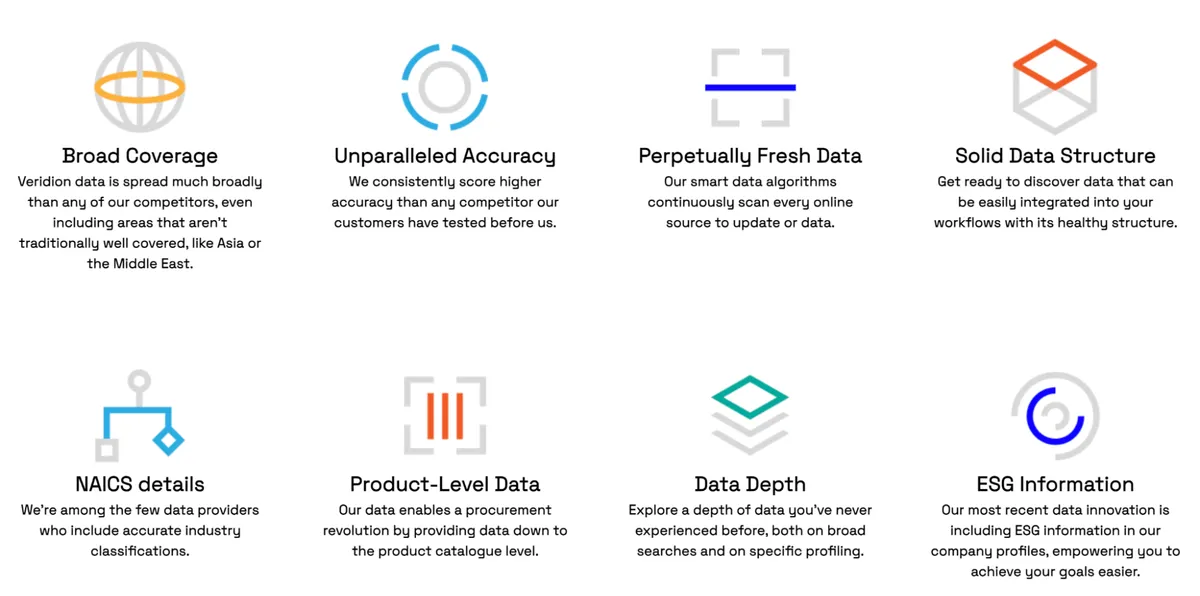
Veridion and ZoomInfo fit when you need a company-to-company hierarchy rolled up to an ultimate parent across large lists.
ZoomInfo's documentation centres on CRM account structure and lead routing, while Veridion's covers procurement, risk and insurance, with API and batch delivery.
Source: Veridion
OpenCorporates fits when you want registry-sourced officer and relationship data with traceable sources, though its individual-owner data is mostly UK-derived.
Conclusion
Corporate structures are complicated. They mask the real owner behind nominees, officers, and entities.
Tracing these layers requires looking beyond the first name or entity that appears in a registry record.
If you want to find out the company owner, you should combine different sources to find and verify the information you require.
Try a quick exercise. Take ten random companies from your list and compare what the registry shows and what the detailed corporate hierarchy mapping shows.
Look for differences in ownership, parent companies, and corporate relationships. It will show you the risk of relying solely on registries, and you will also see how inefficient this approach is at scale.
Articles
Discuss how these trends affect your organization.
Our analysts are available for a short call. Bring a specific question and we will ground it in the data.
Insights
Keep reading
More analysis, research, and outcomes grounded in live company intelligence.
Market Intelligence: Use Cases Across Departments
Want to make better decisions across departments? Learn how market intelligence use cases apply to your entire organization.
How to Gather Market Intelligence In 5 Steps
In this guide, we're breaking down the five key steps you need to take to gather market intelligence that drives real action.
How Is AI Revolutionizing Market Intelligence?
Explore the key ways AI is transforming market intelligence workflows and helping businesses stay ahead of the competition.