Insights / Articles
The CRM Hygiene Playbook: How to Keep Firmographic Records Clean Without Manual Work
Tired of messy firmographic data? This playbook reveals how to maintain clean firmographic records without tedious manual work.

- Duplicate company records can bloat your CRM by 10% to 30% if left unchecked.
- Poor data quality costs the average enterprise between $12.9 million and $15 million a year.
- A firmographic record can look complete on your dashboard and still be lying to you.
- Governance documents fail for one specific, avoidable reason.
Your CRM looks like a well-oiled machine until you run a report on a campaign segment and half the accounts are duplicates, out of date, or missing an industry tag.
Firmographic decay takes place slowly, one unrefreshed field at a time. Manual cleanup can help you fix some records, but it will not address the root cause.
A better approach is to automate how your customer relationship management system (CRM) prevents duplicates, refreshes data, detects decay, and assigns responsibility.
This blog covers four processes that keep your CRM's firmographic records clean without another manual cleanup sprint.
1. Define Automated Deduplication Rules
Duplicate records do not appear out of nowhere. Duplicates arise when you fill out forms, enter information manually, or import .CSV files. You only notice them when two reps start working on the same record without realizing it.
Deduplication is more common than you may think. Industry estimates put duplicate rates at 10% to 30% of records in CRMs without an active data-quality program.
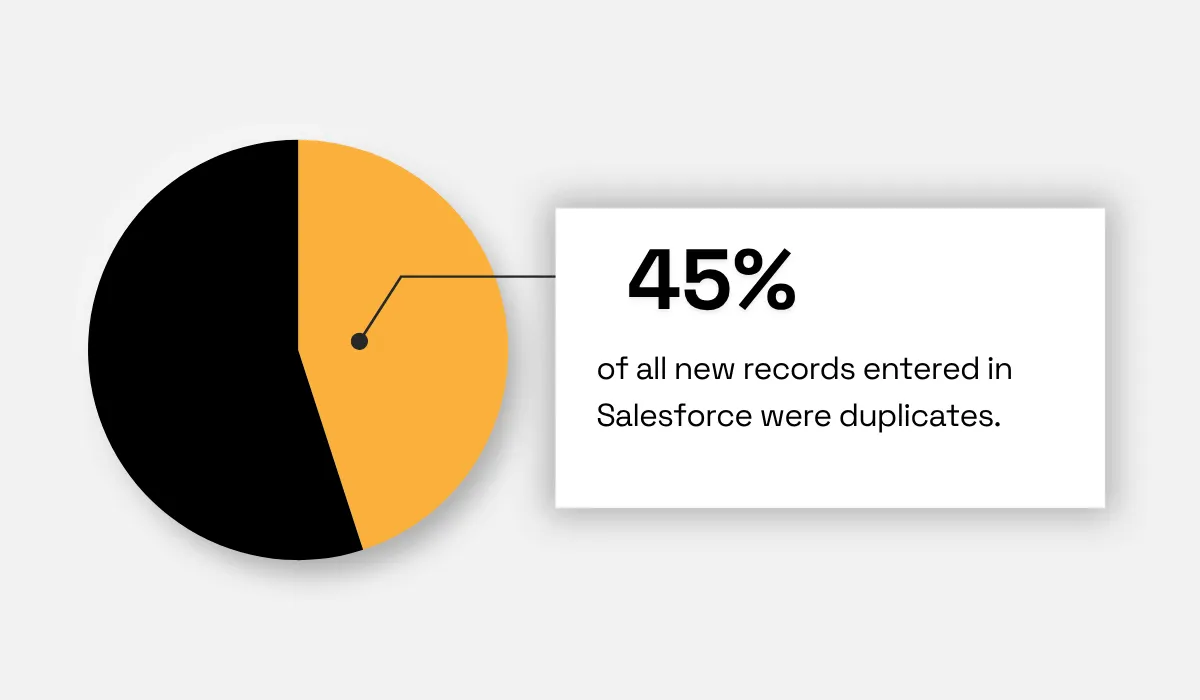
Plauti, a data quality company, performed an analysis of more than 12 billion Salesforce records in 2021 and found that 45% of all new records entered that year were duplicates, with the rate climbing to 80% for records created through API integrations like marketing tools and web forms, compared with just 19% for manually imported records.
Duplicate account records inflate reporting and confuse reps. If you have two different records for the same company, such as "Acme Inc." and "Acme Incorporated," you may consider them two separate opportunities to close. In addition, reps spend a lot of time calling prospects who already contacted someone on your team.
This has become an unavoidable problem among senior executives. According to Salesforce's 2026 State of Data and Analytics research, 74% of sales teams that have adopted AI are now prioritizing data hygiene specifically to support it.
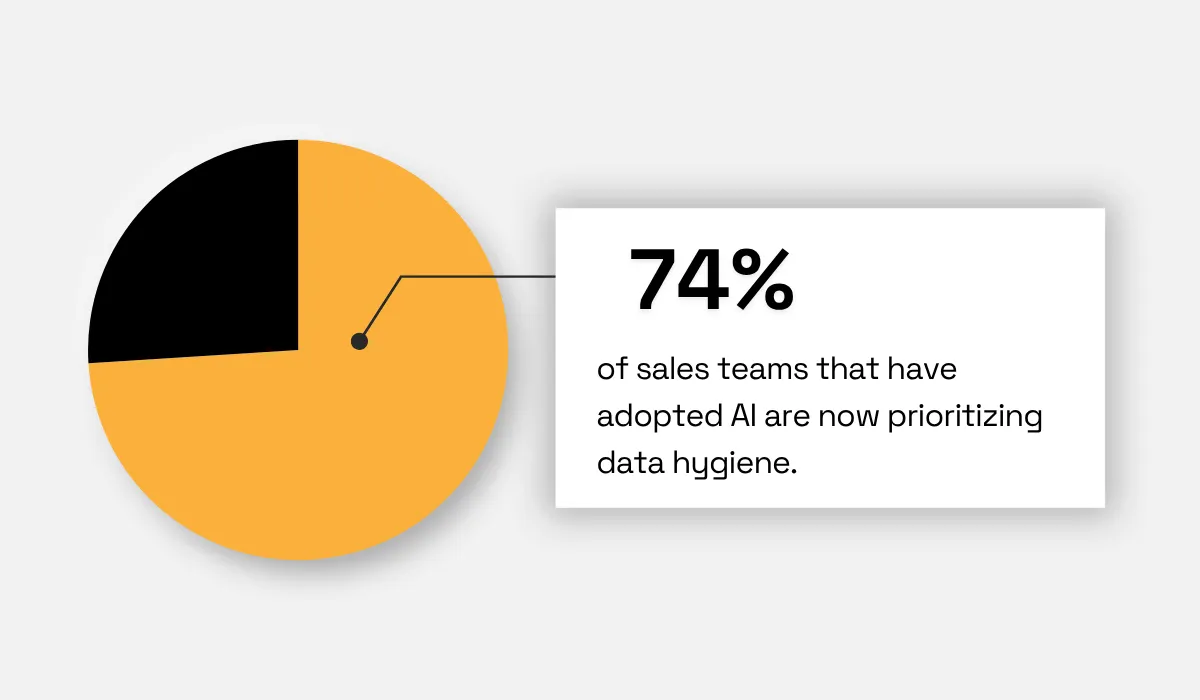
Illustration: Veridion / Data: Salesforce
Feed an AI model or a routing rule two records for the same company, and the output breaks either way. Fix this before you touch a single existing record by defining your matching criteria first.
For company and account deduplication, company name alone is a weak signal. "Acme Inc." and "Acme Incorporated" refer to the same business, but an exact-string match will treat them as distinct.
The domain is your most reliable anchor. Two records sharing an email domain almost always represent the same business, no matter how the company name is spelled.
But the domain shouldn't stand alone. Pair it with a normalized company name and a physical address as supporting signals.
A single parent company can register multiple domains. On the other hand, a subsidiary may share the same address as its parent but not a shared domain.
This explains why the exact-match approach alone misses many existing duplicates.
Fuzzy matching, comparing normalized names, addresses, and partial identifiers against a confidence threshold, catches near-duplicates that exact matching lets straight through.
But fuzzy logic carries its own risk. A high-confidence auto-merge rule can just as easily combine two different companies with similar names in the same city.
To avoid that, set the highest confidence threshold for automatic merge, and send the rest for manual review.
In summary, prevention is better than cure. Include a duplicate check in real time at each point of data entry into your CRM: from web forms, list imports, and API sync from your enrichment tools.
When a new record fails to match against your primary criteria, route it to review instead of letting it create a fresh entry by default.
That single change closes the gap where most new duplicates are actually created, since form-fill flows and enrichment tool syncs tend to be the two highest-volume sources of new duplicates once you go looking for where they come from.
They both feed data to your CRM fast and should be audited before they generate more work for you in terms of merging duplicates.
2. Establish Enrichment Cadence by Pipeline Stage
A single refresh schedule for your entire CRM wastes effort in one direction and starves it in the other. If you enrich every account monthly, you burn API calls and review time on prospects that you are not going to do business with.
When you enrich all accounts quarterly, you lose opportunities; your highest-value opportunities go stale, yet they're most valuable during negotiation.
Data doesn't deteriorate at a single pace, which is why the blanket cadence approach falls flat. Contact information changes rapidly as people change jobs and positions.
The scale of workforce movement shows why. In 2025, the U.S. Bureau of Labor Statistics recorded 62.8 million job separations, which included 38 million quits.
Work email addresses decay by about 23% per year as people change employers. Company-level firmographic fields – industry classification, headquarters location, ownership structure – shift more slowly, but they still drift as companies grow, merge, and restructure.
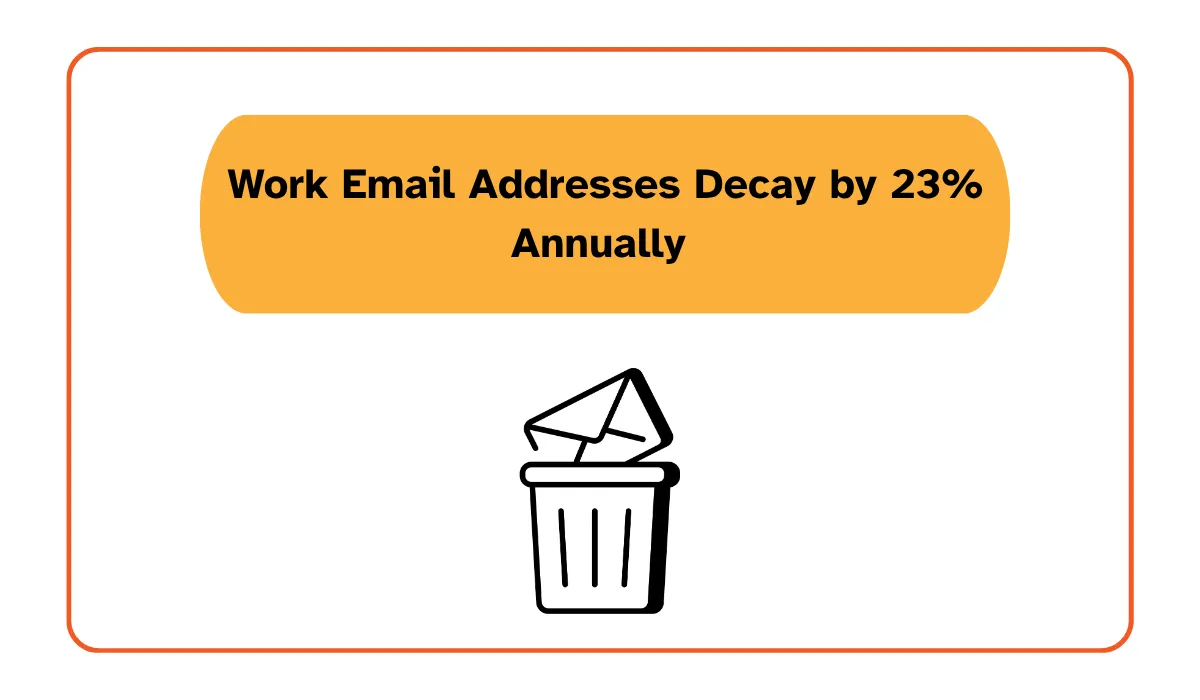
Illustration: Veridion / Data: Zero Bounce
That gap between fast-decaying contact fields and slower-moving company fields is the entire argument for a tiered cadence rather than a single schedule for everything.
A tiered cadence solves this. Run cold and inactive prospects on a quarterly refresh, as they're not driving decisions right now; the cost of staleness will be low.
Active leads and accounts, on the other hand, warrant monthly attention, since they are the records that feed your current pipeline reporting.
High-value opportunities need real-time or near-real-time enrichment, triggered by deal stage, deal size, or membership in a named priority account list, rather than by a calendar date.
A deal in the late-stage negotiations requires an immediate update to the firmographic profile for that account. An old headcount or revenue band at this stage could mislead a forecast that leadership was counting on.
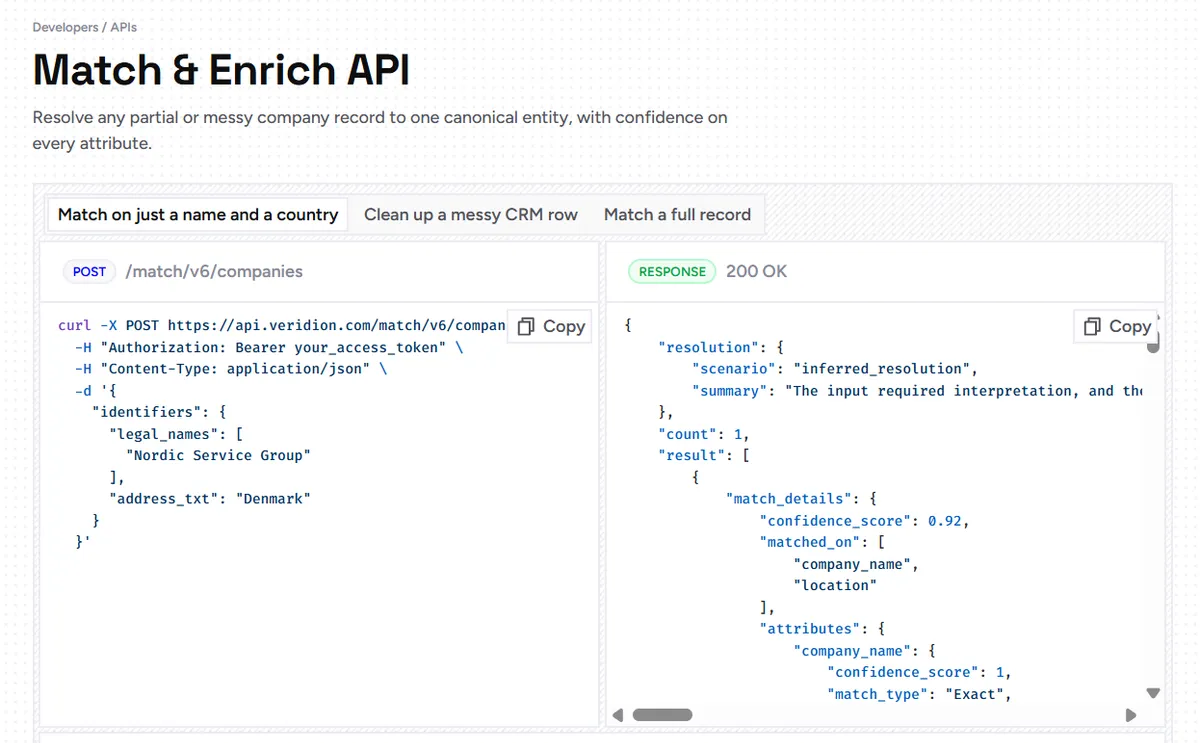
This is where the continuous layer changes the math. Veridion's Match & Enrich API enriches firmographic profiles weekly across the entire company graph, behaving more like a maintenance layer than a one-time enrichment layer for the organization's layered cadence.
Source: Veridion
There's no need to wait for the next data cleansing cycle: a sales rep can access current information about headcount, revenue, or industry whenever they wish. This makes enrichment ongoing rather than sporadic.
Defining your enrichment cadence begins with determining your high-value thresholds. These could include a minimum deal size, a certain deal stage, or even an agreed-upon list of named accounts.
This definition turns your tiered cadence from theory into practice.
3. Build Data Decay Monitoring Dashboards
Just because a CRM looks good on the surface doesn't mean its underlying fields stay fresh. Not having a way to detect this until something breaks downstream is a common problem for almost any team.
This could be when a campaign's bounce rate spikes, a rep flags an incorrect phone number, or a deal stalls because the firmographic profile behind a lead score is outdated.
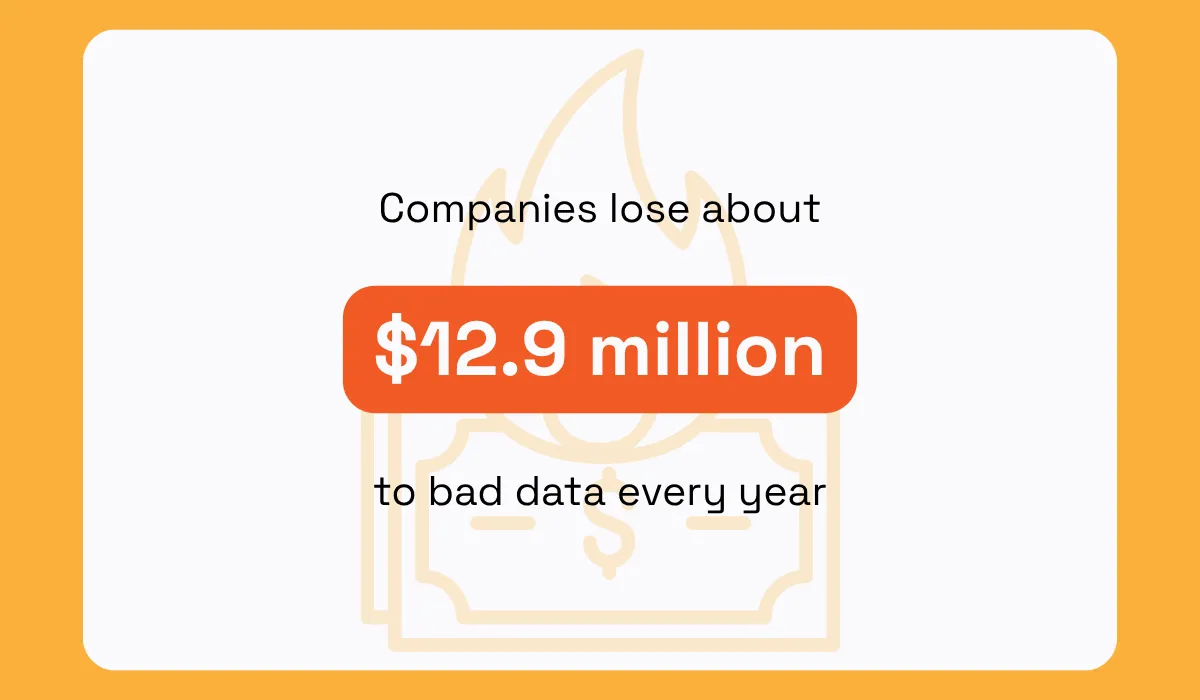
That blind spot carries a real price tag. Gartner, a business insights company, estimates organizations lose about $12.9–$15 million per year to poor data quality.
Unfortunately, data decay is silent. A record doesn't flag itself as outdated. It sits there looking complete, with every field populated, until the damage shows up somewhere else entirely.
In 2022, Unity Technologies, the video game software company, disclosed that corrupted training data had quietly degraded its advertising models, a failure the company later tied to roughly $110 million in lost revenue.

Source: Apple Insider
Silent decay is the hardest kind to catch, because records may look complete and pass every validation check but no longer reflect reality.
For example, a company field showing "51–200 employees" might be technically populated and formatted correctly, yet the company doubled in size eighteen months ago and nobody re-verified it.
To address data decay, focus on visibility instead of waiting for complaints to emerge. Monitor the completeness rate (the percentage of records with all necessary fields populated) and aim for 80%+.
Monitor the bounce rate trend for your outbound email campaigns, because any value exceeding 2–3% indicates decaying contact data beneath the surface.
In addition to that, monitor the duplicate rate: any value above 5% should be addressed immediately. Lastly, monitor the percentage of records that were not touched/enriched for X period of time (X = 90 days for contact-level fields and 18 months for firmographics).
The share of records refreshed by an external source in the recent past tells you where your maintenance program is actually reaching versus where it's just a policy on paper.
Building a simple version of such a dashboard doesn't need new tooling. A weekly report pulling these five numbers out of your existing CRM reporting layer is enough to start; the point is having them in one place on a fixed schedule, not building something elaborate.
Make this practice even sharper by tying monitoring directly to segmentation and scoring accuracy, not just general database hygiene.
A stale industry classification doesn't just look untidy. It can silently pull an account out of your ICP filter or skew a lead score a rep is using to prioritize their day.
Flag decayed fields that run active scoring models first because they do the greatest harm if they go unnoticed.
4. Establish Clear Data Ownership Rules
Deduplication rules, tiered enrichment cadences, and monitoring dashboards only work if someone is accountable for acting on what they reveal.
Without accountability, the dashboard that identifies outdated information becomes an unread report, and your deduplication strategy becomes one that nobody follows.
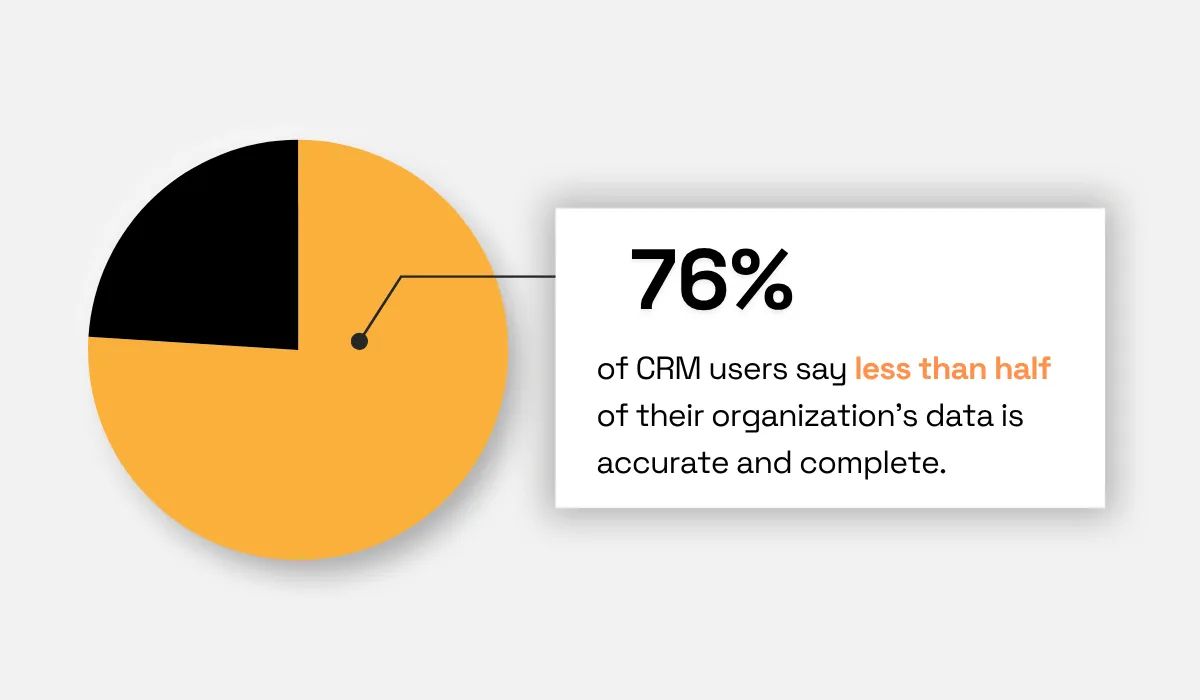
The consequences show up clearly in the numbers: according to research by Validity, an email platform company, 76% of CRM users say less than half of their organization's data is accurate and complete, even at companies running deduplication rules, tiered enrichment, and monitoring dashboards.
The missing piece here is usually ownership.
Most organizations centralize all data ownership in IT or a single system administrator. That model breaks down because the admin who configures the CRM rarely has the business context to judge whether a field like "lead source" or "deal stage" is actually correct; they can enforce structure, but not meaning.
Additionally, no cross-functional group with real authority across sales, marketing, product, and finance meets regularly to resolve data issues, so problems get reassigned instead of fixed. A sales ops lead knows immediately if an account hierarchy field is wrong. An IT admin usually doesn't.
A workable ownership strategy needs to include functional segregation. Marketing Ops should own the fields it creates, such as lead source and campaign attribution.
SalesOps then owns the deal stage and account hierarchy, while RevOps owns governance and enforcement without owning every field.
A responsible, accountable, consulted, and informed (RACI) model that is defined at the field level, not the process level, makes this efficient.
For each critical field, name who is Responsible for keeping it accurate day to day, who is Accountable when it goes wrong, who gets Consulted before its definition changes, and who is simply Informed when it updates.
Here's a sample RACI template for firmographic data cleansing:
Data Cleansing Task / Phase | Data Engineer / IT | Sales / Marketing Ops | Data Analytics Lead | Chief Data Officer / VP | Sales & Marketing Reps |
|---|---|---|---|---|---|
Phase 1: Setup & Definition | |||||
Define firmographic data standards (e.g., industry codes, revenue tiers) | C | R | R | A | C |
Identify duplicate rules and matching logic (e.g., domain vs. name) | R | R | C | A | I |
Select external data enrichment vendors (e.g., ZoomInfo, Dun & Bradstreet) | C | R | C | A | I |
Phase 2: Execution & Automation | |||||
Extract raw firmographic data from CRM/ERP systems | R | C | I | A | I |
Build automated normalization scripts (e.g., standardizing "US" vs "USA") | R | C | I | A | I |
Run third-party data enrichment APIs | R | R | I | A | I |
Phase 3: Validation & Resolution | |||||
Review and resolve edge-case conflicts manually | I | R | C | A | C |
Validate post-cleanse data sample accuracy | C | R | R | A | I |
Push cleaned, enriched data back to production systems | R | C | I | A | I |
Phase 4: Governance & Maintenance | |||||
Train end-users on entry standards to prevent dirty data | I | R | I | A | R |
Monitor ongoing data decay rates and fill-rate metrics | C | I | R | A | I |
It doesn't matter how well you document your field ownership rules if they live in a slide deck that's only shared once.
Document the field ownership map in a living, shareable document that connects directly to your CRM and includes every important field, the person responsible for it, its definition, and the field refresh expectation.
Review and rotate ownership at regular intervals, for example, every quarter. Otherwise, the mapping will become obsolete, just like your data.
Enforce your ownership rules with intake gates. Before anyone adds a new field or changes a definition, require them to name an owner and a use case, the same way you would gate a schema change in any production system.
Onboard every new hire referencing the field ownership map, so new hires learn who to ask instead of guessing.
Adherence tends to hold when ownership is tied to something people are already measured on, such as forecast accuracy for sales ops or campaign attribution for marketing ops, rather than treated as an extra chore layered on top of existing work.
Conclusion
Cleaning firmographic data is never a one-time project. It is a system you operate: prevention happens upfront, cadence aligns with value, decay is visible before it causes harm, and ownership endures beyond the rule creator.
Put those four pieces in place, and manual cleanup becomes the exception, not the maintenance strategy.
Your teams can spend less time questioning CRM records and more time using them to make reliable revenue decisions.
Articles
Discuss how these trends affect your organization.
Our analysts are available for a short call. Bring a specific question and we will ground it in the data.
Insights
Keep reading
More analysis, research, and outcomes grounded in live company intelligence.
Looking for a Global Data Collection Partner? These Companies are Worth Considering
Looking for a global data collection partner? This guide will introduce companies worth considering and explain what sets them apart.
How to Build a Firmographic Lead Scoring Model That Actually Predicts Revenue
Looking to build a firmographic lead scoring model? This guide will show how company data can help prioritize leads and improve revenue predictions.
6 Growth Signals That Turn Stale Company Profiles into Live Buying Indicators
Tired of stale company profiles? Uncover 6 growth signals that transform them into live buying indicators. Find the best firmographic data providers.