Insights / Articles
Platform VS Add-On Acquisition: Different Questions, Different Data
Add-ons made up 77% of US PE deals in 2022, yet one company can suit either role. How platform vs add-on acquisition screening changes the data you check.

- The same company can qualify as a platform for one buyer and an add-on for another.
- Some buyers waive platform size requirements when assessing add-ons.
- Shared customer industries do not establish customer overlap or cross-selling potential.
- Public profiles cannot establish management capacity for further acquisitions.
In a platform vs. add-on acquisition comparison, the difference is the company's intended role. A platform provides the base for growth and further acquisitions. An add-on strengthens an existing portfolio company.
That changes what you need to check.
Veridion supplies company data for both searches, with different filters and priorities.
This guide compares the questions you should ask, the data that helps answer them, and what still needs checking before you move a target forward.
What Is the Difference Between a Platform and an Add-On Acquisition?
A platform acquisition is the first company a private equity (PE) firm buys to build a larger group around. Your central question is whether the company can support that responsibility.
An add-on acquisition is a company that a group buys later to strengthen it. When choosing an add-on, you should consider what it contributes, which capabilities it needs to retain, and what support the platform must provide.
Say a PE firm buys an industrial maintenance company, which then buys a smaller rival in another region. The first deal is the platform. The second is the add-on.
Area | Platform question | Add-on question | Evidence needed |
|---|---|---|---|
Business activities | Can it anchor the growth plan? | Does it add a needed capability? | Products, services, certifications |
Customers and locations | Is its market position established? | Does it extend or deepen coverage? | Customer markets, sites, sales records |
Financial size | Does it meet platform requirements? | Is its contribution relevant? | Revenue, earnings, cash flow |
Management and systems | Can it support a larger group? | What must stay or connect? | Leadership, reporting, systems |
Ownership | What would form the platform? | What would join the group? | Entity IDs, ownership, acquisition scope |
These are different assessment priorities, not different diligence standards.
According to PitchBook’s Q2 2023 US PE Breakdown, add-ons accounted for 76.5% of U.S. PE buyout transactions in 2022, up from 72.5% in 2021.
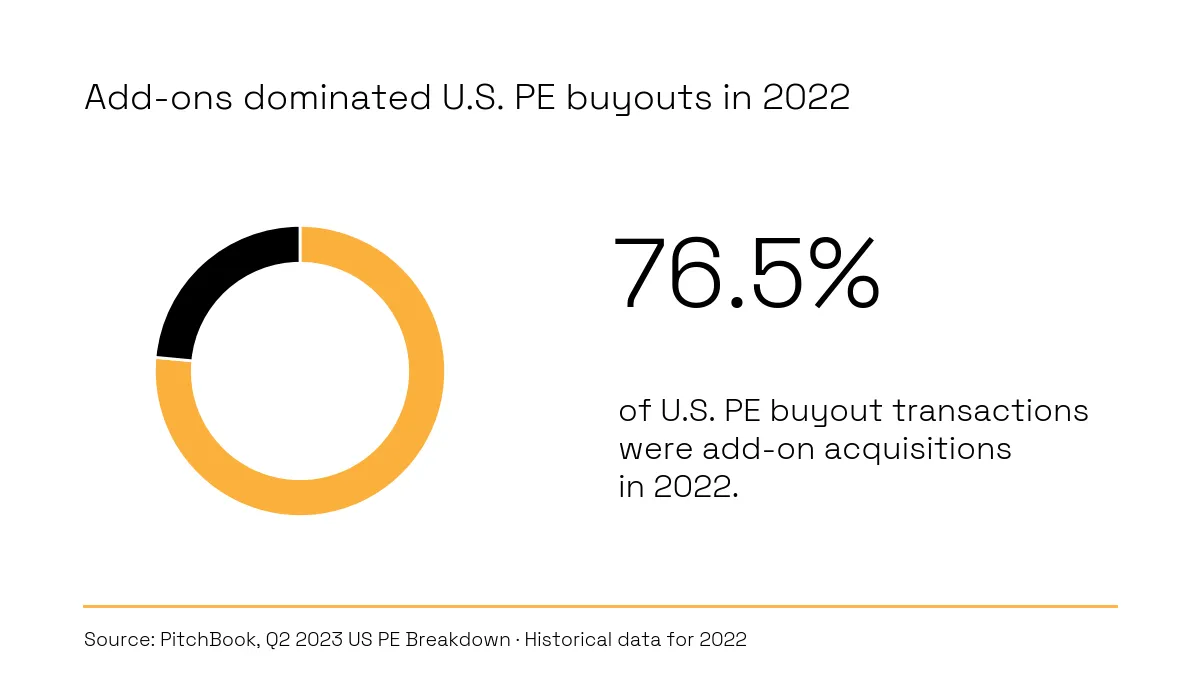
That shows how common add-ons have become. That doesn't mean every smaller company suits an existing platform. You still need to establish what the target would contribute and whether it fits the buyer's plans.
Where do bolt-ons and tuck-ins fit? Both usually sit under the add-on label, and sources draw the line differently.
BDO, a global accounting and advisory network, says a tuck-in usually adds a product or service and needs less integration support than a bolt-on, which may bring in a different business model.
The Corporate Finance Institute notes that people often use the terms interchangeably. It describes a tuck-in as fully absorbed, with more intensive integration, and a bolt-on as keeping some independence.
In this article, both sit within the broader add-on category. A bolt-on keeps more of its own operations or identity, and a tuck-in gets absorbed into an existing unit.
When you discuss a deal with colleagues or advisers, confirm what each person means by these terms.
How Do the Screening Questions and Data Needs Differ?
Both searches can start from the same company data. They split once you define what the target must do.
A platform search tests whether a company can carry your growth plan, while an add-on search tests what it brings to a business you already own.
That difference shows up in four areas:
- Business activities, customers, and locations
- Company size and financial performance
- Management and operating systems
- Ownership and corporate structure
Each section below compares both roles, so you can see where your questions and data change.
Business Activities, Customers, and Locations
For a platform, first establish what the company does and why customers prefer it. A broad industry classification will rarely give you these insights.
You need the platform's service mix, products, customer industries, certifications, and operating locations. Then investigate whether its position depends on a particular contract, owner relationship, or specialist capability.
For an add-on, start with the existing platform's needs. Does it require maintenance technicians in another region? A service it currently outsources? Access to a different customer market?
That changes which companies you include. A general maintenance provider could suit a platform search. An add-on search for refrigeration expertise should distinguish refrigeration maintenance from equipment sales or general facilities work.
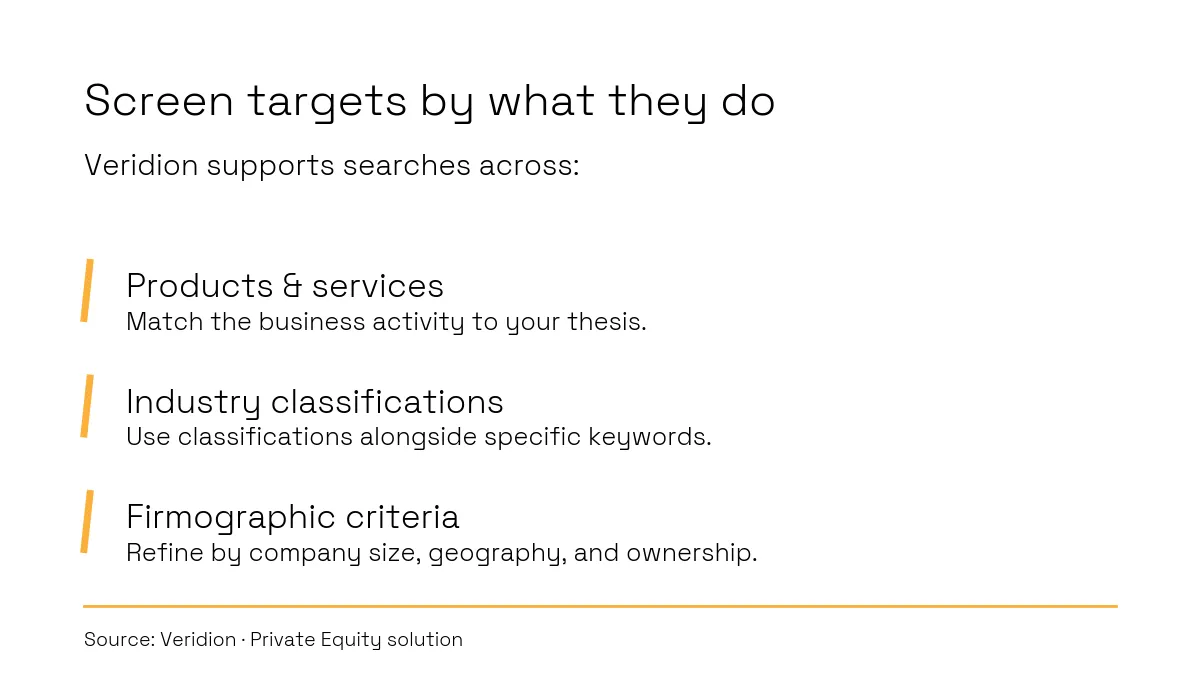
Veridion supports searches combining products, keywords, industry classifications, and firmographic criteria such as size, geography, and ownership. It also supports snippets from company sources. You can turn a thesis into firmographic filters for a platform search.
Source: Veridion
For an add-on search, you can anchor on what the portfolio company makes, instead of relying on its industry code. Each match returns the text snippet that triggered it so that you can check the evidence.
A global consultancy's experience shows the same principle in market research. Its projects needed market sizing, competitor mapping, and supplier discovery, and each had its own geography, industry, and attributes.
One project involved small HVAC operators in Georgia and Alabama. The other project dealt with Mexican merchants by industry category, with counts, locations, and revenue splits. Veridion delivered each one as a separate dataset built to that brief.

Source: Veridion
For acquisition screening, apply the same principle: a platform search might cover an entire service market, while an add-on search might isolate a missing capability or region.
One caution matters here. Shared customer industries do not prove shared customers. Similar services do not establish cross-selling revenue.
Get the businesses to provide customer-level sales records, compare account identities, and test purchasing needs before relying on either assumption.
Company Size and Financial Performance
Size helps establish relevance. It does not determine the acquisition role on its own.
For a platform acquisition, assess whether the revenue, earnings, cash generation, and business stability match your specific requirements.
For an add-on acquisition, assess the target's financial condition and contribution relative to the existing platform.
Platforms often face firm size limits. A platform carries the plan, so buyers want enough scale and profit before they commit.
Add-ons, on the other hand, often face looser limits because buyers judge them by what they add to an existing business. A small company can still earn its place by opening a new region or filling a capability gap. Looser limits don't mean lighter checking, though.
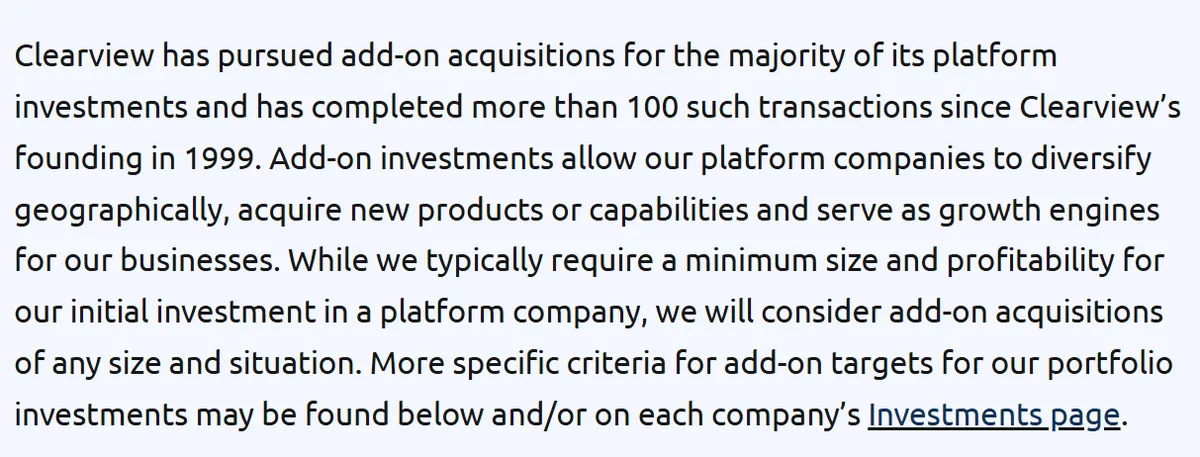
Companies with published criteria show how this works in practice. Clearview Capital targets $5 million to $25 million in earnings before interest, taxes, depreciation, and amortization (EBITDA), with smaller companies accepted as add-ons. Its add-on page says it will consider deals of "any size and situation."
Source: Clearview
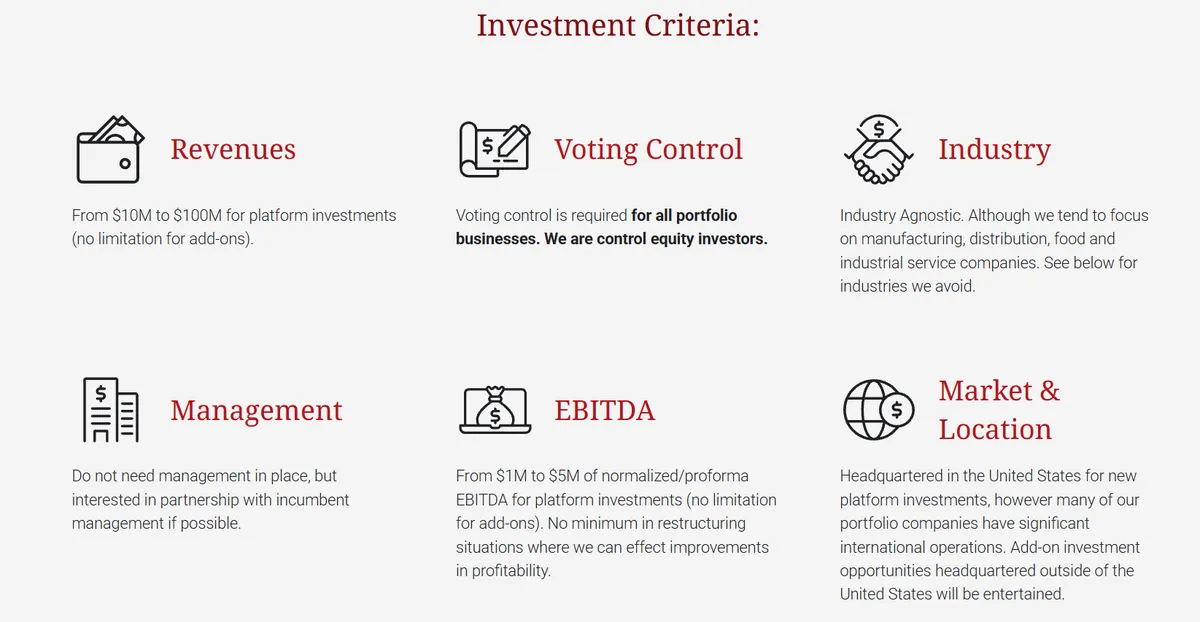
The Anderson Group, on the other hand, looks for $10 million to $100 million in revenue and $1 million to $5 million in normalized EBITDA for platforms, with no limit for add-ons. It also waives the minimum EBITDA requirement in restructuring situations. These are buyer-specific requirements, not market-wide rules.
Source: The Anderson Group
Now separate the numbers you get.
A published revenue figure must include a reporting period, currency, and entity scope.
A modeled estimate should be clearly labeled as an estimate. Employee count and site count are size proxies, meaning indirect indicators, not substitutes for revenue or earnings.
Veridion's methodology states that private companies without disclosed financials return modeled values, labeled accordingly. Use those values to prioritize research, not as confirmed target financials.
For each role, ensure you have historical accounts, current management reporting, cash-flow information, and customer-level revenue.
Check recurring versus project work, customer concentration, and the basis of earnings adjustments.
RSM, a network of assurance, tax, and consulting experts, has PE diligence guidance that specifically includes historical performance, cash flows, forecasts, working capital, and financial controls.
These checks still apply to smaller add-ons.
Management and Operating Systems
The management question changes with the role.
With a platform, you ask whether the team and systems can handle repeated acquisitions. With an add-on, you ask who must stay and what must connect. Public data can't fully answer either question, as you'll see below.
Start with the platform. A business can run well today and still struggle once it has to buy, absorb, and report on a series of companies.
AlixPartners, the global financial consultancy firm, warns that many companies were never designed to absorb other businesses, so it advises platforms to build a detailed integration playbook and a plan for bringing technology and data together. Management experience can fall short too.
Authors writing for INSEAD, the global business school, note that platform managers may lack post-merger integration experience and that the PE firm should provide dedicated support.
These limitations don't always end the case. A buyer may still proceed if the opportunity justifies the time and cost of fixing them.
An add-on raises a different issue. The platform already exists, so your focus shifts to key people, contracts, and the systems that must work with the platform.
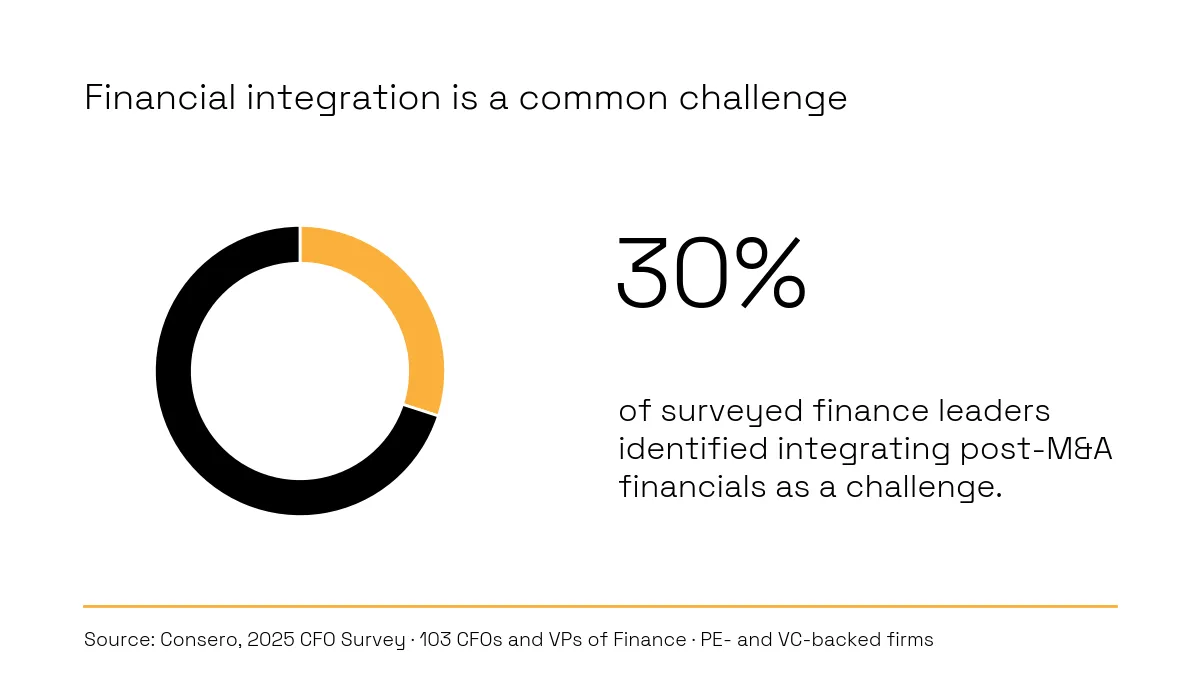
Finance teams feel the strain directly. In Consero’s 2025 survey of 103 CFOs and VPs of Finance at investor-backed companies, 30% identified integrating post-M&A financials as a finance-specific challenge.
That's why the review should start before the deal closes. BPM, an accounting and advisory firm, advises reviewing accounting systems, payroll, vendor contracts, and IT during diligence. BDO adds that departing staff may hold knowledge the integration depends on, such as how an obscure system works or who manages a key supplier relationship.
The planned level of integration determines how detailed these checks need to be.
For either type, review reporting, key-person dependencies, payroll, and system compatibility. If the businesses will share finance or operating systems, also assess ledger mapping, overlapping roles, and migration requirements. The scope depends on the planned integration, not the deal label alone.
Here is what to check.
Public biographies, job advertisements, and information about the company’s software provide useful starting points. However, they do not establish management capability, available capacity, or system compatibility.
Request reporting samples, process walkthroughs, and an organizational chart. Then discuss key-person dependencies with management.
Get specialists to review relevant systems, data quality, interfaces, and access requirements. That review will help determine whether your intended operating arrangement is feasible, instead of assuming matching software names mean compatible systems.
Ownership and Corporate Structure
Before assessing fit, establish which company you are assessing.
A trading name, operating company, subsidiary, and ultimate parent can represent different parts of a group. A parent's revenue or employee count may therefore misrepresent the business under review.
For a platform, identify the entities and operations that would form the acquired base. For an add-on, establish exactly which business would join the existing portfolio company.
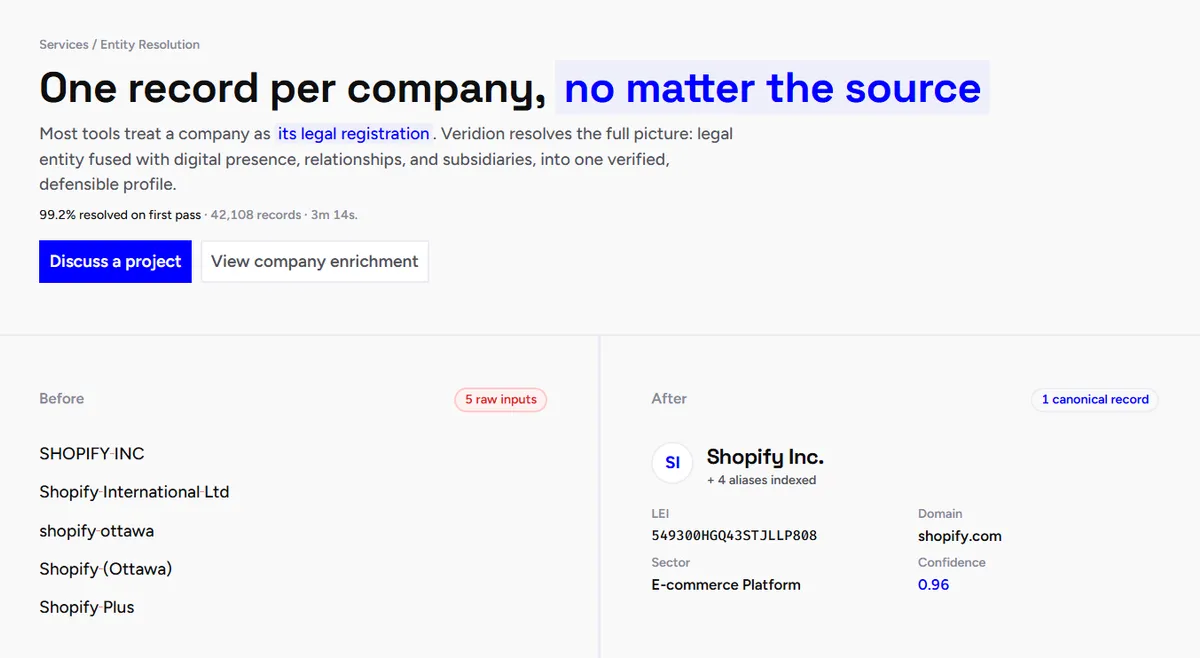
Build the record around legal names, registration identifiers, jurisdictions, website domains, and operating addresses. Add parent-subsidiary links, while keeping each legal entity distinct.
Veridion's Entity Resolution service provides canonical identifiers, corporate hierarchies, aliases, and relationship evidence that support this work.
Source: Veridion
Next, verify the boundaries.
Identify which entities employ staff, hold customer contracts, operate facilities, and own essential assets. Confirm whether reported financials describe the whole group or only the proposed target.
If an operating business depends on services from its parent, record that dependency for further review.
An ultimate-parent result does not, by itself, prove PE ownership. An ownership label does not establish current ownership percentages or an owner's willingness to sell. Confirm material conclusions against current records and direct discussions.
For location checks, use Veridion's operational footprint due diligence guide, rather than treating a registered address as proof of active operations.
Can the Same Company Be a Platform or an Add-On?
Yes. The same company can suit either role because buyers ask it to perform different jobs.
Consider Northline Industrial Maintenance, a fictional company. Let’s say its website describes preventive maintenance and emergency repairs for food-processing plants.
Public materials list two service depots and an operations director. A company-data record estimates revenue at $18 million and headcount at 85.
Remember, these are screening inputs, not confirmed financials or proof of management depth.
Buyer A wants a platform that can begin acquiring regional operators soon after purchase. It assumes the target will provide much of the leadership and reporting capacity.
Buyer B already owns a fictional maintenance platform serving neighboring regions. That platform has central finance and reporting functions. It wants local technicians and depots in Northline's territory, but still needs to confirm that it can support the additional business.
Screening area | Available evidence | Still to verify | Assessment |
|---|---|---|---|
Commercial fit | Maintenance services, food-processing focus, two depots | Active coverage, contracts, customer concentration | Platform: assess market position. Add-on: assess geographic fit. |
Operating capacity | An operations director is listed | Leadership capacity, reporting, owner dependence | Platform: capacity unverified. Add-on: test staff retention and central support. |
Financial fit | Revenue and employee estimates | Actual revenue, earnings, cash flow, entity scope | Both: provisional pending verification. |
Acquisition scope | Trading name and listed locations | Ownership, included entities, shared services, seller interest | Both: confirm scope and seller interest. |
Buyer A might pause Northline because its plan depends on leadership capacity that remains unproven. Buyer B might continue because the same business appears relevant to a defined geographic need.
Neither decision proves Northline is a good or bad acquisition. The buyers have different requirements. If further evidence shows that one depot is inactive, Buyer B may reject it, while Buyer A could still investigate its broader business.
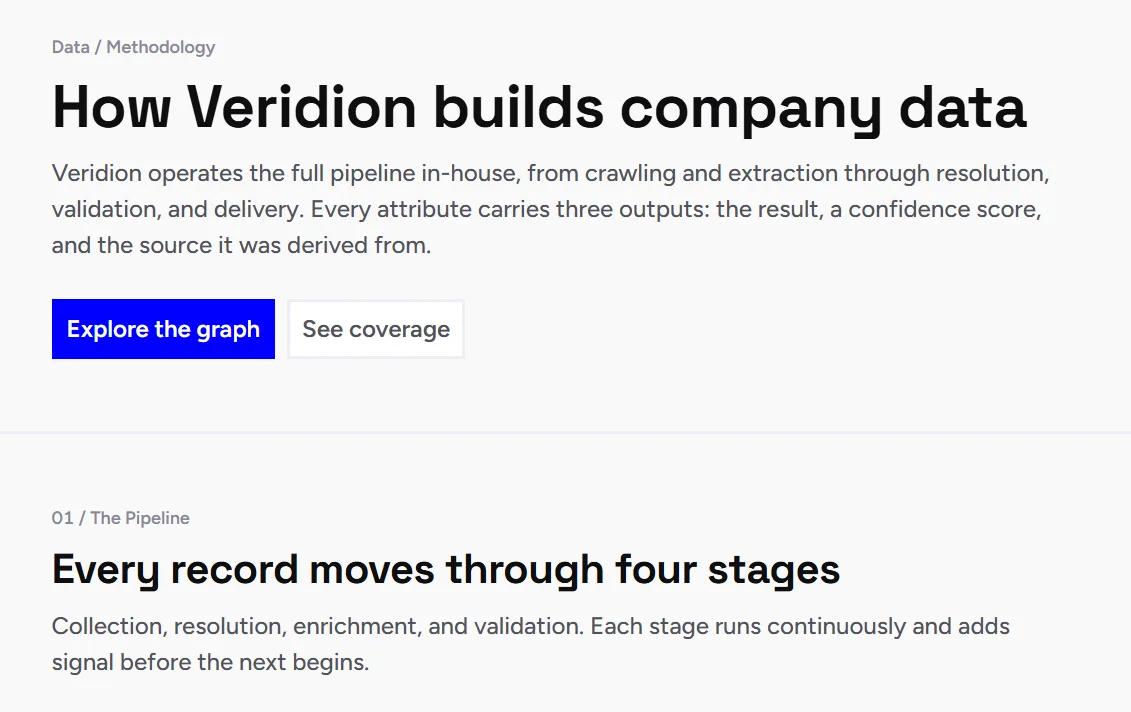
Keep the evidence traceable. Veridion's data methodology describes source trails, last-harvested dates, and confidence scores.
Source: Veridion
Check those before relying on an attribute. A confidence score reflects the data claim, not the likelihood of successful acquisition.
Conclusion
Platform and add-on searches can share company data, yet they test different things.
A platform should carry your growth plan while an add-on strengthens the business you already own. Your filters, priorities, and evidence gaps should demonstrate that distinction.
Take one target under review and note down its intended role, the main questions that role creates, and the evidence still needed. Use that record to decide whether to continue researching, pause, or rule it out.
Articles
Discuss how these trends affect your organization.
Our analysts are available for a short call. Bring a specific question and we will ground it in the data.
Insights
Keep reading
More analysis, research, and outcomes grounded in live company intelligence.
How Private Equity Firms Use Firmographic Filters to Build Smarter Deal Pipelines
Tired of sifting through endless leads? See how private equity firms leverage firmographic data providers to pinpoint high-value deals.
How to Verify a Company’s Operational Footprint in Private Equity Due Diligence
We break down the process of surfacing and validating every location and activity that keeps a business running for PE due diligence.
How to Build a Strong Market Intelligence Strategy
Learn how to build a strong market intelligence strategy that helps you track trends, understand competitors, and make smarter decisions.