Insights / Articles
How to Build a Point-in-Time Company Dataset for Credit Model Validation
Values captured in 2026 do not prove you knew them in 2023. Build point-in-time company data in six steps.

- Build point-in-time company data for reliable credit model validation.
- Track historical company changes and when records became available.
- Join features using the correct dates and availability cutoffs.
- Use out-of-time validation to test performance on later data.
To build point-in-time company data for credit model validation, you fix observation dates, freeze the company universe, store every attribute with valid and known dates, join features as of each date, and split the data by time. The result lets validators test a model on what was actually known at each decision, which a dataset of current company profiles can’t do.
Veridion ships every company attribute with its source and last-harvested date and can deliver data on a schedule, so each delivery can be stored as a dated snapshot.
How to Build a Point-in-Time Company Dataset Step by Step
You start with a list of borrowers or issuers, their credit outcomes, and your company data. You end with one row per company per observation date, holding only the values known on that date. The six steps below get you there:
1. Define Observation Dates and the Outcome Window
First, set your observation dates: the points at which you capture the information used to predict future credit performance. Depending on your model, you might use monthly snapshots, quarterly reporting dates, or dates tied to credit reviews.
Match the schedule to the model’s use: a monthly monitoring model needs more frequent dates than an annual credit assessment model.
Next, define the outcome window. This is the period after an observation date during which you measure the result you want to predict.
For a model that predicts default within 12 months, a single observation looks like this:
- Observation date: March 31, 2024.
- Outcome window: April 1, 2024, to March 31, 2025.
- Target: Whether the borrower defaults during that period.
The model estimates default risk from what was known on March 31, 2024. Once the window closes, the borrower’s repayment history shows whether a default occurred, and you can compare that outcome with the model’s prediction.
That comparison only works with a complete window. If your default records end in September 2026, a borrower assessed in March 2026 has only six months of follow-up, and treating it as a non-default would distort training or validation.
You also need to account for the lag between an event and when your team learns about it. If a company files its accounts on March 20 but your pipeline receives them on March 24, they can’t enter a March 22 snapshot.
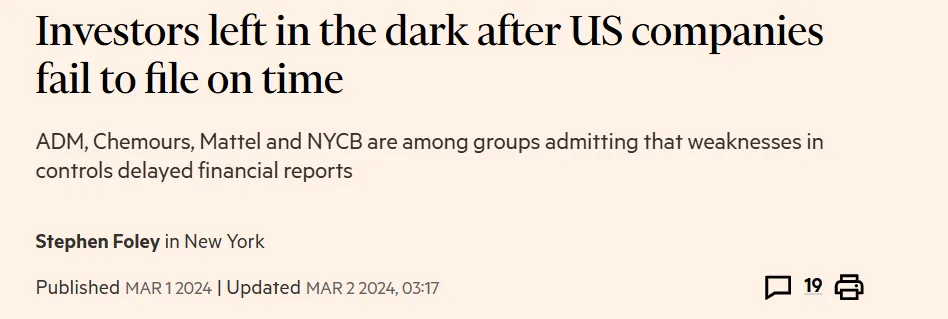
Delayed filings are also common: many US companies miss their filing deadlines.
Source: Financial Times
So set an explicit availability cutoff for each observation date, with a realistic delay for ingestion, processing, and validation.
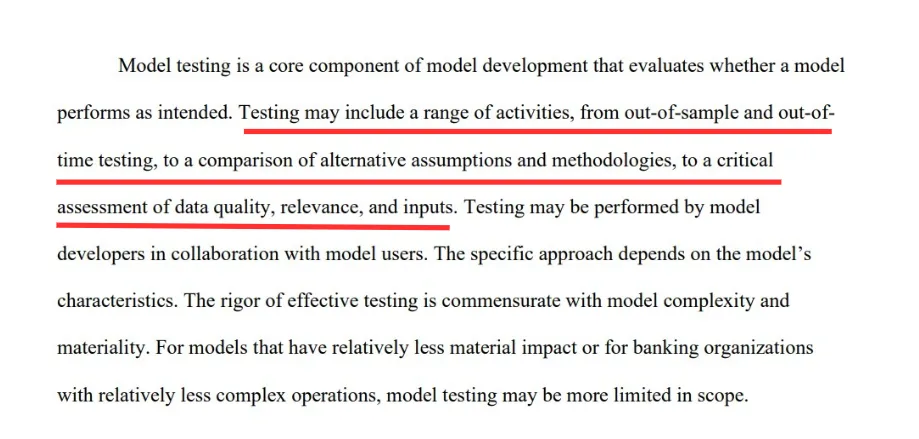
Regulators expect this kind of care with data. The Federal Reserve’s revised model risk management guidance, SR 26-2, issued on April 17, 2026, lists out-of-time testing and a critical assessment of data quality among the activities model testing may include.
Source: Federal Reserve
Once these dates are fixed, you can establish which companies belong in each snapshot.
2. Freeze the Company Universe as It Was on Each Date
Rebuild the list of borrowers and issuers separately for each observation date, starting from your internal lending records, issuer lists, or historical portfolios. Include businesses that later defaulted, dissolved, merged, or were acquired.
A company that defaulted in December 2024 stays in the March 2024 cohort if it met your inclusion rules then, even if it’s no longer in your portfolio.
Next, give each company a stable identity. Borrowers rebrand, change legal names, merge, or get new identifiers from external providers, and your entity resolution should neither split one company into several nor merge distinct legal entities. Keep a stable internal ID mapped to external identifiers, and record the effective dates of name changes, acquisitions, and ownership changes.
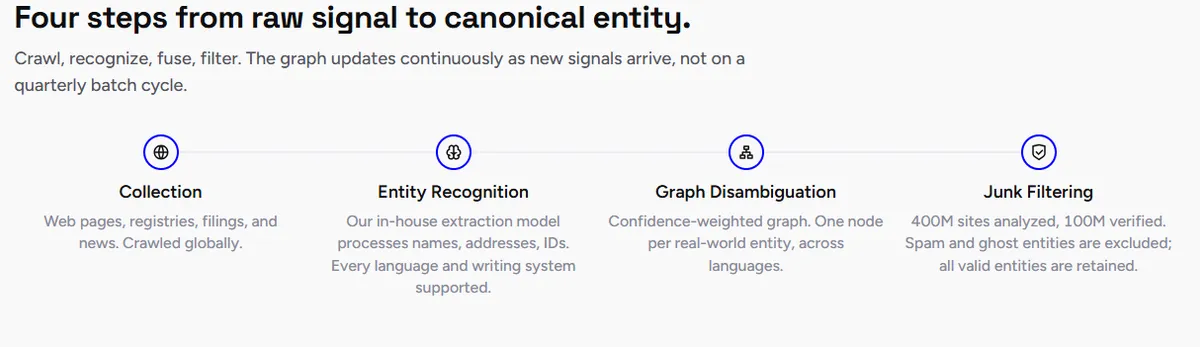
Veridion’s Entity Resolution can map inconsistent company records to a canonical company identity. You can use the resolved identifier to connect external company information with your internal borrower or issuer records.
Source: Veridion
A resolved identity doesn’t tell you which version of an attribute was available on a given date, though. That history needs its own storage.
3. Store Every Company Attribute With Valid and Known Dates
Every company attribute carries two dates, even if you only store one:
- Valid date: when the value was true in the real world.
- Known date: when your team, or your provider, learned it.
They rarely match.
Consider a borrower whose registered address changed on June 1, 2024. The change might only appear in a public record on June 8, and your provider might deliver the updated record on June 10.
If you store only the address and its effective date, you can’t tell when your pipeline could first use the new one, and that distinction is central to point-in-time correctness.
To keep old versions when values change, use one of two common designs: a Type 2 slowly changing dimension (SCD) or a bitemporal table.
A Type 2 SCD design creates a new row for each version of an attribute, with dates defining when that version applies.
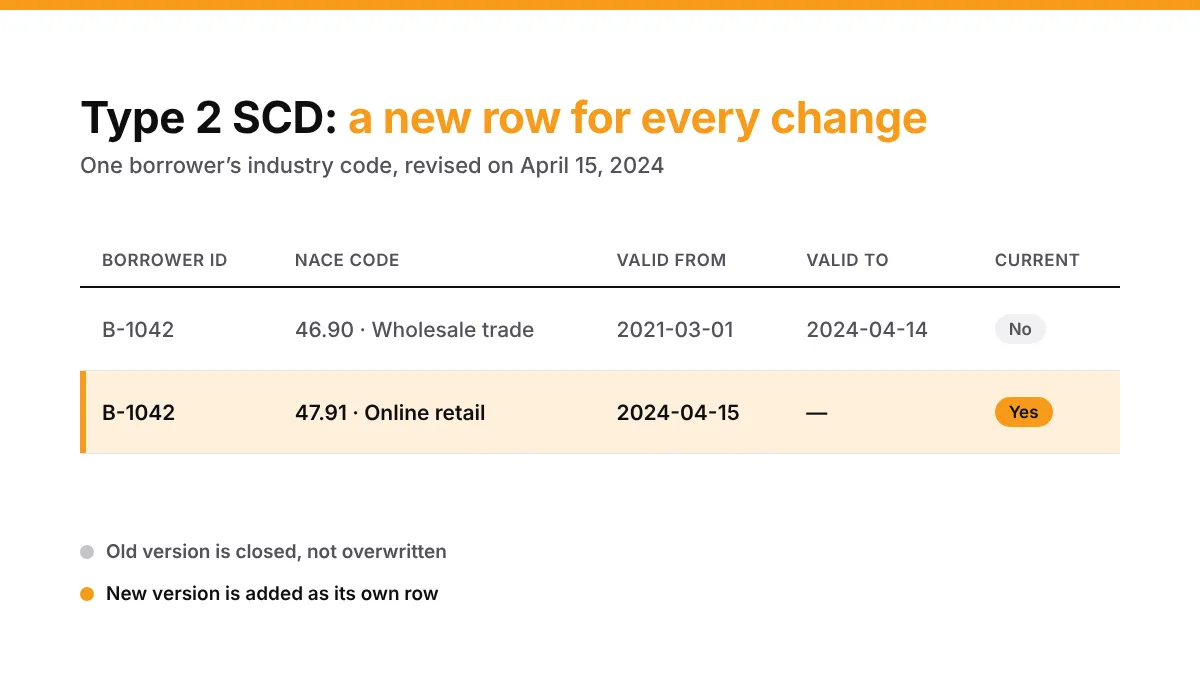
Illustration: Veridion
A bitemporal design tracks both the period when a fact was valid and the period when the system knew or recorded it.
Jon Pither, CEO and co-founder of software engineering firm JUXT, explains why bitemporality matters in this blog.
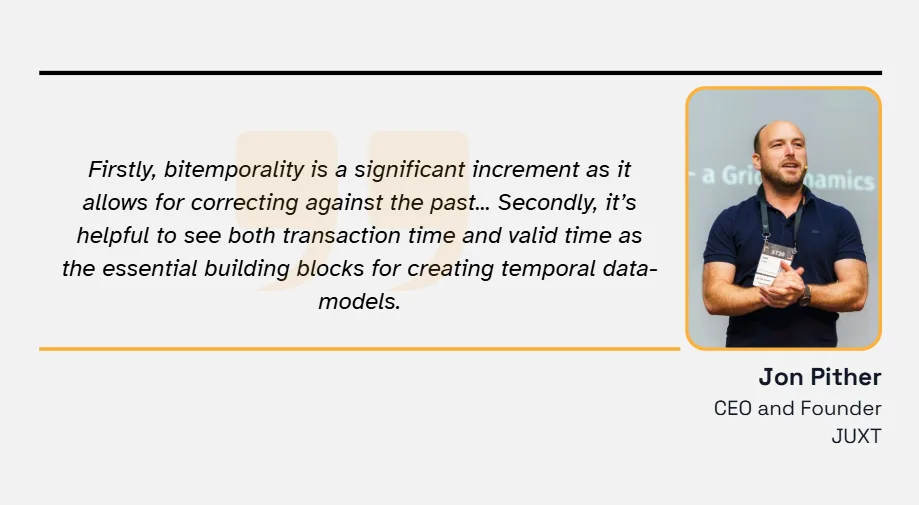
You don’t need a separate table for every attribute, as long as historical values stay retrievable and their timelines are explicit.
Ideally, each record carries these timestamps or equivalent metadata:
Timestamp | What it records | Why the as-of join needs it |
|---|---|---|
Observation date | The date for which you are building the company snapshot | Defines the point in time being reconstructed |
Valid from / valid to | When the attribute applied to the company | Establishes the period in which the value was true |
Recorded (known) date | When the value or version entered the source system | Helps exclude information recorded after the observation cutoff |
Retrieval date | When your pipeline received the record | Establishes when your team could actually use the value |
Provider's last-harvested date | When the provider last collected or checked the underlying source, where supplied | Helps assess source freshness and distinguish old evidence from recent verification |
Keep the dates distinct. A provider's last-harvested date does not necessarily establish when a fact first became known. Similarly, a retrieval date alone does not prove that the underlying information was publicly available on that date.
Apply the same historical controls to industry classifications and parent-subsidiary relationships. Store each with:
- Effective dates for every classification or link
- The full version history, not only the latest value
- The taxonomy version it came from (for example, a given edition of NACE, SIC, or NAICS)
Note that many company data APIs return only the latest profile, not earlier versions. If you start collecting when your model project begins, you can’t reconstruct older states, so capture company data on a defined schedule.
Veridion delivers company data through APIs, batch delivery, and warehouse integrations with Snowflake, BigQuery, and Databricks across more than 744.5M companies.
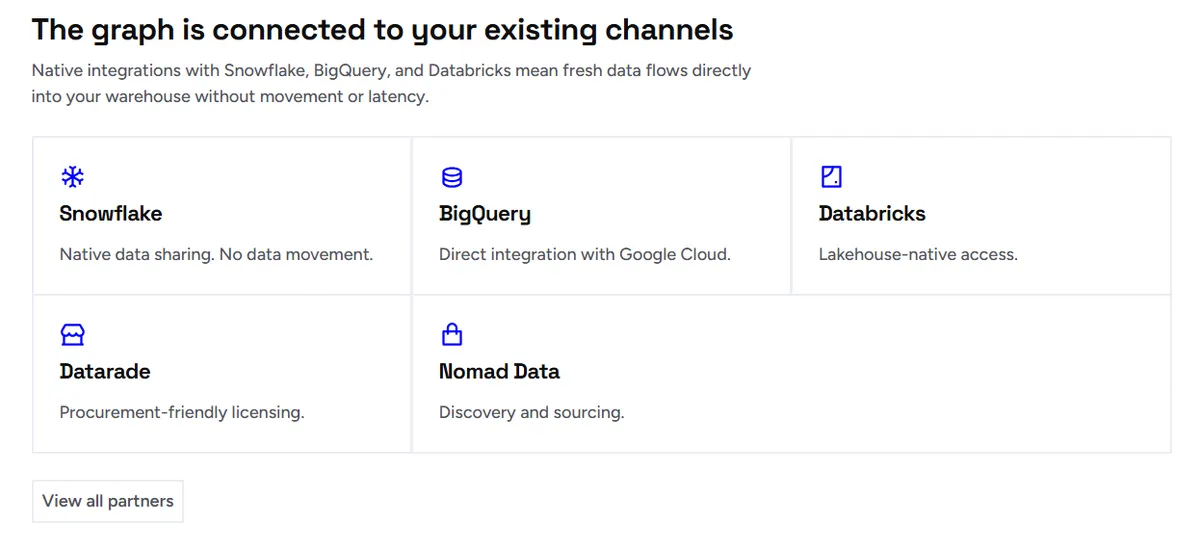
Source: Veridion
If you store each scheduled batch file in a dated partition, keep incremental updates with their delivery dates instead of overwriting earlier versions, and snapshot shared warehouse tables on a regular schedule, you build your own history of Veridion’s data over time. Each attribute also ships with a confidence score and a source trail that includes its last-harvested date, so you can store both alongside the value.
4. Join Features as of Each Observation Date
A point-in-time join connects two tables: your observation records, which list each company and the date you’re evaluating it, and your feature table, which stores every version of each company attribute with its validity and availability timestamps. For each observation, the join picks the latest feature version that was valid and available by that date.
For example, say you’re building a March 31, 2024 snapshot for a borrower whose industry classification was recorded in January 2024 and revised in April. The snapshot must use the January version if it was valid and available by the cutoff. The April revision belongs in a later snapshot.
A join on the valid date alone isn’t enough. A provider may correct a record after your observation date and backdate it to January, even though your team only received it in April. Filtering on validity alone would let that correction into the March snapshot.
Your join should therefore apply two separate conditions:
- Validity: The attribute applies to the company on the observation date.
- Availability: The relevant version was recorded and accessible by the observation cutoff.
Where source timestamps differ, define which availability timestamp governs the join. For strict reconstruction of your own pipeline, the retrieval timestamp is the one to use. Feature stores such as Feast and Databricks support as-of joins out of the box, matching each observation to the latest feature value at or before its timestamp, within a set lookback window.
By default, though, Feast joins on event time, so a correction loaded after your observation date can still slip in. Apply the availability filter before the join.
Also set a maximum age (lookback window) for every feature, based on how often it refreshes and how fast it changes. An address stays useful longer than an employee count or operating status, and values older than the limit should be marked stale.
The resulting join should reproduce the features your model could have used at each observation date, not simply the most recent values available when you run the query.
5. Split the Dataset by Time, Not at Random
There are two common ways to set aside validation data:
- In-time holdout: a random slice of the development period, set aside and tested after the model is built.
- Out-of-time validation: data from a different, later period than the one used for development.
Credit model validation relies on the second. A random holdout shares the economic conditions of the training data, so it says little about how the model copes when conditions shift. Out-of-time validation tests exactly that.
Regulation requires it, too. Article 175(4) of the EU Capital Requirements Regulation requires banks that use statistical rating models under the internal ratings-based (IRB) approach to validate them with “out-of-time and out-of-sample performance tests.”
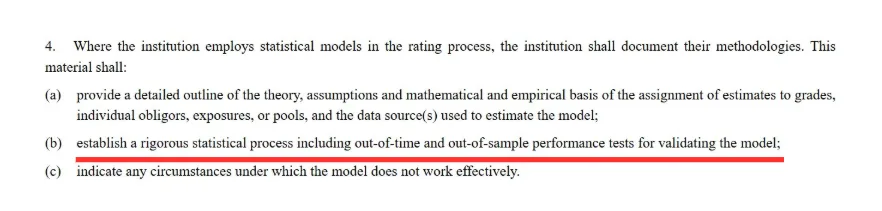
Two further checks remain:
- Keep each company on one side. One borrower appears on many observation dates, and its rows look alike. If some land in development and some in validation, the model has effectively seen the answer. Treat corporate groups the same way, so a parent and its subsidiaries stay together.
- Decide how to treat unfinished outcome windows. The latest observation dates may not have a full window yet. A company observed eight months ago can't show a 12-month result.
In such cases, you can drop those dates from validation, hold them in a separate monitoring sample labeled as immature, or use a shorter, documented window and report those results separately from the full-window ones.
6. Document Missing Values, Coverage, and the Dataset Version
First, separate two states that often get merged:
- Not known yet: the value existed, but your team hadn't received it by the observation date.
- Missing: the value was never available from any source, or doesn't apply to this company.
A model that learns from “not known yet” sees decisions as they really looked. One that learns from “missing” is learning the gaps in your data. Give each its own status code, and never fill either with zero.
Next, report coverage by observation date: how many companies have a value for each attribute in each period.
The table below shows illustrative figures:
Observation date | Companies | With revenue | With industry code | With parent link |
|---|---|---|---|---|
Q1 2023 | 4,200 | 61% | 94% | 70% |
Q1 2024 | 4,350 | 68% | 96% | 78% |
Q1 2025 | 4,500 | 74% | 97% | 83% |
Validators need this because coverage rarely stays flat. If an attribute is thin in early years and dense later, the model may be learning from coverage rather than credit risk.
This is also a governance expectation for banks. The Basel Committee’s BCBS 239 principles say a bank’s risk data aggregation capabilities and risk reporting practices should be “fully documented and subject to high standards of validation” (paragraph 29, under Principle 1). Under Principle 4, paragraph 43 expects data to be “materially complete, with any exceptions identified and explained.”
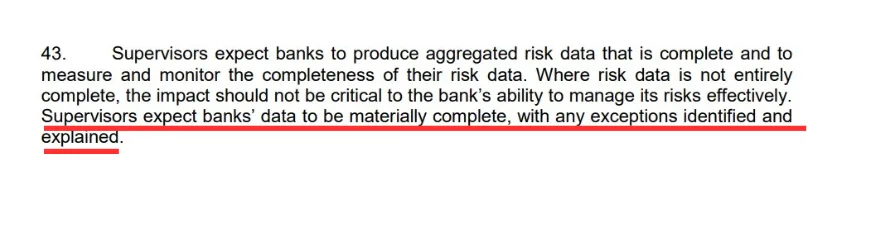
Finally, add a one-page data note for validators covering:
- Observation dates, outcome window, and the availability-lag rule
- How the universe was built and how identity was handled
- Sources behind each attribute and how often each refreshes
- The as-of join logic and each attribute's maximum age
- The time split, including treatment of unfinished windows
- Known gaps and limitations
Version every build, too. Record the build date, code version, and each source's snapshot dates. A validator or auditor can then recreate the exact dataset behind a validation from two years ago.
What to Do When Company History Doesn't Go Back Far Enough
Most teams’ company data history starts the day they began capturing it. A provider may return values for older periods today, but that doesn’t mean you had them then, so don’t backdate your first snapshot.
A record captured in 2026 does not prove your team knew that value in 2023. Assigning it an earlier known date creates a false history and can introduce data leakage into model validation.
Keep the gap visible, and mark the attribute as unavailable for that observation date unless you can establish when the information became accessible.
You can recover part of the missing history from dated sources. Registry filings and legal records show when a company submitted its accounts or registered a change.
A provider’s last-harvested date shows when the information was last collected or checked. Store these dates with each value and label where they came from, but neither proves when your own pipeline received the information.
Veridion's work with a card and payments provider shows why this distinction matters.
The provider wanted to identify customer growth or contraction before those changes appeared in transaction data.
In this build, Veridion combined four observed signals across rolling 12-month windows:
- Net change in active physical locations
- Employee-count changes
- Website changes
- Technology-stack upgrades
Each company received an explainable growth score from −10 to +10, alongside a written reason and a High, Medium, or Low confidence rating.
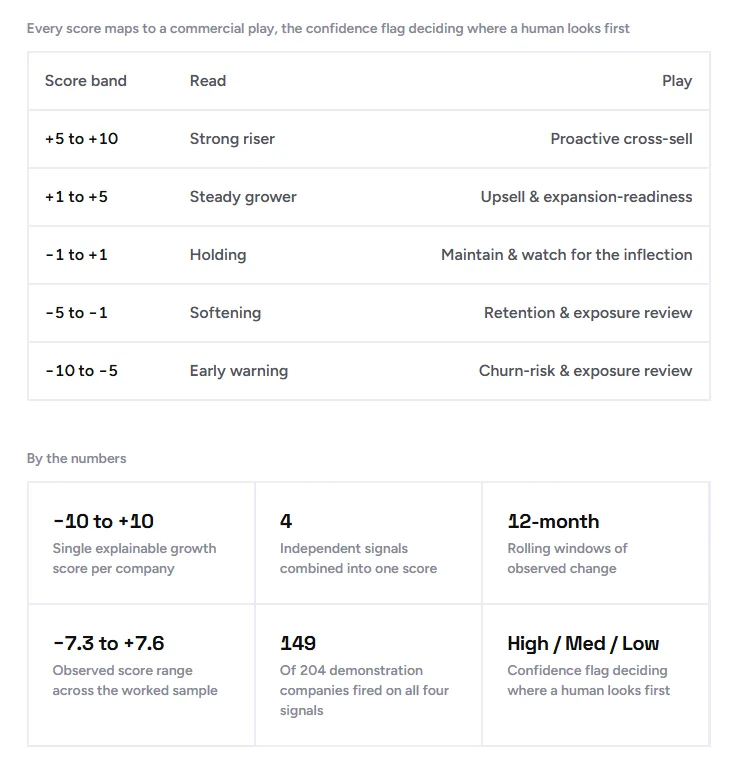
Source: Veridion
To stop backfilled data from faking growth, a newly discovered location counted toward expansion only once it was verified as open.
Employee history also passed checks for data glitches, duplicate identities, and impossible overnight doublings. Every score can also be traced back to the dated location, headcount, tech-stack, and website-change records that produced it.
Apply the same discipline to credit datasets: preserve the source dates, distinguish observed facts from later discoveries, and record any assumptions.
If you cannot establish when a value became available, flag the limitation rather than presenting it as known history.
Conclusion
A point-in-time company dataset shows not just what each value was, but when it became known and whether your pipeline could use it at each observation date. That’s what lets credit teams validate models without leakage and explain how every historical feature was built.
Most teams need to start with step 3: capture company data on a schedule and store each delivery as a dated snapshot. This week, pick one attribute your model relies on and check whether you can tell when each of its values became known.
Articles
Discuss how these trends affect your organization.
Our analysts are available for a short call. Bring a specific question and we will ground it in the data.
Insights
Keep reading
More analysis, research, and outcomes grounded in live company intelligence.
Data Lineage for Credit Ratings: Building a Traceable Evidence Chain
How credit rating data lineage works in practice: capturing provenance, entity identifiers, transformations and overrides.
Best Practices for Leveraging Market Intelligence
Not sure how to apply market intelligence effectively? Learn which practices top businesses rely on and how you can too.
How Is AI Revolutionizing Market Intelligence?
Explore the key ways AI is transforming market intelligence workflows and helping businesses stay ahead of the competition.