Insights / Articles
Point-in-Time vs. Current Company Data: What Should Your Credit Model See?
By June 20 your data had the address a borrower changed on June 1. Decide which of six credit use cases need point-in-time company data.

- Use current inputs for live borrower assessments.
- Use PIT inputs to reconstruct historical predictions.
- Veridion supplies current data with source trails.
For a live borrower assessment, a credit model needs inputs available by its prediction cutoff, including relevant historical information. For historical development and testing, company-data inputs must reflect what was available at each past prediction date.
Mixing up the two can cause expensive mistakes, like poor credit decisions and misleading model performance results.
Current vs. Point-in-Time Company Data: What Each One Answers
Current company data describes a business using the latest information available in a dataset. It answers the question, “What do we know about this company today?”
This type of data (and the answer you get) may include the company's current:
- operational status
- business activities
- operating locations
- other relevant company attributes
Point-in-time (PIT) company data refers to the information that was available to you about a company on a particular date in the past. It can include the same attributes mentioned above, but reflects what was known at that historical point rather than when you're conducting the analysis.
It answers the question, "What did we know about this company on a specified past date?"
Here's how current vs. historical company data compare:
Current company data | Point-in-time company data | |
|---|---|---|
The question it answers | What do we know about this company today? | What information was available about this company on a specified past date? |
What values are tied to | A current profile | A historical prediction cutoff |
Supporting source Available update or collection dates | Evidence that the selected version was available by that cutoff | |
How a refresh impacts the values | Updates the current value as new information becomes available | Adds new versions while preserving earlier values and their availability history |
What to check in the data | Source Attribute freshness Confidence scores Refresh frequency | Timestamps Historical coverage Retained changes As-of retrieval rules |
In this article, point-in-time company data does not mean point-in-time probability of default (PD).
PIT company data includes only facts available at the historical cutoff. A fact that was true but unavailable to the model must not appear in its inputs.
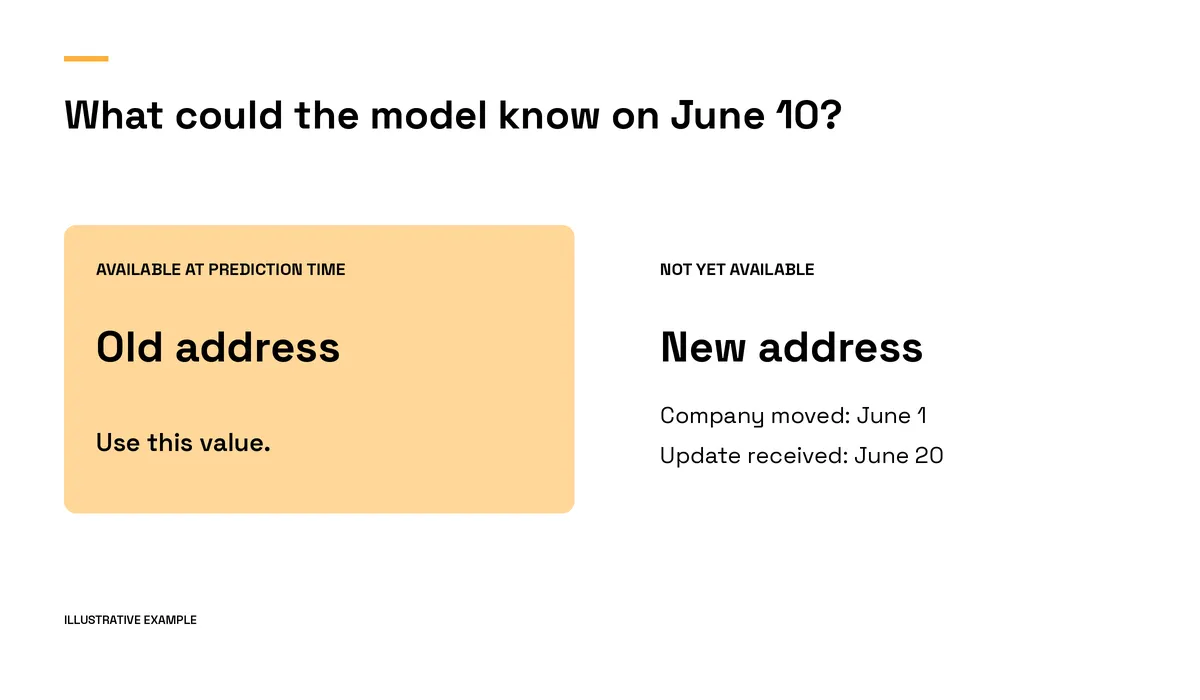
For example, let's say a company relocated on June 1, but its updated address only entered your dataset on June 20.
Assuming the old address was the latest recorded value available to the model, a June 10 reconstruction should retain it. The June 20 update must not be backfilled into that earlier prediction.
Source: Veridion
Historical tests need inputs available at the original prediction date.
Later information can make the model appear more accurate than it was.
What Your Credit Model Should See, by Use Case
Your credit model should use the company data that matches the job it's doing.
In general, live assessments require current company data, while testing past decisions requires point-in time data.
The table below applies credit-risk monitoring principles from the Basel Committee on Banking Supervision and point-in-time retrieval concepts from Feast to common credit workflows:
Use case | Dataset to use | What to check before using the dataset |
|---|---|---|
Onboarding new borrowers | Current company data | Attribute accuracy Freshness Correct company identification |
Monitoring existing borrowers | Current company data | Refresh cadence Whether material company changes are captured |
Periodic borrower reviews | Current company data | Updated attributes Changes from the previous review |
Retrospective model validation | Archived predictions and subsequent outcomes; PIT company inputs if predictions are reconstructed. | Prediction dates, outcome horizons, and original inputs or their reproducibility |
Vintage analysis of loan cohorts | Origination and performance records; PIT company attributes when comparing borrower characteristics. | Origination dates and equal months on book Company attributes available at origination |
Model development and backtesting | PIT company inputs for historical training and testing, plus subsequent outcome labels |
In practice, you may need both datasets for the same borrower: current information to evaluate its creditworthiness today and historical information to assess how your model would've performed on past decisions.
Use Current Profiles for Live Decisions
For live borrower assessments, use the latest company information required by the model, alongside relevant financial history and other approved inputs. Relevant workflows include:
- Onboarding new borrowers
- Monitoring existing borrowers
- Conducting periodic credit reviews
For example, if you're using outdated data for onboarding checks, you might approve a loan to a company that has since ceased operations.
If you're using it for portfolio monitoring, you might miss warning signs of increasing borrower risk and delay intervention.
And if you're using it for periodic reviews, you could maintain credit limits or lending terms that no longer reflect the borrower's circumstances.
However, having a current company profile doesn't automatically make every attribute equally up to date or reliable.
Before using it in live assessments, you need to establish four things:
Source visibility | Can your team identify where the information came from? |
|---|---|
Refresh cadence | How frequently are different attributes checked for changes? |
Attribute freshness | When was each value last collected, checked, or updated? |
Change visibility | Can you compare the latest profile with the information used during the previous review? |
These checks help identify attributes that may have changed since they were last verified.
Veridion's data methodology is designed to minimize such risks.
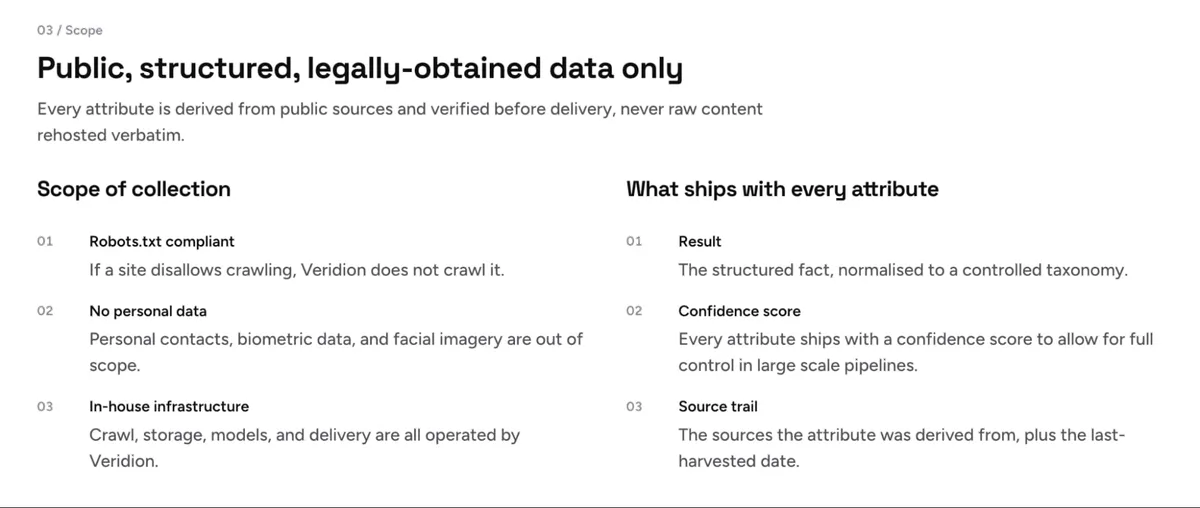
Veridion’s methodology states that core company profiles refresh continuously, volatile signals daily, and technographics on a rolling 90-day window.
The methodology also describes attribute-level confidence scores and source trails with last-harvested dates. A last-harvested date indicates source collection, not necessarily when the fact became true or available to your model.
This gives teams context for assessing the evidence behind an attribute.
Source: Veridion
To illustrate why this matters, let's look at how a specialty commercial insurer used Veridion's data in its underwriting workflow.
The insurer needed explainable ESG information for sustainability-linked underwriting, including evidence its reinsurer could review.
In this implementation, its core company graph refreshed weekly, while the data came with supporting evidence that reviewers could examine.
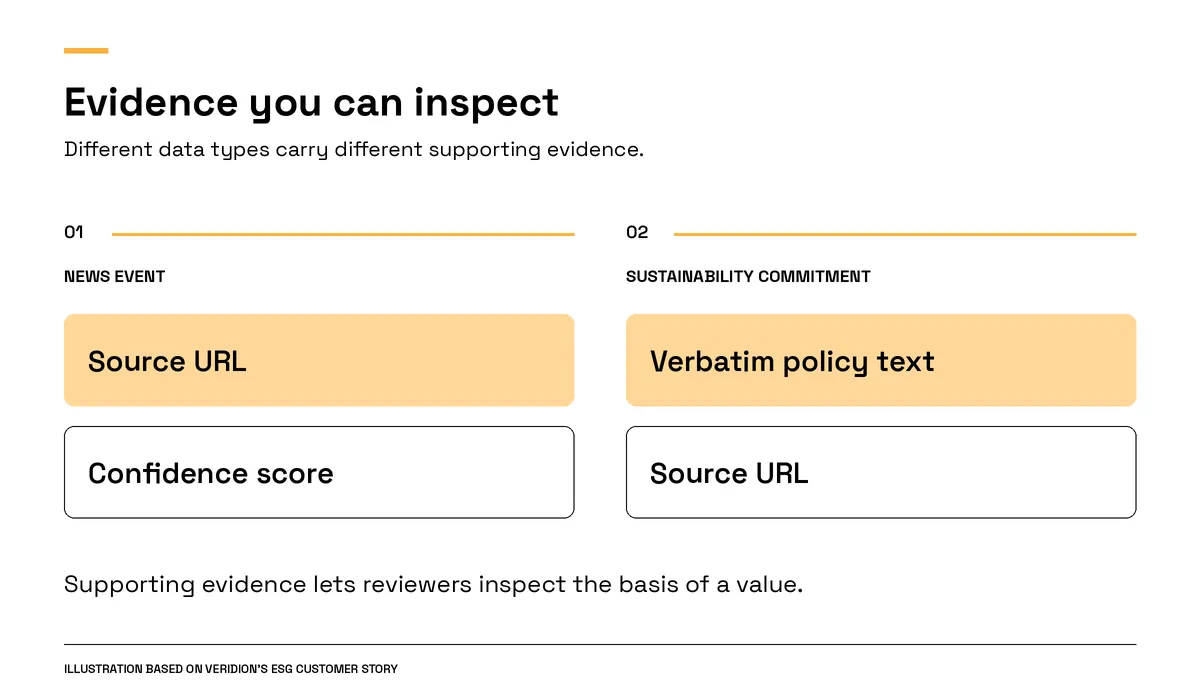
For example, the data Veridion extracted from news sources came with source URLs and confidence scores.
Other data, such as companies' publicly stated sustainability commitments, included the exact wording of each pledge and source URLs, so analysts could verify the claims themselves.
Source: Veridion
The customer’s reinsurer reviewed and endorsed the methodology. For credit teams, the example illustrates how documented refresh schedules and traceable sources support the review of company data.
Check that each input is timely enough for its intended use, refers to the correct borrower and reporting period, and can be traced to supporting evidence.
During periodic reviews, compare the current profile with the previous review’s version to identify changes that may affect credit risk.
Use Point-in-Time Data to Test the Past
Point-in-time company data is primarily used for developing and testing credit models against historical decisions.
These data can support the following analyses, whose purposes may overlap:
- Vintage analysis: Comparing groups of loans issued during different periods.
- Retrospective validation: Comparing historical predictions with actual outcomes.
- Backtesting: Checking how a model would have performed on past lending decisions.
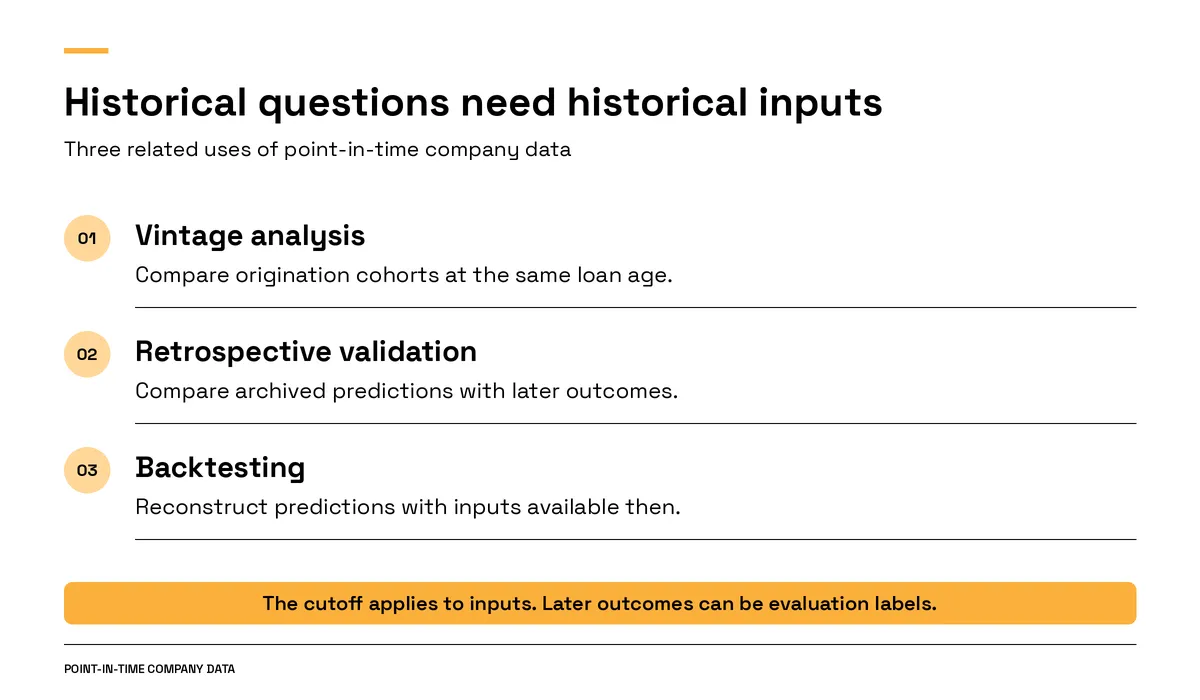
In vintage analysis, loans are typically grouped by their origination month or quarter and compared at the same age, as Lendbox explains.
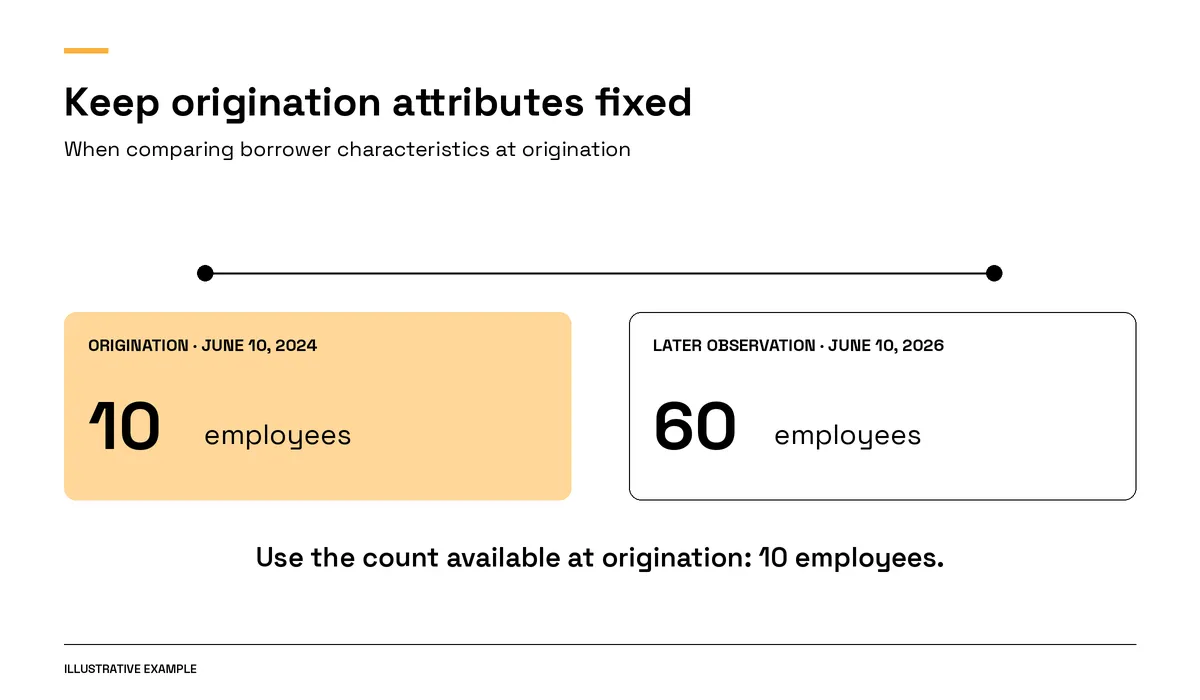
To compare performance across borrower characteristics at origination, use the company attributes available when each loan was issued, rather than today’s values.
Source: Veridion
Retrospective validation can compare archived predictions with subsequent outcomes, such as whether borrowers defaulted.
Backtesting can form part of retrospective validation. If you reconstruct historical predictions, use company-data inputs available at each original prediction cutoff.
Apply the historical cutoff to model inputs. Subsequent defaults, repayments, or losses can be used as outcome labels, but must not enter the features used to generate the historical prediction.
Source: Veridion
Before using PIT company data for any of these purposes, check the following:
Are previous values retained?
Confirm that updates preserve earlier attribute values.
What does each date represent?
Distinguish when a value was valid from when it became available to the model.
Can you retrieve a profile as it was known?
Check that an as-of query reconstructs the information available on the requested date.
Do not assume that a provider retains historical versions or supports as-of retrieval. Confirm both capabilities before relying on the feed for historical testing.
If the provider does not support historical retrieval, retain the payloads you receive with receipt timestamps and version identifiers. These records preserve what your pipeline received; their historical resolution depends on your collection cadence.
What Breaks When You Swap Them
Using the wrong company dataset can affect both your credit decisions and your model testing results.
Here are the three common mistakes:
- Using current data for historical tests
- Using an outdated historical snapshot for a live assessment
- Mixing current and historical data pipelines
The first mistake is known as data leakage.
In this scenario, you're testing a past credit decision using a company's current attributes. This gives the model access to information it couldn't have known at the time, potentially making it appear more accurate than it actually is.
In a 2021 study on credit scoring, Hongyi Qian and his colleagues explain how using future information in historical predictions can inflate validation results and contribute to disappointing real-world model performance.
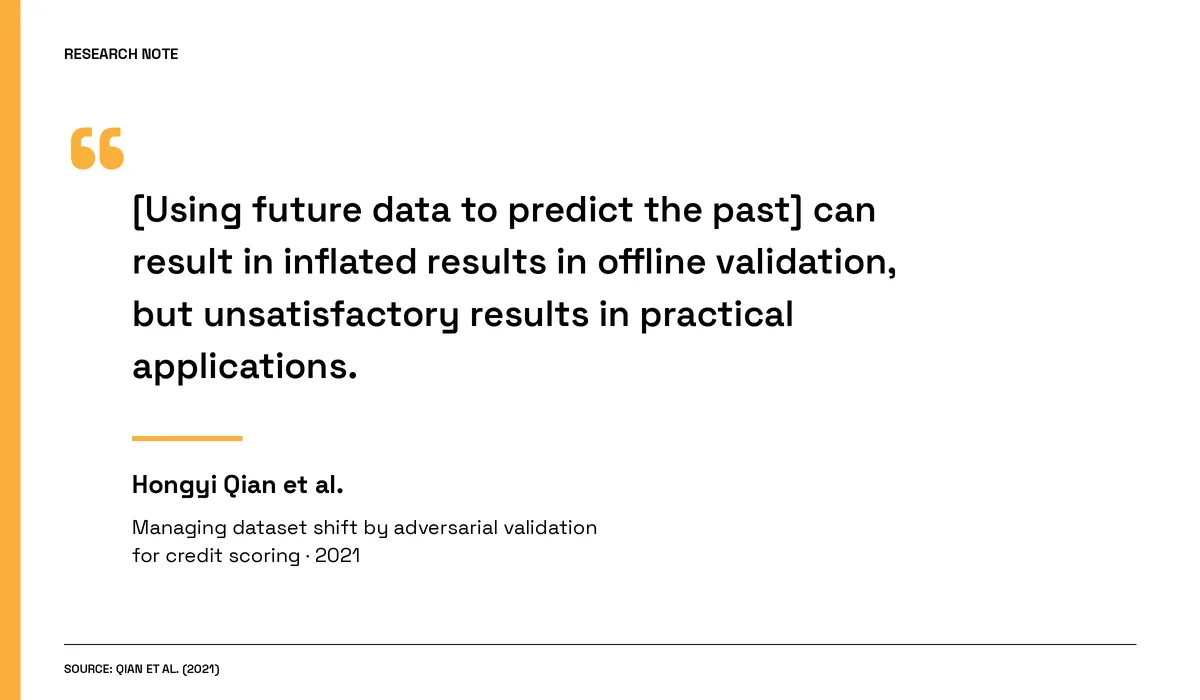
Illustration: Veridion / Quote: Qian et al. (2021)
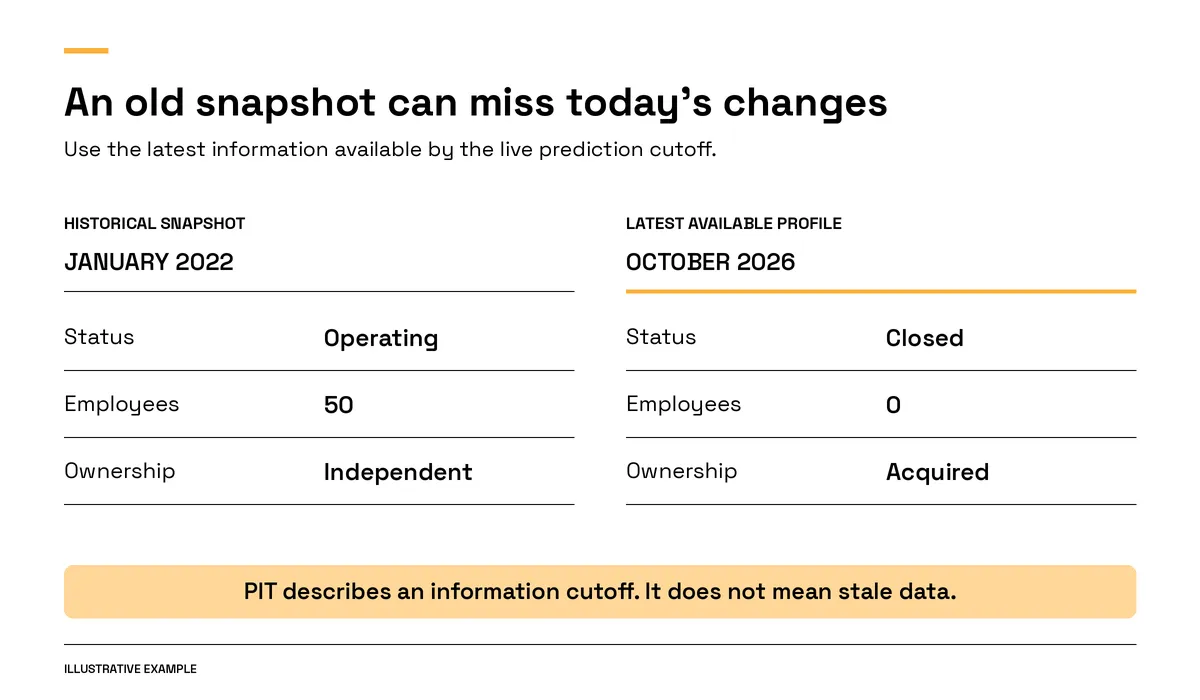
Using an outdated historical snapshot for a live assessment can omit changes recorded since that snapshot, such as a closure or ownership change.
Source: Veridion
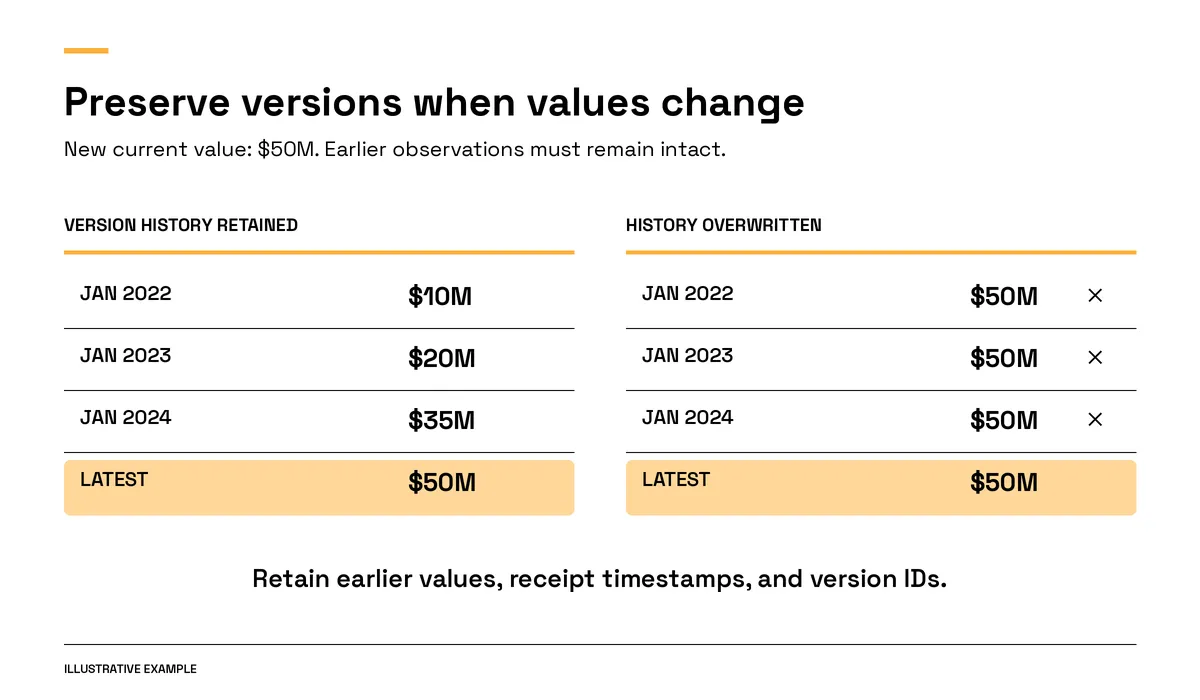
Finally, the third common mistake is using mixed pipelines.
The risk arises when live and historical workflows use ambiguous retrieval rules, reuse stale snapshots, or overwrite versions needed for historical reconstruction. Sharing a storage platform is not itself a problem.
Source: Veridion
A large gap between backtest and production performance can signal a problem.
Changes in borrower populations or economic conditions can also explain the gap, so investigate before attributing it to the inputs.
To investigate, take a sample of historical lending decisions and check whether the company attributes used in testing were actually available on the original decision dates.
How to Check Which Data Your Model Uses
To check whether your model uses current or point-in-time company data, look at the records it pulls and the dates attached to them, if you have them.
Current datasets typically contain one active profile per company, showing its latest available attributes.
PIT datasets, meanwhile, should retain historical versions of those attributes and the dates needed to reconstruct what was known at a particular point in the past.
For example, you might find fields such as:
- valid_from
- valid_to
- recorded_at
Read each timestamp’s definition. Validity dates alone do not establish historical availability; version history must also show when each value or correction entered the pipeline.
Use clearly defined current and historical views, whether implemented as separate tables or as views over versioned data.
For example, you could use:
- company_current for the latest company profiles
- company_history for previous versions and their associated dates
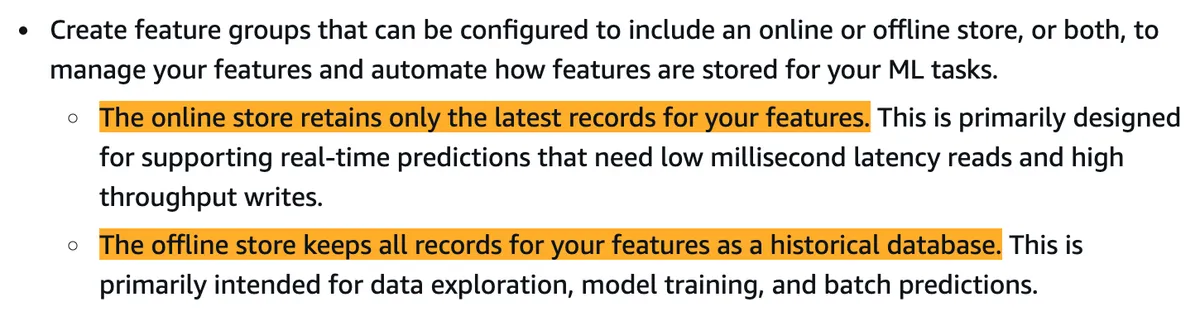
Amazon SageMaker Feature Store offers a related storage pattern: its online store retains the latest records by event time, while its offline store retains historical records. This separation alone does not guarantee point-in-time correctness. Historical retrieval must still respect the timestamp that represents availability to the model.
Source: Amazon Web Services
Your data engineering team should be responsible for maintaining these tables and documenting their contents, while credit model owners should confirm which dataset each model needs.
Here's a quick checklist you can use to review an existing model:
- Are the company-data tables clearly labeled as current or historical?
- Do you know what the timestamps in each table represent?
- Are previous values retained when company attributes change?
- Can historical tests retrieve information available on the original decision date?
- Do live assessments receive updated company information?
If you can't answer one of these questions, it's worth reviewing the relevant data pipeline before relying on the model's results.
What to Ask a Company Data Provider About History
Before integrating a provider’s company data into your credit models, check what the provider documents about its timestamps, updates, and historical records.
Veridion’s Match & Enrich documentation defines the following record and matching metadata. Its methodology separately describes attribute-level source trails:
Metadata | What it shows |
|---|---|
created_at | When the company profile was first added to Veridion’s database. |
last_updated_at | When company information was last extracted and checked for updates. |
match_details.confidence_score | Confidence that the returned company matches the supplied input. |
These details help assess record freshness and entity matching. Match confidence is not a credit score or a measure of every enriched attribute’s accuracy.
However, they won't necessarily tell you when the data first entered your own systems or whether previous values were preserved for point-in-time analysis.
That's why you should carefully assess how any company data provider, including Veridion, delivers its data, whether it retains historical profiles, and, if so, for how long.
Here are a few key questions to ask third-party data providers:
Does each value have a source and date?
Check whether the date refers to publication, collection, or an update.
How often does each attribute refresh?
Ask for field-level schedules, including company status, employee count, and business activities.
Are previous values retained?
Check whether updates preserve earlier versions or overwrite them.
Can you retrieve a historical profile?
Confirm that it reflects what was known on the requested date and ask how far back the history extends.
Test both an ordinary change and a late-reported correction. Check whether an earlier as-of query excludes information first made available after that cutoff.
Check whether the returned values differ as expected and whether you can trace the changes to their original sources.
On the other hand, if historical profiles aren't available, consider storing dated copies of the company data you receive going forward. Just remember that saving profiles today won't recreate information you never collected in the past.
Conclusion
Current company data is primarily used for live borrower assessments, while PIT company data supports historical model development, validation, and backtesting.
Using stale snapshots for live assessments, later information in historical inputs, or overwriting earlier versions can produce unreliable decisions and misleading test results.
Before using either dataset, make sure you understand what its timestamps and other metadata represent, how often it updates, and whether previous values are retained.
Start by checking one of your existing credit models to see whether its company data matches the dates of the decisions it's meant to support.
Articles
Discuss how these trends affect your organization.
Our analysts are available for a short call. Bring a specific question and we will ground it in the data.
Insights
Keep reading
More analysis, research, and outcomes grounded in live company intelligence.
How to Choose a Third-Party Risk Data Provider (Without Getting Burned)
Tired of unexpected vendor issues? Learn how to identify emerging market risks and choose a third-party risk data provider that keeps you safe.
5 Types of Market Intelligence You Need to Know About
Explore five different types of market intelligence that can shape your competitive edge. Find out which ones your team should prioritize.
How Successful Companies Use Market Intelligence for Business Growth
Discover how successful companies use market intelligence to unlock new growth opportunities. Learn more in our latest guide.