Insights / Articles
Financial Proxies vs. Observed Company Facts in Private Company Credit Risk
The same €20 million revenue can be audited accounts or a headcount estimate. Label three evidence types in your private company credit risk data.

- Reported revenue and estimated revenue require different validation tests.
- A revenue estimate looks like reported revenue once a transfer drops its label.
- Revenue estimated from headcount can double-count a separate headcount input.
- Veridion labels modeled financial values to distinguish estimates from published figures.
In private company credit risk, a €20 million revenue figure could come from company accounts or a headcount-based estimate. Its label should identify the source so you know whether to examine the disclosure or test the estimation method.
Observed non-financial facts need validation too. For an operating location, confirm it belongs to the company and remains current.
This article explains how to distinguish these evidence categories and validate each one. It also examines double counting when a proxy depends on information already entering your credit model.
What Separates Reported Facts, Estimated Proxies, and Observed Facts?
Reported financials, estimates and observed company facts appear side by side in datasets. Their format alone tells you little about how they were obtained, so evidence labels help establish what each value supports in private company credit risk.
Reported Financial Facts
Reported financial facts are figures disclosed by a company or recorded in its filings. They include revenue from audited accounts and unaudited management statements.
The reporting period identifies when the company earned the revenue, while audit status shows how much assurance the accounts carry. Last year’s audited revenue covers a completed financial year. This quarter’s unaudited sales figure is more recent but carries less assurance.
A filing on a registry does not mean the accounts were audited. Companies House, for example, checks accounts for basic filing requirements, including the financial year and authentication.
Estimated Financial Proxies
Financial proxies for private companies derive financial measures from other information.
A provider estimating revenue from headcount, for example, applies assumptions about revenue per employee within a sector.
The result is still an estimate, however precise the number looks. Presenting it as reported revenue conceals those assumptions and implies the company disclosed the figure.
Observed Non-Financial Facts
Observed facts concern company characteristics, including operating locations and ownership links. What they establish depends on their source. An “active” registry status confirms the company’s legal status, not that it is still trading. That takes evidence of business activity.
Several operating factories show that a company has a physical footprint, but say little about profitability or cash available for debt payments.
You also need to separate observations from conclusions drawn from them. Verify a factory address against the company’s identity. If a provider infers an industry classification from factory activity, examine the evidence and classification method.
The table summarizes these distinctions and the labels needed to preserve them.
Category | What it is | Example fields | Who stands behind it | Typical failure | How it should be labeled |
|---|---|---|---|---|---|
Reported financial fact | Financial figure disclosed by the company or in a filing | Annual revenue; operating earnings | Reporting company; auditor within the audit’s scope | Wrong period; restatement overlooked; audit assurance assumed | Reported, with period and audit status |
Estimated financial proxy | Financial measure derived from other information | Revenue estimated from headcount | Estimate producer, responsible for its methodology | Estimate presented as disclosure; unsuitable sector assumptions | Estimated or modeled, with method reference |
Observed non-financial fact | Sourced evidence about a company characteristic | Operating location; activity; legal status; ownership link | Original source; provider responsible for matching and attribution | Wrong entity; outdated observation; financial strength inferred from footprint | Observed, with source context and observation date |
Of these columns, the label needs the most attention in practice, since it has to stay with each value as data moves between systems.
Declared Records and Observed Evidence in Practice
Much of Veridion’s data concerns observable company characteristics. Its data methodology documents source trails and confidence scores, and labels financials that private companies don’t disclose as modeled values.
In Catching the Fraud a Clean Registry Check Misses, an Italian credit bureau that supplies business-risk data for SME lending wanted to catch shell companies that pass a clean registry check. Veridion scored 1,007 Italian companies on 14 evidence flags covering their physical, digital, reputational and operational footprint.
One energy retailer had an active registry status, a named director and no court records. Its observed footprint showed a 2022 regulatory fine from Italy’s competition authority, fraud complaints in customer reviews, a dead domain and a registered address shared by 21 to 99 companies.
Each flag traced back to a named source, such as an Italian court, regulator or registry record. The company scored 100 out of 100, while only 36 of the 1,007 companies reached the High or Critical tiers.
The excerpt below contrasts the company’s declared profile with the findings prompting further investigation.
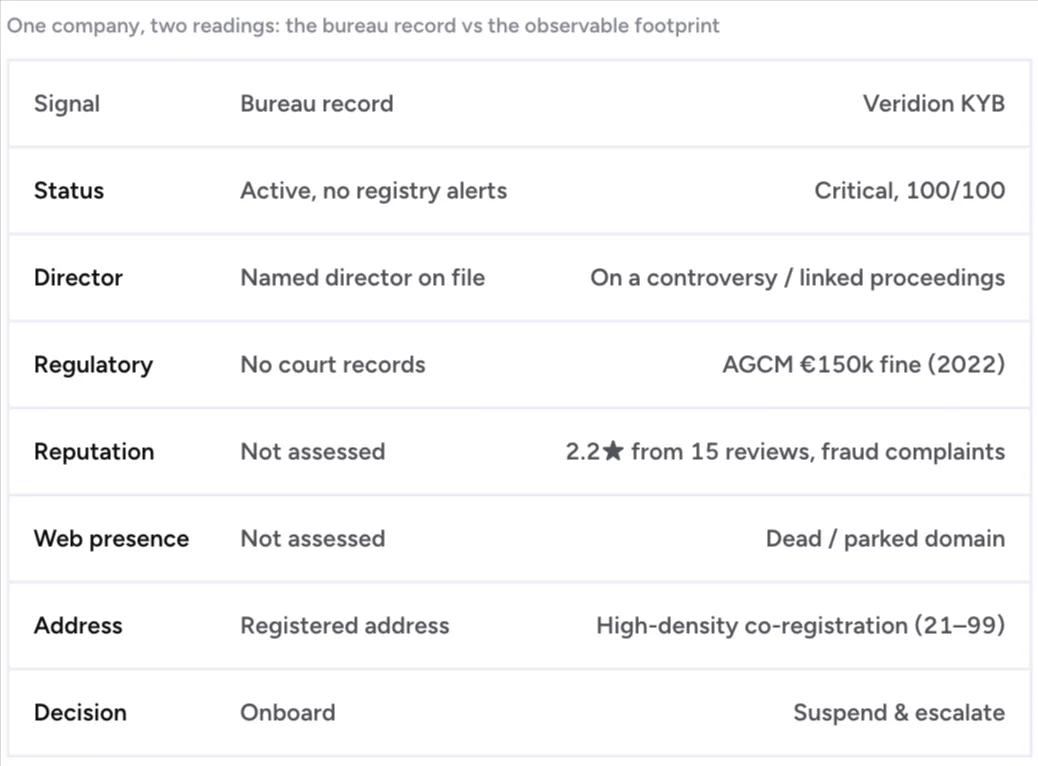
Source: Veridion
The registry records confirmed who the company said it was. The footprint evidence raised questions about how it operated, which justified further investigation but said nothing about its capacity to repay debt.
How Should Each Category Be Labeled?
A revenue estimate needs to remain identifiable as an estimate wherever you send it. Keep its evidence category next to the value in your private company credit risk data, together with the provenance details described in Veridion’s Evidence Confidence checks.
Take the €20 million revenue figure from the introduction. Suppose the API identifies it as estimated, but your warehouse imports the amount without its label. The credit model then receives €20 million with no indication it was estimated.
The flowchart below traces how the value loses its category during this transfer.
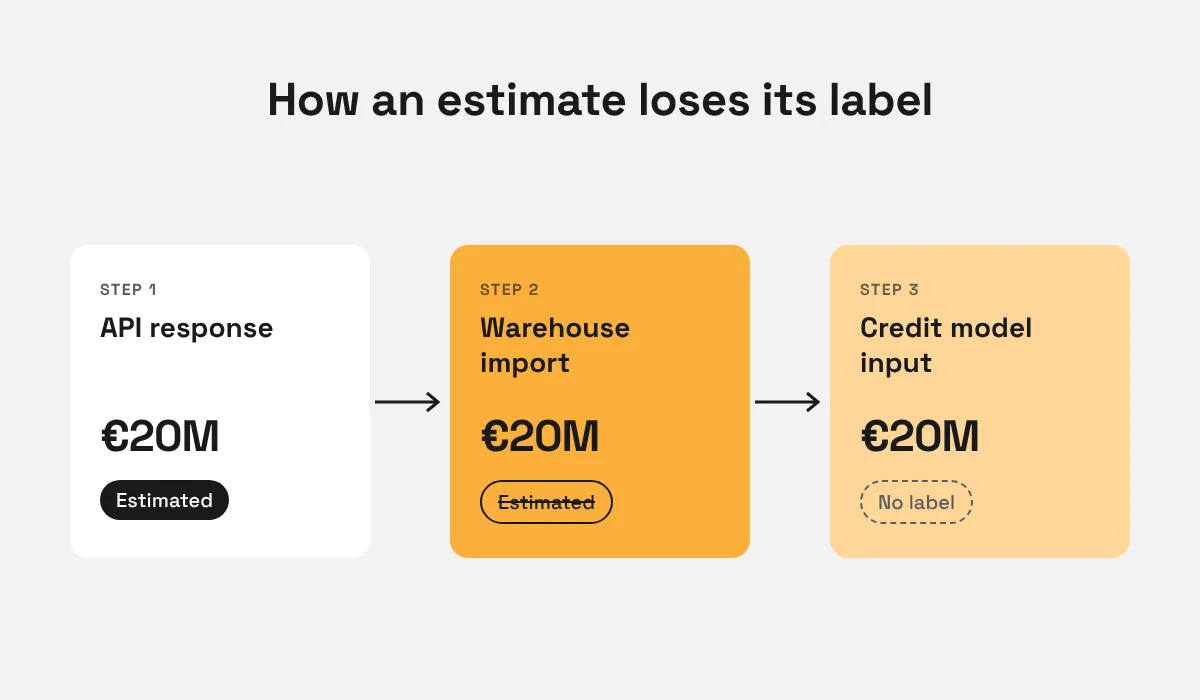
Illustration: Veridion
An analyst looking at the final field has to go back to the original API response to see where the figure came from. The transformation records should show which step removed the label.
Veridion’s API documentation shows how a provider can keep the label attached. Its revenue.type and employee_count.type fields mark each value as “Extracted” or “Modelled”, as in the excerpt below.
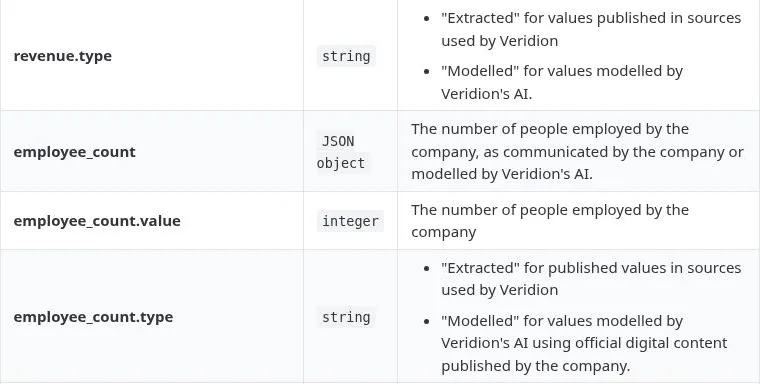
Source: Veridion
“Extracted” means the value was published in a source Veridion consulted. You still need to assess that source, since it may be a company disclosure or another party’s figure, and check audit status for financial figures. “Modelled” means Veridion estimated the value.
Preserve these provider labels alongside your internal evidence categories. A modeled employee count remains an estimate even though headcount is non-financial. Classify the field according to how its value was obtained.
How Should Each Category Be Validated?
After identifying a field’s origin, assess whether it supports the intended credit decision. The right validation depends on the evidence category.
Reported Financial Facts
For reported revenue, examine the underlying accounts to confirm the reporting period and audit status. Check for revisions or restatements affecting the figure.
The dates also need scrutiny. Accounts published in September for a December year-end cover a period ending nine months earlier. Consider what happened during this interval and whether more recent information is needed for the decision.
For historical validation, preserve the information available on the decision date. Replacing the original accounts with a later restatement would introduce evidence the analyst lacked at the time.
Estimated Proxies
Compare revenue estimates with disclosed figures for the corresponding legal entity and reporting period, aligning currency and units.
Measure the size of each error and whether the estimate overstates or understates revenue. Breaking results down by company type and size reveals patterns an overall figure can hide, such as persistent overestimation among small manufacturers. Repeat the analysis on later periods to check whether the results hold.
The flowchart below outlines this process.
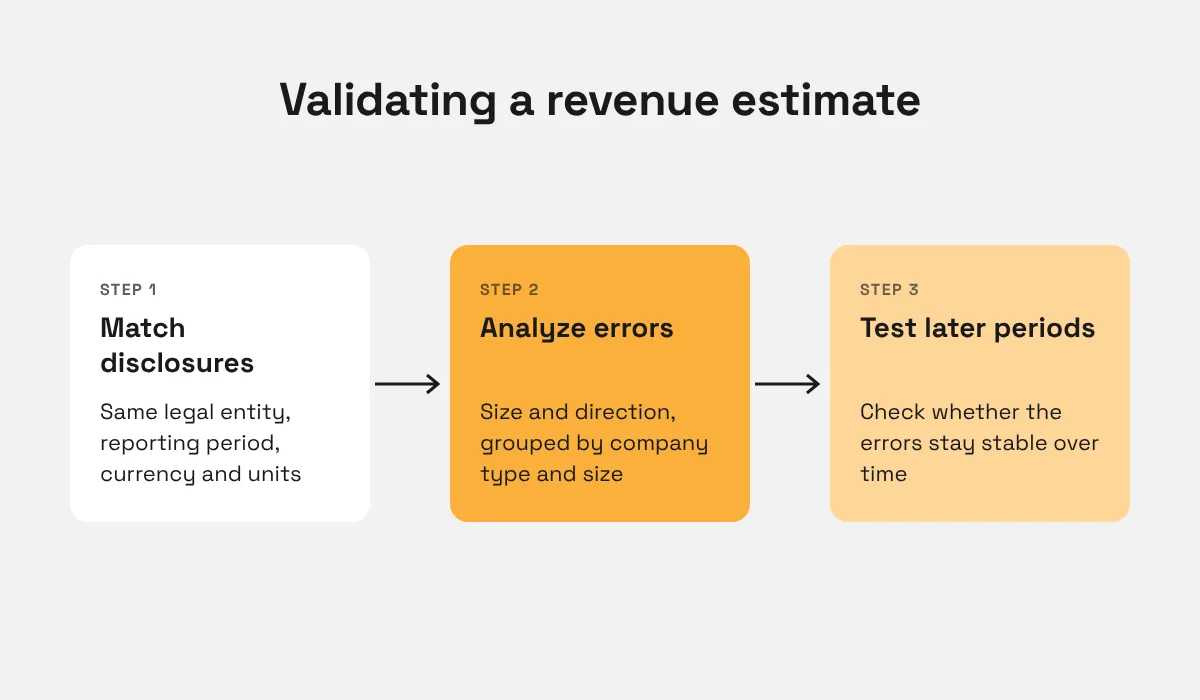
Illustration: Veridion
The comparison sample also limits what these tests establish. Results from large firms publishing accounts say little about how the estimate performs on small borrowers that disclose little.
The EBA’s 2021 discussion paper on machine learning for IRB models recommends particular care in assessing whether external data represents the portfolio a model is applied to. It is a non-binding paper on banks’ models, so it informs proxy validation rather than setting rules for it.
Observed Facts
For an observed location, first establish its connection to the borrower. A parent company’s factory address does not establish where its subsidiary operates.
Review accepted matches and rejected candidate links against verified identities to assess how well the matching process identifies the correct company. Precision measures how many accepted links are correct, while recall measures how many true links the process found.
A high match rate alone leaves these questions unanswered, as the Office for National Statistics explains in its data linkage and matching policy. The excerpt below reinforces this distinction.
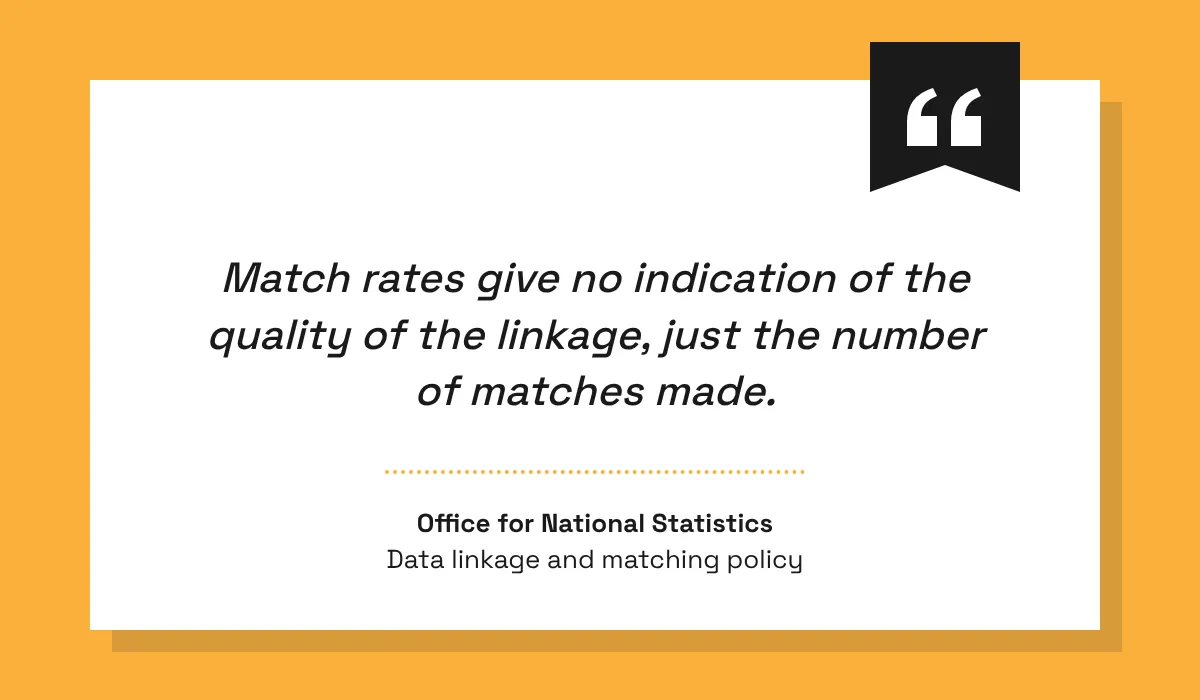
Illustration: Veridion / Quote: Office for National Statistics
An accurate match still needs a current observation and supporting sources. Check the observation date and trace source origins. Several websites repeating one announcement count as one source.
Record unresolved conflicts so analysts see where the evidence remains uncertain.
Independent Validation and Regulatory Scope
Validation should involve someone independent of data or model development, with the expertise to challenge whether the inputs suit the model’s purpose. Vendor claims need this scrutiny too.
US banking guidance SR 26-2, issued in April 2026, covers effective challenge and vendor-product validation. The April 2026 version of PRA SS1/23 addresses input representativeness and independent validation.
These references concern banking supervision. BCBS 239, also a banking standard, sets accuracy and integrity principles for risk data at systemically important banks. Credit rating agencies are outside its direct scope. For an agency adopting comparable controls, its own governance policies define how they apply.
How to Use All Three Without Counting the Same Evidence Twice
The model owner decides how much influence each input receives, subject to validation and approval. The data layer supports these decisions by preserving evidence categories and recording each value’s origin. A label identifies an estimate, while the model’s implementation determines its influence on the assessment.
Preserve Evidence Categories as Inputs
When your system substitutes an estimate for missing reported revenue during data enrichment, record the substitution alongside the value. This lets the validation team compare performance across companies with disclosed revenue and those assessed using estimates.
Keep these records through training, testing and deployment. Otherwise, a single revenue column obscures whether performance differences relate to the borrower or the estimation method.
Assess Proxy Uncertainty
Validation results help the model owner decide how to incorporate a proxy. An estimate with large errors might still indicate company size well enough, if testing confirms it.
Another option is sensitivity analysis, varying the estimate within the error range found in validation and observing the effect on model output.
The model owner evaluates these options against the intended credit decision. There is no universal weight or acceptable error range, so the analysis has to show whether the proposed use is defensible.
Trace Shared Inputs and Test for Double Counting
Consider a private manufacturer with an observed employee count of 200. A provider estimates its annual revenue from headcount and sector information.
Your credit model uses both this estimate and the employee count.
Headcount now contributes through two routes. If both inputs influence the assessment of company size, the same observation can end up carrying too much weight. The diagram below traces those routes.
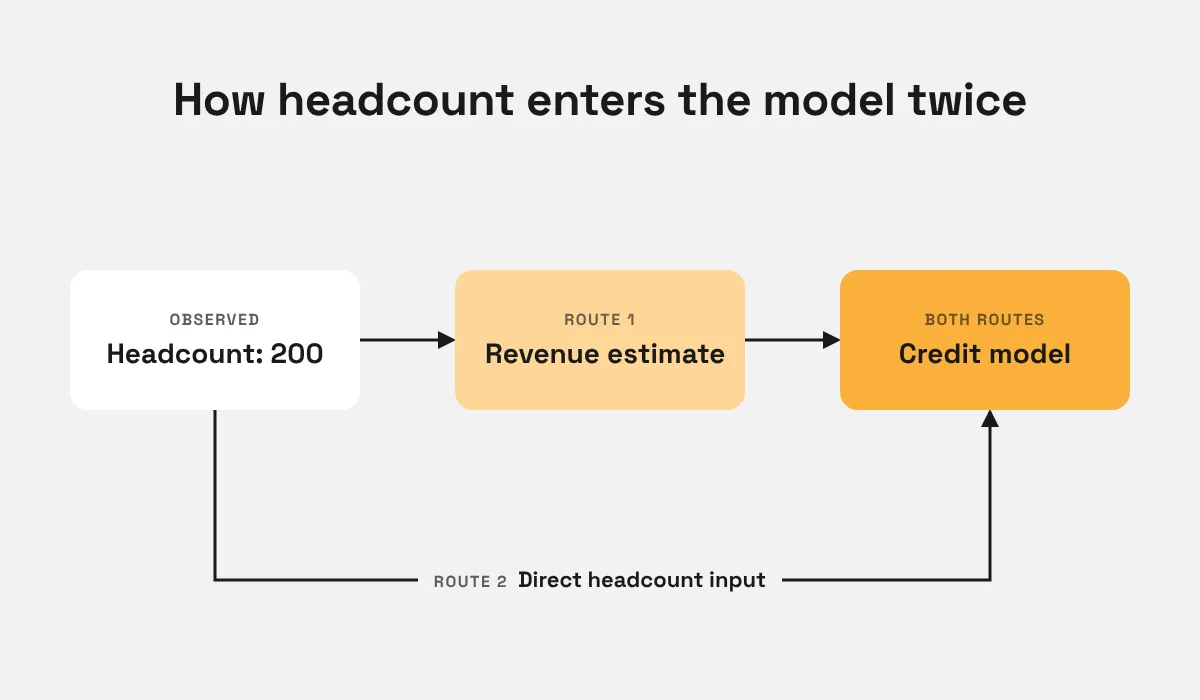
Illustration: Veridion
The question is whether the estimate adds predictive information beyond headcount. The proxy’s documented inputs help identify the overlap, but correlation alone establishes little about its effect on predictions.
To investigate, compare the model versions below. Refit each on equivalent training data, then evaluate performance on consistent held-out samples and subsequent periods. Examine results within relevant company groups, as an aggregate result might conceal differences between them.
Model version | Inputs retained | Predictive performance | Effect of varying input values |
|---|---|---|---|
Both inputs | Headcount and estimated revenue | To be tested | To be tested |
Direct headcount input removed | Estimated revenue | To be tested | To be tested |
Revenue estimate removed | Headcount | To be tested | To be tested |
Headcount still contributes through estimated revenue when its direct input is removed.
Individual feature-importance tests might obscure this dependence. Scikit-learn’s documentation shows that permuting one input barely affects performance when the model can get the same information from a correlated input. That small effect can make the permuted input look less important than it is, so test linked inputs together.
The choice of tests depends on the model’s design and access to derivation details. If the vendor withholds those details, document the missing information and include this limitation in the proposed use submitted for approval.
Document Approval and Review
The model owner records the proposed use and its rationale. Independent validation examines the evidence and tests. The designated authority draws on these findings to approve or reject the proposal.
Record the decision and validation status in the model inventory, with known limitations and shared source dependencies. PRA SS1/23 discusses these dependencies and proxy documentation.
At scheduled reviews, assess whether the evidence still supports the approved use. Review earlier if the data or estimation methods change significantly or performance declines. For vendor products, SR 26-2 covers vendor oversight and shared dependencies.
Conclusion
Proxies and observed facts each have a role in credit assessment, provided their labels preserve the distinction between reported, estimated and observed evidence. Without this distinction, the validation team has to reconstruct each value’s origin.
To check your own records, take the input list of one private company model and tag each field by category. Include non-financial estimates such as modeled headcount. Then confirm the tags are stored with their values and flag any estimate presented as a reported figure.
Articles
Discuss how these trends affect your organization.
Our analysts are available for a short call. Bring a specific question and we will ground it in the data.
Insights
Keep reading
More analysis, research, and outcomes grounded in live company intelligence.
6 Issuer Data Quality Checks Before a Case Reaches the Rating Committee
Tired of rating committee delays? Ensure top-notch issuer data quality with 6 essential checks. Avoid costly errors and streamline your process.
Best Practices for Data Enrichment
Learn how data enrichment best practices help businesses turn raw data into accurate and actionable insights.
Best Practices for Leveraging Market Intelligence
Not sure how to apply market intelligence effectively? Learn which practices top businesses rely on and how you can too.