Insights / Articles
Private Equity Deal Sourcing Platforms: Database, CRM or Live Data Layer?
Most PE firms own several sourcing tools, yet work lands in spreadsheets. See which of eight jobs your private equity deal sourcing platform or CRM covers.

- Map manual sourcing work before adding tools.
- Test database coverage and field-level freshness.
- CRMs manage relationships and pipeline; discovery features vary.
- Veridion adds company intelligence to your existing CRM.
A private equity deal sourcing platform can serve as a searchable company database, a relationship and pipeline CRM, or a live company data layer. You may need several because each handles different sourcing jobs.
Veridion supplies the underlying company-intelligence layer alongside your existing CRM, rather than replacing it.
This guide compares the three categories by sourcing job to help you identify gaps in your current stack.
What Jobs Does a Private Equity Deal Sourcing Platform Need to Do?
Before choosing the right platform, figure out what work needs to be done and who does it now. Otherwise, you will end up buying yet another search platform as associates keep reconciling company information and manually recreating pipeline reports.
Start with these eight jobs:
- Discover candidates that fit the thesis
- Keep one record per company
- Classify companies against the thesis
- Enrich profiles
- Rank against the thesis
- Manage relationships and outreach
- Track pipeline and report
- Keep data current
These jobs involve different information. A company's business activities help you assess thesis fit. A partner's notes from a conversation with the target company's founder tell your team what was discussed and when to follow up. Neither replaces the other.
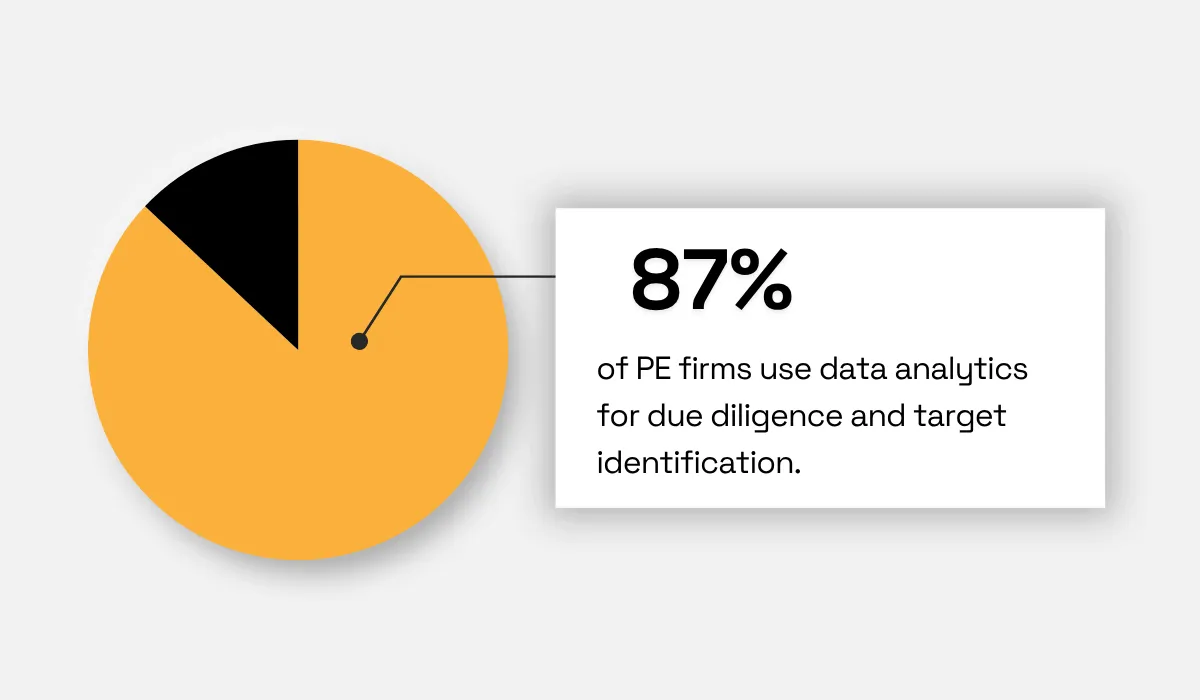
The distinction is critical as sourcing grows more analytical. In PwC’s Private Equity Trend Report 2024, 87% of respondents reported using data analytics to identify prospective deal targets. The survey covered 250 PE principals at European funds with at least €250 million in assets under management.
This was the adoption rate, not the quality of the underlying records.
Assign a person and a system to each job, including work done in spreadsheets or through manual searches. If two platforms handle the same job, identify which holds the master record and how updates reach the other.
Use this workflow map to assess deal sourcing software.
What Is a Deal Sourcing Database Best Suited For?
Treat a deal sourcing database as a searchable collection of company records. Its central purpose is to help you turn investment criteria into a candidate list.
An associate can use size, industry, geography, and available financial data to build an initial candidate list. The list’s completeness depends on the database’s coverage, classifications, and available fields.
Private-company coverage deserves close examination. Apollo’s November 2024 analysis found that private companies accounted for 86% of US companies and 96% of European companies with last-12-month revenue above $100 million, measured by company count.
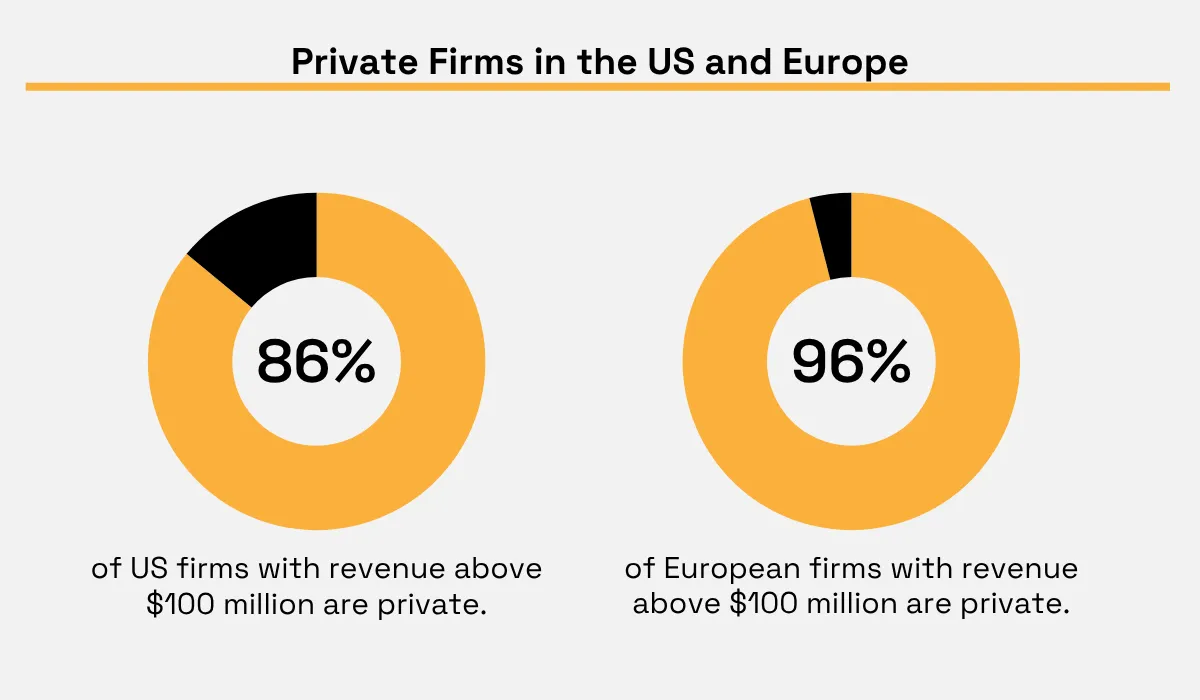
Illustration: Veridion / Data: Apollo Academy
Publicly available information on private companies varies by jurisdiction and company type, so assess how the provider sources, verifies, and refreshes each record.
That's why you should treat the limits as design questions, not assumptions about every product:
How often do records refresh?
Ask how often each field is checked and updated. A single dataset-level date cannot show whether every attribute is current.
How well are private and niche companies covered?
Test a familiar subsector for missing companies. Check whether classifications capture niche business activities beyond broad industry codes.
How are duplicates and ownership handled?
Check that duplicate records are resolved and distinct parents and subsidiaries stay linked. Define whether your target is a legal entity, operating business, or corporate group.
What happens after export?
Check whether exported lists can receive updates and sync with your CRM. A static spreadsheet needs a separate refresh process.
Then score the database against the eight jobs instead of its headline record count. A large database typically does discovery, classification, and enrichment. Check whether the product also includes pipeline and relationship tools, and whether its integrations match and update records in your internal systems.
A fast export is useful only if the list remains usable and current in your downstream systems.
What Is a PE CRM Best Suited For?
A private equity (PE) CRM is a system of record for relationships, communications, and deal pipeline. Its value comes from preserving what your team knows and making that knowledge available to the right colleagues.
A general sales CRM is commonly configured around leads, opportunities, and revenue. A PE-focused CRM adapts the data model and workflows to investment opportunities and the relationships around them.
A PE CRM has to model companies, founders, bankers, co-investors, and portfolio executives, and link them across deals that may run for years.
It can track opportunities through investment-committee review, consolidate captured emails and meeting notes, and show authorized colleagues the latest recorded interactions with a founder.
Deal management software usually adds workflow on top, such as stage checklists, document handling, and investment committee reporting.
A CRM's company data has to come from somewhere: manual entry, email and calendar capture, or a third-party feed. CRM records need ongoing maintenance regardless of how they are populated.
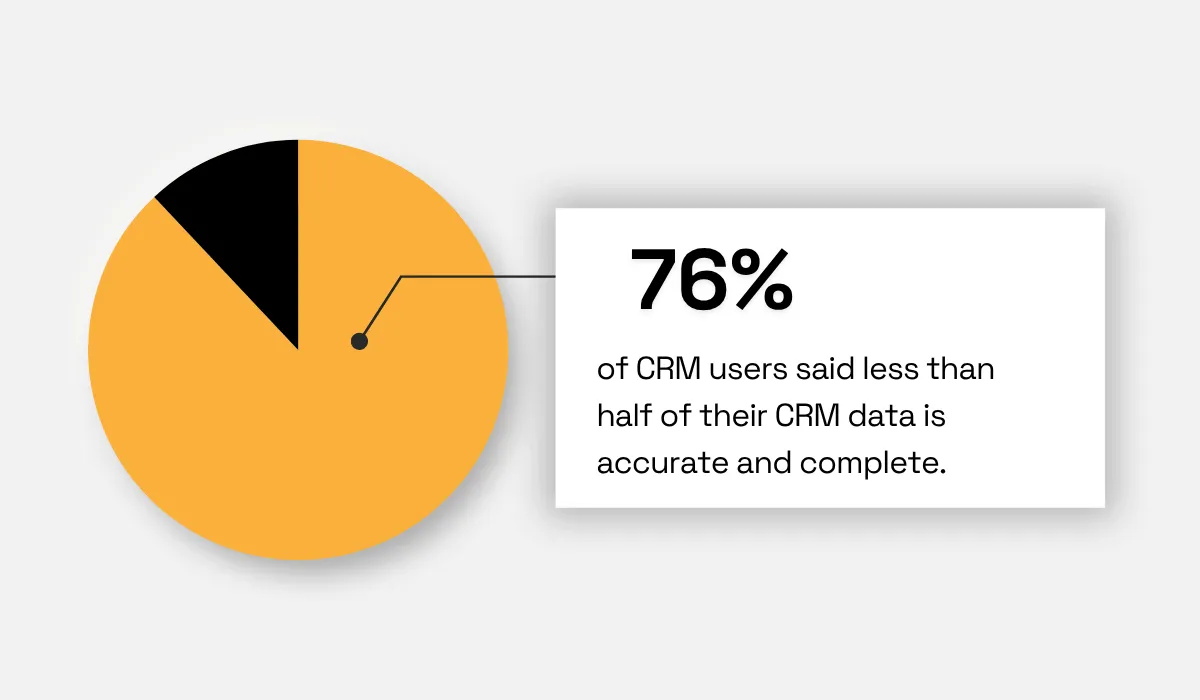
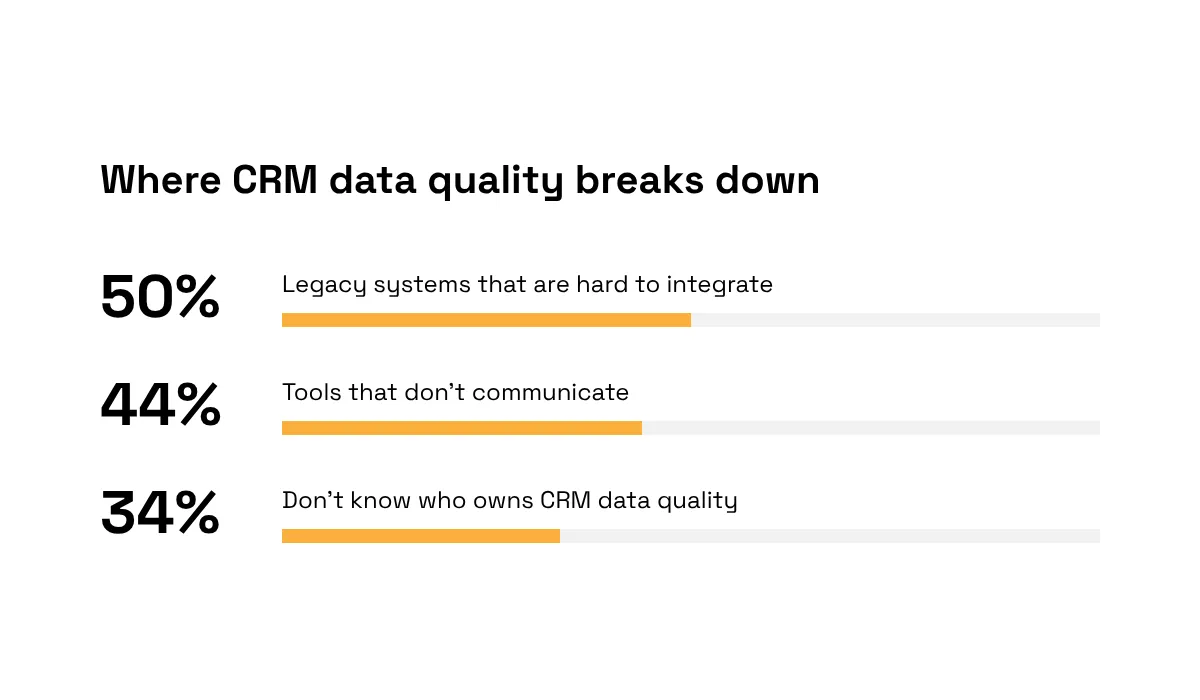
Validity’s State of CRM Data Management in 2025 surveyed 602 CRM users and administrators in the US, UK, and Australia. Of those respondents, 76% said less than half of their organization’s CRM data was accurate and complete.
This was a cross-industry, self-reported finding.
Check whether the CRM can discover companies beyond existing records through built-in sourcing tools or connected datasets.
A CRM can combine information your team enters, activity captured from email and calendars, and external enrichment. Relationship intelligence uses that activity to help identify existing connections and assess interaction history.
Company enrichment provides additional inputs, such as a revised company description or employee count.
Where does your CRM obtain company intelligence, and can that source identify businesses outside your existing records?
For reporting purposes, test whether your team can produce a consistent investment-committee view of stages, owners, next actions, and sourcing history.
Check how company data, pipeline stages, and ownership fields stay consistent across the CRM and your investment and reporting systems.
What Is a Live Company Data Layer for Deal Sourcing?
A company data layer delivers structured company information through APIs or bulk feeds. Depending on the service, it supports discovery, entity matching, classification, enrichment, and refreshes for connected applications.
Its responsibilities differ from a CRM's.
The data layer helps establish which company a record represents and what that business currently does. Your CRM preserves who spoke with its founder, what the team learned, and where the opportunity sits.
Test whether the layer can discover companies beyond your existing list, classify them against your thesis, enrich their profiles, and keep those attributes current.
Test ranking separately because it relies on criteria you define based on the data provided.
Define ‘live’ in operational terms: the provider’s refresh cadence, the timestamps available for records or attributes, and the delivery schedule to your systems. Veridion’s last updated at records when company information was last extracted and checked for updates.
Veridion for private equity provides the underlying company intelligence layer using APIs and batch ingestion. Veridion offers company search, matching, classification, enrichment, corporate relationships, and attribute refreshes.
Source: Veridion
The platform covers 744.5M companies in 250 countries, with 465 attributes per company. You can add company intelligence to your sourcing workflow while retaining your CRM for relationship history and pipeline management. Matching and field-level update rules determine how the two stay aligned.
The integration becomes clearer in practice.
A financial-intelligence platform extended its private-company coverage with Veridion. Its institutional clients, including asset managers, hedge funds, and sell-side researchers, were moving deeper into private equity and private credit.
The platform's existing pipelines ran on disclosure-based feeds, which were deep on listed companies and thin on private operating businesses.
The team weighed building its own private-company pipeline against licensing one. It chose to license Veridion's company knowledge graph as the data layer underneath its private-markets products.
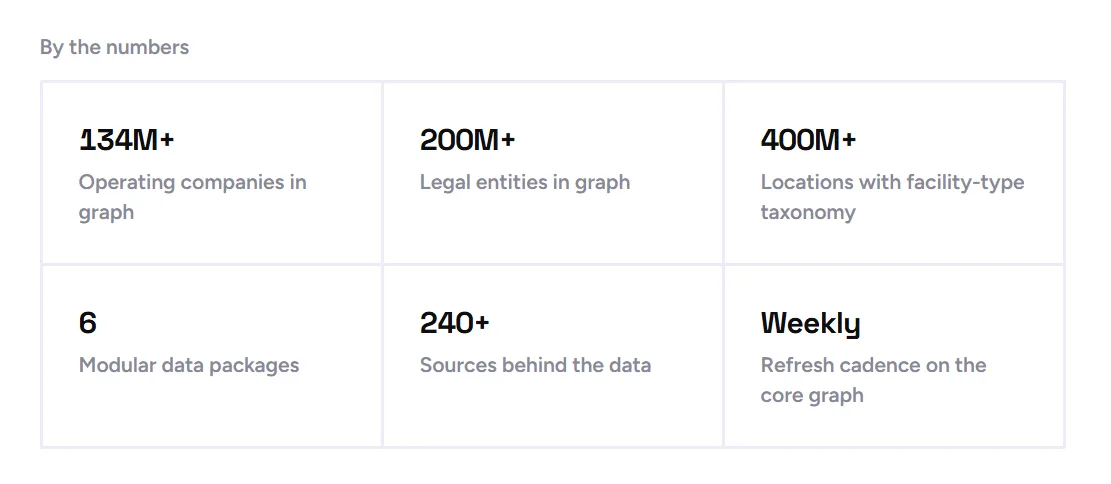
Source: Veridion
Records are received in batches via Veridion's Match & Enrich layer. Match & Enrich maps Veridion’s entity keys to the platform’s existing identifiers, allowing the customer to retain its own identifier system.
The content team selects relevant data packages, including firmographics, operational indicators, locations, and ESG, and joins them to its existing company records. According to Veridion, production has run continuously since 2023, with the private-company expansion adding scope to the original production license.
This customer is a financial intelligence platform, not a PE firm. For acquisition-target workflows, the relevant principle is identifier continuity: external intelligence can enrich records while preserving existing IDs.
How Do the Three Categories Compare Across Sourcing Jobs?
Each category covers a different set of jobs.
The table below describes typical architectures, not guaranteed features, because databases can add workflow tools and CRMs can embed external company intelligence.
Sourcing job | Deal sourcing database | PE CRM | Live data layer |
|---|---|---|---|
Discover candidates that fit the thesis | Filters and keyword search | Existing records; optional built-in or connected discovery | Company universe for connected apps |
Keep one record per company | Provider IDs; check export matching | Internal IDs and duplicate controls | Entity resolution and ID mapping |
Classify companies against the thesis | Categories, tags, and activity search | Thesis tags and imported classifications | Classifications and activity data for your rules |
Enrich profiles | Profiles to view or export | Team input plus external enrichment | Structured attributes via APIs or files |
Rank against the thesis | Filters, sorting, and relevance scores | Custom scores and team priorities | Inputs for your scoring rules |
Manage relationships and outreach | Limited tracking or CRM integration | Conversation history, owners, and follow-ups | No conversation or outreach management |
Track pipeline and report | Lists and optional pipeline tools | Stages, next actions, and reports | Reporting inputs, not stage management |
Keep data current | Provider refreshes; exports need sync | Activity capture and connected company updates | Provider refreshes; downstream delivery needs integration |
The database supports research, the CRM preserves relationship and pipeline context, and the data layer supplies reusable company information.
Gaps appear when a target record moves between systems without its identifier or a way to receive updates.
Deloitte’s 2026 GenAI in M&A Pulse Survey identified integration with approved deal data sources as the most important capability of an M&A technology solution. The survey covered 500 US-based PE, portfolio-company, and corporate M&A leaders.
Veridion serves as the company data layer. Your CRM remains the system of record for relationships and pipeline.
How Should You Choose or Combine the Three?
Choose tools based on gaps in your current stack, rather than assuming one category should replace the others. Adding a data layer should address a company-intelligence problem, not force a CRM migration.
Evaluate how data moves between your existing tools and who is responsible for maintaining its quality.
When choosing a category, begin with four questions:
Which jobs are still manual?
Map spreadsheet work and repeated searches to the eight sourcing jobs. Use the gaps to prioritize software needs.
Where does data go stale?
Check exported lists and CRM fields against the refresh schedule each attribute needs.
Where do duplicate or ownership errors enter?
Review imports and automatically created records. Check for duplicate entities and double-counted corporate groups.
What needs to move between systems?
Define which records and fields must flow where, then choose an API, bulk transfer, or native sync.
Then consider the combinations.
A database plus CRM makes sense when your team needs an analyst-friendly research interface and a shared relationship record. Before adding anything else, test the existing connection. It may already support the enrichment and updates you need.
A CRM plus data layer makes sense when relationship management works fine, but company discovery or profiling requires more intelligence. This also applies to teams building a sourcing view inside an internal tool or warehouse. Before proceeding, make sure someone will own integration maintenance.
All three can make sense when analysts need database research tools, but the data team also needs company profiles across several systems. Be clear about their roles. Otherwise, you'll pay for redundant intelligence without clarifying which source owns which field.
The connection needs rules, too.
First, try to match the incoming record to the existing CRM record before automatically creating new records. Save the CRM record ID alongside the external company record ID, and handle ambiguous cases separately. Don't assume that two subsidiaries with the same website are actually duplicates.
Second, set write-back permissions per field. Allow external enrichment to update approved company fields, such as employee count or business description. Protect relationship owners, deal stages, and conversation notes from unintended overwrites.
Third, designate ownership. The operations lead can define fields and manage exceptions, while data or IT maintains the integration. The deal team checks whether the resulting records support sourcing decisions.
Veridion's data enrichment best practices provide more guidance on how to establish that governance.
Finally, test how existing acquisition-target records move between systems. Review a manually validated sample of matches and track false matches, duplicate creation, missing fields, and successful updates. See whether your initial thesis rationale and relationship history are still present after the next refresh.
Conclusion
Databases, CRMs, and data layers all play different roles. The database may provide discovery, the CRM may retain relationships and pipeline, and the live data layer provides company intelligence in both cases.
Identify which sourcing jobs your current tools leave unfinished.
This week, take one existing acquisition-target list and map the eight jobs against your current tools. Assign an owner to every gap, then trace one company from discovery through its next CRM update.
Articles
Discuss how these trends affect your organization.
Our analysts are available for a short call. Bring a specific question and we will ground it in the data.
Insights
Keep reading
More analysis, research, and outcomes grounded in live company intelligence.
Best Practices for Data Enrichment
Learn how data enrichment best practices help businesses turn raw data into accurate and actionable insights.
Why Legacy SIC and NACE Rev. 2 Codes Miss Modern Niche B2B Companies
Struggling with niche industrial product sourcing? Legacy industry codes fail modern B2B companies. Find out why and how to adapt.
How Is AI Revolutionizing Market Intelligence?
Explore the key ways AI is transforming market intelligence workflows and helping businesses stay ahead of the competition.