Insights / Articles
No Humans in the Loop: How AI-Powered Entity Resolution Automates B2B Data Matching
Tired of manual B2B data matching? See how AI-powered entity resolution drives decision automation, eliminating human error and boosting efficiency.

- Rule-based matching fails when enterprise company names differ.
- Combining web data with legal filings fixes data mismatches.
- Golden records improve enterprise data quality.
- Automated matching reduces manual review.
How many versions of the same company are hiding in your enterprise data?
Say one system lists the legal entity. Another uses a trading name. And a third contains an old brand or spelling variation.
At enterprise scale, finding and merging those records manually becomes impossible. And simple matching rules only get you so far.
That’s where AI-powered entity resolution comes in.
Below, we’ll explore how it automates complex B2B data matching and achieves high accuracy at scale. Read on to learn how your teams can build a single, reliable view of every company.
Where Manual and Rule-Based Matching Falls Apart
At first glance, company matching might look like a string comparison problem.
If two records say “Acme Ltd,” you match them. If one says “Acme Limited,” you add a fuzzy matching rule. Problem solved, right?
Except real B2B data doesn’t always behave that neatly.
A single company can appear under its legal name in a corporate registry, a shortened brand name on its website, and a local subsidiary name in your procurement system.
Below are six of the most common reasons for B2B entity mismatches:
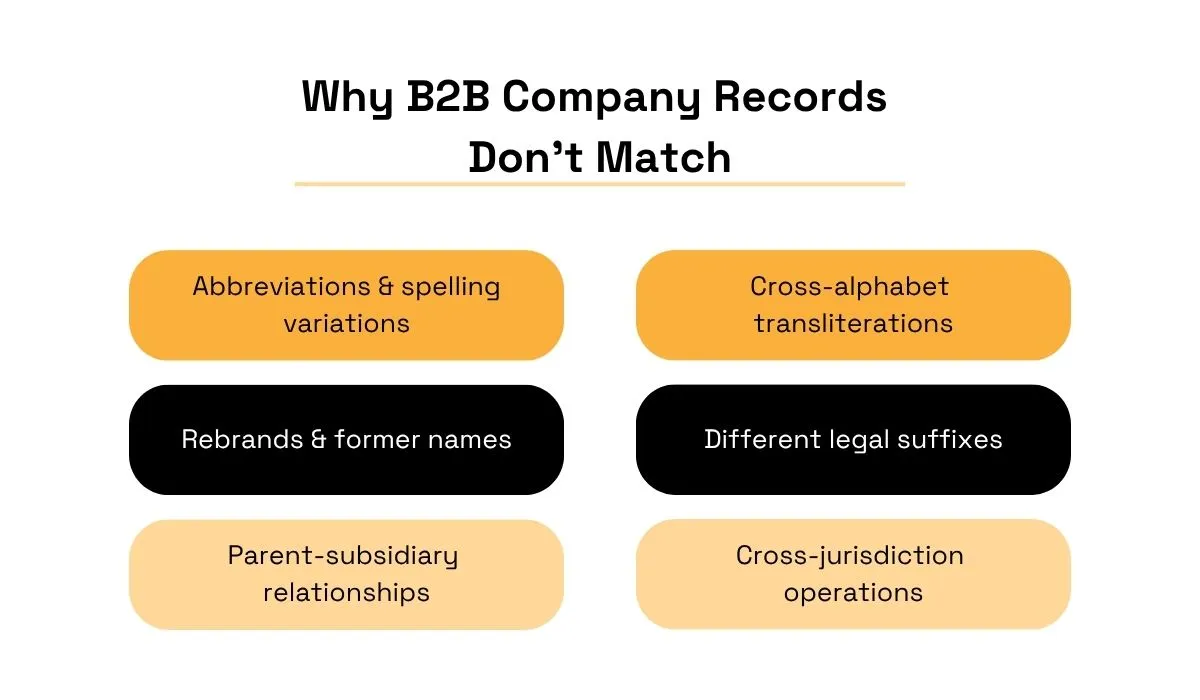
Source: Veridion
The same company can therefore look like several different businesses. Meanwhile, two genuinely separate companies can look almost identical.
This is where exact matching breaks down.
A rule such as company_name = company_name has high precision when records are standardized. However, it misses legitimate matches as soon as the strings differ.
Basic fuzzy matching casts a wider net by measuring how similar two strings are. But similarity is not the same thing as identity.
Imagine two records: “ABC Logistics Ltd” and “ABC Logistics LLC.”
A fuzzy matcher may confidently connect them because their names are almost identical. But they could be separate businesses operating in entirely different countries.
Now consider “Meta Platforms, Inc.” and “Facebook.”
Of course, the strings are completely different. But depending on the date and context of the records, they may refer to the same corporate organization following Facebook’s 2021 rebrand.

Source: Meta
And this is the main problem with rule-based matching. Basically, the rules only see the fields you tell them to compare.
Real companies, however, exist in context. What exactly does that mean, though?
A company’s identity is reflected in:
- Addresses
- Websites
- Products
- Directors
- Subsidiaries
- Corporate filings
- Social profiles
- Locations
- Relationships with other organizations.
Modern entity resolution uses that broader context to answer a more useful question. We'll look at how it works in the next section.
Simply put, instead of: “Do these two company names look alike?”
It asks: “Based on all the available evidence, are these records describing the same real-world business?”
At enterprise scale, this distinction is huge.
When you’re integrating millions of records, even a tiny error rate can produce thousands of incorrect matches or missed connections. And manual review just can’t expand enough to absorb the difference.
The matching process itself has to become more intelligent.
Inside the Entity Resolution Engine
Entity resolution is the process of determining whether multiple records refer to the same real-world entity.
With an emphasis on the word “entity.”
So instead of treating each row in a database as an isolated string, an entity resolution engine builds a broader picture of the company behind that row.
So instead of relying on a single identifier, an entity resolution engine compares multiple views of the same company. The more those views align, the more confidently it can determine whether two records refer to the same underlying entity.
This is exactly why modern entity resolution relies increasingly on multiple views of the same organization.
Veridion, for example, uses two distinct perspectives on company identity.
The Operating View shows how a company presents and operates in the real world through its digital footprint. This can include its website, products and services, and other operational signals.
The Legal View reflects the company as it appears in official registries, filings, and corporate records.
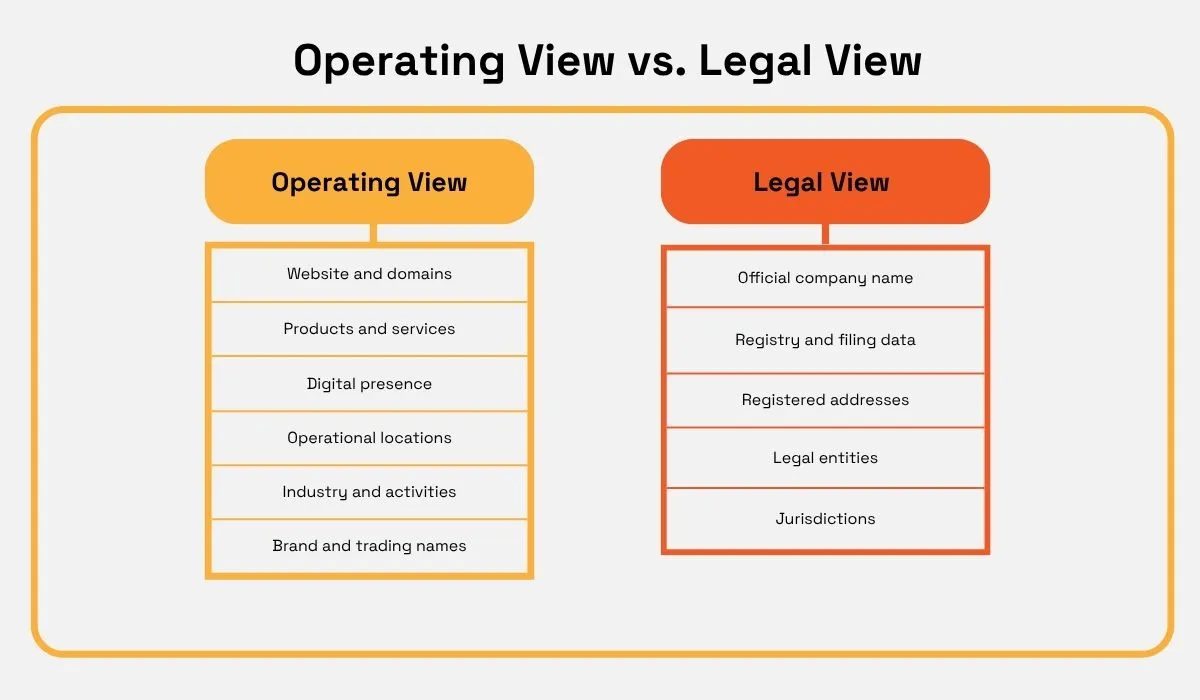
Source: Veridion
Why does that distinction matter?
Well, because the business your procurement team knows may not use the same name as the legal entity signing the contract.
Imagine a manufacturer whose website and customers know it as “Northstar Components.”
Its registry record, however, may identify it as “NSC Manufacturing Holdings S.R.L.” So any conventional name matcher will see two different strings entirely.
The challenge gets even bigger when a company operates across multiple jurisdictions, where legal names, registration records, or corporate structures can differ from one country to another.
But a multi-view entity resolution system can examine the wider evidence connecting them.
- Does the legal entity operate at the same address?
- Does its website use the Northstar brand?
- Do the products and services align?
- Are the locations, corporate relationships, and other identifiers consistent?
There isn’t a single data point that has to carry the decision.
Instead, the system cross-references evidence from different representations of the business until it figures out if the records point to the same underlying entity.
The same approach also works for complex corporate structures.
For example, a parent company and its subsidiary may share an address, website domain, or branding, yet still represent separate legal entities.
The challenge doesn't stop there. Companies evolve constantly. They:
- Rebrand
- Change websites or addresses
- Acquire or sell subsidiaries
- File new corporate records
Why does this matter?
If entity resolution happens only during a periodic cleanup project, yesterday’s correct match can become tomorrow’s stale record.
And the cost of outdated data can be substantial, to say the least.
According to Forrester, more than a quarter of organizations estimate they lose at least $5 million every year to poor data quality.
7% put those losses at a whopping $25+ million.
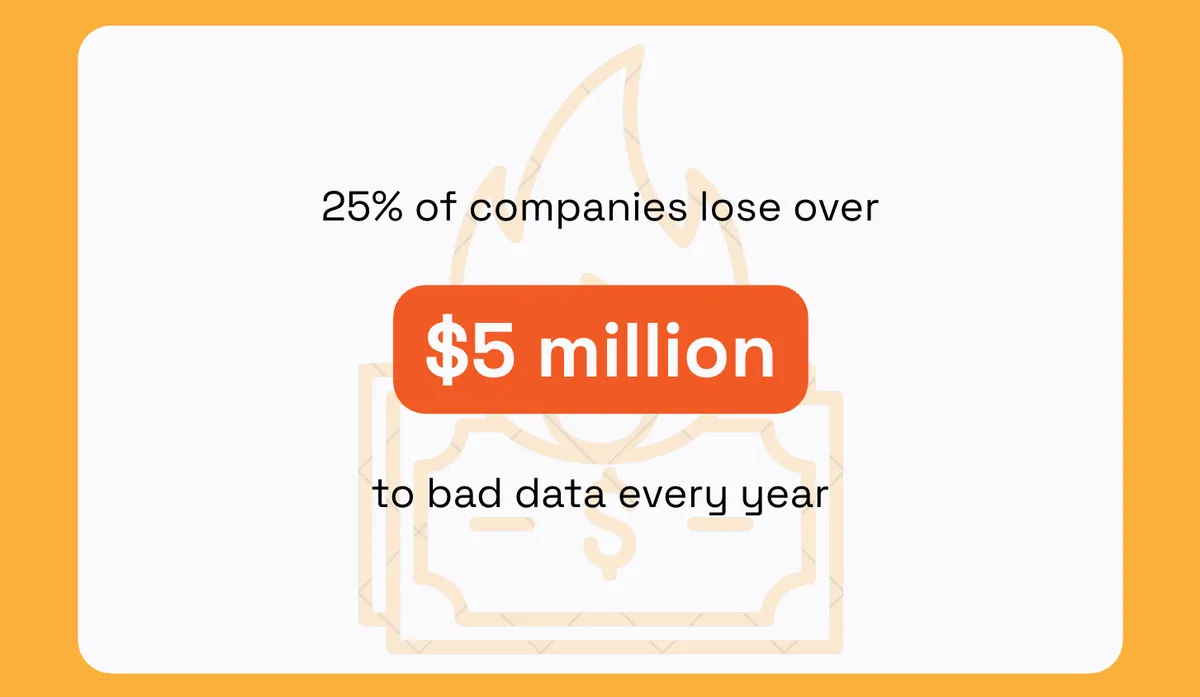
Continuous data collection thus becomes a must.
Instead of treating matching as a one-time event, an automated system can reassess entities as new information becomes available.
This creates a living identity layer that evolves along with the companies it represents.
Veridion follows this approach.
It refreshes 693M company profiles every week by analyzing ~1.4B web pages per month and other trusted sources.
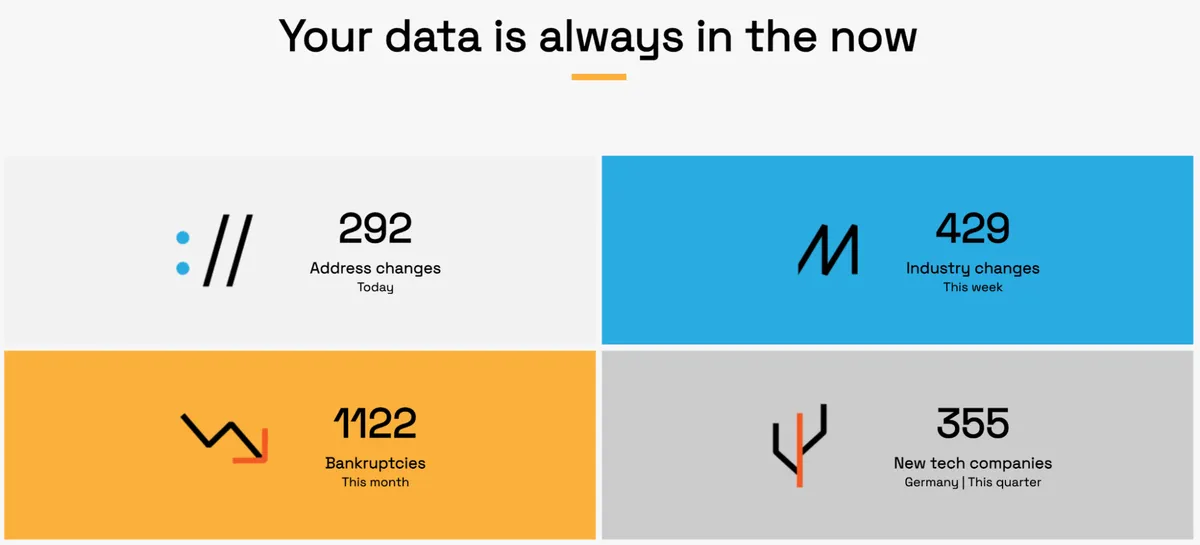
Source: Veridion
Entity resolution is all about building enough evidence to make the right decision.
How 99%+ Match Accuracy Is Achieved at Scale
High match accuracy doesn't come from finding one perfect identifier. In messy B2B data, sometimes that identifier just doesn’t exist.
Instead, 99%+ accuracy comes from combining multiple independent signals and cross-validating them against each other.
Each signal contributes additional evidence. The system evaluates them together instead of relying on any single identifier.
None of these identifiers proves identity on its own. Together, though, they create a much more reliable picture.
That's also how the broader industry approaches the problem.
As Data Ladder notes in its comparison of leading platforms, the best solutions combine multiple matching signals and cross-validation techniques.
Below are some of the most common signals they evaluate:
Signal | What it helps verify |
|---|---|
Company names | Spelling variations and rebrands |
Website & domains | Operational identity |
Registered addresses | Legal presence |
Corporate filings | Official legal entity |
Products & services | Business activity |
News & social profiles | Recent organizational changes |
This approach is truly valuable, especially at enterprise scale.
The harder the case, the more expensive it is to get wrong. To make matters worse, those are exactly the cases automated systems are most likely to misclassify.
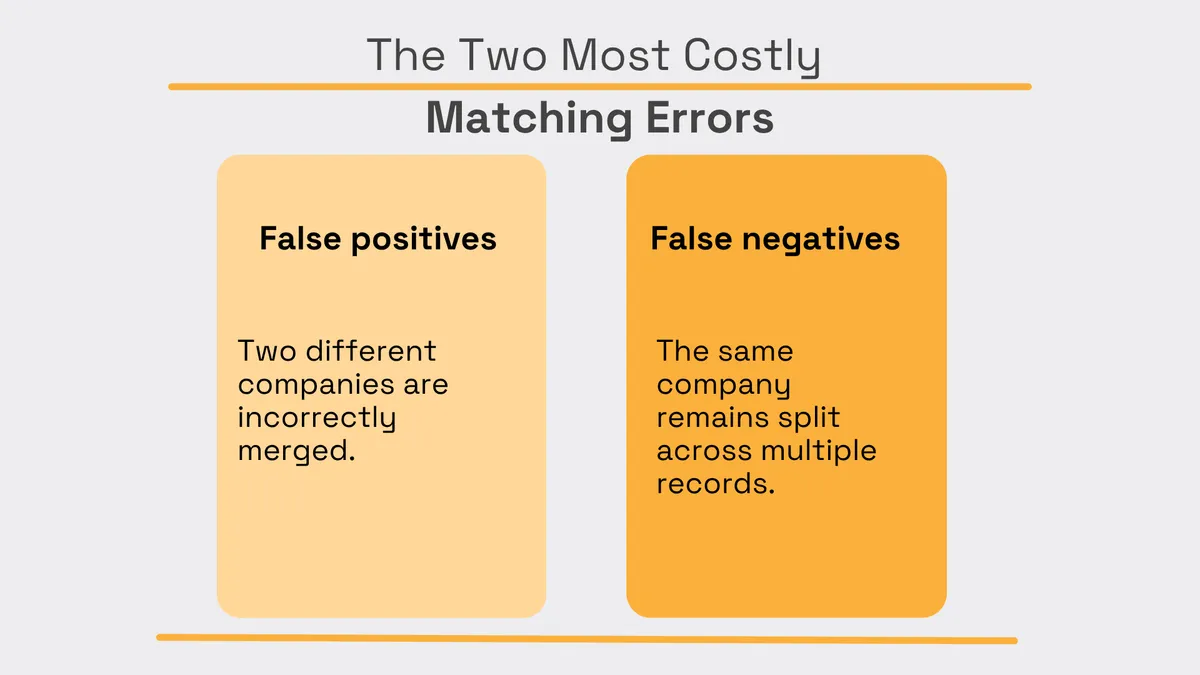
Related companies, subsidiaries, renamed organizations, and businesses sharing similar names or addresses can easily produce two costly errors.
The visual below explains them side by side:
Source: Veridion
Both distort procurement, risk, and analytics workflows.
That's why modern entity resolution doesn't stop after making that initial match.
The system continuously reassesses existing relationships as new information appears. That includes:
- New filings
- Ownership changes
- Websites moving
- Companies rebranding.
So a match that looked correct last year may be entirely wrong today.
That’s why the wider entity resolution market has increasingly adopted this continuous approach.
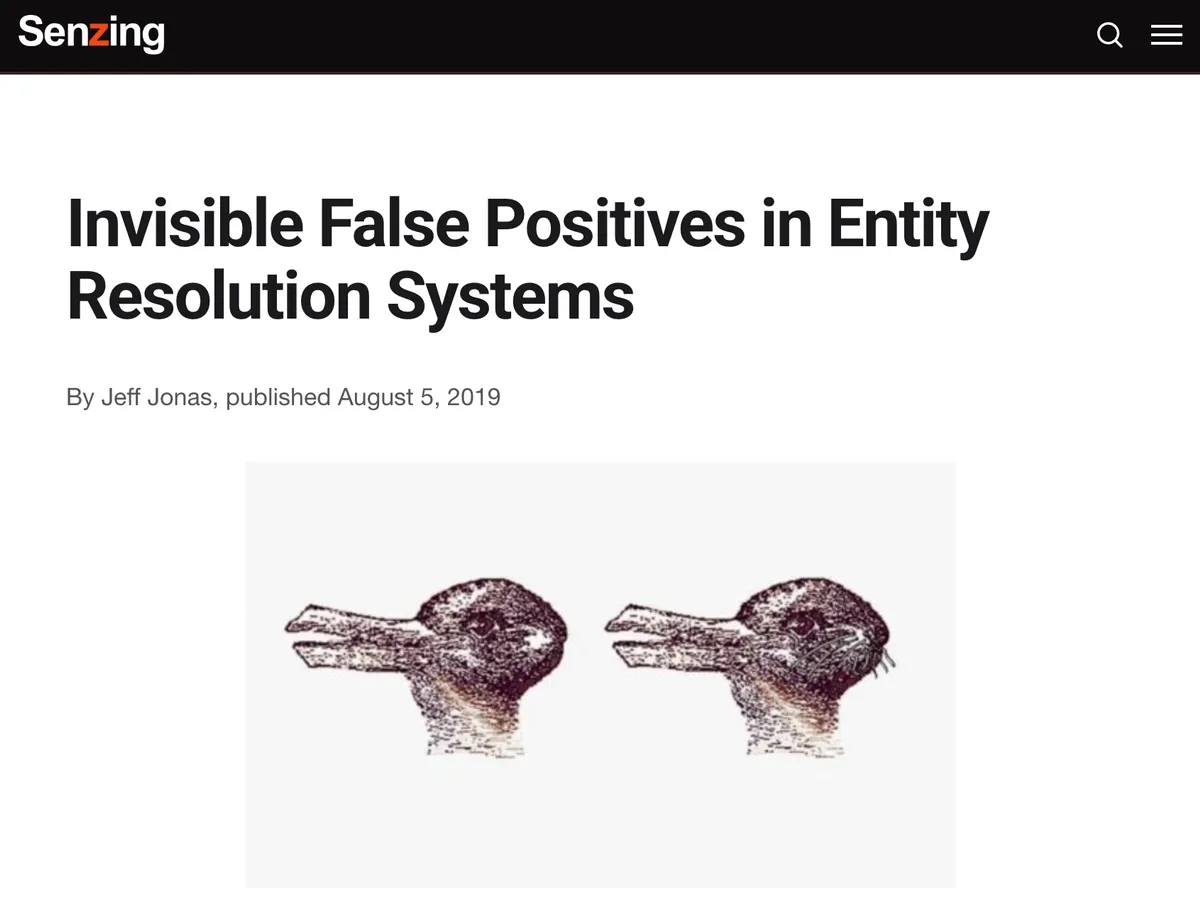
For example, Senzing describes one tough challenge as the "invisible false positive."
Source: Senzing
That’s a match that initially appears correct but is later disproven when new evidence becomes available. In other words, achieving high accuracy is an ongoing process.
Likewise, platforms like Quantexa emphasize confidence scoring and continuous entity resolution rather than relying on static, one-time matching.
Veridion follows the same principle by combining its Operating and Legal Views and continuously refreshing the underlying data.
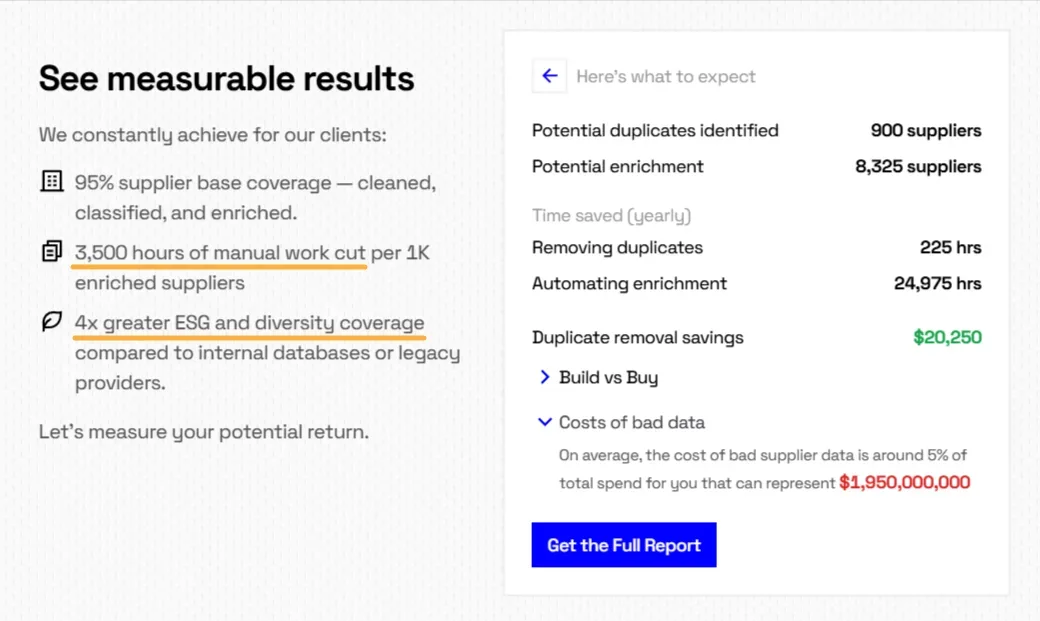
Ultimately, it reports 99% supplier deduplication.
Source: Veridion
At enterprise scale, success means building enough evidence (and continuously validating it) that the vast majority of matching decisions can happen automatically.
That gives your human experts time to focus only on genuinely ambiguous cases.
What Automated Matching Unlocks for B2B Teams
Entity resolution may sound like a technical data-cleaning process. However, its true value appears downstream.
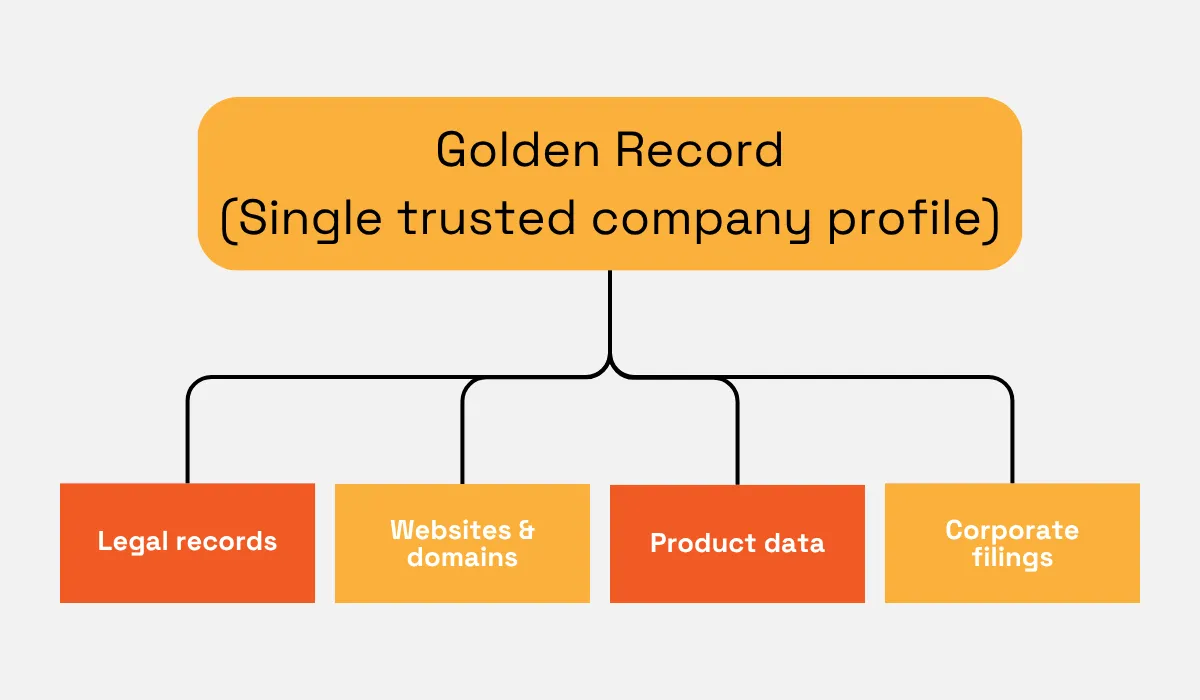
Once you can reliably determine which records belong to the same company, you can build a golden record.
That’s one single, authoritative representation of that business created from information previously scattered across multiple systems.
Imagine a global enterprise working with the same supplier across five business units.
- One ERP contains the supplier's legal name
- A procurement platform uses its trading name
- The CRM contains an old brand
- A regional spreadsheet lists a local subsidiary
- A risk system contains another variation created during onboarding.
Without entity resolution, those records remain fragmented. That, in turn, can have costly consequences.
Procurement can underestimate total spend because purchases are divided between multiple supplier IDs. Risk teams can assess one record while missing another. Finance may process duplicate vendor accounts, while analysts count the same company multiple times.
And if a parent-subsidiary relationship is missed, teams may not realize how much exposure ultimately sits with the same corporate group.
A golden record gives every team a common reference point.
So instead of deleting source records, it links them to the same underlying entity. That gives you a trusted view that downstream systems can rely on.
For procurement, that means cleaner spend analysis and a more accurate picture of supplier exposure.
For risk and compliance teams, it helps connect sanctions alerts, ownership changes, or adverse events that might otherwise remain attached to separate records.
CRM teams benefit as well, as they eliminate duplicate customer accounts that fragment interaction histories and distort pipeline reporting.
Source: Veridion
Reliable entity resolution also transforms data integration.
And when it's paired with company data enrichment, your organizations can also improve the quality and completeness of the data behind them.
Without reliable entity resolution, every supplier database, CRM migration, acquisition, or market intelligence feed creates another reconciliation project.
And again, this is where manual review might work for hundreds of records, but it quickly becomes a bottleneck at enterprise scale.
Automated entity resolution removes that bottleneck.
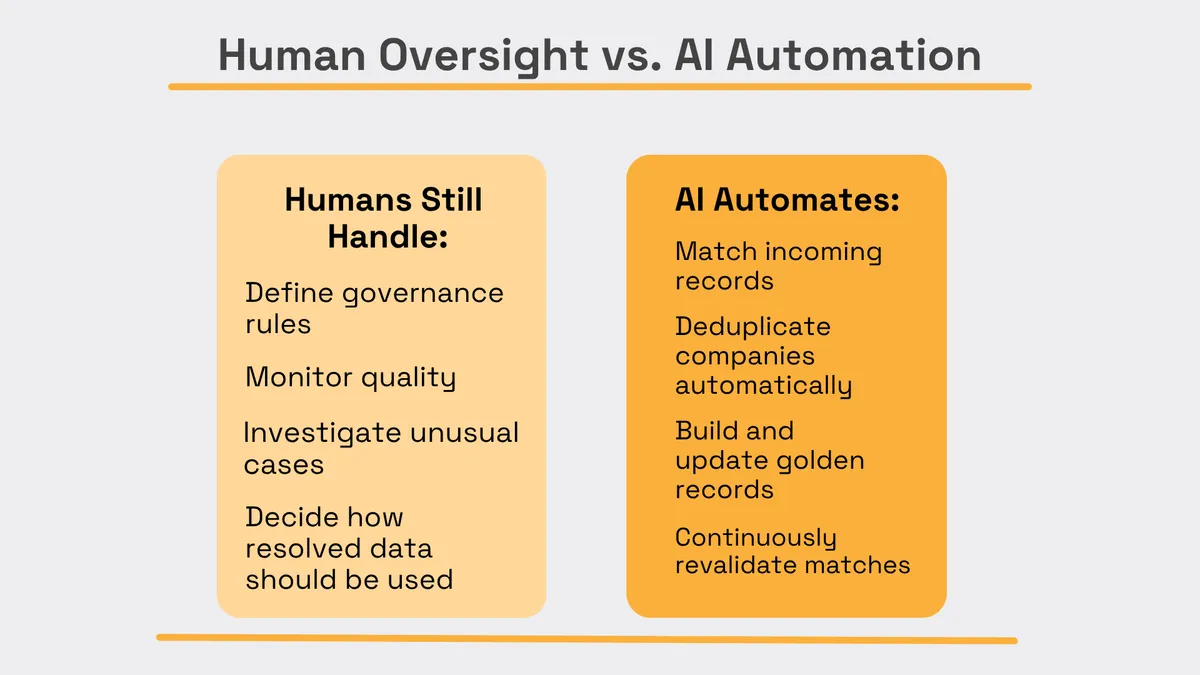
New records can be matched against existing entities as they enter the system. That leaves only the most ambiguous cases escalated for human review.
And that’s the practical meaning of "no humans in the loop."
It doesn't eliminate human oversight.
The visual below highlights which tasks AI can automate and where human expertise remains vital.
Source: Veridion
What disappears is the assumption that someone must manually verify every routine match before data can move through the business.
That distinction is even more relevant today, as more and more organizations adopt AI.
AI systems can only reason over the data they receive. So if one supplier enters a model as five different companies, or if two unrelated businesses are merged into one, the model starts from an inaccurate assumption.
Entity resolution provides the trusted identity layer that analytics, procurement, risk, and AI systems all depend on.
Analytics become more accurate because counts reflect real companies rather than database rows. Procurement gains cleaner spend visibility, and risk teams see a more complete picture of each organization.
The result: AI applications receive cleaner, better-connected context.
The more automated your downstream workflows become, the more valuable that foundation becomes.
Conclusion
Enterprise data keeps changing. That’s a given.
But now you know how AI-powered entity resolution keeps it connected.
By building trusted golden records and automating routine matching, you can reduce hours and hours of manual work. Ultimately, you improve data quality and give every team a consistent view of the companies they work with.
The result is faster decisions, more reliable insights, and a stronger foundation for everything built on your B2B data.
Articles
Discuss how these trends affect your organization.
Our analysts are available for a short call. Bring a specific question and we will ground it in the data.
Insights
Keep reading
More analysis, research, and outcomes grounded in live company intelligence.
What Are the Benefits of Data Enrichment?
Want to understand the benefits of data enrichment? This guide will explain how enriched data supports better decisions and analytics.
Master Data Management: Best Practices to Follow
Want to improve how you manage your enterprise data? This article will walk you through master data management best practices worth adopting.
How Decision-Grade Data Powers More Efficient Commercial Insurance Pricing
Tired of inefficient commercial insurance pricing? See how decision automation with decision-grade data transforms your underwriting.