Insights / Articles
How Credit Rating Agencies Can Use Alternative Data When Private Company Financials Are Sparse
Alternative data for credit scoring keeps a private-company credit view current between filings, using activity, headcount, and hiring.

- Private-company financial information is often less frequent and less current than public-company disclosure.
- Observable information about identity, business activity, headcount, locations, hiring, and ownership can help analysts understand what is changing between formal reporting dates.
- Alternative data should supplement audited financial information, not replace it.
Credit analysts can get a detailed financial picture of a public company every few months. Private companies are different.
Financial statements may arrive only once a year, months after the period they describe, or not be publicly available at all.
That leaves analysts trying to understand what is happening in the business today with information that may already be out of date.
Alternative data can help. The key is not to treat it as a replacement for audited financials.
Instead, use observable information about a company’s identity, activity, size, growth, and ownership to keep the credit view current between formal disclosures.
Confirming the Company’s Identity and Corporate Structure First
Before you use any external data, make sure you are looking at the right company. A hiring trend, product launch, facility change, or ownership record is useful only when it belongs to the borrower you are assessing.
This process is known as entity resolution. It connects a borrower to the correct legal entity and then establishes its relationship with parent and sister companies.
That matters because a company may not operate as an independent business. A parent may provide financial support during a downturn, while other entities in the group may share financing arrangements or ownership.
One tool that can help with identity verification is the Legal Entity Identifier (LEI). An LEI is a unique 20-character code used to identify legal entities.
The system was developed after the 2008 financial crisis, when regulators and market participants struggled to understand exposures between institutions.
The LEI system is useful, but it does not cover every private company. Even when an LEI exists, analysts need to check whether the underlying record is current.
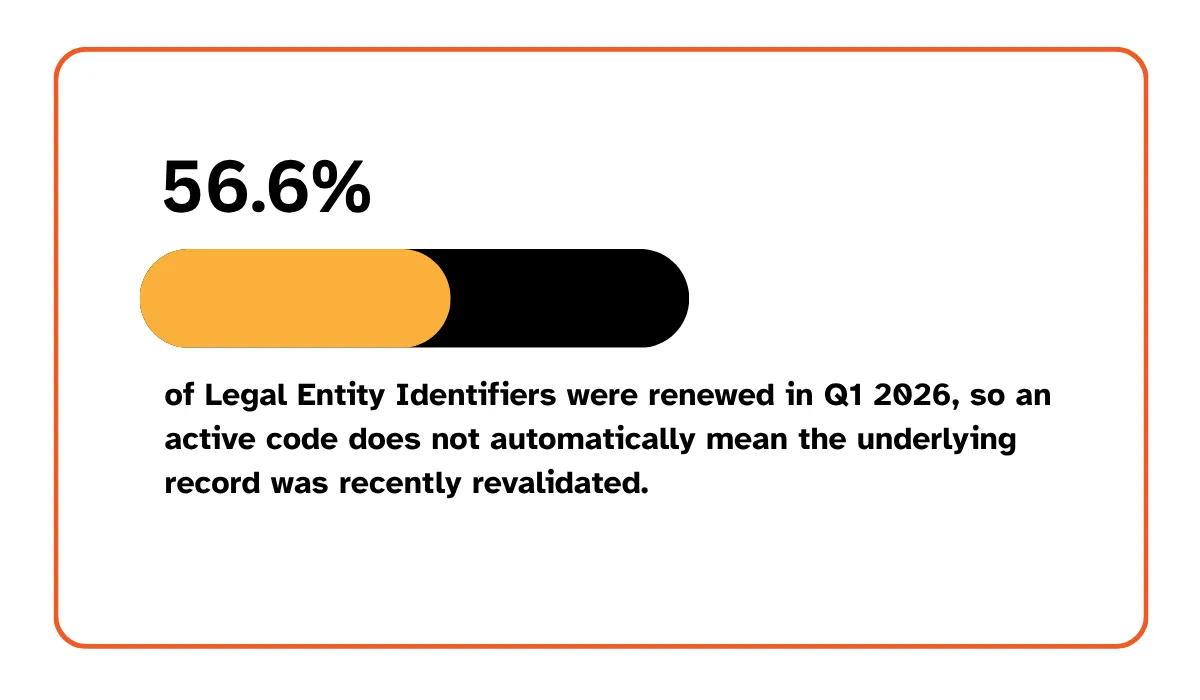
The Global LEI Foundation, or GLEIF, reported more than 3 million active LEIs and a 56.6% renewal rate in Q1 2026. That is why verification has two parts: identify the correct company and confirm that the information attached to it is current.
Public registries can help, but coverage and update frequency vary by country. International company groups can be harder to map because the same business may appear under different names across different records.
External company-intelligence data can help connect these records and add current operational information from public sources.
Veridion’s entity resolution service is one example of a data layer that can help rating teams build a more complete private-company profile.
Whatever source you use, keep the distinction between observed information and audited information clear in the credit file.
A reviewer should be able to see where each input came from and whether it was independently verified. Once the identity is reliable, you can start looking at what the company is doing.
Assessing Current Business Activity and Product Changes
An industry code tells you what a company is classified as at inception, but it does not always tell you what the company is doing today.
In the US, the North American Industry Classification System (NAICS) provides a standard way to classify business activity.
But classification systems change slowly, and company records can remain unchanged even after the business itself has moved in a different direction.
The Census Bureau reviews NAICS every five years. Its 2022 NAICS implementation timeline shows that many economic programs will complete the transition to the 2022 codes by the end of 2027.
That illustrates why a formal classification can trail the company’s current activity.
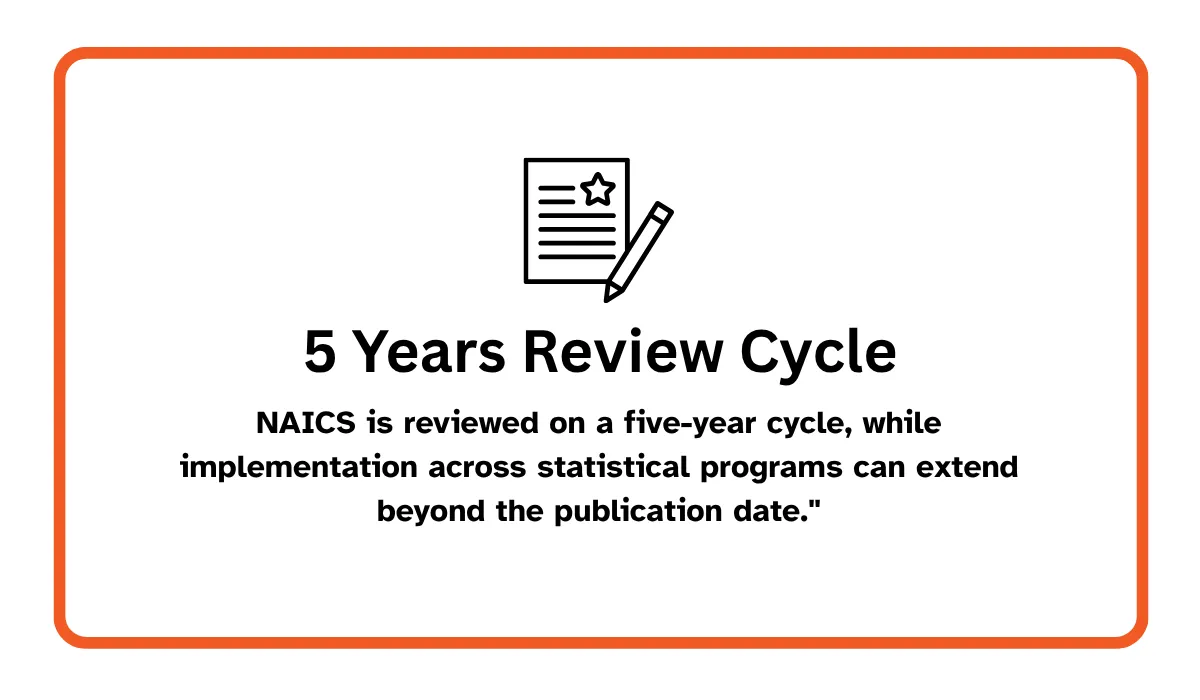
Illustration: Veridion / Data: U.S. Census Bureau
Consider a manufacturer that moves from consumer electronics into defence components. Its registered industry may remain unchanged, but its commercial environment has shifted.
Buyers may now include government contractors. Contracts may be larger, payment terms may change, and regulatory requirements may increase.
Those changes can appear first in product pages, job advertisements, company announcements, and press coverage. An analyst who monitors these sources can see the direction of the business before the change appears in an annual financial statement.
The important point is to treat this information as operating context, not as a substitute for financial performance.
A new product does not automatically mean higher revenue or lower credit risk. It tells you that the business has changed and that assumptions about its market, customers, costs, and risk exposure may need to be revisited.
This is also where disciplined data enrichment practices matter: classification data becomes more useful when it is checked against fresh, observable information.
Using Employee Scale and Operating Footprint to Understand Company Size
Revenue and assets are the clearest ways to measure company scale. Private borrowers, however, may not disclose those figures publicly, and the latest available numbers may be months or even a year old.
That is common in private-company credit work.
Credit Benchmark reports that about 87% of its consensus credit ratings cover non-public companies, reinforcing how often analysts assess companies without the same public disclosure available for listed firms.
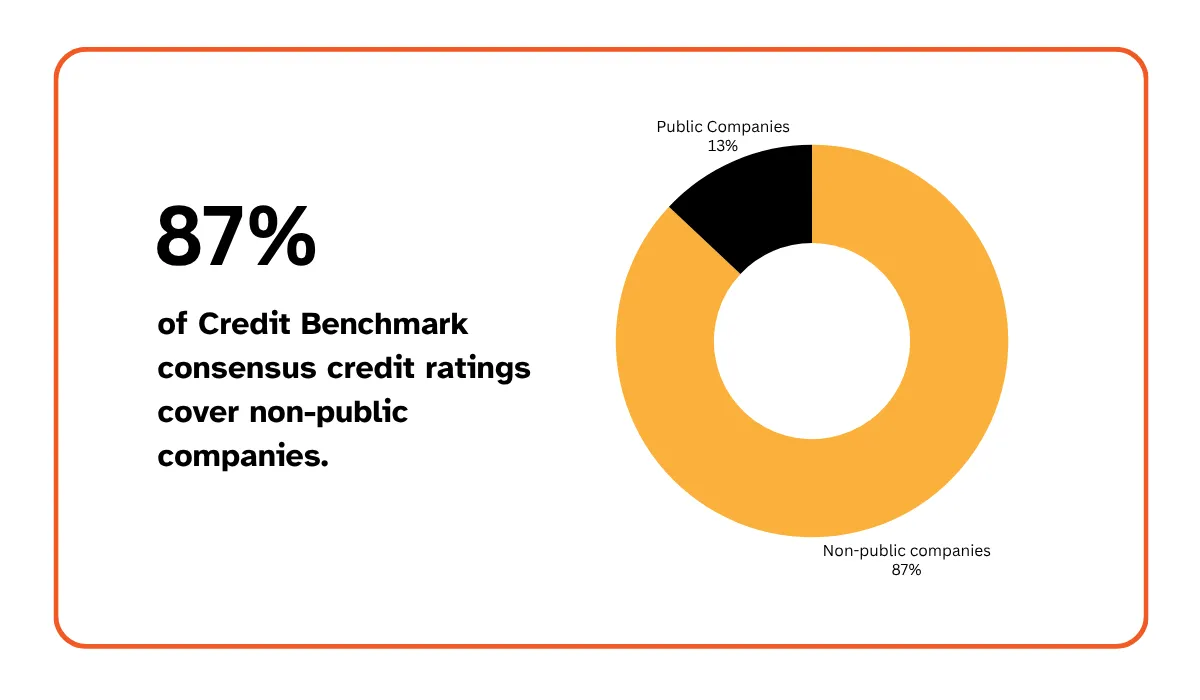
Illustration: Veridion / Data: Credit Benchmark
Headcount and operating footprint can provide useful context in the meantime. They are proxies, not financial measurements. They can help you understand whether a company appears small, mid-sized, or large, but they cannot tell you its exact revenue or asset value.
Headcount is particularly useful when tracked over time.
A company that grows from 100 employees to 150 has clearly expanded its workforce. That does not mean revenue increased by 50%. The relationship between employees and revenue varies significantly by industry.
Outsourcing, automation, contract workers, and seasonal staffing can change that relationship. A software company may generate substantial revenue with a relatively small workforce, while a labour-intensive business may need hundreds of employees to produce a similar amount.
Physical locations need the same caution.
A small office and a manufacturing plant are both counted as locations, but they represent very different levels of economic activity. The type and purpose of each facility matters more than a simple location count.
For that reason, these measures are most useful for directional assessment. Ask whether the business appears to be expanding, contracting, or remaining broadly stable.
Then compare the finding with companies in the same industry and check it against other sources.
The broader benefit of this kind of cross-checking is explained in Veridion’s overview of data enrichment benefits: adding fresh context can make an existing company record more useful without pretending that the added data is a disclosed financial metric.
Once you have a reasonable view of the company’s current scale, the next question is whether that scale is moving up or down.
Tracking Signs of Growth or Contraction
Changes in hiring and physical operations can provide an earlier view of a company’s direction than its financial statements.
This matters because private-company reporting can trail the underlying business by several months.
Imagine a manufacturer whose margins begin to weaken in September. If its annual financial statements are not available until the following spring, the deterioration may remain invisible to an external analyst for much of that period.
Changes in hiring, facilities, or other operating activity may appear much earlier.
Workforce data is one area worth monitoring. IBISWorld’s credit-risk research on labour and workforce conditions highlights how staffing pressure can affect margins, repayment resilience, and credit assessment.
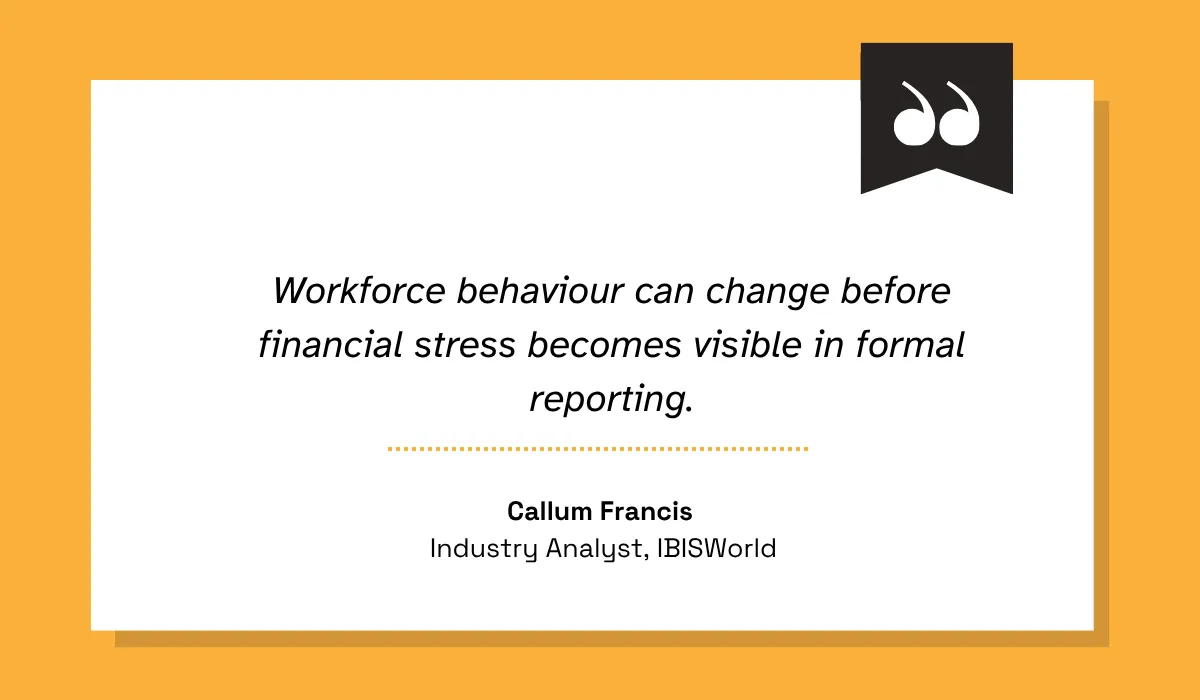
A company advertising for engineers, sales staff, and operations employees may be preparing for expansion. A company that starts withdrawing those vacancies may be changing course.
But neither observation should be interpreted on its own.
A hiring surge may support an expansion that later proves unprofitable. Layoffs may indicate financial pressure, but they may also be part of a successful cost-reduction programme.
Closing a facility can weaken a business when it removes productive capacity, or strengthen it when it removes a loss-making operation.
Operational changes should therefore trigger questions rather than automatic conclusions. Ask what changed, why it changed, whether management had already announced the change, and whether other evidence supports the same interpretation.
For broader background on how alternative information is used in credit assessment, see the Congressional Research Service overview of alternative data in credit scoring.
The corporate use case is different from consumer scoring, but the same discipline applies: non-traditional information is useful when its source, relevance, and interpretation are clear.
Keeping a record of what triggered a review also improves surveillance.
If a rating team notices a sudden hiring reversal, the file should show when it was observed, what other evidence was checked, and how the finding affected the analyst’s assessment.
Mapping Ownership and Corporate Relationships
Operational information tells you what a company is doing. Ownership tells you who may influence what happens next.
A private borrower may be part of a larger corporate group. Its financial position may be affected by a parent company, sponsor, sister companies, shared lenders, or common refinancing dates.
A standalone financial statement cannot always show those relationships clearly.
The Financial Stability Board’s May 2026 report on vulnerabilities in private credit estimated the market at $1.5 trillion to $2 trillion and highlighted the importance of interconnections among private credit funds, banks, insurers, and private equity firms.
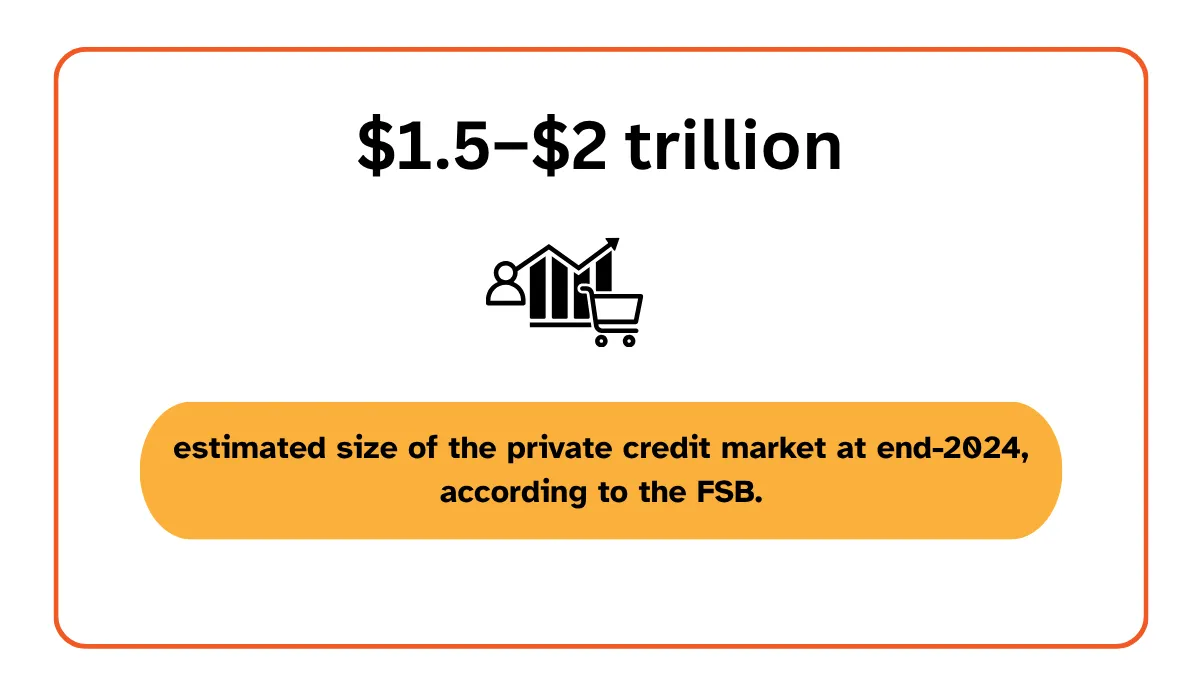
Illustration: Veridion / Data: Financial Stability Board
Private equity ownership adds another layer.
Several portfolio companies may depend on the same sponsor, financing partners, or refinancing timetable. If the sponsor experiences financial pressure, more than one borrower could be affected.
Looking at each company separately would make that connection easy to miss.
A structured relationship map can make these connections easier to analyse.
A knowledge graph can represent each company as an entity and each ownership relationship as a connection. Analysts can then trace a borrower to its parent, subsidiaries, and other related companies.
This is particularly useful for portfolio surveillance.
If several borrowers are connected to the same parent or sponsor, the rating team can identify concentration before a problem becomes visible through individual company financials.
Ownership information should still be treated as context, not as a standalone rating input. The same rule applies to employee data, business activity, and operating changes.
Alternative data is most useful when it strengthens the evidence around a credit assessment without overriding reliable audited financial information.
Conclusion
Private-company financial information will often be less frequent and less current than public-company disclosure.
Credit teams therefore need ways to understand what is happening between formal reporting dates.
The strongest approach is not to replace financial statements, but to build a current operating picture around them.
Start by confirming the right legal entity and corporate relationships. Then, monitor business activity, employee scale, operating footprint, growth or contraction, and ownership.
Each source answers a different question.
Together, they give analysts more evidence to investigate changes before the next financial statements arrive. Used carefully, alternative data can make private-company credit surveillance more timely, transparent, and evidence-based.
Articles
Discuss how these trends affect your organization.
Our analysts are available for a short call. Bring a specific question and we will ground it in the data.
Insights
Keep reading
More analysis, research, and outcomes grounded in live company intelligence.
Best Practices for Data Enrichment
Learn how data enrichment best practices help businesses turn raw data into accurate and actionable insights.
What Are the Benefits of Data Enrichment?
Want to understand the benefits of data enrichment? This guide will explain how enriched data supports better decisions and analytics.
Best Practices for Leveraging Market Intelligence
Not sure how to apply market intelligence effectively? Learn which practices top businesses rely on and how you can too.