Insights / Articles
Buy-And-Build Strategy: Map the Platform, Add-On Universe and Acquisition Runway
Looking into a buy-and-build strategy? This guide will explain how to identify platform companies, map add-on targets, and assess acquisition runway.

- Hundreds of companies in a market can shrink to a short list once you screen for services and size.
- Some targets that look independent already belong to a corporate group.
- Some sponsors set minimums for platforms but consider add-ons of any size.
- Doubling your buying pace halves how long your target pool lasts.
Add-on acquisitions accounted for more than half of global private equity deals in the first half of 2026. A buy-and-build strategy starts with a platform company, then grows through add-on acquisitions. Before you commit, your team has to check whether enough suitable businesses exist to support the plan.
You might find hundreds of businesses, then discover many belong to existing groups or fall outside your criteria.
How much of your list qualifies? This guide explains how to map platform candidates and the add-on universe with company data from sources such as Veridion. You’ll then test your thesis and calculate runway at different acquisition paces.
How Buy-and-Build Variants Differ
Consider a healthcare software platform that sells practice-management software. If it buys a billing business, it can add patient invoicing and payment collection to its product range and sell both products to existing customers.
Financial data company Preqin reports add-on acquisitions accounted for more than half of global private equity transactions during January–June 2026.
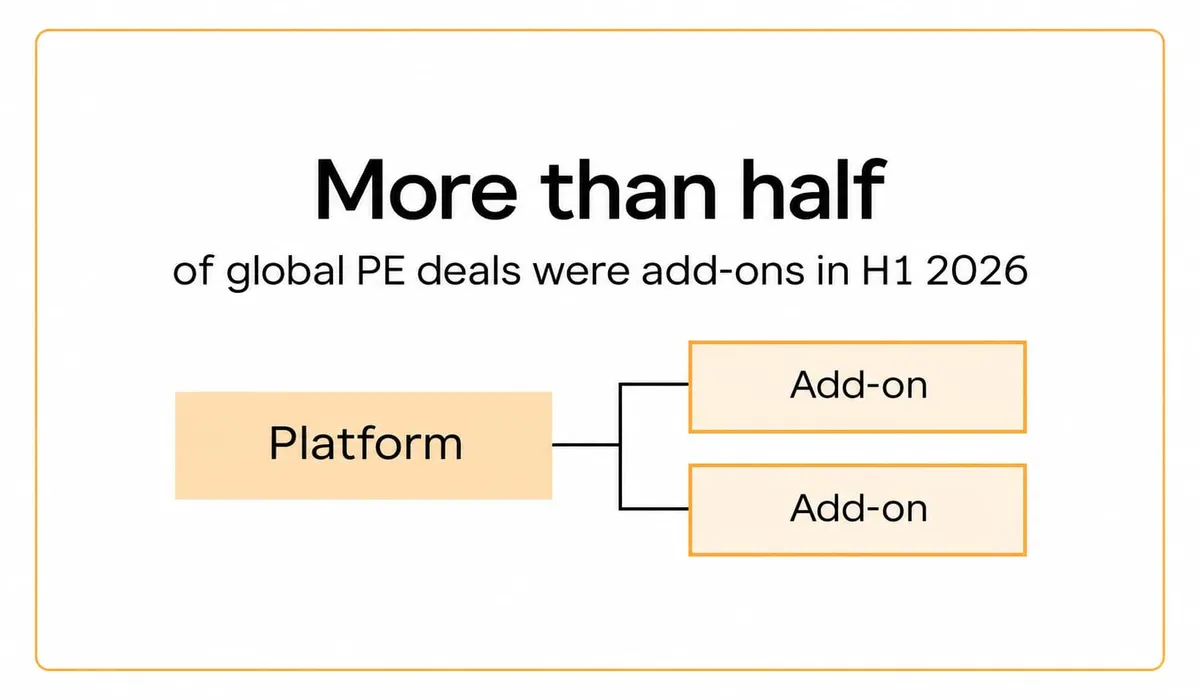
Firms pursue add-ons for different reasons. An accounting group buying regional practices expands its territory, and the healthcare software platform above expands its product range.
The table below compares common terms, using hypothetical examples.
Variant | Purpose of add-ons | Integration approach | Short PE example |
|---|---|---|---|
Buy-and-build | Expand a platform through a planned acquisition program | Select shared functions according to the investment plan | Healthcare software group buys clinical applications and combines sales teams |
Roll-up | Consolidate businesses serving a fragmented market | Combine ownership; consolidation of operations varies | Accounting group acquires regional practices and centralizes finance |
Bolt-on | Enter a territory or acquire a capability | Keep the acquired business’s brand and identity | Billing software business retains its brand within a healthcare software group |
Tuck-in | Expand the platform’s existing operations | Absorb staff and customer accounts within the platform | Accounting practice transfers its clients and staff to an existing branch |
Serial acquisition | Pursue repeated acquisitions over time | Integration varies by transaction | Industrial-services group purchases businesses through an ongoing acquisition program |
Buy-and-build and roll-up describe acquisition programs, while bolt-on and tuck-in describe individual deals within them.
Serial acquisition simply means repeated purchases, so a buy-and-build program also counts as one. At the deal level, the labels get less consistent. Some sources use bolt-on and tuck-in interchangeably. Falcon River, a firm that finds off-market businesses for acquisition, draws the line at what happens after the purchase. A bolt-on keeps its identity, while the platform absorbs a tuck-in.
Bain’s research looks at the program as a whole. It defines buy-and-build as an explicit strategy in which a platform company makes at least four add-on acquisitions of smaller companies.
Before you start mapping, agree on what the acquisitions should achieve. An accounting roll-up strategy directs the search toward accounting practices in selected territories. A healthcare software platform seeking billing capabilities screens for billing products and ends up with a different target pool.
How to Test a Buy-and-Build Strategy With Company Data
A buy-and-build private equity thesis depends on a platform and enough suitable businesses to acquire around it. The five steps below test both, from defining eligible targets to calculating runway and deciding whether to proceed.
1. Turn the Thesis Into Testable Claims
Suppose your team sees an opportunity to consolidate commercial HVAC maintenance firms. If you plan to make four acquisitions a year, how many independent maintenance firms near a potential platform’s branches meet your criteria?
Write down the minimum count you’d accept.
To count those firms, define what qualifies as maintenance. Look for inspections and repairs to heating and cooling systems in commercial premises. Equipment sales without maintenance services fall outside your segment, even if the industry code matches.
Veridion’s activity-based classification uses what companies say they do, and custom classification maps them to your team’s own definition.
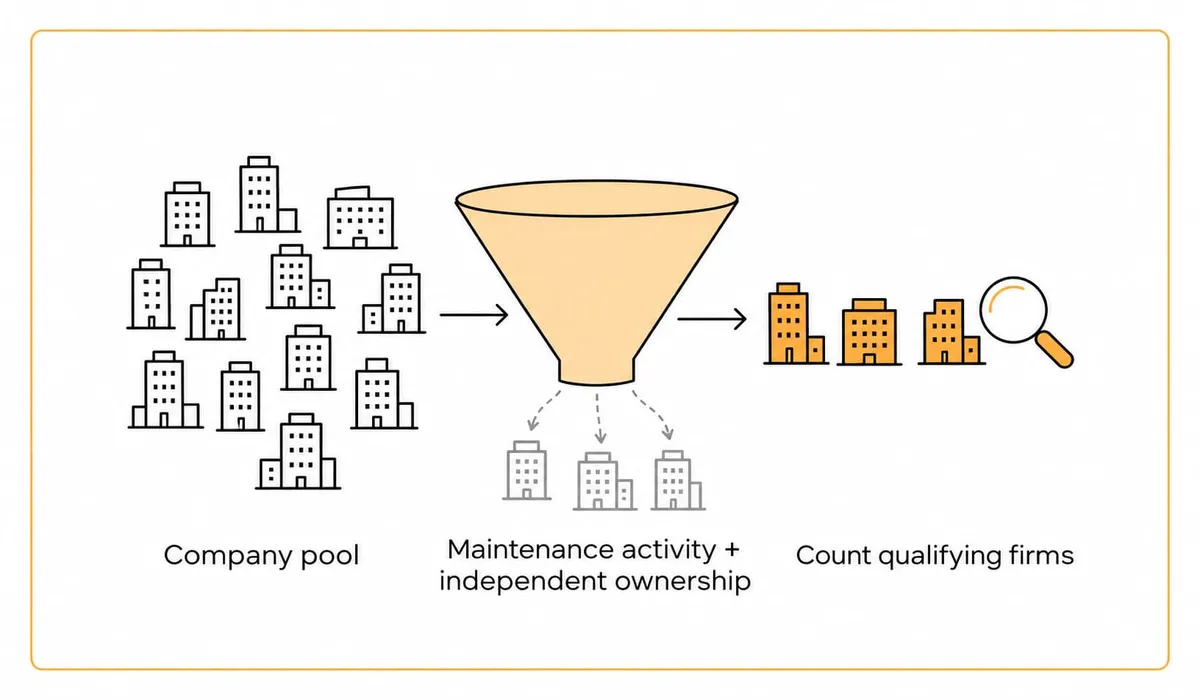
This definition decides which companies enter the tests. For a target-count test, count qualifying companies using service descriptions and ownership records as evidence. Your team sets the minimum and records the pass/fail rule.
Source: Veridion
The table below tests the pool’s size and location. The thresholds are examples. Set your own to match the acquisition plan.
Testable claim | Measure and supporting fields | Illustrative threshold | Decision rule |
|---|---|---|---|
The region contains sufficient independent maintenance firms | Unique company count using service activity, ownership and operating locations | At least 30 firms in selected states | Pass at 30 or above; fail below |
Sufficient firms fit the acquisition size band | Count within the regional pool using annual revenue and estimate flags | At least 24 with $2–10 million annual revenue | Pass at 24 or above; fail below |
Eligible targets cluster near platform branches | Count within the revenue band using operating-site coordinates | At least 12 within 150 miles of a platform branch | Pass at 12 or above; fail below |
These are acceptance thresholds, not counts. The actual count comes from the company records.
Agree on the rules before you look at the results. If missing ownership evidence prevents a definitive count, mark the test untested and assign follow-up research. Document the reason for any threshold revision so enthusiasm for individual businesses doesn’t quietly lower the minimum.
Repeat this for each platform candidate to compare the pools around their branches.
2. Map the Potential Platforms
Start with the business you expect to run the acquisition program.
For an HVAC company, that means the branches your acquisitions will extend and the finance team that will absorb each acquired business’s accounts. Company records show the current footprint. Diligence later checks whether management and systems can keep up with the planned pace.
Your firm’s investment criteria narrow this search. MPE Partners (Morgenthaler Private Equity), for example, targets North American platforms with $8–40 million in earnings before interest, taxes, depreciation and amortization (EBITDA). Its sectors include high-value manufacturing and commercial and industrial services.

Source: MPE Partners
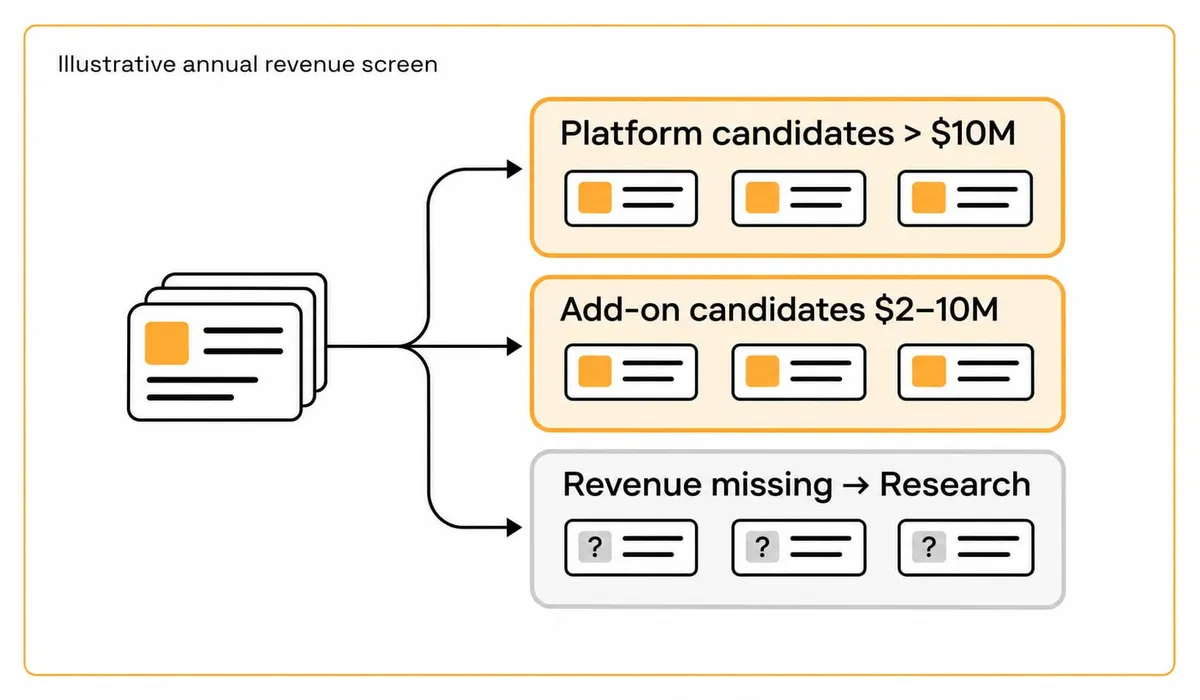
To screen for potential platforms and add-ons, start with the company’s services and operating locations. If both fit your search, check its annual revenue. In this exercise, the platform pool starts above $10 million, and the add-on pool covers $2–10 million.
If revenue is missing, flag the company for follow-up and leave it outside both pools.
If an estimate sits close to the cutoff, treat the placement as provisional. For example, a company whose revenue is modeled at $10.2 million goes in the platform pool for now. If its accounts show $9.8 million, reclassify it as an add-on candidate.
Veridion’s revenue field indicates whether each figure was extracted from published sources or modeled. Label each estimate and record its source date so the team knows which figures to verify against company accounts.
Source: Veridion
Revenue is only useful here if it belongs to the business you’re assessing.
Two trading names might share a parent, and published revenue might cover the whole group. Verify the acquisition entity and the scope of its financial figures, and move companies between pools if needed.
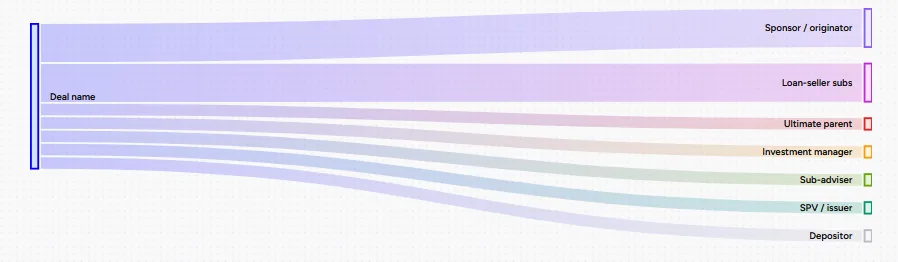
Veridion’s securitization case study shows a related problem. A structured-finance rating agency needed to resolve a list of names, many of which were securitization deals and special-purpose vehicles (SPVs) rather than operating companies. To act on each deal, it had to identify the operating entities behind it.
Source: Veridion
Veridion traced entity roles and ownership links, verifying the mappings against U.S. Securities and Exchange Commission (SEC) filings and rating-agency reports. In one private equity-owned auto ABS, the mapping separated the funds that owned the originator from the manager that administered it and the sub-adviser that directed investment without owning anything. For your shortlist, keep the evidence linking each target to its parent, and confirm whose earnings you’re looking at.
Once identities are confirmed, Veridion’s PE data supplies activity and location data to map targets around each platform. Compare that pool against your step 1 criteria and note open questions for the add-on assessment.
3. Map the Add-On Universe Around the Platform
What do you want the next acquisition to contribute? For an HVAC maintenance platform entering a neighboring state, search for maintenance firms serving commercial premises there. If the aim is to sell refrigeration services to existing customers, look for refrigeration specialists within the platform’s service territory.
Size and profitability thresholds also differ between platforms and add-ons. Clearview Capital, a private investment firm, sets minimums for platform investments while considering add-ons “of any size and situation.”

Source: Clearview Capital
Clearview also publishes add-on criteria for each portfolio company, so its search still has clear limits. Specify eligible services and territories for your platform. Compare target revenue with platform revenue to spot larger acquisitions that need a closer look at funding and management capacity.
As you expand the search, check new results against the records you verified in step 2.
Merge duplicates using matching identifiers, but keep separate subsidiaries and their parent links. Veridion’s entity resolution service supplies identifiers and subsidiary relationships for this task. Its corporate group data traces operating organizations to their ultimate parents.
Record confirmed sponsor or competitor ownership with evidence dates. Where ownership remains unknown, note the missing evidence and assign follow-up research.
Group the verified targets into tiers by how closely they match the platform, based on what they do and where they operate. The map below separates maintenance firms in adjacent territories from refrigeration specialists within existing coverage. Then rank the tiers by your platform’s priorities.
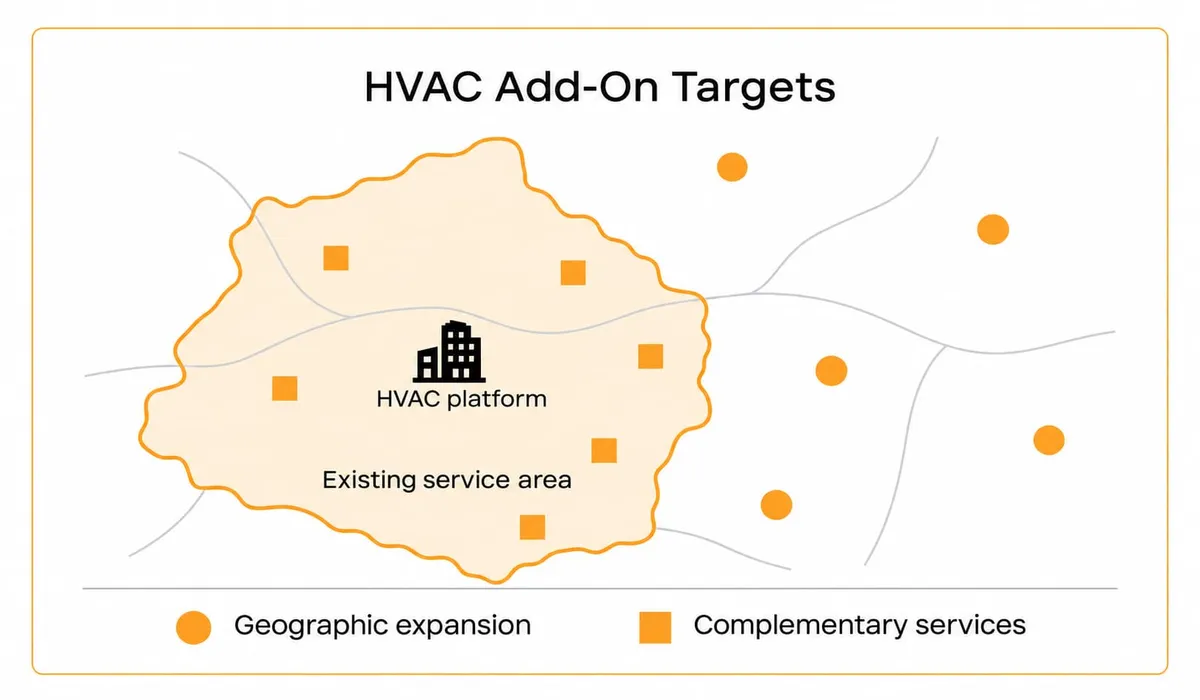
Source: Veridion
The qualifying businesses now form the pool for the runway calculation. If independent ownership is mandatory, leave out companies with unknown ownership until research confirms their status.
4. Test the Acquisition Runway Before You Execute
Your map shows how many targets qualify and where they operate. Acquisition density measures how concentrated they are within a region or service segment. A cluster near existing branches supports local expansion, but targets in distant states mean checking whether the platform can cover new areas.
For the calculations below, let’s assume your team has verified 24 qualifying targets.
Acquisition runway estimates how long this pool lasts at a given buying pace. Divide the target count by planned annual acquisitions. At four acquisitions per year, 24 targets imply six years of runway. At eight per year, they imply three years.
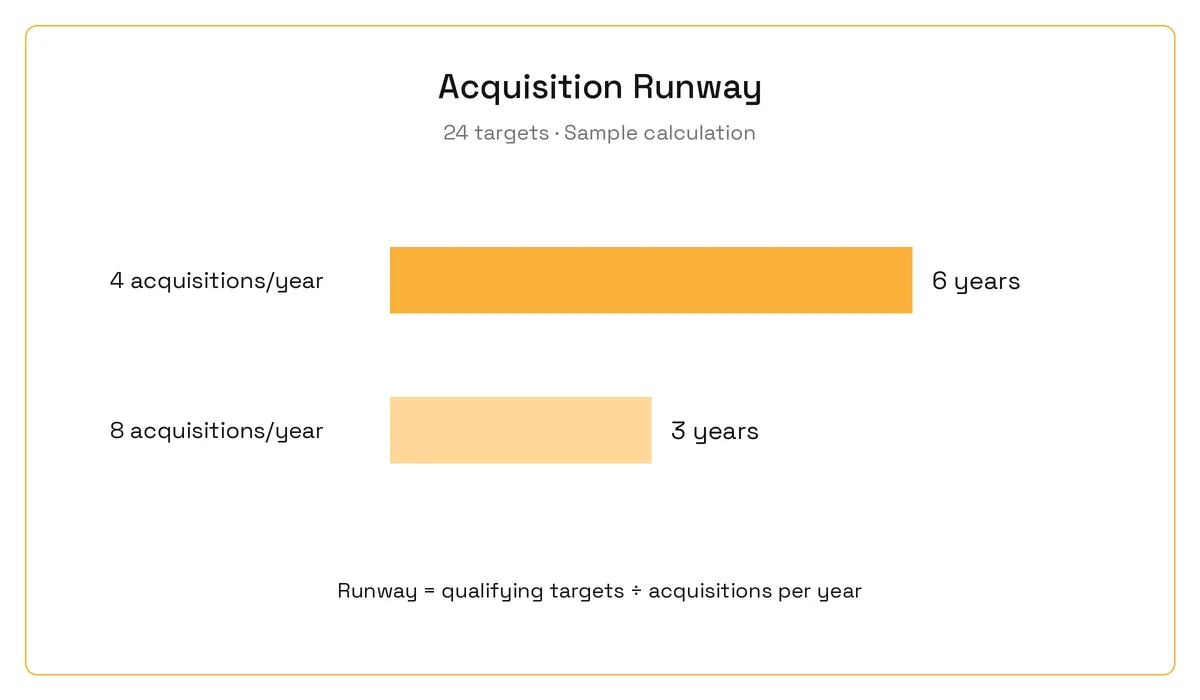
Source: Veridion
Both estimates assume the entire pool remains available and no new targets enter it. Test your buy-and-build strategy against a reduced pool to see how much runway depends on those assumptions.
Suppose your team narrows the revenue screen from $2–10 million to $2–7 million. Eighteen targets qualify, implying 4.5 years at four acquisitions per year.
In a separate scenario, assume eight businesses from the original pool remain unavailable throughout the acquisition period. The remaining 16 imply four years at four acquisitions per year.
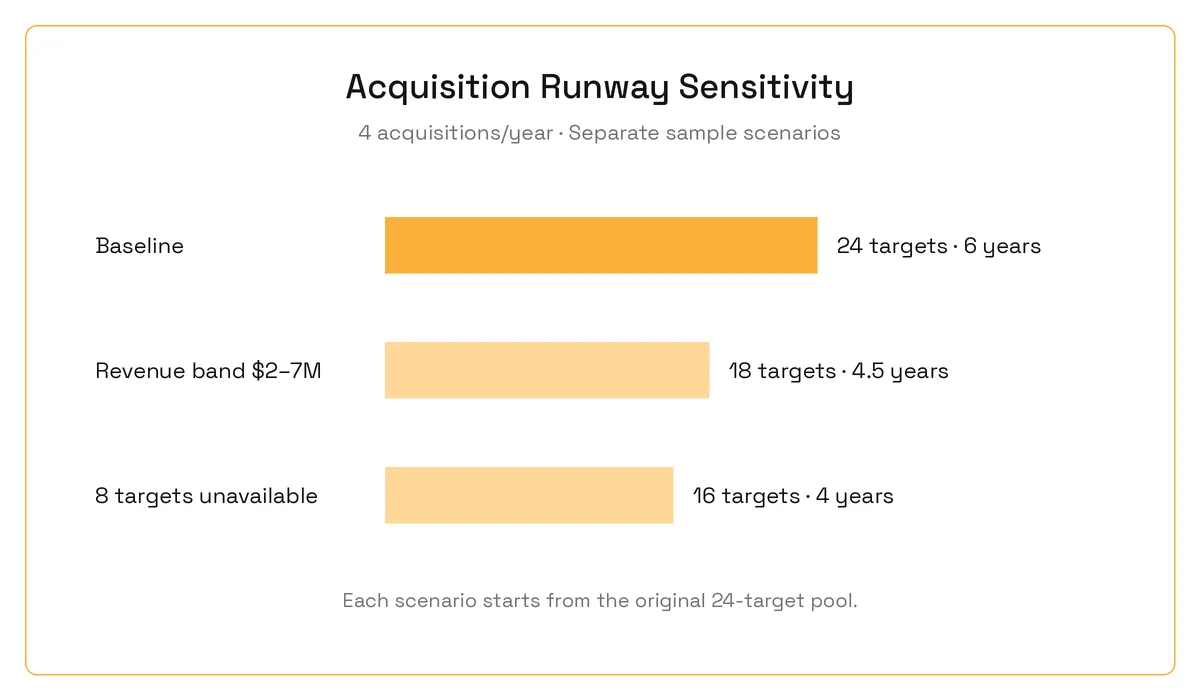
Source: Veridion
Each scenario starts with 24 targets. If you combine them, count each excluded company once, even if it’s both outside the revenue band and unavailable.
A competitor’s completed acquisition also removes a target if the new ownership falls outside your eligibility rules. Check ownership links against dated deal announcements or filings, and separate completed purchases from pending ones.
Refresh the map close to the investment decision and repeat the activity and ownership screens. Veridion’s custom classification and regularly refreshed company data let you rerun the density and runway tests on current records before you commit.
The resulting pool meets your screening criteria, but whether owners will sell, and on what terms, is still unknown.
5. Decide Against Your Pre-Set Criteria
Compare the runway findings and target counts with your original thresholds. Mark each claim as passed, failed or untested, recording the evidence date. If the narrower $2–7 million screen becomes your criterion, its 18 targets fall short of the 24-target minimum, however attractive individual businesses look.
If all mandatory tests pass, advance to diligence.
A failed test means rethinking the thesis, or dropping it. If you revise the acquisition scope, document the reason and rerun the tests. If evidence is missing, pause and assign someone to find it.
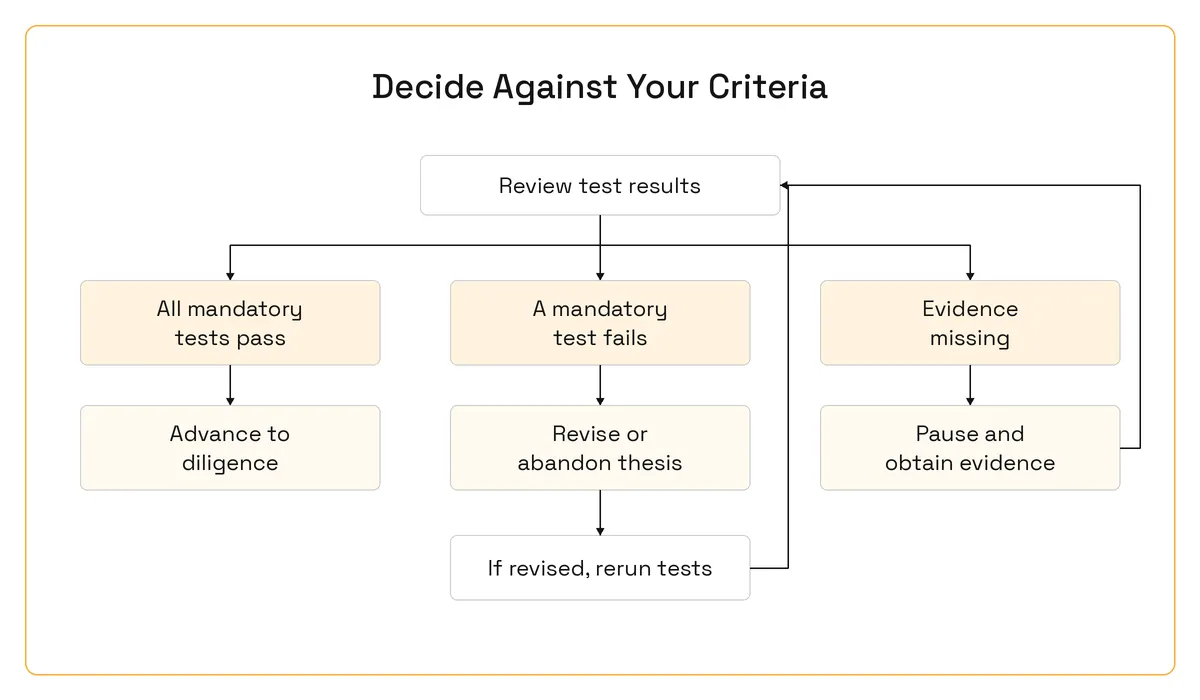
Source: Veridion
For candidates advancing to diligence, resolve outstanding questions about earnings and whether owners will consider selling. Refresh the data on a set schedule, such as monthly, and review it again whenever a competitor buys a mapped business.
Passing the mapping tests doesn’t finish the job. Valuation checks whether proposed prices support the intended return, and financing tests debt capacity against repayment obligations. Integration planning covers management capacity and systems consolidation, two problems examined in AI company V7 Labs’ integration analysis.
Record why you made the decision so the next review can start from that evidence.
Conclusion
You’re committing to a sequence of acquisitions, so examine the businesses behind the plan while there’s still room to reconsider it. Company data shows whether your buy-and-build strategy has enough qualifying targets to sustain the proposed pace.
Set your criteria before the search, and hold the plan to them.
Start with one thesis and write three testable claims with thresholds. Map a platform candidate and its add-on tiers, then calculate runway at two acquisition paces to compare how long the pool lasts.
Articles
Discuss how these trends affect your organization.
Our analysts are available for a short call. Bring a specific question and we will ground it in the data.
Insights
Keep reading
More analysis, research, and outcomes grounded in live company intelligence.
Why Legacy SIC and NACE Rev. 2 Codes Miss Modern Niche B2B Companies
Struggling with niche industrial product sourcing? Legacy industry codes fail modern B2B companies. Find out why and how to adapt.
How Successful Companies Use Market Intelligence for Business Growth
Discover how successful companies use market intelligence to unlock new growth opportunities. Learn more in our latest guide.
9 Essential Sources of Market Intelligence
Want to boost your market knowledge? These 9 market intelligence sources will show you where to look and how to apply the insights.