Insights / Articles
How to Prioritize Surveillance Alerts Across Thousands of Issuers
How credit rating surveillance teams can score alerts by magnitude, persistence and data confidence, and run a queue analysts actually trust.

- The biggest change isn't always the most important alert.
- Several weak signals can become a serious warning when they converge.
- Too much automation can make an alert queue harder to trust.
Continuous data feeds can track changes for thousands of issuers. But once the alerts start piling up, spotting those changes isn't the hardest part.
Prioritization is.
In a nutshell, it means figuring out which changes deserve analyst attention now, which can wait, and which are just noise.
Read on to see how to score alerts based on the changes they capture, then build a queue your analysts can trust.
Score an Alert's Priority Using Change Characteristics
All detected changes do not carry the same credit significance.
A useful priority score should consider more than whether an indicator moved or crossed a threshold. It should combine:
- The characteristics of the change itself
- The reliability of the underlying data
- The issuer's existing credit position.
Credit surveillance is all about identifying changes that could affect a rating. In the EU, for example, credit rating agencies are required to monitor ratings on an ongoing basis and review them when any changes that could affect those ratings happen.
But how do you know when a change deserves immediate human attention?
Let's look at the dimensions that can help you decide which alerts rise to the top.
Weigh Magnitude, Persistence, and Materiality Together
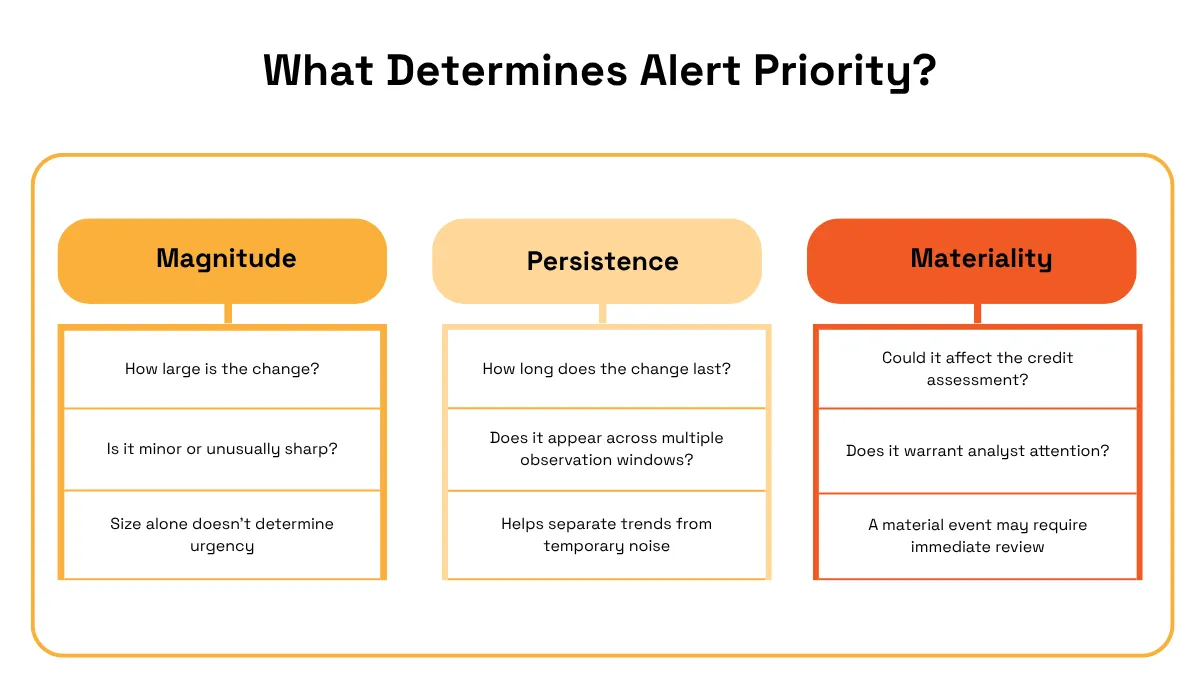
A big change can look urgent on its own, but magnitude alone doesn’t tell you an analyst needs to investigate it.
An issuer’s operating metric can jump sharply for one observation window and then return to its previous range. Compare that with another issuer whose metric deteriorates modestly across several consecutive windows.
The first change is larger, sure. But the second tells you much more. Here’s what these two examples might mean:
Big single change | Small gradual change |
|---|---|
The metric jumps sharply in one window. | The metric worsens modestly across several windows. |
It may reflect a temporary event or reporting anomaly. | It suggests a persistent change in the issuer’s performance. |
That's why persistence is relevant when scoring trend-based alerts.
Repeated observations help you distinguish between an emerging trajectory and a single anomalous data point. And this can happen a lot when you are working with high-frequency feeds where temporary fluctuations are inevitable.
Research on corporate distress supports looking beyond individual signals.
Take this IMF study on non-financial corporate distress. They build their early-warning system using multiple balance-sheet, financial-market, and macroeconomic variables.
However, persistence shouldn't become a blanket requirement either.
Some single events are serious enough to warrant immediate review. Here are a few examples:
- Bankruptcy filing
- Covenant breach
- Acquisition
- Major ownership change
The more important question is materiality: could this new information affect the current credit assessment?
That's also how CRA regulation frames surveillance. ESMA requires CRAs to review ratings when material changes occur that could affect a credit rating, rather than whenever any underlying data point changes.
In the US, the SEC similarly requires registered rating agencies to keep documented surveillance controls.
The visual below explains magnitude, persistence, and materiality side by side:
Source: Veridion
You can treat them as complementary, not interchangeable, dimensions.
A persistent deterioration can gradually accumulate priority. But an urgent enough event can jump straight to the front of the queue.
Weigh Data Confidence and Source Strength
Even an apparently material change becomes less useful when you can't trust the data behind it.
One data feed might flag an ownership change based on a single web source. Another might report the exact same change based on an official filing, backed up by several other sources.
Both alerts tell you the same thing. But the second gives you much stronger evidence that the change actually happened.
In credit surveillance, source quality is part of the analytical foundation itself. Under the EU CRA Regulation, CRAs must base ratings on relevant available information and take measures to ensure that the information they use comes from trustworthy sources.
That gives you another useful scoring dimension: evaluate not just what changed, but how strongly the available evidence supports that conclusion.
And there’s another important aspect here.
Acting too quickly on unreliable data risks treating noise as a meaningful signal. You can end up sending analysts after changes that aren’t even real.
That's why validating enriched data against reliable sources should be part of your broader data-quality process.
This is where structured company data can become one input into the surveillance stack.
Let’s talk Veridion.
As a business data provider for enterprise data teams, Veridion provides live updates about the whole business world, giving you a continuously updated view of the digital business landscape.
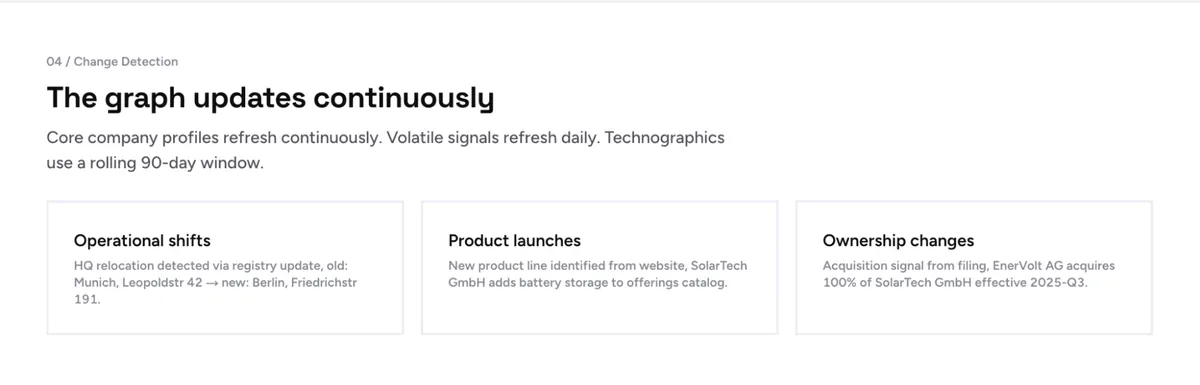
Source: Veridion
Veridion's data methodology delivers a confidence score and source along with each company attribute.
When sources disagree, its system evaluates factors like:
- Recency
- Source authority
- Cross-source corroboration
- Internal consistency
- Supporting evidence
- Signal staleness.
This mix of live, enriched company data and confidence information make Veridion data a useful input into your surveillance stack.
And in surveillance teams, those fields can become inputs to your own priority logic. A high-confidence change can receive more weight, and a weak signal can be routed for corroboration instead of immediate escalation.
Importantly, confidence in a data point isn't confidence in a rating action. The data helps determine which changes deserve investigation. It doesn't determine the rating itself.
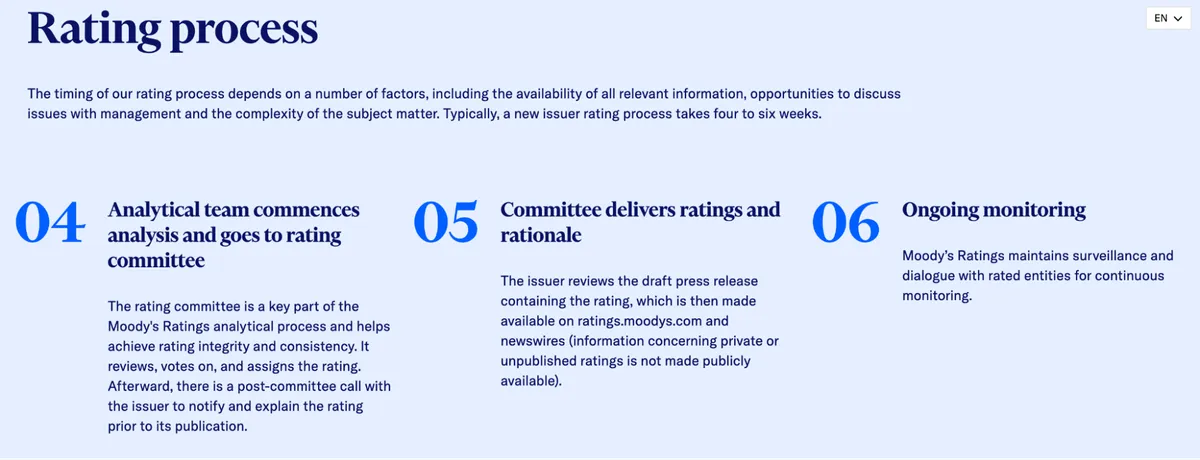
Moody's monitoring policy, for example, describes analysts reviewing relevant information during surveillance.
Source: Moody’s
S&P Global Ratings explains the broader principle: quantitative analysis can inform the assessment, but final rating determinations always require qualitative factors and analytical judgment through a rating committee process.
Automation just narrows the stream to signals worth investigating.
Weigh Issuer Context and Correlated Changes
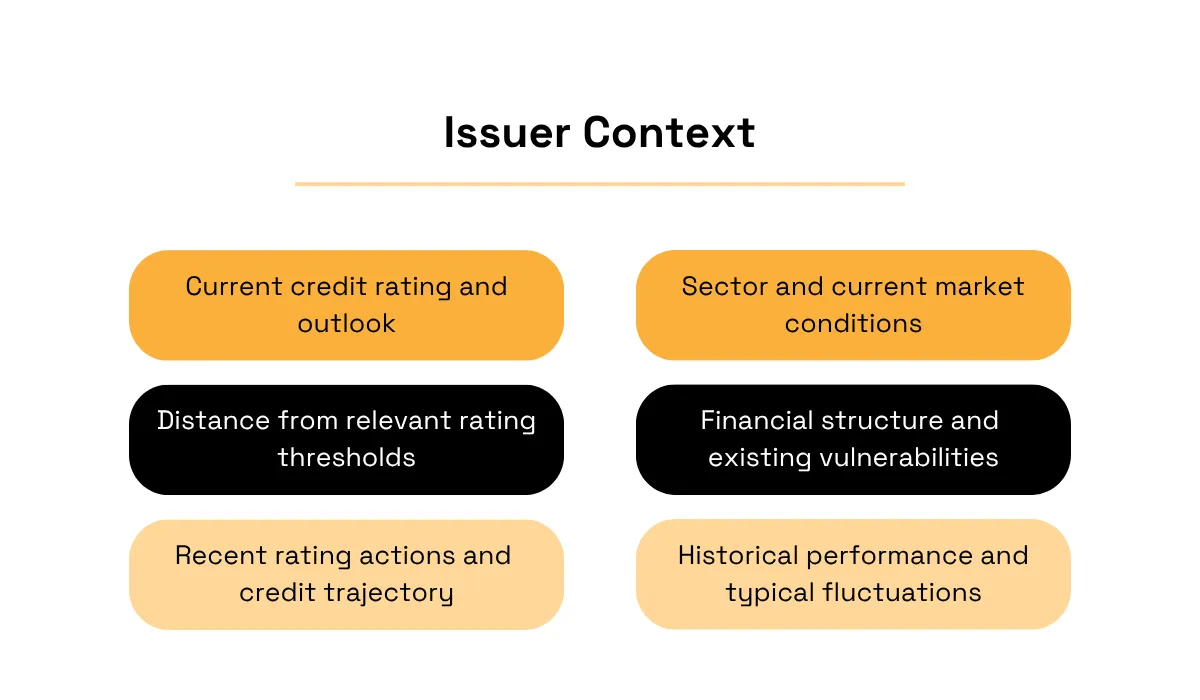
Finally, let’s talk context. In other words: What does this change mean for this issuer?
A deterioration that barely moves the needle for a strong, stable issuer may be a real red flag for one already under pressure or approaching a relevant rating threshold.
Likewise, the significance of a metric depends on the issuer’s:
- Sector
- Financial structure
- Historical performance
- Other assumptions underlying its current rating.
Here are the key factors that help put each alert into context:
Source: Veridion
Current CRA methodologies explicitly reflect this context dependence.
Fitch's 2026 bank rating criteria is a good example.
When a factor or trend could affect a rating, surveillance analysts assess what should happen next. They may:
- Send the issuer to a rating committee
- Request more information
- Determine that no action is needed.
So your alert score should incorporate issuer-specific context next to the raw change.
Next, you should look for correlated changes.
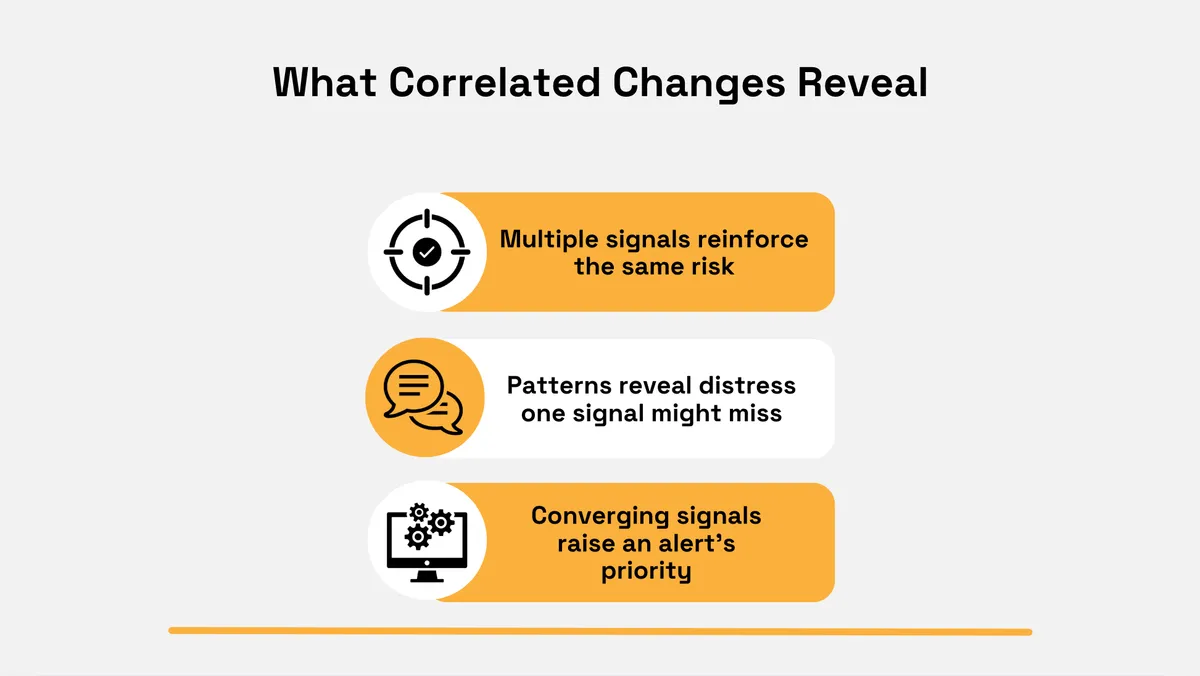
One moderate signal could be inconclusive. But several related signals moving in the same direction can tell you something relevant.
For example, declining employee numbers alone may have several explanations. But declining headcount appearing together with weakening financial indicators and restructuring activity gives you a more coherent pattern of potential distress.
This is consistent with modern credit-risk research.
A 2024 IMF model for monitoring private-company default risk shows this in practice.
Instead of relying on one signal, it combines market data, company financial ratios, and broader economic indicators to assess default risk in real time.
For your prioritization engine, the lesson is straightforward: don't score alerts as if they exist independently.
Look at the issuer's starting position. Then see if other recent changes reinforce the same risk hypothesis.
When several credible signals converge around an already vulnerable issuer, individually modest alerts can make a super high-priority case.
Here are three main things correlated changes can reveal:
Source: Veridion
That context is what turns a change-detection system into a useful surveillance system.
Operate the Alert Queue So Analysts Trust It
Even a perfectly scored alert is useless if it lands in a queue analysts can't trust.
Your workflow must turn priority scores into clear actions, and route alerts with enough context to investigate them. Otherwise, the bottleneck simply moves from detecting changes to processing them.
Here's how to build the operational layer around your scoring model.
Design Severity Tiers and Control False Positives
The first step: translate numerical priority scores into severity tiers that tell analysts what needs attention first.
In credit surveillance, that means more than a generic label. These tiers should reflect the potential consequence for the rating.
Here’s how that might look:
Severity tier | What it captures | Action |
|---|---|---|
Critical | Material events with potential rating impact | Immediate analyst review |
High | Emerging negative trends or credible warning signals | Prioritize for investigation |
Medium | Relevant changes that warrant monitoring | Review and continue monitoring |
Low | Low-confidence or weakly supported signals | Await corroboration or further evidence |
The exact boundaries will depend on your methodology and workflow.
After all, a bankruptcy filing and a small deterioration in an operating metric shouldn't compete for analyst attention just because both crossed a numerical threshold.
As ESMA's CRA Regulation explains, ongoing surveillance is focused on material changes that could affect a credit rating. The emphasis is on “affect a credit rating.”
At the same time, avoid turning every plausible signal into a high-priority alert.
Too many false positives create a familiar problem: analysts spend scarce time disproving noise instead of investigating meaningful changes.
Data from the 2025 SANS Detection & Response Survey is clear about this:
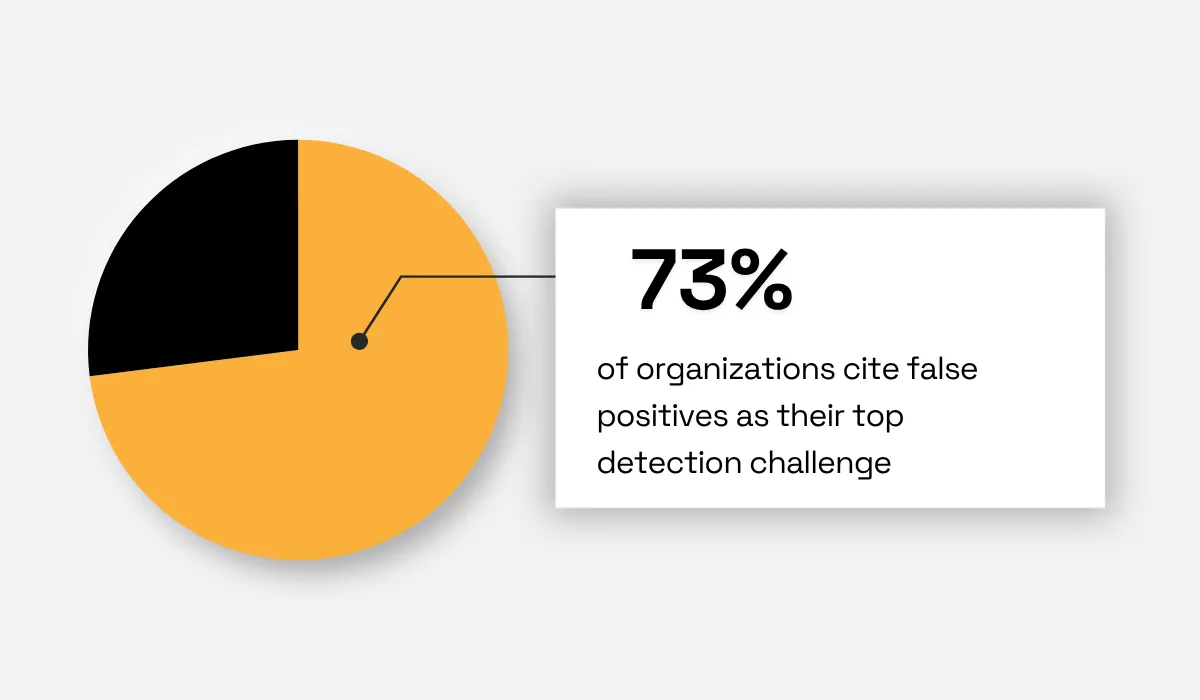
Illustration: Veridion / Data: 2025 SANS Survey
What’s worse, a queue that escalates too much noise trains analysts to ignore it completely.
Research from cybersecurity provides a good workflow analogy.
Exaforce describes "severity inflation" as a situation where too many alerts are escalated out of caution. This gradually degrades the signal-to-noise ratio and trust in the whole triage process.
The lesson transfers neatly to credit surveillance, even though the appropriate thresholds do not. There is no universal "correct" escalation rate for a CRA queue.
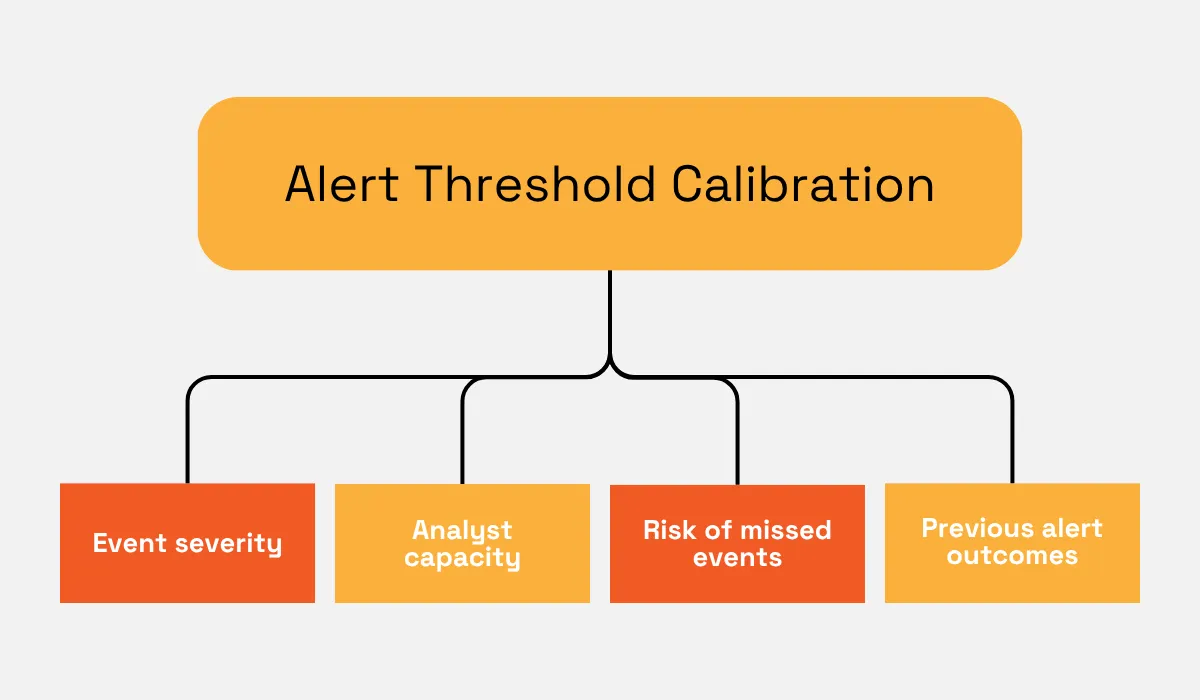
Instead, calibrate your alert thresholds around four key factors:
Source: Veridion
Then measure what happens after deployment:
- Which sources generate the most dismissed alerts?
- Which alert types consistently lead to analyst escalation?
- Are potentially material changes being surfaced early enough?
This kind of historical validation is already central to credit rating methodology governance.
ESMA requires CRA methodologies to be continuous and subject to validation based on historical experience, including back-testing.
Your alert-ranking layer should thus adopt the same basic discipline.
Test its priorities against actual outcomes and adjust when the evidence shows that the queue is getting them wrong.
Design the Queue and Preserve Analyst Override
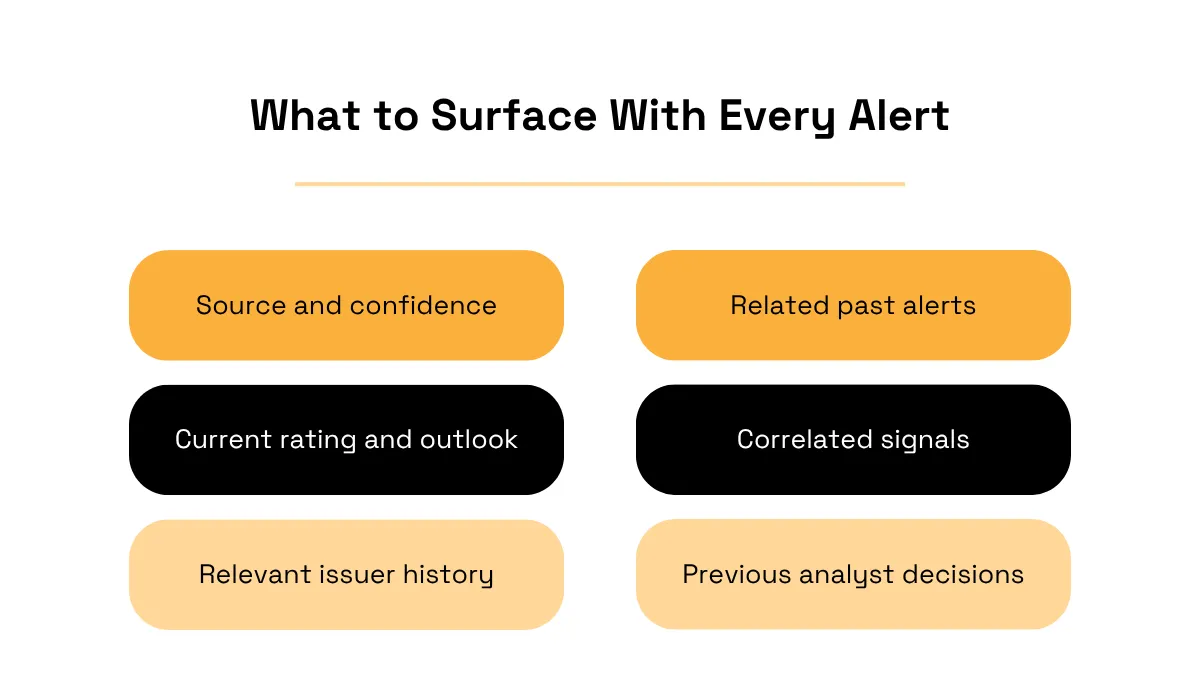
So, you've decided what deserves attention. Now, route each alert to the right analyst with enough context to act quickly.
After the detected change and severity score, here’s what to do next:
Source: Veridion
Think of it as an evidence package, not a notification.
Cybersecurity triage offers another great analogy. Exaforce describes analysts switching between multiple systems just to gather the context needed to investigate an alert.
Credit surveillance involves different evidence, but the principle transfers: analysts shouldn't have to reconstruct the issuer's situation from scratch.
Route alerts by:
- Analyst coverage
- Sector
- Geography
- Ownership rules.
Then keep one vital feature: analyst override.
Automated scores can't account for every issuer-specific circumstance. An analyst can recognize that a moderate signal reinforces an existing concern. Or that an apparently serious change actually has a benign explanation.
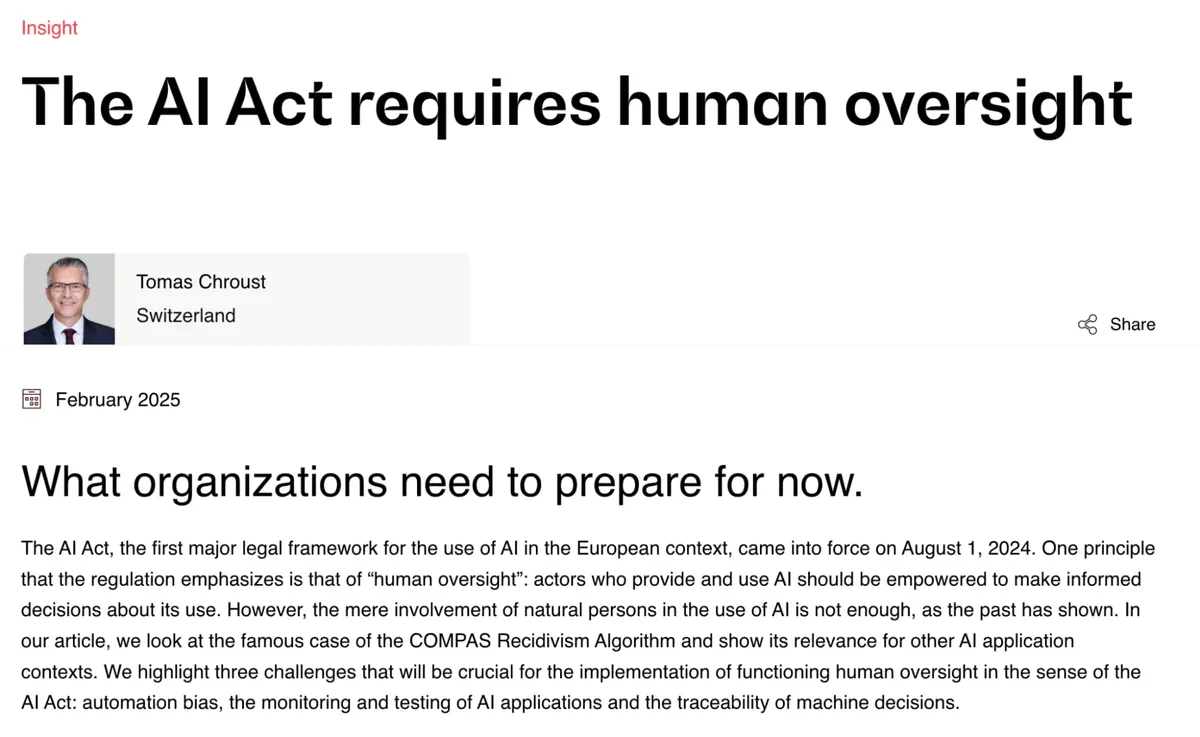
Similar high-stakes systems give human intervention top priority.
The EU AI Act's human-oversight provisions require high-risk systems to let human overseers understand their limitations and override or reverse outputs where needed.
Source: BearingPoint
The principle for your queue is this: automation should prepare the work, not own the decision.
Your system ranks, enriches, and routes. Your analysts investigate and exercise judgment.
Build Feedback Loops That Improve the System Over Time
Finally, every analyst decision creates potentially useful training data. But "dismissed" isn't enough.
Here's how the rationale behind an analyst's decision can help improve the system:
Analyst outcome | What it can reveal |
|---|---|
Alert closed because the data was wrong | Data-quality problem |
Real change dismissed as immaterial | Scoring problem |
Related signals lead to escalation | Correlation logic may be working |
Without that rationale, these outcomes can look identical in your database.
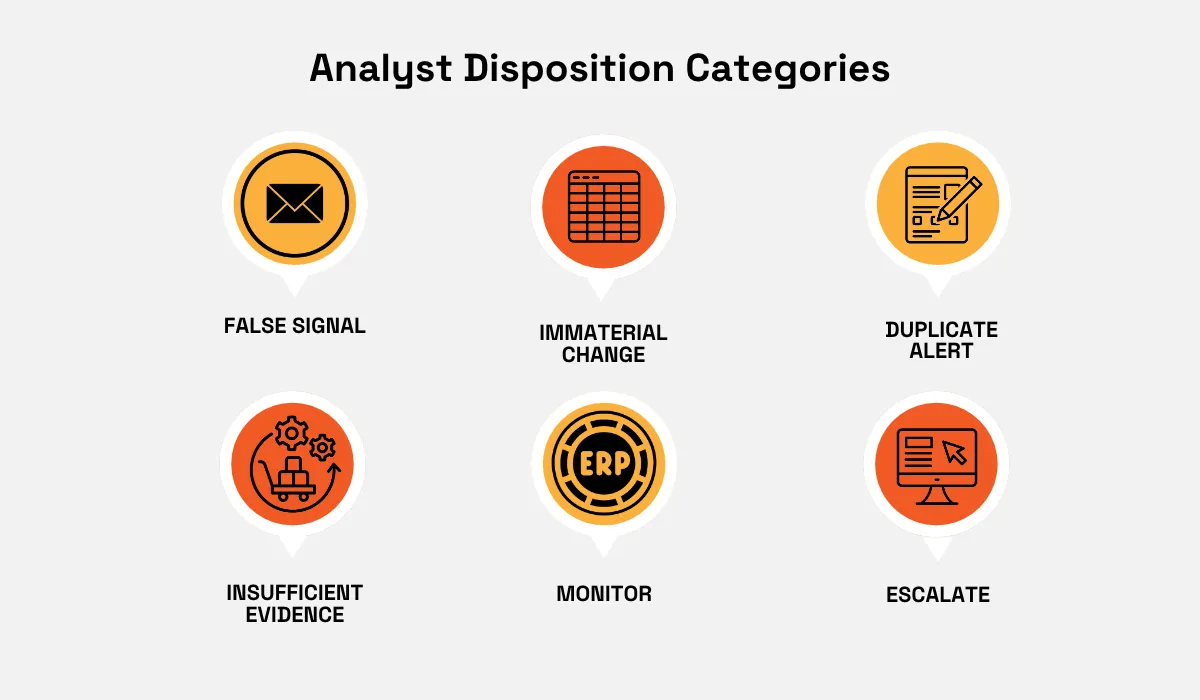
That's why your workflow should show structured dispositions as well as brief analyst reasoning.
Categories might include:
Source: Veridion
Exaforce notes that without documented triage rationales, teams lose institutional knowledge that could otherwise reveal false-positive patterns and improve the system.
In credit surveillance, however, analyst feedback shouldn't automatically retrain your model after every closure.
Instead, treat those outcomes as governed evidence:
- Regularly review dismissed alerts
- Audit decisions for consistency
- Check if particular sources or alert types are being over- or underweighted.
Then use reviewed and approved findings to recalibrate scoring weights, thresholds, correlation rules, or routing logic.
This also aligns with CRA governance. ESMA requires periodic review of methodologies, models, and key rating assumptions, as well as monitoring of systems and internal controls.
As Michael Porter, Harvard Business School professor and strategy expert, put it:

Illustration: Veridion / Quote: Harvard Business Review
That's a smart way to think about alert prioritization as a whole.
Let automation filter what doesn't deserve immediate attention. That leaves your analysts more time for the decisions that actually need human judgment.
The goal isn't simply a faster queue, it's a more defensible one, with evidence and appropriate review behind every change to its prioritization logic.
Conclusion
At scale, better surveillance isn't about generating more alerts. It's about making the right alerts impossible to miss.
Score changes intelligently, then give analysts the context and authority to challenge the system. Do this well, and thousands of signals become a queue humans can actually trust.
Articles
Discuss how these trends affect your organization.
Our analysts are available for a short call. Bring a specific question and we will ground it in the data.
Insights
Keep reading
More analysis, research, and outcomes grounded in live company intelligence.
Best Practices for Data Enrichment
Learn how data enrichment best practices help businesses turn raw data into accurate and actionable insights.
What Are the Benefits of Data Enrichment?
Want to understand the benefits of data enrichment? This guide will explain how enriched data supports better decisions and analytics.
9 Essential Sources of Market Intelligence
Want to boost your market knowledge? These 9 market intelligence sources will show you where to look and how to apply the insights.