Insights / Articles
Credit Risk Early Warning Signals: Company Changes Worth Monitoring
Looking into credit risk early warning signals? This guide will explain which company changes can indicate emerging financial or operational risk.

- A borrower’s risk profile can change while its headquarters and registered industry code stay the same.
- Headcount cuts carry more weight when they coincide with location closures or discontinued offerings.
- Weekly data refreshes help catch company changes sooner, but disclosure delays still affect detection.
Your borrower can change long before its next financial report arrives. That’s why credit risk early warning signals are there.
They’re the changes in company status, ownership, footprint, activity, headcount, or jurisdiction that can reveal emerging risk before financial statements do.
Weekly refreshed company data, like Veridion’s, helps you monitor these changes across your portfolio easily.
We’ve compiled the quick guide below on what to watch and when to review.
Business Status and Ownership Changes
Start with changes to a company’s legal status and controlling ownership.
When these changes are confirmed through official records, they’re your clearest signals. They establish a specific event, not an operational trend you need to interpret.
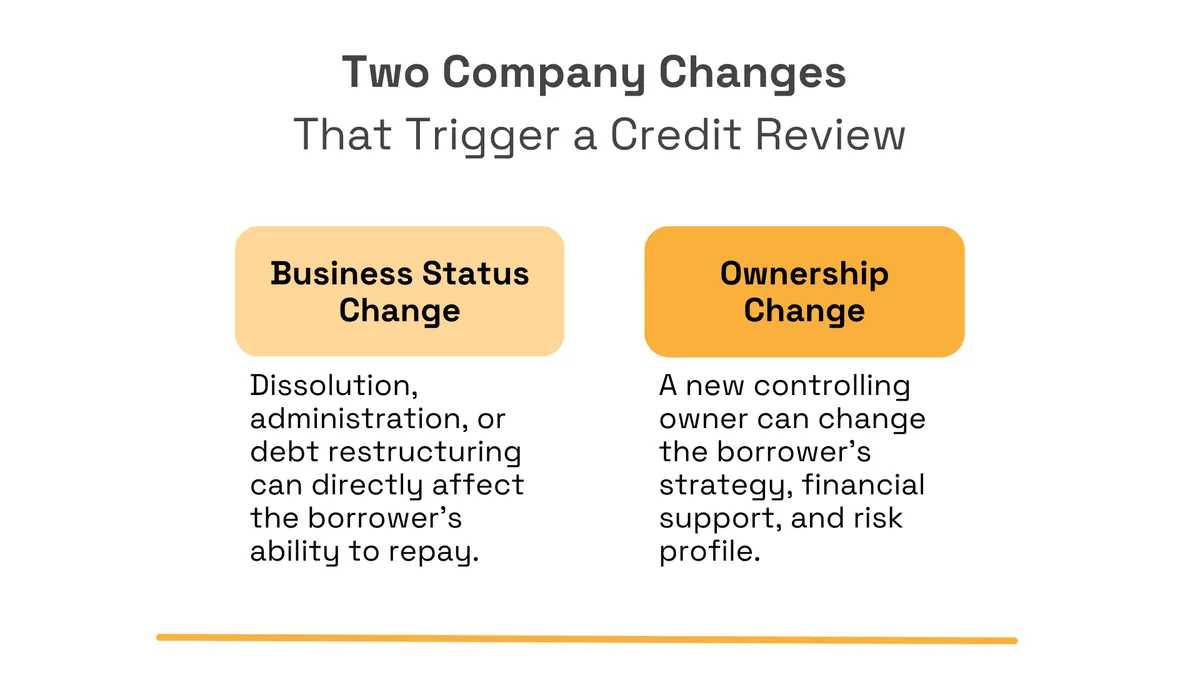
First, let’s see business status change and ownership change side by side:
Source: Veridion
A change in business status needs immediate attention. That can be a borrower:
- Entering administration
- Beginning a formal debt restructuring
- Being dissolved
After any of these changes, review your exposure without waiting for the next scheduled assessment.
These events can change who controls the business, how creditors recover their money, and whether existing repayment arrangements are still viable.
UK government guidance, for example, explains that administration can mean a company “does not have to pay all its debts in full.”
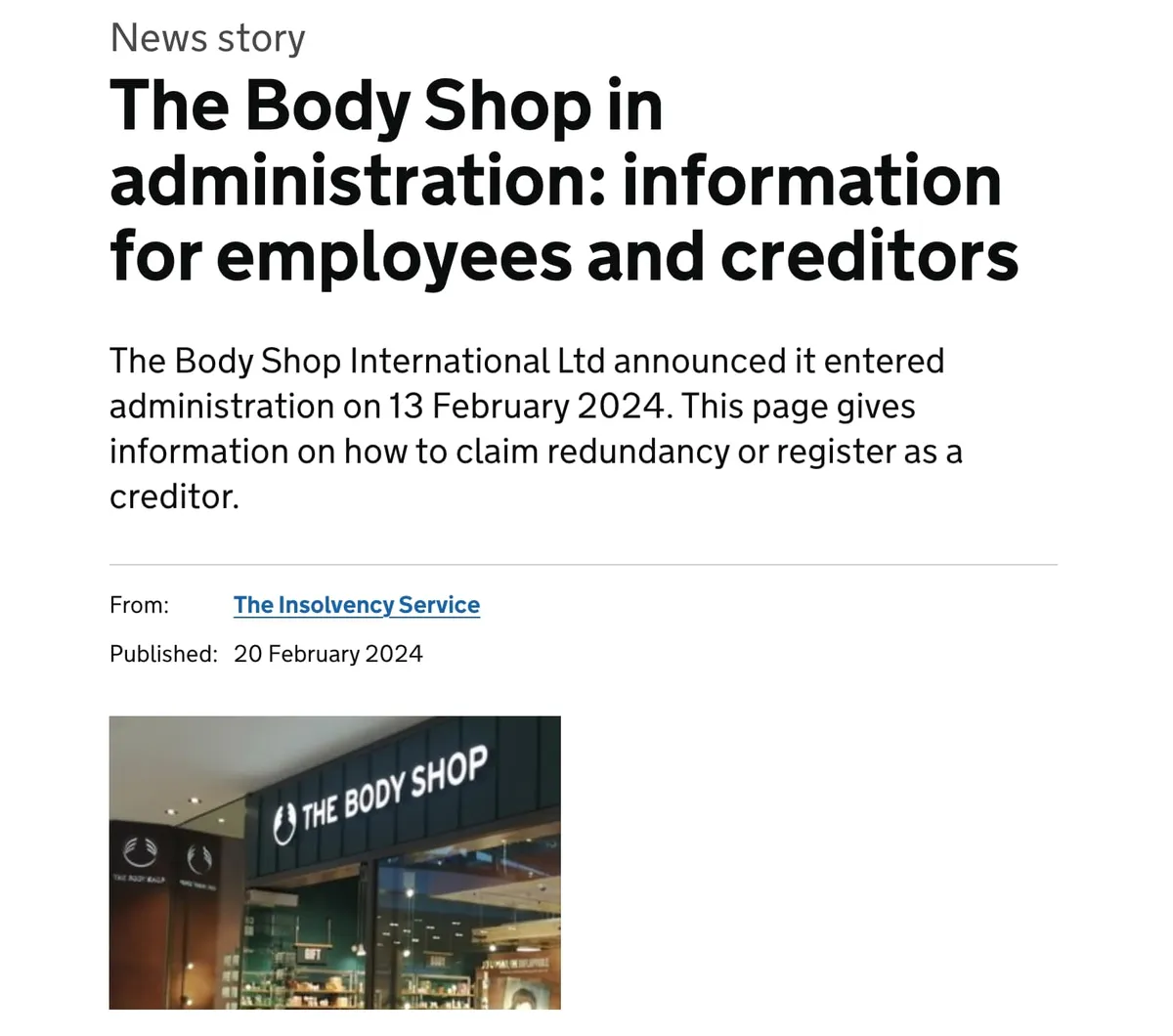
Take The Body Shop International Limited, which entered administration in February 2024.
Source: UK Gov
For a lender exposed to that entity, the appointment of administrators would warrant an immediate review of repayment prospects and recovery options.
Administration is already a distress event (rather than an early hint of trouble). So its place in your monitoring framework is to ensure you act promptly if the borrower’s legal position changes.
A change in controlling ownership requires reassessment, too.
A new majority shareholder or controlling party can:
- Introduce different borrowing plans
- Change dividend policies
- Alter expectations of financial support from the parent company
And this can happen even when the borrower’s products and operations look unchanged on paper.
For example, if a borrower changes parent companies, reassess financial support and any change-of-control provisions.
However, public visibility can lag the event itself.
In the UK, companies must report changes to people with significant control within 14 days of confirming the change. So that deadline is not a guarantee of immediate disclosure.
That makes disclosure timing only part of the challenge: once a change becomes public, your monitoring needs to catch it.
This is where Veridion can help you.
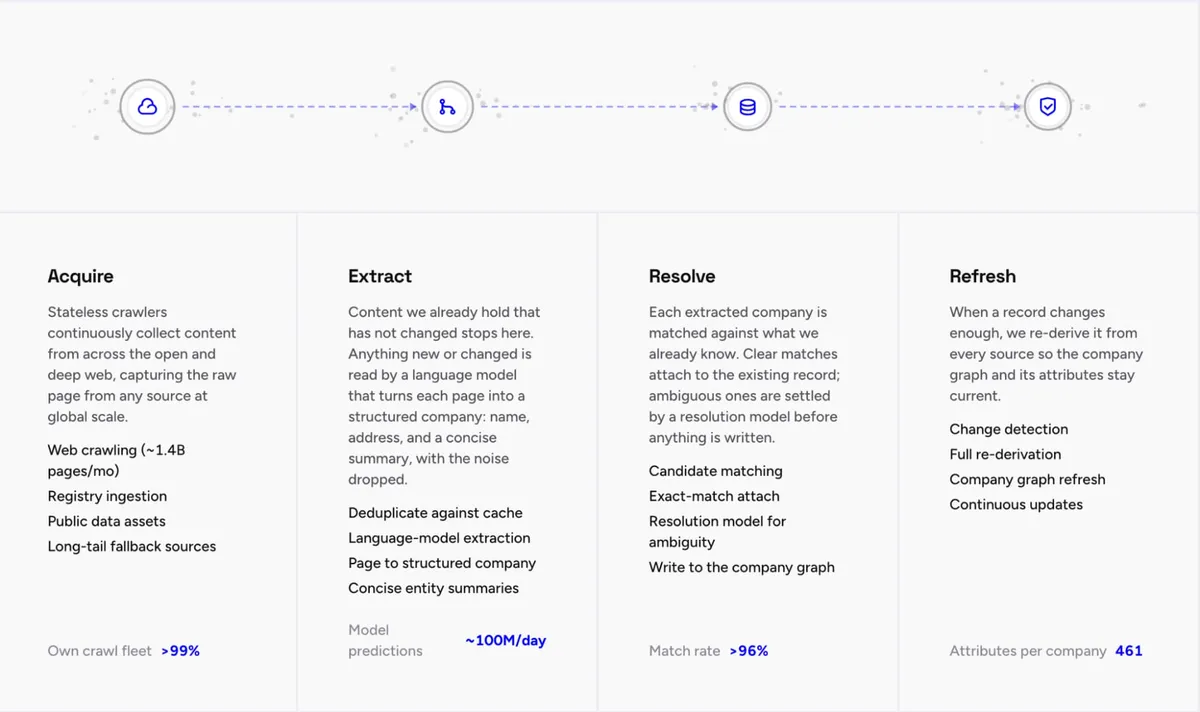
Veridion’s weekly refreshed company data and corporate hierarchy help you track status and ownership changes over time. In a nutshell, you can flag these changes between scheduled reviews and connect them to the relevant borrower.
Source: Veridion
Across 744.5M companies, Veridion turns web and registry content into structured records. Our platform resolves ambiguous matches and links relevant information to the correct company. That’s your foundation for reliable data enrichment.
Each data point traces back to sources and reasoning you can verify. Your credit team ends up with solid evidence to investigate a flagged change.
Set your trigger around the confirmed event: a material status change or a new controlling owner. Then, verify the affected legal entity, establish what changed, and reassess the assumptions supporting your credit decision.
Operating Footprint Changes
A borrower’s headquarters can stay the same while its operating footprint shrinks. If you just monitor the registered address, you can miss changes that suggest cost-cutting or demand pressure before their full effects appear in reported revenue.
Here’s what to watch for and what each change can mean:
Change to watch | What it can mean |
|---|---|
Gradual contraction across operating sites | Sustained cost-cutting or weaker demand |
Closure of an individual facility or office | Consolidation to improve efficiency, or withdrawal from an underperforming operation |
Closure or loss of a critical operating site | Reduced capacity to generate the cash needed for debt payments |
Let’s talk about a sustained contraction in physical presence first.
A company moving into smaller premises, consolidating offices, or withdrawing from several markets may be reducing costs to protect its ability to meet obligations.
In this case, compare the new footprint with the one you assessed when extending credit.
Assess how the contraction changes the borrower’s ability to service debt:
- Pace: Rapid, unplanned cuts can suggest urgent cash pressure and warrant a prompt review.
- Activities affected: Reductions in core revenue-generating operations raise more concern than cuts to surplus office space.
- Remaining capacity: If the remaining sites cannot support expected sales, the borrower may generate less cash for debt payments.
A confirmed closure gives you a specific event to investigate. If it removes excess capacity but preserves sales, lower costs could actually strengthen repayment capacity. But if it reduces the borrower’s ability to serve customers, it could weaken it.
In other words, you also need to understand why the operational change happened.
Best Buy is a good example here.

Source: ABC7
In the 2024 fiscal year, the issuer closed 24 large-format stores as it was completing eight Experience store remodels. They described their approach as adapting to changing shopping behaviour and improving store efficiency.
For a credit team, those closures justify checking the execution of the strategy and its effect on repayment capacity. But they don’t confirm any financial distress.
To distinguish a planned adjustment from a warning sign, answer these questions:
- Do closures match an announced strategy?
- Is there replacement capacity?
- Is the company still investing in its remaining operations?
Unexpected closures across several regions, especially alongside headcount cuts or discontinued offerings, deserve closer scrutiny.
Then there’s the loss of a key operating site.
Closing a primary production facility or a flagship location can affect the borrower more than shutting several smaller offices.
Say a borrower closes the only facility producing its main product. Now, review how it will maintain sales and service its debt. And if that site also secures your loan, reassess the implications for collateral and recovery.
Veridion’s location-level company data helps you examine operating sites individually, instead of relying on the headquarters address alone. Our Location Resolver distinguishes actual business locations from registered or mailing addresses.
Define your review trigger around the scale, speed, and importance of the change.
A confirmed closure of a critical site may warrant immediate review. But a gradual contraction needs comparison with the borrower’s strategy and other company risk signals.
Activity and Product Changes
This is one of the easiest categories to miss. Why?
A borrower can change what it does without its registered industry code immediately reflecting the shift. So if you’re just doing registry-based monitoring, you can miss changes to the business model supporting your credit assessment.
Monitor shifts in actual business activity. For example, a company moving from manufacturing equipment to licensing technology changes the activities generating its cash flow, and therefore the risks you have to assess.
The new model may involve different:
- Customers
- Contract terms
- Regulatory requirements
- Investment needs
So even if the company keeps its name and legal entity, your original assumptions about repayment capacity might need updating.
Registered classifications provide useful context, but they depend on companies reporting changes.
For example, Companies House instructs UK businesses to update their Standard Industrial Classification (SIC) codes by filing a confirmation statement. But the code is not a live record of operational activity.
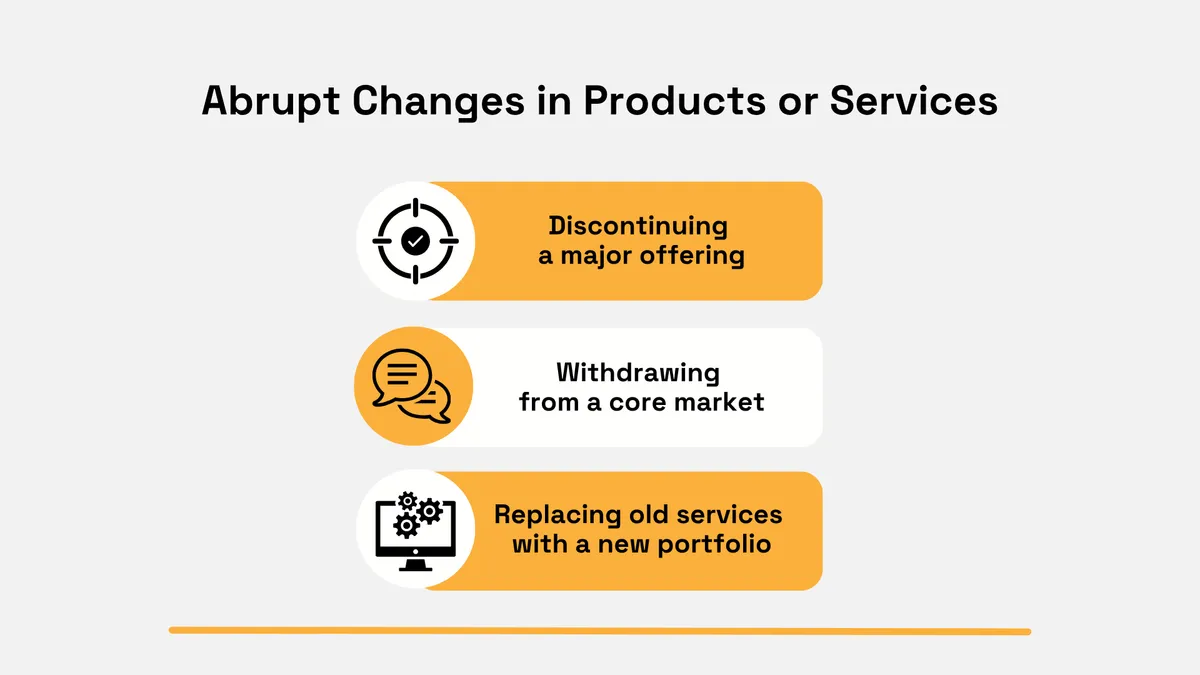
An abrupt change in products or services deserves equal attention.
Here’s what that can mean in practice:
Source: Veridion
These changes can reflect a strategic pivot or financial pressure; either warrants a closer look.
Take what General Motors did in December 2024.

Source: GM
The issuer announced it would stop funding Cruise’s robotaxi development and refocus its autonomous-driving efforts on personal vehicles. GM cited the time and resources needed to scale the robotaxi business, along with increasing competition.
GM expected the restructuring to reduce their annual spending by more than $1 billion once completed.
For creditors, this changes both expected spending and future revenue opportunities. So review:
- Whether the savings strengthen repayment capacity
- What the transition costs
- Whether forecasts still assume revenue from the abandoned activity
The review here shouldn’t automatically assume increased or decreased risk. Instead, it should test the replacement business model.
Start by comparing current product pages, service descriptions, and company announcements with the previous profile.
Check if a disappearing offering represents:
- A confirmed discontinuation
- A rebranding
- A simple website update
Veridion uses web content to classify companies by their actual activities. That helps you identify shifts that a registered industry code may not show yet. This adds an operational view to your credit risk monitoring.
Trigger a review when the change affects a core activity or an offering material to repayment capacity. Then see what replaces it, how credible the transition plan is, and, of course, if your current credit assessment still fits their business.
Headcount Changes
Workforce reductions can reveal a borrower’s response to weakening demand or cost pressure. This also happens before the full impact shows up in financial statements.
A sudden decline can also change the company’s ability to deliver the products and services that support repayment.
Here’s what to watch out for:
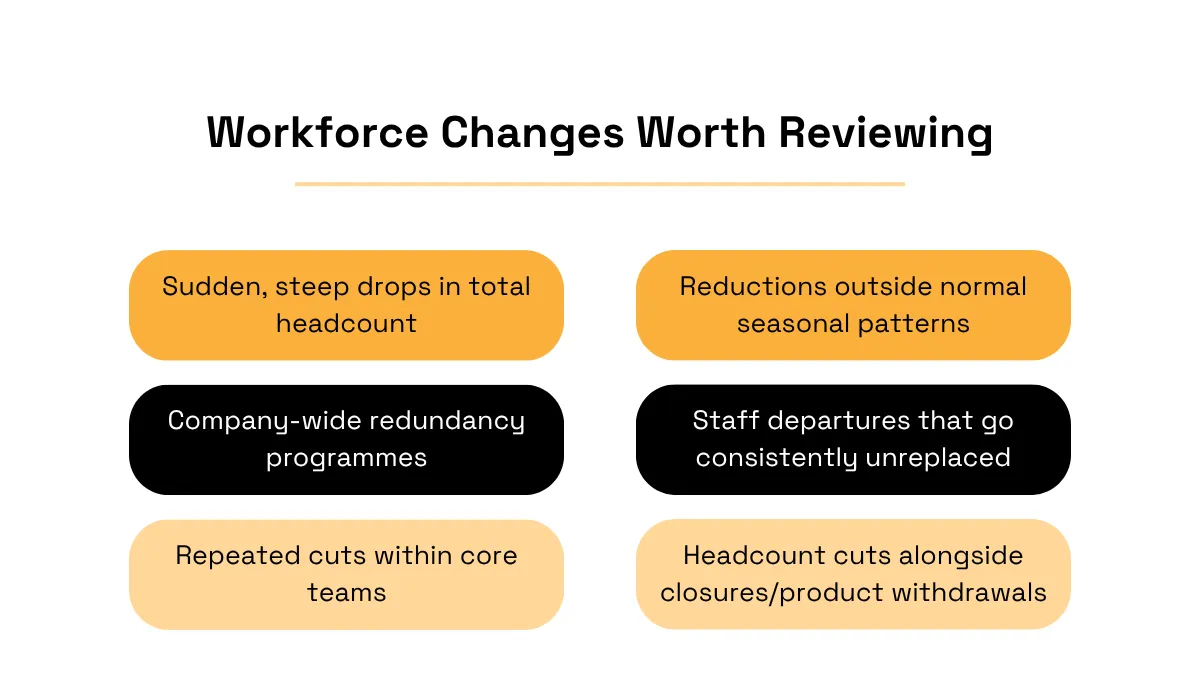
Source: Veridion
Make sure you calibrate your threshold against the company’s history, sector, and workforce size. A 50-employee drop means something very different at a business employing 200 people compared to one with 20,000.
Then, measure both the percentage decline and its speed against the borrower’s usual staffing pattern.
A 10% reduction in one quarter could be the point at which you investigate, especially at a business with a usually stable headcount. Remember, your thresholds should reflect the sector, size, and seasonality.
Make sure you distinguish routine turnover from net contraction: departures alone don’t indicate a shrinking workforce if employees are replaced.
Headcount decline is a weak signal on its own, but is useful alongside other company changes. Cuts combined with site closures or discontinued products give you more reason to reassess repayment capacity.
Peloton’s 2024 restructuring plan illustrates this combination nicely.

Source: Peloton
The issuer announced an approximately 15% workforce reduction, affecting about 400 employees, together with continued retail closures.
For a lender, this raises a practical question: can the borrower achieve savings while preserving the operating capacity needed to service debt?
But before you escalate, confirm that headcount figures cover the same:
- Entity
- Employee population
- Measurement basis
Changed data coverage or a subsidiary sale can otherwise resemble workforce contraction.
Use a verified, unusual decline to trigger review, and give it higher priority when footprint or activity changes reinforce it.
Jurisdiction Changes
A borrower’s geographical exposure can develop gradually: think overseas expansion, new subsidiaries, and shifts in operating locations.
That’s why it’s easy to under-weigh these changes. The headquarters stays familiar, but the business takes on risks outside your original assessment.
Watch for new exposure to jurisdictions your credit policy identifies as higher risk. Use these observable changes to trigger a review, then assess their implications for repayment.
Change to watch | Observable review trigger | What the review should assess |
|---|---|---|
Overseas expansion | A confirmed announcement or opening of an operating site in a higher-risk jurisdiction | Planned investment, currency exposure, and regulatory requirements |
A new subsidiary | A newly registered or acquired subsidiary in a higher-risk jurisdiction appears in the borrower’s corporate structure | Its purpose, funding, obligations, and links to the borrower |
Relocation of a core operation | A confirmed plan to move a core activity into a higher-risk jurisdiction | Transition costs, continuity of revenue, and access to cash |
These triggers prompt investigation. They don’t automatically establish increased credit risk.
For example, a borrower repaying a euro-denominated loan might expand into a market with exchange restrictions. Its new operation could trade successfully but struggle to convert local earnings into euros for debt payments.
The Basel Committee calls this transfer risk. Its supervisory principles call for banks to monitor it together with country risk and individual borrower exposure.
Here’s what a new operation can also introduce:
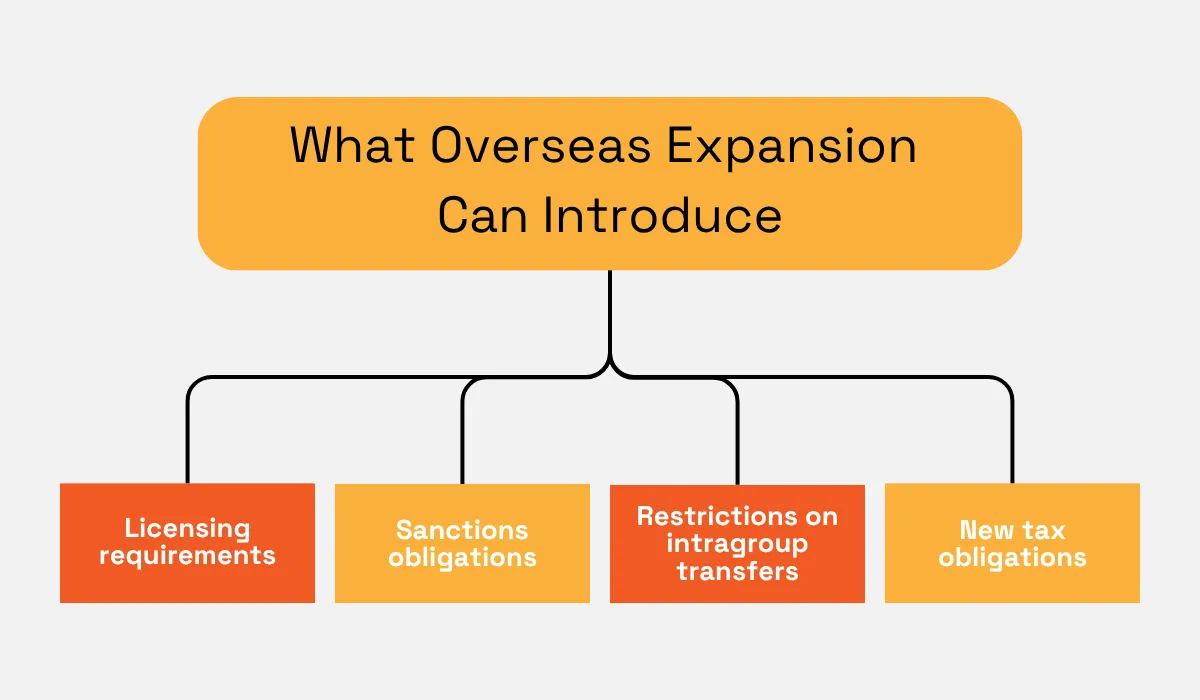
Source: Veridion
Use relevant country-risk assessments and applicable rules to define “high risk.” The Financial Action Task Force (FATF) lists flag financial crime concerns, which may be useful if you’re looking at potential sanctions or licensing breaches, but they don’t give you a complete credit risk assessment.
For your data team, link new subsidiaries and operating sites to the borrower’s corporate hierarchy, then compare its country footprint across updates.
Trigger review when the change materially affects:
- Operating conditions
- Access to cash
- Portfolio country concentration
So check how much of the borrower’s revenue, assets, or operations their new jurisdiction represents. Greater concentration means disruption could have a bigger effect on repayment.
Then assess any protections. For example, currency hedging can reduce exchange-rate exposure, but it doesn’t remove any sanctions risk or restrictions on cash transfers.
Conclusion
Company changes can reveal emerging credit deterioration before its full impact reaches financial statements. That’s why monitoring continuously helps you catch those changes and react in good time.
So start with two or three signals that matter most to your portfolio. Define the change that would trigger a review, then check how quickly your current data would actually show it.
An early warning is useful only when it reaches the right team early enough to act.
Articles
Discuss how these trends affect your organization.
Our analysts are available for a short call. Bring a specific question and we will ground it in the data.
Insights
Keep reading
More analysis, research, and outcomes grounded in live company intelligence.
Best Practices for Data Enrichment
Learn how data enrichment best practices help businesses turn raw data into accurate and actionable insights.
From Annual Review to Continuous Credit Risk Assessment
How continuous credit risk assessment works in practice: setting a baseline, choosing refresh cadence, defining triggers and routing changes.
Using Alternative Firmographics for Faster SMB Credit Risk Assessment
Struggling with slow SMB credit risk assessment? Uncover how alternative firmographics can revolutionize your process and speed up decisions.