Insights / Articles
Customer Risk Analysis: From Onboarding Checks to Continuous Monitoring
Customer risk analysis continues after onboarding, with a baseline, periodic reviews, continuous monitoring and escalation.

- Your onboarding profile can become outdated long before the relationship ends.
- A risk rating set at onboarding is a snapshot, not a permanent record.
- Material events should change both the risk rating and the monitoring response.
- Escalation only works when the threshold and the owner are set before risk crosses it.
A risk profile developed during onboarding is a first step, and it’s not immutable. The ownership can shift. The scope of operation can grow or shrink. New subsidiaries might arise. The business can move into new jurisdictions or covertly transform its activities.
If you treat the original dataset as permanently valid, real deterioration can go unnoticed for years.
This guide covers the full lifecycle of customer risk analysis, from the checks that establish who a business is to the reviews and triggers that keep that picture accurate.
1. Verify the Customer at Onboarding
Your first risk decision is only as reliable as the customer profile behind it. Onboarding enables you to establish who the business is, what it does, where it operates, and how it is structured.
First, verify the legal name, registration identifiers, incorporation and operating status, registered and trading addresses, ownership and control, and parent-subsidiary relationships.
Then verify the operating profile: locations, industry classifications, activities, products or services, size, and the jurisdictions where the company operates.
Each of these core pieces of information provides different insight, and skipping one leaves a gap that can surface later as a surprise.
For lending and underwriting, go beyond the declared industry code. A hauler, for instance, may also run a repair workshop, store goods, or operate a training center. Those activities create different credit, liability, property, and operational exposures.
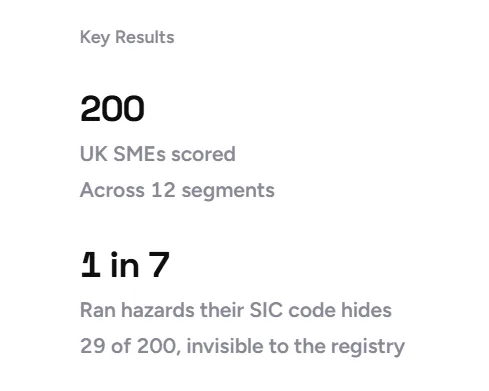
In a Veridion analysis of 200 UK SMEs, nearly one in seven businesses carried hazardous operations that their Standard Industrial Classification (SIC) code did not account for.
Source: Veridion
Additionally, isolate legal identity from operating reality. A company may remain legally active while changing locations, adding facilities, shifting its product mix, or expanding into new markets.
While it is tempting to treat a completed onboarding checklist as the end goal, it can expose you to risk.
Here is the best way to do it: match each document to a canonical company identity, then compare the customer's data against independent registers and trustworthy public/commercial databases.
Preserve the source, date, and confidence for every important field and flag conflicts for review instead of silently selecting one value.
This approach ensures your onboarding ends with a dated, evidence-backed profile, not the assumption that it will remain correct.
2. Establish the Initial Risk Baseline
Once you know who a business is, you need to turn that picture into an actual risk grade, not just a completed file. This requires creating an initial risk baseline.
A working baseline captures two things: the assessed risk level and the reasoning behind it.
Record why a customer landed where they did. This lets a reviewer later tell the difference between a company whose risk genuinely changed and one whose risk was simply reassessed by someone applying different judgment.
What factors play a role in assigning that grade, and what weight to give each factor, depends on the application. For example, a commercial lender might value creditworthiness, leverage, industry prospects, management quality, collateral, and group risk more than anything else.
An insurer may prioritize operational considerations, asset locations, products, perils, and policy-based exposure.
The Customer Risk Team, by contrast, may place greater emphasis on ownership clarity, legality, geographies, and observable validation of the declared profile.
The scoring model should reflect those differences rather than using a generic "customer risk score" and applying it identically to every decision.
The Office of the Comptroller of the Currency states that rating criteria should be clear, precisely defined, and based on objective and subjective factors. Ratings should also reflect expected borrower performance and transaction structure.
With this in mind, define which company attributes matter for each use case and how those attributes influence the assessment.
Most importantly, preserve the baseline historically. When the customer changes six months later, your analyst should be able to see what was known at onboarding, what assumptions were made, and which factors have since changed.
This makes a risk rating only a reference point, not a permanent attribute.
When creating your scoring model, you can document the baseline in four layers:
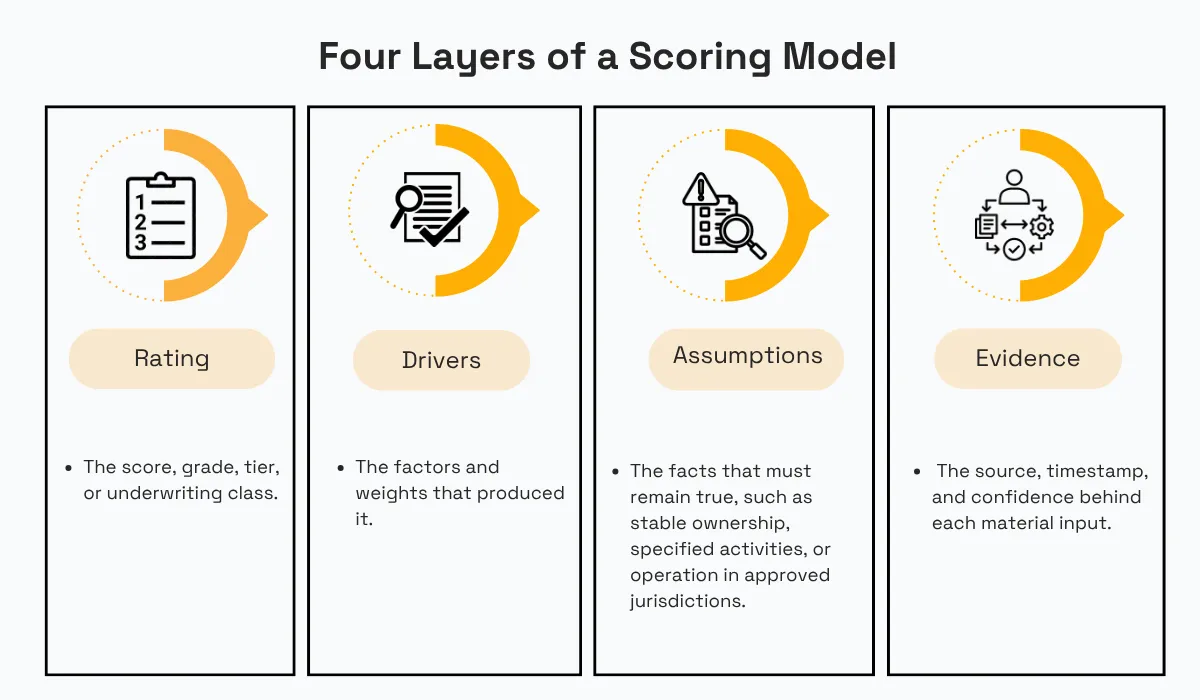
Illustration: Veridion
After that, determine how you would test your baseline. Check your ratings against defaults, claims, losses, exceptions, and overrides by analysts.
Analyze rating migrations and extract cases where risks grew before the model detected them. This turns a baseline into a controlled decision log, not just another number.
3. Reassess Risk Through Periodic Reviews
Periodic reviews give you up-to-date insight into whether your customer profile and risk classification remain accurate months after onboarding.
They create a formal control point to collect updated information, check assumptions, and document a decision.
The review should compare the customer's current state with the original baseline and the most recent approved profile.
How often you review risk should be determined by the type of risk and exposure. Anti-Money Laundering Specialists (ACAMS), an anti-financial crime community, describes a common example: annual reviews for high-risk customers, every 24 months for medium-risk customers, and every 36 months for low- or standard-risk customers.
The time periods used by ACAMS are examples, not hard-and-fast rules. When deciding how often to review, consider factors such as the size of your exposure, volatility in your sector, the jurisdiction in which you operate, product complexity, and information availability.
Real lending policies show what this looks like in practice. One US community bank's loan risk rating policy, disclosed in its own SEC filings, requires at least 80% of its commercial real estate loan book reviewed annually, with lines of credit reviewed at every reaffirmation and borrower credit scores refreshed at least once a year.

Source: US SEC
This is not an aspirational target. It is a minimum set by the bank's risk rating and review policy, because if you assign a rating and never review it again, it becomes meaningless.
Now, the important distinction. Do not simply repeat the onboarding checklist. Reconstruct the profile as it exists today, compare each material field with the baseline, and assess the effect of every difference.
Ask what changed, when it changed, what evidence supports the update, and whether it affects the current rating.
Stale inputs can hide deterioration. A 2025 Federal Reserve study of commercial real estate loans found that financial information one quarter more out of date was associated with a 3.77-basis-point increase in default probability. That was 9.5% above the sample's average default probability of 0.396%.
While these results do not prove that staleness caused each and every default, they do provide evidence that you should not rely on outdated borrower information for reviews.
Therefore, adopt a review template that shows old value, current value, source, date detected, materiality assessment, rating effect, reviewer, and approval. That structure keeps the review focused on change and decision impact.
4. Monitor Company Data Continuously
Scheduled reviews have gaps that continuous company-data monitoring covers. Ongoing monitoring catches changes while they're still relevant and useful, rather than months later at the next cycle.
The goal is to identify relevant changes between formal reviews. Focus on changes to the business itself, such as operating status, ownership, locations, operating footprint, business activities, products or services, subsidiaries, and jurisdictional exposure.
This is different from transaction monitoring or sanctions screening. The question here is simpler:
Has the business itself changed in a way that could affect the customer's risk profile?
That could be a new operating location, a newly established subsidiary, a change in ownership, an expansion into a different industry, or evidence that the company is operating differently from the profile recorded at onboarding.
The value of continuous monitoring depends on the freshness and breadth of the underlying company data.
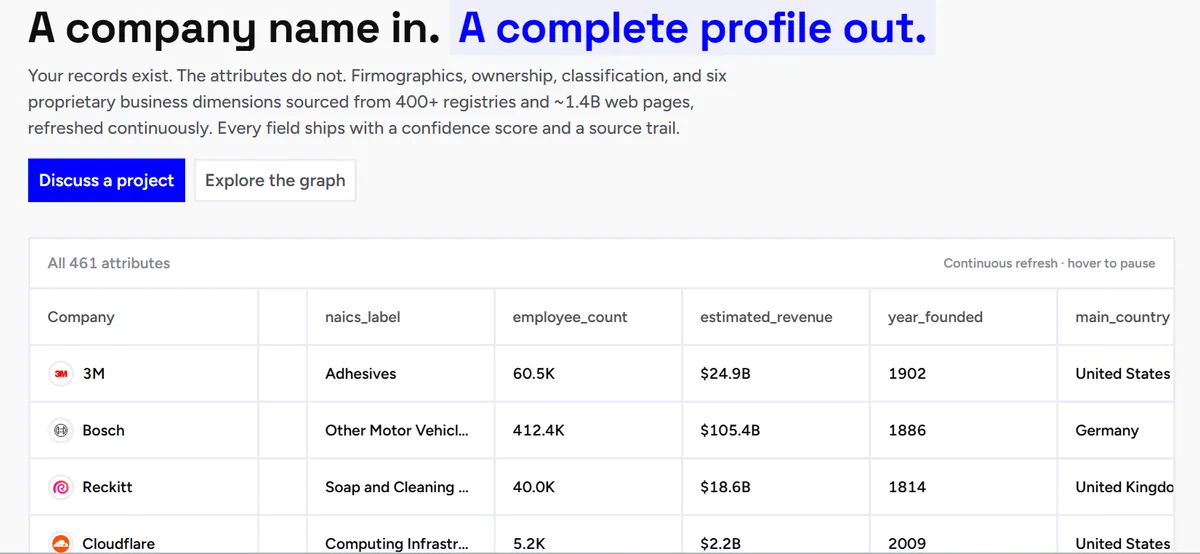
That is exactly where continuously refreshed company data becomes useful. Veridion tracks structural change across active companies.
Source: Veridion
The platform can also support both the initial enrichment of an onboarding file and the ongoing updates that keep a profile current afterward, rather than treating the two as separate problems solved by separate tools.
A UK card and payments provider used this kind of data to solve a specific gap: its own transaction data only showed growth or distress after the fact, once spend had already shifted.
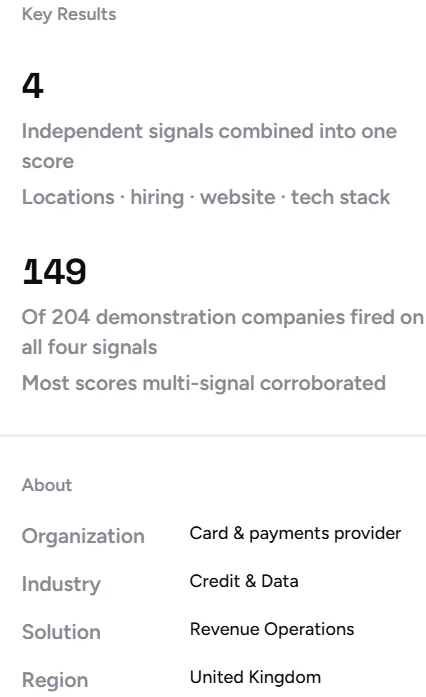
Using Veridion's company knowledge graph, the provider built a single explainable growth score for every company in its book, drawing on four independent, observed signals: net change in physical locations, employee-count trajectory, a year-over-year read of the live website, and verified moves to a more modern tech stack.
Across the 204-firm sample, the score neatly separated the book into significant decline, stability, or strong growth. Of these firms, 149 were supported by three or four triggers, not just one nice number.
Each score was translated into action. For risers, it meant proactive cross-sell. For weak ones, it implied account retention and exposure management.
Source: Veridion
This holds beyond one specific use. Identify the company characteristics that actually drive your business decisions, and watch them, rather than trying to track everything at once.
5. Reassess Risk When a Material Event Occurs
Not every data update deserves a full reassessment, and treating them all the same way wastes analyst time on changes that carry no real risk signal.
The changes worth pulling a file back into review are the ones that could invalidate the original risk assessment outright: a change in ownership, a shift in business activities, entry into a new jurisdiction, a major expansion or contraction, the closure of a key location, or the creation of a new subsidiary.
These are structural changes to the business itself, not noise in the data.
Sardine, a fraud prevention company, uses a customer lifecycle management framing to show why the distinction matters, with a simple example: a sole trader onboards as a modest, local online shop and is rated low risk. Two years later, an overseas holding company acquires the business, and it starts sending large cross-border payments.
If a program lacks triggers, the ownership change and payment shift sit in two different systems, with no follow-up requested. As a result, the customer continues to be treated as the low-risk local store it no longer is.
Triggers and thresholds can address this by focusing on customers that need attention, rather than spreading review effort evenly across the portfolio where little has changed.
So determine your thresholds by factors and portfolio. This will help you shift focus away from manual, fixed-point-in-time profiles toward more dynamic ones that automatically initiate appropriate review action when the client's risk status changes.
Use a simple decision sequence when defining triggers and setting thresholds:
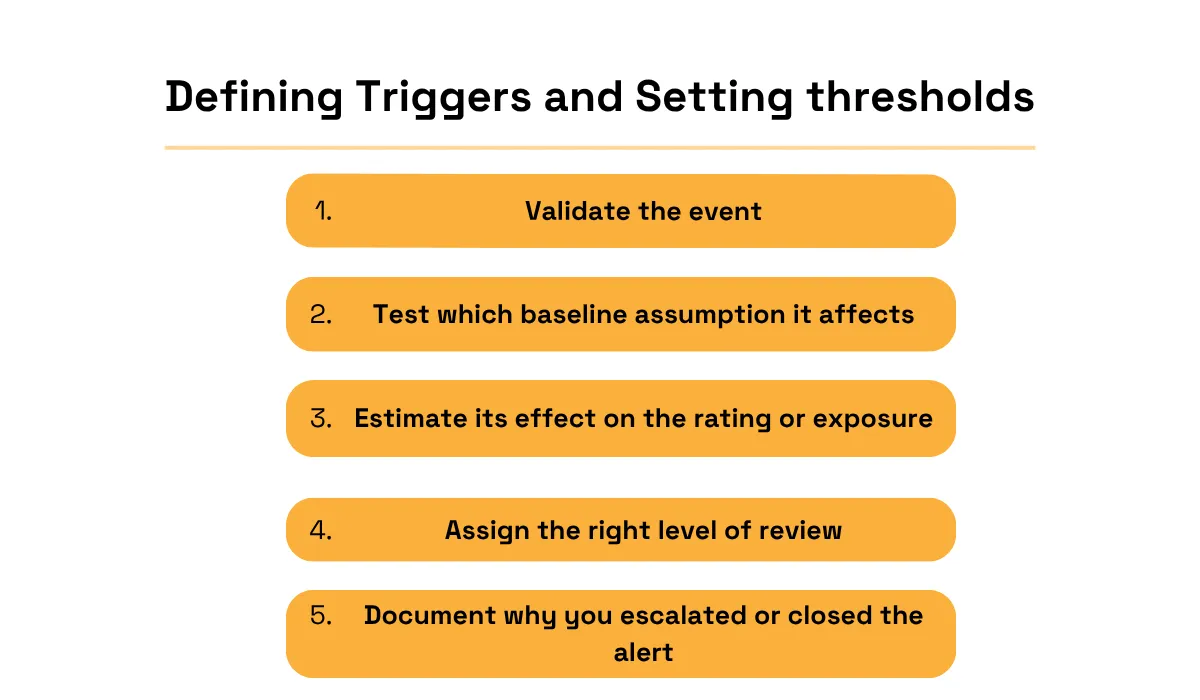
Illustration: Veridion
The important point is consistency. Analysts should know which changes require action and which can simply update the customer record.
A material event should always shorten the distance to the next review, never wait for the calendar to close it.
6. Escalate When Risk Crosses a Defined Threshold
Once a review or reassessment identifies an increase in risk, the next course of action should be known in advance.
Depending on the use case, escalation can mean additional due diligence, a formal analyst or underwriter review, a revised risk rating, changes to lending limits or pricing, a policy review, closer monitoring, new restrictions, or, in the more serious cases, ending the relationship.
The threshold for each response action must be predefined, and responsibility for taking it must sit with a specific role rather than a task list.
The cost of getting this wrong is not hypothetical. The UK bank Barclays was fined £42 million over failures that traced back to the period after onboarding, not the onboarding checks themselves; a static program left a large, well-resourced institution unable to catch and act on risk that had already changed.

Source: The Guardian
Financial crime compliance is not the only lesson here. Any risk management program that regards the onboarding review as completed will be similarly vulnerable once circumstances change.
The best approach is to assign a named owner to each threshold before it is ever crossed, so no one has to decide in the moment who should be looking at a file.
Design an escalation matrix that will provide answers to five questions:
- Which threshold has been crossed?
- Who will verify the information?
- Who will make the decision?
- What actions can we take?
- What should be documented and communicated?
After the decision, update the customer profile, rating, rationale, and monitoring plan. The revised assessment will become the new baseline.
A higher-risk customer may need tighter alert thresholds and more frequent reviews. A lower-risk customer may qualify for lighter review intensity, but only when the evidence supports the change.
Conclusion
Customer risk assessment is most effective when you view risk management as a process, not a single activity performed during onboarding.
Start with validated company data. Document your original baseline logic, test it with regular reviews, monitor for changes between reviews, and define clear triggers for when reassessment is needed.
When risk crosses a threshold, escalate through a clear decision path and establish the revised assessment as the new baseline.
Now you'll have a customer risk process that stays aligned with the business you are actually assessing, not the business you first met.
Articles
Discuss how these trends affect your organization.
Our analysts are available for a short call. Bring a specific question and we will ground it in the data.
Insights
Keep reading
More analysis, research, and outcomes grounded in live company intelligence.
Best Practices for Data Enrichment
Learn how data enrichment best practices help businesses turn raw data into accurate and actionable insights.
What Are the Benefits of Data Enrichment?
Want to understand the benefits of data enrichment? This guide will explain how enriched data supports better decisions and analytics.
5 Best Practices for Effective Insurance Underwriting
Want to improve your insurance underwriting process? This guide covers five essential best practices to boost accuracy and efficiency.