Insights / Articles
Grata & SourceScrub Alternatives for PE Deal Sourcing
One PE firm cut a full day of target research to 15–30 minutes. Compare five Grata competitors by coverage, data freshness, search and pricing.

If you're comparing Grata competitors for private equity deal sourcing, Veridion, PitchBook, Inven, S&P Capital IQ Pro and Gain.pro are among the alternatives to consider.
Some focus on finding private companies, others combine company discovery with financial and transaction research, while others support sourcing through data integrated into your own systems.
This article compares the five alternatives by company coverage, data freshness, search capabilities, access options and pricing.
Grata and SourceScrub Alternatives at a Glance
Grata, SourceScrub, Veridion, PitchBook, Inven, S&P Capital IQ Pro and Gain.pro all support private company discovery and research, but differ in the markets they cover, how they refresh company information and how you access their data.
Tool | Best for | Private company coverage (regions) | Data updates | Access | Pricing model |
|---|---|---|---|---|---|
Grata | Middle-market company discovery and market mapping | Global; 22M+ companies | 50M+ monthly updates to firmographic and contact data | Web app, API, bulk data | Custom/contact sales |
SourceScrub | Finding founder-owned and bootstrapped companies through source-based research | Global; 17M company listings | Continuously refreshed | Web app, API, bulk data | Custom/contact sales |
Veridion | Thesis screening and company data for internal sourcing systems | Global; 744.5M companies | Core profiles continuously refreshed; volatile signals daily; technographics on a rolling 90-day cycle | Web app, API, bulk data | Custom/contact sales |
PitchBook | Deal sourcing alongside transaction and private market research | Global private and public capital markets | New verified data published continuously across six publishing cycles per day | Web app, API, bulk data | Custom/contact sales |
Inven | AI-assisted target discovery and niche market mapping | Global; 160+ markets with active coverage | Company information refreshed weekly | Web app, API, integrations, MCP | Custom/contact sales |
S&P Capital IQ Pro | PE target screening, company financials and transaction research | Global; 60M+ private companies, including 16M+ with recent financials | News and market activity monitored in real time; company-profile refresh frequency not publicly specified | Web platform, Excel; API and data feeds through S&P Global | Custom/contact sales |
Gain.pro | Private company research with financial, ownership and market analysis | Global; curated profiles for sizeable independent businesses plus GenAI profiles for smaller companies | Curated profiles updated at least annually and after major ownership or M&A events | Web app, API, integrations | Custom/contact sales |
Veridion
Veridion is a company data provider that supplies private company data for investment screening and market research.
You can search companies through its Playground or connect the data to proprietary sourcing systems through APIs and batch delivery. Its private equity solution supports searches based on investment criteria, including industry, company size and ownership.
Veridion's key features for deal sourcing include:
Thesis-based screening | Searches can combine product, industry and location criteria with company size and ownership characteristics. This is relevant for firms looking beyond familiar databases for founder-led, family-owned or bootstrapped businesses that meet a specific investment thesis. |
|---|---|
Company activity data | Veridion tracks developments such as hiring, geographic expansion and headquarters moves. These operational signals can expose prospective investments missing from an established dataset. |
Data delivery | APIs and batch delivery bring company records into internal databases and sourcing models. This model suits firms building proprietary market intelligence infrastructure. |
Here’s an example of how these features work in practice.
A US financial-data provider wanted to find investable private companies its clients weren’t yet tracking, including pre-PE and pre-VC businesses, and see which of them were gaining momentum.
Its existing data relied on static financials and registration records, which show where a company has been but miss early growth signals.
Veridion compared snapshots of the same companies over time to build signals around hiring, geographic expansion, reputation trends and headquarters moves, then combined them into a single investability score.
Of 1,670 companies with detected HQ or footprint moves, 1,209 (72%) weren’t on the provider’s existing list, and 992 showed footprint growth with a median increase of 111%.

Source: Veridion
Among Grata alternatives, Veridion places more emphasis on supplying company data for proprietary sourcing systems, though its Playground also supports direct searches.
Grata concentrates more of the sourcing process in its own platform. The distinction matters most for firms building internal screening models or combining several datasets.
The main limitation is that data confidence varies across company types and regions.
Veridion's data methodology notes that micro-companies and businesses in sparse-data regions may have lower confidence. Undisclosed private company financials may also be modelled, while some lower-priority information can take days or weeks to reach the dataset.
Veridion does not publish fixed prices. Pricing varies by data coverage, usage, delivery method, services and customization requirements.
PitchBook
PitchBook is a private capital market research platform covering companies, investors, funds and transactions.
If you source PE or VC deals, its company and deal screening tools let you identify potential investments and then examine their financing, ownership and transaction history within the same platform.
PitchBook's key features for deal sourcing include:
Company screening | PitchBook filters companies by industry, location and investment criteria. This helps assess sector fit and potential investment timing. |
|---|---|
Transaction research | PitchBook connects company profiles to financing and deal records, including transaction size, structure, valuations and multiples. These records help you examine a target’s previous financing and compare acquisition prices, with details of the investors and advisors involved. |
Target monitoring | Saved lists and alerts track events such as acquisitions, fundraising and executive movements. A business that does not meet your investment criteria today can return to your attention after activity relevant to your thesis. |
In Tesi’s sourcing example, the team identifies Finnish businesses in its target sectors and examines funding dates and time in existing investors’ portfolios, drawing on PitchBook's financing and deal records.
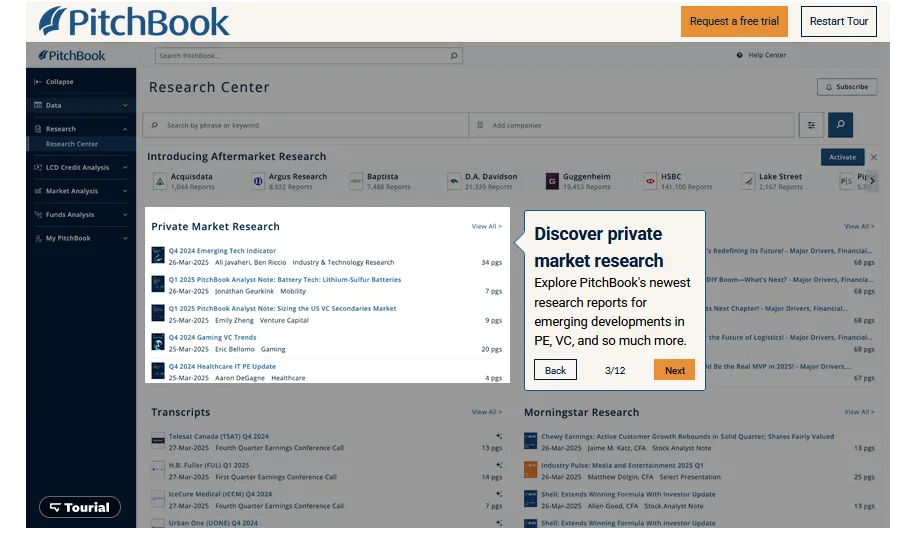
Source: PitchBook
The sourcing process is visible in Tarsadia Investments' experience.
The firm uses PitchBook's screeners to reduce millions of companies to a small group of prospects. In one instance, vice president Jay Santoro found a company through an incumbent investor's portfolio, obtained the CEO and co-founder's contact information and made a cold approach that eventually led to a deal.
PitchBook combines company discovery with detailed transaction records, financing histories and investor research. Grata focuses more on identifying middle-market private businesses. PitchBook is particularly useful when your sourcing process involves examining previous deals and the investors behind them.
PitchBook's main limitations are coverage gaps and cost. Recent Capterra reviews indicate that coverage is limited for certain illiquid private investments. A lower-middle-market PE associate also rated PitchBook's value for money 3/5 despite rating the product highly overall, pointing to cost as something to watch out for.
PitchBook does not publish standard subscription prices. Pricing is customized, so prospective customers need to contact sales.
Inven
Inven is an AI-based company search and market-mapping platform built for mergers and acquisitions (M&A) research.
For PE teams, you can describe an investment thesis in natural language, identify private companies matching it and qualify the resulting list using company, ownership and transaction data.
Inven's key features for deal sourcing include:
Thesis-driven company search | Natural-language searches and screening criteria are suited to narrow sectors where conventional industry classifications may group very different businesses together. This supports market mapping for platform investments and add-on searches where the target universe is not already known. |
|---|---|
AI-assisted qualification | The AI Screener evaluates companies against criteria you define, reducing the manual website-by-website work involved in deciding which businesses belong on a target list. |
Search-to-outreach workflow | Company research includes professional contacts, while exports and integrations move qualified targets into subsequent research or outreach. For PE teams running recurring origination, this reduces the work between constructing a market map and contacting prospective targets. |
Inven's search covers 28M+ companies across 160+ markets, and a verified PE user on G2 specifically identified the AI Screener as valuable for list qualification.
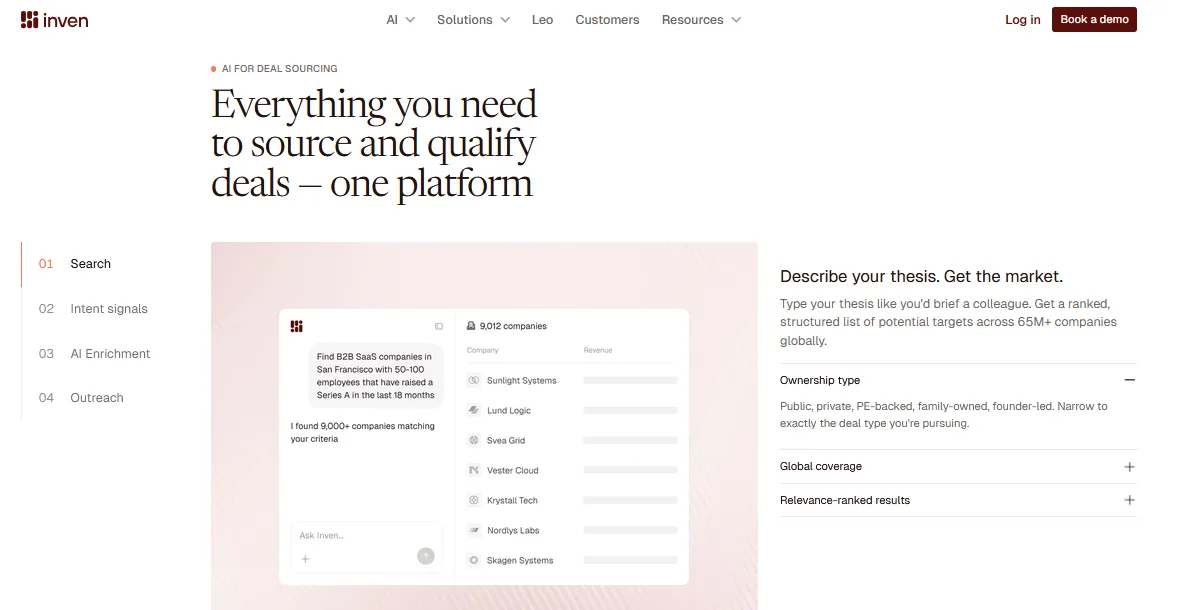
Source: Inven
There is a concrete PE example behind those features. Netherlands-based Lexar Partners previously assembled target lists through manual web research.
With Inven, the firm reports reducing a full day of sourcing to 15–30 minutes, making the process roughly 10× faster and turning it into a weekly routine across the firm. It also reports finding companies in niche international searches where another platform had struggled.
For firms considering SourceScrub competitors, Inven puts more emphasis on natural-language discovery and AI-assisted qualification.
SourceScrub builds private company intelligence partly from its researched source network, while Inven is designed around describing a thesis, generating a company universe and screening that universe inside an AI-led workflow.
The main limitation is the accuracy of contact data.
In a September 2025 G2 review, a verified private equity user sourcing lower-middle-market acquisition targets reported occasional inaccuracies in contact data. Another reviewer, Miles T., raised similar concerns about contact information drawn from LinkedIn. Firms preparing outreach lists may need to verify decision-maker details independently.
Inven does not publish standard subscription prices. Prospective customers need to contact the company for pricing based on their requirements.
S&P Capital IQ Pro
S&P Capital IQ Pro is a financial and market intelligence platform covering public and private companies, investors and transactions.
Its database includes 60M+ private companies, making it relevant to PE teams researching acquisition targets, company financials, ownership structures and deal activity.
S&P Capital IQ Pro's key features for deal sourcing include:
Private company screening | You can search companies by industry, geography, revenue, employee count and other financial criteria. These filters support investment-thesis searches for established businesses, including potential platform acquisitions and add-on targets. |
|---|---|
Financial and transaction research | S&P Global reports 16M+ private companies with recent financials. Company records bring together available financial statements, ownership information and transaction histories. PE analysts can examine a target's financial position alongside comparable companies and previous acquisitions when deciding which businesses merit further investigation. |
Company monitoring and data access | Watchlists and alerts track developments affecting companies under consideration, while Excel integration supports financial analysis. |
For firms maintaining proprietary sourcing models, S&P Global's private company data services also support API and data-feed delivery.
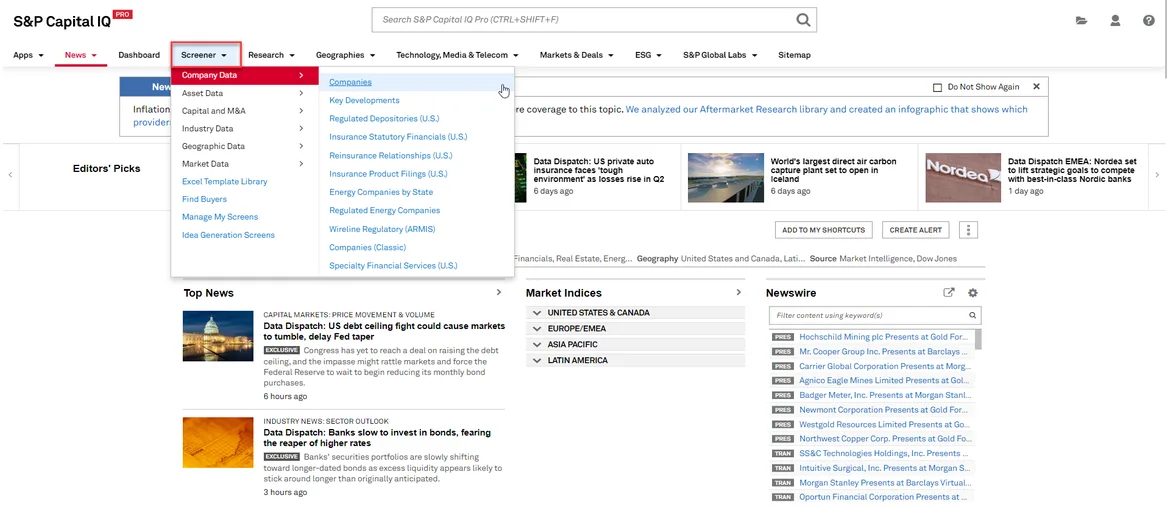
Source: S&P Global Market Intelligence
An Asia-based PE firm adopted Capital IQ Pro to research potential investments, identify buyers and co-investors and examine opportunities across industries. Its investment team also used the platform's fund and transaction intelligence to support investment research.
The case illustrates how company discovery and wider financial research can form part of the same sourcing process.
Grata and SourceScrub concentrate more directly on private company discovery, particularly in the middle market. S&P Capital IQ Pro combines company screening with financial analysis, transaction research and public market intelligence.
It suits PE teams that want to examine a potential acquisition's financial position and comparable deals within the same platform.
The main limitation is a weaker fit for smaller, founder-owned targets.
Although Capital IQ Pro covers millions of private companies, financial disclosure varies across businesses. Its emphasis on financial statements and transactions may be less useful when sourcing smaller, founder-owned companies with limited public information.
The platform's extensive capabilities may also exceed the requirements of teams focused primarily on building target lists.
S&P Global does not publish standard Capital IQ Pro subscription prices. Contact its sales team for a quote based on the required data and services.
Gain.pro
Gain.pro is a private market intelligence platform for finding and researching companies, deals and investors.
For PE sourcing, you can search for businesses matching an investment thesis, then examine their financials, ownership and M&A history before deciding which targets merit further research.
Gain.pro's key features for deal sourcing include:
Thesis-based company discovery | You can describe targets in qualitative terms such as “add-on targets for a large HVAC supplier,” then narrow the results by location; revenue; Earnings Before Interest, Taxes, Depreciation, and Amortization (EBITDA); employee count and ownership. Saved searches become watchlists that flag new matches and financial updates. |
|---|---|
Private company financials | Curated profiles include reported and adjusted income statement, balance sheet and cash-flow data. Gain.pro traces financial figures to their sources and identifies estimates separately. This distinction matters when you are comparing private businesses whose financial disclosure varies considerably. |
Ownership and transaction research | Profiles connect current shareholders and legal structures with ownership changes, buyouts, VC rounds, exits, acquisitions and divestments. Public sources are continuously monitored for ownership developments, giving you another way to identify sponsor-backed companies and investigate potential add-ons. |
Gain.pro's thesis-based discovery follows a broader PE sourcing approach in which firms use firmographic data to build deal pipelines around defined investment criteria.
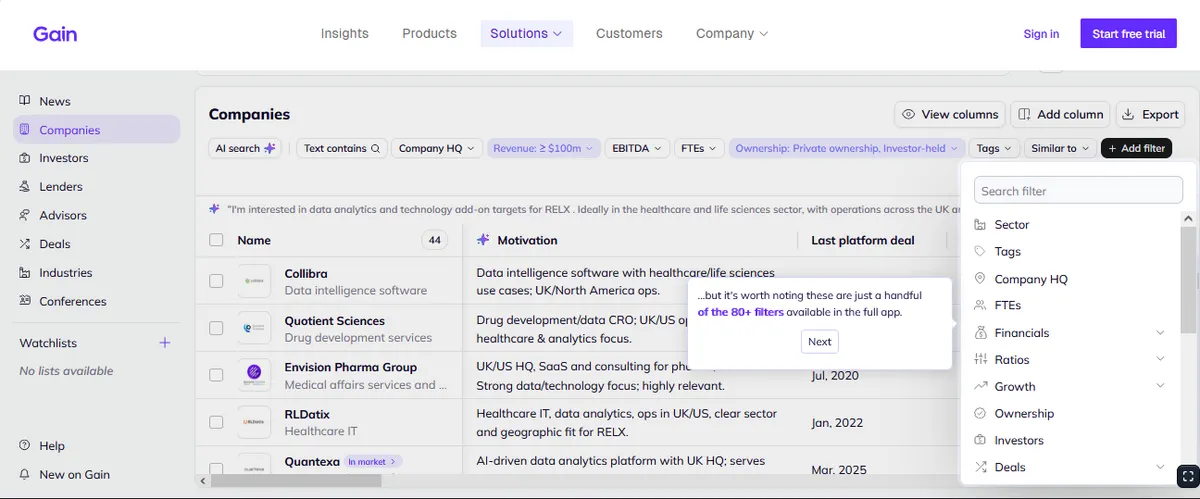
Source: Gain.pro
Gain.pro also distinguishes between analyst-curated and GenAI company profiles. Curated profiles cover sizable independent businesses, including companies meeting thresholds such as €50 million+ revenue, €5 million+ EBITDA or 250+ employees.
Smaller businesses are primarily covered through GenAI profiles assembled from company websites, LinkedIn, legal-entity records and Gain.pro's existing classification data.
Gain.pro overlaps with Grata and SourceScrub in target discovery but adds detailed financial, ownership and transaction research around the companies you find.
Its distinction from PitchBook is narrower: both support private market research, while Gain.pro combines analyst-curated profiles with GenAI coverage for smaller businesses.
The main limitation is that not all financial figures are reported. Gain states, “AI estimates revenue and EBITDA to fill any gaps.” Check whether a target’s financial figures are reported or estimated when comparing acquisition candidates.
Gain.pro does not publish standard subscription prices. Pricing is custom and requires contacting the company.
Conclusion
The right alternative depends on how your firm sources deals. A dedicated sourcing platform may suit teams that want to find and qualify targets in one place.
For research involving transactions, investors and financing, a broader private market database may be useful. Firms with proprietary sourcing models should also consider how easily company data integrates into their existing systems.
Shortlist two or three platforms and test them against companies you already know. Check whether they appear in the results, how complete their records are and when the information was last updated.
Articles
Discuss how these trends affect your organization.
Our analysts are available for a short call. Bring a specific question and we will ground it in the data.
Insights
Keep reading
More analysis, research, and outcomes grounded in live company intelligence.
How Private Equity Firms Use Firmographic Filters to Build Smarter Deal Pipelines
Tired of sifting through endless leads? See how private equity firms leverage firmographic data providers to pinpoint high-value deals.
Coresignal Alternatives for Company Data at Scale
Not every team that outgrows Coresignal needs the same data. Six Coresignal alternatives compared by data sources, coverage, refresh and pricing.
5 Trends Shaping the Future of Market Intelligence
Want to future-proof your business strategy? Explore the top trends defining the future of market intelligence.