Insights / Articles
How to Set Up Always-On Credit Risk Monitoring
Review calendars say when you look at a credit, not when it changes. Get changes to analysts sooner with credit risk monitoring built on three rule types.

- Use the last approved credit review as your baseline.
- Each source’s update schedule limits how quickly you can detect its changes.
- Investigate alerts promptly; escalate urgent cases while validating evidence.
- A review does not equal a rating change.
A review calendar tells you when you'll review a credit, but it does not tell you when the credit changes.
Always-on credit risk monitoring fills that gap by checking relevant borrower and issuer data as it changes. It filters out routine updates and sends material cases to analysts sooner.
The goal is faster detection, not automatic rating changes.
Analysts still investigate the evidence and follow established approval processes.
Continuously updated company data, such as Veridion's, can feed one layer of that pipeline. Here is how you build the rest.
Establish a Baseline and Decide What You Monitor
Continuous credit monitoring requires a reference point.
For each borrower or issuer, retain the approved profile from the last full review as the reference for assessing new information.
Change needs context.
A newly formed entity within the borrower’s group may have little credit impact. But if it changes guarantees, cash flows, or creditors’ repayment priority, it may warrant review.
Therefore, your benchmark should specify the borrower, other obligors, guarantors, facilities, exposure, current rating/model grade, and the sources for these numbers.
It should also document the effective date, source, freshness date, methodology/model version, analyst adjustments, and approval history.
For banks using the internal ratings-based approach, Basel Framework paragraph CRE36.46 specifies the rating histories and supporting information they must retain.
CRE36.41 also calls for a new rating assessment when material information emerges, alongside regular rating reviews.
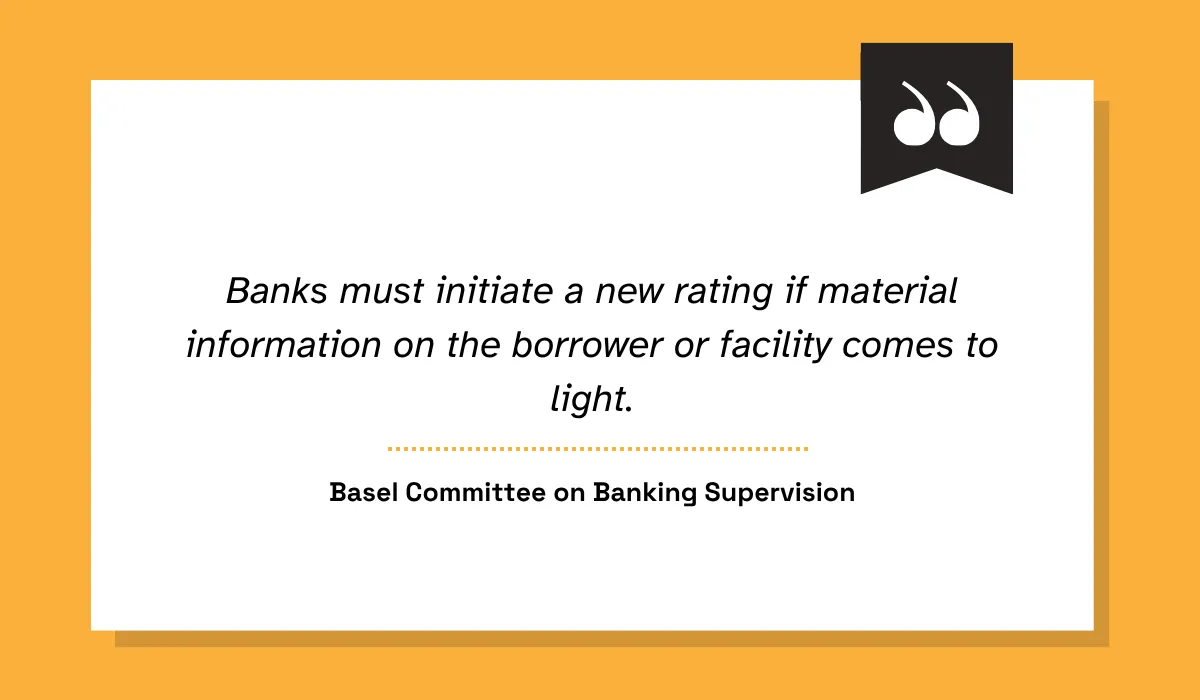
Illustration: Veridion / Quote: Basel Committee on Banking Supervision (BCBS)
Define which fields the pipeline will monitor so analysts receive relevant alerts. Group them into three categories:
- Financial: covers reported results and covenant status.
- Operational: covers what the business does and where.
- Structural: covers ownership, legal form, and registry status.
At each full review, retain a snapshot of the monitored field values, sources, and observation dates. Record why each field is monitored and who owns it. Our guide to credit risk early warning signals explains which company changes are worth tracking.
Finally, tie each field to the data source that feeds it. Then reset the baseline after every full reassessment.
Update the approved baseline after reassessment, while retaining its history. Record changes analysts have already reviewed so subsequent refreshes do not repeatedly flag the same evidence.
Record the reassessment date, decision, and required approvals with each baseline version. This gives analysts and data teams the same approved reference for future comparisons.
Detect Changes Against the Baseline
Refresh each monitored source according to its defined cadence. Compare each new observation with the previous observation to detect new changes, then assess those changes against the approved baseline.
Record each new change event with the previous and current values, source, and detection date. Retain the approved baseline value for context. Apply materiality rules to decide whether the event warrants an alert; do not create another event simply because the value still differs from the baseline.
A comprehensive change log includes:
- Borrower's canonical identifier
- Field that changed
- Old and new value
- Source, observation time, and ingestion time
- Effective time (where available)
- Validation status
Store the raw observation or a reliable reference to it. The audit trail gives analysts the information the system held at each stage.
Checking a weekly source every day does not provide new observations between its updates. Detection also depends on when the source publishes the information and when your system retrieves it.
Label each feed honestly and measure detection lag from the source event to ingestion.
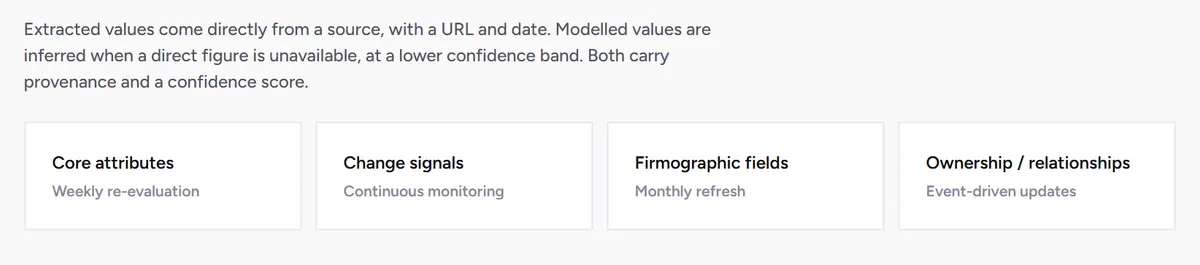
Veridion can operate as one event and context layer in this stage. Veridion lists different update schedules by data type, including weekly re-evaluation of core attributes and continuous monitoring of change signals. Configure retrieval and comparisons around the fields your integration uses.
Source: Veridion
Veridion’s API documentation describes last_updated_at as the UTC date and time when company information was last extracted and verified for updates. It does not identify which individual fields changed. The documented fields you can compare against a baseline include company_status as provided by the registry (Active or Inactive), legal form, jurisdiction, location details, business model, and core offerings.
Link each portfolio company to its Veridion record and maintain that mapping over time, using former_veridion_id where applicable. Keep the accepted baseline profile and compare refreshed records against it to calculate field-level differences in your surveillance platform.
For example, compare registry status, location counts, and business activity fields returned by your integration against the accepted baseline. Use such differences as evidence for review. They do not establish a credit conclusion on their own.
Consider it as one factor among many. The financial statements, payment details, and covenant report will be alongside it.
On each refresh, record newly detected field changes and link them to the relevant baseline version and any existing case. Keep the field name, previous and current values, detection date, and source.
Your company identifiers should be consistent to keep the log trackable. The aim is to flag potentially material changes when new evidence becomes available, rather than waiting for the next scheduled assessment.
Filter Changes Through Materiality Rules
Not every detected change affects credit quality. Materiality rules determine which changes warrant an alert. For example, a borrower may update its product page or website footer.
A company may also correct a filing. A spelling correction may be immaterial, while a revised filing or product description may contain information relevant to repayment capacity. Assess what changed before deciding whether to alert.
In a credit surveillance operating model, a materiality layer is required between identified changes and the alert queue. The criteria need to address three questions: Does this change matter for this type of exposure? Is the evidence strong enough? Does the event become meaningful when combined with other changes?
Implement three rule types:
- Single-event rules for changes that warrant individual review.
- Threshold rules for those movements that become relevant only after exceeding a certain approved level.
- Combination rules for several weaker changes that combine to become material.
Add severity levels and suppression mechanisms. Duplicate observations should not create another case. Distinguish corrections to source data from changes in the borrower’s circumstances, and assess whether a correction changes the credit assessment.
A previous analyst decision may necessitate a temporary suppression period, but the system must record it and who owns the suppression.
Governance is as vital as logic. The credit risk policy should define materiality, and portfolio teams should propose portfolio-specific rules.
Model risk or independent validation activity must test performance where rules impact models. Data teams must implement the approved rules without silently redefining them.
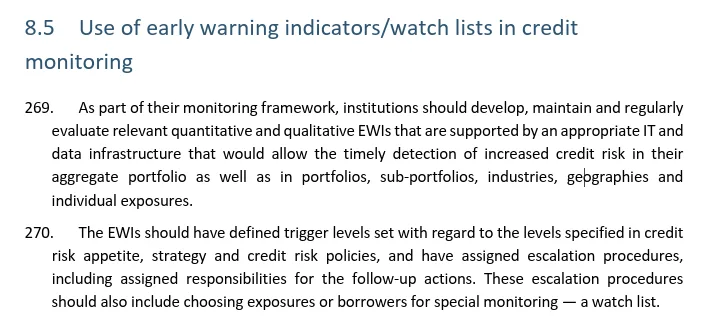
Guidance on loan origination and monitoring issued by the European Banking Authority states that there must be early warning indicators, both quantitative and qualitative, defined trigger levels, defined escalation processes, and follow-up responsibilities.
Source: European Banking Authority
Before deployment, document each rule, its owner, the escalation process, and the evidence needed for review. Our guide to credit risk reassessment triggers covers events that may warrant reassessment.
Review the rule library on a fixed cadence and whenever the portfolio changes. Record rule version, approval date, portfolio impacted, test results, and rationale for removal.
Route Material Events Into an Alert Queue
A material event creates a case, not just a notification. The analyst must have enough information about the change, why the rule triggered, and potential exposure.
Each queued case should contain:
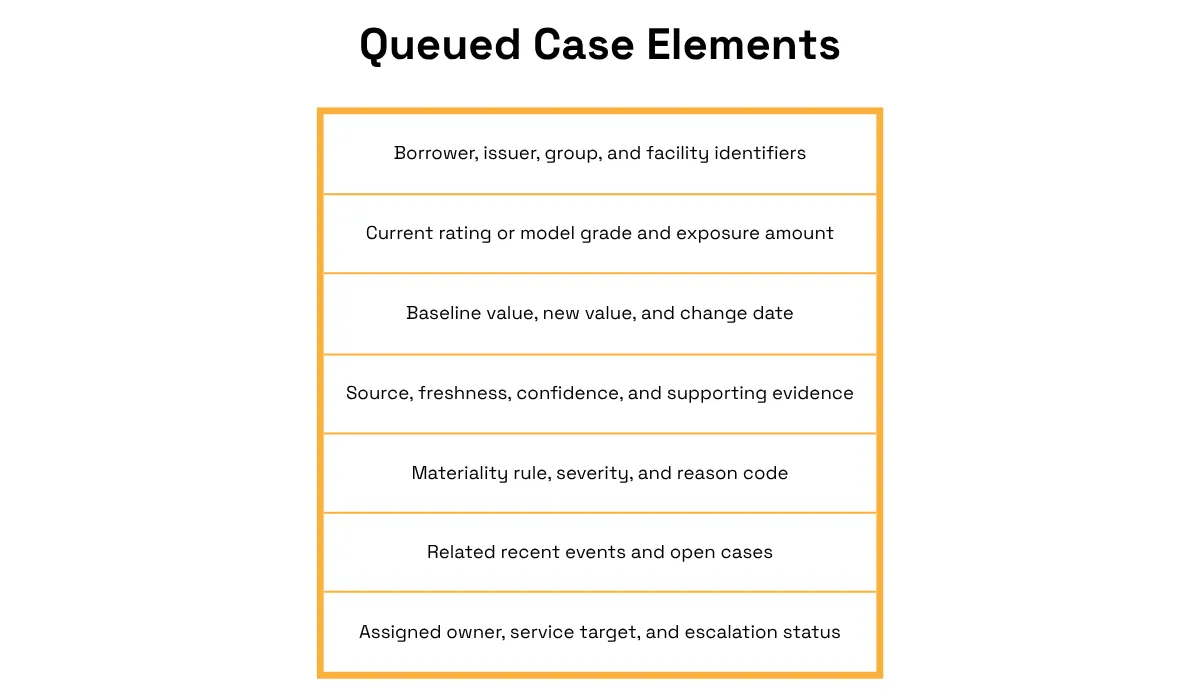
Illustration: Veridion
This is the hand-off point between the automated steps and human review. Before this point, the system can collect, compare, score, suppress, and route. After this point, a named person owns the decision.
Additionally, the queue requires controls to prevent duplication, protect sensitive information, and maintain accountability.
Consolidate events related to the same underlying event into a single case. Validate low-confidence evidence and label the uncertainty. For potentially severe or time-sensitive events, validation and analyst review should proceed in parallel.
Use role-based access control to protect sensitive borrower data.
Finally, document all status changes: who opened, transferred, elevated, or closed the case, so the internal audit can trace its history.
When alert volume rises, prioritize cases by credit relevance, exposure, severity, evidence strength, time sensitivity, and portfolio concentration. Our guide to prioritizing surveillance alerts explains how to apply these factors across an issuer portfolio.
Regulatory guidance supports this emphasis on timely routing. The US Interagency Guidance on Credit Risk Review Systems says an effective process should promptly identify actual and potential credit weaknesses so an institution can act in a timely way. It also expects review records to show the date and analysis supporting the assigned risk rating.
The alert queue makes detection an accountable action. This process must give the right analyst the context needed to evaluate the event promptly. At the same time, it must maintain a transparent record of the case management process.
Done properly, this process should help identify potential weaknesses in credits without treating each material alert as a sign of deterioration or a reason to change the rating.
Have Analysts Investigate Before Escalating
The analyst investigates what caused the flagged change and whether it affects credit risk. An alert alone does not establish deterioration.
Check whether the evidence is accurate, relevant, and linked to repayment capacity or potential loss. For trend-based alerts, assess persistence; a serious single event may warrant immediate escalation while validation continues.
Many factors can drive changes. For example, a new registered address may occur after the borrower discloses an acquisition. A legal form change may occur after the planned refinancing.
The analyst must test explanations against evidence. In December 2025, US prosecutors charged Tricolor’s former CEO Daniel Chu and former COO David Goodgame over alleged collateral fraud.
Prosecutors said that, by August 2025, the company had pledged approximately $2.2 billion in collateral despite having only about $1.4 billion in real collateral.
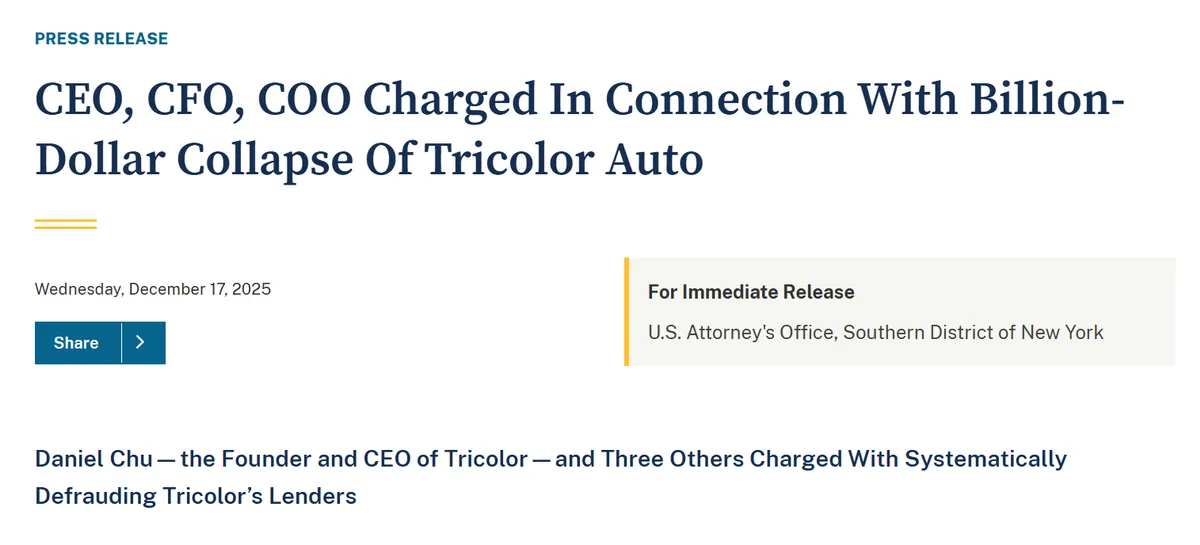
Source: U.S. Attorney’s Office
Goodgame pleaded guilty in June 2026. For monitoring teams, the example illustrates why explanations for data discrepancies should be checked against underlying records.
Document all decisions during surveillance, as well as any evidence that contradicts the trigger. This will strengthen governance and improve the system.
Our guide on data lineage for credit ratings suggests tracking the source, observation date, entity ID, transformation, model version, and any human override.
An investigation can lead to the outcomes below. Keep the case open if more evidence is needed, with an owner and a date for follow-up.
Inaction | The change is normal, inaccurate, immaterial, or already incorporated into the rating |
|---|---|
Watchlist or additional scrutiny | Uncertainty exists, or there is potential for deterioration that is not enough to trigger a formal rating decision |
Reassessment | The evidence may be material to the borrower grade, the facility grade, the probability of default, loss expectation, terms, provision, or strategy for the portfolio |
To investigate thoroughly, verify the change from another source. Consult with the relationship manager or the borrower and compare the change with the benchmark.
Then document the result, the evidence, the date, and the analyst. Also, have another individual review the watch list and reassessment decision.
Base Rating or Model Action on the Full Reassessment
A trigger starts a review; it does not determine the outcome on its own. Base rating changes on the relevant evidence and required approvals. Watchlist placement or interim exposure controls may precede the full reassessment where internal policy allows. A change to one borrower’s model output is different from recalibrating the model itself. An alert may prompt a model review, but recalibration requires evidence of a broader model issue, validation, and the required approvals.
For NRSROs, SEC Rule 17g-8(d)(1)(x) identifies review of the lead analyst’s work before a formal rating action as an internal-control factor they must consider.
A 2018 BIS working paper examined sovereign rating announcements from 2005 to 2012. Of 89 negative watch announcements, 61.8% were followed by a downgrade within 91 days; 38.2% were followed by neither an upgrade nor a downgrade in that period.
Of 31 positive watch announcements, 58.1% were followed by an upgrade within 91 days, while 41.9% were followed by neither an upgrade nor a downgrade.
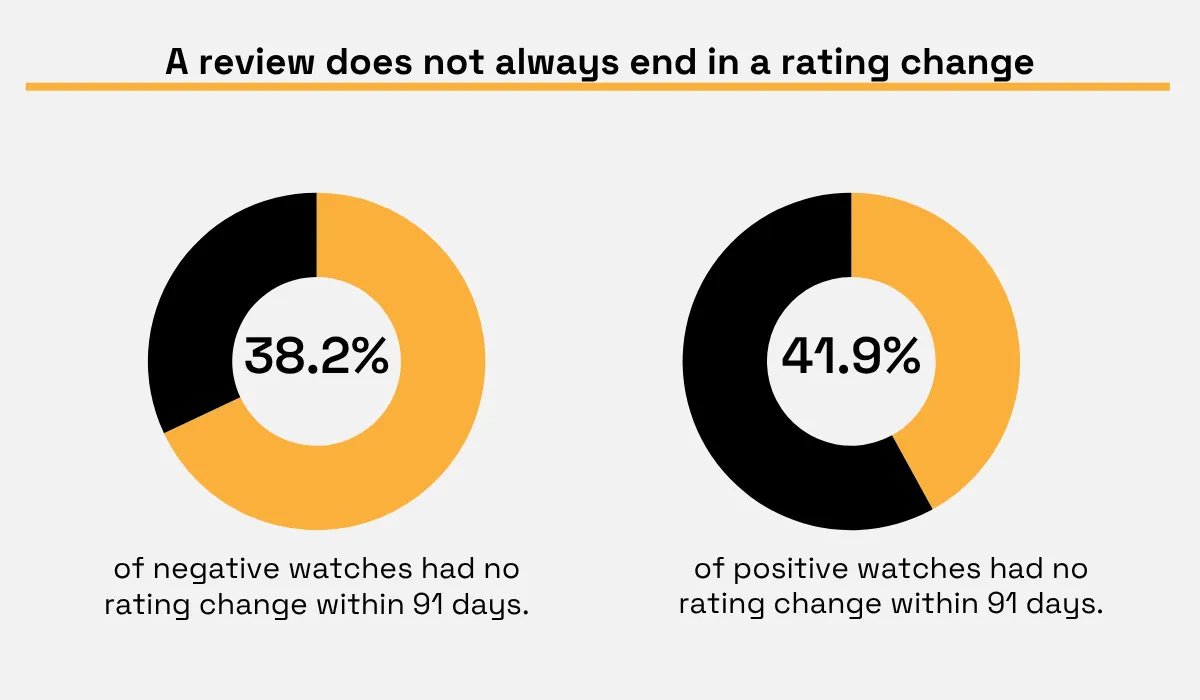
Illustration: Veridion / Data: Bank for International Settlements (BIS)
These historical findings concern sovereign watch announcements, rather than the outcomes of all rating reviews. A watch announcement signals the possibility of a rating change, rather than a predetermined outcome.
A well-established system uses all results. Record the outcome of each trigger event without action, watchlist decision, reassessment, or rating change. Calculate the action rate for each rule and field monitored.
Review rules with low action rates, but assess false alarms, missed events, and the severity of the risks they cover before changing or retiring them. Back-test the pipeline against past downgrades, and determine the time between initial detection of the change and the rating action.
Conclusion
Continuous credit risk monitoring is an operational concept rather than a single solution. Its aim is to bring deterioration from new data to an analyst while retaining the investigative element and rating governance process.
Begin with something small. Select a segment of your portfolio and determine the time that will pass before your planned review picks up on a material change.
Compare that delay with the pipeline’s actual detection and analyst-review times to estimate how much earlier your team could respond.
Articles
Discuss how these trends affect your organization.
Our analysts are available for a short call. Bring a specific question and we will ground it in the data.
Insights
Keep reading
More analysis, research, and outcomes grounded in live company intelligence.
5 Credit Risk Assessment Mistakes Caused by Bad Company Data
Bad company data derails credit risk assessment, from registry lag to entity mismatches. Five common mistakes and how better data fixes them.
How to Prioritize Surveillance Alerts Across Thousands of Issuers
How credit rating surveillance teams can score alerts by magnitude, persistence and data confidence, and run a queue analysts actually trust.
Data Lineage for Credit Ratings: Building a Traceable Evidence Chain
How credit rating data lineage works in practice: capturing provenance, entity identifiers, transformations and overrides.