Insights / Articles
Why Corporate Family Trees Matter in Risk Assessment
How can corporate family tree data revolutionize your risk assessment? Uncover the hidden connections that impact your business's security.

- Corporate family tree data maps parent, subsidiary, affiliate, and joint venture links.
- Ownership links show how risks can flow across the corporate structure.
- Corporate family tree data reveals hidden exposure across each layer.
Standard company data describes a business as though it stands alone. Very few of them do.
Most large firms consist of a group of parent companies, subsidiaries, affiliates, and joint ventures.
Members of a group share owners, funding, guarantees, and reputation.
Damage to one of them can reach the others within days.
Corporate family tree data maps every one of those links. The sections below cover what the data holds and the four risks it exposes.
What Does Corporate Family Tree Data Actually Include?
A corporate family tree shows how one company links to others through ownership and control.
Parents are at the top. Below them come subsidiaries, plus affiliates and joint ventures that a company only partly owns.
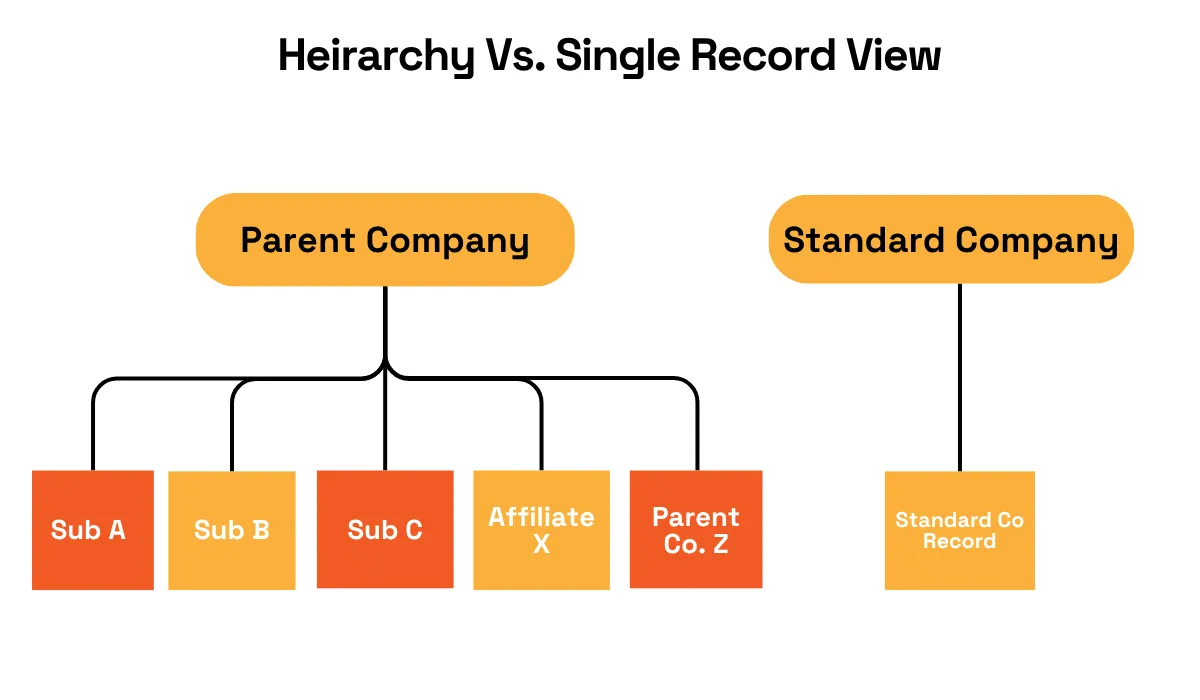
Illustration: Veridion
A normal company profile cannot show any of this.
A profile lists what a firm does and where it works. A family tree adds who owns the firm and what the firm owns.
A manufacturer might sell a well-known brand across five countries. Its profile lists revenue, staff numbers, and head office.
The family tree behind it could hold a Cayman parent, twelve subsidiaries, and two foreign joint ventures.
The shape of a group can change fast. Companies buy each other, spin off units, and rename subsidiaries every year. A family tree has to keep up with each of those moves.
Ownership comes in more than one form.
Direct ownership is a simple shareholding on a company's register. Indirect ownership runs through other companies, trusts, or stand-in holders in between.
Control does not always match ownership. One company can steer another through voting rights, board positions, or management deals. A small stake can still carry real control.
The company right above a subsidiary is rarely the one in charge at the top. Ownership can pass through several holding companies first. A family tree follows that whole path upward.
Most business records stop at a single company. A registrar notes that company's name, address, main activity, and accounts. It rarely links the record to the companies above or below it.
Registries also work country by country.
A parent in one country and its subsidiary in another report to different regulators. Neither registry shows the ownership link between them. The result is a patchwork that is often incomplete.
A group can look small in one country and large across the whole world. Only a combined, cross-border view reveals its true size.
Regulators have started to push against this secrecy.
The Financial Crimes Enforcement Network's ownership rule is one example. It makes many foreign-registered companies name the real people who own them.
Without a map of ownership, each subsidiary looks like a separate business.
Shared parents stay hidden in the operating and legal entity views that risk teams rely on. Real risk enters through that blind spot.
Why Does Corporate Family Structure Matter So Much?
A company viewed on its own hides the risk that runs through its family. Risk travels along ownership links that a single-company view will miss.
A map of the connections brings those risks into view.
Four patterns show up again and again:
- Subsidiary risk
- Hidden concentration
- Sanctions exposure
- Financial contagion
Ownership data helps risk teams see each of these risks more clearly.
The payoff is the same in every case.
A hidden link becomes something a team can see and act on. A risk that looked spread across many names turns out to rest with one owner.
Each pattern works the same way underneath. A single-company view sees the business alone. An ownership view sees everything around it, where much of the risk lives.
Subsidiary Risk Is Parent Risk
A subsidiary may be legally separate from its parent, but its problems can still affect the parent.
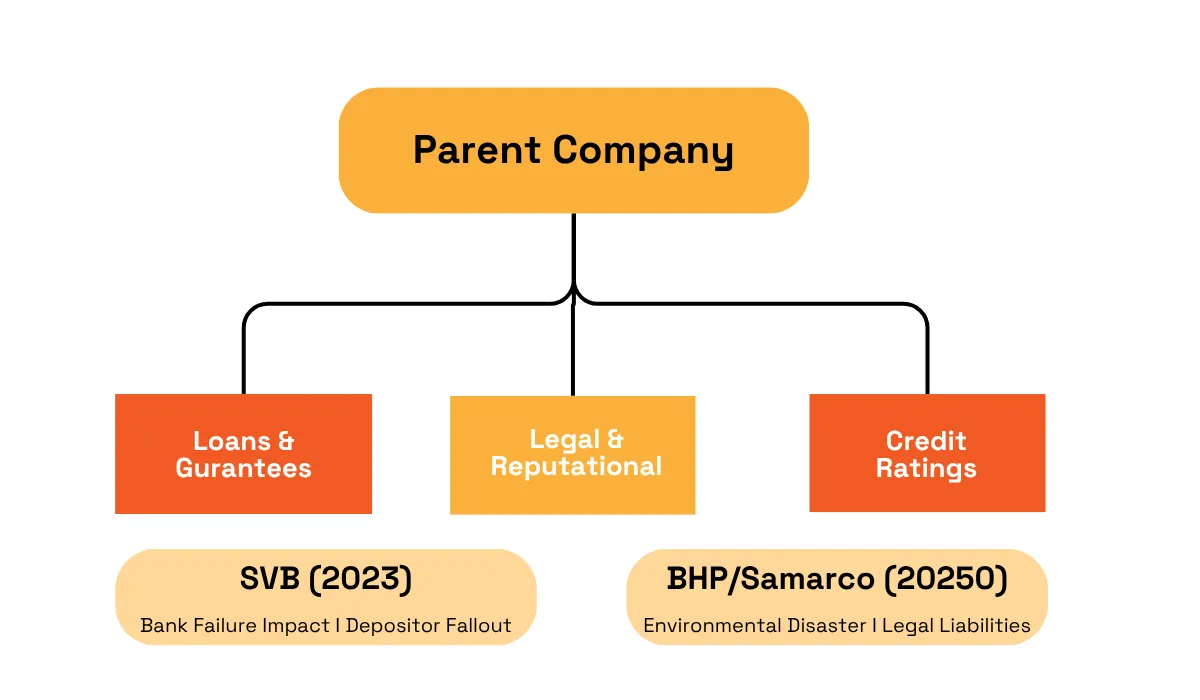
It can have its own address, board, and accounts, but trouble at the subsidiary can still affect the parent’s balance sheet, credit rating, and share price.
The links are direct. Loans between group companies, shared guarantees, and shared managers all tie a parent to its subsidiaries. Damage to reputation crosses those lines too.
Source: Veridion
For example, if a parent guarantees a subsidiary's loans, a default there lands on the parent. The two balance sheets are joined in practice.
The damage runs both ways. Regulators seized Silicon Valley Bank in March 2023. Its parent, SVB Financial Group, filed for Chapter 11 the next week.
The bank itself stayed out of that filing.
Even so, the parent lost its main business and the cash it held at the bank. Two sister companies, SVB Securities and SVB Capital, kept running on their own.
One failure at the bank reshaped the whole group for good. Its brand, funding, and customers never came back the same.
Courts are moving the same way. In November 2025, an English court found BHP liable for a dam collapse in Brazil.
The Fundão dam belonged to Samarco, a joint venture owned by BHP and Vale.
BHP stood as the parent in the case, even though Samarco ran the dam. More than 600,000 people brought the claim.
Damages could reach around £36 billion.
First, the ruling decided who was responsible. The next stage decided how much BHP must pay.
BHP planned to appeal, but the case has already set an important precedent for parent company liability.
Ratings agencies work the other direction too. A downgrade at the parent usually drags its main subsidiaries down. Their funding, brand, and management all lean on the parent.
A rating is a bet on a whole group. A shock at the parent changes that bet for every unit below. The family view is what makes the bet honest.
The lesson for risk teams is simple. Credit checks, legal checks, and reputation checks cannot stop at one company. Every parent and subsidiary feeds the same picture.
Insurers and lenders have already changed the questions they ask. A file on one company alone no longer shows how risk builds. A parent's file today has to cover the whole family.
Concentration Risk Hides Behind Separate Legal Names
Supplier concentration looks safe until ownership data says something else. A team can buy parts from five vendors with five names and five contracts. All five can still trace back to one parent.
One hidden parent turns a diverse-looking supply base into a single point of failure. Trouble at that parent hits all five vendors at once. The buyer only learns this when the trouble arrives.
Rebrands and mergers keep producing vendors that look independent.
Their accounts are often filed apart, and their addresses point to different countries. The ownership chain is what ties them together.
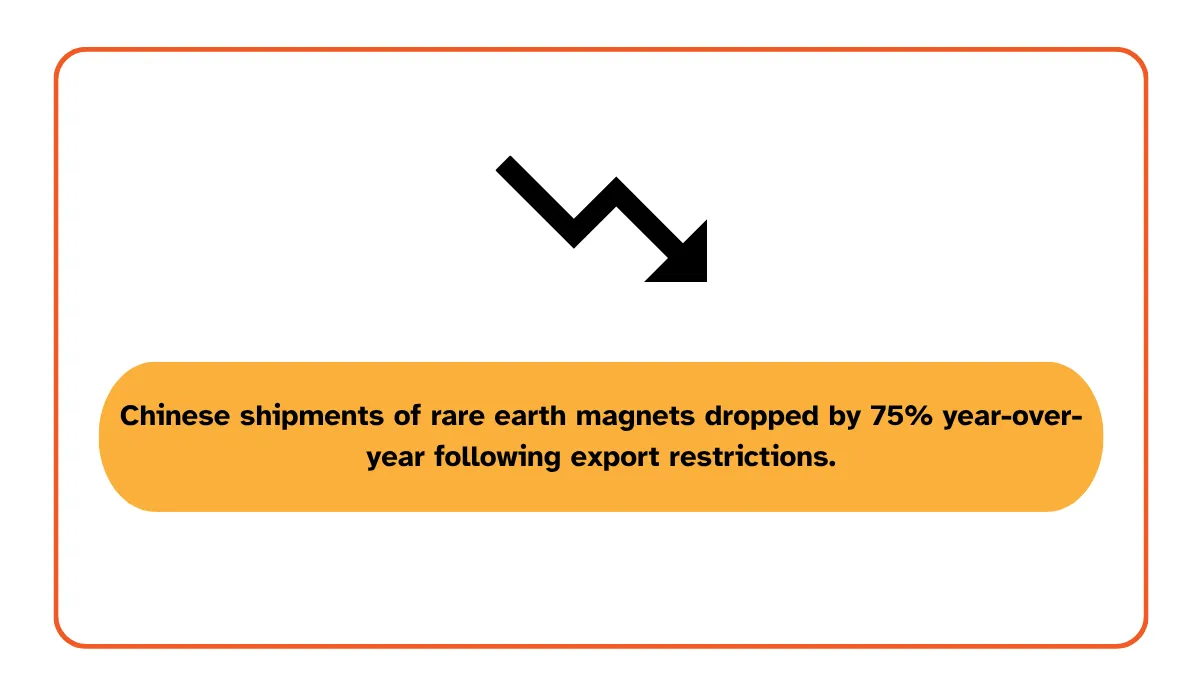
Illustration: Veridion / Data: European Central Bank
The rare earth market is the sharpest recent example.
China put export licences on rare earths in April 2025. Chinese magnet shipments then fell by about 75% in May.
Some European carmakers had to pause their lines. The risk ran deeper than any first-tier supplier list showed.
The International Energy Agency notes how concentrated this supply had become.
The real problem hid in the roots. Many suppliers that looked separate shared the same owner. A plain supplier list could not show that.
Buyers who thought they had spread their orders found one source underneath. State and holding-company ownership make this worse.
Chinese steel is a clear case.
Dozens of separately named steelmakers roll up under one parent group. The group in turn answers to a state investment body. The buyer sees two vendors, while ownership data shows one.
It’s the same for semiconductor supply chains. Advanced chip packaging and testing are clustered inside a few Asian firms. Some of them share the same parent groups.
A buyer might spread orders across those names for backup. In practice, it can still lead to one owner. Real backup needs an ownership check behind the logos.
Supplier forms ask about ownership, yet many buyers never check the answers. A form can name a private holding company and still pass review.
Ownership data catches what the form misses.
The check works best on real ownership data rather than a form’s answers. A supplier's stated parent is often only the company just above it. The true owner can be several layers higher.
A third-party risk data layer that maps ownership shows shared parents across suppliers. With this, a buyer can see each vendor's ultimate parent and match it against the others. Shared parents then show up straight away.
Ordinary vendor screening misses that. The result turns a hidden risk into an obvious one.
Sanctions Exposure Travels Through the Ownership Chain
Sanctions can affect a company even if it is not directly named on a sanctions list.
A company may pass every list check and still face sanctions risk if a sanctioned person or company owns part of it.
In the US, when sanctioned parties own at least half of a company, that company is treated as sanctioned too.
The owned company can still be affected even if its name is not on any sanctions list.
This law follows ownership through a chain. A sanctioned party can own a company that owns another company. Both child companies are then count as sanctioned.
Regulators keep widening this ownership test. In September 2025, the US published a new law to include affiliates of listed firms. It covered companies half-owned by parties already on the list.
Even though the affiliates law was later paused for a year, its arrival still shows where export controls are heading: ownership is at the centre of these checks.
The number of sanctions programs has grown year after year. Many of them now depend on who owns a company.
A real case shows the cost of missing this.
In September 2025, US regulators settled with a Texas freight forwarder for about $1.6 million. The forwarder had chartered a Venezuelan cargo airline.
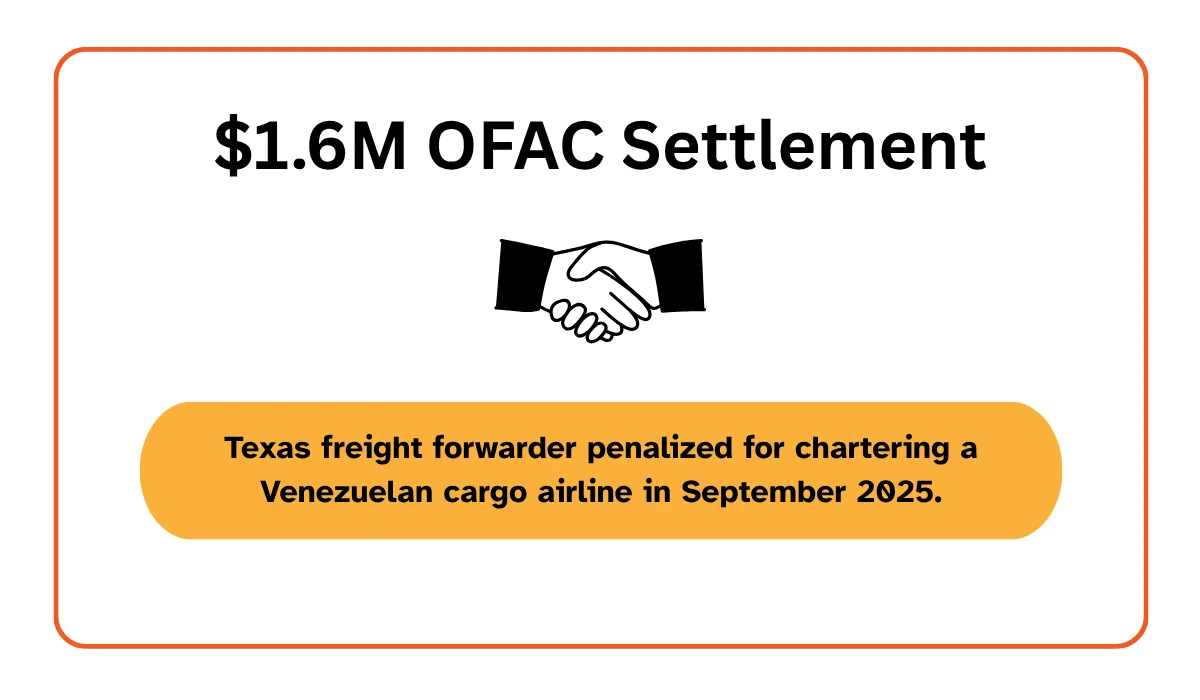
The airline was fully owned by a sanctioned state carrier. The forwarder had checked the airline's own name and found no match. The parent link still made the whole deal a breach.
The aircraft itself carried a second sanctions problem. It had once been blocked as the property of an Iranian airline. A later transfer to the Venezuelan operator did not clear that status.
Two owners in the chain were sanctioned, and the forwarder saw neither. A screen that read only the direct partner would pass this deal. Name-only screening cannot catch any of this.
An ownership check would have stopped it.
Every new partner needs its ownership mapped at sign-up. Every mapped partner needs a fresh check as ownership shifts.
Veridion's entity resolution engine helps by linking companies to their parents and owners. It maps those links across borders.
Paper records can say a partner is clean while the real risk hides. Enforcement looks at who owns the partner on the day of the deal.
Actioning insights from an ownership map is what keeps a team ahead.
Financial Contagion Follows Ownership Links
Sanctions screening follows ownership because a listed party can hide behind a clean name. Credit exposure follows the same lines for a different reason.
Companies in one group lend to each other, guarantee debts, and pool cash in shared accounts. A guarantee is a promise by one company to repay another's debt on default.
Each arrangement ties a legally separate entity to the finances of its relatives.
A subsidiary can report healthy accounts while its parent runs short of cash. The parent then withdraws funding, sells assets, or stops paying for shared services. Lenders who reviewed only the subsidiary see none of that approaching.
China Evergrande Group shows how far damage can travel inside one group. The Hong Kong listed parent raised money from foreign investors outside mainland China.
Its main building business, Hengda Real Estate, operated inside the mainland.
Chinese regulators opened an investigation into Hengda over its disclosures in 2023. Evergrande then told the market it could not issue new notes. Notes are bonds, the IOUs a company sells to investors for cash.
The block came from a rule about the group rather than about the parent alone. An investigation at Hengda disqualified the entire group from issuing new offshore debt. Evergrande's restructuring plan depended on issuing exactly those instruments.
A Hong Kong court wound up the parent in January 2024. Group liabilities had reached about 2.39 trillion yuan by mid-2023. Foreign creditors of the parent lost their route to repayment.
Hengda was 60% owned by the parent and never entered liquidation itself. Creditors of the parent held no direct claim over Hengda's mainland assets. Ownership was the only thing linking their money to the investigation.
Support promises ran the other way as well. Hengda had signed keepwell agreements covering some of the group's offshore notes. A keepwell agreement commits one company to keep a related borrower solvent.
A map of that structure only pays off when a credit team acts on it. Reviews need the whole group priced as one exposure rather than one borrower.
Alerts belong on every entity in the tree rather than on the borrower alone. Guarantees and intercompany loans belong on the exposure schedule as real claims. Ownership maps need refreshing on a schedule, because groups restructure between annual reviews.
A credit limit set against one company covers only part of the real exposure. Group-level review closes that gap before the next shock arrives.
Conclusion
Standard records often make a company look like it stands on its own. But behind most businesses is a wider network of parent companies, subsidiaries, affiliates, and partners.
That network matters because problems can travel through it. Financial trouble, legal issues, sanctions exposure, or supply chain problems at one company can affect others in the group.
Mapping these connections gives risk teams a clearer view of the business they are actually dealing with.
Instead of looking at one company in isolation, they can see where the real exposure sits and make better decisions with the full picture in view.
Articles
Discuss how these trends affect your organization.
Our analysts are available for a short call. Bring a specific question and we will ground it in the data.
Insights
Keep reading
More analysis, research, and outcomes grounded in live company intelligence.
How to Verify Business Addresses and Company Status in the US
Tired of uncertainty? Learn how to find business addresses and verify company status in the US to ensure legitimate dealings.
Sector-Specific ESG: Adjusting Pillar Weightings for High-Risk Industries
This article will explain how sector-specific ESG pillar weightings help account for different risk exposures across high-risk industries.
The Hidden Danger of Shared Facilities: Identifying Co-Located Business Risks in P&C Liability
We will explore co-located business risks in P&C liability and show how identifying businesses at shared facilities can strengthen risk assessment.