Insights / Articles
How Credit Rating Agencies Scale Credit Estimates for Unrated Private Borrowers
Scaling credit estimates for unrated private borrowers means resolving entities, joining sparse financials and keeping every borrower record current.

- Only 22% of data and IT decision-makerstrust their organization’s data accuracy.
- S&P Global refreshed ~30% of estimates more than twice in 2023.
- Good pipelines flag uncertainty instead of hiding missing data.
How do you build a credit-estimate pipeline when the borrowers themselves are difficult to pin down?
For a small portfolio, analysts can resolve messy records, chase missing information, and check changes one borrower at a time.
That approach breaks down when the analysis runs into thousands of private companies. Names differ across systems, financial data can be incomplete, classifications can become outdated, and ownership structures are not always obvious.
The pipeline of unrated borrowers has to do more than collect data. It needs to identify the right borrower, connect the right information to that borrower, prepare consistent inputs, and keep the record current.
Building the Pipeline Foundation for a Large Borrower Universe
Coming up with one credit estimate isn't the hard part. The hard part is doing it for thousands of private borrowers at once, most of whom show up with messy names, no public identifiers, and financials that may or may not exist.
To scale credit estimates for unrated private borrowers, credit rating agencies (CRAs) need to get three things right before any scoring: knowing who the borrower actually is, what's true about them, and where they sit in an industry and ownership structure.
Borrower-Universe Intake and Entity Resolution
A private borrower’s data rarely arrives as a neat, ready-to-use record.
You may have a legal name in one file, a trading name in another, and an old address somewhere else.
Someone may have entered 'ABC Technologies' while another system says 'ABC Technology Pvt Ltd.'
Are they two companies? Usually not. But a large credit pipeline cannot rely on someone spotting that manually every time.
The problem gets harder when the name itself is not enough to identify the entity.
Google’s parent company, for instance, may appear as Alphabet Inc., Google LLC, or simply Google, depending on the source and the relationship being captured.
A pipeline that treats each name as a separate borrower could split information that belongs to the same corporate group. Scale that across tens of thousands of entities, and small naming differences become a serious data problem.
Lance Risi, Product Manager at S&P, highlights this data issue well:
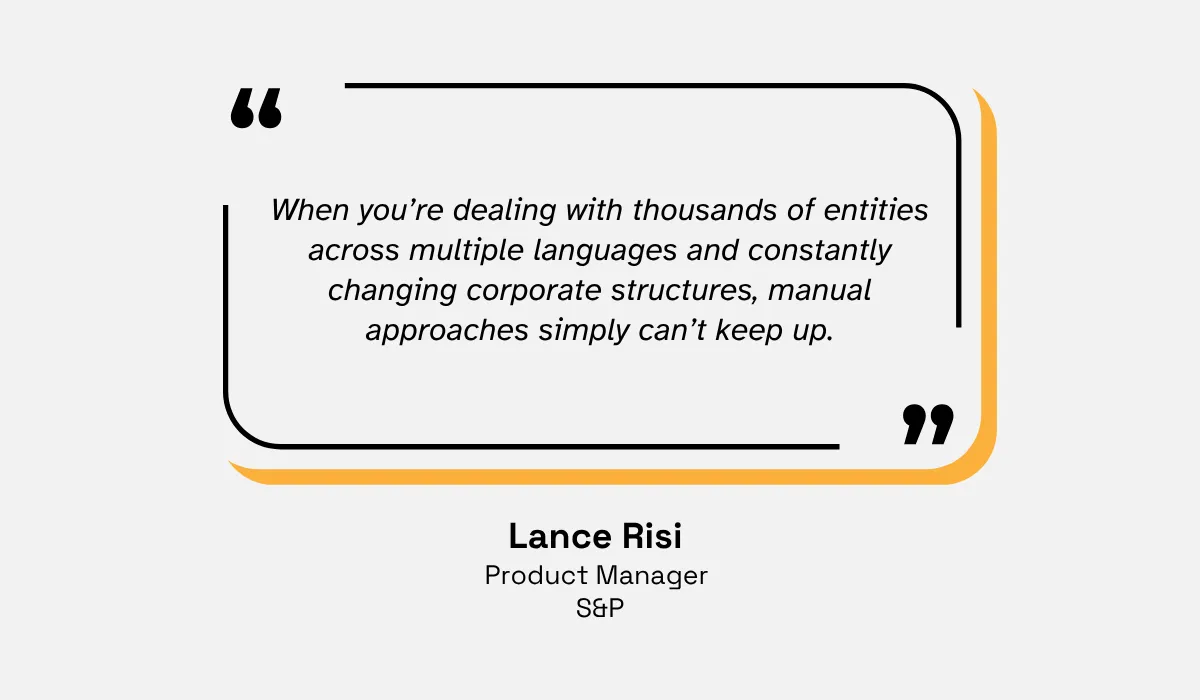
Illustration: Veridion / Quote: Waters Technology
And so, when credit estimating, the same borrower can enter the pipeline more than once, with its financials, ownership links, and risk signals split across records.
Entity resolution is the answer to this problem.
This is a process that connects records that refer to the same real-world company and creates one stable borrower record.
For credit estimates, entity resolution is a foundation rather than a cleanup step. It needs to happen before enrichment, classification, or credit analysis.
The pipeline first needs to answer one basic question: who exactly are we estimating?
Company Enrichment and Financial-Data Joins
Once the borrower is identified, the next problem for credit rating agencies is filling in the rest of the profile.
For a public issuer, analysts can usually start with structured financial filings.
But for private borrowers, the information may sit across different documents, systems, and sources. Some fields may even be missing completely.
So the pipeline needs to bring together what it can find.
That can include company details, business activity, ownership information, and other operational or structural signals. Financial information can then be joined to the right entity instead of being treated as a standalone file.
This sounds straightforward until you look at the scale.
Research from Quantexa, a decision intelligence platform, found that only 22% of UK Data and IT decision-makers believed their entire organization trusted the accuracy of its available data.
Another 43% said their organization was not getting the full value from its data.
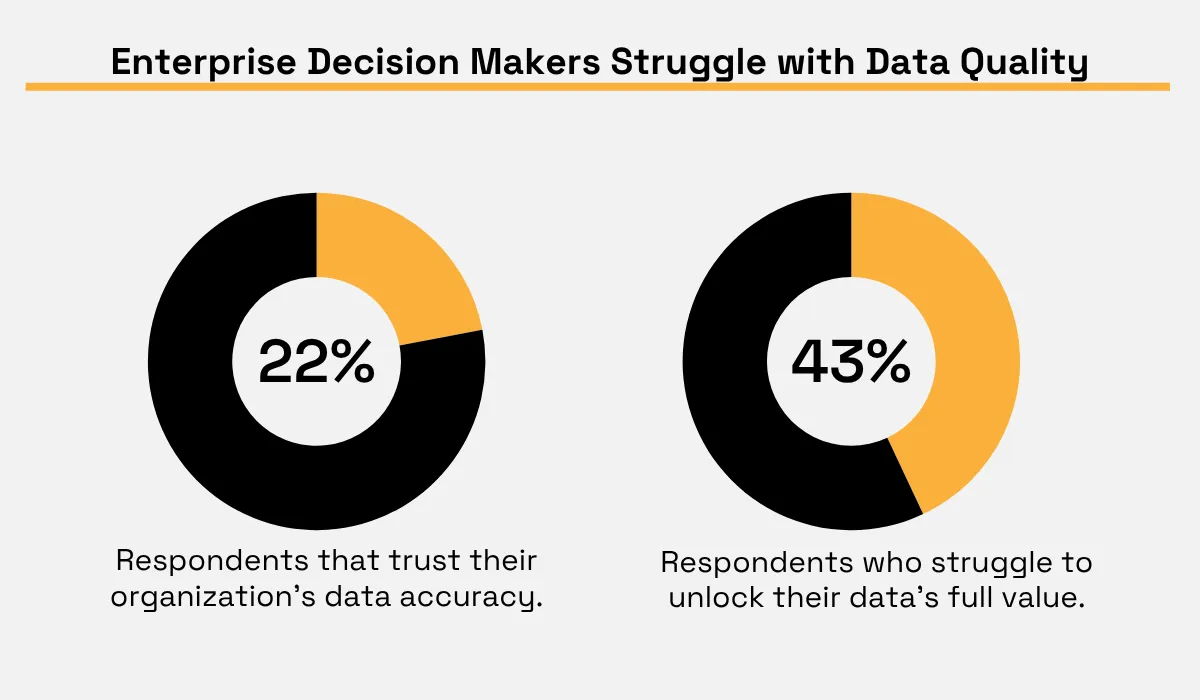
So, if an analyst is preparing credit estimates for 100 unrated companies, for instance, even a small number of inaccurate, outdated, or mismatched company records can affect the inputs used to assess those borrowers.
And there is another issue: data is not always sitting in one clean place waiting to be joined.
Different records may use different names or contain different versions of the same information. Some data may be current while another record is years old.
So what happens when financial disclosure is thin?
The pipeline has to look for other signals that help describe the business. Operational information can help show what the company actually does. Structural information can help show how it is connected to other businesses.
As Ramki Muthukrishnan, Managing Director & Analytical Manager at S&P Global Ratings, puts it:
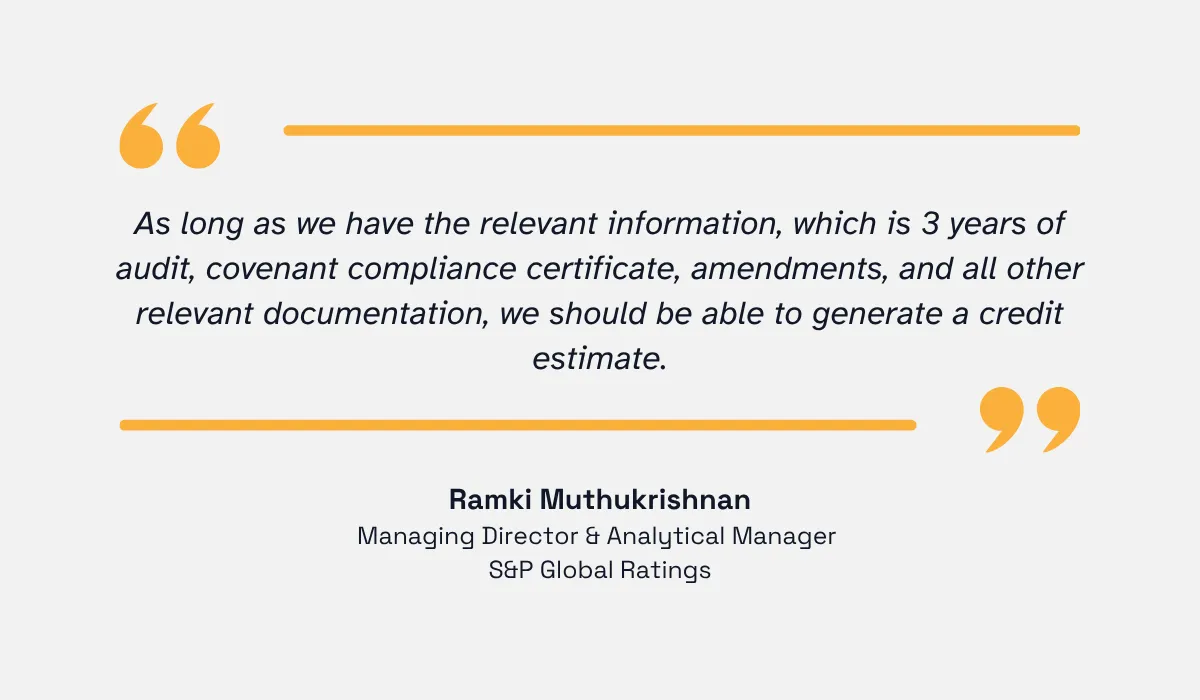
Illustration: Veridion / Quote: S&P Global Ratings
For credit estimates, the goal is not more data; it is adding the right data to the right borrower.
Classification and Hierarchy
Now the pipeline knows who the unrated borrower is and has started building its record.
But two questions remain: what kind of business is it, and where does it belong?
If similar companies are classified differently, peer comparisons become harder.
If a subsidiary is mistaken for a standalone company, risk can also be attached to the wrong part of the group.
Classification gets especially tricky when the business does not fit neatly into one box. With private borrowers, the issue is compounded further with much less public information.
Now, many CRAs rely on company classification code systems. But the same codes can accelerate the entire classification problem.
For instance, the North American Industry Classification System (NAICS) and Global Industry Classification Standard (GICS) do not organize companies in the same way.
NAICS classifies businesses by their main economic activity, while GICS uses four levels: sector, industry group, industry, and subindustry. So when a credit estimator brings in data from different providers, the same borrower may arrive with different classifications depending on the source.
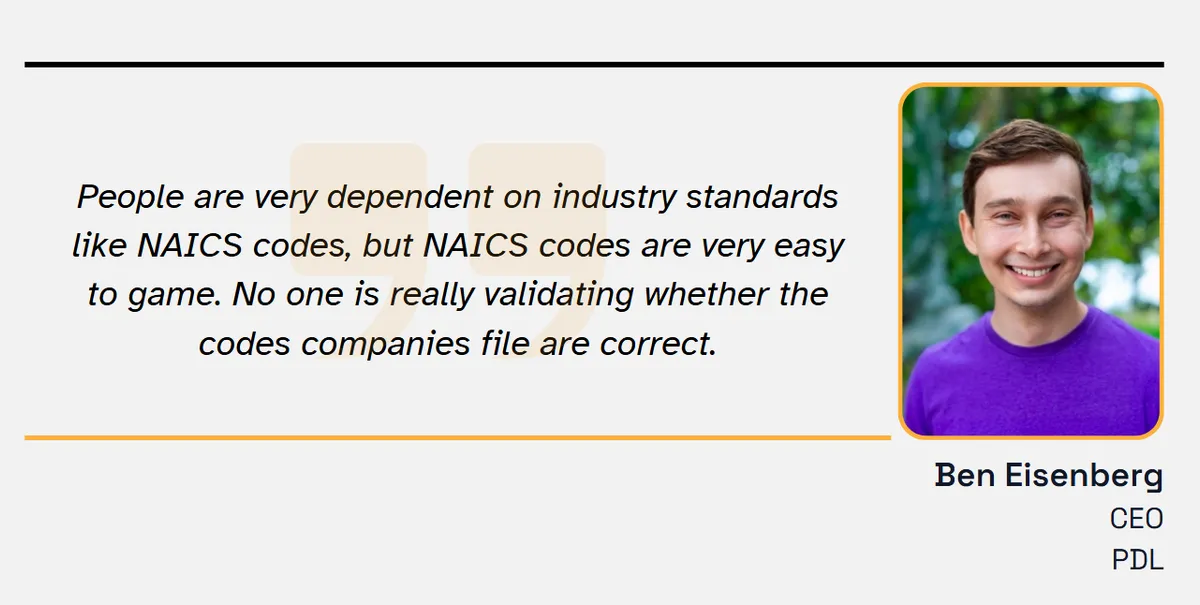
Now add time to the problem. NAICS is reviewed every five years, in years ending in 2 and 7.
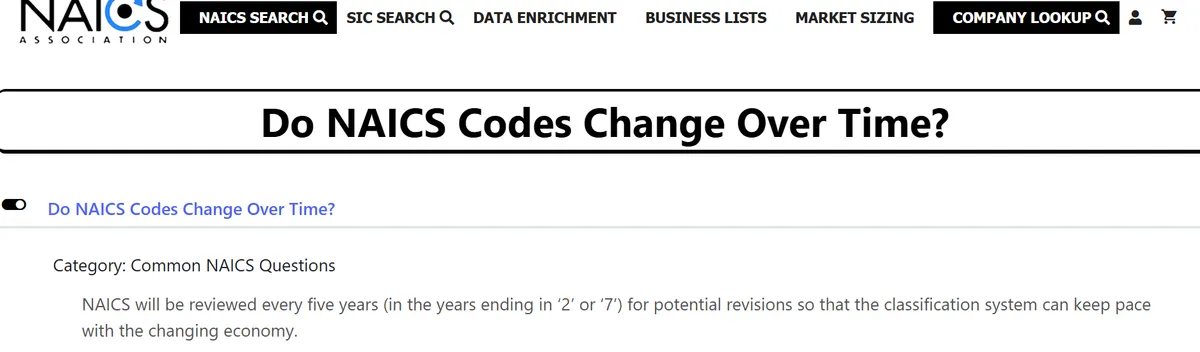
Source: NAICS
Think about how many private companies can change their products, revenue mix, or business model in that timeframe. A borrower can move into a new industry, but its old classification may continue sitting in a dataset until the next update.
Ben Eisenberg, CEO at People Data Labs (PDL), explains the NAICS issue precisely:
And classification is only one part of the hierarchy.
A private group may have a parent company, several subsidiaries, and separate legal entities underneath them. Two entities may have almost identical names, while another subsidiary may have a completely different legal name.
If that structure is not resolved properly, information about the parent can end up attached to the subsidiary, or the same group can be treated as several unrelated borrowers.
So for a large credit-estimate pipeline, classification cannot be a one-off label slapped onto a borrower.
It needs to be applied consistently, updated as the business changes, and tied back to the right entity and group structure.
Otherwise, the pipeline may just not be processing the right businesses in the right way.
Operating the Pipeline Once Borrowers Are Onboarded
Getting an unrated borrower into the pipeline is only the start. The harder part is keeping its information usable as new data arrives and the business itself changes.
At this stage, the pipeline has to keep the credit team moving without hiding uncertainty or creating extra manual work.
Handling Missingness and Normalization
When performing credit estimates, CRAs rarely receive data in one standard format.
A financial statement might use one currency; another source might use another. One provider may report revenue in millions, while another gives the full figure. Even basic fields can use different names, dates, or formats.
Normalization can help here, bringing different sources into a common structure.
But then there is also the problem of missing data. What happens when there is simply no number to normalize?
A missing Earnings Before Interest, Taxes, Depreciation, and Amortisation (EBITDA) figure is not the same as an EBITDA figure that was entered incorrectly. An old address is not the same as an address that was never collected.
Daniel Cash, Senior Fellow at the Centre for Policy Research (UNU-CPR), sums up the issue well:
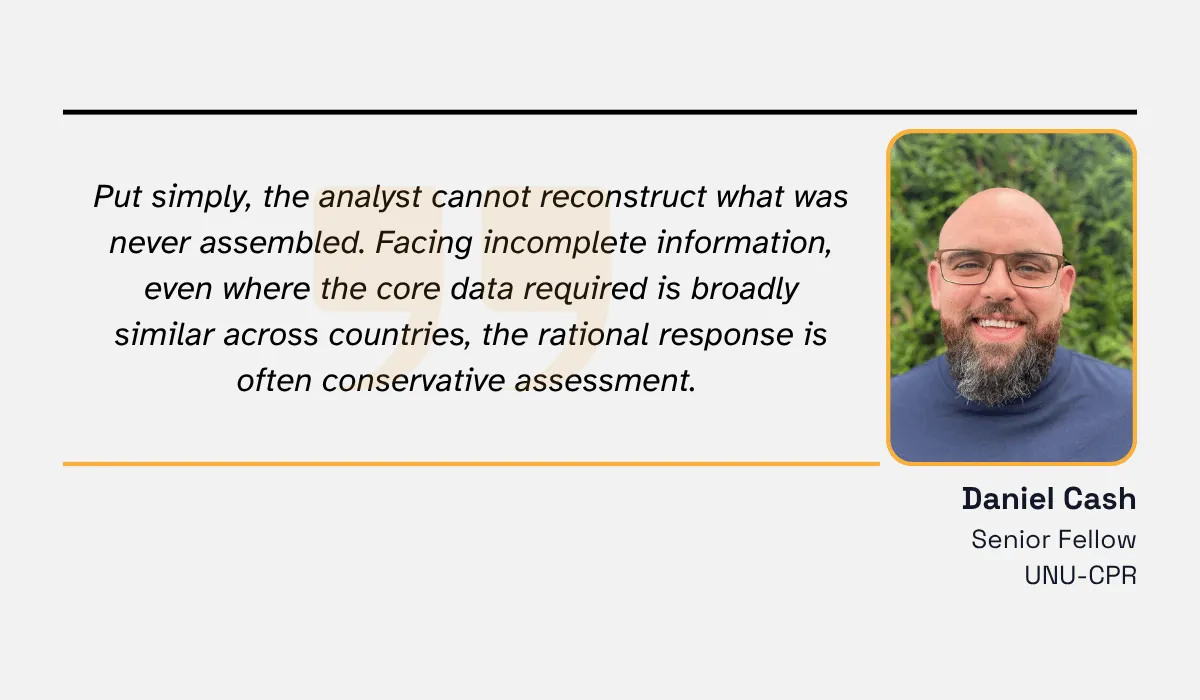
Illustration: Veridion / Quote: The Conversation
So, whether it’s normalization or missingness, credit estimates must not quietly fill the gap and make the record look complete.
It should mark the missing field, retain where the available information came from, and flag cases that need analyst attention.
EY, one of the largest professional services networks worldwide, also points to the lack of universal identifiers, unclean data, and the growing number of data vendors as specific challenges for private-credit data management.
The better approach here is to make different data comparable without pretending that incomplete data is complete.
Feeding Analyst and Model Inputs
Data coming from borrowers cannot simply be passed into a model as received. It needs to be checked, standardized, and organized first.
Moody’s, one of the top three credit rating agencies in the US, shows why this approach matters.
Its Data Alliance combines contributed private credit data from more than 125 financial institutions across 25 markets. The dataset includes more than 100 million financial statements covering 20 million private firms and more than 2.9 million defaults.
The data is cleaned, standardized, anonymized, and checked against 200 business rules before it can support analytics and credit and risk models.
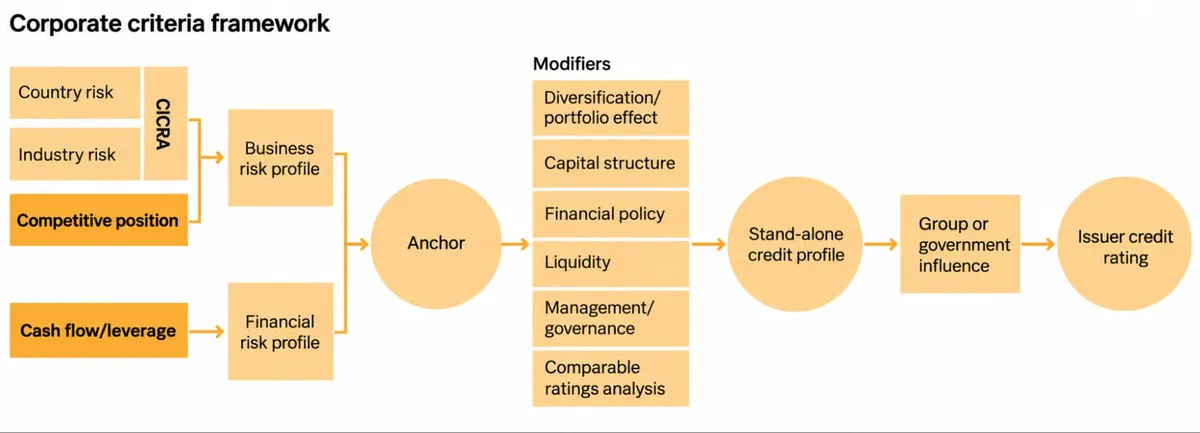
S&P Global, another top credit rating agency in the US, takes a different but complementary approach with its Credit Estimate Calculator.
The calculator adapts S&P’s corporate rating methodology for credit estimates and standardizes the calculations and inputs used by analysts.
It brings together business risk, financial risk, and modifier inputs to produce an indicative credit estimate, which analysts can then adjust before arriving at the final estimate.
The inputs are not limited to financial ratios; they include country and industry exposure, competitive position, profitability, historical and projected financial data, ratio weightings, volatility assessments, and other adjustments.
Analysts select these inputs based on their judgment.
Source: S&P Global
For a large pool of unrated borrowers, a pipeline that simply moves data from one system to another creates another layer of manual checking.
But a pipeline that validates, standardizes, and prepares the inputs gives analysts a cleaner starting point and makes model-driven credit estimation more consistent.
Refresh Cadence and Exception Queues
A borrower record can be accurate today and wrong six months later.
That is especially true for private companies. So the pipeline needs a refresh process, not just onboarding.
But refreshing everything at the same frequency may not make sense. Some information can wait for a scheduled update. Other changes should trigger an immediate review.
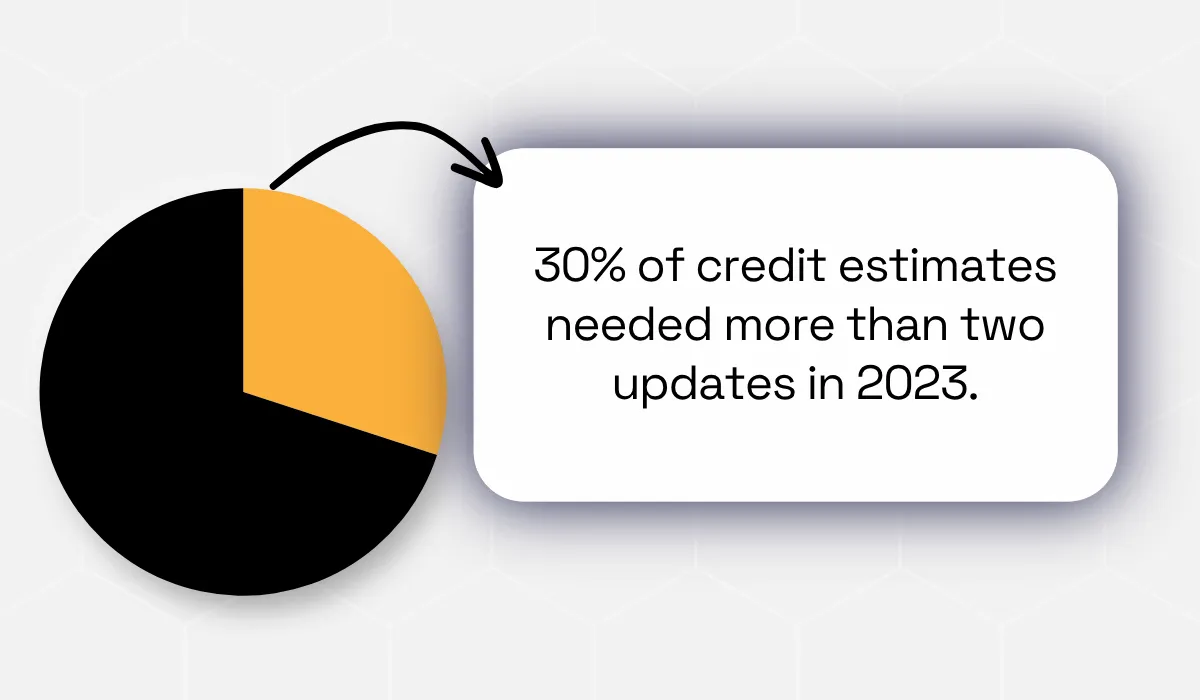
In this LinkedIn post, Scott Tan, Managing Director and Head of Credit Estimates at S&P Global, states that credit estimates are typically refreshed within 12 months, but material events can lead to earlier updates.
In 2023 alone, ~30% of the credit estimates assessed at S&P Global were updated more than twice because of material events or requests from Collateralized Loan Obligation (CLO) managers.
That suggests a better model for a large pipeline: scheduled refreshes plus event-driven exceptions.
Veridion can support this model by keeping the underlying company record current between formal review points.
Its continuous refresh process detects changes, re-derives affected attributes, and retains the evidence behind each update.
Entity resolution helps maintain one canonical borrower record across different names, subsidiaries, and identifiers, reducing the risk of refreshing the wrong entity.
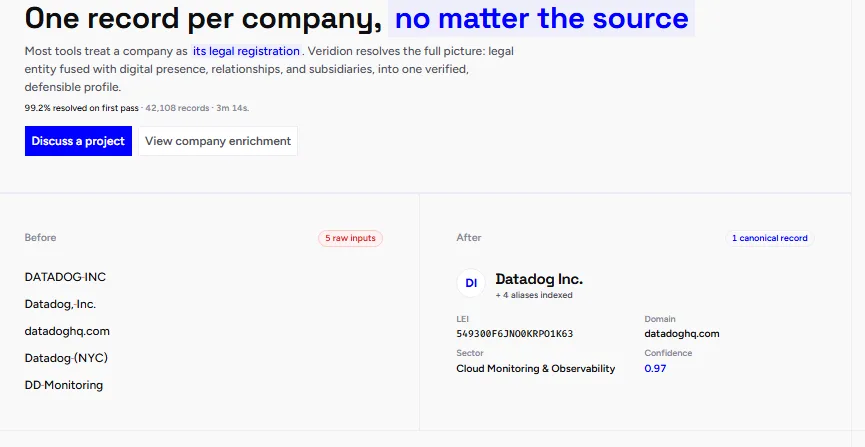
Source: Veridion
Its data methodology also provides source trails, confidence scores, and last-harvested dates for each attribute.
For a large private-company universe, Veridion’s private equity solution shows how continuous updates and change signals can support portfolio monitoring.
Bulk delivery and APIs can then feed these updates into the rating pipeline at a defined cadence, while material changes can be routed for analyst review.
Conclusion
Scaling credit estimates is not simply a matter of putting more borrowers through the same process.
The pipeline has to identify the right company, build a usable record, handle missing information, and keep that record current. It also has to know when a change is routine and when it deserves an analyst’s attention.
That is where data quality becomes a credit issue, not just a data-management issue.
A strong pipeline gives analysts cleaner inputs, clearer exceptions, and a more consistent view of unrated borrowers. And as private-credit volumes continue to grow, that foundation becomes harder to treat as just a back-office task.
Articles
Discuss how these trends affect your organization.
Our analysts are available for a short call. Bring a specific question and we will ground it in the data.
Insights
Keep reading
More analysis, research, and outcomes grounded in live company intelligence.
Data Lineage for Credit Ratings: Building a Traceable Evidence Chain
How credit rating data lineage works in practice: capturing provenance, entity identifiers, transformations and overrides.
Point-in-Time Credit Estimates vs. Monitored Private Ratings: Different Data Requirements
We will explore point-in-time credit estimates vs monitored private ratings and show how data collection, updates, and monitoring needs will change.
How to Build Comparable Peer Groups for Private Company Credit Analysis
This article will explain how to create peer groups for private company credit analysis and improve benchmarking when financial disclosure is limited.