Insights / Articles
From Company Discovery to Rating Candidate: Building an Issuer Coverage Pipeline
Rating teams use an issuer coverage pipeline to turn thousands of raw company records into a short list of unrated issuers worth an analyst's time.

- 55% of data leaders wasted resources because of poor data.
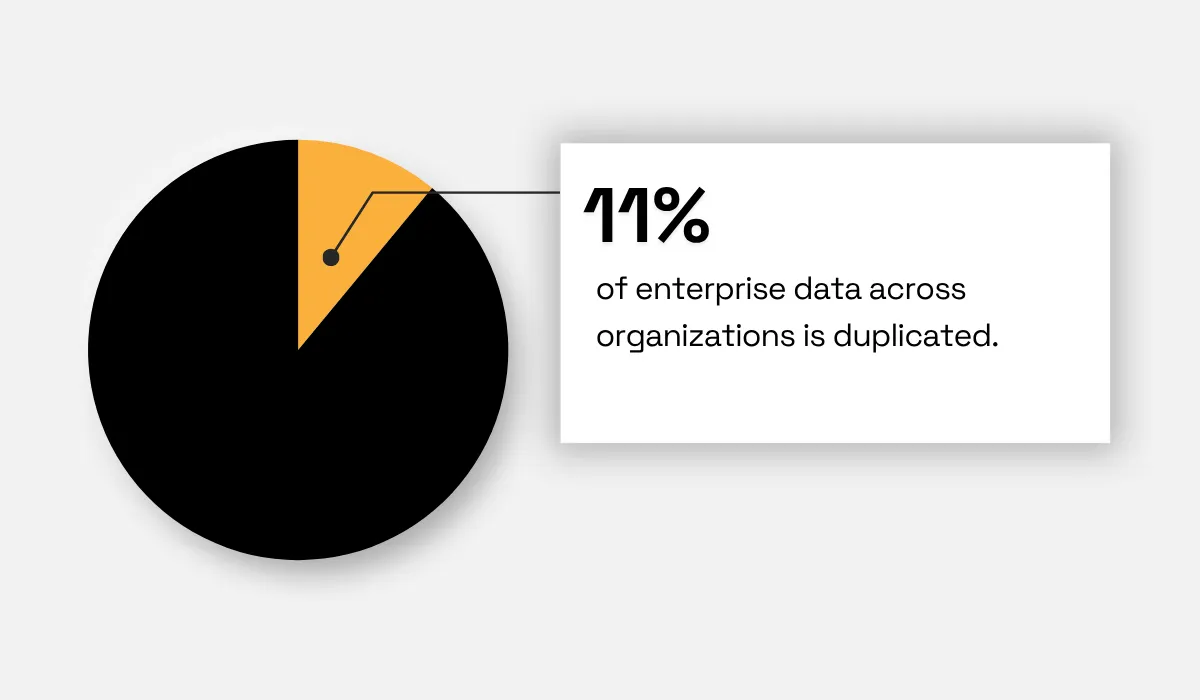
- On average, 11% of an organization's data records are duplicates.
- Clean company identities make analyst review more focused.
- Better filtering helps teams find relevant issuers faster.
Have you ever wondered what happens before a credit rating agency puts an issuer in front of an analyst?
The rating is only the visible part of the process.
Before that, someone has to find the right companies, work out which records belong to the same business, understand their corporate structure, and decide which issuers are actually worth reviewing.
That becomes difficult when thousands of companies enter the pipeline from different sources.
A good issuer coverage pipeline solves this problem step by step. It helps rating teams move from a broad company universe to a focused set of rating candidates.
1. Ingest Raw Company Sources
The first step to building a strong issuer coverage pipeline is collecting company data from multiple sources.
Credit rating agencies (CRAs) can receive underlying data from national business registries, regulatory filings, stock exchange listings, procurement platforms, news feeds, and company disclosures.
Now, each source can use its own formats, identifiers, naming conventions, and data fields. This creates an immediate data-quality challenge.
Salesforce's State of Data and Analytics 2nd Edition report found that 55% of data and analytics leaders training or fine-tuning their own models had wasted significant resources because of poor underlying data.
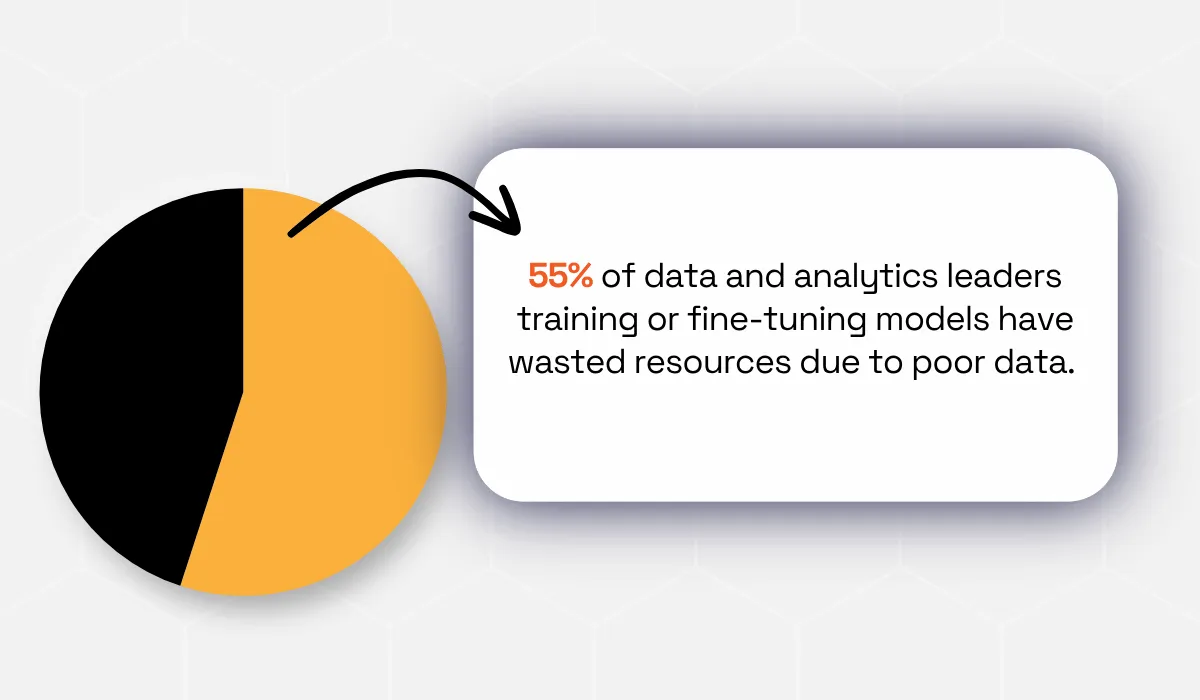
Illustration: Veridion / Data: Salesforce
The impact can be greater in a credit workflow.
An incorrect or incomplete company record can affect later stages such as entity matching, classification, eligibility checks, and candidate scoring.
Data ingestion therefore needs to capture the source record accurately while preserving important identifiers and source information.
2. Match and Deduplicate Company Records
Company records from different sources rarely use the same information in the same way.
One source may list a business as 'Acme Corp.' Another may use 'ACME Corporation,' while a third may use 'Acme Co Ltd.'
Addresses can also differ, and registration or tax identifiers may use different formats.
These records may refer to the same company.
Quantexa, a Decision Intelligence (DI) company, did an enterprise survey on data trust.
They found that, on average, 11% of data records across organizations are duplicated.
For a rating pipeline, these duplicate records create a direct problem.
The same issuer could appear multiple times, creating separate profiles or risk scores.
Records therefore need to be matched to the underlying legal or operating entity and consolidated into one company record.
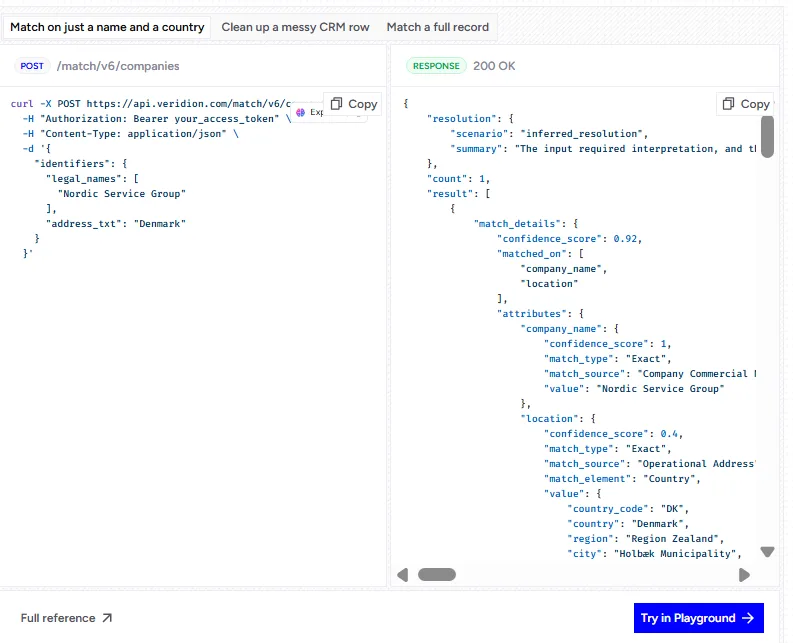
Veridion’s Match & Enrich API can match a company using limited information, such as a name and country, and return a canonical “veridion_id” along with the matched attributes and confidence scores.
This gives downstream processes a consistent entity to work with instead of relying on the original, incomplete record.
Source: Veridion
The resolved entity can then be enriched with details such as registered and operating addresses, registry IDs, company status, employee count, revenue, industry classifications, business model, and digital presence.
Because the same “veridion_id” connects to Veridion’s other APIs, the resolved company can also be carried into later data enrichment workflows without creating another identity-matching step.
3. Resolve Corporate Hierarchy
Company risk cannot always be assessed at the individual-entity level.
A business may be owned by another company, operate as a subsidiary, or belong to a larger corporate group. These relationships can span several countries and multiple ownership layers.
Missing these relationships can lead to an incomplete view of an issuer's exposure.
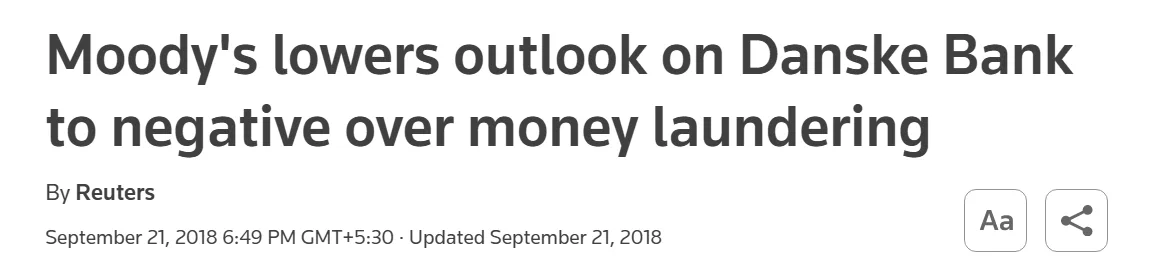
Take the case of Danske Bank (Denmark's largest lender), which, through its small Estonian branch, processed an estimated €200 billion in suspicious transactions between 2007 and 2015.
It became one of the largest money laundering scandals in European banking history. The entire unfolding impacted Danske Bank’s credit rating.
Source: Reuters
Cases like these show why resolving hierarchy well is essential.
A subsidiary's numbers can look completely fine in isolation while the parent's real exposure tells a different story entirely.
So resolving hierarchy means asking questions for every issuer like the following:
- Who owns this company?
- What's the ownership percentage?
- Is there an ultimate parent two or three layers up that drives the group’s credit profile?
This helps analysts understand where a company is positioned within a wider corporate group and prevents related entities from being assessed in isolation.
4. Classify Business Activity
What does this company actually do? This question may sound simple, but it rarely is.
Classification systems like SIC and NAICS were built decades ago, and they haven't kept pace with how businesses operate today.
CRAs cannot rely only on traditional classification systems to assess issuers.
According to The Data City, a UK-based data and business classification company, around 15% of UK companies, close to 740,000 of them, fall into vague “not elsewhere classified” catch-all codes.
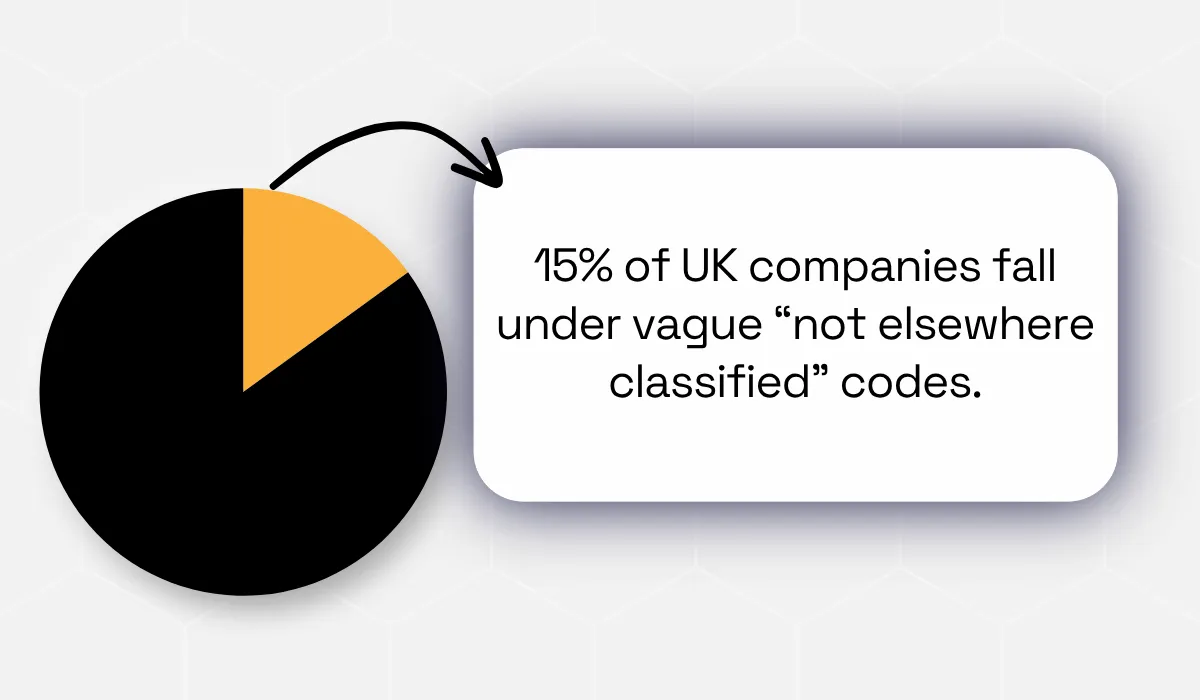
Illustration: Veridion / Data: The Data City
That's hundreds of thousands of businesses the official system can't describe.
So, if analysts cannot pin down a company's core activity, they can't group it with the right peers.
They also can't apply sector-specific risk factors or build a fair comparison set for analysis.
A fintech running a peer-to-peer lending platform might get dumped into an old 'business credit institution' code that has nothing to do with how the company actually makes money, or where its real risk sits.
A rating pipeline therefore needs more than a single industry code.
Besides codes, business activity can be assessed using company descriptions, products and services, websites, industry information, and other structured or unstructured signals.
Better classification creates more relevant peer groups and supports more consistent analysis.
5. Apply Eligibility Rules
A CRA first needs to establish whether an entity is within the scope of its rating activity.
This initial screening can depend on factors such as the type of borrower, market presence, debt issuance, available financial information, and the nature of the rating being requested.
The exact criteria vary by agency and rating type.
A company issuing debt in the public market, for example, may enter the rating process through an issuer or instrument request, while a private company with limited disclosure may require a different assessment path.
Eligibility rules also carry higher importance because a company may look relevant under one framework but less relevant under another.
There is also a market reason to be selective.
Since 2019, around 80% of euro-denominated benchmark bond issuance has involved more than one rating, according to Matthew Palmer, Managing Director at Fitch Ratings. Two ratings have become common for these transactions.
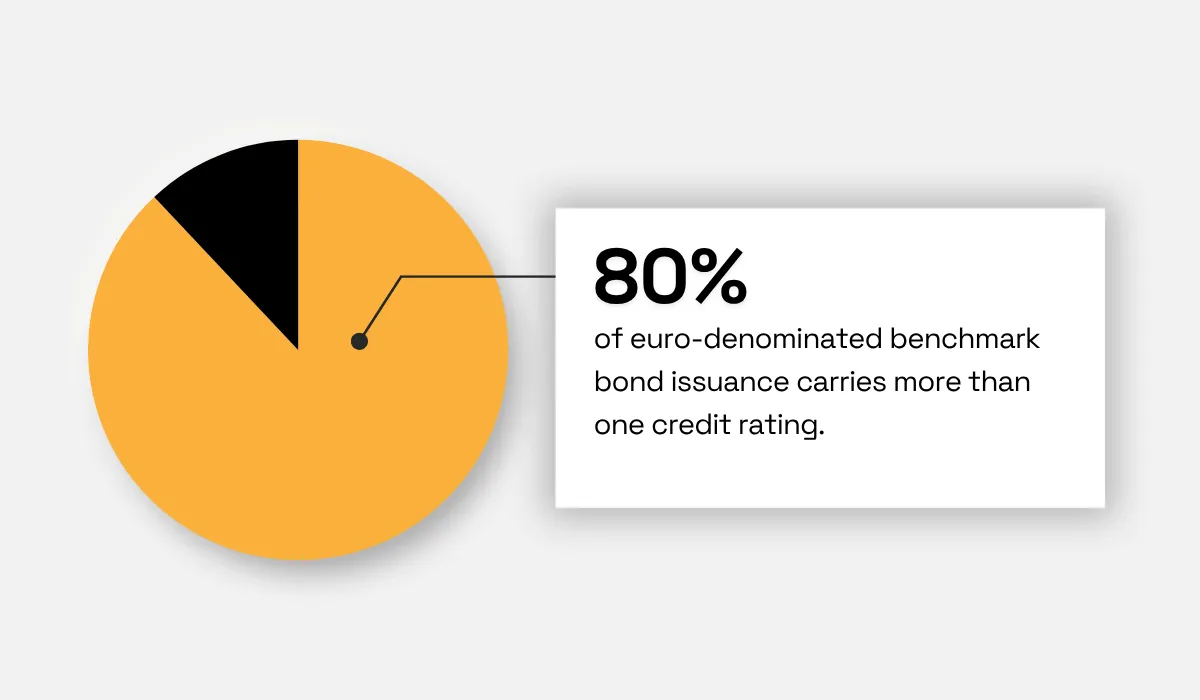
Illustration: Veridion / Data: Treasury Management International
So, the question that arises here is this: Are eligibility rules actually filtering for relevance, or are CRAs giving out ratings to all issuers without filtering?
If the criteria for eligibility are skewed from the beginning, CRAs could be wasting a monumental amount of time reviewing issuers that don’t even qualify in the first place.
6. Check Existing Rating Coverage
An eligible company is not necessarily a new rating opportunity.
To avoid wasted effort or re-rating an already rated entity, the pipeline needs to compare potential candidates against existing coverage before sending them forward.
S&P Global Ratings, for instance, covers more than 9,500 issuers and approximately 79,000 securities worldwide.
Along with Moody's and Fitch, the three major agencies account for more than 95% of the global credit ratings market.

Illustration: Veridion / Data: European CEO
In other words, there is a good possibility that the entity or instrument analysts are trying to access has already been accessed or carries ratings.
This makes coverage re-checking an important part of the pipeline. It needs to identify existing ratings, rating agencies, relevant securities, and other available coverage information.
Cross-referencing this information can help remove candidates that do not represent new coverage opportunities.
7. Identify Coverage Gaps
The next step is to identify companies that meet the relevant criteria but do not have existing coverage.
Research from Credit Benchmark, a consensus credit intelligence platform, puts traditional agency coverage at somewhere around 10% to 15% of institutional lending portfolios.
So, the economics only work for public issuers with liquid debt and fees big enough to justify analyst time.
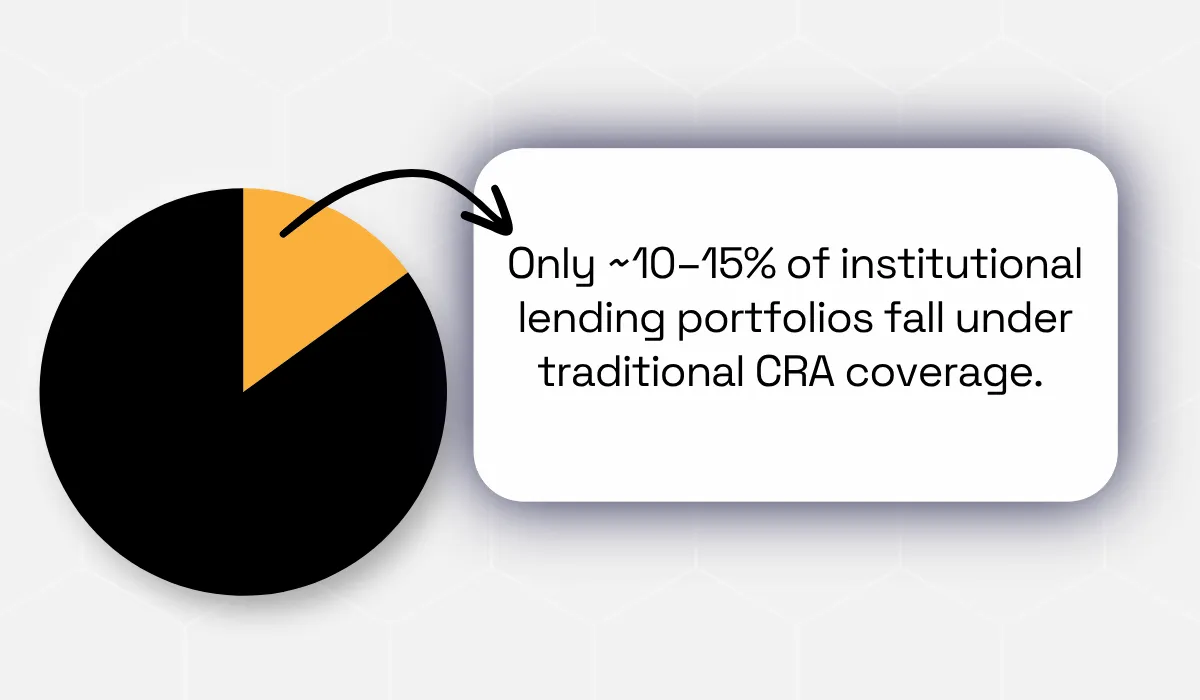
Illustration: Veridion / Data: Credit Benchmark
This leaves a significant portion of lending exposure outside traditional agency coverage.
Private credit is an important part of this.
The Financial Stability Board also noted that private credit borrowers typically do not have public credit ratings.
For coverage teams, this creates a large pool of companies that may warrant further assessment.
Depending on the scope of the pipeline, this could contain hundreds or thousands of companies.
The pipeline can identify these opportunities by comparing them with existing ratings and other available coverage data.
8. Score and Prioritize Candidates
Once companies pass eligibility checks, the next question that arises is which one should an analyst look at first?
This is where scoring helps.
Financial strength, company size, industry, country, ownership, debt exposure, and other relevant factors can each contribute to the final score.
Moody’s scoring and rate-card approach toward rating U.S. local governments issuing debt shows how this can work.
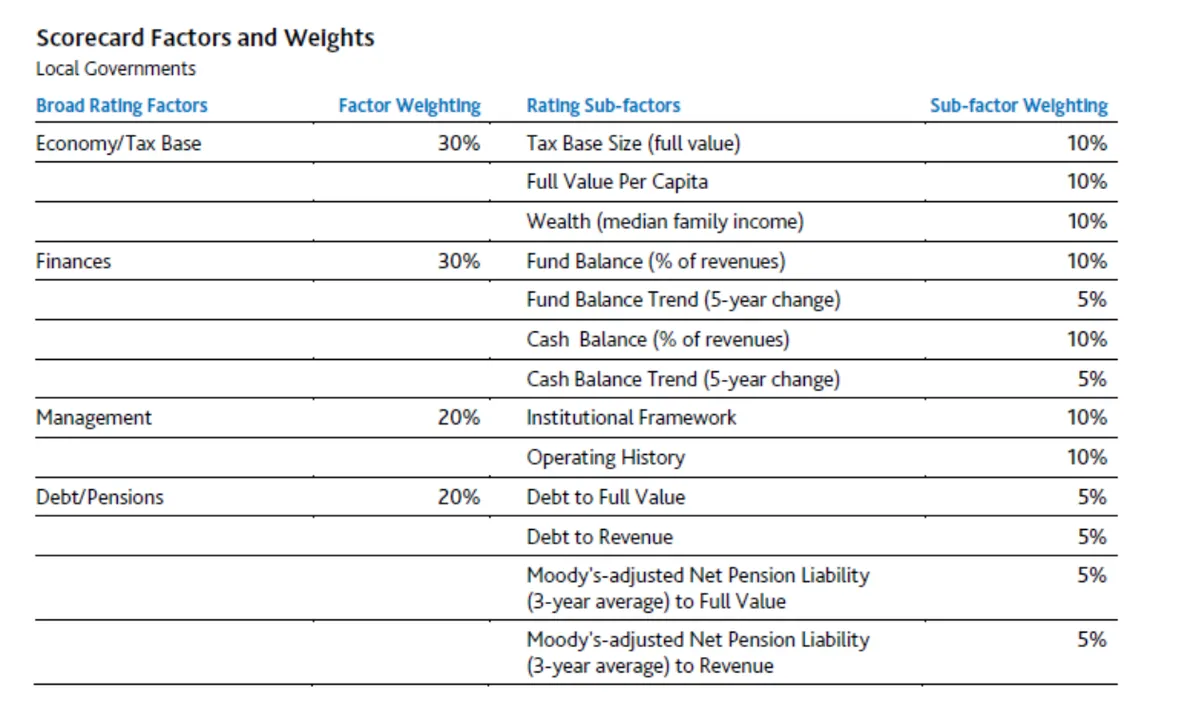
Source: lwm-info.org
Different factors, including country, can carry different weights or values in a credit assessment.
The same approach can be applied when deciding which unrated companies deserve analyst attention.
CRAs may even use their own parameters, calculators, and ratios for further refinement.
But there is a catch. If the model is fed messy company records, duplicate entities, or wrong industry classifications, the score can be wrong before the analyst even sees it.
So, data hygiene is of utmost importance here.
The score simply narrows the gap list and tells you who moves to the top. However, it does not replace analyst judgment.
9. Route Candidates to the Analyst Queue
Once candidates have been ranked, they need to reach the right analysts with enough information to support the initial review.
Anaconda's 2020 State of Data Science Report, based on responses from 2,360 data professionals across more than 100 countries, found that almost 45% of a data professional's time was spent on data loading and cleansing; visualization accounted for another 21%.
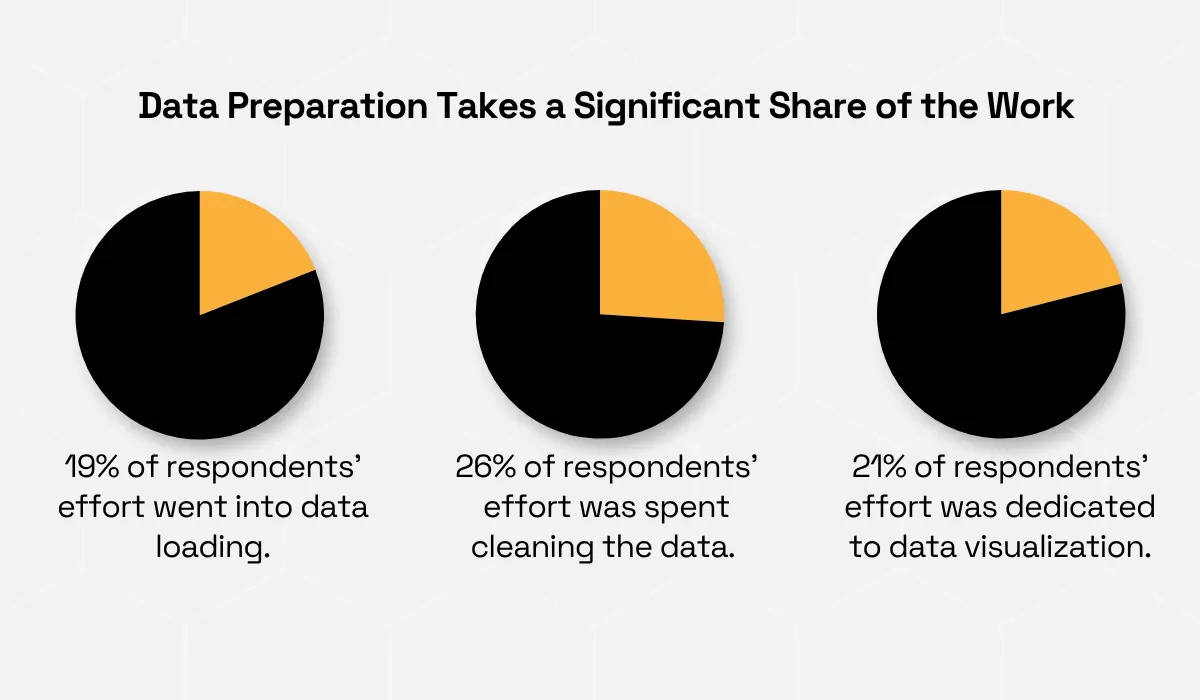
So, if data lands in an analyst's queue still needing to be cleaned, matched, and reconciled, the analyst is doing data janitor work instead of credit analysis.
A well-built pipeline flips that.
By the time a candidate reaches the queue, matching is done, hierarchy is resolved, classification is applied, and eligibility is checked.
Not to mention, it allows the analyst to focus on credit assessment, investigation, and judgment rather than repetitive data preparation.
10. Architect Continuous Refresh
An issuer coverage pipeline cannot rely on a one-time data collection process.
Companies can change their operations, restructure ownership, issue new debt, or cease operating.
This means company records, classifications, hierarchies, eligibility status, and coverage information can all become outdated.
Now, most CRAs follow an annual rating refresh cycle, with additional updates triggered by significant events or material changes. Further, most treat ratings as an ongoing monitoring process.
Moody, for instance, describes its surveillance as continuous monitoring, with multiple screening steps used to identify ratings that may require further review.
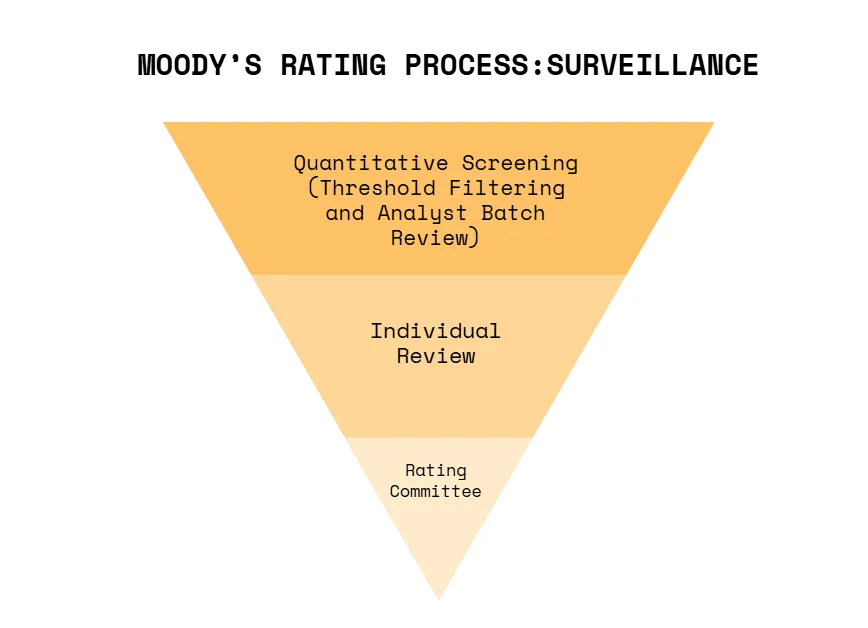
Illustration: Veridion / Source: lwm-info.org
The same principle applies to the data pipeline supporting issuer coverage.
Existing records need to be re-matched and enriched regularly.
Corporate relationships need to be checked for changes. Eligibility rules need to be reapplied when relevant. Candidate scores also need to be recalculated as company circumstances change.
A continuous refresh process keeps the coverage universe aligned with the underlying market.
Without regular updates, a pipeline can gradually become a historical snapshot rather than a reliable source of current issuer opportunities.
Conclusion
Finding a rating candidate is not as simple as finding an unrated company.
A company first needs to be identified correctly, understood in context, and checked against existing coverage. Only then can a coverage team decide if it is worth an analyst’s time.
That is the real value of an issuer coverage pipeline.
It gives the team a repeatable way to move from a large company universe to a smaller set of relevant candidates.
And as the number of companies, borrowers, and data sources grows, having that process in place becomes even more important.
Articles
Discuss how these trends affect your organization.
Our analysts are available for a short call. Bring a specific question and we will ground it in the data.
Insights
Keep reading
More analysis, research, and outcomes grounded in live company intelligence.
A Closer Look at the Top B2B Data Enrichment Companies Businesses Rely On
Struggling to find reliable firmographic data providers? Uncover the top B2B data enrichment companies that businesses trust to fuel growth.
Best Practices for Data Enrichment
Learn how data enrichment best practices help businesses turn raw data into accurate and actionable insights.
How Successful Companies Use Market Intelligence for Business Growth
Discover how successful companies use market intelligence to unlock new growth opportunities. Learn more in our latest guide.