Insights / Articles
What Should a Credit Risk API Return? A Data Team Checklist
Scores alone do not make a credit risk API useful. Check six field groups, from identifiers and match confidence to timestamps, before you choose one.

- Separate published figures from modeled estimates.
- Check match confidence, data sources, and timestamps.
- Veridion supplies company data for credit risk workflows.
Credit risk workflows are not based on scores alone. There is much more data the system requires.
Missing or unsuitable input data can make a credit score less reliable and harder to interpret.
Your credit risk API should give accurate company identifiers, financial data, ownership details, and information about the data source and when it was last updated. It can then feed the required data into your workflows.
Six Field Groups a Credit Risk API Response Should Include
Use the following six groups to assess whether an API returns the company data and metadata your credit risk workflow needs.
Identity: Stable Identifiers and Match Confidence
First and foremost, a credit risk API should return the company identifier.
Note that legal names may differ from trading or brand names; a company might be acquired, or there simply could be another entity with similar names. In such cases, there’s always a chance of mismatch.
A reliable identifier pinpoints the entity you’re dealing with. For further confirmation, the credit risk API should provide a confidence score for the match.
Some of the common identifiers are:
- Legal entity identifier (LEI)
- D-U-N-S number by Dun & Bradstreet
- Tax identification number (TIN)
- Company registration number (CRN)
- Value-added tax identification number (VAT ID)
Not every company registers in the same or every system. The registration varies by jurisdiction and depends on the company’s legal obligations and circumstances. If you only look at one system, there’s a chance you’ll miss something.
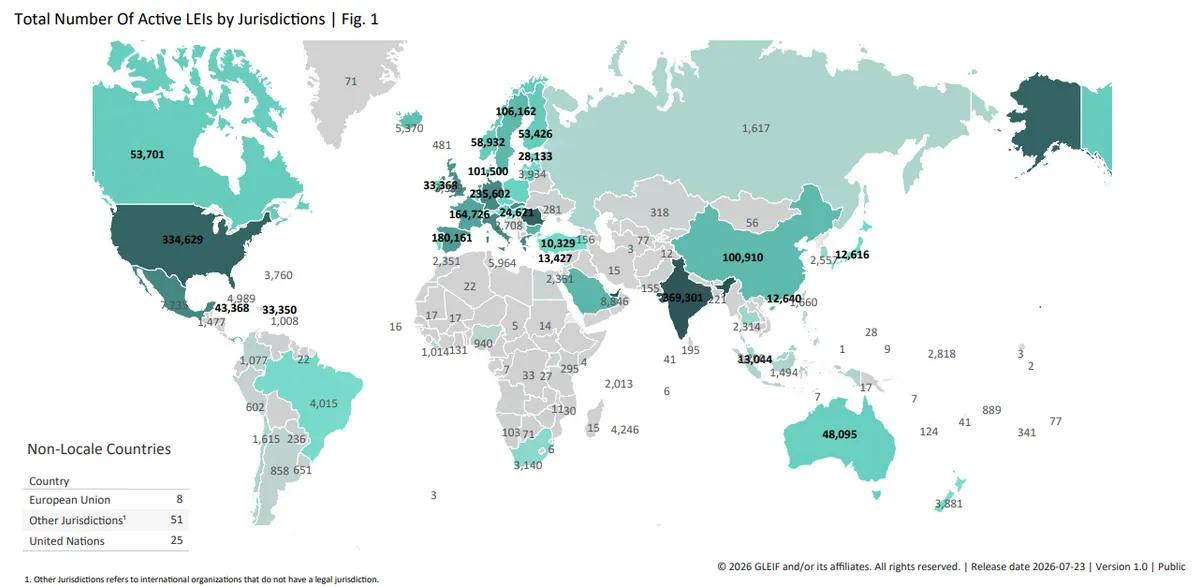
GLEIF, the Global Legal Entity Identifier Foundation, released a 2026 Q2 report that states the total active LEI count exceeded 3.1 million by the end of 2026’s second quarter, with a quarterly growth rate of 3%.
This number is far less than the number of businesses around the globe. The LEI adoption can be seen in the following figure published in the same 2026 Q2 report.
Source: GLEIF
For this reason, your API must be able to operate in multiple identifier systems or use a single, consolidated system that links identifiers across them.
Veridion provides an example of this approach. Each result includes a veridion_id. Where an entity’s ID has changed, former_veridion_id provides the previous identifier.
It also returns a confidence score, which helps you decide which matches to accept and which need further review.
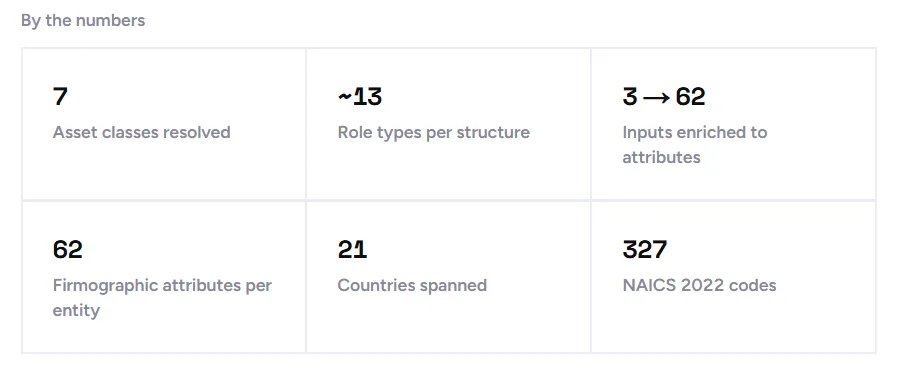
For example, one structured-finance rating agency needed to identify the entities behind securitization deals. Instead of company names, their input consisted of deal names, securitization trusts, and special-purpose vehicles (SPVs).
Veridion mapped each deal to the operating companies behind it and identified roles: sponsors, loan sellers, parent companies, investment managers, and depositors.
It enriched the resolved entities with 62 firmographic attributes across 21 countries and verified the mappings against SEC filings and rating-agency reports.
Source: Veridion
This gave the agency a traceable way to identify the companies whose disclosures were relevant to its credit and ESG analysis.
Company State: Status, Classification, and Corporate Structure
After locating the exact entity, the second step is to examine the company’s background.
The company data API should provide information on the following categories:
- What the company is
- What it does
- Its corporate hierarchy
- Industry classification
- Business activities
This data renders a snapshot of the company. It explains its background, links, and current business state and activity. This information sets the foundation for your credit risk assessments.
In a 2023 Ag View Solutions podcast, Jeremy Doetch discussed how he evaluated borrowers at German American State Bank.
He explained that management quality and ownership structure were part of his assessment of a company’s credit profile.

Illustration: Veridion / Quote: Ag View Solutions
Industry classification provides context for evaluating sector-specific risks. Business activities help identify potential exposure to operational or market changes.
A company’s corporate hierarchy shows group-level dependencies and exposure to related entities.
Without this information, the financial statements and all other data will lack the context for interpretation.
The Match & Enrich API returns the following classification, activity, and registry fields:
- Main industry
- Main business category
- Main sector
- NAICS / NACE / ISIC / SIC codes
- Company description
- Business model
- Offerings
- Operational footprint
- Company status as recorded by the registry
- Legal form
- Company type (public or private)
These fields help credit professionals understand the company’s identity and activity. Verify parent and subsidiary relationships separately rather than inferring them from legal form.
Financial Features and How They Were Derived
After basic company knowledge, financial data is the most important.
When your workflow uses financial figures, check which metrics the API returns and how each value was obtained.
Financial disclosure requirements vary by jurisdiction and company type. Some private companies publish financial statements, while others disclose only limited information.
The financial information available to an API may therefore differ in detail, reporting period, and source coverage.
This makes it harder for creditors to assess the creditworthiness of private companies.
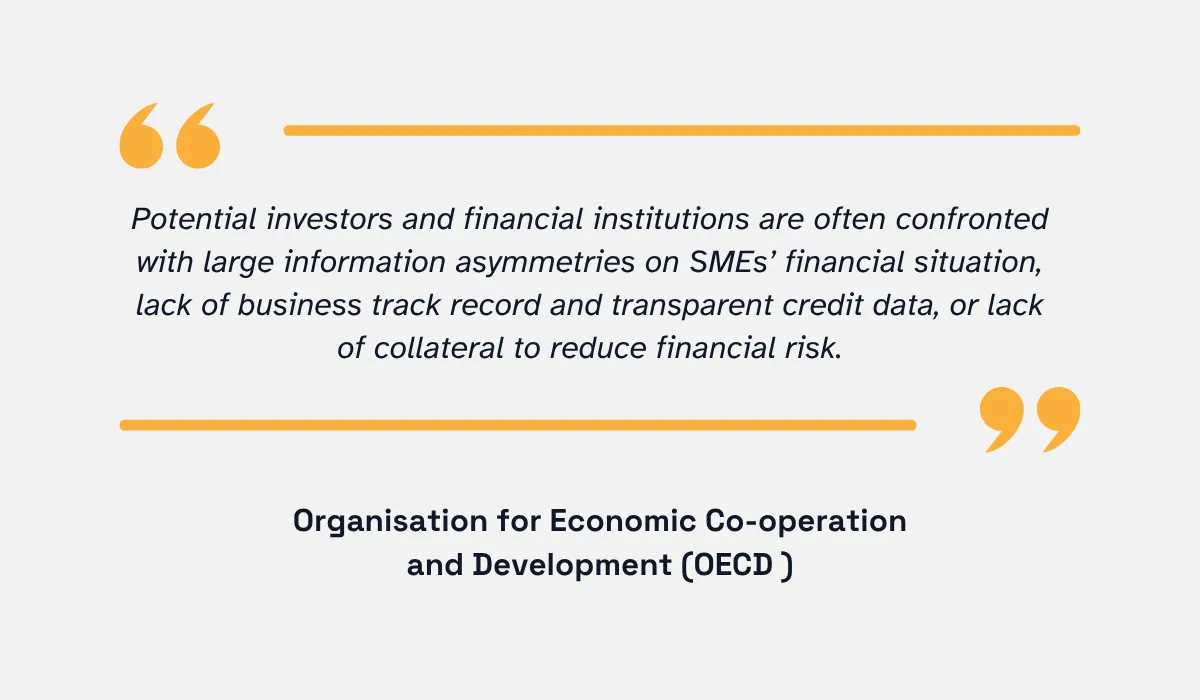
The Organisation for Economic Co-operation and Development (OECD) highlights this point in its 2022 report Financing Growth and Turning Data into Business. It directly links data problems with investors’ and lenders’ limitations in performing credit risk assessment of SMEs.
Due to data unavailability or discrepancies, algorithms often estimate data based on contextual evidence. The accuracy of these estimates should be evaluated separately from reported figures.
The API should clearly distinguish published values from model-generated estimates.
Derivation labels explain how a value was obtained; they do not guarantee that published figures are correct or that estimates need no validation.
Financial values should include their currency or unit, reporting period, and derivation label so your pipeline can interpret them correctly.
Veridion’s Match & Enrich API provides yearly revenue and employee count. Revenue and employee count values each have a type field: revenue.type and employee_count.type.
- Extracted: a published value taken from a source used by Veridion.
- Modelled: a value estimated by Veridion’s AI models.
This helps creditors distinguish reported financial figures from model-generated estimates.
Confidence, Missingness, and Provenance
To assess data quality and traceability, check how the API represents confidence, missing values, and sources.
Here’s a breakdown of these attributes.
Confidence value | Shows how reliable a value or entity match is. Your downstream systems can use it to accept high-confidence results automatically and flag low-confidence fields for human review |
|---|---|
Missing-value indicator | Shows explicitly when data is missing rather than using zero, which can be interpreted as a value. For example, a missing debt figure does not mean the company has no debt |
Data provenance | Identifies where the value came from (data lineage) and when it was last updated. This allows analysts to verify questionable information, while auditors can trace decisions back to their source |
These controls also support regulatory expectations for risk data governance.
The Basel Committee on Banking Supervision's principles for effective risk data aggregation and risk reporting stress accuracy, integrity, completeness, and the ability to reconcile risk data with its sources.
Principle 3 calls for accurate and reliable risk data.
Principle 4 calls for capturing and aggregating all material risk data across the banking group.
BCBS 239 sets supervisory expectations for risk data aggregation and reporting, primarily for systemically important banks. The Committee itself has no legal enforcement authority; implementation depends on national supervisory frameworks.
The principles support the need for accurate, complete, and traceable risk data, but do not prescribe specific API fields such as confidence scores or null indicators.
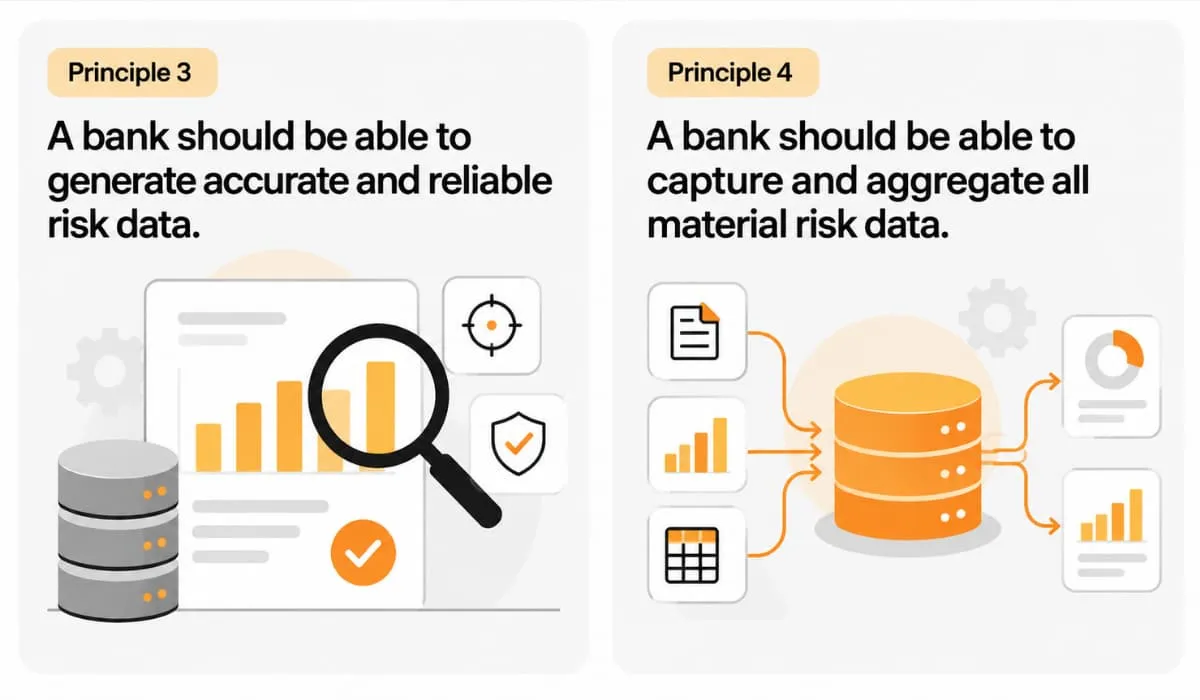
This means a credit risk API should not return a number without enough context to interpret it.
Confidence scores, explicit missingness, and data provenance provide that context and traceability. Downstream validation rules can use this information to flag missing or uncertain inputs before they enter a risk model.
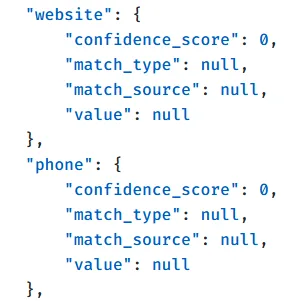
The response can contain null values in match details, as shown for website and phone in the example below.
Source: Veridion
Its match_details.confidence_score rates the overall match from 0 to 1. The match_details.attributes object explains how individual input identifiers matched, including the matched value, match type, and match source.
These fields help you assess whether the returned company matches your input and whether the match needs manual review. They do not establish the accuracy or document-level provenance of every field in the company profile.
Time: Timestamps, Change Metadata, and History
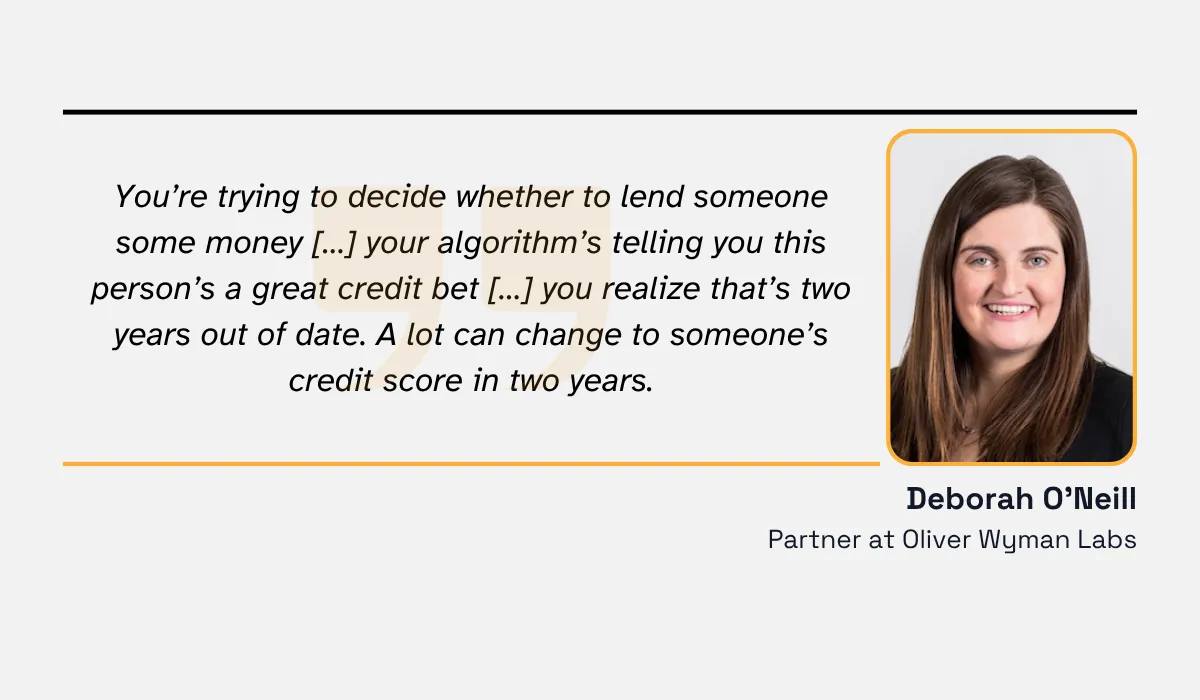
Outdated company data can lead to poor credit decisions.
A company’s financial position, ownership, or operations may change after its information was collected.
In an Experian interview, Deborah O’Neill, introduced as a partner at Oliver Wyman Labs, highlighted this problem:
A credit risk API should return a timestamp showing when each company record was last updated or verified.
Veridion’s last_updated_at records when company information was last extracted and checked for updates. It is a record-level timestamp, rather than the reporting date or verification date of every individual value.
However, timestamps alone do not show what changed. Analysts need access to historical records or a change log.
This helps risk teams monitor changes to ownership, company status, and other factors that could affect a company’s creditworthiness.
For backtesting, your workflow needs point-in-time data that reflects what was available on each prediction date. A company history or change log is sufficient only if it preserves that information.
It helps with backtesting by checking how accurately a model would have predicted past credit outcomes.
Use only information available at the time of each prediction. Historical data may come from the provider or from snapshots retained in your own data pipeline.
Using information that was unavailable at the prediction date introduces look-ahead bias and can make a model’s performance appear better than it would have been in practice.
Schema Stability and Delivery
Credit risk models depend on consistent data inputs.
If a field is renamed or a data type is changed, it can disrupt the model or cause incorrect values to enter production.
A stable API preserves compatibility within a supported version and documents breaking changes, migration steps, and deprecation timelines.
Delivery options matter too. Real-time API calls provide the latest available company data when the credit teams need to review changes.
Bulk delivery supports large-scale workflows, such as enriching entire portfolios, refreshing datasets, and running batch risk assessments.
Both delivery options are important and should be available to support different workflows and data requirements.
You can use the following checklist to assess the credit risk API for all the field groups we have discussed.
Field group | What to check in the response | Why it matters for credit risk |
|---|---|---|
Company identifiers | LEI, registration numbers, match confidence | Links records to the correct legal entity |
Company State | Registry status, industry, business activity, parent and subsidiary links | Supports peer comparisons and assessment of group exposure |
Financial and risk data | Financial metrics; published/modeled label; reporting period; currency/unit | Supports analysis of debt repayment capacity and default risk. |
Data provenance | Source, confidence, missing values | Helps teams assess reliability and identify gaps |
Timestamps and history | Last-updated time, change history | Flags outdated data and supports point-in-time backtesting |
Schema and delivery | Versioning, field types, real-time API, bulk options | Keeps production pipelines stable and supports different workloads |
Use this checklist to identify which requirements your API meets and which your wider data pipeline must handle.
How Credit Risk Workflows Combine API Layers
The term “credit risk API” can mean different things.
A credit risk workflow usually combines several data layers. Your requirement from a credit risk API could be to calculate a risk score, provide reported financial figures, or enrich company records.
These services support different parts of the assessment. Depending on your workflow and the provider’s coverage, you may need to combine multiple APIs.
For example, D&B Direct for Finance provides scores and ratings through configurable data packages.
Veridion belongs to the company intelligence layer: its APIs resolve company records and return identity, industry, legal status, and operating information.
These three data layers work together. You can use a shared company identifier to link the correct entity across systems.
You can then combine company intelligence with financial statements and feed the combined data into a scoring model.
Here’s a breakdown of the three data layers.
Layer | What it returns | What to verify separately | Where it sits in the workflow |
|---|---|---|---|
Decision or scoring | Scores, ratings, credit reports | Underlying company data or raw financial facts | Assesses creditworthiness and supports decisions |
Financial data | Reported financial figures and statements | Credit scores or current operating context | Supports financial analysis and model features |
Company intelligence | Company identifiers, industry, legal structure, operating context | Credit rating or complete financial statements | Resolves entities and enriches records before analysis and provides company background |
Check which layers your provider covers and how you will link any additional sources to the same company.
Conclusion
A credit risk API is only as good as the data it provides.
Company identity, financial figures, ownership links, confidence scores, and timestamps all matter when you're assessing a business.
You need to know where the data comes from, how reliable it is, and when it was last updated.
Before you choose a credit risk API, test it with 20 to 50 companies you already know.
Use the checklist above to see which fields it returns and whether it supports your workflow. Identify any gaps that an additional API or your own data pipeline needs to fill.
Articles
Discuss how these trends affect your organization.
Our analysts are available for a short call. Bring a specific question and we will ground it in the data.
Insights
Keep reading
More analysis, research, and outcomes grounded in live company intelligence.
Top B2B Data APIs for Powering Enterprise Decision Engines
Struggling with enterprise decision-making? Unlock powerful insights with top B2B data APIs designed for decision automation.
How to Gather Healthcare Market Intelligence That Supports Better Decisions
Struggling to make informed healthcare decisions? Get actionable healthcare market intelligence to guide your strategy and drive better outcomes.
How to Build a Strong Market Intelligence Strategy
Learn how to build a strong market intelligence strategy that helps you track trends, understand competitors, and make smarter decisions.