Insights / Articles
How to Build a Credit Risk Watchlist with Company-Level Dana
Credit flags made up 99% of watchlist balances in Freddie Mac data for August 2026. Plan your credit risk watchlist around six rules, from entry to exit.

- Two reports can still count as a single source.
- A confirmed company change may pose little credit risk.
- Closing a review does not always end enhanced monitoring.
- A factory can stay closed while repayment risk improves.
A credit risk watchlist supports consistent decisions when its entry, escalation, and removal rules are defined in advance.
Without those rules, the list can become a collection of notes rather than a repeatable monitoring process.
This guide explains how to define entry criteria, monitored company changes, severity tiers, confidence rules, escalation thresholds, and removal criteria. Structured company data, such as Veridion’s, can help teams monitor changes systematically.
1. Set Entry Criteria for the Watchlist
A borrower or issuer enters your credit risk watchlist when a predefined condition is met.
Document each entry criterion so any analyst can test it against the same evidence.
Start by separating the financial triggers from company-level triggers.
Financial triggers include a missed payment, a breached covenant, or a debt-service coverage ratio (DSCR) below a set threshold.
Company-level triggers include a confirmed change in legal status or the closure of a major operating site. The second group is covered in the next section.
For each trigger, document four things:
- The condition that adds a company name to your list.
- The evidence required to confirm it.
- The person or system responsible for checking it.
- The condition that allows it to leave the list.
Define the exit test alongside the entry trigger so resolved cases have a clear path off the list.
The May 2020 interagency guidance on credit risk review systems, published by the Federal Reserve and three other federal agencies, recommends a written credit risk rating framework and a clear explanation of why particular loans warrant management’s special attention.
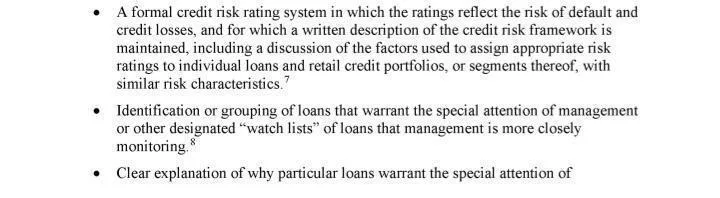
Other credit teams can use the same approach to document why a borrower needs closer monitoring.
The guidance also addresses review responsibilities and disagreements over risk ratings.
Loan officers know the borrower best and often spot problems first, but the guidance cautions against relying too heavily on them and describes ratings as typically reviewed by someone outside the approval process.
The guidance recommends an agreed process for resolving rating differences. The rating indicating weaker credit quality typically prevails unless the independent reviewer accepts additional evidence supporting a higher rating.
Assign an owner to check each trigger, and define when the case requires review by someone independent of the lending and approval process.
Then write down what happens when two analysts disagree.
For example, your policy might retain the assessment indicating lower credit quality until additional evidence is accepted through the agreed review process.
A practical model comes from the servicer watchlist framework maintained by the CRE Finance Council (CREFC).
Its commercial real estate framework assigns codes to defined events and pairs those codes with instructions for classifying and documenting loans.
Some of the triggers use measurable thresholds, while others allow discretion for circumstances that a fixed number cannot capture.
Where your policy permits judgment or an exception, document how it affects the watchlist decision.
For a hypothetical borrower, your policy might flag DSCR below 1.10. If the policy permits an exception for a temporary event, document the repayment assessment, supporting evidence, and approval.
Specify who can approve an exception and when it must be reassessed.
When setting a threshold, use the loan's terms, the borrower's baseline, and the portfolio's risk policy.
A single ratio may not suit every borrower or product. Therefore, record the basis for the threshold and review it when the portfolio, lending policy, or risk appetite changes.
2. Define the Company Changes You’ll Monitor
Financial statements describe performance over a reporting period, so some relevant company changes may appear in other records first.
A watchlist uses these events as additional evidence, provided the team verifies what happened and assesses whether it affects repayment.
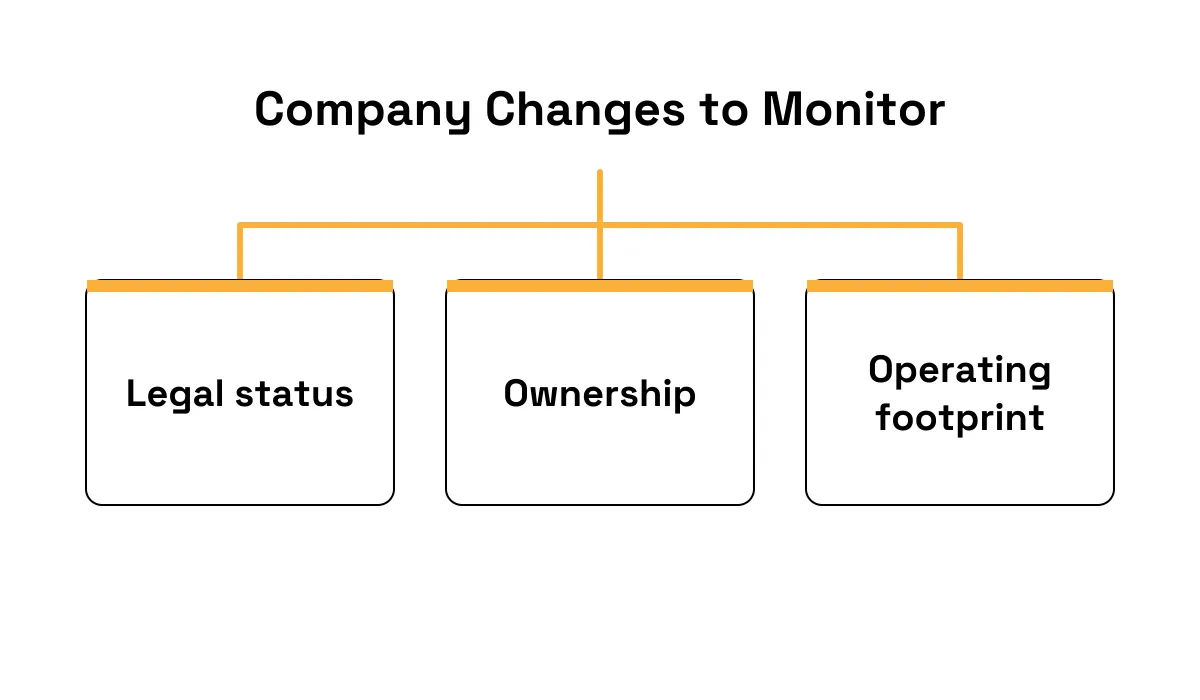
Start with three categories of company changes:
Source: Veridion
Legal status covers the borrower’s status in the relevant registry. When using a normalized data feed, check how registry statuses map to the values returned by the provider.
Ownership covers changes in the direct parent, ultimate parent, or corporate relationships around the borrower.
Operating footprint covers the sites where the company works, produces, stores, or distributes goods.
Monitor these categories across the portfolio through a defined data feed and comparison process, with analysts reviewing material changes.
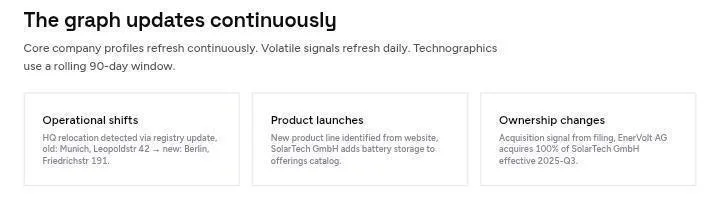
Veridion's company data platform provides structured company attributes and corporate relationships.
Source: Veridion
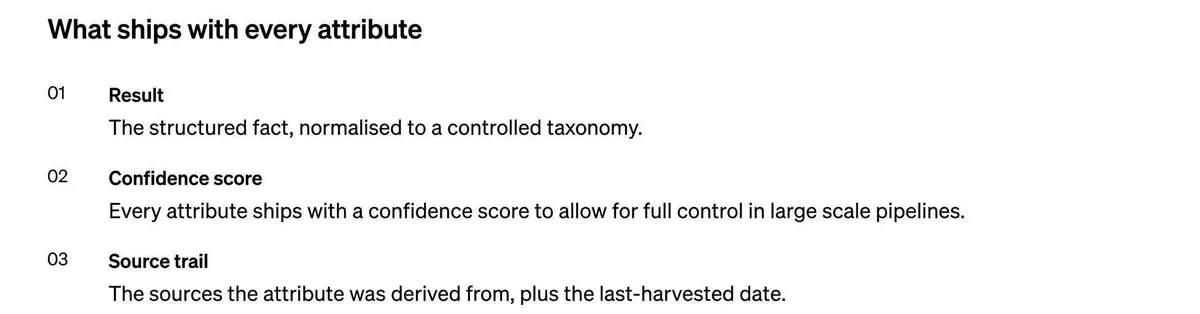
Its published data methodology states each attribute has a result, confidence score, and source trail, including a last-harvested date.
Those details are useful when the pipeline compares a new value with a recorded baseline and retains the evidence behind the change.
For instance, a change in company status does not automatically mean the borrower can no longer repay. Confirm that the record refers to the borrower rather than an affiliate, and assess the implications for the loan. Similarly, an address change or a lower location count does not by itself confirm a facility closure.
A structured-finance rating agency faced a related entity-resolution problem: some input names identified securitization trusts or SPVs rather than operating companies.
In Veridion’s published customer story, its company knowledge graph resolved those instruments to the entities behind them, classified their roles, and enriched the records. The mappings included written justifications and were checked against SEC filings and rating-agency reports.
The agency could then identify the relevant operating entities and the public company whose disclosures it should use. For a watchlist, this illustrates why a company change must be linked to the correct borrower, issuer, or related entity before its credit implications are assessed.
For each category, name the attributes you will track, the source or data feed, the refresh process, and the circumstances that create an alert.
For the broader monitoring workflow, see our guide to continuous credit risk assessment.
3. Build Severity Tiers for Flagged Changes
Severity tiers determine how urgently a flagged change needs attention.
Without them, a minor administrative update competes with a major one that may affect repayment.
CREFC’s servicer watchlist framework labels triggers as:
- Credit
- Informational
These classifications help users focus on higher-priority loans. Each trigger has a default classification, which the servicer can adjust based on the circumstances of the loan.
Freddie Mac’s MSCR Performance Data as of August 31, 2026, applies these categories to the servicers’ watchlist.
Credit entries accounted for 99% of watchlist unpaid principal balance, while Informational entries accounted for 1%. These percentages describe the watchlist balance, not the full loan portfolio.
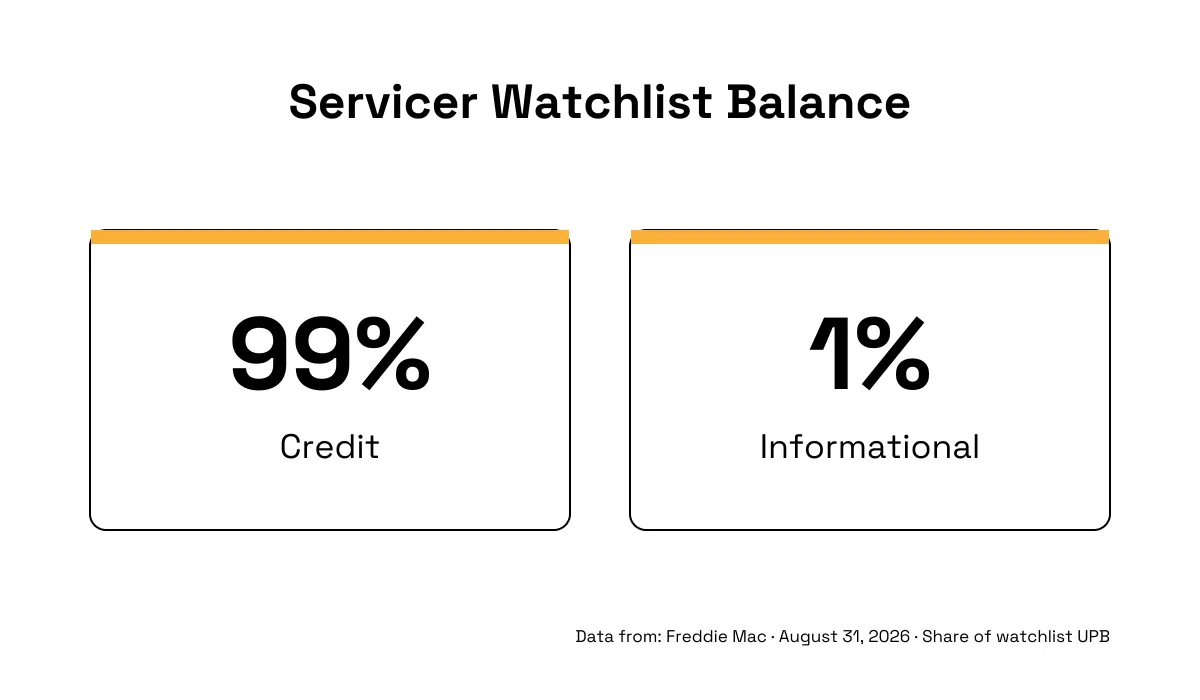
Illustration: Veridion / Data: Freddie Mac
Use this distinction as a starting point, then define review priorities and deadlines suited to your portfolio.
In your own policy, a credit flag might cover a missed payment or a confirmed closure of a key production site with a material effect on repayment capacity.
An informational flag might cover a weakening ratio that remains within the agreed limit or a verified company change whose effect on repayment is limited.
Record potential severity separately from confidence in the evidence.
A confirmed low-impact address change may be high confidence but low severity, while a credible report of a plant closure may be potentially high severity but still need confirmation.
Assign credit entries a prompt review deadline. Give informational entries a review date as well, and reassess them sooner if new evidence or another trigger appears.
Specify when an entry can move up or down, what evidence is needed, and who approves the change.
4. Add Confidence Rules to Filter Weak Signals
Confidence rules define the evidence needed to confirm a signal and use it in a watchlist decision.
Define which sources can establish an event on their own and when corroboration is required.
Assess independence by tracing each report to its original evidence.
A news article that repeats a registry record is not independent confirmation of that record.
If the original entry is wrong or outdated, the article may repeat the same error.
Two publishers do not provide independent corroboration if both rely on the same company announcement. For a facility closure, check that each source identifies the same company and site and supports the closure itself.
Independent corroboration strengthens the evidence, but the number of sources alone does not determine its quality.
State whether each type of evidence can confirm an event, requires corroboration, or should remain pending verification.
Veridion's data methodology shows how a data provider applies this logic.
Its methodology describes confidence information and source trails for individual attributes.
Source: Veridion
Veridion checks values against independent sources. Agreement between sources contributes to its assessment of confidence.
When sources conflict, the system weighs recency, authority, and the full evidence trail before settling on a value.
Stale signals are flagged and deprioritized through attribute decay.
These mechanisms provide inputs for your watchlist policy. Your team still needs to define what evidence is sufficient, how conflicting reports are handled, and when a signal requires revalidation.
Also distinguish observed values from estimates. Veridion’s API identifies revenue as Extracted or Modelled. Retain that distinction when comparing values over time so a change in estimation method is not automatically treated as a change in the borrower’s performance.
For a reported facility closure, your policy might require two independent origins before marking the event as confirmed. Record potential severity separately from verification status.
Define when one authoritative source is sufficient and when a potentially serious but unconfirmed report requires immediate analyst review.
For unresolved or conflicting reports, assign a verification owner and a deadline rather than leaving the signal pending indefinitely.
Keep a record of the source, the date it was collected, the value or event it supports, and your decision.
That record lets a reviewer reconstruct why a flag was raised and whether the evidence met the policy.
5. Set Escalation Thresholds
After the confidence rules, the next step is to set thresholds that determine when a flagged borrower moves from monitoring to formal review.
Write the rule before an event occurs, including the combinations or recurrence of signals that trigger it and the deadline for review.
In its 2022 CreditWatch action on Jackson, Mississippi’s general obligation debt, S&P Global Ratings cited a one-in-two likelihood of a downgrade within 90 days.
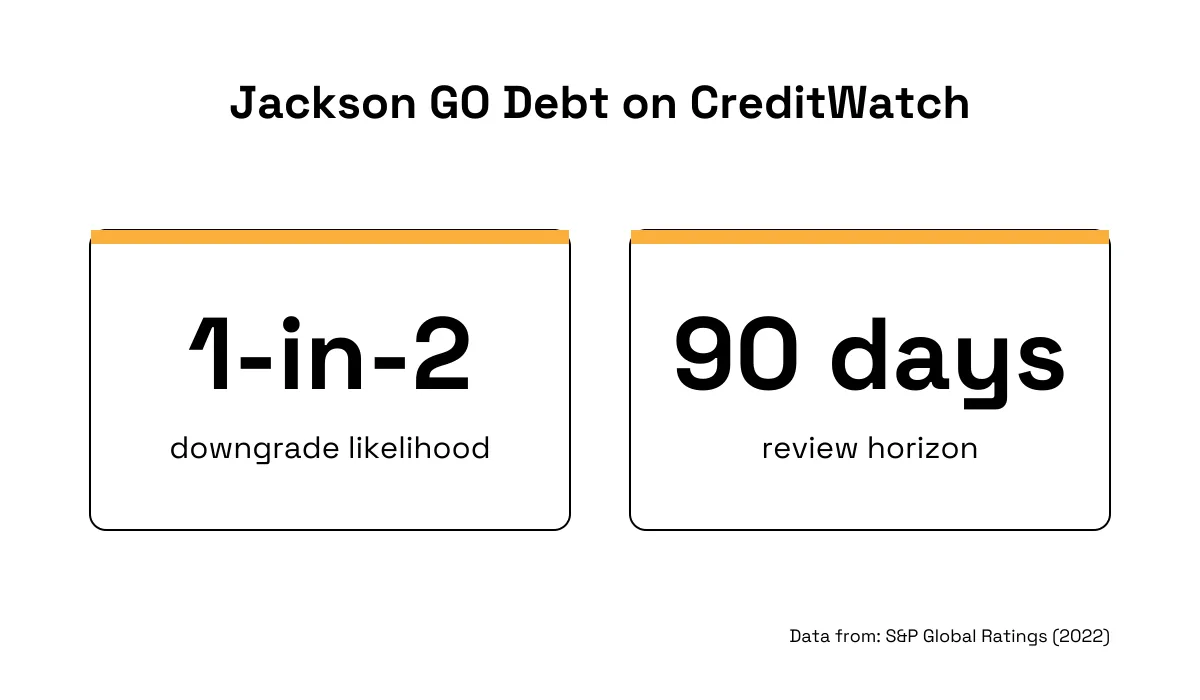
Illustration: Veridion / Data: S&P Global Ratings
That was a rating-agency assessment of a specific issuer, not a universal threshold for lenders.
An explicit threshold gives analysts a common basis for review. A deadline identifies when a decision is due and who is responsible for reaching it.
For your own process, separate events that warrant immediate review from signals that are important in combination.
Consider a hypothetical manufacturer whose DSCR falls from 1.50 to 1.20, remaining above its 1.10 covenant minimum. Under the lender’s documented entry rule, the decline creates an informational watchlist entry.
A company announcement and a separate local authority inspection notice then confirm that its main production site has closed. The analyst verifies the borrower and site identifiers, records the event as confirmed, and assigns the closure high potential severity.
Under the lender’s escalation policy, weaker debt-service coverage combined with a confirmed material operating disruption triggers formal review by the assigned credit analyst within two business days. These thresholds and deadlines are illustrative.
Document each part of the rule: the entry trigger, monitored company change, severity, confidence requirement, escalation owner, and review deadline.
Once a case enters formal review, distinguish closing the review from removing the borrower from the watchlist. A review can end with a decision to continue enhanced monitoring.
6. Define Removal Criteria
Every watchlist trigger needs an exit condition.
Otherwise, old entries remain after their original cause has passed and make it harder to distinguish active concerns from resolved ones.
Define what evidence supports removal and whether improvement must hold for a specified period.
For a missed-payment trigger, the exit test might require arrears to be cleared and the loan to be current for a specified period.
For a missing-document trigger, the exit test is receipt and review of the required document.
Removal should require evidence that meets the policy’s defined exit test. This may show that the original issue has been resolved or that its effect on repayment has been adequately mitigated.
For a facility closure, the exit test might require verified reopening or evidence that replacement capacity has restored operations and repayment capacity.
Assess borrower statements alongside supporting evidence, and obtain any independent confirmation required by the exit policy.
Premature removal can reduce enhanced scrutiny while the underlying concern remains unresolved. Define how the borrower returns to routine monitoring and what would trigger renewed escalation.
Record the evidence, the date the exit test was met, and the person who approved removal.
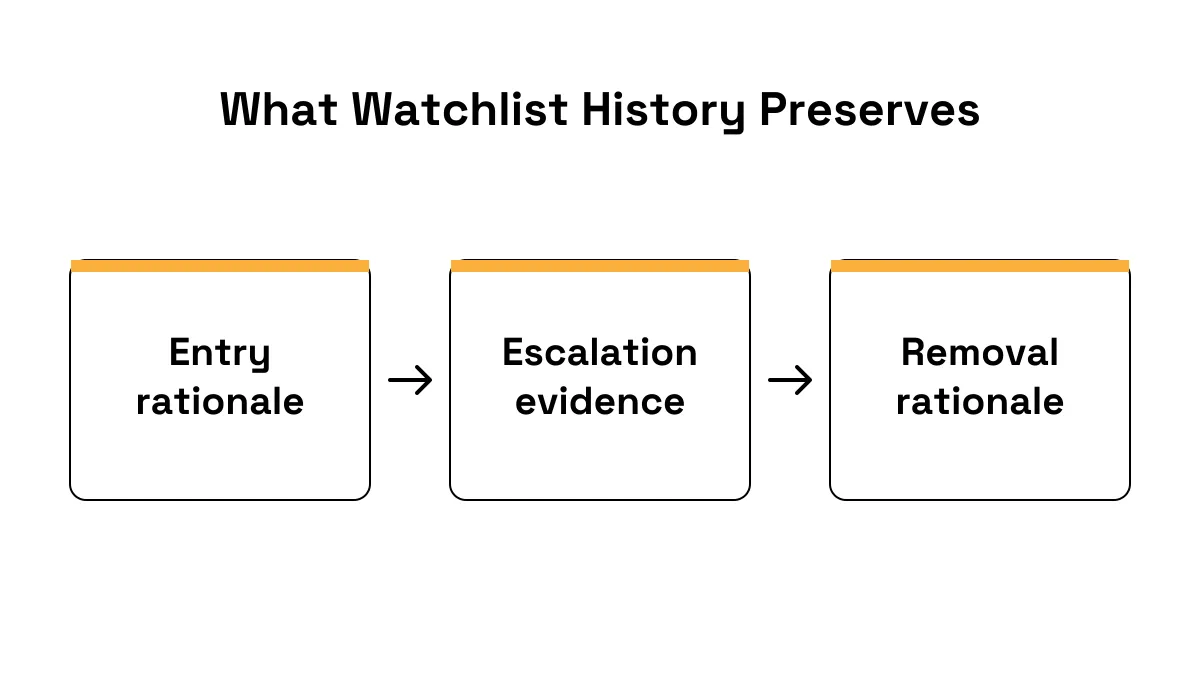
After the approval, keep the watchlist history.
The active list should show current concerns, while the history should preserve:
Source: Veridion
This makes it possible to review whether the rules worked and to improve them when recurring cases reveal a weakness.
Conclusion
A useful credit risk watchlist shows why each borrower needs attention, what action is due, and what evidence would justify removal.
Those decisions become repeatable when entry, confidence, severity, escalation, and removal rules are written together.
Choose one trigger your team currently handles informally and document its entry condition, evidence standard, escalation action, and exit test.
Apply the rule to the next case and review whether it produces the decision your policy intended.
Articles
Discuss how these trends affect your organization.
Our analysts are available for a short call. Bring a specific question and we will ground it in the data.
Insights
Keep reading
More analysis, research, and outcomes grounded in live company intelligence.
Using Alternative Firmographics for Faster SMB Credit Risk Assessment
Struggling with slow SMB credit risk assessment? Uncover how alternative firmographics can revolutionize your process and speed up decisions.
How to Build a Strong Market Intelligence Strategy
Learn how to build a strong market intelligence strategy that helps you track trends, understand competitors, and make smarter decisions.
5 Types of Market Intelligence You Need to Know About
Explore five different types of market intelligence that can shape your competitive edge. Find out which ones your team should prioritize.