Insights / Articles
When Should You Reassess a Business Customer’s Risk? 6 Triggers to Monitor
Not every data update warrants a new customer risk analysis. Six triggers separate material changes, like insolvency or a new owner.

- 16.7% of sampled US financial-service locations were no longer operating in 2022.
- Business changes warrant review when they challenge existing risk assumptions.
- Headcount and location changes matter more when supported by other signals.
- Effective monitoring combines immediate triggers with defined review thresholds.
A new owner, a factory closure or a sudden drop in headcount may change what you know about a business customer. But not every data update calls for a new risk assessment.
The question is which developments are significant enough to warrant another look. Routine business activity may have little effect on the existing assessment, while a material event could alter the customer’s risk profile.
Here are six triggers that can help you make that call.
Business Status Change
A formal status update is one of the clearest reasons to reassess a business customer. Insolvency, dissolution, administration, or suspension of operations can affect whether the company remains able to meet obligations established at the start of the relationship.
The Basel Committee on Banking Supervision’s 2024 guidance on counterparty credit risk illustrates how institutions approach such changes. Each institution determines which events or thresholds warrant attention, based on its risk policies and exposure to counterparties. When monitoring identifies a trigger, the institution verifies the change and decides whether it warrants a revised risk assessment.
The guidance also makes clear what should happen when a change materially affects a counterparty's risk profile:
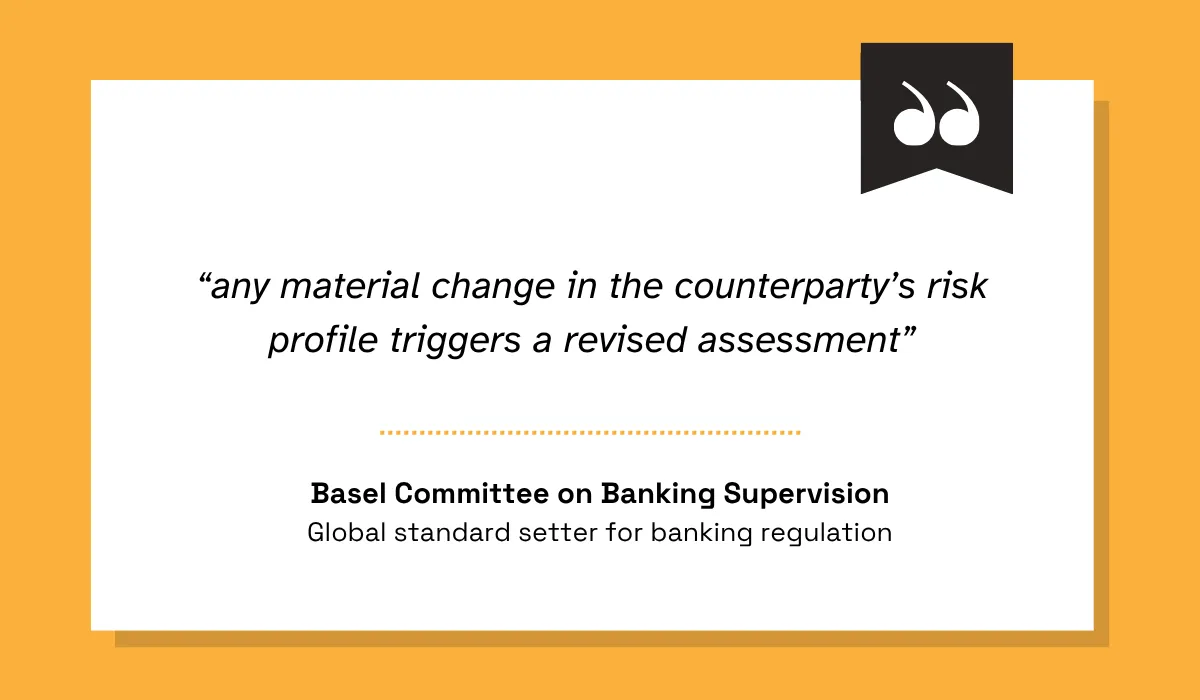
Illustration: Veridion / Quote: Basel Committee on Banking Supervision
For business-status monitoring, the urgency depends on the event. Insolvency may call for immediate review, while a change from active to dormant status requires more context before the analyst can determine its significance.
The distinction looks like this:
Hard triggers | Changes requiring more context |
|---|---|
Insolvency | Restructuring |
Dissolution | Active to dormant |
Administration | Temporary inactivity |
Suspension of operations | Other registry status changes |
Hard triggers call for prompt scrutiny, but the recorded status alone may not explain the customer's circumstances. An analyst needs to check what the event means under the laws of the relevant jurisdiction and when it took effect.
For example, a company entering administration may continue trading while an administrator oversees its affairs. Dissolution may mean the company has legally ceased to exist. These differences affect how the analyst interprets the customer's ability to meet its obligations.
The next step is to examine the institution's exposure and the terms of its agreement with the customer. For a lender, this means checking the outstanding loan balance and relevant covenants to establish whether the status change breaches a contractual condition or affects repayment. The analyst can then determine whether the existing risk rating needs updating.
Less definitive developments require supporting evidence. Dormant classification, for example, may indicate that normal activity has stopped. The analyst needs to establish why the status changed and whether the company continues to meet its obligations before adjusting its rating.
Ownership Change, New Subsidiaries, or Related Parties
A business can continue operating normally after the people or entities behind it have changed substantially. A new controlling owner, parent company or subsidiary introduces financial dependencies, geographic exposure or compliance risks absent from the initial customer review.
Legal ownership tells only part of the story.
The Financial Action Task Force (FATF), the international standard setter for anti-money laundering and terrorist financing, defines a beneficial owner as the natural person who ultimately owns or controls an entity, including through an ownership chain or other means.
Discovering a previously unidentified beneficial owner can alter the picture established during the earlier assessment. The analyst then has grounds to verify whether effective control has passed to another party.
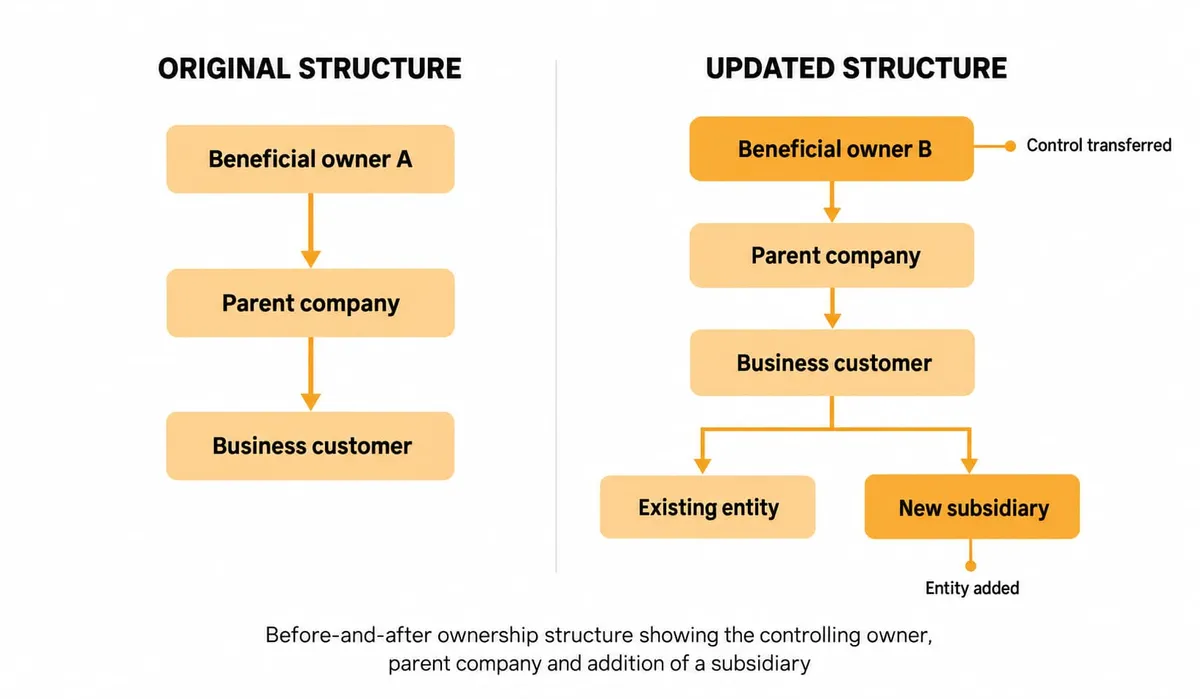
Source: Veridion
An ownership change may also have consequences under a customer's existing credit agreements. For example, a 2026 credit agreement filed with the US Securities and Exchange Commission identifies the acquisition of beneficial ownership of at least 35% of a company's voting equity by a person or group as a change-of-control event.
In this example, acquiring the specified voting interest is what triggers the contractual provision. The threshold is specific to that agreement. An analyst reviewing an ownership change would therefore check the customer's financing documents to see whether the transaction meets a change-of-control condition and what rights or obligations follow.
Corporate structure is another thing to consider. Parent and subsidiary relationships can broaden the financial or geographic exposure attached to a customer, particularly where several entities depend on one another.
Veridion’s guide to automated entity resolution examines this issue through parent, subsidiary, and sister-company relationships in commercial underwriting.
The review threshold depends on the scale and consequence of the event.
A transfer of control, newly identified beneficial owner or subsidiary in a higher-risk jurisdiction could justify immediate review, while a minor shareholder movement could remain under monitoring.
Operating Footprint Contraction, Expansion, or Closures
A major development in a company’s operating footprint can affect its capacity, financial commitments or exposure. Facility closures, consolidation or several new sites opened within a short period can warrant a fresh look at the customer.
Location count alone says little about operational importance. The function of each facility is necessary context because an office, warehouse, distribution center and manufacturing plant play different roles in a business.
Closing a small sales office might have little effect on production. Losing a primary factory or distribution center presents a different question because much more of the company’s output or revenue could depend on the site.
Function is only useful once the analyst knows the facility is still operating.
In a 2025 Social Science Computer Review study, researchers examined a sample of 3,267 US financial-service establishments listed in SafeGraph data and found 16.7% were no longer operating in 2022.
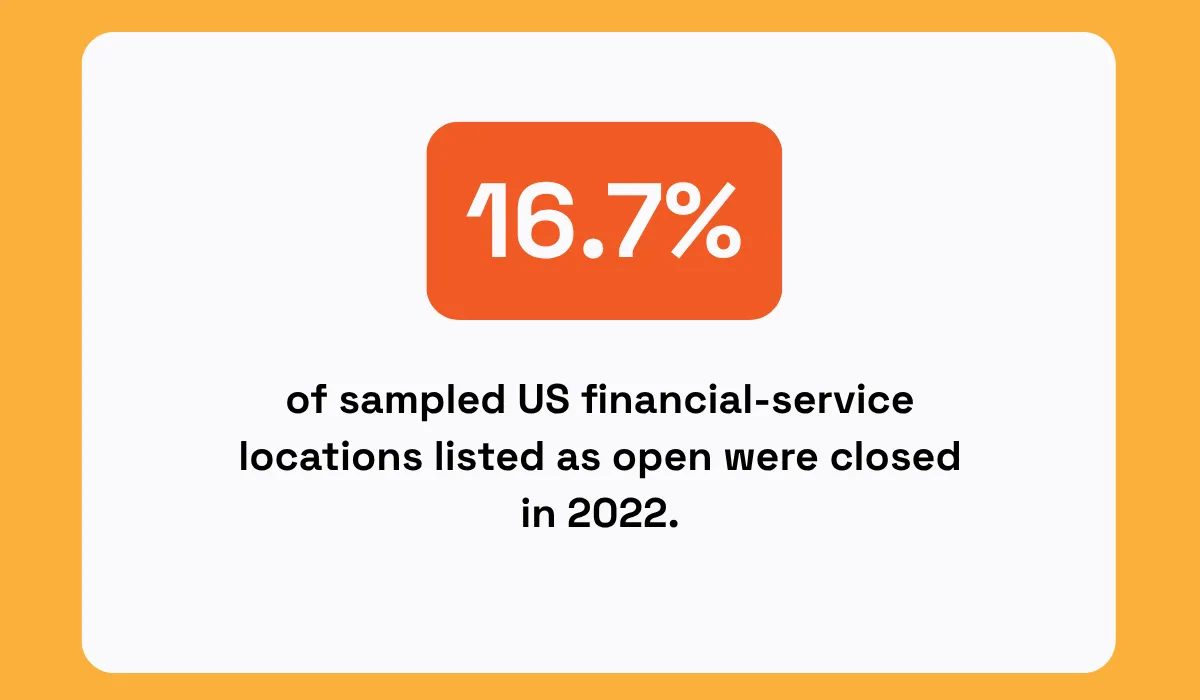
Illustration: Veridion / Data: Social Science Computer Review
New factories, warehouses or branches can indicate growth, although rapid expansion also increases demands on capital, staffing and execution.
Scale matters too. Shutting one of four production plants calls for closer scrutiny than one of twenty small offices, especially where the remaining operations become concentrated in fewer locations or regions.
Other evidence can strengthen the case for review. A facility closure accompanied by a sharp headcount reduction or declining business activity gives the analyst more grounds to examine whether the assumptions behind the existing credit, rating or underwriting decision remain appropriate.
Industry, Activity or Product Shift
A company’s registered industry code can remain in place as its operations evolve. Discontinuing a core service, entering a new sector or developing a materially different product line introduces licensing, liability or operational exposure absent from the earlier customer review.
Official classifications sometimes lag developments on the ground. In its Annual Integrated Economic Survey guidance, the US Census Bureau says respondents cannot modify the North American Industry Classification System (NAICS) code for their primary business during the current survey year. An updated description can flag a location for reclassification in a future survey year.
A registered code can therefore reflect an established business line even as newer information points to additional operations.
Eurostat’s NACE Rev. 2.1 classification captures the distinction: an enterprise can conduct several economic activities, with its principal activity defined by the largest share of total value added.
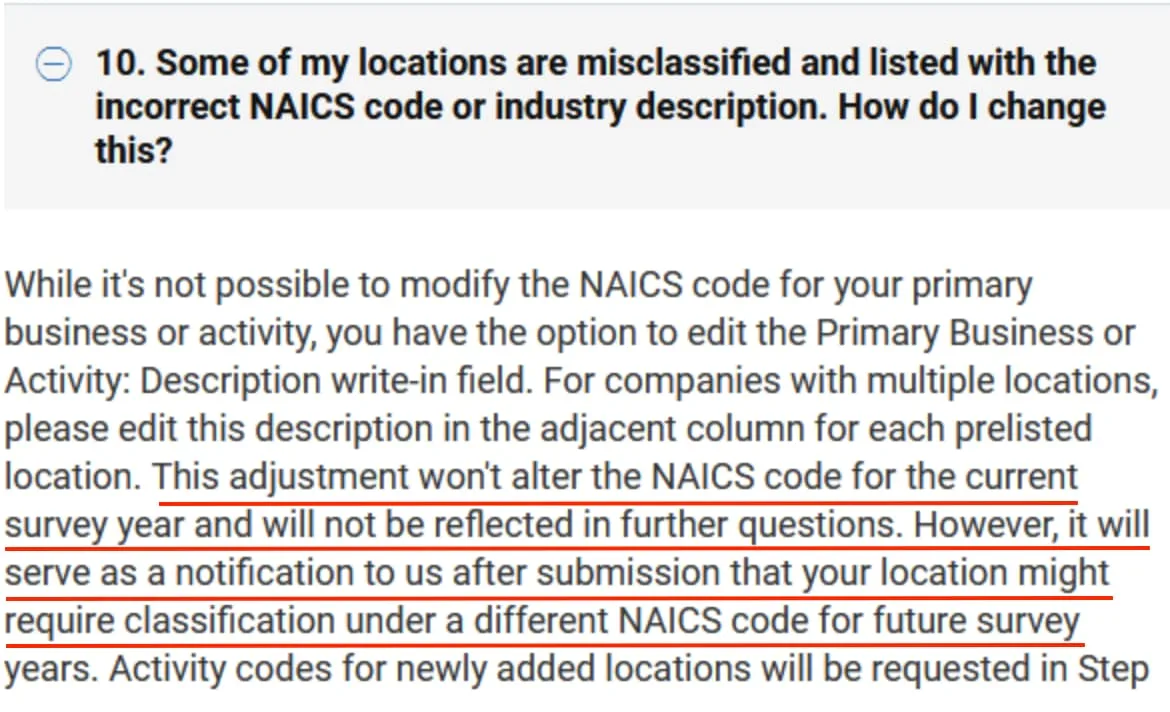
Source: U.S. Census Bureau
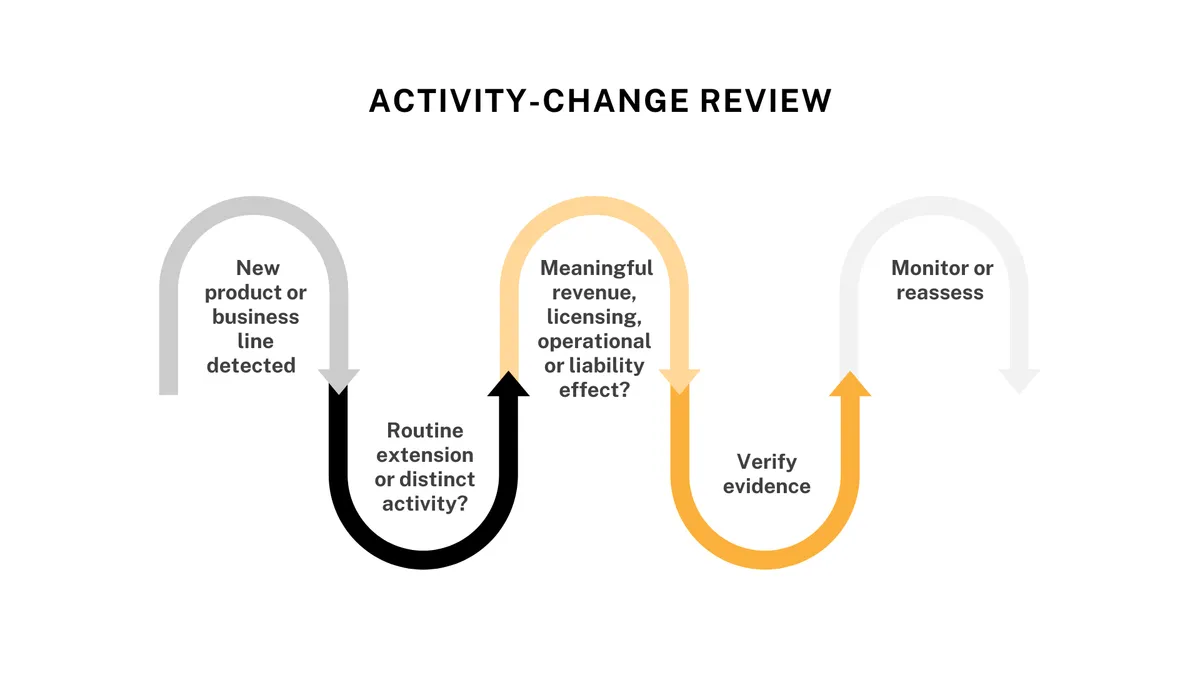
The significance of a new product or service depends on its role in the business and the risks it introduces. An activity that accounts for a substantial share of revenue, requires additional licences or exposes the company to different liabilities may warrant reassessment.
Products and services data supplements the registered industry code. Risk teams assess the size and role of the emerging operation to establish its importance within the enterprise.
Source: Veridion
Consider an insured software company launching an additional software product. Its underwriting basis remains broadly intact. If the company begins manufacturing physical equipment and this becomes a major revenue stream, separate liability and operational considerations enter the assessment.
A mismatch between classification records and observed operations calls for examination once the emerging activity becomes substantial. Its contribution to revenue and role within the enterprise determine whether the credit, rating or underwriting assumptions still fit.
New Jurisdiction Exposure
A company can retain its products and business model as its geographic footprint expands. Entry into another country introduces local licensing, regulatory, currency, tax or sanctions considerations absent from an earlier customer review.
The depth of this shapes its relevance. An isolated overseas sale has different implications from substantial cross-border revenue, a new legal entity or an operating facility.
BCBS defines country risk as “the risk of exposure to loss caused by events in a foreign country.” Its banking principles require international lending and investment exposures to be identified, measured and monitored at country level.
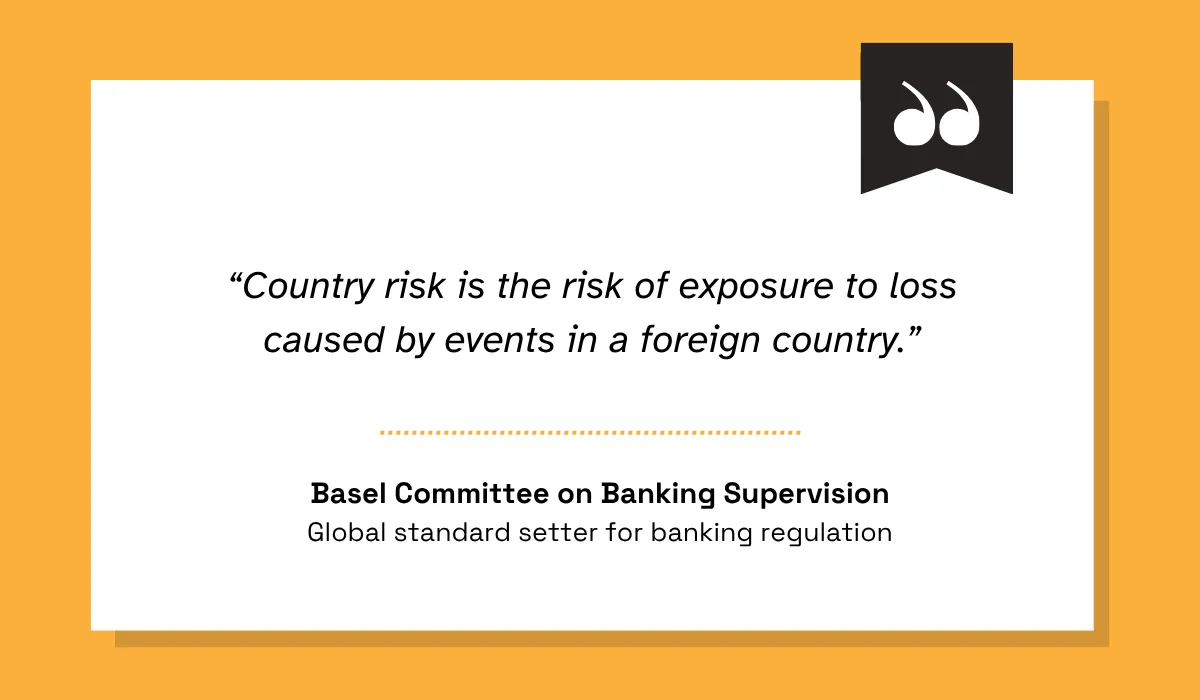
Illustration: Veridion / Quote: Basel Committee on Banking Supervision
Those considerations focus as commercial ties to the market deepen. A physical site brings local licensing or tax obligations, whereas substantial foreign-currency revenue exposes repayment capacity to exchange-rate conditions despite the absence of local premises.
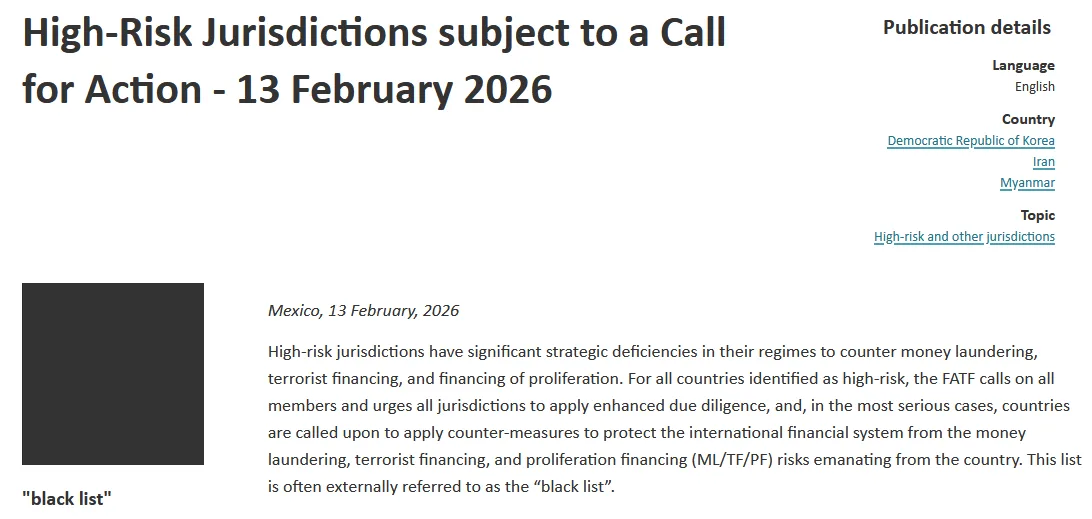
The jurisdiction also influences the response. In February 2026, FATF called for enhanced due diligence for high-risk jurisdictions with serious strategic deficiencies, with measures applied according to the risks involved.
Source: Financial Action Task Force
Identifying the country is only part of the job. Veridion’s private-credit underwriting guide notes that a registered address can miss factories, warehouses, offices and other operating sites spread across several regions.
The detected presence still requires verification. A legal entity or facility in a high-risk jurisdiction warrants immediate scrutiny, whereas gradual activity in a familiar market remains under monitoring until revenue, transactions or operations cross a defined threshold.
Sharp Headcount Movement
A sudden rise or fall in employee numbers often points to an operational development. Workforce contraction can follow restructuring, outsourcing or a facility closure. A hiring surge sometimes accompanies expansion, an acquisition or entry into another market.
Company size puts the number in perspective. A 100-person reduction removes a third of the workforce at a 300-person manufacturer, compared with 0.5% at an organization employing 20,000 people.
Even a large percentage swing needs verification. Seasonal recruitment, temporary staffing, acquisitions and ordinary turnover can produce sharp fluctuations with little lasting effect on the underlying business.
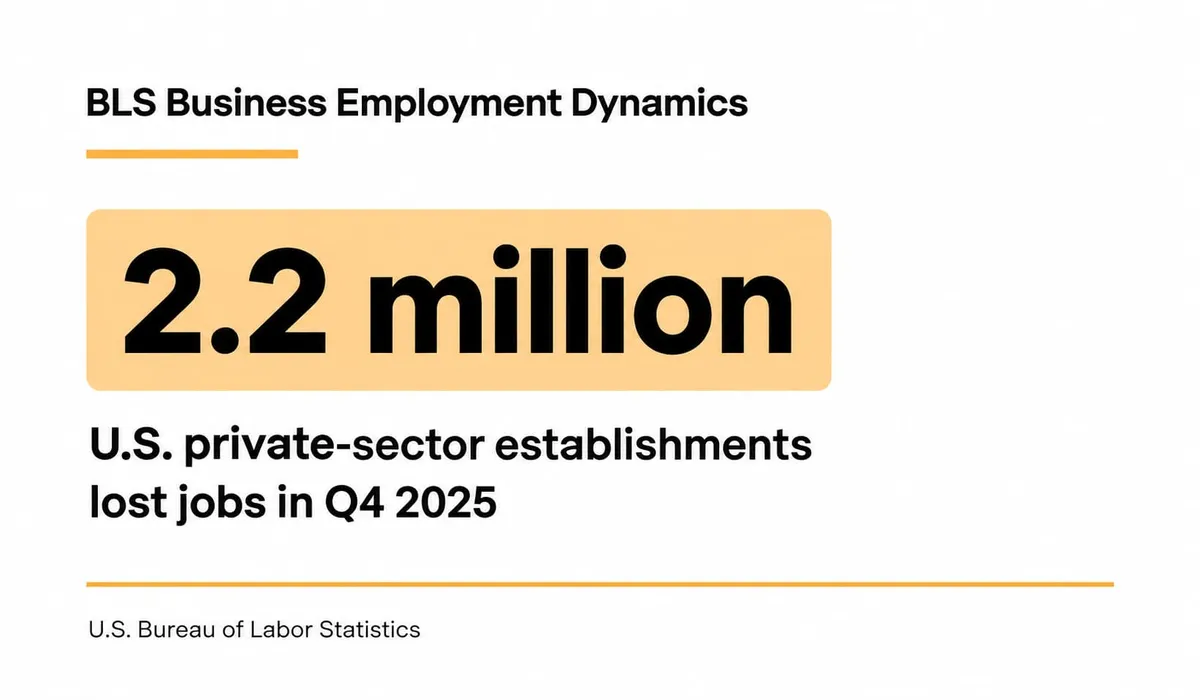
Illustration: Veridion / Data: U.S. Bureau of Labor Statistics
Duration helps distinguish a temporary fluctuation from a persistent trend. Comparing several observation periods establishes whether staffing returns to its normal range or follows a sustained trajectory.
Veridion’s private-credit underwriting guide treats employee count as an indicator of operating scale and recommends interpreting it alongside industry, business activity and other operating evidence, rather than reading staffing levels as a direct measure of financial performance.
Supporting evidence is key. A workforce decline alongside a factory closure deserves closer examination than an isolated fall in estimated employee numbers.
The cause still needs verification before the staffing data influences a credit, rating or underwriting decision. Percentage scale, persistence and supporting business evidence determine whether the development warrants reassessment.
How to Set Material-Change Thresholds for Reassessment
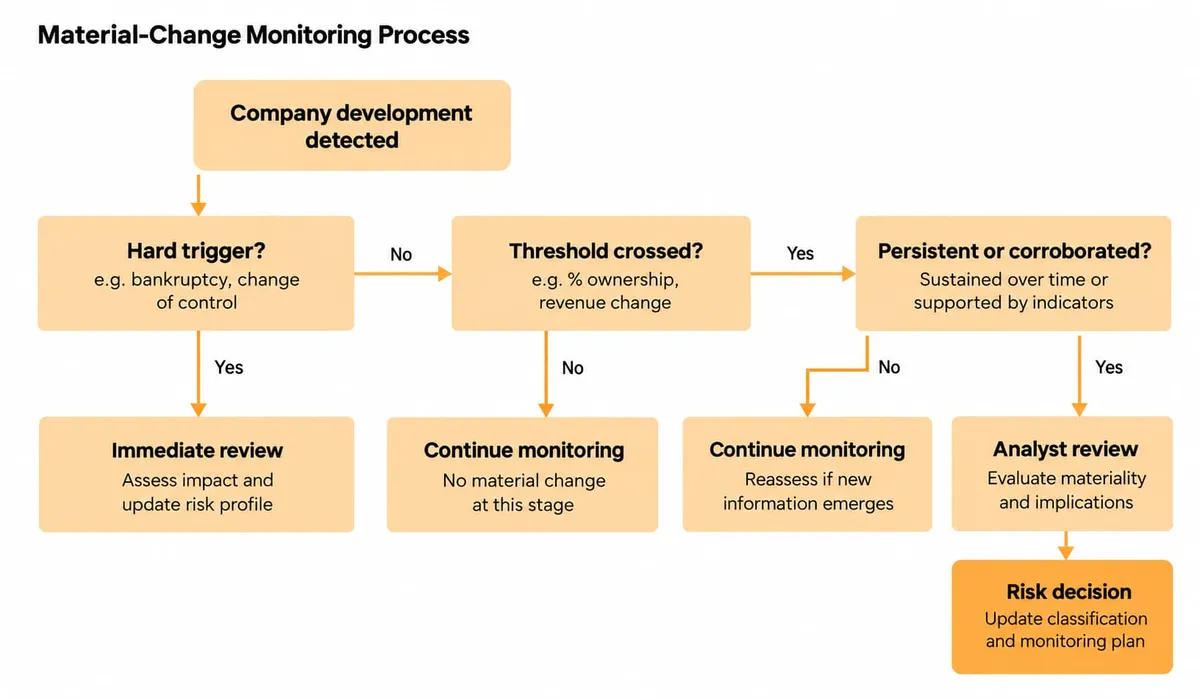
A monitoring system becomes noisy if routine data updates repeatedly send customers back for reassessment. Material-change rules reserve immediate scrutiny for consequential events, while less definitive developments build relevance through size, duration or corroborating evidence.
Hard triggers occupy one end of the framework. Insolvency, dissolution or a contractual change of control can initiate immediate review because the event itself affects information underpinning the credit or underwriting decision.
Headcount, operating footprint and similar indicators require numerical or time-based criteria. Organizations might specify a percentage, an observation window or persistence across multiple periods before escalating the account.
Trigger type | Example rule | Response |
|---|---|---|
Hard trigger | Insolvency or dissolution detected | Immediate review |
Percentage threshold | Headcount crosses a defined percentage | Verify and assess |
Observation window | Movement occurs within the monitoring period | Compare with historical pattern |
Persistence rule | Development continues across multiple periods | Assess for escalation |
Combined signals | Facility closure accompanies workforce decline | Prioritize analyst review |
Customer characteristics also influence where those boundaries belong. A 100-person workforce decline has different implications for a small private borrower and a multinational, just as loss of a primary production plant differs from loss of a minor office.
Corroborating indicators make an isolated event more informative. A facility closure requiring verification gains relevance when workforce contraction and declining business activity appear alongside it.
Company data keeps these rules useful between scheduled reviews. In one commercial underwriting deployment, Veridion supplies a global insurer with operating locations, classifications and operational signals through a company knowledge graph. Its core graph is refreshed weekly, with volatile attributes refreshed daily.
Source: Veridion
Continuous monitoring flags accounts crossing the organization’s escalation criteria. Analysts examine the supporting information to determine whether the credit, rating or underwriting position warrants a new assessment.
Conclusion
Business customers keep evolving after the first assessment. Ownership, operating footprint, business activity, geographic exposure and headcount may each signal a development significant enough to revisit the original risk assumptions.
The key is deciding what deserves review. Hard events may demand an immediate response, while contextual signals need defined thresholds, observation periods and supporting evidence.
Build those rules around the risks relevant to your portfolio and use current company data to spot significant developments between scheduled reviews. A disciplined material-change framework directs analyst effort toward customers whose circumstances warrant a fresh assessment.
Articles
Discuss how these trends affect your organization.
Our analysts are available for a short call. Bring a specific question and we will ground it in the data.
Insights
Keep reading
More analysis, research, and outcomes grounded in live company intelligence.
5 External Data Signals That Strengthen Private-Credit Underwriting
Struggling with private credit underwriting? Uncover 5 external data signals that can significantly improve your risk assessment.
What Counts as True Facility-Level Data?
What truly defines facility-level data? Uncover the critical internal variety switch and ensure your data accuracy for better decision-making.
How Commercial Underwriters Use Automated Entity Resolution to Verify SMBs Instantly
Tired of slow SMB verification? See how commercial underwriters leverage automated entity resolution for instant, accurate verification.