Insights / Articles
Single-Source vs Multi-Source Firmographic Enrichment: Which Approach Wins?
Single-source and waterfall firmographic data enrichment compared, with a practical test for coverage, accuracy and cost per usable record.

- Single-source enrichment pulls firmographic data from one provider.
- Waterfall enrichment combines multiple providers to recover records a single source misses.
- A broader single source reduces how much a waterfall needs to recover, lowering the cost of stacking additional providers.
Should your enrichment strategy lean on one data provider, or stack several to cover what one alone might miss?
Pick wrong, and you either pay for coverage you never needed, or miss records that cost you a deal.
Even the largest data provider in the world doesn't rely on one feed alone, and that says something about how this decision really works.
So let's break down what each approach gets you, and how to tell which one your target list needs.
What Is Multi-Source Firmographic Enrichment?
Multi-source firmographic enrichment, also called waterfall enrichment, queries more than one data provider for the same company record and merges whatever each one returns into a single, more complete profile.
With it, you don't have to accept one vendor's answer for a company's employee count or industry code; you can run the same request through Provider A, then Provider B, then Provider C, keeping whichever field each one fills best and sending the gaps to the next.
So why bother stacking vendors instead of picking a good one and moving on?
That's because a single provider can't be comprehensive enough, even if they're at the very top of the market.
Dun & Bradstreet, the largest firmographic data provider in the world, is very upfront about this on its own site.

Source: Dun & Bradstreet
Though its UK branch reports 580m business entities in its database, it doesn't get there from one feed.
It says outright that it consolidates data from more than 30,000 different sources across 190 countries to build that single database, spanning:
- Public registries
- Partner networks
- Web-derived signals
Even after building the industry's largest database, D&B still relies on a worldwide network of independently operated partner firms to source and maintain data outside its home markets: Altares covers France and the Benelux. CRIF covers Italy and parts of the Middle East. Informa D&B covers Portugal and Spain.
If the single largest provider in the industry still needs local partners to keep pace outside its core regions, a buyer relying on only that provider inherits the same unevenness.
However, stacking sources creates its own disadvantages because every additional provider means another:
- Contract
- API to maintain
- Set of field definitions that don't quite match the last ones.
Someone has to decide which source to go for when two vendors disagree on the same company's employee count, and that governance layer doesn't build itself.
Adopting waterfall enrichment without planning for this conflict-resolution logic often leads to a database that's technically more complete and practically harder to trust.
What Is Single-Source Firmographic Enrichment?
Single-source firmographic enrichment works the opposite way from waterfall enrichment.
With it, you pick one provider, wire your entire enrichment pipeline to that one feed, and treat whatever it returns as your system of record.
There's no second opinion to reconcile or field-by-field arbitration between vendors.
Whatever the source knows, you know and whatever it doesn't, you don't either.
That single-provider commitment could sometimes be a broad commercial vendor a team wires its entire pipeline to, expecting one source to carry the full weight of company size, industry, and activity data.
Other times it's a narrow, purpose-built authoritative source, brought in for one specific fact where a single legally recognized answer matters more than breadth.
An example of this authoritative source is Companies House, the UK's official company registrar.
Since 18 November 2025, it has had a legal requirement under the Economic Crime and Corporate Transparency Act 2023 to verify the identity of directors, people with significant control, and anyone filing on a company's behalf.
For that specific question – who legally controls this company and who they claim to be – there is one clear answer, and it comes from one source alone.
In situations like this, the single-source shines.
If the data point you need has one legally recognized answer, running it through multiple vendors adds noise and possibly a compliance headache if two paid vendors disagree with the actual government record.
There's one contract to manage and one methodology to document.
So when an auditor asks where a specific fact came from, there's one place to point to instead of explaining which of three vendors won an internal tiebreak.
This same narrowness of single-source firmographic enrichment is also its weakness the moment your need goes beyond what the source was built to track.
Still referencing Companies House, it confirms who's legally registered and who controls a company.
But it has nothing to say about that company's employee count, revenue band, or industry depth beyond a basic Standard Industrial Classification (SIC) code assigned at incorporation and rarely updated afterward.
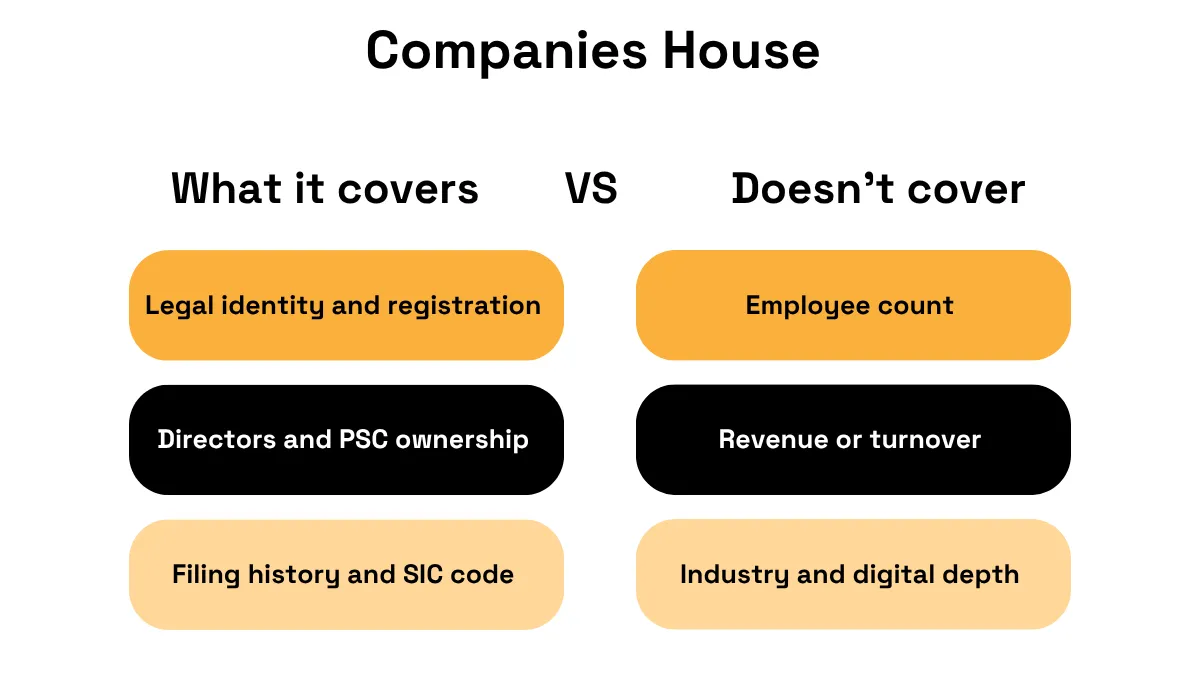
Illustration: Veridion / Data: Companies House
If you're enriching your records with Companies House alone, you get airtight legal identity and close to nothing else after.
Beyond registries too, any single commercial provider, no matter how broad its marketing claims, has the same shape of blind spot.
It's strong in some places, and weak in others.
Which Approach Actually Wins?
The honest answer is neither approach wins on its own.
Which enrichment source serves you better depends entirely on your specific target market and where your current data already falls short.
Start with the account list you already care about, then run your current provider and whatever you're evaluating against it within the same short window, ideally the same week or two.
B2B contact and firmographic data decays continuously, so testing your current source in March and a challenger in June means you're comparing two different snapshots of reality.
There are two ways to structure this comparison: the rigorous version and the faster version.
The rigorous version, also known as the apples-to-apples test, runs your full account list through both the single source and the waterfall independently, then compares the complete results side by side.
The faster version, and the one most teams run, tests your current source first, isolates only the records it missed or returned thin, and sends just that failure set to the second approach.
That shortcut saves you from paying to re-verify records your current source already handles well.
But with the faster version, don't assume the records your current source already matched are correct just because they came back filled.
A returned field isn't automatically an accurate one.
If you're going to hold the second source's results to an accuracy standard, spot-check a sample of your first source's hits against that same standard, not just its misses.
Spot-checking your first source's hits often reveals if it has its own real error rate you'd been crediting with full accuracy.
Otherwise you're comparing an accuracy-checked result from one side against an unchecked, assumed-correct result from the other.
That changes your comparison because it can shrink the apparent advantage your current source looks like it had, or even flip which source comes out ahead once both are held to the same standard.
Whichever structure you choose, what comes back is your real, ICP-specific answer, checked to the same standard on both sides.
But recovery rate alone doesn't tell the whole story, and this is where a lot of evaluations stop too early.
Sammy Mscisz, Head of Commercial Operations at data provider RevenueBase, has run this kind of evaluation for other companies for years, and points out a common failure mode directly.
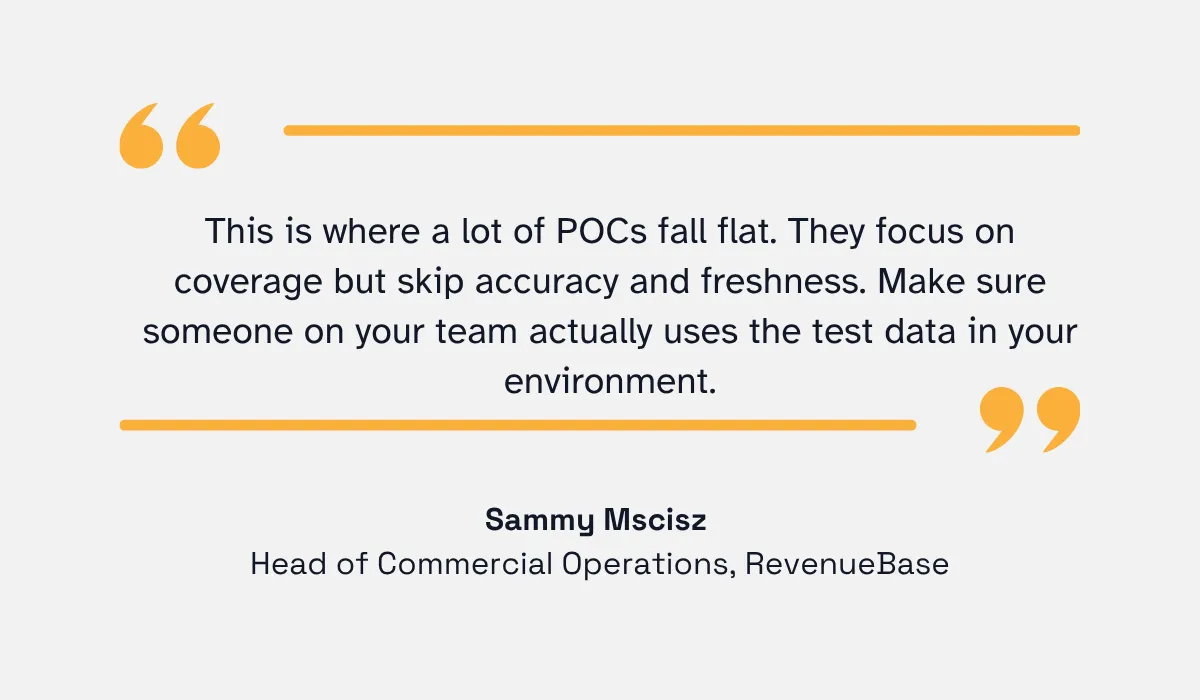
Illustration: Veridion / Quote: RevenueBase
A provider returning with a field for a record can still be wrong.
If your test only asks "did we get a value back," you'll systematically overrate any source that fills fields confidently, whether or not those fields are actually correct.
So build the accuracy check into the test itself, not as an afterthought.
Pull a sample of what came back, and manually verify a portion of it against a source you trust, like the company's website or a recent filing, rather than assuming a returned field is a correct one.
While doing this, track the costs the same way.
The right number is the price per usable record, meaning a record that's both filled and correct.
A source that charges less per record but returns twice as many unusable fields can end up more expensive than one that costs more upfront and rarely needs a second look.
Every additional source in your pipeline is another set of field definitions to reconcile and another decision about which provider wins when two disagree on the same fact.
Veridion: A Single Source That Shrinks the Gap a Waterfall Exists to Fill
The entire rationale of the waterfall is based on recovering the records your first source leaves unresolved.
So, the broader your first source's coverage is, the fewer records you have to pass to the second or third provider.
Veridion is a perfect example of the single source built for this.
It covers multiple companies across countries and territories, and the composition of that coverage is the most important.
Veridion discloses that 77% of its coverage sits in the:
- Long tail
- Small
- Informal
- Hard-to-find businesses
Traditional sources, the kind discussed earlier in this piece, consistently fail to cover these areas.
Coverage alone isn't the whole argument, though. Depth matters just as much, especially against the governance cost raised earlier in this piece.
Veridion structures multiple attributes per company, built from sources spanning company websites, trade registries, news and filings, and licensed data feeds.

Source: Veridion
Where a team running its own waterfall has to build the logic for deciding which provider wins when two disagree, Veridion runs that resolution internally.
A waterfall earns its complexity by recovering records the first source missed; Veridion, on the other hand, is the practical payoff of building for depth and long-tail reach from the start.
Conclusion
The best enrichment strategy is the one that gives you the most usable data with the least unnecessary complexity.
Neither single-source nor waterfall wins that on its own.
It comes down to how much of your target list one broad source already resolves, and whether what's left over is worth a second vendor's cost and complexity.
The real test is comparing your ICP sources against the same accounts, measuring both coverage and accuracy, and calculating what you're actually paying for usable records.
Articles
Discuss how these trends affect your organization.
Our analysts are available for a short call. Bring a specific question and we will ground it in the data.
Insights
Keep reading
More analysis, research, and outcomes grounded in live company intelligence.
How to Connect a Firmographic Data API to Your CRM, CDP, and BI Stack (A Technical Guide)
Struggling to integrate firmographic data providers? This technical guide shows you how to connect their APIs to your CRM, CDP, and BI stack.
5 Firmographic Data Accuracy Problems That Silently Kill Your Pipeline
In this article, you will learn five firmographic data accuracy problems that can weaken your pipeline and lead to poor targeting and prioritization.
12 Firmographic Variables That Actually Matter for B2B Targeting
In this article, you will learn which firmographic variables for B2B targeting matter most and how they help identify better-fit companies.