Insights / Articles
7 Data Gaps That Make Private Company Credit Ratings Harder to Defend
In this article, you will learn which private company credit rating data gaps can make assessments harder to support, explain, and defend.

- A rating tied to the wrong entity misplaces support and liabilities.
- Label every input as audited, unaudited, estimate or projection.
- Old industry codes and addresses can hide what a borrower really does.
- A dated source trail shows what you knew when you issued the rating.
A private company credit rating is only as defensible as the evidence behind it.
Private borrowers disclose less financial and operational information than public issuers, so when an auditor, regulator, investor or model validation team questions a rating, you may have little to show them.
The seven credit rating data gaps below explain where that evidence usually runs thin.
Veridion supports the non-financial side with source trails and last-harvested dates on its attributes, while the analysis and decision stay with you.
No Proof the Rating Covers the Right Company or Group
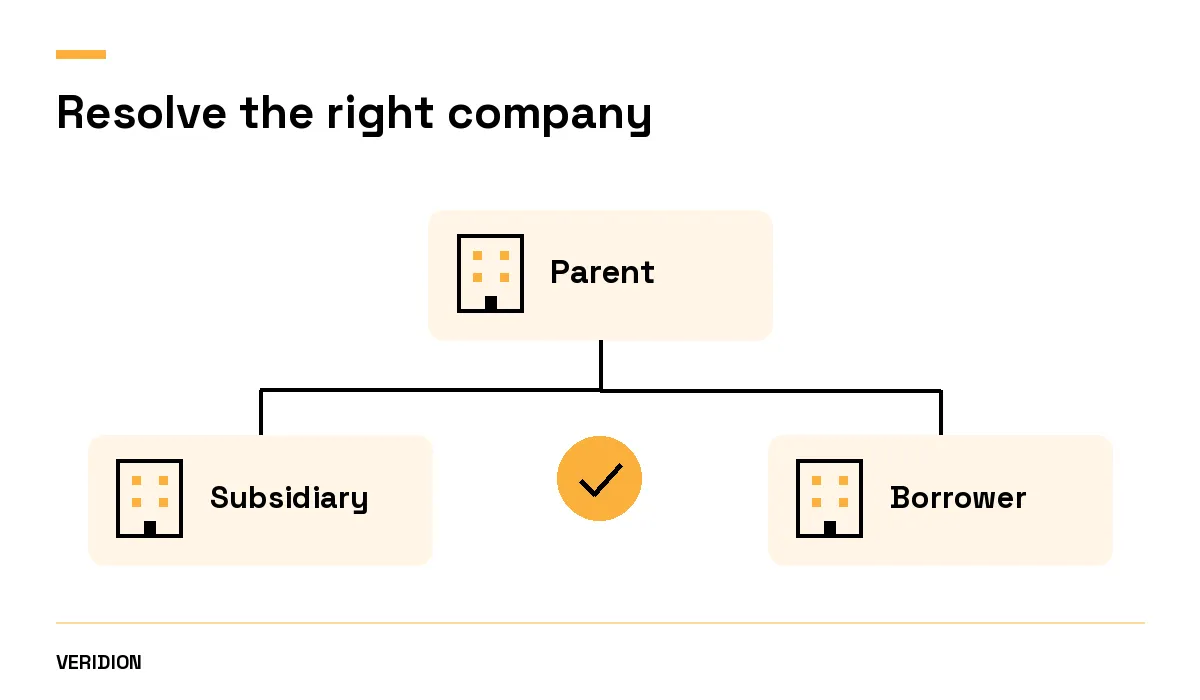
Before a rating is challenged, you should be able to show which legal entity it covers and where that entity sits in its group.
A name alone rarely settles that.
Private borrowers are often matched by name, and the parent companies, subsidiaries and financing vehicles around them may not appear together in any public record.
For companies that file annual reports with the SEC, the group is easier to see.
Under SEC Regulation S-K, an annual report includes an exhibit listing subsidiaries, with certain insignificant subsidiaries eligible to be omitted under Item 601(b)(21).
The exhibit applies only to companies that report to the SEC. A business with no listed securities or public shareholders isn't obliged to publish its group structure, so you have to piece together registry records, company disclosures and lender documents.
Without that, you can't tell whether the information covers only the operating company or also the related entities with obligations tied to the business.
Veridion's entity resolution service is built for this problem.
It links a company to its corporate hierarchy and documents each decision with a confidence score.
Source: Veridion
The reasoning and signals behind the match are recorded, so you can audit it at the record level.
Veridion supplies company data, not credit ratings or credit scores. It doesn't replace analyst judgment or audited financial statements.
Low-confidence records are flagged explicitly, and a low score only becomes a problem when the rating relies on the match and the file doesn't show how it was settled.
If a validation team asks why a borrower was linked to a particular parent, your answer is the evidence: who reviewed the match, which registry record or filing confirmed or corrected it, and when.
Settling flagged matches before you issue the rating, and keeping that note in the file, gives you that answer. The checks that settle these matches before committee are covered in 6 Issuer Data Quality Checks Before Rating Committee.
Self-Reported Financials With No Independent Check
The data gap in a private company rating is the missing independent check on the financial figures behind it.
Public companies include audited financial statements in the Form 10-K they file with the SEC.
Private borrowers often have shorter financial histories, unaudited accounts or infrequent updates, leaving you with less independent evidence to test the figures supplied.
That doesn't mean the figures are wrong, only that you can't prove they're right, and that is what makes the rating hard to defend.
Projections are the hardest inputs to check, because they describe results that haven't happened yet.
In an April 2025 study, S&P Global Ratings found that almost half of the US speculative-grade issuers in its seven-year sample missed management's earnings projections by more than 33%.
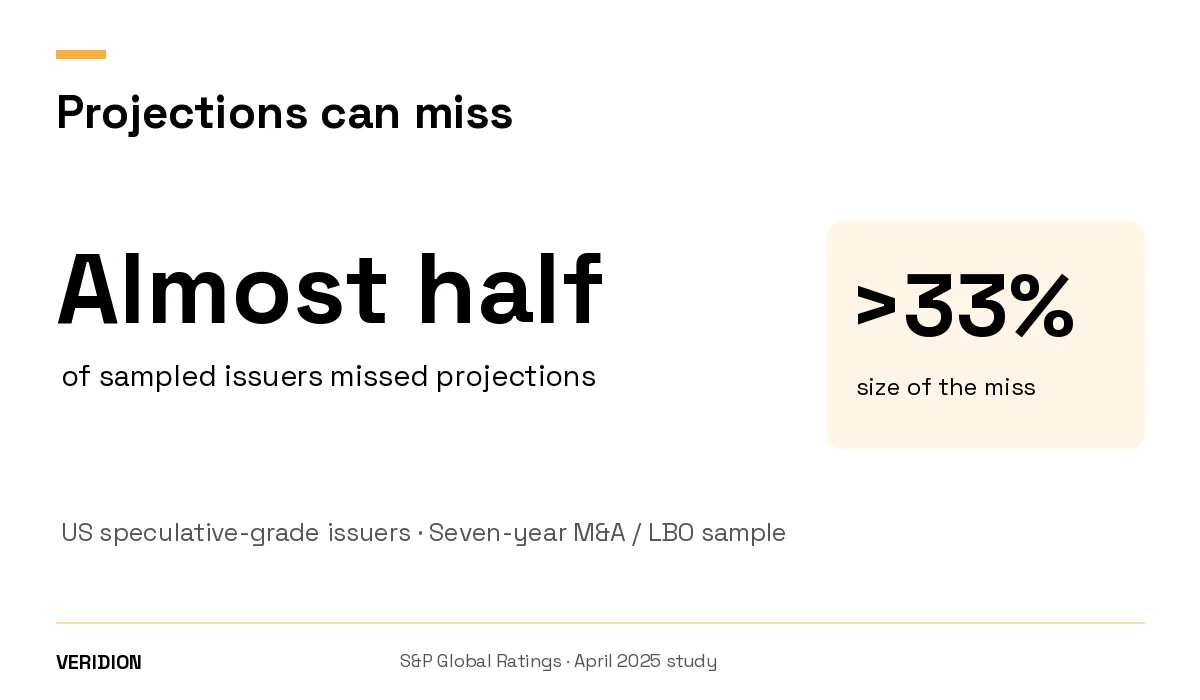
Illustration: Veridion / Data: S&P Global Ratings
The sample covered speculative-grade issuers in M&A and leveraged buyout transactions, not private companies alone, so treat it as evidence of how far management projections can miss, not as a private-company statistic.
But it shows how little weight a management projection can carry on its own.
Bloomberg reported that in the third quarter of 2025, an Apollo-managed fund valued a loan to software company Medallia at 77 cents on the dollar.
A fund co-managed by Future Standard and KKR valued it at 91 cents, while Blackstone's mark was 82 cents.
The highest and lowest marks had a difference of 14 cents per dollar, equivalent to $1.4 million on a $10 million holding.
Each lender held the same loan to the same borrower.
Bloomberg presented the gap as an example of how much discretion lenders have when they value private loans.
Infrequent updates make the gap harder to close.
The Financial Stability Board (FSB) notes that private credit valuations are often updated only quarterly, which may be adequate in normal markets but less so under stress.
Your rating faces the same problem.
If a reviewer's estimate differs from yours, you can defend your figure only if the file shows what supported it.
So you need to record what was checked, not just what was received.
For every input behind the rating, label it as audited, unaudited, management estimate or projection.
Note who reviewed it, against which document, and how much weight the analysis gives each category.
Where the rating depends on a projection, also record a downside case so the file shows the rating was tested against a weaker outcome than management's.
Peer Comparisons Built on an Old Industry Label
An outdated industry label weakens the peer group and sector assumptions behind a private company credit rating.
In the United Kingdom, a limited company picks its Standard Industrial Classification (SIC) code based on its principal activity when it registers with Companies House, the UK's register of companies.
The Office for National Statistics (ONS) receives that self-reported code through a regular feed.
After registration, the company confirms or updates that code itself in its annual confirmation statement, and Companies House doesn't verify it.
In a 2022 analysis of its own business register, which draws on Companies House, tax and survey data, ONS found that 2.9% of the roughly 2.77 million businesses on it had their industry code changed during 2020.
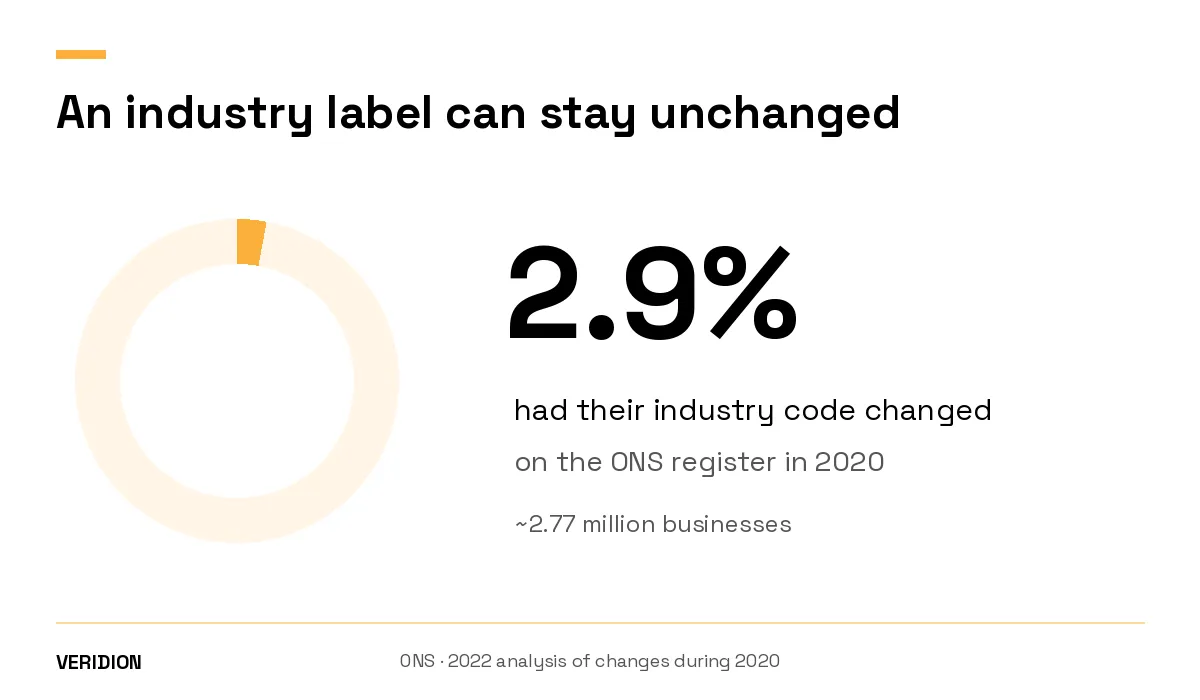
Illustration: Veridion / Data: Office for National Statistics
ONS interpreted that low figure as a sign the register is stable, and for statistics that is a fair reading.
For a credit file, it means a borrower's code rarely changes from one year to the next, so a stable label tells you little about whether the business still does what it registered for.
More than 90% of classification changes followed the addition of more reliable information, such as a survey response or Companies House registration.
The label affects which companies count as peers and which sector risks inform the assessment.
S&P Global Ratings, for example, builds a corporate issuer's business risk profile from industry risk, country risk and competitive position.
If the borrower's activity is classified incorrectly, both the comparison set and the assumptions drawn from it become harder to justify later.
A Registered Address Standing In for the Real Footprint
If your rating file lists one address for the borrower, that address says very little about where the company operates.
A registered address records where a company is legally based, and companies often pick that location for legal or administrative reasons.
For example, Delaware's Division of Corporations presents the state as a legal home for businesses and credits its corporate laws, its Court of Chancery, its legal community and the Division itself as the reasons companies choose to incorporate there.
A company incorporated there can run its plants and branches, and serve its customers, anywhere else.
US law does not let public companies stop at the registered address.
Item 102 of Regulation S-K requires them, to the extent material, to disclose the location and general character of their principal physical properties and to identify the segments that use them.
A private borrower has no such requirement, so the public record often holds little beyond the registered address unless the company or the loan documents provide more.
The gap widens when a company operates in several countries.
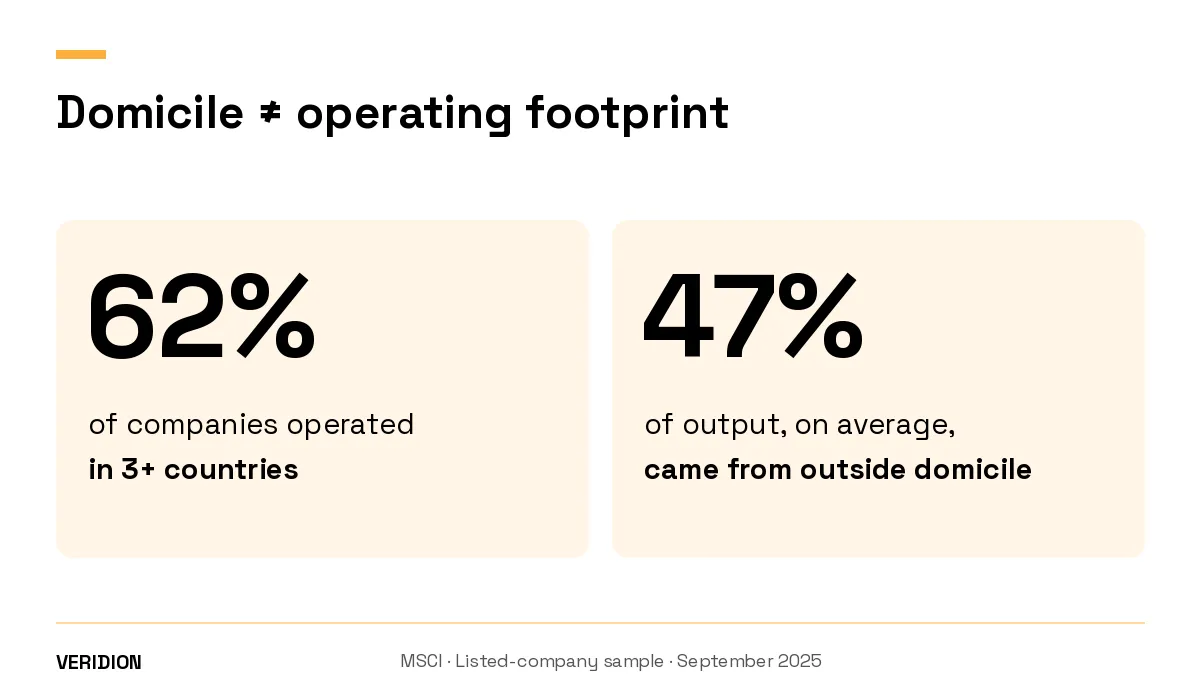
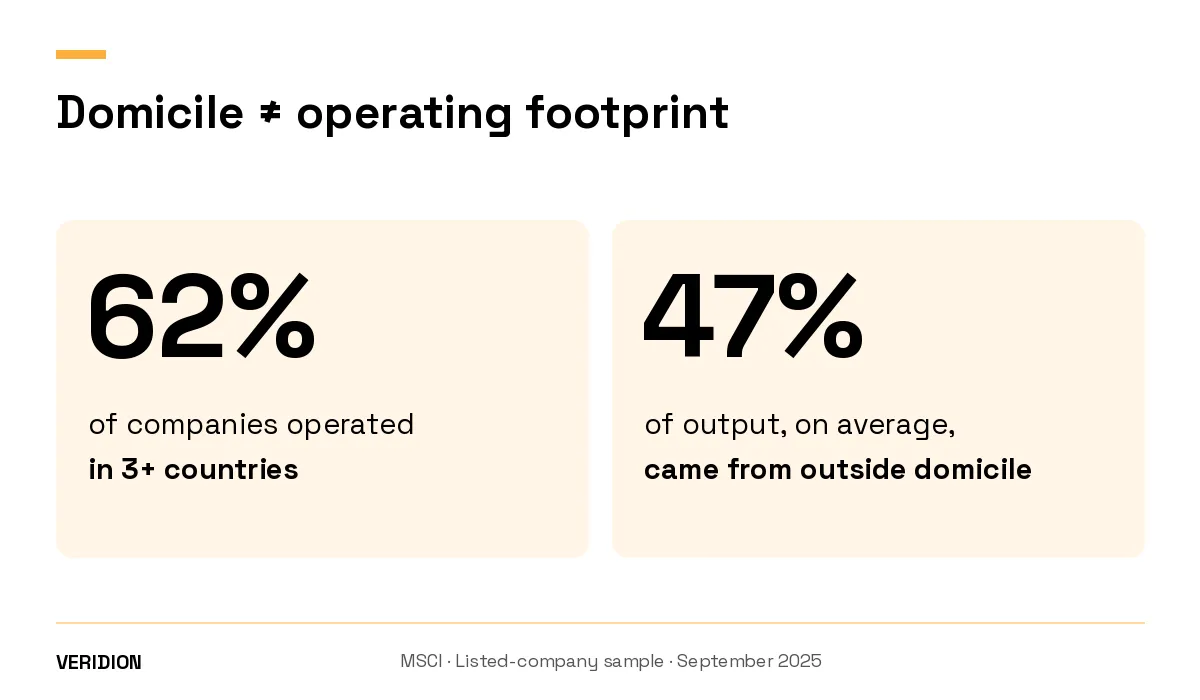
MSCI, which sells data and analytics to investors, analyzed 11,215 listed companies held in the equity portfolios of 18 asset owners, using asset-level location data as of September 2025.
On average, 47% of a company's output was linked to operations outside its country of domicile, and 62% of the companies operated in three or more countries. The sample covered listed companies, so it shows how far domicile and footprint can diverge, not how private borrowers compare.
Operations in several countries bring different regulators and different local hazards.
A registered address can also hide the opposite problem: a borrower whose revenue depends on one plant or warehouse carries concentration risk that the file can't show if it never recorded the site.
A file that records everywhere the borrower operates, and how that was known, is much more defensible.
A Status Change the Rating File Never Caught
A register shows a borrower's status as of its last formal notice, and its finances as of its last filed accounts, which can be many months before the rating date.
How old those accounts can be depends on the reporting rules the borrower falls under.
In the UK, a company whose securities are admitted to a UK regulated market must publish its annual financial report within four months of its year end and a half-yearly report within three months of the end of that period, under the FCA's Disclosure Guidance and Transparency Rules.
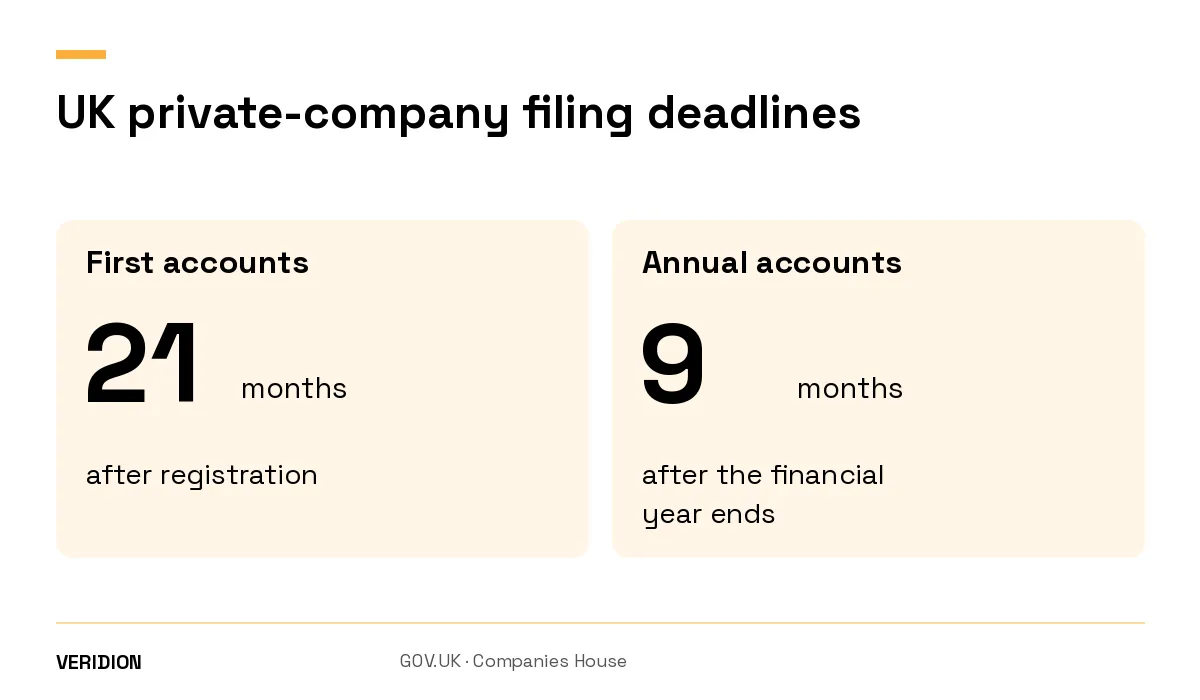
A UK private limited company has nine months after its financial year ends to file accounts with Companies House.
Source: UK Gov
Companies House states on its search page that it does not verify the accuracy of the information filed.
Registers also record only formal steps.
Administration, liquidation and strike-off reach a register only when a notice is lodged or published. Talks with lenders and covenant waivers usually come earlier and leave no entry on the register.
That gap matters when the change surfaces.
A reviewer will ask when the administration or restructuring became knowable and why the rating file didn't reflect it.
If the file records which register was checked, on what date and what it showed, you can show the change wasn't yet on record.
Without that, the rating looks as though it missed a public signal.
No Record of What You Knew on the Rating Date
Point-in-time evidence is the record of what you saw on the day a rating was issued.
A challenge can arrive months or years later, when the company's address, status, financials and peers may have changed.
The current record may be more accurate than the original and still less defensible, because the new values have overwritten the ones the analyst used.
If the original inputs are gone, you have no reliable way to show what information was available when the rating was issued.
Regulators treat the rating record as something to keep.
Under Rule 17g-2 of the Securities Exchange Act, a rating agency registered with the SEC (a nationally recognized statistical rating organization, or NRSRO) must retain the internal records used to form the basis of a credit rating.
The rule names nonpublic information and work papers explicitly, and it covers private credit rating reports.
It also requires agencies to keep communications about determining, maintaining or monitoring a rating.
In its 2023 order against Kroll Bond Rating Agency (KBRA), the SEC repeated its long-standing view that preserved records are the primary means of monitoring compliance with the securities laws.
A rating whose record is missing can't be examined, and that is the position a challenged rating team is in.
KBRA, a privately owned rating agency based in New York, settled the case in September 2023.
The SEC found that KBRA employees at all levels of seniority had discussed rating activity over text and WhatsApp messages since at least January 2020, and that those messages weren't retained.
Some contained snapshots of internal documents, including a spreadsheet analyzing a specific transaction.
KBRA paid a $4 million penalty for this.
The SEC said the failures likely deprived it of records during investigations and examinations.
This is what happens to a rating's evidence base when the working material is outside the file.
To avoid this, keep the value used, its source and the date it was retrieved. Add the analyst's workings and the committee's decision.
When new information arrives, add it as a dated entry instead of overwriting the old one.
The file then shows what you knew at the time and what you learned later.
Veridion's data methodology supports this with timestamped sources.
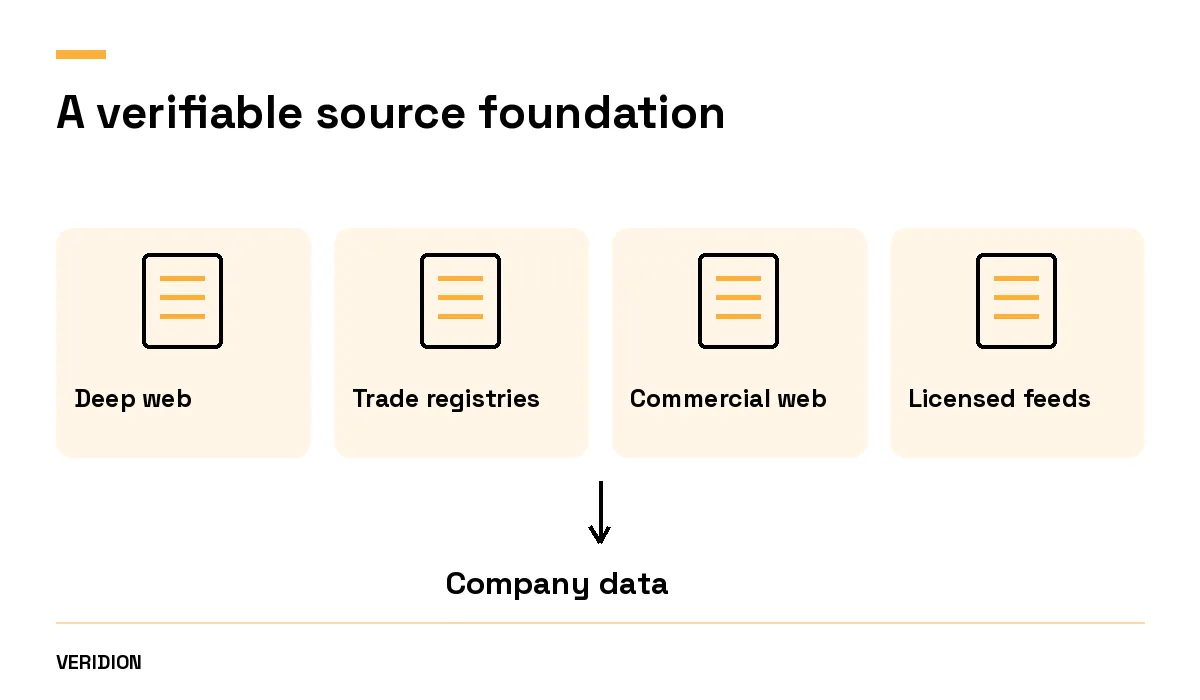
Every attribute ships with a source trail, which lists the sources it was derived from and the last-harvested date.
Source: Veridion
That date lets you determine how old a figure was when you used it, and you can record it in the evidence pack.
It isn't a historical snapshot, so you still need to keep your own dated copy of what you used.
Data You Can't Trace to a Source or a Date
A plausible data point is difficult to defend if the file cannot show where it came from and when it was collected.
A company address may come from a registry, a facility location from the company's website, and an industry label from a third-party classification.
Those sources have different purposes and refresh cycles, so a single 'last updated' date for the whole company record can hide how old an individual attribute is.
Veridion supplies the non-financial side of that record.
On top of the source trail, every attribute carries a confidence score, so a reviewer can see how firmly a value was established.
Source: Veridion
Veridion's revision history also ties every change to a value back to the evidence that caused it.
Across the 744.5M companies Veridion covers, that gives you a documented evidence trail for the non-financial context behind a rating, such as location, ownership and activity.
Conclusion
A rating can be reasonable and still be difficult to defend if the evidence behind it cannot be reconstructed.
For private credit rating defensibility, none of these seven gaps makes a rating wrong on its own, but each makes it harder to prove when someone asks.
The practical test is to take one recent private-company rating and check whether another reviewer could identify the borrower, trace the material inputs to their sources and recover the dated record used at issuance.
Where that record is incomplete, document the limitation and build the missing evidence into the next review cycle.
Articles
Discuss how these trends affect your organization.
Our analysts are available for a short call. Bring a specific question and we will ground it in the data.
Insights
Keep reading
More analysis, research, and outcomes grounded in live company intelligence.
6 Issuer Data Quality Checks Before a Case Reaches the Rating Committee
Tired of rating committee delays? Ensure top-notch issuer data quality with 6 essential checks. Avoid costly errors and streamline your process.
How Credit Rating Agencies Build a Coverage Universe of Unrated Companies
How rating agencies build a coverage universe of unrated companies, from defining scope and deduplicating records to ranking candidates by relevance.
How to Prioritize Surveillance Alerts Across Thousands of Issuers
How credit rating surveillance teams can score alerts by magnitude, persistence and data confidence, and run a queue analysts actually trust.