Insights / Articles
How Credit Rating Agencies Build a Coverage Universe of Unrated Companies
How rating agencies build a coverage universe of unrated companies, from defining scope and deduplicating records to ranking candidates by relevance.

- Fewer than 5% of the world's public companies carry a rating from S&P Global Ratings.
- Duplicate entity records can lead analysts to unknowingly research the same company twice.
- HCA Inc. kept filing SEC reports for years after going private, because surviving public debt kept a reporting duty alive independent of its delisted equity.
A credit rating is only useful if you know which companies are worth assessing in the first place.
That becomes difficult when companies are scattered across fragmented data sources, with the same business appearing under multiple identities, and existing ratings are spread across different agencies.
Building a reliable coverage universe starts long before credit analysis.
This guide covers the process for discovering, filtering, and continuously prioritizing companies.
Building a Clean Candidate Universe
Before you can judge if a company deserves a particular rating, you should know the company exists, has a distinct legal entity, and no duplicate version of it is already sitting somewhere else in the system.
This phase’s one job is producing a clean, correctly identified set of real companies.
No credit judgment can happen here yet, because any analysis you make on top of a messy universe multiplies whatever errors are already baked into it.
That's why identification is treated as its own discipline, worked through in four distinct steps.
Define the Universe and Discover Companies at Scale
This process starts with a boundary.
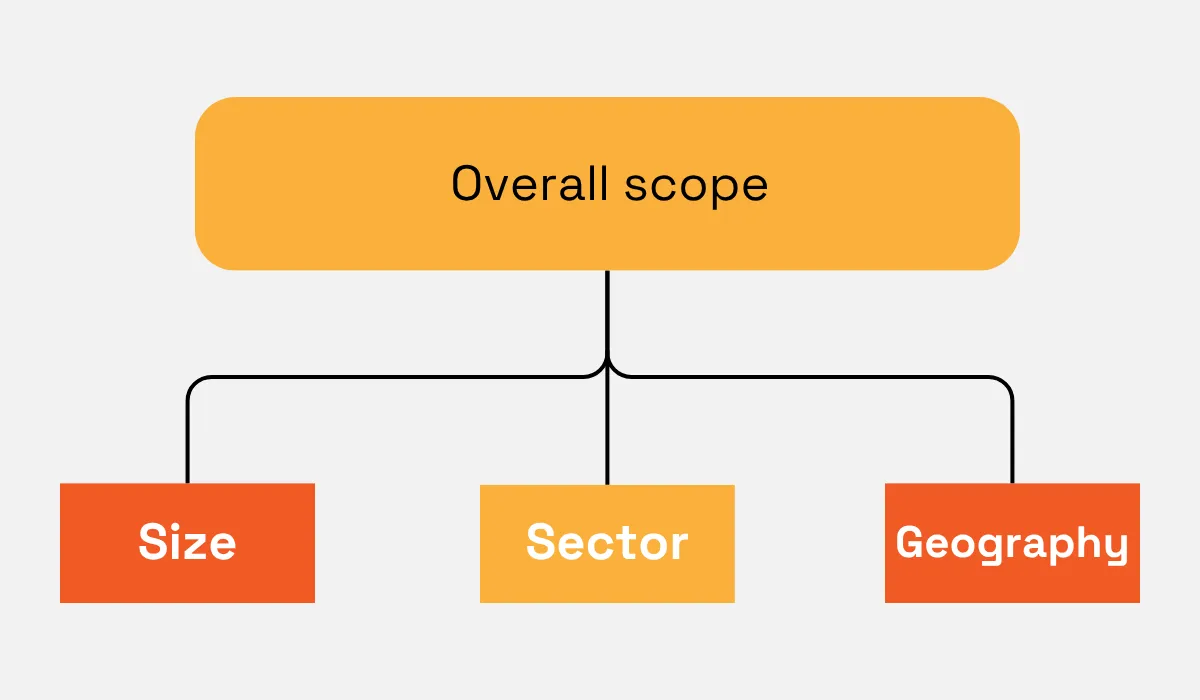
Before any discovery work begins, you have to define what elements count in your scope.
Source: Veridion
This helps you identify the edges you need to pull in companies you can prioritize.
S&P Global Rating's Corporate Methodology and companion Sector-Specific Corporate Methodology both spell out which entity types and sectors a rating approach applies to before a single company gets assessed.
Once this boundary exists, you discover which companies are within it.
This is a lot harder when dealing with a private company that isn't in a single centralized registry.
In the US, for example, there's no single national companies registry.
A company registers with whichever state's Secretary of State it chooses, and each state sets its own disclosure rules.
The Electronic Data Gathering, Analysis, and Retrieval (EDGAR) system, the closest thing to a centralized US company log, only covers companies that register securities or report to the Securities and Exchange Commission (SEC).
A private company that never issues public securities has no reason to ever appear there.
S&P Global Ratings covers around 8,350 issuers globally, of which roughly 2,300 are public companies, against an estimated 46,000 public companies worldwide.
That puts coverage under 5% of public companies, the segment with the most disclosure and the easiest data to find.
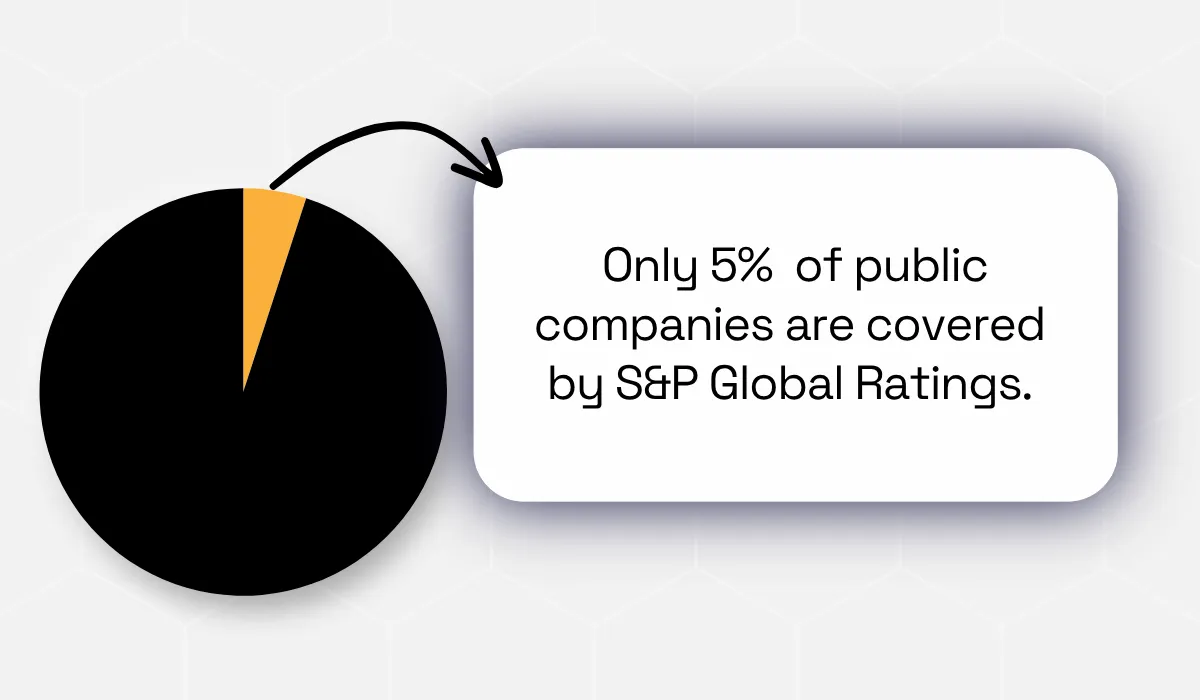
Illustration: Veridion / Data: S&P Global Ratings
So, if under 5% of the best-documented segment of the corporate world carries a rating, the private segment, which discloses far less, is in a considerably deeper shortfall.
For a coverage universe to mean anything, the discovery has to reach past the names that surface on the first pass.
Deduplicate Entities
A universe assembled from more than one source will contain the same company twice, possibly more, just with two different names.
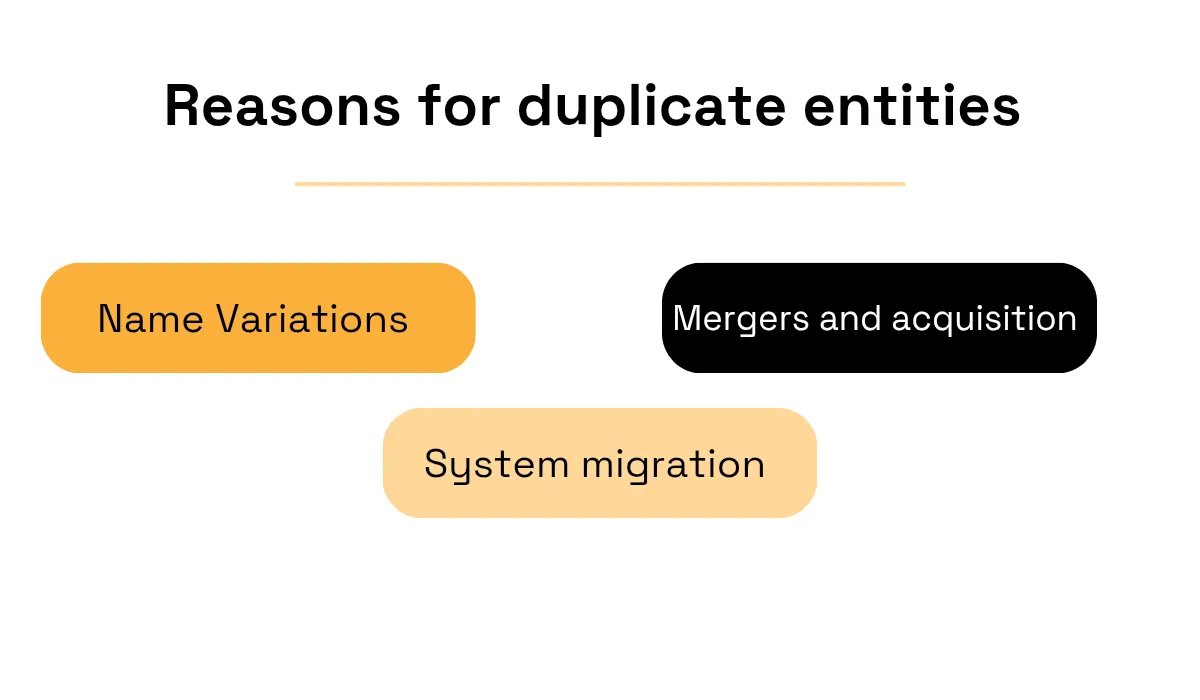
This happens for three major reasons:
Source: Veridion
One registry lists a company as "Acme Inc," while another lists "Acme Incorporated" at a different address, and when you pull from both sources, you end up with what looks like two companies instead of one.
But name variation isn't the only issue.
Mergers and acquisitions can easily be a common source too, when two companies’ data gets folded into the same system without a shared identifier linking the old records to the new combined entity.
This makes both the acquirer's and the target's original records persist side by side.
System migrations cause this same problem by moving data from one platform to another, including duplicates whenever the migration doesn't map every record correctly.
This is an issue common enough that data teams treat it as an expected risk of any migration.
The Global Legal Entity Identifier Foundation (GLEIF) treats this as a two-stage problem.
Before a record gets published, LEI issuers are required to run it through GLEIF's "Check for Duplicates" and "Data Governance” pre-checks to catch problems before they enter the public data pool at all.
After publication, GLEIF checks the entire LEI repository daily and publishes a public score, the Total Data Quality Score, every month.
Anyone can also flag a live record after they fact-check through GLEIF's challenge facility if they spot a duplicate that the automated checks missed.
Under GLEIF's policy, one legal entity gets precisely one LEI.
If one company is found holding three, two of them get formally marked as duplicates and flagged in the public index.
This process of deduplication has to happen before filtering or prioritization.
Confirm Private or Public Status
After deduplication, you should ensure the remaining entities have either a public or private status.
This decides which data sources are worth checking, since a public company comes with a trail of regulatory filings that a private one doesn't.
A public company files with SEC EDGAR on a standardized, free-to-search schedule.
They file an annual 10-K carrying audited financial statements, quarterly 10-Qs with unaudited but still standardized financials, and 8-Ks disclosing specific material events like a leadership change or bankruptcy as they happen.
Their equity or debt also trades continuously, generating a market-priced signal between filings that you can trace in real time.
None of that exists for a private company.
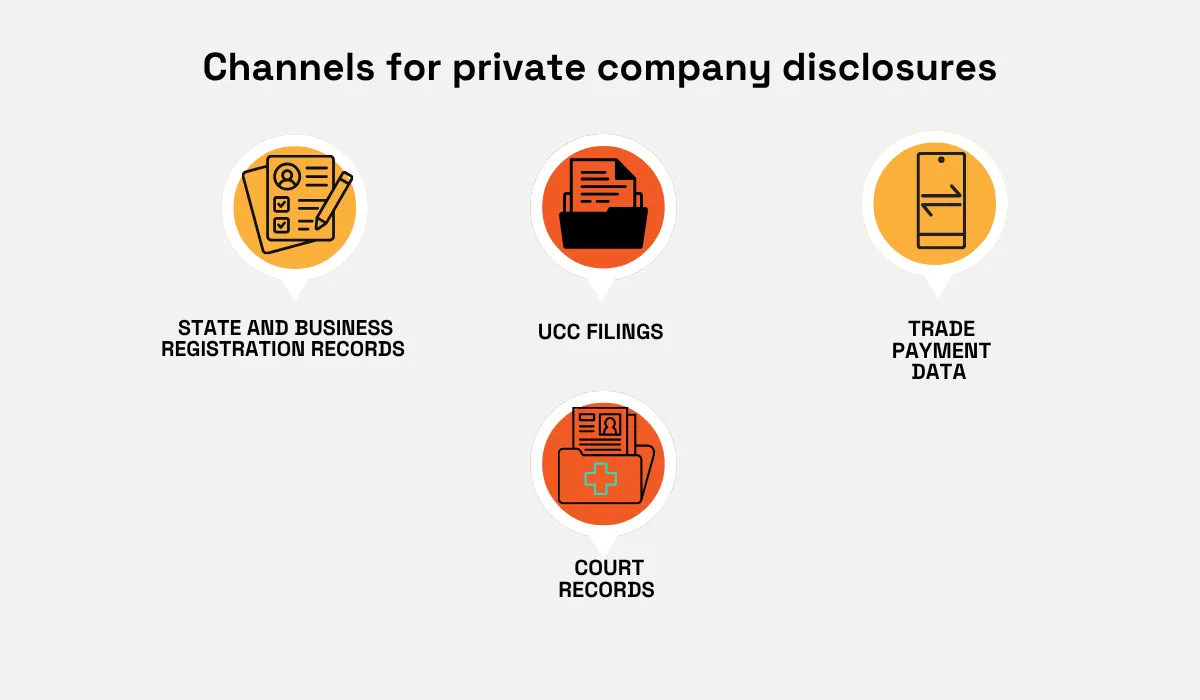
Instead, whatever disclosure exists on a private company comes through a different set of channels entirely:
Source: Veridion
Under SEC rules, a public company can deregister its equity once its shareholder count drops below 300, or below 500 if it holds no significant assets.
Its duty to file one-time reports is suspended the moment it files Form 15, with full deregistration following 90 days later.
That process, technically, turns a public company private. But it doesn't necessarily turn off every reporting duty the company carries.
Their status can also flip within days.
Nordstrom, the US department store retailer, went private on May 20, 2025.
The Nordstrom family and Mexican department store operator El Puerto de Liverpool completed a merger, paying $24.25 per share in cash, making their stock come off the NYSE the next day, but their bonds did not.
They still had six series of notes outstanding, from the 4.000% notes due 2027 to the 5.00% notes due 2044.
Then, on June 2, 2025, Nordstrom filed a Form 15 covering their stock and all six note series.
This ended the duty they had to file reports with the SEC.
After that date, the 10-K for the fiscal year ended February 1, 2025 is the last annual report you will find on EDGAR.
That is where a status check built on SEC filings goes wrong.
The filings themselves show the status change. But, Nordstrom stops producing them, so it looks like it dropped out of the public-company workflow.
In reality, they're still an issuer with six bond series that you'd need to cover.
These are the status you need to get right to save you from chasing the wrong kind of disclosure later.
Resolve to the Correct Legal Entity and Corporate Group
A company rarely presents its legal identity to the world.
What customers, employees, and news coverage see is almost always a trade name or brand, not the entity registered with the state.
Alphabet Inc. is the legal entity behind Google. Meta Platforms, Inc. is the legal entity behind Facebook and Instagram.
None of the contracts, obligations, or credit exposure attach to "Google" as a brand name.
They attach to whichever registered legal entity signed the paperwork.
Large companies often run different products, regions, or business lines through separate subsidiaries sitting underneath one recognizable public name.
Resolving to the correct legal entity means tracing the company's name back to the registered entity that carries legal and financial obligations.
Once you know the correct legal entity, you still need to know where it sits in a larger ownership structure.
This could be independent, or a subsidiary of a parent that might already be part of your coverage elsewhere.
Narrowing and Prioritizing the Universe
By this point, your list holds companies listed once and matched to its legal entity and corporate group.
But the list is still too big to work through at once.
Some of those companies fall outside what your agency rates, and others already have a rating.
This phase narrows the universe against your coverage’s mandate, checks it against what's already been rated, and ranks what's left so your limited time goes toward the companies where it can make the biggest difference.
Apply Sector, Geography, and Size Filters
Your candidate universe, the full list of companies, can still be much larger than your coverage universe, which is the set of companies your agency actually plans to rate.
Moving from one to the other means applying eligibility rules, which decide who stays on the list and who comes off.
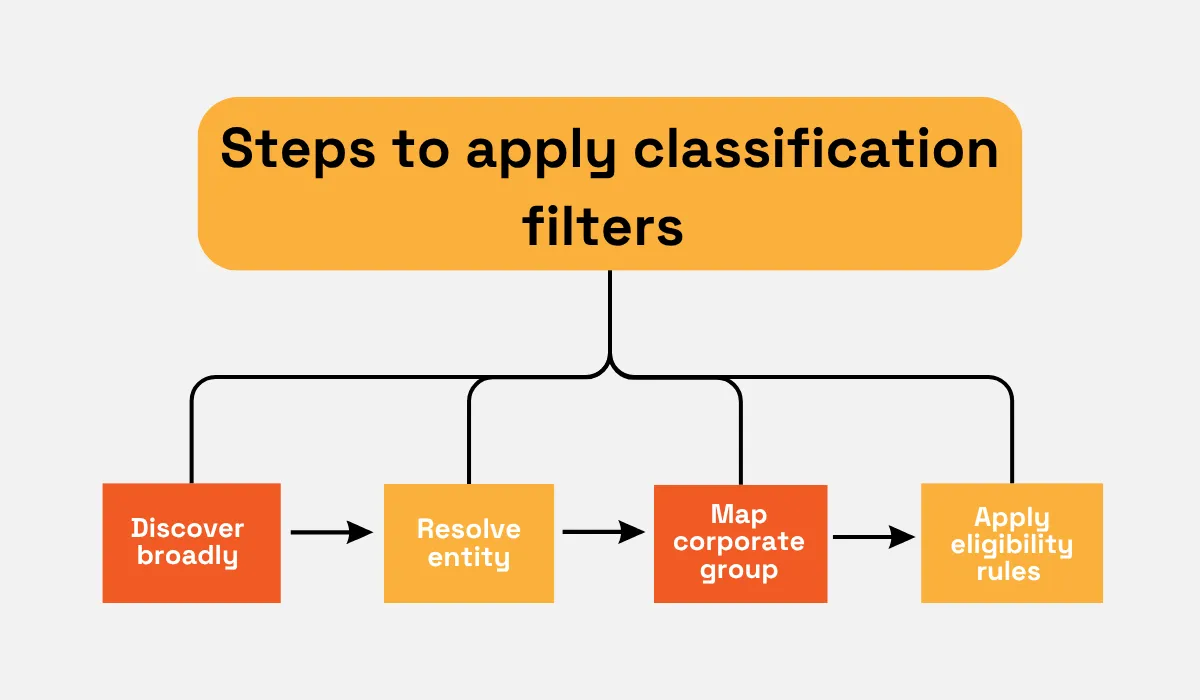
Once each company is matched to its registered legal entity and mapped to its parent company, if it has one, you apply the eligibility rules that determine which companies belong in the coverage universe and which ones should be excluded.
Those rules depend on the agency and the mandate.
This step re-applies the same boundary used in the discovery stage, when sector, geography, and size determined what counted as scope, except now it's being used with a universe of companies that are matched to their legal entity and parent.
To start, you first identify if an entity falls within the relevant industry classification, then check if its geographic footprint matches the agency's remit, and finally evaluate whatever size or financial criteria apply to the particular coverage program.
Source: Veridion
Filtering comes after resolution because you now know what each record actually represents.
GLEIF's Level 2 LEI data connects legal entities to their direct and ultimate accounting-consolidating parents, providing a standardized way to establish where an entity sits within a corporate structure.
If the candidate is genuinely independent, its attributes determine whether it passes the filter.
If it belongs to an existing group, you would need to consider the group's structure, subsidiary's role, and the methodology that applies to entities within that structure before deciding whether to retain or exclude it.
This helps you remove entities that fall outside the mandate while preserving candidates whose eligibility becomes clear after their identity and company relationships have been established.
Check Against Existing Ratings Coverage
Once the universe has been filtered to companies that fit the coverage mandate, the next question is: “Are those companies missing from credit ratings coverage?”
That requires you to check how a company appears on its website.
The purpose of this step is to identify coverage gaps.
The first challenge is matching the candidate universe to existing ratings records.
Company names are a poor basis for this on their own. The same legal entity can appear under a former name, a shortened name, a trade name, or a different formatting convention.
That means a simple name-based lookup produces both false matches and missed matches.
A more reliable workflow uses persistent identifiers wherever they are available, with the LEI acting as one useful cross-reference point.
GLEIF's LEI Mapping program exists specifically to connect LEIs with identifiers used in other systems.
This mapping ecosystem includes identifiers such as:
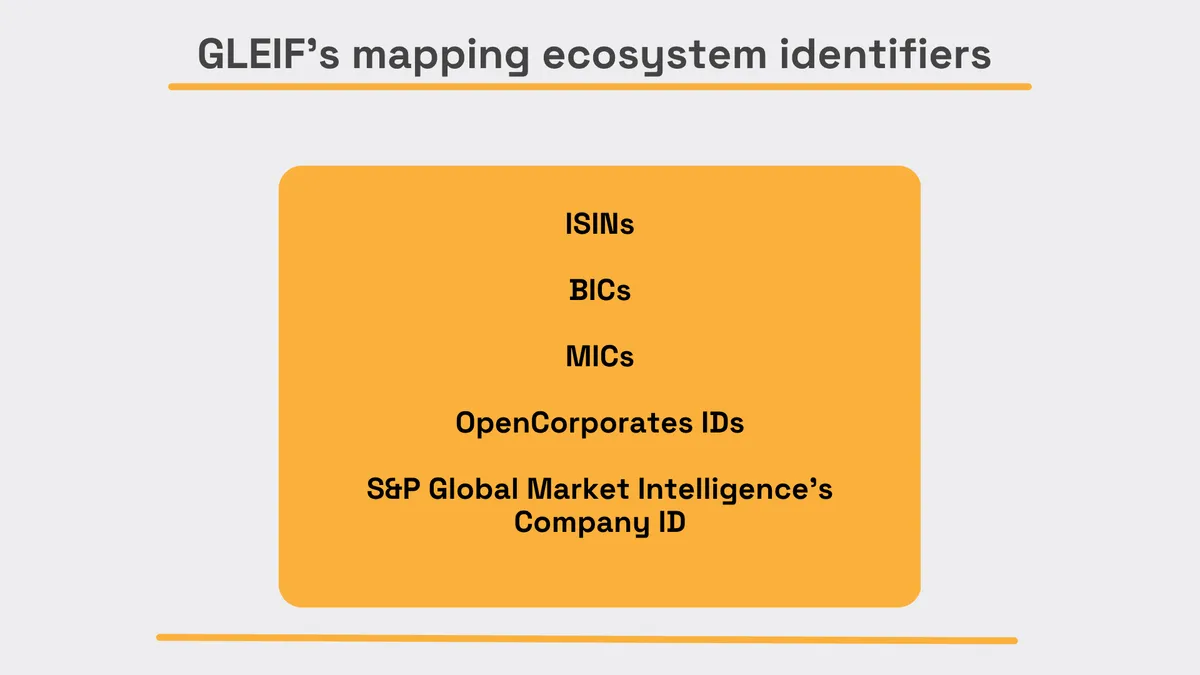
According to GLEIF, these mappings make it easier to gather, aggregate, and reconcile information across otherwise separate identifier systems.
Potential matches that fail the identifier check can then be sent for additional resolution using names, addresses, ownership relationships, securities identifiers, or other attributes.
S&P Global Ratings allows users to search for ratings by company name, ticker, CUSIP, or keyword and retrieve current ratings and related information.
That makes prioritization more useful because now a company with no rating identified anywhere deserves a different priority from one that already has a Moody's or Fitch assessment but falls outside your own agency's coverage.
Prioritize and Refresh the Universe Continuously
After the coverage check, you have a list of companies that fit the mandate but don't have your coverage.
The final step is to rank those candidates according to the signals that make them more relevant, timely, or strategically important to the coverage program.
- Company size
- Growth signals
- Sector
- Geographic exposure
The exact scoring model will vary by companies, but the inputs can be made concrete.
These signals are already used across credit and company intelligence workflows.
Taking a look at global credit rating agency Moody's private-credit framework: it identifies size, leverage, profitability, industry dynamics, geographic exposure, and sovereign risk among the factors that can drive credit-risk assessment.
The ranking only works while the underlying company data remains current.
If your universe is a one-time project and none of those changes have flowed back into it, the ranking will still look perfectly clean while representing an outdated version of the market.
The blind spots you removed in the earlier stages can gradually reopen.
The universe therefore needs a refresh cycle alongside its ranking logic.
When new evidence arrives, the system should be able to update the attributes that drive eligibility and priority, then recalculate where the company belongs in the queue.
This is where a continuously updated company data layer can support the workflow.
Veridion's company intelligence data provides structured company information across attributes such as:
- Business classification
- Company size
- Business activity
- Corporate relationships
Its data pipeline continuously collects, resolves, enriches and validates company information, while its company graph connects entities, attributes and relationships.
This helps you build the ranking on attributes that are designed to change with the underlying company.
Conclusion
Building a coverage universe of unrated companies is not simply about finding more company names.
The quality of the universe depends on whether each entity is correctly identified, properly classified, matched to its corporate group, and checked against existing ratings coverage.
That work also needs to continue after the initial universe is built.
A continuously refreshed data foundation helps ensure that you are working from an accurate view of the market and can focus your attention where genuine coverage gaps exist.
Articles
Discuss how these trends affect your organization.
Our analysts are available for a short call. Bring a specific question and we will ground it in the data.
Insights
Keep reading
More analysis, research, and outcomes grounded in live company intelligence.
How to Build Comparable Peer Groups for Private Company Credit Analysis
This article will explain how to create peer groups for private company credit analysis and improve benchmarking when financial disclosure is limited.
Data Lineage for Credit Ratings: Building a Traceable Evidence Chain
How credit rating data lineage works in practice: capturing provenance, entity identifiers, transformations and overrides.
6 Issuer Data Quality Checks Before a Case Reaches the Rating Committee
Tired of rating committee delays? Ensure top-notch issuer data quality with 6 essential checks. Avoid costly errors and streamline your process.