Insights / Articles
How Veridion’s Entity Resolution Engine Achieves a +99% Matching Rate for B2B Databases
Struggling with B2B data deduplication? Veridion's entity resolution software boasts a +99% matching rate, transforming your databases.

- No single data source is enough.
- A confidence-weighted graph achieves a match rate above 99% on aliases, subsidiaries, and complex entities like securitization vehicles.
- Fresh data is necessary to keep records accurate as companies relocate, restructure, or change hands.
Same company. Five different names.
“Stripe Inc.” in one system. “stripe.com LLC” in another. A subsidiary buried under a third one – the chaos grows exponentially.
Multiply that across millions of companies, and you end up with data that merely looks complete at first glance. You end up with duplicate entries masquerading as different companies scattered across your systems, each with its own signature.
Veridion’s entity resolution engine fuses every signal about a company into one verified record, at a match rate above 99%. That simplicity saves the one thing that matters most for businesses: time.
Here’s how it works.
Collecting Signals from Multiple Sources
Before you can resolve anything, you need to see its faults and determine if a fix is needed. If that’s obscured, it’s essentially a problem entirely outside your field of view.
Veridion’s engine starts by crawling a wide range of sources:
- Company websites
- Trade registries
- Regulatory filings
- News coverage
- Associations and certifying bodies
Our methodology runs on continuous crawling, pulling in roughly ~1.4B web pages a month, alongside registry ingestion and public data feeds.
This breadth matters, but not just because “the more the merrier.”
In reality, no single source tells the whole story, and relying on just one channel would end up costing you at some point, whether you realize it or not.
This multi-pronged approach isn’t unique to Veridion. Industry guidance on business verification puts it plainly: no single data source provides complete verification, and effective identification requires combining multiple sources.
As Jeff Jonas, CEO of entity resolution company Senzing, puts it, the payoff of getting this right is knowing “who’s who and who’s related to who” – the foundation for every higher-quality decision that follows.
So, treat it like a puzzle that you diligently assemble, piece by piece.
A registry gives you the legal name. A website gives you the brand name a company actually trades under. A filing might surface a subsidiary registered under a different name entirely, in a different country, and so on.
Each individual data source will be accurate on its own terms, but they have their limitations. For instance, a legal registry can tell you a company exists and who owns it, but don’t expect to find out what the company actually does, where it operates day to day, or whether it’s still active in any meaningful sense.
That gap between legal existence and operating reality is exactly where most enterprise data goes stale.
Traditional matching tools treat each of these sources as a separate record, since on paper they are different strings of text.
Entity resolution works from a different premise: a “Stripe Payments Co.” and a “stripe.com LLC” might be the exact same business wearing different clothes, and the job is to prove it.
For teams running CRM, vendor risk, or credit models on top of this data, the difference shows up as a practical problem: it dilutes records, cluttering them with question marks and uncertainty, ultimately wasting time on research and confirmation that should never have needed double-checking.
Even worse, the inefficiencies don’t stop there.
No digital system by itself can realize that these similar-but-different records belong together until an employee catches and flags them manually. It’s painful, tedious, and time-consuming.
Surveys on enterprise data put a number on how common this is: a survey by the IBM Institute for Business Value found that nearly 77% of respondents agree or strongly agree that data silos hinder their organization’s ability to perform real-time analytics and make data-driven decisions, and 83% believe silos undermine innovation by blocking cross-departmental idea-sharing.
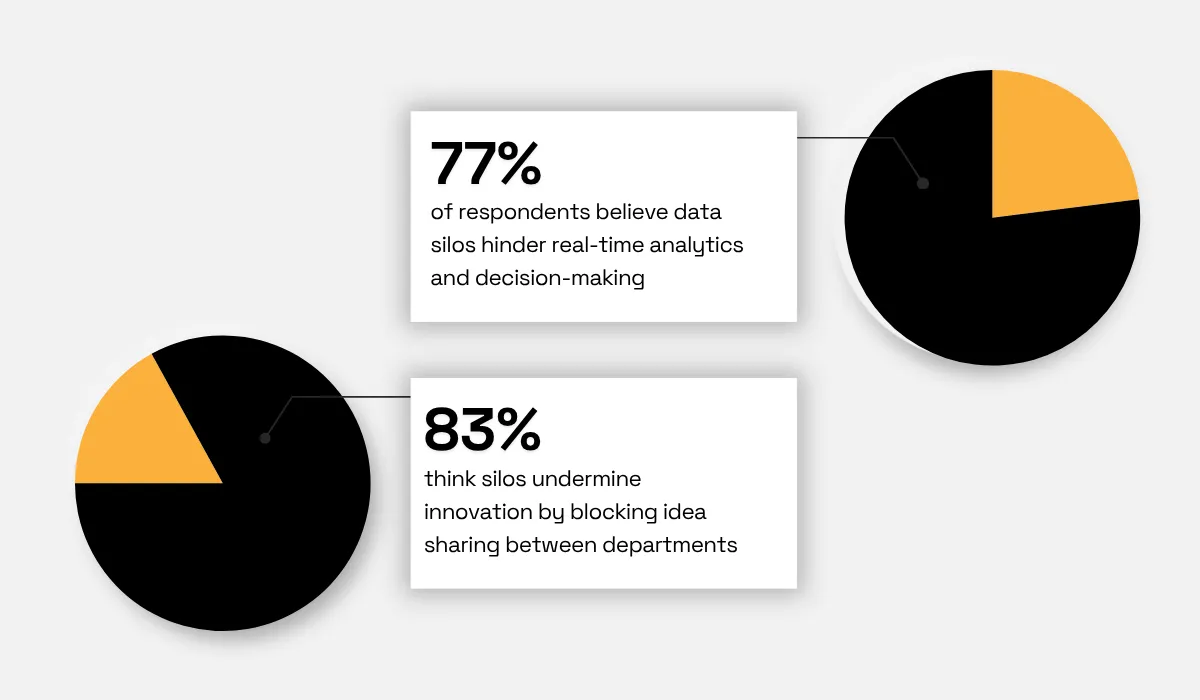
That last point is worth hammering. Fragmented company records are one of the more expensive versions of that problem, because they touch billing, risk, and reporting all at once.
Recognizing and Extracting Company Entities
But gathering the raw content doesn’t instantly render it usable. You still have to provide structure – a crawled web page is just text and HTML, not a company record-worthy piece of workable data.
This is where Veridion’s extraction models come in.
The same raw content is processed after aggregation to extract and enrich business-critical data, including company names, primary and secondary locations, and other business identifiers.
What comes out the other end is a structured record with all the necessary information, tagged and normalized, so it can actually be compared against other records.
Before this step, you have a pile of documents. After it, you have clean, precious data.
Getting to that stage has caused many headaches in the past. A comparative study of multilingual entity-extraction tools found that identifying organizations was consistently the hardest category to get right, harder than extracting people’s names, across every tool and language tested.
Unlike people's names, company names don’t typically follow the exact same patterns across all the registries they appear.
Even though it seems like a minor issue, legal suffixes, abbreviations, transliterations, and branding decisions that vary by country and by era add lots of bumps on your road to reaching a ‘one record per company’ structure.
Take a mid-sized German manufacturer with a Polish sales office and a Japanese distribution partner.
Its legal filing reads “Musterfirma GmbH.” Its Polish subsidiary: “Musterfirma Sp. z o.o.” Its Japanese partner refers to it by a name, in a mix of kanji and romanized script, that shares no characters with either.
Read as raw text, that’s three unrelated businesses. Normalized past suffixes, scripts, and transliteration, it’s one company wearing three faces.
A 2025 study in the Journal of Financial Economics put real numbers on this.
Researchers building a global company-description dataset found that AI language models processing Chinese text initially captured only 10% of Chinese firms, showing a direct casualty of the model struggling with non-Latin scripts. Coverage for Japan and South Korea suffered the same way.
Even after supplementing with full commercial data, researchers found lasting underrepresentation in many markets.
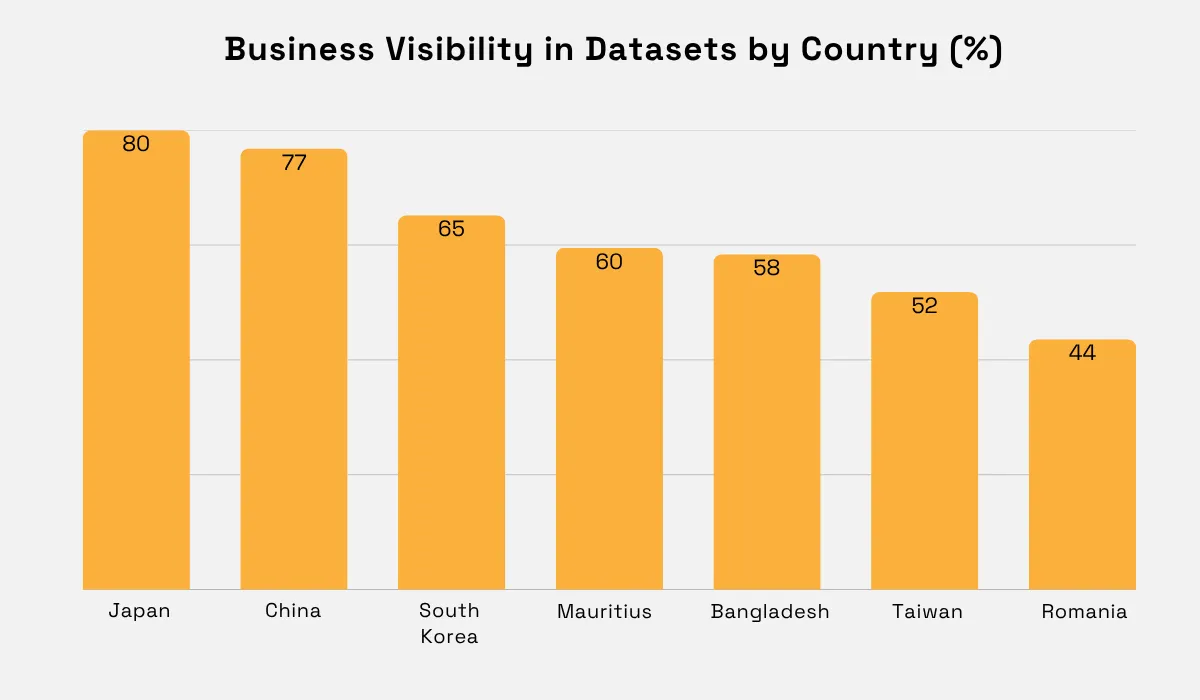
Illustration: Veridion / Source: Journal of Financial Economics
The damage from weak language handling doesn’t fully undo itself downstream.
Crucially for multinational conglomerates, Veridion’s process runs across languages and writing systems, so a filing in Mandarin or Cyrillic gets parsed the same way as a filing in English.
Get this step wrong, and it’s not just noise. It caps how much of the world you can actually see.
Matching Records Through Graph-Based Disambiguation
Removing ambiguity encoded in language itself is a large step forward, but it’s not the end of the road yet. Extracted records still need to be connected. Here’s where resolution takes an even more coherent shape.
The simplest approach to disambiguating your records is through fuzzy matching. You compare names and addresses for similarity and establish matches above a set percentage-based threshold.
While it works for straightforward cases, it can break down fast once companies get complicated, which, as you should probably know by now, is likely to happen sooner rather than later.
Veridion’s tools instead operate in a slightly more sophisticated manner.
We construct a graph, and on it, each real-world company is represented by a single node. Each node, in turn, connects out to its aliases, subsidiaries, parent companies, locations, and domains.
The system also evaluates relationships between entities with a confidence-weighted model to judge on more concrete data than just name and address alone.
With this graph structure, you gain enough insight to disentangle the hardest cases much more easily.
One extra usability benefit is easy visual identification. You don’t need to pore over endless text-heavy tables to confirm two entities have nothing to do with each other. Here, two companies with nearly identical names stay separate – their nodes disconnected – because nothing else in the graph links them.
Conversely, it’s also simpler to identify seemingly unrelated entities. An unsuspecting subsidiary gets connected to its parent because of ownership records uncovered in a separate database, even though normally that link would go undetected.
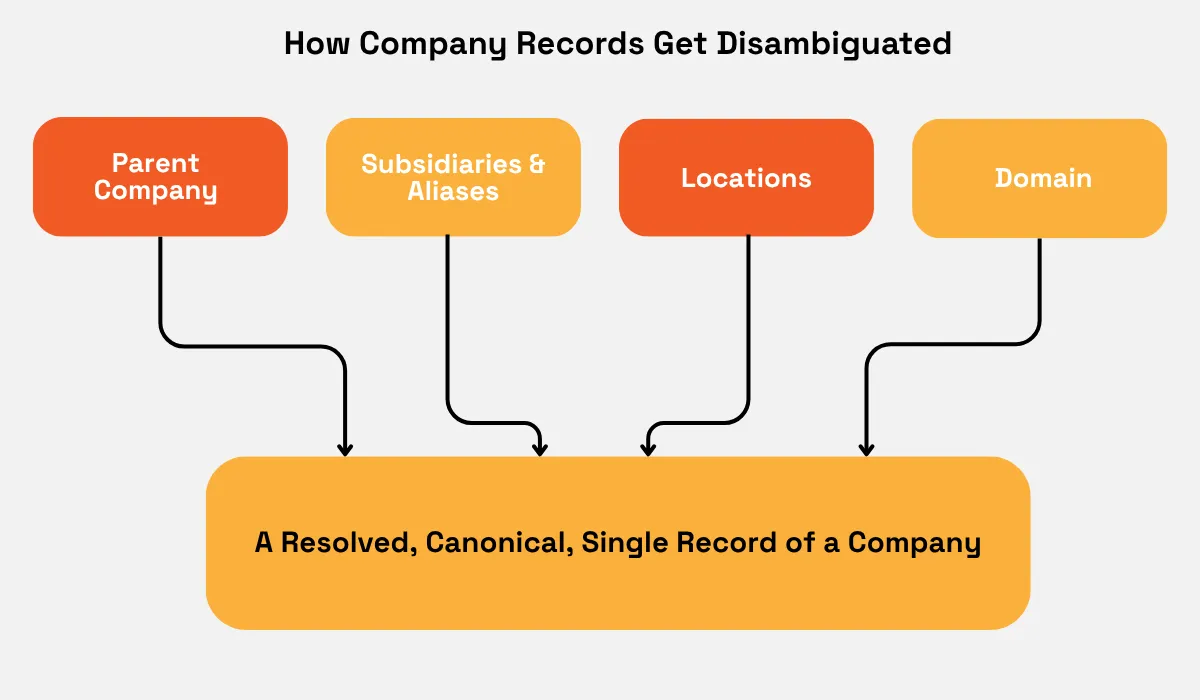
Source: Veridion
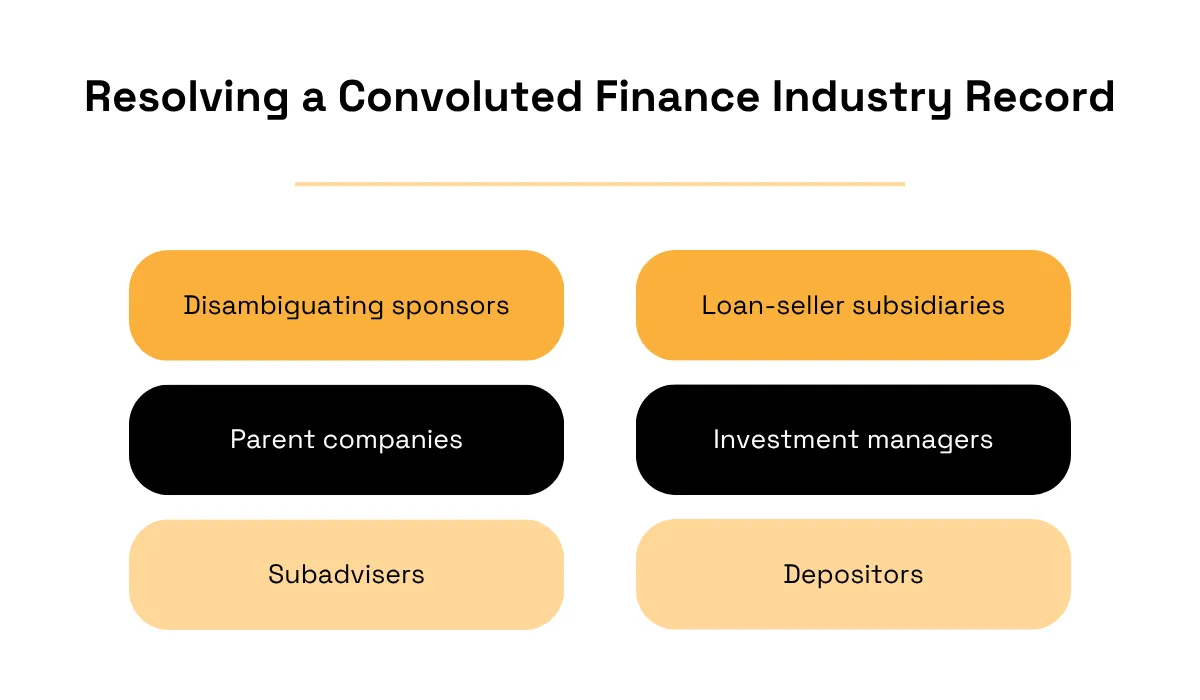
For a real-world application, let’s take a look at the securitization industry.
A structured-finance rating agency came to Veridion with a list of names to resolve. The problem?
Many of those names weren’t companies at all.
They were securitization trusts, special-purpose vehicles, and the deals themselves. Legal shells created to hold assets, deliberately walled off from the institutions that built them.
Standard company matching had nothing to grab onto, since each deal name pointed to an entity with no employees, no website, and no operating history.
Veridion resolved each instrument against its knowledge graph to the network of real entities behind it.
Source: Veridion
Every one of those mappings was checked against SEC filings and rating-agency reports before it was accepted, which matters as much as the resolution itself to ensure veracity.
A graph that connects entities confidently but can’t show its reasoning is asking you to take it on faith. One that documents why each connection was made is something an analyst can actually audit.
Filtering Unreliable Data
Not every source on the web is worth trusting. Some sites are spam. Some are abandoned or outdated.
This leaves you with the task of figuring out whether it’s something you can incorporate into your process. If it isn’t but you don’t have that awareness, you could be causing even more unintentional harm (and piling on more work for the future).
Here, Veridion acts as a digital data bouncer. Before any questionable data makes it into your records, it first gets filtered and verified.
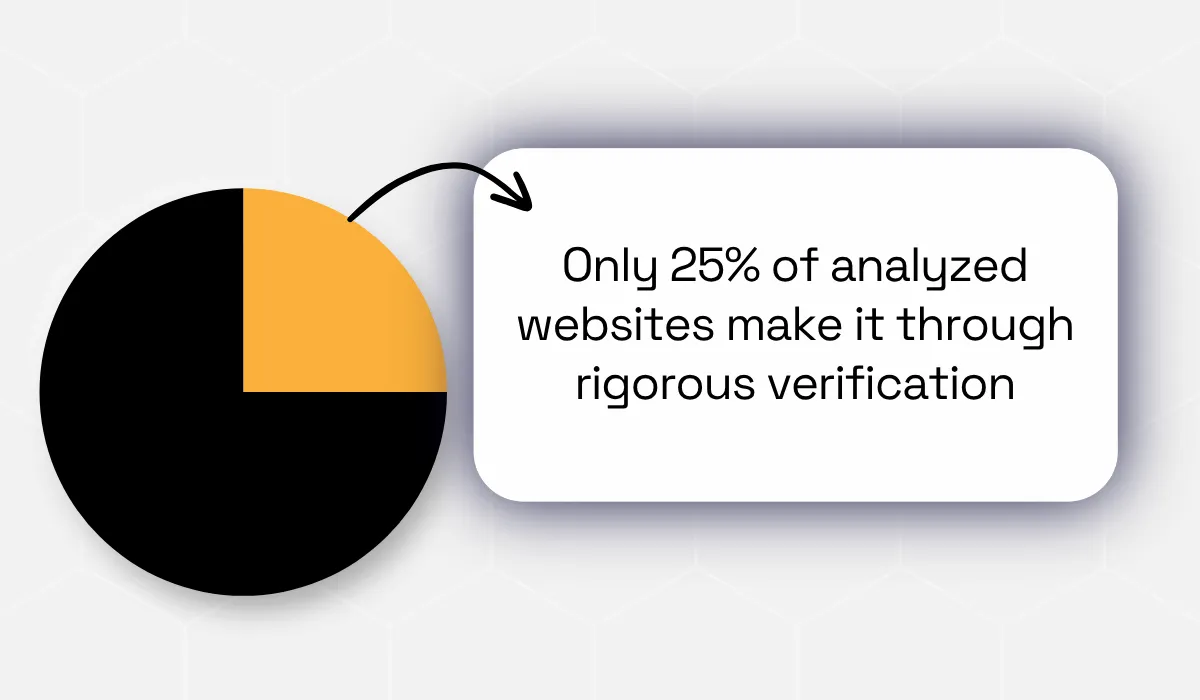
The system analyzes hundreds of millions of websites and retains the verified entities, discarding spam sites and “ghosts” before they ever reach the graph.
In reality, out of roughly 400 million sites analyzed, only about 100 million are verified and kept. That’s a rejection rate of roughly three out of every four.
Source: Veridion
It’s important to note here that this filtering step happens before matching, not after.
Merging good records with junk ones would achieve the exact opposite of what’s needed. Instead of a cleaner dataset, it would just launder the junk into something that only looks trustworthy.
To further highlight how important this step is, let’s look at the cost of neglecting data quality. Research cited by Neo4j puts the average cost of poor data quality at $12.9 million a year for the organizations carrying it.
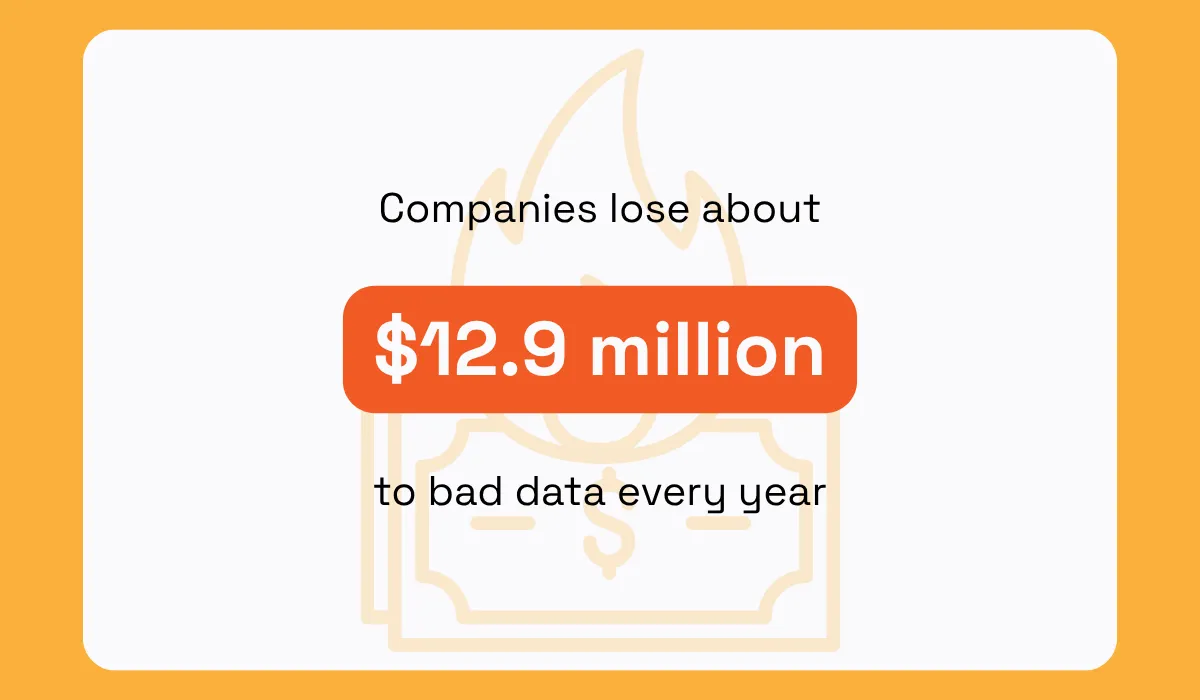
That cost isn’t easy to pin down and eliminate directly, either. It’s usually spread across missed fraud signals, incomplete customer views, and compliance exposure from records that were never properly verified in the first place, which is the exact opposite of the clean foundation data enrichment depends on.
So—filter, filter, and filter. Early and often. That’s the only way to prevent this problem (and the creep of its appended costs) from spiraling out of control and biting you later on.
Continuous Updates Instead of Static Matching
A resolved record is only accurate for as long as the company itself stays still. Which is an unlikely scenario, to say the least.
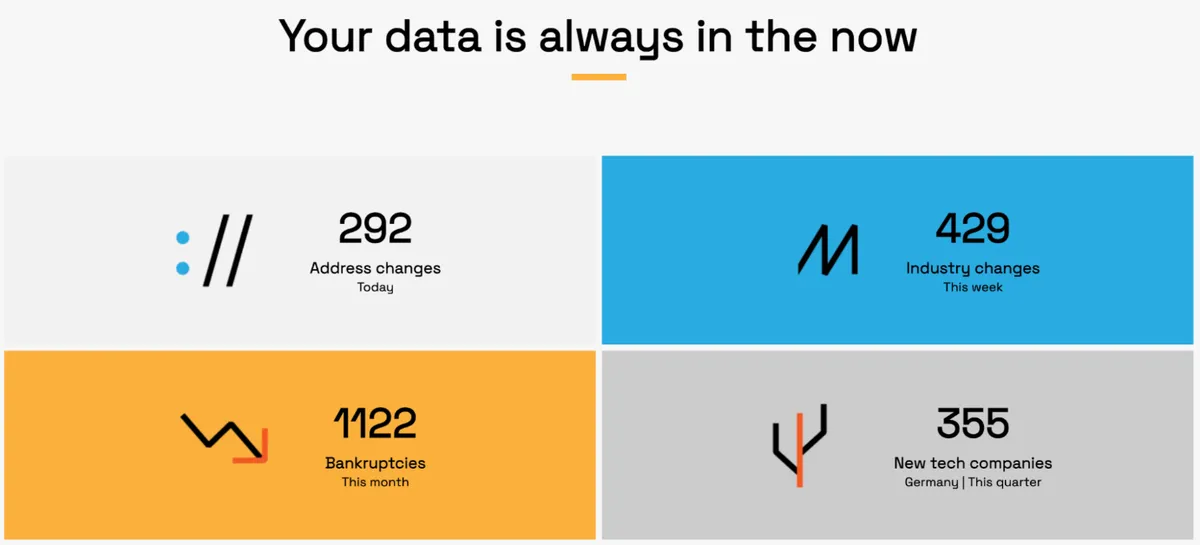
Offices get moved, ownership changes hands, mergers, rebranding, bankruptcies and dissolutions – a match that was 100% correct last quarter can be wrong today, and nothing about the record itself will tell you that.
This is why entity resolution should be seen as an ongoing process. Veridion does exactly that.
Source: Veridion
We continuously refresh core company profiles and flag volatile signals daily. On top of that, when a node on the graph goes through enough significant changes, the record goes through the disambiguation process once again, so that your systems never operate on obsolete data.
This doesn’t happen automatically anytime a change simply occurs and gets picked up. Before they get greenlit and enter your live record, attributes need to arrive with sufficient supporting evidence and a clear set of filters. Otherwise, you’d end up right where you started – with a ton of faulty, unverified data, swayed by a constant barrage of dubious signals.
Our tool also works on a hierarchy. When sources disagree, it escalates conflicting information to a higher-order model and weighs recency, authority, and the full evidence trail before settling on a value.
Think about what this replaces in practice; how many gaps it closes:
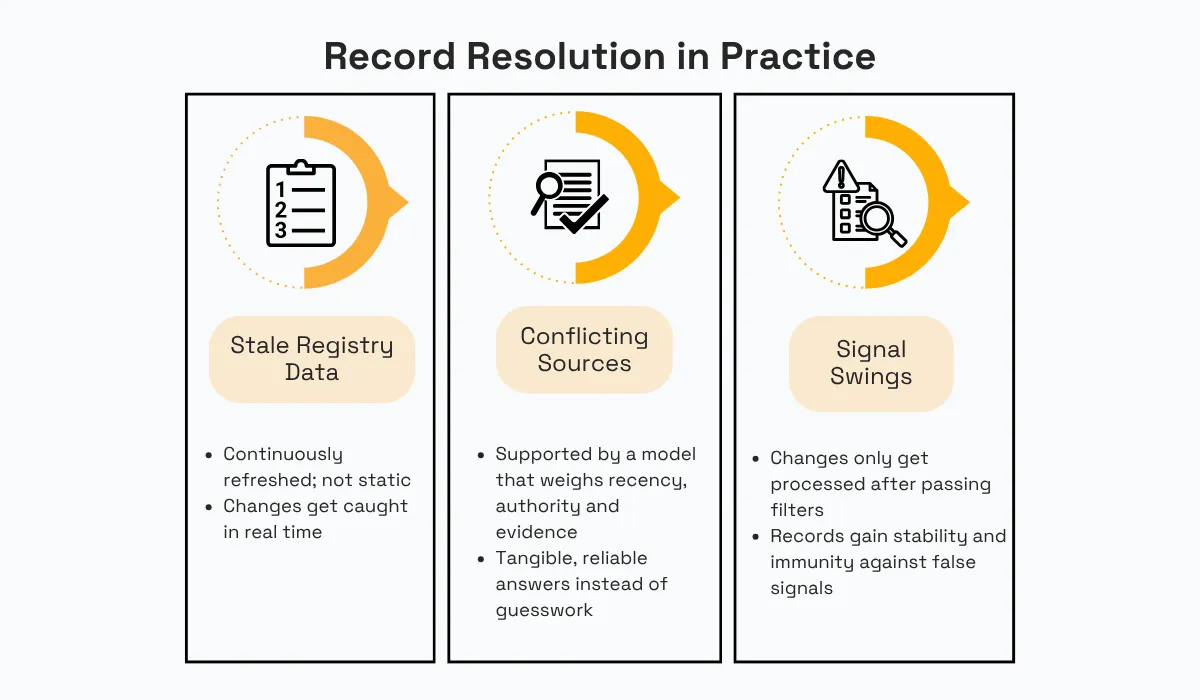
Source: Veridion
The end result is a company graph that gets more accurate with age instead of less. And our entity resolution tool is over 99% accurate on first pass.
Typically, static datasets start decaying the moment they’re published. Ours is built to do the opposite, which is a meaningfully different assurance, affording you more safety when making business-critical decisions.
Conclusion
Changes to company data used to mean five different records, five gaps in your own systems, and a decision made on whichever version happened to be in front of you. Not anymore.
Entity resolution helps close this loop.
Through collection, extraction, graph-based matching, filtering, and continuous refresh, you can consolidate each record to a consistent source of truth, no matter how many names or years separate its various appearances.
Articles
Discuss how these trends affect your organization.
Our analysts are available for a short call. Bring a specific question and we will ground it in the data.
Insights
Keep reading
More analysis, research, and outcomes grounded in live company intelligence.
Verifying if a Business is Still Active (Without Calling Them)
Tired of chasing down businesses that might be inactive? Learn how to track company status and verify active vs inactive businesses.
6 Data Enrichment Tools You Need to Know About
Explore six standout tools that transform data enrichment capabilities and can help guide your decision-making and go-to-market strategy.
The Hidden Cost of Stale Supplier Intelligence
Are you missing crucial signals to identify emerging market risks? Stale supplier intelligence can cost you dearly. Uncover the hidden dangers.