Insights / Articles
AI Deal Sourcing Fails Without Entity Resolution: A Practical PE Workflow
A target listed three times, another with its parent's headcount: AI deal sourcing ranks it all. A PE workflow that resolves records before the model does.

- AI sourcing ranks whatever records it gets, errors included.
- 59% of M&A leaders say AI outputs need significant manual validation.
- Entity resolution helps prevent duplicate and mismatched records from distorting AI rankings.
- Resolving records before enrichment helps keep attributes attached to the correct company.
- Removing duplicate entities shrank one knowledge graph by about 40% and improved AI answers in most tests.
Duplicate records and mismatched company data can distort AI deal sourcing rankings. The same target may appear several times, while another is scored using someone else’s revenue.
Entity resolution links those records to the correct companies before ranking. Veridion matches inputs such as names, domains, and identifiers to a single company profile.
The following six-step workflow shows where to resolve records, add company data, and review uncertain matches.
Why Does AI Deal Sourcing Fail Without Entity Resolution?
In Deloitte’s 2026 survey of 500 US private equity and corporate M&A leaders, 74% of AI users said they use or pilot it for portfolio strategy and target screening.
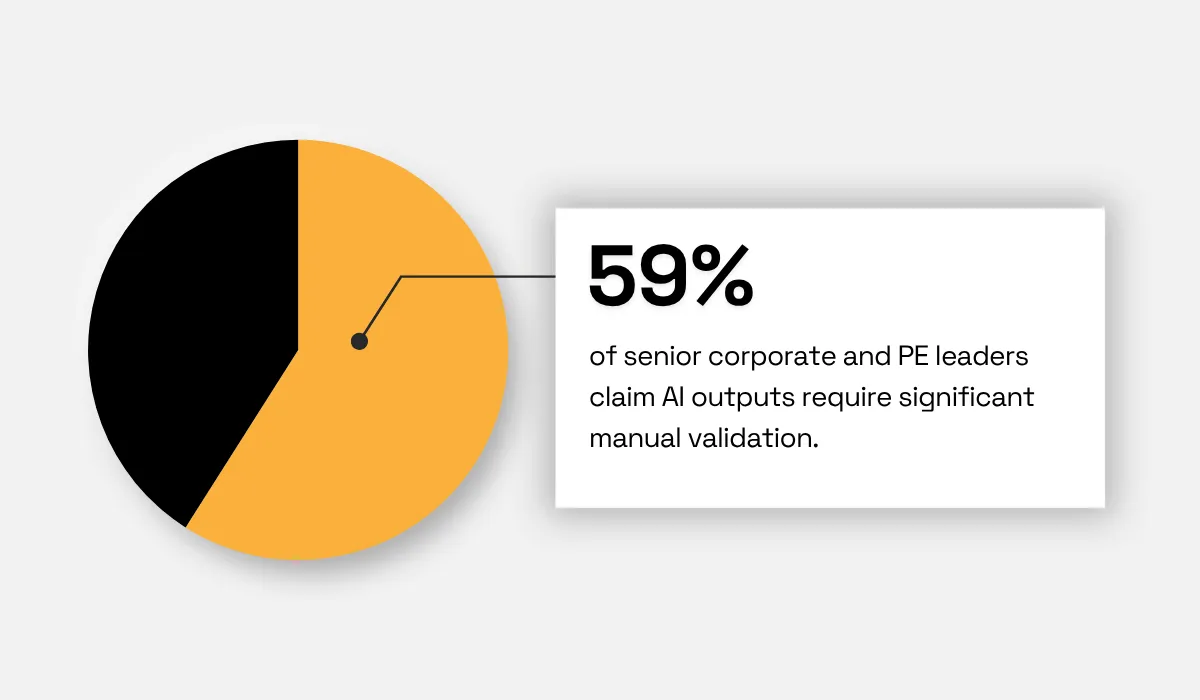
The output doesn’t always hold up, though: 59% of respondents said AI outputs require significant manual validation, the most common tool challenge in the study.
When a shortlist comes back wrong, the model usually takes the blame, but the problem is often in the records it was given.
An AI tool treats every record as true, so data errors go straight into the ranking, usually in one of five forms:
- Duplicates in the target universe. “Corvane Dental Partners” (CRM), “Corvane Dental” (database export), and corvanedental.com (news mention) get scored as three companies.
- Facts attached to the wrong company. Halvorsen Logistics in Ohio and Halvorsen Logistics in Ontario keep separate records, but news of the Ontario firm’s new contract lands on the Ohio profile.
- A subsidiary and its parent mixed up. A 60-person regional HVAC contractor’s record carries its parent group’s 2,000 employees, so the AI screens it out as too large.
- A false merge. Apex Controls Inc. (automation, Texas) and Apex Controls Ltd (security, UK) collapse into a single record, with one company’s headcount and the other’s product lines.
- A summary based on the wrong company. The AI describes a target’s growth using news about a similarly named business, without making the mismatch apparent.
Of the five, the false merge tends to do the most damage. Every later step, from enrichment to ranking, then uses a record that combines two different companies.
Academic research also shows the impact of duplicates. In a 2025 preprint, researchers from Nanyang Technological University, Nanjing University, and Mila studied AI systems that answer questions from knowledge graphs (networks of linked entities) built by LLMs from general text. Merging duplicate entities cut about 40% of the entities in each graph and improved answers in most of their tests across four systems.
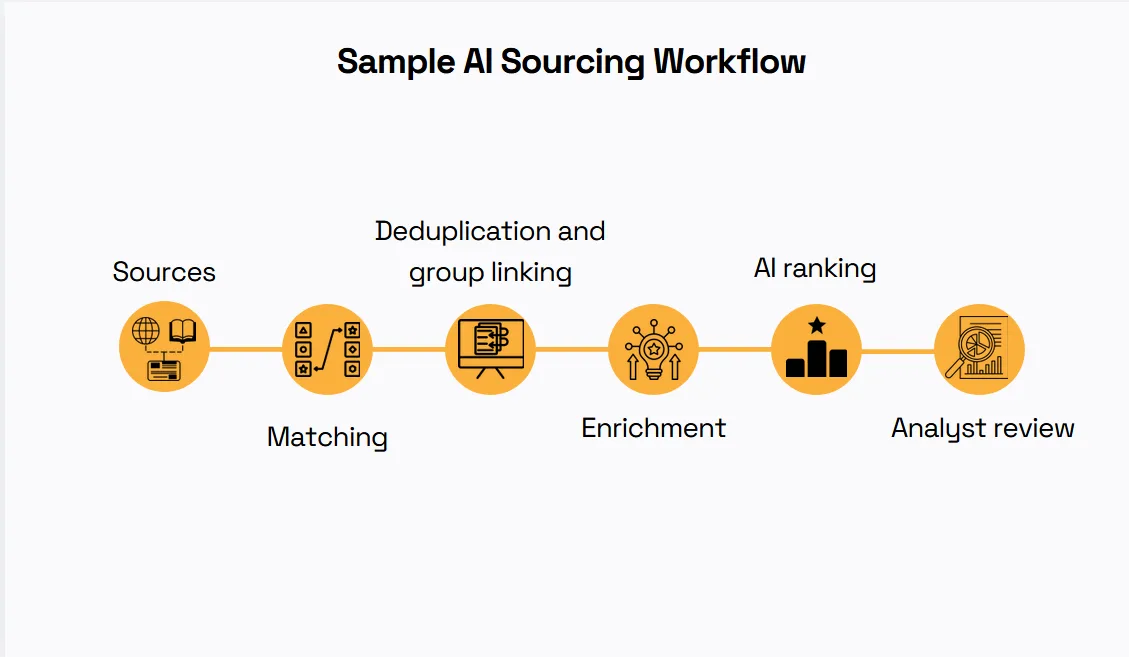
Our work in market intelligence illustrates why records need to be resolved before ranking. The workflow below places matching, deduplication, and enrichment before AI screening.
Source: Veridion
Start by preserving the original inputs from each source.
How to Build an AI Deal Sourcing Workflow on Resolved Records
The first four steps prepare company records for AI screening. The final two cover how to use those records and feed review findings back into the matching process.
1. Collect Inputs from Every Source Before the AI Sees Them
A sourcing process takes in company data from many directions at once. As EQT’s Sven Törnkvist and Petter Weiderholm write, AI in sourcing can draw on structured data (financial reports, payroll) as well as unstructured data such as news and emails.
These sources provide different types of company information:
- Database and CRM records give you names, often shortened or outdated (e.g., “Corvane Dental”).
- Identifiers such as domains, addresses, and registration numbers come in different formats, and many records carry only one or two of them.
- Introductions and teasers may use a code name (“Project Molar”) until the real company is revealed.
- News mentions name companies in free text, usually by brand.
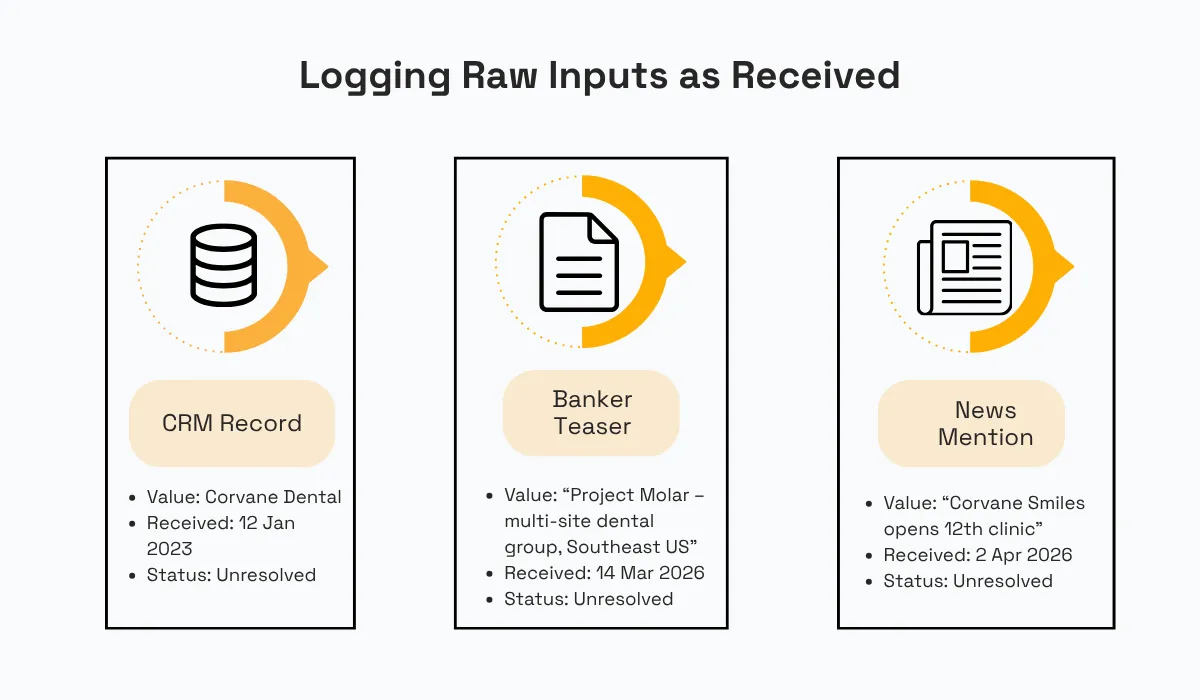
Keep each input exactly as received, along with its source and date. Cleaning or overwriting the original too early can remove details needed to distinguish companies in Step 2.
For example, a 2023 CRM entry and last week’s news item might describe the same company before and after a rename (or an acquisition).
Source: Veridion
Preserving the originals lets you rerun an incorrect match in Step 2 and trace the sources behind AI-generated claims in Step 5.
2. Resolve Each Input to One Company Record
Match each raw input to a single company record. Registration numbers are strong matching signals because no two companies in the same registry share one. Legal name, domain, address, and location come next.
A name on its own is the weakest signal, since it can be shared, abbreviated, or hidden behind a code name.
LEI coverage is limited, however. GLEIF counted just over 3.1 million active Legal Entity Identifiers (LEIs) in mid-2026, a small slice of the private companies that deal teams screen.
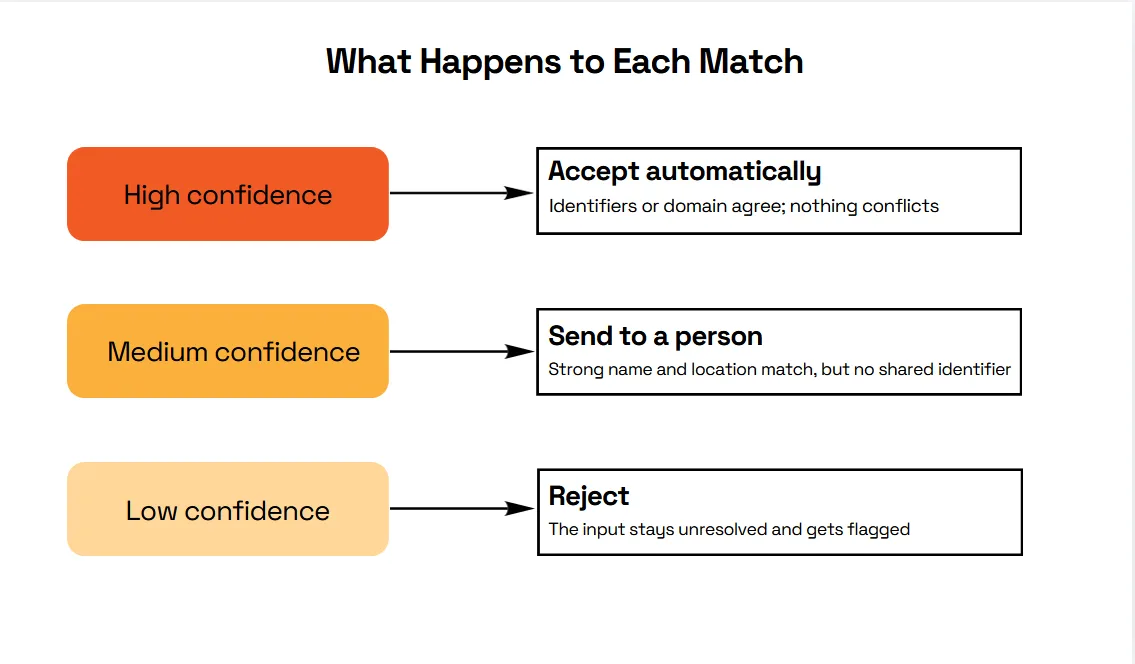
Our guide to AI-powered B2B data matching covers the mechanics. For a sourcing workflow, what matters is the confidence score on each match, which sorts it into one of three lanes:
Source: Veridion
There’s no universal cutoff for these lanes, as our explainer on match scores notes. In sourcing, a false merge costs more than a missed match. When in doubt, review.
For each match, record which signals agreed or conflicted and which rule determined the outcome. Reviewers will need this evidence to check the match and investigate later ranking errors.
Resolving records also doesn’t mean merging everything that looks alike. A missed match costs you one duplicate, but a false merge creates a company that doesn’t exist, and every step after it inherits the error.
Veridion’s entity resolution matches fragmented names, domains, and identifiers to the correct company among 744.5M companies. It produces a deduplicated, enriched profile that PE teams can use for AI-assisted screening and ranking.
Matches still need checking, though, as one recent project in structured finance shows. A global structured-finance rating agency asked us to resolve three securitizations.
These deals aren’t operating companies. Each one is a legal shell, a trust or special-purpose vehicle, and the companies that actually set it up and run it sit behind it.
We matched each deal against our company graph, resolved it to the operating entities behind it, and classified each one by role. Each deal had about 13 role types behind it, from sponsor and originator to depositor and loan-seller, and each resolved entity was enriched with 62 firmographic attributes. For every deal, we also flagged the one public company whose disclosures the agency would pull data from, typically the listed parent, since the SPV itself discloses nothing.
Every mapping came with a written justification, checked against SEC filings and rating-agency reports. That check corrected cases where an unchecked assumption would have named the wrong entity.
For acquisition targets, the same principle applies: verify the company match before using its attributes to screen or rank the target.
3. Link Each Record to Its Corporate Group
Once every input points to one company, the duplicates disappear. The three Corvane inputs mentioned earlier collapse into one canonical record.
Deduplication gives you a more reliable target count. A list of 400 names might represent only 340 distinct companies.
Next, link each canonical record to its parent and wider group, wherever that’s known.
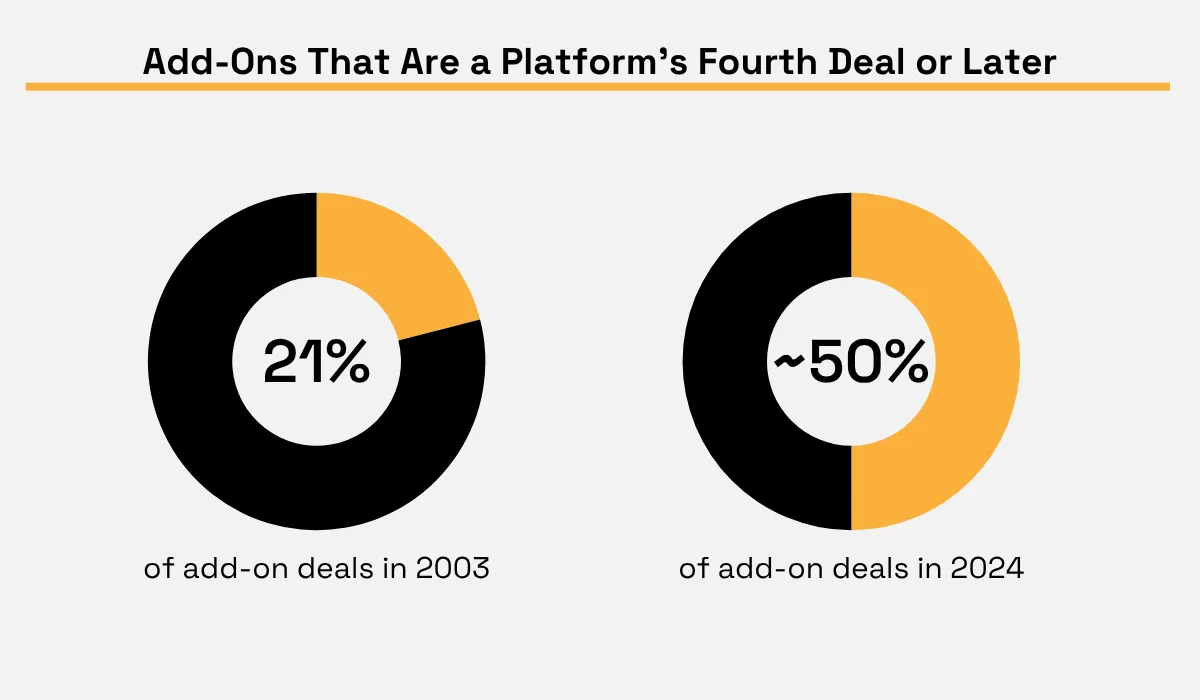
For PE teams, that link matters more every year. According to Bain’s 2024 Global Private Equity Report, close to 50% of add-on deals were at least a platform’s fourth acquisition, up from 21% in 2003.
Source: Veridion / Data: Bain & Company
Many names on a target list, in other words, already belong to someone else’s platform.
With the hierarchy in place, you can flag each group member and decide how to treat it:
- Owned by a strategic acquirer. Usually removed from the universe.
- Owned by another sponsor. Kept, but tracked separately from independent targets.
- Sister companies under one parent. Treated as one opportunity, not several.
The HVAC contractor can now be screened using its own 60 employees, with its parent relationship recorded separately.
Our corporate groups data, available under an enterprise contract, shows where a company sits in its group, from ultimate parent to majority-owned subsidiaries, and keeps investment funds separate from their portfolio companies.
4. Enrich the Resolved Record
Enrichment adds the company attributes needed to test your investment thesis. Resolve the records first so those attributes are attached to the correct company.
If you enrich a raw list, every duplicate gets its own set of attributes. The three Corvane inputs might come back with three different employee counts, and the AI has no way of telling which one to trust.
A false merge also causes enrichment data from different companies to accumulate in the same record.
As our guide to data enrichment best practices puts it, data enrichment adds to a record but can’t fix it.
For most sourcing theses, focus on four groups of attributes:
- Activity: products, services, and end markets.
- Size: employees, revenue, and number of sites.
- Location: headquarters and operating footprint.
- Ownership and group structure: carried over from Step 3.
Label each value as observed (taken straight from a source, such as a registry filing or the company’s website) or estimated (modeled, as a private company’s revenue often is). Store its source and date alongside.
LLM answers can also omit information relevant to investment decisions. When McKinsey’s Private Capital Practice compared LLM answers with expert interviews across more than 100 queries, about 40% of the important data points the experts raised were missing from the LLM answers.
Once estimates are marked, both the AI and the analyst reading its output can weigh them accordingly.
For Corvane, the enriched record might look like this:
Attribute | Value | Type | Source | Date |
|---|---|---|---|---|
Activity | Multi-site general dentistry | Observed | Company website | Apr 2026 |
Locations | 12 clinics, GA and SC | Observed | Website, news | Apr 2026 |
Employees | ~240 | Estimated | Modeled from web signals | Mar 2026 |
Revenue | $35M to $45M | Estimated | Modeled | Mar 2026 |
Ownership | Founder-owned, no parent found | Observed | Registry filings | Feb 2026 |
With every value labeled and sourced, the record is ready for the AI to read.
5. Feed the AI Only Resolved Records
Use the resolved and enriched records for AI screening and ranking.
General partners (GPs) already identify sourcing as a valuable use of generative AI. In a Bain & Company and StepStone survey of 103 GP investment and investor relations professionals, 33% named deal sourcing and market mapping as their highest-ROI use of generative AI, behind only due diligence (40%).
Instead of piecing a company together from free text, the AI reads one company ID and its structured fields, which makes the output traceable.
So ask the tool to cite as it goes. A claim like “12 clinics across Georgia and South Carolina” should point back to the exact field it came from, and to that field’s source.
The AI’s job then has clear limits:
- Use AI to screen companies against the investment thesis.
- Base rankings on fields the tool can cite.
- Have AI draft summaries for analyst review.
- Keep investment decisions with the deal team.
- Require the tool to flag missing data rather than fill gaps without disclosure.
Andre Retterath, general partner at Earlybird Venture Capital, describes this division of responsibilities. He built the first version of the firm’s in-house sourcing platform:
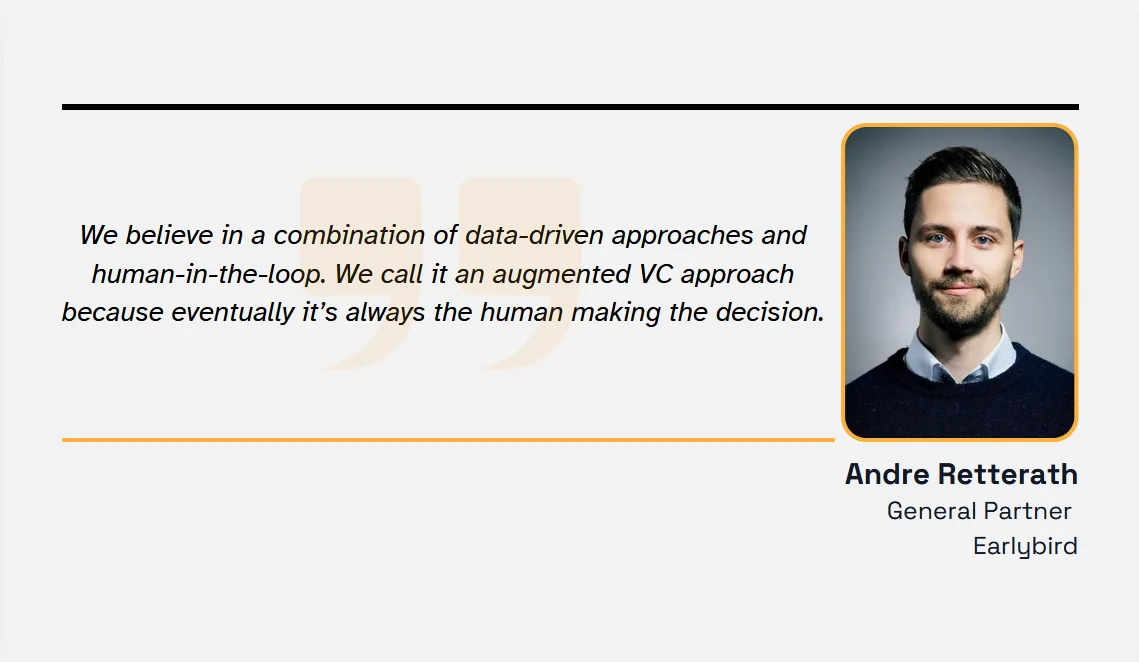
Illustration: Veridion / Quote: DataFramed
Consider how the same investment thesis could rank a raw list and a resolved list. On the raw list, Corvane might occupy three of the top 20 slots. The HVAC contractor could be excluded because of its parent’s headcount, while Apex could rank for products sold by a different company. Resolving these records helps prevent those ranking errors.
Even on clean records, AI stops being useful before due diligence. It can’t judge a management team or validate financials, so that’s where the shortlist passes to people.
6. Review Exceptions to Improve Match Quality
Two kinds of exceptions end up in review: the medium-confidence matches from Step 2, and odd rankings, such as a company the team knows well dropping off the list.
Assign these cases to an analyst or associate with sector knowledge who can check whether “Corvane Smiles” refers to Corvane Dental Partners.
Each decision should then feed back into the matching rules so the same mistake doesn’t keep coming back. If reviewers keep confirming matches where domain and address agree, move that pattern into the auto-accept lane.
To measure progress, keep a reference set of 30 to 50 companies your team has already resolved by hand, and run it through the same workflow the AI uses.
On that set (and on a fresh random sample, repeated each cycle), track four numbers:
- Duplicates that survived
- False merges (two companies in one record)
- Missed matches (one company split across records)
- Group members shown as independent
Track false merges and missed matches separately, because rules that reduce one type of error can increase the other.
To illustrate, here’s what three months of tracking might look like on a 40-company reference set:
Metric | Jan | Feb | Mar |
|---|---|---|---|
Duplicates that survived | 6 | 4 | 2 |
False merges | 3 | 2 | 1 |
Missed matches | 4 | 5 | 5 |
Group members shown as independent | 4 | 3 | 2 |
In this example, tighter rules cut false merges from three to one, while missed matches crept up by one.
EQT’s Motherbrain team made a similar trade-off. Armin Catovic, now Director of Data and AI at Funnel, told Hyperight in 2023 that the team first focused on catching every relevant company, then shifted toward making sure what it caught was right.
Finally, give the queue a named owner, usually a data or operations lead working alongside the deal team. Review it weekly and rerun the reference set monthly or after any rule change.
Conclusion
Resolving company records before AI screening helps prevent duplicate and mismatched data from distorting your shortlist.
To check your workflow, pick ten familiar companies from your AI tool’s latest target list.
Look for duplicates, incorrect matches, and group members listed as independent. Use the findings to identify which matching or ownership checks need attention.
Articles
Discuss how these trends affect your organization.
Our analysts are available for a short call. Bring a specific question and we will ground it in the data.
Insights
Keep reading
More analysis, research, and outcomes grounded in live company intelligence.
Feeding Clean B2B Firmographic Data into LLMs to Prevent AI Hallucinations in Market Intelligence
Tired of AI hallucinations in market intelligence? Learn how feeding clean B2B data into LLMs prevents inaccurate insights.
No Humans in the Loop: How AI-Powered Entity Resolution Automates B2B Data Matching
Tired of manual B2B data matching? See how AI-powered entity resolution drives decision automation, eliminating human error and boosting efficiency.
What is a Match Score? Understanding the Waterfall Methodology in Company Data Enrichment
Tired of inaccurate company data? Understand the data enrichment API match score and fuzzy company name matching with the Waterfall Methodology.