Insights / Articles
What Is Data Leakage in Credit Risk Models?
Leaked future information lets a weak model pass a strong backtest. Spot three types of data leakage in credit risk models and the check you run on each.

- Data leakage makes a credit risk model look more accurate in testing than it can be on new borrowers.
- Target leakage, train/test contamination, and temporal leakage require different checks.
- Use Veridion’s entity and source metadata to support company-data audits.
A strong backtest can hide a weak model.
Data leakage in credit risk models happens when information unavailable at prediction time enters your model development. It ends up inflating test results and undermining performance on new borrowers.
Learn how company status, ownership, headcount, and location data can introduce target leakage, train/test contamination, and temporal leakage, and how to check for each.
What Is Data Leakage in a Credit Risk Model?
Data leakage happens when you build a credit risk model using information you wouldn’t have when making the actual prediction.
That’s how the model gains an unfair advantage during evaluation. So its results overstate how well it can assess your new borrower.
As computer scientists Sayash Kapoor and Arvind Narayanan explain:
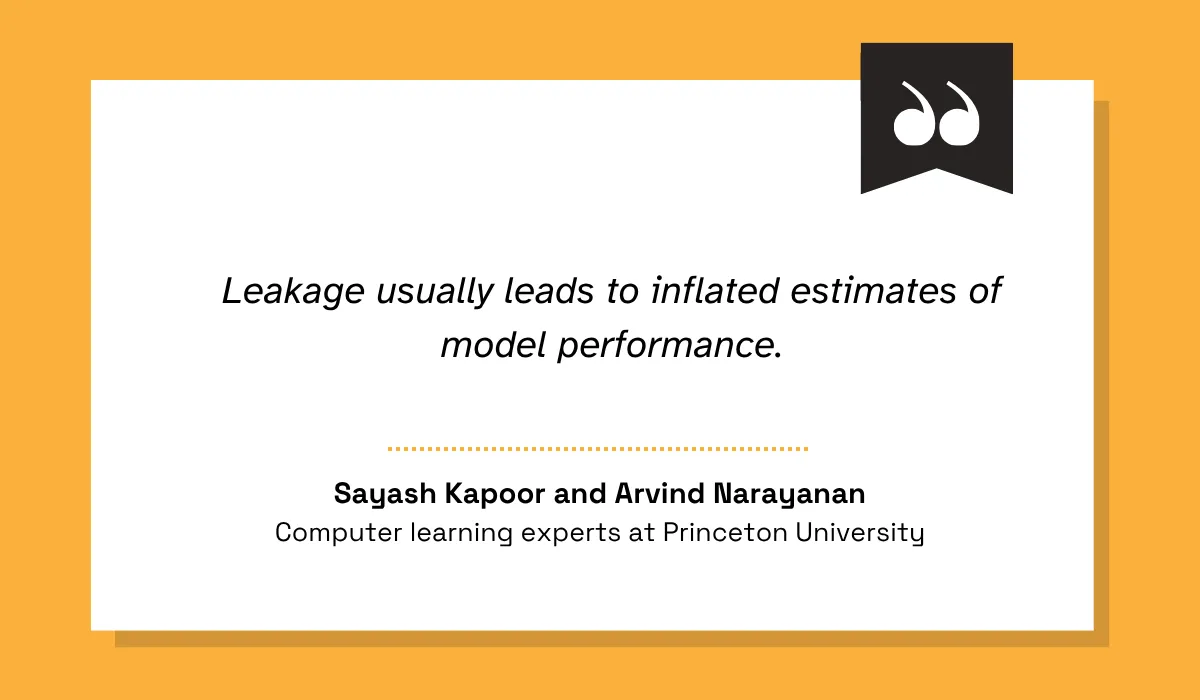
A model can thus pass testing because it relies on information that won’t be available when you actually need to make a lending or rating decision.
So throughout this article, data leakage means a flaw in model development and validation, not an unauthorized exposure of confidential information.
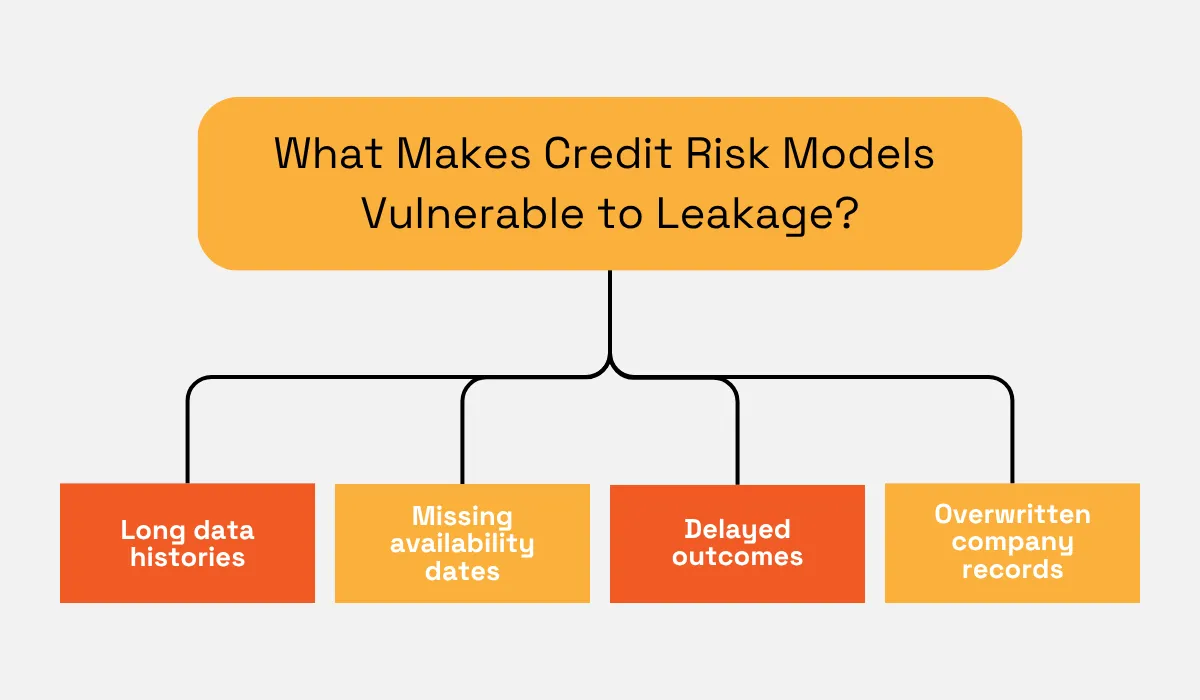
Credit risk modeling creates several opportunities for this problem, as the visual below shows:
Source: Veridion
You may train on years of borrower and company records without a reliable record of when each status, ownership, or headcount value became available.
The outcome also takes time to observe.
For a 12-month default target, a default may be observed before the window ends, while confirming non-default generally requires the full follow-up period. Information learned during that window belongs in the outcome record, not in the original prediction features.
Say you assess a borrower in January. In September, it enters administration. If you later assemble the January training row using its updated status, the model learns what happened after the assessment.
This mistake is even easier to make when a company database replaces old information with the latest updates. You might think you’re showing the model the company’s status when it applied for a loan, but again, you’re only showing it what happened after.
So the key question is: could you have used the value when the prediction was made?
Three Types of Data Leakage in Credit Risk Models
Data leakage is an umbrella term for multiple ways information can enter a model where it doesn’t belong. The three types below can overlap, but each requires a different check and fix.
Target Leakage
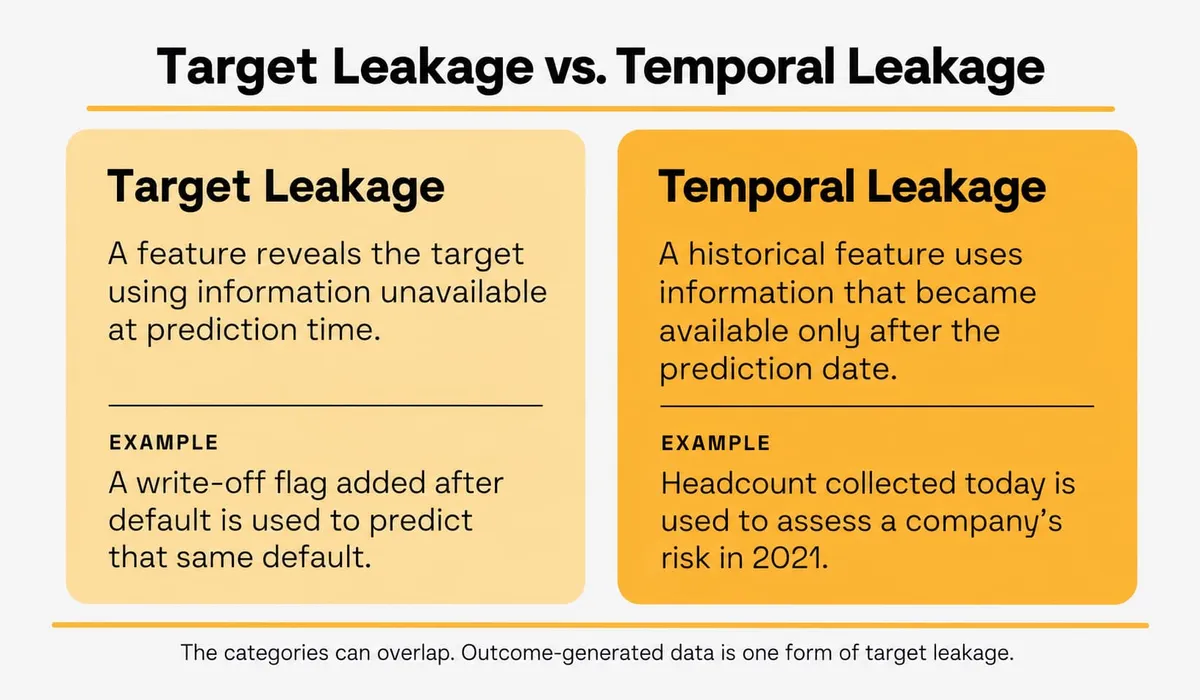
Target leakage occurs when a feature reveals information about the target that would not legitimately be available when making the prediction. One common form is an outcome-generated feature, such as a write-off flag recorded after default.
In a default prediction model, this form of leakage gives the model a consequence of default as though it were an advance warning.
Here’s a simple example: you’re predicting which companies will default within the next year. Your training dataset includes a company-status field updated to “in administration” after the borrower defaulted.
That status may separate defaulting companies from healthy ones very well. But now, the model is recognizing an outcome that already happened, rather than learning how to anticipate it.
Here are some examples of how information recorded after default can slip into your model:
Company-data field | How it leads to target leakage |
|---|---|
Company status: “in administration” | Updated after default, the status tells the model what happened instead of warning it beforehand. |
Company status: “restructuring” | If restructuring resulted from default, the updated status reveals a consequence of the outcome you’re trying to predict. |
Collections or write-off flag | If added because the borrower defaulted, the flag gives the model the answer directly. |
New owner after a distressed sale | If default led to the sale, the new ownership record reveals a consequence of default. |
These fields aren’t automatically leakage. The problem is when you use a value created by default to predict that very default.
IBM illustrates the same mechanism through an outcome-generated feature: a model learns from information that appears only after the event. So the validation results are misleading.
The visual below compares target leakage with temporal leakage:
Source: Veridion
In these examples, target leakage comes from outcome-generated information, while temporal leakage comes from using information unavailable at the prediction date. The categories can overlap.
To catch target leakage, trace suspicious features back to the business process that created them. Check if you’re using evidence of an approaching default or information recorded because it already happened.
Train/Test Contamination
Train/test contamination happens when information from your test set influences model development. This compromises the test’s purpose: checking how well your model performs on data it hasn’t learned from.
Two common routes are preprocessing on the full dataset and unintended borrower overlap. Test information can also influence development when you repeatedly use test results to select features, models, or hyperparameters.
How contamination happens | What that means |
|---|---|
Preprocessing uses the full dataset before the split | Test data influences how you prepare training data. I.e., when scaling headcount, encoding industry, selecting features, or applying SMOTE. |
The same company or group appears in both sets | Different names or IDs hide overlapping borrowers or related companies, so the test may reward familiarity rather than performance on unseen companies or groups. |
Fitting preprocessing steps before splitting the dataset lets test information influence training.
Suppose you standardize company headcount using the mean and standard deviation of every borrower, then split the data into training and test sets. The test borrowers have already influenced that calculation.
You can get the same problem when you use the full dataset to:
- Learn industry encodings
- Select features
- Apply SMOTE oversampling
Scikit-learn recommends splitting first and learning preprocessing transformations only from training data. Then, you apply those fitted transformations to the test set.
The second route is letting the same company appear on both sides under different names or IDs.
For example, the same borrower can appear under its legal name in training and its trading name in testing. If the test is meant to measure performance on unfamiliar companies, aliases of the same borrower must stay in one partition. Monitoring existing borrowers requires a different design: earlier observations may appear in training, with later observations reserved for testing.
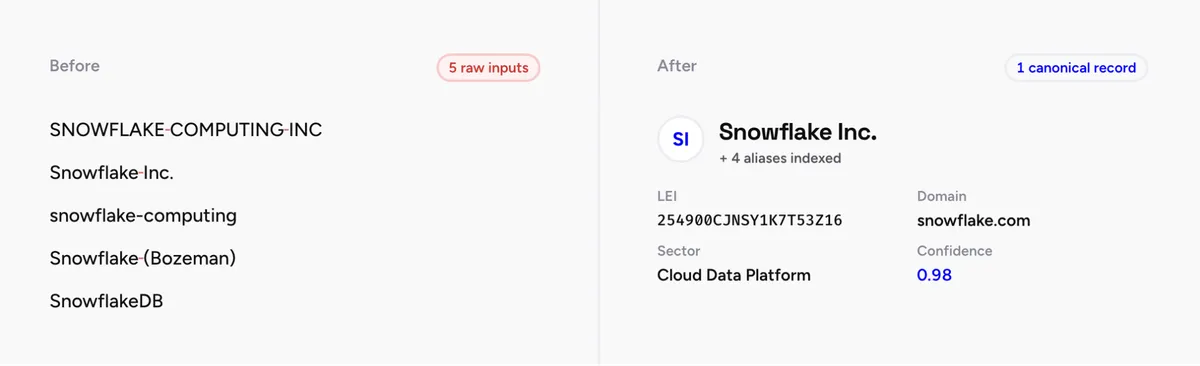
Veridion helps connect company records that refer to the same borrower, as the example below shows.
Source: Veridion
Veridion’s Entity Resolution consolidates company identities into resolved records and links entities to their corporate hierarchy. These identifiers and relationships help you deduplicate borrowers.
Then, you can organize splits by company or group instead of relying on row-level separation.
So you still define and enforce the split. Resolving identities gives you a clearer basis for deciding which records must stay together.
For example, a structured-finance rating agency needed to connect securitization deal names with the companies behind them. Veridion used its company knowledge graph to map the entities and their roles, enrich the records, and verify the mappings against SEC filings and rating-agency reports.
The agency could then identify the operating companies behind each deal and the public company whose disclosures it should use. For leakage checks, this kind of relationship mapping helps identify connected records before you decide which must stay in the same partition.
Your split should reflect the intended use: predictions for unfamiliar borrowers, future assessments of existing borrowers, or both.
Temporal Leakage
Temporal leakage happens when a company feature reflects information that became available after the prediction date. The value may be accurate today, but it’s invalid for a historical prediction.
Suppose you’re testing a credit risk model on borrowers assessed in 2021. Then, you add the current company details shown below:
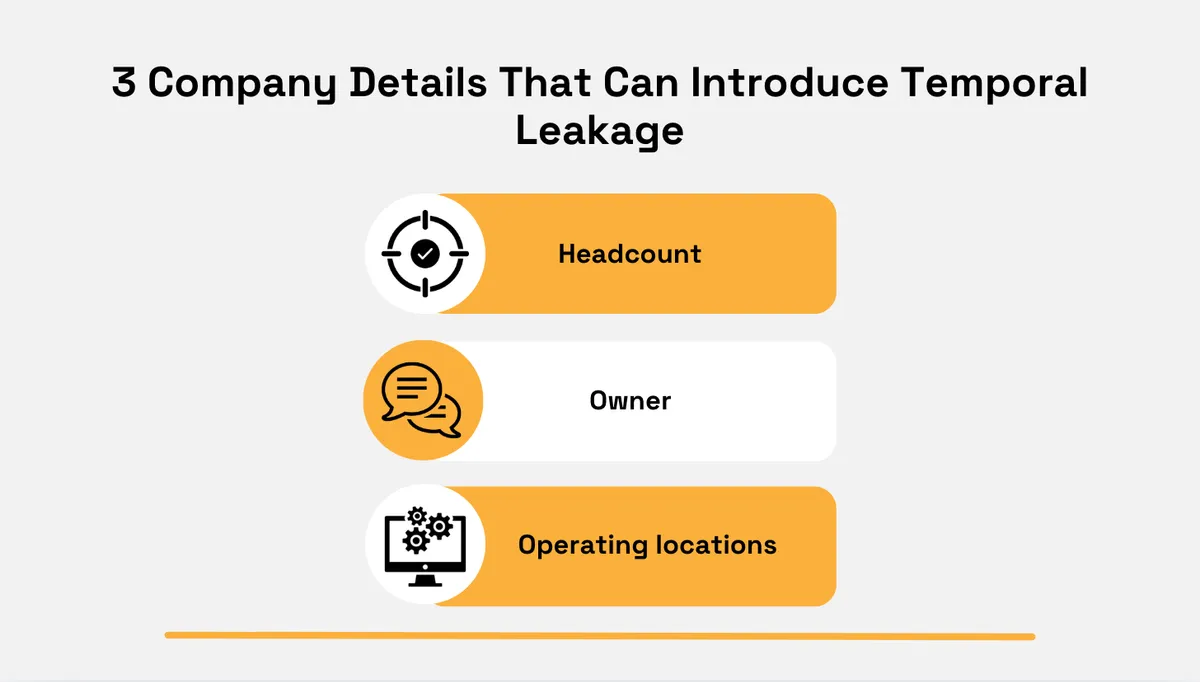
Source: Veridion
These later updates give the model information that was unavailable in 2021, making the backtest misleading.
Unlike the outcome-generated examples above, a temporally leaked feature does not need to result from default. A routine acquisition or expansion can introduce leakage if information about it was unavailable at the historical prediction date.
Check the availability of each value against the date of the prediction it supports. A chronological train/test split cannot correct future information already embedded in historical rows.
How Do You Detect and Prevent Data Leakage in a Credit Risk Model?
There’s no single fix for data leakage, because you need to check what each feature reveals and when information became available.
Leakage can remain hidden in an apparently strong backtest unless you audit feature construction, data availability, and evaluation boundaries.
In a 2026 preprint on an equity-trading benchmark, Zhang and colleagues found that certain uses of unavailable information inflated performance despite keeping the chronological evaluation split unchanged.
In a credit modeling context, training on earlier borrowers and testing on later ones won’t help if both sets contain company attributes that were unavailable at their respective prediction dates.
Audit Features for Suspicious Strength and Timing
Start with features that appear unusually good at separating defaulting companies from other borrowers. A company-status field that almost perfectly identifies defaults is suspicious enough for an investigation.
Then, check feature importance.
If ownership or status dominates the model, trace the underlying values to see if they capture a genuine warning (or a consequence of the outcome).
Strong predictive power doesn’t always mean leakage. Treat it as a reason to examine the feature’s origin, business meaning, and availability.
The image below shows three questions you can ask about every feature:
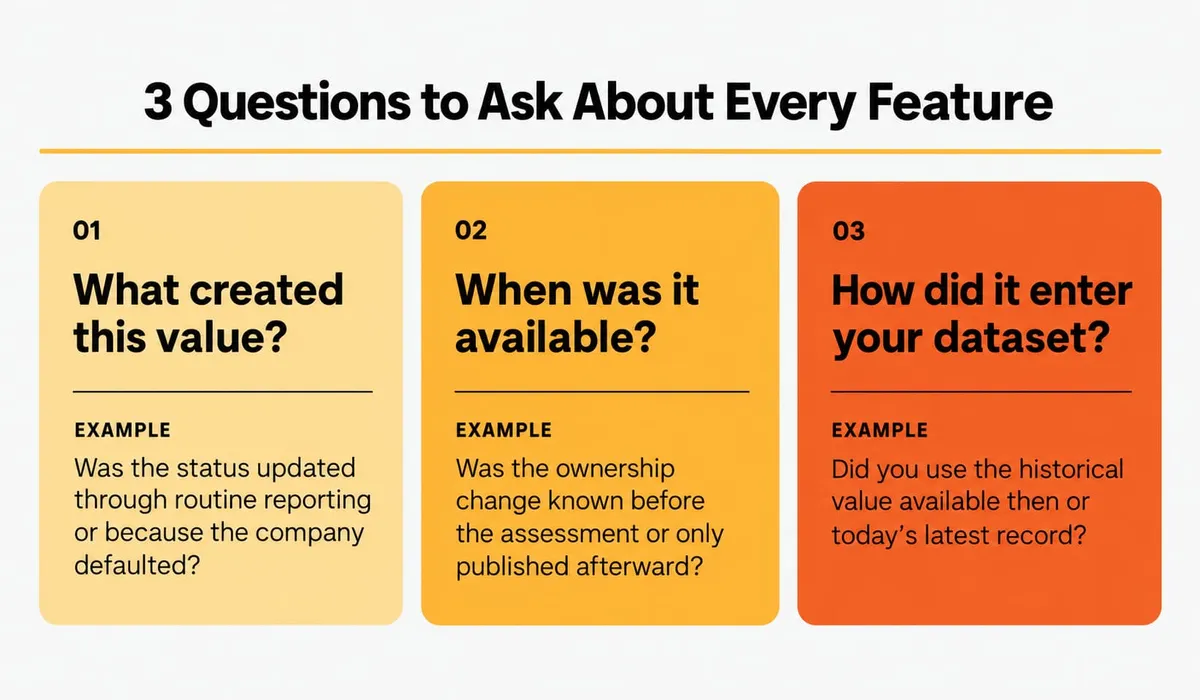
Source: Veridion
Even a highly predictive headcount decline is leakage if you only learned about it after the assessment.
Use development validation to investigate and correct suspect features. Rerunning the same evaluation can help diagnose their effect, but reserve an untouched test set for the final performance estimate. A performance drop reveals reliance on the removed features; it does not prove leakage on its own.
Your goal here is to confirm that every feature uses information you could have accessed when making the prediction.
Split by Time and by Company, Then Preprocess
Split your data before fitting any preprocessing steps. For SMOTE, use an imbalanced-learn pipeline to keep resampling within training folds. Follow these three rules:
Fit preprocessing on training data only | Fit scaling, encoding, and feature selection within each training fold. If you use SMOTE, place it inside an imbalanced-learn pipeline so resampling affects only training folds; leave validation and test distributions unchanged |
|---|---|
Split chronologically | Train on earlier observations and test on later ones, using only training outcomes already known at the simulated training date |
Keep companies separate | Keep each borrower on one side of the split when testing unfamiliar companies, and separate whole groups when testing unfamiliar corporate families |
Financial validation can require stricter separation.
Chapter 7 of Marcos López de Prado’s Advances in Financial Machine Learning explains purging and embargo. When training and validation labels use overlapping outcome windows, purge training observations whose label intervals overlap the validation intervals.
In cross-validation schemes that also use observations after a validation block for training, an embargo can exclude nearby later observations.
For walk-forward testing, ensure that every training label was available before the simulated training cutoff.
The visual below explains both:
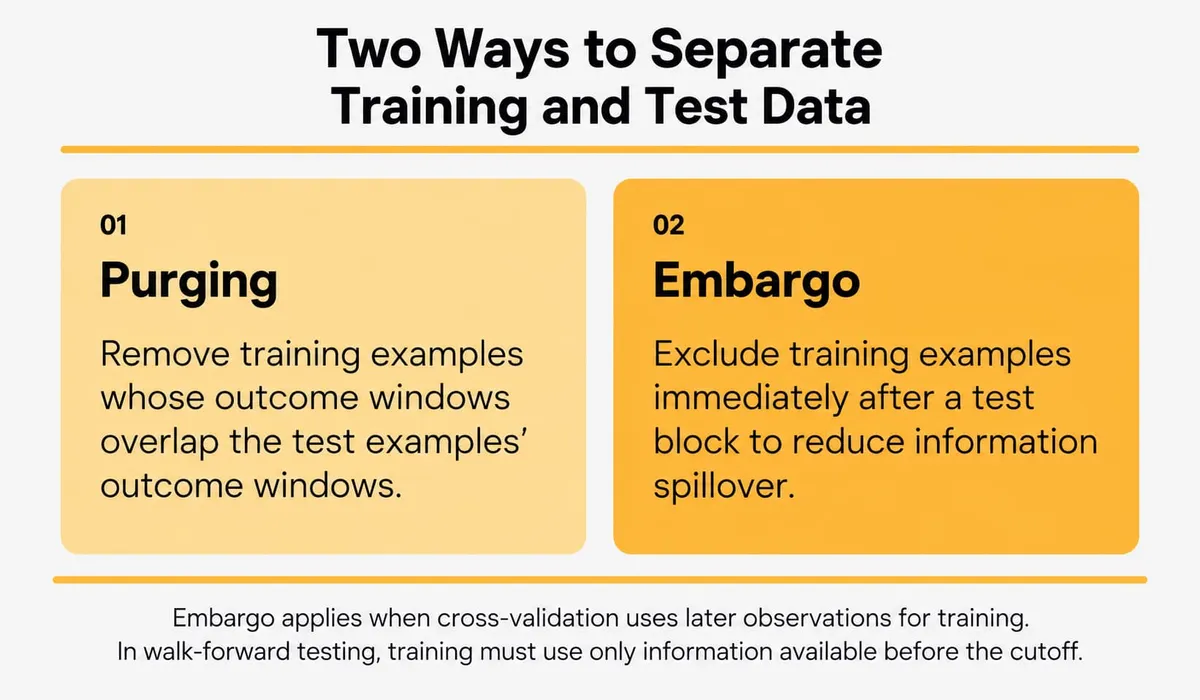
Source: Veridion
Choose these boundaries around your outcome horizon and information dependencies. A fixed gap can’t compensate for company features that already include future information.
Keep a Record of When Each Value Was Known
Keep evidence of availability alongside each feature value. That turns “could we have known this then?” into a question you can answer from records.
When you capture a company’s headcount, ownership, status, or locations, save:
- The value
- Its source
- The date your system first observed it
Keep later observations as separate entries instead of overwriting the earlier ones.
Say your system first captures a new owner in October, but the source says the acquisition took effect in August. The August effective date alone doesn’t establish that you could have used the information in an August assessment.
Without evidence of earlier availability, use the October observation conservatively. Distinguishing when a change happened from when you learned about it prevents later discoveries from slipping into earlier predictions.
Our data methodology gives you a source trail and last-harvested date for each attribute.
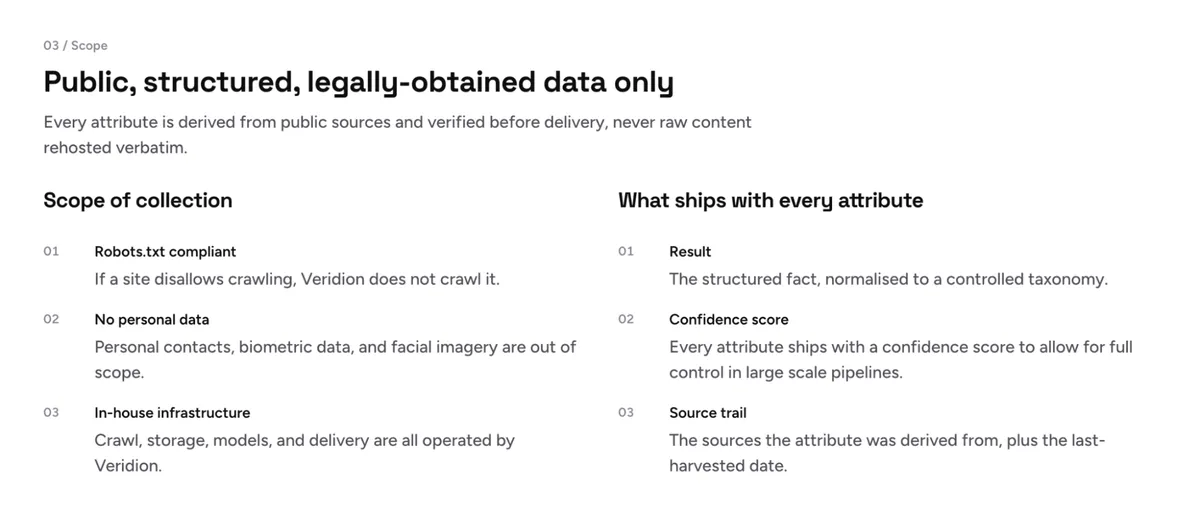
Source: Veridion
Save these details next to the values when you create your own snapshots. That way, you can trace where each feature came from.
A last-harvested date records when Veridion last collected it. It doesn’t by itself prove when the information first became publicly available. So keep your own ingestion records and check the source where that distinction matters.
With these records in place, you can investigate suspicious backtest results without reconstructing availability from memory.
Conclusion
Data leakage can hide inside an impressive backtest, making a model look more reliable than it is. Target leakage, train/test contamination, and temporal leakage each need their own check.
So start with one company feature in your current model. Trace exactly when its value became available and compare that with the prediction date. If you can’t confidently establish whether you could have known it then, start your audit there.
Articles
Discuss how these trends affect your organization.
Our analysts are available for a short call. Bring a specific question and we will ground it in the data.
Insights
Keep reading
More analysis, research, and outcomes grounded in live company intelligence.
From Annual Review to Continuous Credit Risk Assessment
How continuous credit risk assessment works in practice: setting a baseline, choosing refresh cadence, defining triggers and routing changes.
How to Set Up Always-On Credit Risk Monitoring
Review calendars say when you look at a credit, not when it changes. Get changes to analysts sooner with credit risk monitoring.
How to Build a Credit Risk Watchlist with Company-Level Data
Credit flags made up 99% of watchlist balances in Freddie Mac data for August 2026. Plan your credit risk watchlist around six rules.